4th issue May 2017
A meeting with Dr. Noha Saleeb
Autodesk University the road to success
BIM outside the building
INDEX
02
03 04
05 06
01INTRODUCTION:
Houses, buildings, and other facilities construction
profession such as roads and bridges is one of the oldest
professions of history. The architect and the structural
engineer and the contractor used to be all in one person
which was called a builder. Construction science has
been developed with time,..... PAGE 4
A MEETING WITH DR.
NOHA SALEEB
OMAR: What is Building Information Modeling
BIM?
DR. NOHA: it is the use of the most effective
ways to increase the efficiency of the design and
construction operations through four elements of
Project Information .... PAGE 6
Stages of building lifetime
BIM-BAM-BOOM:
Any building which wants to see light by using the
technology of BIM goes through three stages BIM-
BAM-BOOM.
The life cycle of any building Can be divided into three
main stages: design, ..... PAGE 10
History of Building
Information Modeling
Away from the technical details of Building
Information Modeling world, The article addressing
the history of the philosophy of «building information
modeling» in some dilation, (Something to dwell), with
the ascension of a new wave of experts and specialists
of this philosophy to tower of..... PAGE 12
BIM in interior design
and implementation
Construction projects have become easy to study,
engineering, implementation and even management
using building information modeling,
Well, you must have learned this before ... But why and
how? The technique of modeling building information
may be revealed ...... PAGE 13
Visual programming era
and Information modeling
Computational BIM
It seems that the momentum of modern software in
construction industry was not enough with dozens of
various applications even started we overlooks a new era
where technology is changing with a more difficult and
challenging way. ........ PAGE 17
07 08
09 10
11 12
13
BIM OUTSIDE THE
BUILDING
At the conference held on December 2, 2015 in Leeds,
United Kingdom, several aspects were highlighted:
What are the benefits of applying the BIM. And what are
the challenges facing its application. Most highlighted is
the BIM role in the (highway landscap).
We will present some of ..... PAGE 19
Autodesk University the
road to success
Science is unlimited (this is the only phrase that has
caught my imagination since that day began until its
end, and even till I returned home ... Indeed, science is
the one that builds the nations and takes them to higher
places and leads to...... PAGE 21
Howtosolvethemanagement
problemsusingthefourth
dimension(4D)
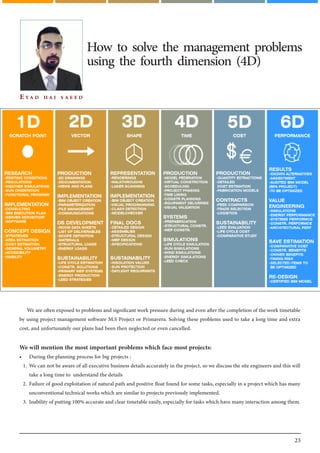
We are often exposed to problems and significant work
pressure during and even after the completion of the
work timetable by using project management software
M.S Project or Primavera. Solving these problems used
to take a long time and extra cost, and unfortunately our
plans had been then.... PAGE 23
Building Information
Modeling and the client
It has been proved that Building Information Modeling
BIM is able to make a revolution in the industry of
construction and the proof of this is the unprecedented
demand from major advanced countries to adopt both
technical and administrative BIM in all future projects
even some of these..... PAGE 26
BIM and CLOUD
COMPUTING
WhoeverworksintheBIMfield;beginnerorprofessional
knows that the strength of BIM relies on adding as
many as experts and specialists in the engineering field
to be able to provide the project with the necessary
professionals, techniques, detection, follow-up and
auditing in ....... PAGE 28
Common Data Environment
CDE
20% to 25% of project team time is wasted in file search.
This loss can be avoided by organizing data as we will
now read when examining the shared data environment.
What we are going to see is a British code that focuses
on the second level of the BIM. There is a collaborative
environment....... PAGE 34
BIM planning execution
BIM uses
P=PLAN D=design C=construction O=operation
Plan:
•P-programming
The tasks that keep the flexibility of the project and
establishing the construction activities such as: building’s
height, circulation,.... PAGE 31
Te amwork
Omar S el i m
Eng. Mohammed Ba-Aqail
Eng. Sonia Ahmed
Eng. Motasem Albanna
4
Dr. Saleh Almobarak
Consultant, author, public
speaker, and trainer in
construction project
management
Introduction:
:
Houses, buildings, and other facilities Construction profession such as roads
and bridges are of the oldest professions of history. The architect and the structural
engineer and the contractor used to be all in one person which was called a builder.
Surely construction science has been developed with time, of course, either in
material or machines or building roads or design methods and implementation.
Since we have Computer (PC) in the middle of the last century, its applications
serve Building Science: design, implementation and management, brings engineering drawing programs of two-
dimension and then evolves into a three-dimension drawing, this is a big quality step.
Before using computers, the designer needed to redraw the whole painting when a modify or correction
for an error was required, which would increase the production cost and time, this becomes easier, faster with
simple cost by using a computer programs. Computer programs have evolved from an architectural, structural,
mechanical and electrical design for calculating amounts and costs for planning and calculation of the schedule,
and the management and professional communication so the computer and the Internet become an essential part
of the project management science.
What is the idea of (BIM) Building Information Modeling, In fact it is sort of an old idea but it was not under
that title, since methods of simulation began to develop, especially using a computer, scientists and innovators
began to apply this method to visualize the process of construction and simulation from the very beginning until
the very end similar to reality, but preceded and displayed in a few minutes to give a prior idea to design and
construction team about the building project process and how to implement it. I remember that Bechtel Global
company has presented a video clip at a conference in the United States about this context for more than twenty
years, which has not mention the word BIM but the logic was the same, the representative mentioned at that
time that by using this approach usually many problems which will face the contractor during implementation
has been avoided.
The idea faces significant challenges, including participating and engagements of massive amounts of
information from multiple points of architectural, structural, mechanical, and electrical designs and other, with
specifications, three-dimensions, cost, schedules and other information, and the possibility will always remain
available to increase the add-on. The idea must have a strong background to carry and support. This background
comes from modern software of BIM, which also requires powerful computers and Internet network which can
accommodate the big amount of information and allow transition of such information with fast suitable channels
to serve the purpose created for it. Thus BIM systems has evolved to a huge network which moves and directs
information as its user directs it to perform a service that previous generation used to dream of, the user can see
each piece and each part of the building with its real form and size and specifications has been put into place,
5
he could see its engagement, integration and intersection with the other parts of the building and in the same
time sequence, that opens new horizons to discover problems and defects and overlaps, thus the opportunity for
design and construction team is given in order to avoid these problems and to improve the design and methods of
construction before the project starts, but the project owner›s ability of expressing opinions and giving proposals
early, becomes possible with the ability of the design and implementation team to give the owner critic an
assessment of its proposals at this early stage, this leads to wonderful services which reduces the time of delivery,
cost, improves quality and performance. This all led to a higher degree of cooperation and communication
between those who are working in the project as the owner, designer, contractor and implementation supervisor.
One of BIM advantages considered as a communication center between other programs such as design CAD
and scheduling program (e.g. Primavera or Microsoft Project), quantities account and financial cost programs,
etc., and it does neither require reprogramming nor merging programs or to has a unified language, but to get
information from it and put them by BIM manager together in a single system, which serves the common goal
while each program remains dependent.
Do we consider BIM the end of what could be developed by human in construction science?
Certainly not, BIM is an important stop resulted a valuable service which worth to take advantage of it as
much as possible, but science never stop until God inherits the earth and what on it. When human learns his
understanding increases and he becomes able to provide greater service to humanity and this is why God wants
us to increase science to serve mankind: Say: Are those who know and those who do not know equal?
6
DR. NOHA: This program focuses on the management
process for all topics related mainly to Building Information
Modelling, the goal. is not to teach a particular application
or just a definition of how to work in building information
modeling at the individual level; but, how to manage an
integrated team which works in building information
modeling. The program is divided into three types of
management, each of which extends across the whole life
cycle:
1.	Technical BIM Management.
2.	Operational BIM Management.
3.	Strategic BIM Management and implementation at
organisational level.
This program is offered online with specialised
involvement in all areas of engineering and construction
related to building information modeling from all over the
world.
OMAR: What is the maturation levels of Building
Information Modeling BIM LEVELS, and how can we get to
the third stage?
DR. NOHA:after the British government issed a mandate
for the necessity of using Building Information Modeling in
all public sector projects by 2016, the government issued a
roadmap which divided the stages of maturation of Building
Information Modeling to three levels and demanded the
participants in the government projects to achieve the second
level BIM Level 2 by 2016.
This level includes - unlike the first level - the cooperation
Dr. Noha Saleeb
A. Professor in Creative
Technologies, Architecture and
Construction at the University
of Middlesex, London, England
Programme Leader MSc BIM
OMAR: What is Building
Information Modeling BIM?
DR. NOHA: it is the use
of the most effective ways to
increase the efficiency of the
design and construction
operations through four elements of Project Information
Management: Using the latest technology, improving the
function of the administration ways and processes (processes
andworkflows),developmentofpositionsandresponsibilities,
and incorporating the latest foreign policies that affect the
project.
OMAR: What are the benefits of Building Information
Modeling?
DR. NOHA: benefits include all phases of the project
from the planning, design and construction down to the
management of the facility, as it covers all sectors from the
owner, designer, contractor and the manufacturer until the
end user. The focus of these benefits is reducing the cost and
time and the loss of waste and energy over the lifetime of the
facility, but with more coordination and quality (in design,
construction and periodic maintenance etc.) and profits and
exports related to the project. Saving also the information and
records of the whole project by modern techniques to be used
easily and efficiently in the future.
OMAR: what does the Master Building Information
Modeling Management MSc BIM consist of?
A MEETING WITH DR. NOHA SLIEB
7
of all the parties since the beginning of the project and the
integration of information by linking geometrical and non-
geometrical information and documents resulting from the
variety of disciplines in new and effective working ways that
raisednewBritishstandardsandcodesforBuildingInformation
Modeling. As for the third phase BIM level 3, till now, a clear
road map is not placed yet because of lacking technological
capabilities and human and practical skills to achieve it. When
you reach the third level of maturity of Building Information
Modeling the work in different teams will be integrated via
cloud networks, and the current separated information and
documents of the project will be linked through Integrated
Model and Database so that everyone works together inside
it at the same time by using the Internet of things and cloud
computing and artificial intelligence techniques. The focus
will be on Big Data analysis issued measuring sensors and
remote sensing Telemetry in buildings to monitor the human
use of energy, lighting and heating depending on the British
code for the Building Information Modeling.
OMAR: How a similar Arab code can be done?
DR. NOHA: To create an Arabic code you first have
to establish a steering engineering group from design,
construction and facilities management disciplines, to include
representativesfromthepublicandprivatesectors,ownersand
designers, contractors and manufacturers, quantity surveyors
and valuation experts, lawyers and insurance experts,
executors of government regulations, and representatives of
Engineering sectors in academic and educational institutions.
The first objectives of the steering group is to determine the
current construction sector practices in the Arab countries
and to study all the problems and limitations, methods of
work that must be addressed, but also to be taken into account
the implementation of any future systems for Building
Information Modeling. Then the team starts to define goals by
usingBuildingInformationModelingthoroughlystudyingthe
experiences of other countries to determine the suitable ones
to be amended to suit the construction of the Arab culture.
After this rich study, the team work can be qualified to set
a road map to transform work systems for using Building
Information Modeling but this plan should be divided into
several stages to facilitate the process of transitioning
gradually and achieving change management smoothly
which can be followed.
This detailed plan is what the new Arab code of Building
Information modeling will be. But it should be noted that
this includes code technology and methods of functioning
of the business (processes and workflows) positions and
responsibilities, foreign affairs policies, with establishment
of educational training courses to guide companies and
individuals on how to follow it. Task Group of experts from
allfields of the AEC sector.
OMAR: What is the difference between application
codes of Building Information Modeling and why it cannot
be applied, for example, applying the British code to another
country inhibitor and evidence?
DR.NOHA:Asmentionedearlierthateachcountryhasits
methods and its own systems in design process, construction
and operations, it also suffers from different problems as a
result of the different external conditions such as the licensing
laws of the state, buying and selling materialand equipment,
laws and quality of existing employment in all sectors and
levels, social legacies affect the business, and even the state
of the national economy. Therefore, single code cannot be
applied to fit all countries. For example, despite the Dubai
Government decision for the necessity of using building
information modeling in certain sectors, but the British code
it is not used completely because it is not a perfect fit for the
sector culture there yet.
8
OMAR: What is the difference between working
framework, protocol, and the standard, even if the state wants
to do any of them, which to start?
DR. NOHA: The protocol is a set of rules or procedures
with detailed step by step explanation to accomplish certain
work or tasks, unlike the standard, which contains the
principles and foundations agreed in a particular area without
going into very precise operational details. A framework is
different in terms of goals, where it represents the structure
of an interrelated group of routes to solve an overall problem
or issue, not an execution action itself. A needs to start with
general standards first, and then a framework to achieve that,
and protocols to execute that.
OMAR: What are the biggest challenges facing the
application of Building Information Modeling in general and
particularly in the Arab countries?
DR. NOHA: The biggest challenges in general, and
especially in the Arab countries are the intellectual and
cultural change for workers in this sector in all fields and
to convince them of the importance of learning new ways
of working which they have not been used to by leaving
traditional methods that they have grown up on. In general,
human nature resists change, especially in Arab societies that
respect the traditions, even in work and they are not used
to flexibility of thinking because of the lack of focus on this
trait in the curriculum since childhood. This problem also is
global and it is more dangerous than the lack of funds for
technological renovation or lack of technical and operational
skillsnecessaryforBuildingInformationModeling,whichcan
be cured by education or loans, but the human soul is difficult to
influence it. and requires a good change management strategy.
OMAR: What is interoperability and how it can be
treated?
DR. NOHA: Interoperability is the ability of the various
IT systems to communicate and exchange information
between them without the need for technical adjustments in
the applications themselves and the way to save information
and to make this exchange happen. An example of this:
the possibility of opening the output model of Building
Information Modeling directly to another program without
having to convert them to other format process, but this
feature is currently unavailable due to reliance on converting
file standard IFC format is the way currently used to ensure
interoperability between different types of programs.
OMAR: How do we link the efficiency of individuals to
work with different working methods of Building Information
modeling?
DR. NOHA: To ensure the efficiency of the team, they
have to be evaluated on three main axes: Experience (any
prior similar acts), Skills (Technical and administrative etc.)
and Knowledge(In themultiplefieldsof BuildingInformation
Modeling). The latter is the hardest axis. Although the
possibilityofmeasuringthefirstandsecondaxeswithevidence
or tests, measuring knowledge of a person needs to determine
its level in several fields of efficiency and not only to achieve
something or not. Currently, there are several efficiency
standards used for this, such as iCMM NBIMS system, or
Penn State system and BIM Maturity Matrix (Succar). By
using these measurements we can determine the efficiency of
workers and their suitability for various business of building
information modeling.
OMAR: What is the level reached by the Arab states in
applying Building Information Modeling?
DR. NOHA: Many Arab countries now, especially in
the Gulf region have begun to apply Building Information
Modeling either by issuing mandatory laws to use them
or by increasing efforts to train individuals. Including the
UAE, Egypt, Qatar, Lebanon, Saudi Arabia, but there are no
organized plans at the state level to follow the evolution of it,
but I expect the increase in that soon.
9
OMAR: What is the relationship between artificial
intelligence and building information modeling?
DR. NOHA: Since the Building Information Modeling
is based on the linking of the building, some information,
you can use artificial intelligence to find and organize
relationships and patterns hidden (Patterns and Relation-
ships) between these information, whether it is in the form
or in the databases, as to find ways to improve them, thereby
increasing the efficiency of facility and management of its
various operations. We also can use artificial intelligence
in robots that are used in construction operations Offsite
Manufacturing, as well as remote sensing in smart buildings
and cities to take the appropriate automatic decisions for
distribution of energy and the use of lighting and others.
OMAR: How does Building Information Modeling affect
the quality?
DR. NOHA: Building Information Modeling affects
positively on quality work, whether in the project planning
phase, design phase or the execution or the building
management and maintenance throughout its life cycle. I will
discuss it in details in an article later with the risks topic.
OMAR: What are lean process?
DR. NOHA: Lean processes are methods to reduce waste
of resources in general, both in time, effort, money or human
efforts, and others. I previously discussed that this is one of
basic Building Information Modeling goals besides, increasing
the quality, reducing risk, increasing visualization and being
environmentally friendly, and therefore lean processes and
products are an essential part of the Building Information
Modeling.
OMAR: How to connect Building Information Modeling
standards of leadership in Energy and Environmental Design
LEED?
DR. NOHA: Leadership in Energy and Environmental
Design is one of the criteria that provides a certificate
to recognize the achievement of the best strategies and
practices in the construction process to be «environmentally
friendly.»(Similar to BREEAM in the UK) Building
Information Modeling can be used throughout the design and
construction stages to achieve that goal.
OMAR: What are the most important Building
Information Modeling application which are used in UK?
DR. NOHA: There are no specific application, but we can
mention as an example:
(AUTODESK) REVIT, NAVISWORKS, GREEN
BUILDING STUDIO, FIELD AND GLUE 360 ETC
GRAPHISOFT ARCHICAD/ GRASSHOPPER/
RHINO BENTLEY SYSTEMS/ TEKLA SYSTEMS
/SOLIBRI MODEL CHECKER /PROJECTWISE / ASITE
/ 4PROJECTS / ACONEX/ SYNCHRO /
COSTX / VICO
10
The importance of the three stages in building information model and building cost management
Stages of building lifetime
BIM-BAM-BOOM
Eng. Kamal Shawki
Any building which wants to see light by using
the technology of BIM goes through three stages
BIM-BAM-BOOM.
The life cycle of any building can be divided into three
main stages: design, implementation and maintenance,
despite the lack of evaluating the benefits of using BIM
system in three stages fully, many users believe that the
benefits of these systems are limited to employ them mostly
in the design phase and they are used in the all building life
cycle as follows:
1.	 BIM (Building Information Model)
The building implementation process is close
to the assembly rather than to construction, the doors
and windows have been moved, for example, its frames,
components and elements from the factory to be installed
in the site only, as well as a lot of construction structures and
processes packaging walls, floors and other parts. Therefore,
the building of this formula is arranged and coordinated,
organized and performed.
Model assembly information at this stage allows
management and enhance pre-manufacturing process
It is the first stage in design where the Special Model
of each discipline is done. This stage represents applying
all design ideas and using information to create Model and
provide the Model with the necessary information to create
it.
2. Phase II: BAM( Building Assembly Model)
At this stage, different Models from all disciplines
are grouped to study the conflicts that may arise as a result
of design and this stage is considered the most important
11
phase of the project and one of the basic objectives which
the technology of BIM is based on .
Model « structure» of the facility transforms from the
design phase to the implementation phase to work as a tool
to provide guidance and direction, as it becomes a virtual
simulation of the building even before its implementation,
which provides all participants a clear set of instructions
and tools to communicate with each other to master the
work and make it done accurately.
Recent global new trends moves to recruitment and use
pre-construction-made mechanisms as much as possible
and this is due to the savings in the aspects of cost, effort
and time, and to some extent it becomes; that leads to the
result of keeping various project resources next to the high
scalability of productivity elements and components of the
building.
The benefit of using these systems is clear as a result
of a private study in Norway where the researcher found
that 30-52% of the cost of implementation in construction
projects is spent as a result of incorrect information
exchanged between the team and the result of the weak
communication capabilities between them. The conflicts
are considered one of the problems that may occur during
the process of implementation, such as the lack of space to
store necessary construction material as a result of filling
the space of storage with other substances either premature
or redundant, such cases as a result of the poor management
of the project in which the assembling model construction
take care of putting solutions and overcoming them. The
use of such form, which usually works to regulate the
movement and the presence of material and coordinating
staff functions contributes positively in reducing the
financial resources and the time taken. A site manager can
prepare the site to what is necessary in time and follow the
level of work development by creating timetable and plan
progress in re-dimensional representation and attached as
a control on the project, which is basically considered the
default form and the management has only to apply it on
the ground.
3. Phase III: BOOM (Building Operation Optimization
Model)
Employment of building operating model stage
is represented by maintenance phase and building
management, which is the last phase in which Building
Information Modeling systems can be employed for the
sustainability of the building life and providing all its
abilities to the users. Planning specialized entities also can
take advantage of how the accumulated daily information
within the model and related to the facilities performance
for the purposes of design and planning of other buildings,
forthepurposeofimprovingthebuildingswork,controlling
and monitoring spaces and the purposes of evaluating
buildings and others. The importance of studying this phase
can be noticed by knowing the amount of building run cost
during its life time, which is estimated by some specialized
researchers between 20-100 double the cost of design and
construction.
Through the building operating model, the building
details can be assessed for example spaces that need to
be re-furnishing or replenish can be identified, selecting
damaged items of moving elements or changeable in the
building, such as doors and windows, metal fences and
furniture for the purpose of replacing or repairing by
knowing its specifications and the date of installation and
identifying the processed or manufactured to contact them
by using the available model information, even after a long
period of time. The ideal operating building model is not
only a mock-up model of three-dimensions, but it works
as a building documents and data safe during its lifetime,
a monitoring technique, alarm means, management alert
to all its parts, and a tool for scheduling maintenance and
repairing work needed during its operating period.
12
Distant from the technical details of its world, the
following article addresses the history of the “Building
Information Modeling” philosophy with some elaboration.
With the new surge of BIM experts and BIM specialists
arising in the architecture, engineering and construction
(AEC) industry, the use of the term «BIM» as a catch-phrase
had, rapidly, increased in the last few years until it became
a common believe amongst a lots of technicians that «BIM»
is a tread-mark belongs to AUTODESK company. The next
few lines will prove this belief wrong.
Although, in his thesis, «Building information modeling
implementation in the construction industry» 2007, Perkins
stated that «Building Information Modeling (BIM) is an
emerging research area. The concept of BIM has been
around since the middle 1990s. However, due to significant
improvements in technology, a great deal of research is
currently underway in facilitating BIM into the building
industry» [1], the technologies and theories responsible for
building information modeling had been evolving since
the seventies. In fact, the first recorded literature about the
concept of building information modeling was represented
in 1975 by Charles Eastman›s article «The use of computers
insteadofdrawingsinbuildingdesign»,inwhichhedescribed
an archetype called «Building Description System (BDS)»,
which not only included the main idea of using parameters
in the design, the algorithm of producing a two dimensional
drawing from a three dimensional model and a « single
integrated database for visual and quantitative analyses»
but also suggested that «Contractors of large projects may
find this representation advantageous for scheduling and
materials ordering». The fact that AUTODESK company
was established in 1982 proves that building information
modeling, as a concept, is seven years prior to the founding
of AUTODESK itself. [2]
In the late seventies and during the eighties, due to the
continuous developing; the term «Building Description
System (BDS)» started to get localized, it was known as
«Building Product Models» in the United States of America,
and known as «Product Information Models» in Europe.
Theterm«BuildingModelling»wasdocumentedforthefirst
time, in the same connotation of the present use of the term
«Building Information Modeling», in Aish›s article titled
«Building modelling: the key to integrated construction
CAD»in1986[3].However,theterm«BuildingInformation
Model» had not been documented until van Nederveen and
Tolman published their paper titled «Modelling multiple
views on buildings» in 1992. [4]
References:
1.	 Perkins E. A., «Building information modeling
implementation in the construction industry», M.Sc. thesis,
university of Florida, 2007.
2.	 Eastman C. M., «The use of computers instead of
drawings in building design», AIA Journal, March, 1975.
3.	 Aish R., «Building modelling: the key to integrated
construction CAD» in CIB 5th International Symposium
on the Use of Computers for Environmental Engineering
Relating to Buildings, CIB، Bath, UK, 1986.
4.	 Van Nederveen G. A. and Tolman F., «Modelling
multiple views on buildings», Automation in Construction,
December, Vol. 1, pp. 215 – 224, 1992.
Kamel Al-Sheikhly
(M.S c .)
History of Building Information Modeling
Translated: Fatma Abohussien
13
Construction projects have become easy to study,
engineering, implementation and even management using
building information modeling,
Well, you must have learned this before ... But why and
how? The technique of modeling building information may
be revealed with its most rapid evolutionary root causes.
But the points of their knowledge remain that were blindly
enabled by these in the nal implementation technique, then
the engineering owners implemented the decision to take
the traditional one true decisions no matter how complex
the real reason behind it.
The modeling of building information originated from
attempts to enhance the capabilities of the human mind
with computer assistance. Prf. Douglas 1962
Thatis,theassignmentofhumanstotheworkofhumans,
and the assignment of computers to the work of computers,
because the cause of problems and default and the shift roles
and responsibilities between the two, and the fact that this
technology is useful to such degree in construction will
certainly be more useful for interior design, especially in
large projects through the following:
1-Ease of exchange of information between all
parties of design or internal implementation
There is no doubt that the most important element in
the modeling of building information is the engineering
informationandthespeedandcentralityofexchange,where
all parties are notified at the same time any modification,
change, correction, development, fork, suspension,
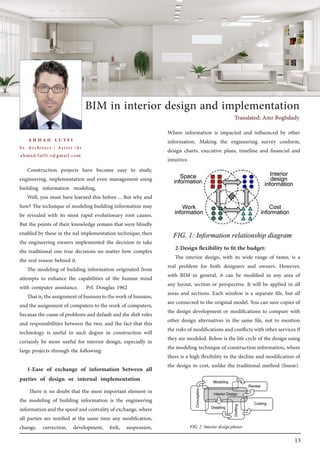
2-Design flexibility to fit the budget:
The interior design, with its wide range of tastes, is a
real problem for both designers and owners. However,
with BIM in general, it can be modified in any area of
any layout, section or perspective. It will be applied in all
areas and sections. Each window is a separate file, but all
are connected to the original model. You can save copies of
the design development or modifications to compare with
other design alternatives in the same file, not to mention
the risks of modifications and conflicts with other services if
they are modeled. Below is the life cycle of the design using
the modeling technique of construction information, where
there is a high flexibility in the decline and modification of
the design to cost, unlike the traditional method (linear).
Where information is impacted and influenced by other
information. Making the engineering survey conform,
design charts, executive plans, timeline and financial and
intuitive.
a h m a d l u t f i
Sr. Architect / Artist /Sr
ahmad.lutfi.v@gmail.com
BIM in interior design and implementation
Translated: Amr Boghdady
14
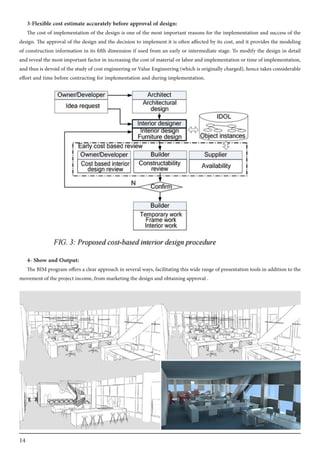
3-Flexible cost estimate accurately before approval of design:
The cost of implementation of the design is one of the most important reasons for the implementation and success of the
design. The approval of the design and the decision to implement it is often affected by its cost, and it provides the modeling
of construction information in its fifth dimension if used from an early or intermediate stage. To modify the design in detail
and reveal the most important factor in increasing the cost of material or labor and implementation or time of implementation,
and thus is devoid of the study of cost engineering or Value Engineering (which is originally charged), hence takes considerable
effort and time before contracting for implementation and during implementation.
4- Show and Output:
The BIM program offers a clear approach in several ways, facilitating this wide range of presentation tools in addition to the
movement of the project income, from marketing the design and obtaining approval .
15
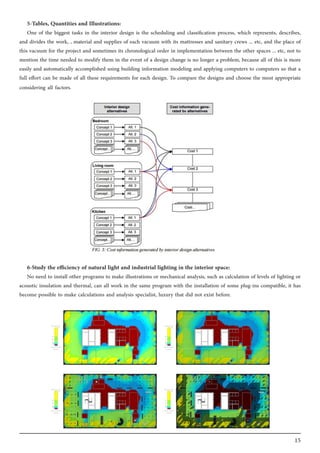
5-Tables, Quantities and Illustrations:
One of the biggest tasks in the interior design is the scheduling and classification process, which represents, describes,
and divides the work, , material and supplies of each vacuum with its mattresses and sanitary crews ... etc, and the place of
this vacuum for the project and sometimes its chronological order in implementation between the other spaces ... etc, not to
mention the time needed to modify them in the event of a design change is no longer a problem, because all of this is more
easily and automatically accomplished using building information modeling and applying computers to computers so that a
full effort can be made of all these requirements for each design. To compare the designs and choose the most appropriate
considering all factors.
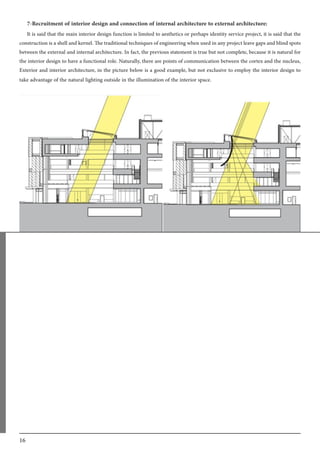
6-Study the efficiency of natural light and industrial lighting in the interior space:
No need to install other programs to make illustrations or mechanical analysis, such as calculation of levels of lighting or
acoustic insulation and thermal, can all work in the same program with the installation of some plug-ins compatible, it has
become possible to make calculations and analysis specialist, luxury that did not exist before.
16
7-Recruitment of interior design and connection of internal architecture to external architecture:
It is said that the main interior design function is limited to aesthetics or perhaps identity service project, it is said that the
construction is a shell and kernel. The traditional techniques of engineering when used in any project leave gaps and blind spots
between the external and internal architecture. In fact, the previous statement is true but not complete, because it is natural for
the interior design to have a functional role. Naturally, there are points of communication between the cortex and the nucleus,
Exterior and interior architecture, in the picture below is a good example, but not exclusive to employ the interior design to
take advantage of the natural lighting outside in the illumination of the interior space.
17
It seems that the momentum of modern software in
construction industry was not enough with dozens of
various applications we even started overlooking a new
era where technology is changing with a more difficult and
challenging way.
This challenge started with the emergence of what is
known as Visual Programming, it is a simple language for
non-programmers, such as artists, architects and interiors
designers.
The strength of the visual programming lies in the
ability to write extra commands did not exist in the original
program which is a very exciting premise, now architects,
designer or engineer can devise suitable commands to
complete their designs. in this way, the mastery of software
and computer applications in construction industry will
not be confined to master the traditional commands in the
program and the efficiency of the engineer in knowledge of
itscommandsonly,butthelevelofchallengenowalsoextend
to the knowledge of the principles of visual programming.
Why Visual Programming?
	 Visualprogrammingisasimplewayofprogramming
as the programming is too complex for architects, designers
and artists with enormous potential but they were not used
widespread till these applications have emerged since 2007,
when David Rutten invited Grasshopper 3D, which works
under Rhinoceros. then the era of parametric design begin,
wedidnotwaittoolonguntilMCGappearedunderthegiant
3DsMAX platform at 2015, and finally Dynamo released to
join the Revit and to announce a new era of information
modeling after its integration with parametric design,
then racing competition among software manufacturers
started, and thus architects and designers tops who owns
the information in the construction industry, after the
development in the construction industry is more linked
to the development of construction material it is now more
linked to the development of this software, which center
used in the new uses of traditional construction material
to produce innovative designs and above the human mind
capabilities.
What is DYNAMO?
As mentioned previously DYNAMO is an application
used under Revit, interestingly free. after many software
companies realized that the strength of the software is the
participation of public in software development. for this
reason, also this application is open source to allow all those
who want to participate in the development of this software,
such as Grasshopper 3D, which works under Rhinoceros.
	 AUTODESK the developer of Revit not satisfied
with Dynamo alone, but spread development to produce
separateprogramcalledDynamoStudiotobecommercially
separated from Revit, So Visual Programming can be used
in the project life cycle from schematic design till handing
Dr. Samer Al-Saiari
architectsamer@gmail.com
Visual programming era and Information
modeling - Computational BIM Translated: Ghatas
18
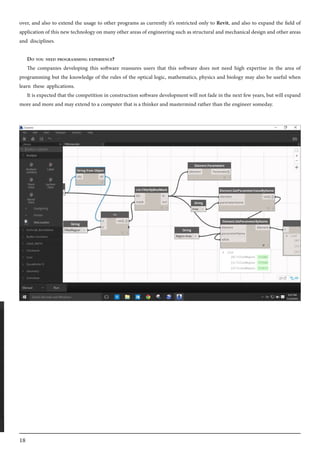
over, and also to extend the usage to other programs as currently it’s restricted only to Revit, and also to expand the field of
application of this new technology on many other areas of engineering such as structural and mechanical design and other areas
and disciplines.
Do you need programming experience?
The companies developing this software reassures users that this software does not need high expertise in the area of
programming but the knowledge of the rules of the optical logic, mathematics, physics and biology may also be useful when
learn these applications.
It is expected that the competition in construction software development will not fade in the next few years, but will expand
more and more and may extend to a computer that is a thinker and mastermind rather than the engineer someday.
19
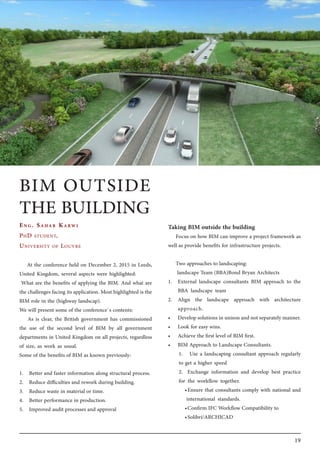
At the conference held on December 2, 2015 in Leeds,
United Kingdom, several aspects were highlighted:
What are the benefits of applying the BIM. And what are
the challenges facing its application. Most highlighted is the
BIM role in the (highway landscap).
We will present some of the conference`s contents:
As is clear, the British government has commissioned
the use of the second level of BIM by all government
departments in United Kingdom on all projects, regardless
of size, as work as usual.
Some of the benefits of BIM as known previously:
1.	 Better and faster information along structural process.
2.	 Reduce difficulties and rework during building.
3.	 Reduce waste in material or time.
4.	 Better performance in production.
5.	 Improved audit processes and approval
Taking BIM outside the building
Focus on how BIM can improve a project framework as
well as provide benefits for infrastructure projects.
Two approaches to landscaping:
landscape Team (BBA)Bond Bryan Architects
1.	 External landscape consultants BIM approach to the
BBA landscape team
2.	 Align the landscape approach with architecture
approach.
•	 Develop solutions in unison and not separately manner.
•	 Look for easy wins.
•	 Achieve the first level of BIM first.
•	 BIM Approach to Landscape Consultants.
1.	 Use a landscaping consultant approach regularly
to get a higher speed
2.	 Exchange information and develop best practice
for the workflow together.
•	Ensure that consultants comply with national and
international standards.
•	Confirm IFC Workflow Compatibility to
•	Solibri/ARCHICAD
Eng. Sahar Karwi
PhD student,
University of Louvre
BIM OUTSIDE
THE BUILDING
20
Next steps for landscaping Architecture:
1.	 BBA: test projects in real, external: compatibility test.
2.	 Incorporate notes by the BBA Landscape Team.
3.	 Scheduling (with workflow).
4.	 Inspecting the Solibri model.
5.	 Quantities
6.	 COBie.
At the end of the talk it was confirmed that BIM will integrate the geometry of the external scene. Other topics
highlighted are the challenges facing the application of BIM as well as the requirements of the BIM challenges:
1.	 Changing the look to BIM as not just about 3D modeling.
2.	 Infrastructure determinants:
•	 (COBie) infrastructure
•	 IFC Infrastructure
•	 Ability of programming and coordination such as Autodesk COBie and IFC3- Improving of:
1.	 Employer Information Requirements	
2.	 Common Data Environment
3.	 COBie to assist data and other recipients
3.	 Material preparation and processing
4.	 Application to small business demands the key of BIM:
•	 Leaving complexity and competition in supply (supply chain)
•	 Be specific about what you want with supply providers
•	 Measuring and making efficient use of production
•	 Provide adequate support for infrastructure
5.	 Take serious actions
21
Science is unlimited (this is the only phrase that has
caught my imagination since that day began until its end,
and even till I returned home ... Indeed, science is the one
that builds the nations and takes them to higher places and
leads to success, nothing but success .
On that 16th day of December, 2016, it was the promised
day with the giants of Autodesk, where they left their offices
and laboratories to seek out the information and everything
new in our engineering and digital world under the banner
LEARN & CONNECT & EXPLORE
The entrance to the conference portal in Dubai where
the event was held
Engr. Ammar Al Tom
AutodeskUniversitytheroadtosuccess
Everyone began to gather and meetings have been started between
the engineers. It was a beautiful atmosphere charged with scientific
communication and benefit from the experiences of others in the
fields of engineering and media, before the announcement of the start
of the conference at about nine and ten minutes, where (Lynn Allen),
Autodesk›s missionary, was the first to start talking. The talk was
about the technology in general and the extent to which the science
reached and how Autodesk managed to diversify all that and make it
a source of inspiration and enlightenment for all.
BIM The future of the industrial industry
With the beginning of the industrial revolution and the entry of
artificial intelligence in all areas of life, the future of the manufacture
of objects on demand has become an important field in the life of
BIM as a science, where Autodesk has benefited from this revolution
to adapt and create many products to serve at BIM field, for example:
•	3D printers that allow us to print forms and blocks for use
in construction purposes such as the administrative building
project that will be built by Dubai as the first building using
such printers, with the participation of the Chinese company
(Wenson), with 185 square meters. The furniture will also be
printed using the printer, which is 20 ahead.
•	The future of the software industry of the BIM has recently
spread various programs for different fields in order to facilitate
theworkinthefieldofBIM,regardingarchitecture,construction,
mechanical and infrastructure programs.
Actually, when someone like (Lynn) speaks, your senses are all
in a state of full attention. She has a great, very knowledgeable and
professional mind by all standards in communicating information to
everyone without any affectation in all of her speeches.
Translated: Bishoy Milad
22
Secondly, (Mr. Nick Manning), vice president of marketing, media
and entertainment, went on the platform and reviewed a number of
promising technologies in the past period. He talked about the virtual
reality, how important it is and how to use it in the field of BIM in
general. He also reviewed Autodesk`s plans to build a smart home
and how to control it through an application on mobile and how
the world will be in the near future with the presence of these smart
technologies.
The most important topic addressed by him was: What is the
augmented reality? What is virtual reality? and What is the difference
between them?
The augmented reality is the combination of virtual reality and
reality of life. Developers can create images within applications
that match and mimic the real world with this technology. They
can also interact with virtual content in real reality and also can be
distinguished.
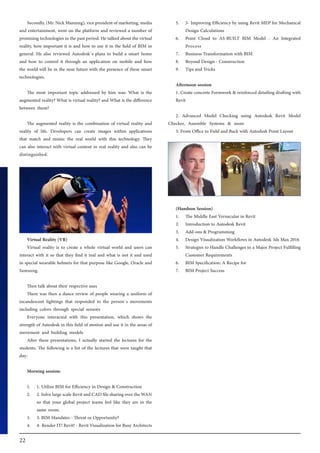
Virtual Reality (VR)
Virtual reality is to create a whole virtual world and users can
interact with it so that they find it real and what is not it and used
in special wearable helmets for that purpose like Google, Oracle and
Samsung.
Then talk about their respective uses
There was then a dance review of people wearing a uniform of
incandescent lightings that responded to the person`s movements
including colors through special sensors
Everyone interacted with this presentation, which shows the
strength of Autodesk in this field of motion and use it in the areas of
movement and building models
After these presentations, I actually started the lectures for the
students. The following is a list of the lectures that were taught that
day:
Morning session:
1.	 1. Utilize BIM for Efficiency in Design & Construction
2.	 2. Solve large scale Revit and CAD file sharing over the WAN
so that your global project teams feel like they are in the
same room.
3.	 3. BIM Mandates - Threat or Opportunity?
4.	 4- Render IT! Revit! - Revit Visualization for Busy Architects
5.	 5- Improving Efficiency by using Revit MEP for Mechanical
Design Calculations
6.	 Point Cloud to AS-BUILT BIM Model - An Integrated
Process
7.	 Business Transformation with BIM
8.	 Beyond Design - Construction
9.	 Tips and Tricks
Afternoon session
1. Create concrete Formwork & reinforced detailing drafting with
Revit
2. Advanced Model Checking using Autodesk Revit Model
Checker, Assemble Systems & more
3. From Office to Field and Back with Autodesk Point Layout
(Handson Session)
1.	 The Middle East Vernacular in Revit
2.	 Introduction to Autodesk Revit
3.	 Add-ons & Programming
4.	 Design Visualization Workflows in Autodesk 3ds Max 2016
5.	 Strategies to Handle Challenges in a Major Project Fulfilling
Customer Requirements
6.	 BIM Specification: A Recipe for
7.	 BIM Project Success
23
We are often exposed to problems and significant work pressure during and even after the completion of the work timetable
by using project management software M.S Project or Primavera. Solving these problems used to take a long time and extra
cost, and unfortunately our plans had been then neglected or even cancelled.
We will mention the most important problems which face most projects:
•	 During the planning process for big projects :
1.	We can not be aware of all executive business details accurately in the project, so we discuss the site engineers and this will
take a long time to understand the details
2.	Failure of good exploitation of natural path and positive float found for some tasks, especially in a project which has many
unconventional technical works which are similar to projects previously implemented.
3.	Inability of putting 100% accurate and clear timetable easily, especially for tasks which have many interaction among them.
E y a d h a j s a e e d
How to solve the management problems
using the fourth dimension (4D)
24
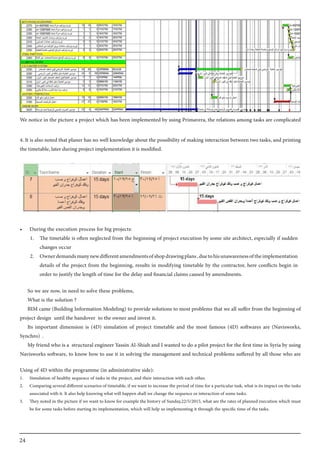
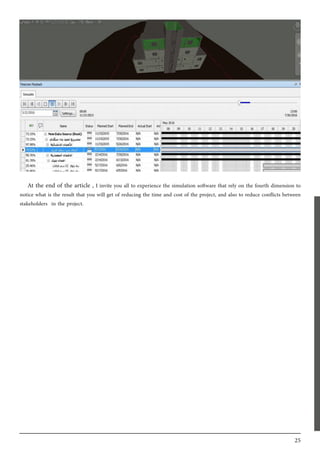
We notice in the picture a project which has been implemented by using Primavera, the relations among tasks are complicated
4. It is also noted that planer has no well knowledge about the possibility of making interaction between two tasks, and printing
the timetable, later during project implementation it is modified.
So we are now, in need to solve these problems,
What is the solution ?
BIM came (Building Information Modeling) to provide solutions to most problems that we all suffer from the beginning of
project design until the handover to the owner and invest it.
Its important dimension is (4D) simulation of project timetable and the most famous (4D) softwares are (Navisworks,
Synchro) .
My friend who is a structural engineer Yassin Al-Shiah and I wanted to do a pilot project for the first time in Syria by using
Navisworks software, to know how to use it in solving the management and technical problems suffered by all those who are
Using of 4D within the programme (in administrative side):
1.	 Simulation of healthy sequence of tasks in the project, and their interaction with each other.
2.	 Comparing several different scenarios of timetable, if we want to increase the period of time for a particular task, what is its impact on the tasks
associated with it. It also help knowing what will happen shall we change the sequence or interaction of some tasks.
3.	 They noted in the picture if we want to know for example the history of Sunday,22/5/2015, what are the rates of planned execution which must
be for some tasks before starting its implementation, which will help us implementing it through the specific time of the tasks.
•	 During the execution process for big projects:
1.	 The timetable is often neglected from the beginning of project execution by some site architect, especially if sudden
changes occur
2.	 Ownerdemandsmanynewdifferentamendmentsofshopdrawingplans,duetohisunawarenessoftheimplementation
details of the project from the beginning, results in modifying timetable by the contractor, here conflicts begin in
order to justify the length of time for the delay and financial claims caused by amendments.
25
At the end of the article , I invite you all to experience the simulation software that rely on the fourth dimension to
notice what is the result that you will get of reducing the time and cost of the project, and also to reduce conflicts between
stakeholders in the project.
26
Engr. Ammar Jassem
Basra University - Faculty of
Engineering
A specialist in buildings
Information Modeling
ammarasha@yahoo.com
Building Information Modeling and
the client
3.Beneficiary :
•The benefits for design department : including speed
and quality of design as well as high competitive value
for design department.
•The benefits for execution department : such as lack of
execution problems thus reducing the cost of the project
and increasing the speed of execution.
•The benefits for owners : they will take maximum
advantage of using BIM because it will reduce the cost
of management and maintenance of the project, which
represents about 80% of the total cost of it.
Through our review of benefits, we see that client is the
real beneficiary of using Building Information Modeling in
projects and therefore he has to be leader of change process
and demands for using BIM. The client’s demand for using
Building Information Modeling in projects will pay all who
do not wish to use it to do in response to the desire of the
client.
For more clarity about the role of client in the process
of using Building Information Modeling. Let`s take a
closer look about modality and role of the client in forcing
designers and contractors to use BIM in projects.
It has been proved that Building Information Modeling
BIM is able to make a revolution in the industry of
construction and the proof of this is the unprecedented
demand from major advanced countries to adopt both
technical and administrative BIM in all future projects even
some of these countries made it mandatory as in the United
Kingdom.
BuildingInformationModelinghasmanybenefitswhich
can be classified according to many types as shown below :
1.The ability of benefit accounting quantitatively :
•Tangible benefits such as reducing the cost of
the project .
•Intangible benefits such as societal benefits
2.The time of benefit occurrence :
•Benefits during design phase of the project such
as reducing clash between the structural, electrical
and mechanical elements of the project.
•Benefits during execution phase of the project
such as reducing change orders.
•Benefits after project delivery, which are usually
long-term and with a high monetary compared to
other benefits.
Translated: Doaa Mohamed
27
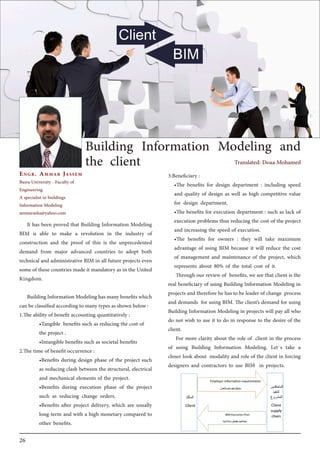
It is clear to us from the figure that the process of using Building Information Modeling be divided into two main sections :
1- Client Requirement :
The client should explain his requirements of using BIM through a very important document called EIR as an acronym. This document is
very important because it clarifies the relationship between the client and the contractors to execute the project. The client explains how to use
BIM through it. Where and what the information is required to be entered in electronic model of the project? And in which formula, and what
is the amount of detail? how to protect information as well as it determines tasks and responsibilities between the client and the contractor
.These requirements differ according to the project for the same client and also differ according to the client , because each client has his own
benefits which he aims. So we cannot make only one formula for all the requirements, but there are attempts to make a basic formula for these
requirements which helps the client to identify his requirements and can be changed according to his own desire. One of these attempts is what
the team in charge of BIM execution in the UK did and you can see it and get the model easily and without any cost.
2- Building Information Modeling Execution Plan (BEP) :
The contractors will reply in response to the requirements of the client with a new document which represents how to execute the
requirements and expresses the maturation and understanding of the contracting company for the client’s requirements. Here the client should
review these documents and select the optimal from them which can carry out the requirements with highest quality and lowest price.
Theclient’srole indeterminingtherequirementsandreviewingexecutionmethodsisnoteasybecauseitrequiresacomplete understanding
of Building Information Modeling and how to use it to conform to the aims of client whether a person or organization. If the client do not
have these specifications, he will be unable to evaluate the work of the contracting companies and force them to make BIM congruous with
his demands only. The client should first build his organization`s capabilities before using Building Information Modeling or he can ask for
external specialists help and contract them to assist him writing the requirements and evaluating the execution plans.
I am going to talk about how to build the capabilities of the client and what are the available solutions around the world and the extent of
applying them in the next article .
28
Mo a z Al -Na g a r
BIM EVANGELIST
BIM and CLOUD COMPUTING
WhoeverworksintheBIMfield;beginnerorprofessional
knows that the strength of BIM relies on adding as many
experts and specialists in the engineering field to be able
to provide the project with the necessary professionals,
techniques, detection, follow-up and auditing in order to
achieve the company implementing such project at least in
a perfect world for a perfect company in perfect and ideal
engineering project in the same time.
But in the real world, the situation is different from
that, as we find that companies are investing in systems
costing more than tens of thousands of dollars but the
returns from these funds benefits don’t exceed from forty
to sixty percent of the total cost of such systems. The reason
is that the system provides work for a part of the project
staff often the architectural department of it (while leaving
the rest to the other disciplines), constructional, electrical,
mechanical, plumbing... etc. Choose other systems to be
closer to their majors and moving away somewhat from the
integration with those systems. This opinion is considered
right sometimes, but other times is considered fatal and
may result in the project failure.
I will refer to this summarized article to talk about
one of the technologies that contribute to consolidate data
exchange between BIM system and those who made as a
Cloud BIM Technique, which began to gain a prominent
place among major construction companies in late 2014.
Note:
“Cloud Computing” which I haven’t found an equivalent for in
Arabic language, so I used the most frequent term in order not to
make the reader confused.
-Teamwork within the program ArchiCAD see engineering in
one place due to the small
SomemanufacturersofBIMsystemrefertosuchtopicsinceatleast
ten years when Graphisoft Company submitted a simple rudimentary
copy which is so-called engineering team to complete the work and
take the new science with data and even add new amendments by
them so that all the team would know what each member do.
This system is considered one of the systems which used until
today but within the offices of the level of SMB Small and Medium
Businesses (because these offices aren’t in need for a large number of
disciplines)
Translated: Abdelrahman Abou Hadid
29
As there is a system called (BIM Server) in some
countries, this system worked simply on the Client / Server
principle; and it is a well-known technique used to make
the dependency of information based on that the engineer
works on his personal computer and then synchronize the
information to the server.
Limited projects implemented by those offices. These
projects are often residential projects where there are no
high construction accounts and the Contractor has a large
space of execution and knowing the CODE used and
necessary construction material for such projects.
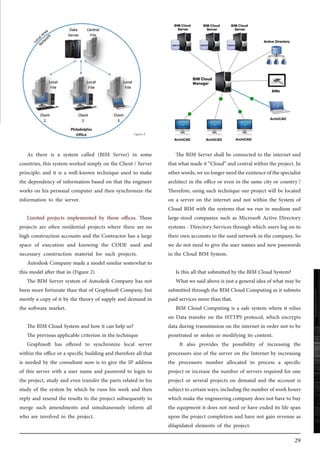
Autodesk Company made a model similar somewhat to
this model after that in (Figure 2)
The BIM Server system of Autodesk Company has not
been more fortunate than that of Graphisoft Company, but
merely a copy of it by the theory of supply and demand in
the software market.
The BIM Cloud System and how it can help us?
The previous applicable criterion in the technique
Graphisoft has offered to synchronize local server
within the office or a specific building and therefore all that
is needed by the consultant now is to give the IP address
of this server with a user name and password to login to
the project, study and even transfer the parts related to his
study of the system by which he runs his work and then
reply and resend the results to the project subsequently to
merge such amendments and simultaneously inform all
who are involved in the project.
The BIM Server shall be connected to the internet and
that what made it “Cloud” and central within the project. In
otherwords,wenolongerneedtheexistenceofthespecialist
architect in the office or even in the same city or country !
Therefore, using such technique our project will be located
on a server on the internet and not within the System of
Cloud BIM with the systems that we run in medium and
large-sized companies such as Microsoft Active Directory
systems - Directory Services through which users log on to
their own accounts to the used network in the company. So
we do not need to give the user names and new passwords
in the Cloud BIM System.
Is this all that submitted by the BIM Cloud System?
What we said above is just a general idea of what may be
submitted through the BIM Cloud Computing as it submits
paid services more than that.
BIM Cloud Computing is a safe system where it relies
on Data transfer on the HTTPS protocol, which encrypts
data during transmission on the internet in order not to be
penetrated or stolen or modifying its content.
It also provides the possibility of increasing the
processors size of the server on the Internet by increasing
the processors number allocated to process a specific
project or increase the number of servers required for one
project or several projects on demand and the account is
subject to certain ways, including the number of work hours
which make the engineering company does not have to buy
the equipment it does not need or have ended its life span
upon the project completion and have not gain revenue as
dilapidated elements of the project.
30
Autodesk has followed by submitting a new product related to it ,which submits part of what we mentioned above, under
the name of BIM 360, it is similar to what Microsoft has done when the company has created Office 365 project through which
famous of Microsoft Office applications is submitted similar to the software we install on our phones.
It is worth to be mentioned that:
Although these systems are advanced systems and effectively help in improving the level of interaction in the project, they
are still limited to exchange data at the project level and it practically doesn`t live up at least to the time of writing such article
(the so-called SAAS or) Software as a Service (ie the program must be installed on your computer, or the MAC computer`s
engineer and wasn`t transferred completely after that to the internet to be installed there and our computers or tablets that
we`re working on just become a login interface or platform of those applications.
Thus I have been submitted a new method of interaction between BIM platforms in a simple number after I had mentioned
the IFC technique previously.
31
Engr. Mohammed Hamad
BIM JOB CAPTAIN
BIMplanningexecution-BIMuses
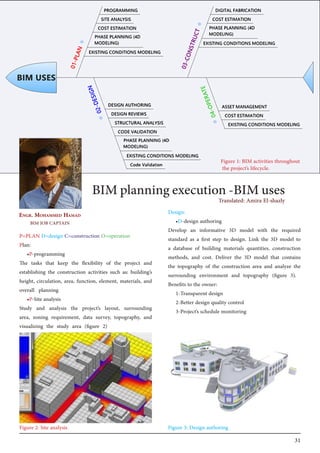
Figure 1: BIM activities throughout
the project’s lifecycle.
P=PLAN D=design C=construction O=operation
Plan:
•P-programming
The tasks that keep the flexibility of the project and
establishing the construction activities such as: building’s
height, circulation, area, function, element, materials, and
overall planning
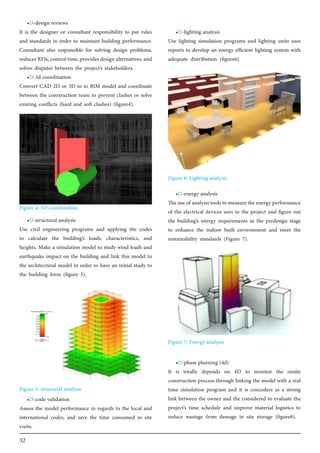
•P-Site analysis
Study and analysis the project’s layout, surrounding
area, zoning requirement, data survey, topography, and
visualizing the study area (figure 2)
Figure 2: Site analysis Figure 3: Design authoring
Design:
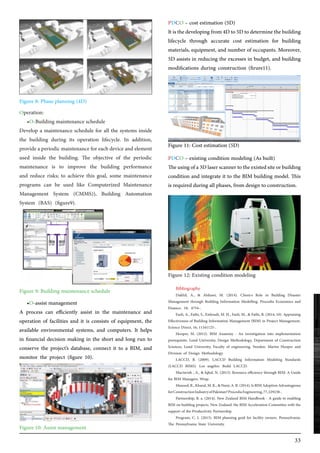
•D-design authoring
Develop an informative 3D model with the required
standard as a first step to design. Link the 3D model to
a database of building materials quantities, construction
methods, and cost. Deliver the 3D model that contains
the topography of the construction area and analyze the
surrounding environment and topography (figure 3).
Benefits to the owner:
1-Transparent design
2-Better design quality control
3-Project’s schedule monitoring
Translated: Amira El-shazly
32
•D-design reviews
It is the designer or consultant responsibility to put rules
and standards in order to maintain building performance.
Consultant also responsible for solving design problems,
reduces RFIs, control time, provides design alternatives, and
solves disputes between the project’s stakeholders.
•D-3d coordination
Convert CAD 2D or 3D in to BIM model and coordinate
between the construction team to prevent clashes or solve
existing conflicts (hard and soft clashes) (figure4).
•D-structural analysis
Use civil engineering programs and applying the codes
to calculate the building’s loads, characteristics, and
heights. Make a simulation model to study wind loads and
earthquake impact on the building and link this model to
the architectural model in order to have an initial study to
the building form (figure 5).
•D-code validation
Assess the model performance in regards to the local and
international codes, and save the time consumed in site
visits.
•D-lighting analysis
Use lighting simulation programs and lighting units uses
reports to develop an energy efficient lighting system with
adequate distribution (figure6).
•D-energy analysis
The use of analysis tools to measure the energy performance
of the electrical devices uses in the project and figure out
the building’s energy requirements in the predesign stage
to enhance the indoor built environment and meet the
sustainability standards (Figure 7).
•D-phase planning (4d)
It is totally depends on 4D to monitor the onsite
construction process through linking the model with a real
time simulation program and it is conceders as a strong
link between the owner and the considered to evaluate the
project’s time schedule and improve material logistics to
reduce wastage from damage in site storage (figure8).
Figure 4: 3D coordination
Figure 6: Lighting analysis
Figure 7: Energy analysis
Figure 5: structural analysis
33
Operation:
•O-Building maintenance schedule
Develop a maintenance schedule for all the systems inside
the building during its operation lifecycle. In addition,
provide a periodic maintenance for each device and element
used inside the building. The objective of the periodic
maintenance is to improve the building performance
and reduce risks; to achieve this goal, some maintenance
programs can be used like Computerized Maintenance
Management System (CMMS)), Building Automation
System (BAS) (figure9).
PDCO – cost estimation (5D)
Itisthedevelopingfrom4Dto5Dtodeterminethebuilding
lifecycle through accurate cost estimation for building
materials, equipment, and number of occupants. Moreover,
5D assists in reducing the excesses in budget, and building
modifications during construction (firure11).
PDCO – existing condition modeling (As built)
Theusingofa3Dlaserscannertotheexistedsiteorbuilding
condition and integrate it to the BIM building model. This
is required during all phases, from design to construction.
•O-assist management
A process can efficiently assist in the maintenance and
operation of facilities and it is consists of equipment, the
available environmental systems, and computers. It helps
in financial decision making in the short and long run to
conserve the project’s database, connect it to a BIM, and
monitor the project (figure 10).
Bibliography
Dakhil, A., & Alshawi, M. (2014). Client›s Role in Building Disaster
Management through Building Information Modelling. Procedia Economics and
Finance, 18, 4754-.
Fazli, A., Fathi, S., Enferadi, M. H., Fazli, M., & Fathi, B. (2014, 10). Appraising
Effectiveness of Building Information Management (BIM) in Project Management.
Science Direct, 16, 11161125-.
Hooper, M. (2012). BIM Anatomy - An investigation into implementation
prerequisite. Lund University, Design Methodology, Department of Construction
Sciences, Lund University, Faculty of engineering. Sweden: Martin Hooper and
Division of Design Methodology.
LACCD, B. (2009). LACCD Building Information Modeling Standards
(LACCD BIMS). Los angeles: Build LACCD.
Mactavish , A., & Iqbal, N. (2013). Resource efficiency through BIM: A Guide
for BIM Managers. Wrap.
Masood,R.,Kharal,M.K.,&Nasir,A.R.(2014).IsBIMAdoptionAdvantageous
forConstructionIndustryofPakistan?ProcediaEngineering,77,229238-.
Partnership, B. a. (2014). New Zealand BIM Handbook - A guide to enabling
BIM on building projects. New Zealand: the BIM Acceleration Committee with the
support of the Productivity Partnership.
Program, C. I. (2013). BIM planning guid for facility owners. Pennsylvania:
The Pennsylvania State University.
Figure 8: Phase planning (4D)
Figure 11: Cost estimation (5D)
Figure 9: Building maintenance schedule
Figure 12: Existing condition modeling
Figure 10: Assist management
34
Om a r Se l i m
draftsman.wordpress.com
Common Data Environment CDE
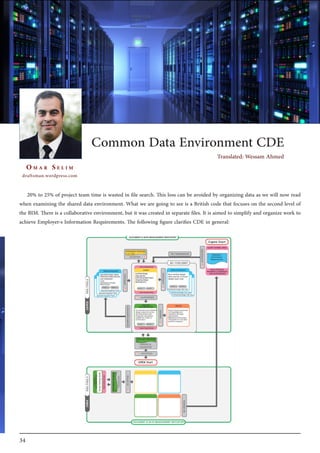
20% to 25% of project team time is wasted in file search. This loss can be avoided by organizing data as we will now read
when examining the shared data environment. What we are going to see is a British code that focuses on the second level of
the BIM. There is a collaborative environment, but it was created in separate files. It is aimed to simplify and organize work to
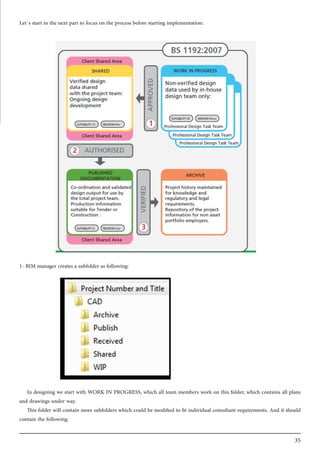
achieve Employer›s Information Requirements. The following figure clarifies CDE in general:
Translated: Wessam Ahmed
35
Let`s start in the next part to focus on the process before starting implementation:
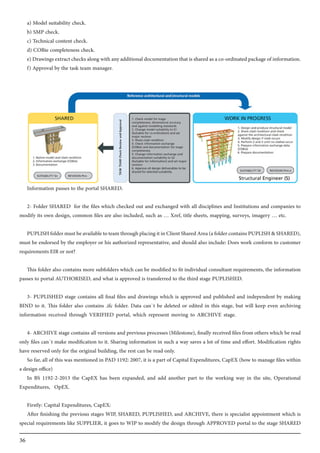
1- BIM manager creates a subfolder as following:
In designing we start with WORK IN PROGRESS, which all team members work on this folder, which contains all plans
and drawings under way.
This folder will contain more subfolders which could be modified to fit individual consultant requirements. And it should
contain the following:
36
a) Model suitability check.
b) SMP check.
c) Technical content check.
d) COBie completeness check.
e)Drawingsextractchecksalongwithanyadditionaldocumentationthatissharedasaco-ordinatedpackageofinformation.
f) Approval by the task team manager.
Information passes to the portal SHARED.
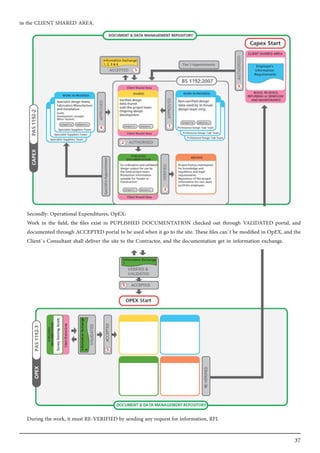
2- Folder SHARED for the files which checked out and exchanged with all disciplines and Institutions and companies to
modify its own design, common files are also included, such as … Xref, title sheets, mapping, surveys, imagery … etc.
PUPLISHfoldermustbeavailabletoteamthroughplacingitinClientSharedArea(afoldercontainsPUPLISH&SHARED),
must be endorsed by the employer or his authorized representative, and should also include: Does work conform to customer
requirements EIR or not?
This folder also contains more subfolders which can be modified to fit individual consultant requirements, the information
passes to portal AUTHORISED, and what is approved is transferred to the third stage PUPLISHED.
3- PUPLISHED stage contains all final files and drawings which is approved and published and independent by making
BIND to it. This folder also contains .ifc folder. Data can`t be deleted or edited in this stage, but will keep even archiving
information received through VERIFIED portal, which represent moving to ARCHIVE stage.
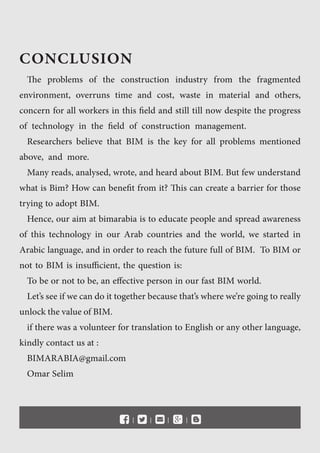
4- ARCHIVE stage contains all versions and previous processes (Milestone), finally received files from others which be read
only files can`t make modification to it. Sharing information in such a way saves a lot of time and effort. Modification rights
have reserved only for the original building, the rest can be read only.
So far, all of this was mentioned in PAD 1192: 2007, it is a part of Capital Expenditures, CapEX (how to manage files within
a design office)
In BS 1192-2-2013 the CapEX has been expanded, and add another part to the working way in the site, Operational
Expenditures, OpEX.
Firstly: Capital Expenditures, CapEX:
After finishing the previous stages WIP, SHARED, PUPLISHED, and ARCHIVE, there is specialist appointment which is
special requirements like SUPPLIER, it goes to WIP to modify the design through APPROVED portal to the stage SHARED
37
in the CLIENT SHARED AREA.
Secondly: Operational Expenditures, OpEX:
Work in the field, the files exist in PUPLISHED DOCUMENTATION checked out through VALIDATED portal, and
documented through ACCEPTED portal to be used when it go to the site. These files can`t be modified in OpEX, and the
Client`s Consultant shall deliver the site to the Contractor, and the documentation get in information exchange.
During the work, it must RE-VERIFIED by sending any request for information, RFI.
TRANSLATION TEAM
FATAMA ABOHUSSIEN
MOHAMED METWALY GHATTAS
WESSAM AHMED
BISHOY MILAD
ABDELRAHMAN ABOU HADID
AMR BOGHDADY
DOAA MOHAMMED
AMIRA EL-SHAZLY
The problems of the construction industry from the fragmented
environment, overruns time and cost, waste in material and others,
concern for all workers in this field and still till now despite the progress
of technology in the field of construction management.
Researchers believe that BIM is the key for all problems mentioned
above, and more.
Many reads, analysed, wrote, and heard about BIM. But few understand
what is Bim? How can benefit from it? This can create a barrier for those
trying to adopt BIM.
Hence, our aim at bimarabia is to educate people and spread awareness
of this technology in our Arab countries and the world, we started in
Arabic language, and in order to reach the future full of BIM. To BIM or
not to BIM is insufficient, the question is:
To be or not to be, an effective person in our fast BIM world.
Let’s see if we can do it together because that’s where we’re going to really
unlockthevalueofBIM.
if there was a volunteer for translation to English or any other language,
kindly contact us at :
BIMARABIA@gmail.com
Omar Selim
l l l l 
CONCLUSION

Bi marabia4en

  • 1.
    4th issue May2017 A meeting with Dr. Noha Saleeb Autodesk University the road to success BIM outside the building
  • 2.
    INDEX 02 03 04 05 06 01INTRODUCTION: Houses,buildings, and other facilities construction profession such as roads and bridges is one of the oldest professions of history. The architect and the structural engineer and the contractor used to be all in one person which was called a builder. Construction science has been developed with time,..... PAGE 4 A MEETING WITH DR. NOHA SALEEB OMAR: What is Building Information Modeling BIM? DR. NOHA: it is the use of the most effective ways to increase the efficiency of the design and construction operations through four elements of Project Information .... PAGE 6 Stages of building lifetime BIM-BAM-BOOM: Any building which wants to see light by using the technology of BIM goes through three stages BIM- BAM-BOOM. The life cycle of any building Can be divided into three main stages: design, ..... PAGE 10 History of Building Information Modeling Away from the technical details of Building Information Modeling world, The article addressing the history of the philosophy of «building information modeling» in some dilation, (Something to dwell), with the ascension of a new wave of experts and specialists of this philosophy to tower of..... PAGE 12 BIM in interior design and implementation Construction projects have become easy to study, engineering, implementation and even management using building information modeling, Well, you must have learned this before ... But why and how? The technique of modeling building information may be revealed ...... PAGE 13 Visual programming era and Information modeling Computational BIM It seems that the momentum of modern software in construction industry was not enough with dozens of various applications even started we overlooks a new era where technology is changing with a more difficult and challenging way. ........ PAGE 17
  • 3.
    07 08 09 10 1112 13 BIM OUTSIDE THE BUILDING At the conference held on December 2, 2015 in Leeds, United Kingdom, several aspects were highlighted: What are the benefits of applying the BIM. And what are the challenges facing its application. Most highlighted is the BIM role in the (highway landscap). We will present some of ..... PAGE 19 Autodesk University the road to success Science is unlimited (this is the only phrase that has caught my imagination since that day began until its end, and even till I returned home ... Indeed, science is the one that builds the nations and takes them to higher places and leads to...... PAGE 21 Howtosolvethemanagement problemsusingthefourth dimension(4D) We are often exposed to problems and significant work pressure during and even after the completion of the work timetable by using project management software M.S Project or Primavera. Solving these problems used to take a long time and extra cost, and unfortunately our plans had been then.... PAGE 23 Building Information Modeling and the client It has been proved that Building Information Modeling BIM is able to make a revolution in the industry of construction and the proof of this is the unprecedented demand from major advanced countries to adopt both technical and administrative BIM in all future projects even some of these..... PAGE 26 BIM and CLOUD COMPUTING WhoeverworksintheBIMfield;beginnerorprofessional knows that the strength of BIM relies on adding as many as experts and specialists in the engineering field to be able to provide the project with the necessary professionals, techniques, detection, follow-up and auditing in ....... PAGE 28 Common Data Environment CDE 20% to 25% of project team time is wasted in file search. This loss can be avoided by organizing data as we will now read when examining the shared data environment. What we are going to see is a British code that focuses on the second level of the BIM. There is a collaborative environment....... PAGE 34 BIM planning execution BIM uses P=PLAN D=design C=construction O=operation Plan: •P-programming The tasks that keep the flexibility of the project and establishing the construction activities such as: building’s height, circulation,.... PAGE 31 Te amwork Omar S el i m Eng. Mohammed Ba-Aqail Eng. Sonia Ahmed Eng. Motasem Albanna
  • 4.
    4 Dr. Saleh Almobarak Consultant,author, public speaker, and trainer in construction project management Introduction: : Houses, buildings, and other facilities Construction profession such as roads and bridges are of the oldest professions of history. The architect and the structural engineer and the contractor used to be all in one person which was called a builder. Surely construction science has been developed with time, of course, either in material or machines or building roads or design methods and implementation. Since we have Computer (PC) in the middle of the last century, its applications serve Building Science: design, implementation and management, brings engineering drawing programs of two- dimension and then evolves into a three-dimension drawing, this is a big quality step. Before using computers, the designer needed to redraw the whole painting when a modify or correction for an error was required, which would increase the production cost and time, this becomes easier, faster with simple cost by using a computer programs. Computer programs have evolved from an architectural, structural, mechanical and electrical design for calculating amounts and costs for planning and calculation of the schedule, and the management and professional communication so the computer and the Internet become an essential part of the project management science. What is the idea of (BIM) Building Information Modeling, In fact it is sort of an old idea but it was not under that title, since methods of simulation began to develop, especially using a computer, scientists and innovators began to apply this method to visualize the process of construction and simulation from the very beginning until the very end similar to reality, but preceded and displayed in a few minutes to give a prior idea to design and construction team about the building project process and how to implement it. I remember that Bechtel Global company has presented a video clip at a conference in the United States about this context for more than twenty years, which has not mention the word BIM but the logic was the same, the representative mentioned at that time that by using this approach usually many problems which will face the contractor during implementation has been avoided. The idea faces significant challenges, including participating and engagements of massive amounts of information from multiple points of architectural, structural, mechanical, and electrical designs and other, with specifications, three-dimensions, cost, schedules and other information, and the possibility will always remain available to increase the add-on. The idea must have a strong background to carry and support. This background comes from modern software of BIM, which also requires powerful computers and Internet network which can accommodate the big amount of information and allow transition of such information with fast suitable channels to serve the purpose created for it. Thus BIM systems has evolved to a huge network which moves and directs information as its user directs it to perform a service that previous generation used to dream of, the user can see each piece and each part of the building with its real form and size and specifications has been put into place,
  • 5.
    5 he could seeits engagement, integration and intersection with the other parts of the building and in the same time sequence, that opens new horizons to discover problems and defects and overlaps, thus the opportunity for design and construction team is given in order to avoid these problems and to improve the design and methods of construction before the project starts, but the project owner›s ability of expressing opinions and giving proposals early, becomes possible with the ability of the design and implementation team to give the owner critic an assessment of its proposals at this early stage, this leads to wonderful services which reduces the time of delivery, cost, improves quality and performance. This all led to a higher degree of cooperation and communication between those who are working in the project as the owner, designer, contractor and implementation supervisor. One of BIM advantages considered as a communication center between other programs such as design CAD and scheduling program (e.g. Primavera or Microsoft Project), quantities account and financial cost programs, etc., and it does neither require reprogramming nor merging programs or to has a unified language, but to get information from it and put them by BIM manager together in a single system, which serves the common goal while each program remains dependent. Do we consider BIM the end of what could be developed by human in construction science? Certainly not, BIM is an important stop resulted a valuable service which worth to take advantage of it as much as possible, but science never stop until God inherits the earth and what on it. When human learns his understanding increases and he becomes able to provide greater service to humanity and this is why God wants us to increase science to serve mankind: Say: Are those who know and those who do not know equal?
  • 6.
    6 DR. NOHA: Thisprogram focuses on the management process for all topics related mainly to Building Information Modelling, the goal. is not to teach a particular application or just a definition of how to work in building information modeling at the individual level; but, how to manage an integrated team which works in building information modeling. The program is divided into three types of management, each of which extends across the whole life cycle: 1. Technical BIM Management. 2. Operational BIM Management. 3. Strategic BIM Management and implementation at organisational level. This program is offered online with specialised involvement in all areas of engineering and construction related to building information modeling from all over the world. OMAR: What is the maturation levels of Building Information Modeling BIM LEVELS, and how can we get to the third stage? DR. NOHA:after the British government issed a mandate for the necessity of using Building Information Modeling in all public sector projects by 2016, the government issued a roadmap which divided the stages of maturation of Building Information Modeling to three levels and demanded the participants in the government projects to achieve the second level BIM Level 2 by 2016. This level includes - unlike the first level - the cooperation Dr. Noha Saleeb A. Professor in Creative Technologies, Architecture and Construction at the University of Middlesex, London, England Programme Leader MSc BIM OMAR: What is Building Information Modeling BIM? DR. NOHA: it is the use of the most effective ways to increase the efficiency of the design and construction operations through four elements of Project Information Management: Using the latest technology, improving the function of the administration ways and processes (processes andworkflows),developmentofpositionsandresponsibilities, and incorporating the latest foreign policies that affect the project. OMAR: What are the benefits of Building Information Modeling? DR. NOHA: benefits include all phases of the project from the planning, design and construction down to the management of the facility, as it covers all sectors from the owner, designer, contractor and the manufacturer until the end user. The focus of these benefits is reducing the cost and time and the loss of waste and energy over the lifetime of the facility, but with more coordination and quality (in design, construction and periodic maintenance etc.) and profits and exports related to the project. Saving also the information and records of the whole project by modern techniques to be used easily and efficiently in the future. OMAR: what does the Master Building Information Modeling Management MSc BIM consist of? A MEETING WITH DR. NOHA SLIEB
  • 7.
    7 of all theparties since the beginning of the project and the integration of information by linking geometrical and non- geometrical information and documents resulting from the variety of disciplines in new and effective working ways that raisednewBritishstandardsandcodesforBuildingInformation Modeling. As for the third phase BIM level 3, till now, a clear road map is not placed yet because of lacking technological capabilities and human and practical skills to achieve it. When you reach the third level of maturity of Building Information Modeling the work in different teams will be integrated via cloud networks, and the current separated information and documents of the project will be linked through Integrated Model and Database so that everyone works together inside it at the same time by using the Internet of things and cloud computing and artificial intelligence techniques. The focus will be on Big Data analysis issued measuring sensors and remote sensing Telemetry in buildings to monitor the human use of energy, lighting and heating depending on the British code for the Building Information Modeling. OMAR: How a similar Arab code can be done? DR. NOHA: To create an Arabic code you first have to establish a steering engineering group from design, construction and facilities management disciplines, to include representativesfromthepublicandprivatesectors,ownersand designers, contractors and manufacturers, quantity surveyors and valuation experts, lawyers and insurance experts, executors of government regulations, and representatives of Engineering sectors in academic and educational institutions. The first objectives of the steering group is to determine the current construction sector practices in the Arab countries and to study all the problems and limitations, methods of work that must be addressed, but also to be taken into account the implementation of any future systems for Building Information Modeling. Then the team starts to define goals by usingBuildingInformationModelingthoroughlystudyingthe experiences of other countries to determine the suitable ones to be amended to suit the construction of the Arab culture. After this rich study, the team work can be qualified to set a road map to transform work systems for using Building Information Modeling but this plan should be divided into several stages to facilitate the process of transitioning gradually and achieving change management smoothly which can be followed. This detailed plan is what the new Arab code of Building Information modeling will be. But it should be noted that this includes code technology and methods of functioning of the business (processes and workflows) positions and responsibilities, foreign affairs policies, with establishment of educational training courses to guide companies and individuals on how to follow it. Task Group of experts from allfields of the AEC sector. OMAR: What is the difference between application codes of Building Information Modeling and why it cannot be applied, for example, applying the British code to another country inhibitor and evidence? DR.NOHA:Asmentionedearlierthateachcountryhasits methods and its own systems in design process, construction and operations, it also suffers from different problems as a result of the different external conditions such as the licensing laws of the state, buying and selling materialand equipment, laws and quality of existing employment in all sectors and levels, social legacies affect the business, and even the state of the national economy. Therefore, single code cannot be applied to fit all countries. For example, despite the Dubai Government decision for the necessity of using building information modeling in certain sectors, but the British code it is not used completely because it is not a perfect fit for the sector culture there yet.
  • 8.
    8 OMAR: What isthe difference between working framework, protocol, and the standard, even if the state wants to do any of them, which to start? DR. NOHA: The protocol is a set of rules or procedures with detailed step by step explanation to accomplish certain work or tasks, unlike the standard, which contains the principles and foundations agreed in a particular area without going into very precise operational details. A framework is different in terms of goals, where it represents the structure of an interrelated group of routes to solve an overall problem or issue, not an execution action itself. A needs to start with general standards first, and then a framework to achieve that, and protocols to execute that. OMAR: What are the biggest challenges facing the application of Building Information Modeling in general and particularly in the Arab countries? DR. NOHA: The biggest challenges in general, and especially in the Arab countries are the intellectual and cultural change for workers in this sector in all fields and to convince them of the importance of learning new ways of working which they have not been used to by leaving traditional methods that they have grown up on. In general, human nature resists change, especially in Arab societies that respect the traditions, even in work and they are not used to flexibility of thinking because of the lack of focus on this trait in the curriculum since childhood. This problem also is global and it is more dangerous than the lack of funds for technological renovation or lack of technical and operational skillsnecessaryforBuildingInformationModeling,whichcan be cured by education or loans, but the human soul is difficult to influence it. and requires a good change management strategy. OMAR: What is interoperability and how it can be treated? DR. NOHA: Interoperability is the ability of the various IT systems to communicate and exchange information between them without the need for technical adjustments in the applications themselves and the way to save information and to make this exchange happen. An example of this: the possibility of opening the output model of Building Information Modeling directly to another program without having to convert them to other format process, but this feature is currently unavailable due to reliance on converting file standard IFC format is the way currently used to ensure interoperability between different types of programs. OMAR: How do we link the efficiency of individuals to work with different working methods of Building Information modeling? DR. NOHA: To ensure the efficiency of the team, they have to be evaluated on three main axes: Experience (any prior similar acts), Skills (Technical and administrative etc.) and Knowledge(In themultiplefieldsof BuildingInformation Modeling). The latter is the hardest axis. Although the possibilityofmeasuringthefirstandsecondaxeswithevidence or tests, measuring knowledge of a person needs to determine its level in several fields of efficiency and not only to achieve something or not. Currently, there are several efficiency standards used for this, such as iCMM NBIMS system, or Penn State system and BIM Maturity Matrix (Succar). By using these measurements we can determine the efficiency of workers and their suitability for various business of building information modeling. OMAR: What is the level reached by the Arab states in applying Building Information Modeling? DR. NOHA: Many Arab countries now, especially in the Gulf region have begun to apply Building Information Modeling either by issuing mandatory laws to use them or by increasing efforts to train individuals. Including the UAE, Egypt, Qatar, Lebanon, Saudi Arabia, but there are no organized plans at the state level to follow the evolution of it, but I expect the increase in that soon.
  • 9.
    9 OMAR: What isthe relationship between artificial intelligence and building information modeling? DR. NOHA: Since the Building Information Modeling is based on the linking of the building, some information, you can use artificial intelligence to find and organize relationships and patterns hidden (Patterns and Relation- ships) between these information, whether it is in the form or in the databases, as to find ways to improve them, thereby increasing the efficiency of facility and management of its various operations. We also can use artificial intelligence in robots that are used in construction operations Offsite Manufacturing, as well as remote sensing in smart buildings and cities to take the appropriate automatic decisions for distribution of energy and the use of lighting and others. OMAR: How does Building Information Modeling affect the quality? DR. NOHA: Building Information Modeling affects positively on quality work, whether in the project planning phase, design phase or the execution or the building management and maintenance throughout its life cycle. I will discuss it in details in an article later with the risks topic. OMAR: What are lean process? DR. NOHA: Lean processes are methods to reduce waste of resources in general, both in time, effort, money or human efforts, and others. I previously discussed that this is one of basic Building Information Modeling goals besides, increasing the quality, reducing risk, increasing visualization and being environmentally friendly, and therefore lean processes and products are an essential part of the Building Information Modeling. OMAR: How to connect Building Information Modeling standards of leadership in Energy and Environmental Design LEED? DR. NOHA: Leadership in Energy and Environmental Design is one of the criteria that provides a certificate to recognize the achievement of the best strategies and practices in the construction process to be «environmentally friendly.»(Similar to BREEAM in the UK) Building Information Modeling can be used throughout the design and construction stages to achieve that goal. OMAR: What are the most important Building Information Modeling application which are used in UK? DR. NOHA: There are no specific application, but we can mention as an example: (AUTODESK) REVIT, NAVISWORKS, GREEN BUILDING STUDIO, FIELD AND GLUE 360 ETC GRAPHISOFT ARCHICAD/ GRASSHOPPER/ RHINO BENTLEY SYSTEMS/ TEKLA SYSTEMS /SOLIBRI MODEL CHECKER /PROJECTWISE / ASITE / 4PROJECTS / ACONEX/ SYNCHRO / COSTX / VICO
  • 10.
    10 The importance ofthe three stages in building information model and building cost management Stages of building lifetime BIM-BAM-BOOM Eng. Kamal Shawki Any building which wants to see light by using the technology of BIM goes through three stages BIM-BAM-BOOM. The life cycle of any building can be divided into three main stages: design, implementation and maintenance, despite the lack of evaluating the benefits of using BIM system in three stages fully, many users believe that the benefits of these systems are limited to employ them mostly in the design phase and they are used in the all building life cycle as follows: 1. BIM (Building Information Model) The building implementation process is close to the assembly rather than to construction, the doors and windows have been moved, for example, its frames, components and elements from the factory to be installed in the site only, as well as a lot of construction structures and processes packaging walls, floors and other parts. Therefore, the building of this formula is arranged and coordinated, organized and performed. Model assembly information at this stage allows management and enhance pre-manufacturing process It is the first stage in design where the Special Model of each discipline is done. This stage represents applying all design ideas and using information to create Model and provide the Model with the necessary information to create it. 2. Phase II: BAM( Building Assembly Model) At this stage, different Models from all disciplines are grouped to study the conflicts that may arise as a result of design and this stage is considered the most important
  • 11.
    11 phase of theproject and one of the basic objectives which the technology of BIM is based on . Model « structure» of the facility transforms from the design phase to the implementation phase to work as a tool to provide guidance and direction, as it becomes a virtual simulation of the building even before its implementation, which provides all participants a clear set of instructions and tools to communicate with each other to master the work and make it done accurately. Recent global new trends moves to recruitment and use pre-construction-made mechanisms as much as possible and this is due to the savings in the aspects of cost, effort and time, and to some extent it becomes; that leads to the result of keeping various project resources next to the high scalability of productivity elements and components of the building. The benefit of using these systems is clear as a result of a private study in Norway where the researcher found that 30-52% of the cost of implementation in construction projects is spent as a result of incorrect information exchanged between the team and the result of the weak communication capabilities between them. The conflicts are considered one of the problems that may occur during the process of implementation, such as the lack of space to store necessary construction material as a result of filling the space of storage with other substances either premature or redundant, such cases as a result of the poor management of the project in which the assembling model construction take care of putting solutions and overcoming them. The use of such form, which usually works to regulate the movement and the presence of material and coordinating staff functions contributes positively in reducing the financial resources and the time taken. A site manager can prepare the site to what is necessary in time and follow the level of work development by creating timetable and plan progress in re-dimensional representation and attached as a control on the project, which is basically considered the default form and the management has only to apply it on the ground. 3. Phase III: BOOM (Building Operation Optimization Model) Employment of building operating model stage is represented by maintenance phase and building management, which is the last phase in which Building Information Modeling systems can be employed for the sustainability of the building life and providing all its abilities to the users. Planning specialized entities also can take advantage of how the accumulated daily information within the model and related to the facilities performance for the purposes of design and planning of other buildings, forthepurposeofimprovingthebuildingswork,controlling and monitoring spaces and the purposes of evaluating buildings and others. The importance of studying this phase can be noticed by knowing the amount of building run cost during its life time, which is estimated by some specialized researchers between 20-100 double the cost of design and construction. Through the building operating model, the building details can be assessed for example spaces that need to be re-furnishing or replenish can be identified, selecting damaged items of moving elements or changeable in the building, such as doors and windows, metal fences and furniture for the purpose of replacing or repairing by knowing its specifications and the date of installation and identifying the processed or manufactured to contact them by using the available model information, even after a long period of time. The ideal operating building model is not only a mock-up model of three-dimensions, but it works as a building documents and data safe during its lifetime, a monitoring technique, alarm means, management alert to all its parts, and a tool for scheduling maintenance and repairing work needed during its operating period.
  • 12.
    12 Distant from thetechnical details of its world, the following article addresses the history of the “Building Information Modeling” philosophy with some elaboration. With the new surge of BIM experts and BIM specialists arising in the architecture, engineering and construction (AEC) industry, the use of the term «BIM» as a catch-phrase had, rapidly, increased in the last few years until it became a common believe amongst a lots of technicians that «BIM» is a tread-mark belongs to AUTODESK company. The next few lines will prove this belief wrong. Although, in his thesis, «Building information modeling implementation in the construction industry» 2007, Perkins stated that «Building Information Modeling (BIM) is an emerging research area. The concept of BIM has been around since the middle 1990s. However, due to significant improvements in technology, a great deal of research is currently underway in facilitating BIM into the building industry» [1], the technologies and theories responsible for building information modeling had been evolving since the seventies. In fact, the first recorded literature about the concept of building information modeling was represented in 1975 by Charles Eastman›s article «The use of computers insteadofdrawingsinbuildingdesign»,inwhichhedescribed an archetype called «Building Description System (BDS)», which not only included the main idea of using parameters in the design, the algorithm of producing a two dimensional drawing from a three dimensional model and a « single integrated database for visual and quantitative analyses» but also suggested that «Contractors of large projects may find this representation advantageous for scheduling and materials ordering». The fact that AUTODESK company was established in 1982 proves that building information modeling, as a concept, is seven years prior to the founding of AUTODESK itself. [2] In the late seventies and during the eighties, due to the continuous developing; the term «Building Description System (BDS)» started to get localized, it was known as «Building Product Models» in the United States of America, and known as «Product Information Models» in Europe. Theterm«BuildingModelling»wasdocumentedforthefirst time, in the same connotation of the present use of the term «Building Information Modeling», in Aish›s article titled «Building modelling: the key to integrated construction CAD»in1986[3].However,theterm«BuildingInformation Model» had not been documented until van Nederveen and Tolman published their paper titled «Modelling multiple views on buildings» in 1992. [4] References: 1. Perkins E. A., «Building information modeling implementation in the construction industry», M.Sc. thesis, university of Florida, 2007. 2. Eastman C. M., «The use of computers instead of drawings in building design», AIA Journal, March, 1975. 3. Aish R., «Building modelling: the key to integrated construction CAD» in CIB 5th International Symposium on the Use of Computers for Environmental Engineering Relating to Buildings, CIB، Bath, UK, 1986. 4. Van Nederveen G. A. and Tolman F., «Modelling multiple views on buildings», Automation in Construction, December, Vol. 1, pp. 215 – 224, 1992. Kamel Al-Sheikhly (M.S c .) History of Building Information Modeling Translated: Fatma Abohussien
  • 13.
    13 Construction projects havebecome easy to study, engineering, implementation and even management using building information modeling, Well, you must have learned this before ... But why and how? The technique of modeling building information may be revealed with its most rapid evolutionary root causes. But the points of their knowledge remain that were blindly enabled by these in the nal implementation technique, then the engineering owners implemented the decision to take the traditional one true decisions no matter how complex the real reason behind it. The modeling of building information originated from attempts to enhance the capabilities of the human mind with computer assistance. Prf. Douglas 1962 Thatis,theassignmentofhumanstotheworkofhumans, and the assignment of computers to the work of computers, because the cause of problems and default and the shift roles and responsibilities between the two, and the fact that this technology is useful to such degree in construction will certainly be more useful for interior design, especially in large projects through the following: 1-Ease of exchange of information between all parties of design or internal implementation There is no doubt that the most important element in the modeling of building information is the engineering informationandthespeedandcentralityofexchange,where all parties are notified at the same time any modification, change, correction, development, fork, suspension, 2-Design flexibility to fit the budget: The interior design, with its wide range of tastes, is a real problem for both designers and owners. However, with BIM in general, it can be modified in any area of any layout, section or perspective. It will be applied in all areas and sections. Each window is a separate file, but all are connected to the original model. You can save copies of the design development or modifications to compare with other design alternatives in the same file, not to mention the risks of modifications and conflicts with other services if they are modeled. Below is the life cycle of the design using the modeling technique of construction information, where there is a high flexibility in the decline and modification of the design to cost, unlike the traditional method (linear). Where information is impacted and influenced by other information. Making the engineering survey conform, design charts, executive plans, timeline and financial and intuitive. a h m a d l u t f i Sr. Architect / Artist /Sr ahmad.lutfi.v@gmail.com BIM in interior design and implementation Translated: Amr Boghdady
  • 14.
    14 3-Flexible cost estimateaccurately before approval of design: The cost of implementation of the design is one of the most important reasons for the implementation and success of the design. The approval of the design and the decision to implement it is often affected by its cost, and it provides the modeling of construction information in its fifth dimension if used from an early or intermediate stage. To modify the design in detail and reveal the most important factor in increasing the cost of material or labor and implementation or time of implementation, and thus is devoid of the study of cost engineering or Value Engineering (which is originally charged), hence takes considerable effort and time before contracting for implementation and during implementation. 4- Show and Output: The BIM program offers a clear approach in several ways, facilitating this wide range of presentation tools in addition to the movement of the project income, from marketing the design and obtaining approval .
  • 15.
    15 5-Tables, Quantities andIllustrations: One of the biggest tasks in the interior design is the scheduling and classification process, which represents, describes, and divides the work, , material and supplies of each vacuum with its mattresses and sanitary crews ... etc, and the place of this vacuum for the project and sometimes its chronological order in implementation between the other spaces ... etc, not to mention the time needed to modify them in the event of a design change is no longer a problem, because all of this is more easily and automatically accomplished using building information modeling and applying computers to computers so that a full effort can be made of all these requirements for each design. To compare the designs and choose the most appropriate considering all factors. 6-Study the efficiency of natural light and industrial lighting in the interior space: No need to install other programs to make illustrations or mechanical analysis, such as calculation of levels of lighting or acoustic insulation and thermal, can all work in the same program with the installation of some plug-ins compatible, it has become possible to make calculations and analysis specialist, luxury that did not exist before.
  • 16.
    16 7-Recruitment of interiordesign and connection of internal architecture to external architecture: It is said that the main interior design function is limited to aesthetics or perhaps identity service project, it is said that the construction is a shell and kernel. The traditional techniques of engineering when used in any project leave gaps and blind spots between the external and internal architecture. In fact, the previous statement is true but not complete, because it is natural for the interior design to have a functional role. Naturally, there are points of communication between the cortex and the nucleus, Exterior and interior architecture, in the picture below is a good example, but not exclusive to employ the interior design to take advantage of the natural lighting outside in the illumination of the interior space.
  • 17.
    17 It seems thatthe momentum of modern software in construction industry was not enough with dozens of various applications we even started overlooking a new era where technology is changing with a more difficult and challenging way. This challenge started with the emergence of what is known as Visual Programming, it is a simple language for non-programmers, such as artists, architects and interiors designers. The strength of the visual programming lies in the ability to write extra commands did not exist in the original program which is a very exciting premise, now architects, designer or engineer can devise suitable commands to complete their designs. in this way, the mastery of software and computer applications in construction industry will not be confined to master the traditional commands in the program and the efficiency of the engineer in knowledge of itscommandsonly,butthelevelofchallengenowalsoextend to the knowledge of the principles of visual programming. Why Visual Programming? Visualprogrammingisasimplewayofprogramming as the programming is too complex for architects, designers and artists with enormous potential but they were not used widespread till these applications have emerged since 2007, when David Rutten invited Grasshopper 3D, which works under Rhinoceros. then the era of parametric design begin, wedidnotwaittoolonguntilMCGappearedunderthegiant 3DsMAX platform at 2015, and finally Dynamo released to join the Revit and to announce a new era of information modeling after its integration with parametric design, then racing competition among software manufacturers started, and thus architects and designers tops who owns the information in the construction industry, after the development in the construction industry is more linked to the development of construction material it is now more linked to the development of this software, which center used in the new uses of traditional construction material to produce innovative designs and above the human mind capabilities. What is DYNAMO? As mentioned previously DYNAMO is an application used under Revit, interestingly free. after many software companies realized that the strength of the software is the participation of public in software development. for this reason, also this application is open source to allow all those who want to participate in the development of this software, such as Grasshopper 3D, which works under Rhinoceros. AUTODESK the developer of Revit not satisfied with Dynamo alone, but spread development to produce separateprogramcalledDynamoStudiotobecommercially separated from Revit, So Visual Programming can be used in the project life cycle from schematic design till handing Dr. Samer Al-Saiari architectsamer@gmail.com Visual programming era and Information modeling - Computational BIM Translated: Ghatas
  • 18.
    18 over, and alsoto extend the usage to other programs as currently it’s restricted only to Revit, and also to expand the field of application of this new technology on many other areas of engineering such as structural and mechanical design and other areas and disciplines. Do you need programming experience? The companies developing this software reassures users that this software does not need high expertise in the area of programming but the knowledge of the rules of the optical logic, mathematics, physics and biology may also be useful when learn these applications. It is expected that the competition in construction software development will not fade in the next few years, but will expand more and more and may extend to a computer that is a thinker and mastermind rather than the engineer someday.
  • 19.
    19 At the conferenceheld on December 2, 2015 in Leeds, United Kingdom, several aspects were highlighted: What are the benefits of applying the BIM. And what are the challenges facing its application. Most highlighted is the BIM role in the (highway landscap). We will present some of the conference`s contents: As is clear, the British government has commissioned the use of the second level of BIM by all government departments in United Kingdom on all projects, regardless of size, as work as usual. Some of the benefits of BIM as known previously: 1. Better and faster information along structural process. 2. Reduce difficulties and rework during building. 3. Reduce waste in material or time. 4. Better performance in production. 5. Improved audit processes and approval Taking BIM outside the building Focus on how BIM can improve a project framework as well as provide benefits for infrastructure projects. Two approaches to landscaping: landscape Team (BBA)Bond Bryan Architects 1. External landscape consultants BIM approach to the BBA landscape team 2. Align the landscape approach with architecture approach. • Develop solutions in unison and not separately manner. • Look for easy wins. • Achieve the first level of BIM first. • BIM Approach to Landscape Consultants. 1. Use a landscaping consultant approach regularly to get a higher speed 2. Exchange information and develop best practice for the workflow together. • Ensure that consultants comply with national and international standards. • Confirm IFC Workflow Compatibility to • Solibri/ARCHICAD Eng. Sahar Karwi PhD student, University of Louvre BIM OUTSIDE THE BUILDING
  • 20.
    20 Next steps forlandscaping Architecture: 1. BBA: test projects in real, external: compatibility test. 2. Incorporate notes by the BBA Landscape Team. 3. Scheduling (with workflow). 4. Inspecting the Solibri model. 5. Quantities 6. COBie. At the end of the talk it was confirmed that BIM will integrate the geometry of the external scene. Other topics highlighted are the challenges facing the application of BIM as well as the requirements of the BIM challenges: 1. Changing the look to BIM as not just about 3D modeling. 2. Infrastructure determinants: • (COBie) infrastructure • IFC Infrastructure • Ability of programming and coordination such as Autodesk COBie and IFC3- Improving of: 1. Employer Information Requirements 2. Common Data Environment 3. COBie to assist data and other recipients 3. Material preparation and processing 4. Application to small business demands the key of BIM: • Leaving complexity and competition in supply (supply chain) • Be specific about what you want with supply providers • Measuring and making efficient use of production • Provide adequate support for infrastructure 5. Take serious actions
  • 21.
    21 Science is unlimited(this is the only phrase that has caught my imagination since that day began until its end, and even till I returned home ... Indeed, science is the one that builds the nations and takes them to higher places and leads to success, nothing but success . On that 16th day of December, 2016, it was the promised day with the giants of Autodesk, where they left their offices and laboratories to seek out the information and everything new in our engineering and digital world under the banner LEARN & CONNECT & EXPLORE The entrance to the conference portal in Dubai where the event was held Engr. Ammar Al Tom AutodeskUniversitytheroadtosuccess Everyone began to gather and meetings have been started between the engineers. It was a beautiful atmosphere charged with scientific communication and benefit from the experiences of others in the fields of engineering and media, before the announcement of the start of the conference at about nine and ten minutes, where (Lynn Allen), Autodesk›s missionary, was the first to start talking. The talk was about the technology in general and the extent to which the science reached and how Autodesk managed to diversify all that and make it a source of inspiration and enlightenment for all. BIM The future of the industrial industry With the beginning of the industrial revolution and the entry of artificial intelligence in all areas of life, the future of the manufacture of objects on demand has become an important field in the life of BIM as a science, where Autodesk has benefited from this revolution to adapt and create many products to serve at BIM field, for example: • 3D printers that allow us to print forms and blocks for use in construction purposes such as the administrative building project that will be built by Dubai as the first building using such printers, with the participation of the Chinese company (Wenson), with 185 square meters. The furniture will also be printed using the printer, which is 20 ahead. • The future of the software industry of the BIM has recently spread various programs for different fields in order to facilitate theworkinthefieldofBIM,regardingarchitecture,construction, mechanical and infrastructure programs. Actually, when someone like (Lynn) speaks, your senses are all in a state of full attention. She has a great, very knowledgeable and professional mind by all standards in communicating information to everyone without any affectation in all of her speeches. Translated: Bishoy Milad
  • 22.
    22 Secondly, (Mr. NickManning), vice president of marketing, media and entertainment, went on the platform and reviewed a number of promising technologies in the past period. He talked about the virtual reality, how important it is and how to use it in the field of BIM in general. He also reviewed Autodesk`s plans to build a smart home and how to control it through an application on mobile and how the world will be in the near future with the presence of these smart technologies. The most important topic addressed by him was: What is the augmented reality? What is virtual reality? and What is the difference between them? The augmented reality is the combination of virtual reality and reality of life. Developers can create images within applications that match and mimic the real world with this technology. They can also interact with virtual content in real reality and also can be distinguished. Virtual Reality (VR) Virtual reality is to create a whole virtual world and users can interact with it so that they find it real and what is not it and used in special wearable helmets for that purpose like Google, Oracle and Samsung. Then talk about their respective uses There was then a dance review of people wearing a uniform of incandescent lightings that responded to the person`s movements including colors through special sensors Everyone interacted with this presentation, which shows the strength of Autodesk in this field of motion and use it in the areas of movement and building models After these presentations, I actually started the lectures for the students. The following is a list of the lectures that were taught that day: Morning session: 1. 1. Utilize BIM for Efficiency in Design & Construction 2. 2. Solve large scale Revit and CAD file sharing over the WAN so that your global project teams feel like they are in the same room. 3. 3. BIM Mandates - Threat or Opportunity? 4. 4- Render IT! Revit! - Revit Visualization for Busy Architects 5. 5- Improving Efficiency by using Revit MEP for Mechanical Design Calculations 6. Point Cloud to AS-BUILT BIM Model - An Integrated Process 7. Business Transformation with BIM 8. Beyond Design - Construction 9. Tips and Tricks Afternoon session 1. Create concrete Formwork & reinforced detailing drafting with Revit 2. Advanced Model Checking using Autodesk Revit Model Checker, Assemble Systems & more 3. From Office to Field and Back with Autodesk Point Layout (Handson Session) 1. The Middle East Vernacular in Revit 2. Introduction to Autodesk Revit 3. Add-ons & Programming 4. Design Visualization Workflows in Autodesk 3ds Max 2016 5. Strategies to Handle Challenges in a Major Project Fulfilling Customer Requirements 6. BIM Specification: A Recipe for 7. BIM Project Success
  • 23.
    23 We are oftenexposed to problems and significant work pressure during and even after the completion of the work timetable by using project management software M.S Project or Primavera. Solving these problems used to take a long time and extra cost, and unfortunately our plans had been then neglected or even cancelled. We will mention the most important problems which face most projects: • During the planning process for big projects : 1. We can not be aware of all executive business details accurately in the project, so we discuss the site engineers and this will take a long time to understand the details 2. Failure of good exploitation of natural path and positive float found for some tasks, especially in a project which has many unconventional technical works which are similar to projects previously implemented. 3. Inability of putting 100% accurate and clear timetable easily, especially for tasks which have many interaction among them. E y a d h a j s a e e d How to solve the management problems using the fourth dimension (4D)
  • 24.
    24 We notice inthe picture a project which has been implemented by using Primavera, the relations among tasks are complicated 4. It is also noted that planer has no well knowledge about the possibility of making interaction between two tasks, and printing the timetable, later during project implementation it is modified. So we are now, in need to solve these problems, What is the solution ? BIM came (Building Information Modeling) to provide solutions to most problems that we all suffer from the beginning of project design until the handover to the owner and invest it. Its important dimension is (4D) simulation of project timetable and the most famous (4D) softwares are (Navisworks, Synchro) . My friend who is a structural engineer Yassin Al-Shiah and I wanted to do a pilot project for the first time in Syria by using Navisworks software, to know how to use it in solving the management and technical problems suffered by all those who are Using of 4D within the programme (in administrative side): 1. Simulation of healthy sequence of tasks in the project, and their interaction with each other. 2. Comparing several different scenarios of timetable, if we want to increase the period of time for a particular task, what is its impact on the tasks associated with it. It also help knowing what will happen shall we change the sequence or interaction of some tasks. 3. They noted in the picture if we want to know for example the history of Sunday,22/5/2015, what are the rates of planned execution which must be for some tasks before starting its implementation, which will help us implementing it through the specific time of the tasks. • During the execution process for big projects: 1. The timetable is often neglected from the beginning of project execution by some site architect, especially if sudden changes occur 2. Ownerdemandsmanynewdifferentamendmentsofshopdrawingplans,duetohisunawarenessoftheimplementation details of the project from the beginning, results in modifying timetable by the contractor, here conflicts begin in order to justify the length of time for the delay and financial claims caused by amendments.
  • 25.
    25 At the endof the article , I invite you all to experience the simulation software that rely on the fourth dimension to notice what is the result that you will get of reducing the time and cost of the project, and also to reduce conflicts between stakeholders in the project.
  • 26.
    26 Engr. Ammar Jassem BasraUniversity - Faculty of Engineering A specialist in buildings Information Modeling ammarasha@yahoo.com Building Information Modeling and the client 3.Beneficiary : •The benefits for design department : including speed and quality of design as well as high competitive value for design department. •The benefits for execution department : such as lack of execution problems thus reducing the cost of the project and increasing the speed of execution. •The benefits for owners : they will take maximum advantage of using BIM because it will reduce the cost of management and maintenance of the project, which represents about 80% of the total cost of it. Through our review of benefits, we see that client is the real beneficiary of using Building Information Modeling in projects and therefore he has to be leader of change process and demands for using BIM. The client’s demand for using Building Information Modeling in projects will pay all who do not wish to use it to do in response to the desire of the client. For more clarity about the role of client in the process of using Building Information Modeling. Let`s take a closer look about modality and role of the client in forcing designers and contractors to use BIM in projects. It has been proved that Building Information Modeling BIM is able to make a revolution in the industry of construction and the proof of this is the unprecedented demand from major advanced countries to adopt both technical and administrative BIM in all future projects even some of these countries made it mandatory as in the United Kingdom. BuildingInformationModelinghasmanybenefitswhich can be classified according to many types as shown below : 1.The ability of benefit accounting quantitatively : •Tangible benefits such as reducing the cost of the project . •Intangible benefits such as societal benefits 2.The time of benefit occurrence : •Benefits during design phase of the project such as reducing clash between the structural, electrical and mechanical elements of the project. •Benefits during execution phase of the project such as reducing change orders. •Benefits after project delivery, which are usually long-term and with a high monetary compared to other benefits. Translated: Doaa Mohamed
  • 27.
    27 It is clearto us from the figure that the process of using Building Information Modeling be divided into two main sections : 1- Client Requirement : The client should explain his requirements of using BIM through a very important document called EIR as an acronym. This document is very important because it clarifies the relationship between the client and the contractors to execute the project. The client explains how to use BIM through it. Where and what the information is required to be entered in electronic model of the project? And in which formula, and what is the amount of detail? how to protect information as well as it determines tasks and responsibilities between the client and the contractor .These requirements differ according to the project for the same client and also differ according to the client , because each client has his own benefits which he aims. So we cannot make only one formula for all the requirements, but there are attempts to make a basic formula for these requirements which helps the client to identify his requirements and can be changed according to his own desire. One of these attempts is what the team in charge of BIM execution in the UK did and you can see it and get the model easily and without any cost. 2- Building Information Modeling Execution Plan (BEP) : The contractors will reply in response to the requirements of the client with a new document which represents how to execute the requirements and expresses the maturation and understanding of the contracting company for the client’s requirements. Here the client should review these documents and select the optimal from them which can carry out the requirements with highest quality and lowest price. Theclient’srole indeterminingtherequirementsandreviewingexecutionmethodsisnoteasybecauseitrequiresacomplete understanding of Building Information Modeling and how to use it to conform to the aims of client whether a person or organization. If the client do not have these specifications, he will be unable to evaluate the work of the contracting companies and force them to make BIM congruous with his demands only. The client should first build his organization`s capabilities before using Building Information Modeling or he can ask for external specialists help and contract them to assist him writing the requirements and evaluating the execution plans. I am going to talk about how to build the capabilities of the client and what are the available solutions around the world and the extent of applying them in the next article .
  • 28.
    28 Mo a zAl -Na g a r BIM EVANGELIST BIM and CLOUD COMPUTING WhoeverworksintheBIMfield;beginnerorprofessional knows that the strength of BIM relies on adding as many experts and specialists in the engineering field to be able to provide the project with the necessary professionals, techniques, detection, follow-up and auditing in order to achieve the company implementing such project at least in a perfect world for a perfect company in perfect and ideal engineering project in the same time. But in the real world, the situation is different from that, as we find that companies are investing in systems costing more than tens of thousands of dollars but the returns from these funds benefits don’t exceed from forty to sixty percent of the total cost of such systems. The reason is that the system provides work for a part of the project staff often the architectural department of it (while leaving the rest to the other disciplines), constructional, electrical, mechanical, plumbing... etc. Choose other systems to be closer to their majors and moving away somewhat from the integration with those systems. This opinion is considered right sometimes, but other times is considered fatal and may result in the project failure. I will refer to this summarized article to talk about one of the technologies that contribute to consolidate data exchange between BIM system and those who made as a Cloud BIM Technique, which began to gain a prominent place among major construction companies in late 2014. Note: “Cloud Computing” which I haven’t found an equivalent for in Arabic language, so I used the most frequent term in order not to make the reader confused. -Teamwork within the program ArchiCAD see engineering in one place due to the small SomemanufacturersofBIMsystemrefertosuchtopicsinceatleast ten years when Graphisoft Company submitted a simple rudimentary copy which is so-called engineering team to complete the work and take the new science with data and even add new amendments by them so that all the team would know what each member do. This system is considered one of the systems which used until today but within the offices of the level of SMB Small and Medium Businesses (because these offices aren’t in need for a large number of disciplines) Translated: Abdelrahman Abou Hadid
  • 29.
    29 As there isa system called (BIM Server) in some countries, this system worked simply on the Client / Server principle; and it is a well-known technique used to make the dependency of information based on that the engineer works on his personal computer and then synchronize the information to the server. Limited projects implemented by those offices. These projects are often residential projects where there are no high construction accounts and the Contractor has a large space of execution and knowing the CODE used and necessary construction material for such projects. Autodesk Company made a model similar somewhat to this model after that in (Figure 2) The BIM Server system of Autodesk Company has not been more fortunate than that of Graphisoft Company, but merely a copy of it by the theory of supply and demand in the software market. The BIM Cloud System and how it can help us? The previous applicable criterion in the technique Graphisoft has offered to synchronize local server within the office or a specific building and therefore all that is needed by the consultant now is to give the IP address of this server with a user name and password to login to the project, study and even transfer the parts related to his study of the system by which he runs his work and then reply and resend the results to the project subsequently to merge such amendments and simultaneously inform all who are involved in the project. The BIM Server shall be connected to the internet and that what made it “Cloud” and central within the project. In otherwords,wenolongerneedtheexistenceofthespecialist architect in the office or even in the same city or country ! Therefore, using such technique our project will be located on a server on the internet and not within the System of Cloud BIM with the systems that we run in medium and large-sized companies such as Microsoft Active Directory systems - Directory Services through which users log on to their own accounts to the used network in the company. So we do not need to give the user names and new passwords in the Cloud BIM System. Is this all that submitted by the BIM Cloud System? What we said above is just a general idea of what may be submitted through the BIM Cloud Computing as it submits paid services more than that. BIM Cloud Computing is a safe system where it relies on Data transfer on the HTTPS protocol, which encrypts data during transmission on the internet in order not to be penetrated or stolen or modifying its content. It also provides the possibility of increasing the processors size of the server on the Internet by increasing the processors number allocated to process a specific project or increase the number of servers required for one project or several projects on demand and the account is subject to certain ways, including the number of work hours which make the engineering company does not have to buy the equipment it does not need or have ended its life span upon the project completion and have not gain revenue as dilapidated elements of the project.
  • 30.
    30 Autodesk has followedby submitting a new product related to it ,which submits part of what we mentioned above, under the name of BIM 360, it is similar to what Microsoft has done when the company has created Office 365 project through which famous of Microsoft Office applications is submitted similar to the software we install on our phones. It is worth to be mentioned that: Although these systems are advanced systems and effectively help in improving the level of interaction in the project, they are still limited to exchange data at the project level and it practically doesn`t live up at least to the time of writing such article (the so-called SAAS or) Software as a Service (ie the program must be installed on your computer, or the MAC computer`s engineer and wasn`t transferred completely after that to the internet to be installed there and our computers or tablets that we`re working on just become a login interface or platform of those applications. Thus I have been submitted a new method of interaction between BIM platforms in a simple number after I had mentioned the IFC technique previously.
  • 31.
    31 Engr. Mohammed Hamad BIMJOB CAPTAIN BIMplanningexecution-BIMuses Figure 1: BIM activities throughout the project’s lifecycle. P=PLAN D=design C=construction O=operation Plan: •P-programming The tasks that keep the flexibility of the project and establishing the construction activities such as: building’s height, circulation, area, function, element, materials, and overall planning •P-Site analysis Study and analysis the project’s layout, surrounding area, zoning requirement, data survey, topography, and visualizing the study area (figure 2) Figure 2: Site analysis Figure 3: Design authoring Design: •D-design authoring Develop an informative 3D model with the required standard as a first step to design. Link the 3D model to a database of building materials quantities, construction methods, and cost. Deliver the 3D model that contains the topography of the construction area and analyze the surrounding environment and topography (figure 3). Benefits to the owner: 1-Transparent design 2-Better design quality control 3-Project’s schedule monitoring Translated: Amira El-shazly
  • 32.
    32 •D-design reviews It isthe designer or consultant responsibility to put rules and standards in order to maintain building performance. Consultant also responsible for solving design problems, reduces RFIs, control time, provides design alternatives, and solves disputes between the project’s stakeholders. •D-3d coordination Convert CAD 2D or 3D in to BIM model and coordinate between the construction team to prevent clashes or solve existing conflicts (hard and soft clashes) (figure4). •D-structural analysis Use civil engineering programs and applying the codes to calculate the building’s loads, characteristics, and heights. Make a simulation model to study wind loads and earthquake impact on the building and link this model to the architectural model in order to have an initial study to the building form (figure 5). •D-code validation Assess the model performance in regards to the local and international codes, and save the time consumed in site visits. •D-lighting analysis Use lighting simulation programs and lighting units uses reports to develop an energy efficient lighting system with adequate distribution (figure6). •D-energy analysis The use of analysis tools to measure the energy performance of the electrical devices uses in the project and figure out the building’s energy requirements in the predesign stage to enhance the indoor built environment and meet the sustainability standards (Figure 7). •D-phase planning (4d) It is totally depends on 4D to monitor the onsite construction process through linking the model with a real time simulation program and it is conceders as a strong link between the owner and the considered to evaluate the project’s time schedule and improve material logistics to reduce wastage from damage in site storage (figure8). Figure 4: 3D coordination Figure 6: Lighting analysis Figure 7: Energy analysis Figure 5: structural analysis
  • 33.
    33 Operation: •O-Building maintenance schedule Developa maintenance schedule for all the systems inside the building during its operation lifecycle. In addition, provide a periodic maintenance for each device and element used inside the building. The objective of the periodic maintenance is to improve the building performance and reduce risks; to achieve this goal, some maintenance programs can be used like Computerized Maintenance Management System (CMMS)), Building Automation System (BAS) (figure9). PDCO – cost estimation (5D) Itisthedevelopingfrom4Dto5Dtodeterminethebuilding lifecycle through accurate cost estimation for building materials, equipment, and number of occupants. Moreover, 5D assists in reducing the excesses in budget, and building modifications during construction (firure11). PDCO – existing condition modeling (As built) Theusingofa3Dlaserscannertotheexistedsiteorbuilding condition and integrate it to the BIM building model. This is required during all phases, from design to construction. •O-assist management A process can efficiently assist in the maintenance and operation of facilities and it is consists of equipment, the available environmental systems, and computers. It helps in financial decision making in the short and long run to conserve the project’s database, connect it to a BIM, and monitor the project (figure 10). Bibliography Dakhil, A., & Alshawi, M. (2014). Client›s Role in Building Disaster Management through Building Information Modelling. Procedia Economics and Finance, 18, 4754-. Fazli, A., Fathi, S., Enferadi, M. H., Fazli, M., & Fathi, B. (2014, 10). Appraising Effectiveness of Building Information Management (BIM) in Project Management. Science Direct, 16, 11161125-. Hooper, M. (2012). BIM Anatomy - An investigation into implementation prerequisite. Lund University, Design Methodology, Department of Construction Sciences, Lund University, Faculty of engineering. Sweden: Martin Hooper and Division of Design Methodology. LACCD, B. (2009). LACCD Building Information Modeling Standards (LACCD BIMS). Los angeles: Build LACCD. Mactavish , A., & Iqbal, N. (2013). Resource efficiency through BIM: A Guide for BIM Managers. Wrap. Masood,R.,Kharal,M.K.,&Nasir,A.R.(2014).IsBIMAdoptionAdvantageous forConstructionIndustryofPakistan?ProcediaEngineering,77,229238-. Partnership, B. a. (2014). New Zealand BIM Handbook - A guide to enabling BIM on building projects. New Zealand: the BIM Acceleration Committee with the support of the Productivity Partnership. Program, C. I. (2013). BIM planning guid for facility owners. Pennsylvania: The Pennsylvania State University. Figure 8: Phase planning (4D) Figure 11: Cost estimation (5D) Figure 9: Building maintenance schedule Figure 12: Existing condition modeling Figure 10: Assist management
  • 34.
    34 Om a rSe l i m draftsman.wordpress.com Common Data Environment CDE 20% to 25% of project team time is wasted in file search. This loss can be avoided by organizing data as we will now read when examining the shared data environment. What we are going to see is a British code that focuses on the second level of the BIM. There is a collaborative environment, but it was created in separate files. It is aimed to simplify and organize work to achieve Employer›s Information Requirements. The following figure clarifies CDE in general: Translated: Wessam Ahmed
  • 35.
    35 Let`s start inthe next part to focus on the process before starting implementation: 1- BIM manager creates a subfolder as following: In designing we start with WORK IN PROGRESS, which all team members work on this folder, which contains all plans and drawings under way. This folder will contain more subfolders which could be modified to fit individual consultant requirements. And it should contain the following:
  • 36.
    36 a) Model suitabilitycheck. b) SMP check. c) Technical content check. d) COBie completeness check. e)Drawingsextractchecksalongwithanyadditionaldocumentationthatissharedasaco-ordinatedpackageofinformation. f) Approval by the task team manager. Information passes to the portal SHARED. 2- Folder SHARED for the files which checked out and exchanged with all disciplines and Institutions and companies to modify its own design, common files are also included, such as … Xref, title sheets, mapping, surveys, imagery … etc. PUPLISHfoldermustbeavailabletoteamthroughplacingitinClientSharedArea(afoldercontainsPUPLISH&SHARED), must be endorsed by the employer or his authorized representative, and should also include: Does work conform to customer requirements EIR or not? This folder also contains more subfolders which can be modified to fit individual consultant requirements, the information passes to portal AUTHORISED, and what is approved is transferred to the third stage PUPLISHED. 3- PUPLISHED stage contains all final files and drawings which is approved and published and independent by making BIND to it. This folder also contains .ifc folder. Data can`t be deleted or edited in this stage, but will keep even archiving information received through VERIFIED portal, which represent moving to ARCHIVE stage. 4- ARCHIVE stage contains all versions and previous processes (Milestone), finally received files from others which be read only files can`t make modification to it. Sharing information in such a way saves a lot of time and effort. Modification rights have reserved only for the original building, the rest can be read only. So far, all of this was mentioned in PAD 1192: 2007, it is a part of Capital Expenditures, CapEX (how to manage files within a design office) In BS 1192-2-2013 the CapEX has been expanded, and add another part to the working way in the site, Operational Expenditures, OpEX. Firstly: Capital Expenditures, CapEX: After finishing the previous stages WIP, SHARED, PUPLISHED, and ARCHIVE, there is specialist appointment which is special requirements like SUPPLIER, it goes to WIP to modify the design through APPROVED portal to the stage SHARED
  • 37.
    37 in the CLIENTSHARED AREA. Secondly: Operational Expenditures, OpEX: Work in the field, the files exist in PUPLISHED DOCUMENTATION checked out through VALIDATED portal, and documented through ACCEPTED portal to be used when it go to the site. These files can`t be modified in OpEX, and the Client`s Consultant shall deliver the site to the Contractor, and the documentation get in information exchange. During the work, it must RE-VERIFIED by sending any request for information, RFI.
  • 38.
    TRANSLATION TEAM FATAMA ABOHUSSIEN MOHAMEDMETWALY GHATTAS WESSAM AHMED BISHOY MILAD ABDELRAHMAN ABOU HADID AMR BOGHDADY DOAA MOHAMMED AMIRA EL-SHAZLY
  • 39.
    The problems ofthe construction industry from the fragmented environment, overruns time and cost, waste in material and others, concern for all workers in this field and still till now despite the progress of technology in the field of construction management. Researchers believe that BIM is the key for all problems mentioned above, and more. Many reads, analysed, wrote, and heard about BIM. But few understand what is Bim? How can benefit from it? This can create a barrier for those trying to adopt BIM. Hence, our aim at bimarabia is to educate people and spread awareness of this technology in our Arab countries and the world, we started in Arabic language, and in order to reach the future full of BIM. To BIM or not to BIM is insufficient, the question is: To be or not to be, an effective person in our fast BIM world. Let’s see if we can do it together because that’s where we’re going to really unlockthevalueofBIM. if there was a volunteer for translation to English or any other language, kindly contact us at : BIMARABIA@gmail.com Omar Selim l l l l  CONCLUSION