International Research Journal of Engineering and Technology (IRJET) e-ISSN: 2395-0056
Volume: 07 Issue: 04 | Apr 2020 www.irjet.net p-ISSN: 2395-0072
© 2020, IRJET | Impact Factor value: 7.34 | ISO 9001:2008 Certified Journal | Page 92
Digital Engineering & Project Management for AEC industry using BIM.
Tejas S Bavadekar1, Anup S Kshirsagar2
1Tejas S Bavadekar: Student, M.Tech Construction Management, Dept. of Construction Project Managament,
MITCOM, MIT-ADT University, Pune, Maharshtra, India.
2Anup S Kshirsagar: Student, M.Tech Construction Management, Dept. of Construction Project Management,
MITCOM, MIT-ADT University, Pune, Maharashtra, India
---------------------------------------------------------------------***----------------------------------------------------------------------
Abstract - In the recent years there has been tremendous use of Building Information Modeling (BIM) across the AEC
(Architecture, Engineering, Construction) Industry. BIM can bedefinedasacollaborativewayofworkingunderpinnedwithdigital
technologies. BIM helps in creating a common language between all Project Stakeholders and system divisions involved a project
and make them an integrated team. The approach of BIM can be said similar to that of Integrated Project Delivery (IPD) systems.
The duties of a Project Management Office (PMO) are now with BIM implementors & BIM enablers. TheProjectManagersarenow
known by the role of Project BIM Co-Ordinator. BIM helps in various activities involved in a project such as Clash-Free Design,
Integrated Inter Disciplinary information & drawings, Easier Quantity Take-off, Project Scheduling, Visualization of the entire
project before its actual execution. In short, it helps in integrating the entire Project Lifecycle. This paper aims to show how the
rapid use of Digital Technologies such as BIM can transform the Project Management for AEC industry. It emphasizes the
importance BIM & its effective use to achieve results. This paper also discusses how in the coming years the dynamics of Project
Management will change for the AEC Industry.
Key Words: Building Information Modelling (BIM), AEC (Architecture, Engineering, Construction) Industry, Project
Management, Integrated Project Delivery (IPD) systems, Project Lifecycle, Project Management Office (PMO).
1. INTRODUCTION
Building Information Modelling (BIM) is a collaborative way of working underpinned by digital technologies, which allow for
more efficient methods of designing, delivering and maintaining physical built assets throughout their entire lifecycle.
Greater efficiencies can be realized due to significant pre-planning during the design and construction phases, providing
comprehensive information at handover stage. (BSI-Little Book of BIM-2018 Edition).
BS 1192:2007+A2:2016 – Collaborative production of architectural, engineering and construction information. Code of
practice.
PAS 1192-2:2013 – Specification for information management for the capital/delivery phase of construction projects using
Building Information Modelling. Pioneering the BIM Standard.
PAS 1192-3:2014 – Specification for information management for the operational phase of assets using Building Information
Modelling.
The National Building Information Model Standard Project Committee defined the BIM as following:
“A BIM is a digital representation of physical and functional characteristics of a facility.Assuchitservesasa sharedknowledge
resource for information about a facility forming a reliable basis for decisions during its lifecycle from inception onward.”
The use of BIM helps in Design Optimization, Precise decision making, anticipating the Potential Project Road-Blocks if any,
Estimation & Quantity Take-off in automated ways, Data Analytics, most importantly complete visualization of the entire
project before its execution.
1.1 History
The concept of BIM theoretically emerged and was developed at Georgia Institute of Technology in the late 1970s and grew
rapidly after that. It grew tremendously since because of the increasing attention paid to the entire process of handling a
project. The big Construction Firms started seeing the merits of implementing BIM in their projects. The term Building
Information Modeling was first used in 2002 to describe virtual design, constructionandfacilities management(Harris,2010).
Graphisoft in 1986 introduced its new software as a solution for virtual building. This software, ArchiCAD, was reallya drastic
improvement in CAD programs of that time since ArchiCAD allowed the creation of three dimensional (3D) modelsofprojects
(Dey, 2010). The terms Building Information Modeling and Building Information Model and the acronym of BIM were
widespread when Autodesk released the "Building Information Modeling” (Autodesk, 2003).
International Research Journal of Engineering and Technology (IRJET) e-ISSN: 2395-0056
Volume: 07 Issue: 04 | Apr 2020 www.irjet.net p-ISSN: 2395-0072
© 2020, IRJET | Impact Factor value: 7.34 | ISO 9001:2008 Certified Journal | Page 93
1.2 Construction Project Management
A Construction Project consists of multiple disciplines. This means involvement of multiple disciplinary stakeholders, who
work in their respective offices acting as silos. It also means they contributetoanyprojectinthreebroadaspectsi.e.Time,Cost,
Decisions. “A combination of favorable demographic trends and the implementation of legislative reforms are generating a
wide range of infrastructure investment opportunities. Total infrastructure spending isprojectedtoreachUSD142.5billionin
2019 and USD 175.8 billion in 2020” as per the report Global powers of Construction 2018, by Deloitte. No matter the scale of
the project, there is a need to manage the construction project & this means requirement of an efficient project management
system & or Project Management Office (PMO) with a capable team to run it. To manage a constructionproject,itisessential to
know the fundamentals of project management & thoroughly understanding the construction processes. As per the Project
Management Body of Knowledge (PMBOK) definitions, the construction project manager is the one who handles project
management planning,cost management,timemanagement, qualitymanagement,contractadministration,safety management
and risk management. The project management office (PMO) or the project manager is responsible for clear & smooth
communication between all of the Project Stakeholders involved in the project, this includes owner, designers, engineers,
professional crew and administrative staffs. These Activities are typically involved in all of the projects big or small scale.
Hence, we can say these are typical functions involved in Project Management.
2. Building Information Modeling Aspects
The aspects of BIM are explained in detail in the points mentioned below:
2-1. Integrated Project Delivery System
Integrated project delivery (IPD) is a growing approach for delivering projects that unites all the different disciplines & their
efforts, then integrates all project stakeholders including project managers, designers, engineers, systems, data and practices
into a collaborative process. IPD focuses on value aspect of the project by optimizing the efficiency of all the
activities/processes involved in the project. IPD essentially combines all of the project stakeholders to form one big team. It
helps all of the project stakeholders to think outside of their own design/discipline & analyze the impacts of interdisciplinary
design. The use of digital technologies which are BIM enabled help the stakeholders to clearly visualize, analyze & simulate
project in a holistic way. This also helps in the minute details of the project, which helps in better delivery of the project & its
management as well. This integrated collaboration approach helps the projectteamtoeffectivelytrack data,assessandreview
the project, make precise decisions when necessary, resolve conflict and discrepancies and execute the project successfully.
IPD is an integrating approach for project management, and BIM is the technological interface that facilitates this process.
These benefits of BIM enabled IPD can be seen throughout the entire lifecycle of the project.
2-2. Technical Aspects of BIM
Project Management using BIM has some key features, these features are summarized below:
Clash Detection
The most common problem of multiple disciplines’ plans for a construction project is the geometrical design inconsistencies.
These issues happen when there is an overlap between the plans of different disciplines. Using BIM, it would be possible to
bring the plans together and detect the clashes between multiple disciplines say, MEP vs Structural etc. The Aesthetics of any
project can also be revised & or optimized because of this process.
Constructability Review BIM
It is possible for project stakeholders, engineers & the construction team to review the technicalities froma constructionpoint
of view & revise or make necessary changes if any. This not only provides a visualization perspective but also give analytics
from any point needed. It helps the team to raise more efficient & precise RFI’s in real time. This real time RFI resolution helps
in early risk mitigation.
Data Science & Analytics
BIM helps to take precise decisions running the model through various simulations & runanalytics ofall sorts,all inthebenefit
of the project. By using appropriate tools, it’s possible to analyze the energy consumption/auditing, changing materials and
orientation, mass and space, renders & aesthetics etc.
International Research Journal of Engineering and Technology (IRJET) e-ISSN: 2395-0056
Volume: 07 Issue: 04 | Apr 2020 www.irjet.net p-ISSN: 2395-0072
© 2020, IRJET | Impact Factor value: 7.34 | ISO 9001:2008 Certified Journal | Page 94
Time & Cost Estimation (4D & 5D BIM)
Time and cost estimation are referred to as 4th & 5th Dimensions of BIM, hence, 4D & 5D BIM. BIM enabled software’s can be
used to determine the critical activities, road-blocks, bottlenecks etc. beforehand to achieve the delivery of project in the
stipulated time. Cost Estimation can now be done at a click. It can be automated rather than having an estimation team to
calculate manually & apply thumb rules etc. Furthermore, BIM tools allow us to simulate the various alternatives for a
construction project and hence helps project managers and executives to reliablypredicttheconsequencesoftheirdecisions &
evaluate them in a very detailed manner, thereby helping to achieve cost optimization.
Integration
The Project Stakeholders or essentially the project team can collaborate in real-time on a single cloud-based platform. It can
allow multi-disciplinary models to truly integrate & help achieve a true digital model of the real building/project. It can help
evaluate the details of each design discipline.
Asset Management
BIM being useful for the entire Project Lifecycle is Asset Management. It is useful for the maintenance, auditing, analysis,
perhaps even for demolition of an existing building/asset. Thismeans ithelpsinproducinganas-builtModel which canprovide
detailed as-built drawings, it can also provide with as built data. This depends upon the accuracy to which the model has been
done. BIM enabled machines & tools also help in Modelling an existing facility/asset.
Element Based Models
BIM models consists of objects and not geometries, such as line, surface, etc. – the whole model can be easily divided into a
specific number of smaller objects. The type & discipline elements areverydistinctly&clearlydefined whichinturnresults ina
better management, optimized design, detailed & automated estimate and faster construction.
Transparency
Due to a centralized & common model to input, modify and analyze the data with clear tracking of each inputs, means an
efficient, clear communication between the Project Stakeholders. This helps to facilitate the communication throughout the
project lifecycle and lessen the disputes between different parties. The entire Project communication is now transparent &
there is clear ownership of Data.
3. Role of BIM in Project Management
3-1. Comparing BIM with PMBOK knowledge areas
The capabilities & functions of BIM are similar/correspond to the PMBOK knowledge areas. Hence, BIM is sought after for
implementation in the project management industry. Integration management which is the first area of PMBOK, has the same
function as BIM. BIM integrates traditional project management such as checklists, document management, tracking
deliverables, plan vs actual, theories etc. using digital tools. BIM being a clear & transparent way of working, assures clear
deliverables & their effective tracking. It also helps in clear scope definitionforeachstakeholder.AnotherBIMaspectisTime&
Cost which is similar to project cost and time management areas in PMBOK. The use of constructability review may be
overlooked but it helps in mitigating almost all of the major risks associated with a Construction Project. BIM allows for clash
detection which enables in clear & detail visualization of clashes between disciplines, this alsohelpsforefficientcollaboration.
Collaboration and team building with BIM is the human resource management as per project management area. Efficient
Communication is the essential feature of BIM which enables real-time, precise communication between projectstakeholders
such as designers, project manager, engineers, construction team, owners, contractors etc. The automated & easier Quantity
take-offs using BIM enabled digital technologies helps in optimized procurement & this is similar to the Procurement
management area of knowledge areas.
3-2. The Benefits & Advantages of implementing BIM
Different sources of construction project management identify key advantages of using BIM (in Autodesk by Matt Ball-
Architecture - Apr 11 2018) are as follows:
o Capture Reality
o Maintain Control
International Research Journal of Engineering and Technology (IRJET) e-ISSN: 2395-0056
Volume: 07 Issue: 04 | Apr 2020 www.irjet.net p-ISSN: 2395-0072
© 2020, IRJET | Impact Factor value: 7.34 | ISO 9001:2008 Certified Journal | Page 95
o Improve Collaboration
o Simulate and Visualize
o Resolve Conflict
o Sequence Your Steps
o Dive Into Detail
Among other benefits are as follows:
 Enhanced project collaboration and control among stakeholders
 Improved productivity (less re-work, conflicts and changes)
 Better project quality and performance
 Faster project delivery
 Reduced wastages
 Reduced construction costs & overall project cost reduction.
 New revenue and business opportunities
BIM enabled software’s establish a single cloud-based repository which can be accessed in real-time by the project
stakeholders. This also ensures that everyone has access to a current & latest version of the document/data, which helps to
avoid all miscommunications etc. Precise & accurate visualizations of a design, resolving & correcting anyminor/majorissues
with the design, easy & automated 2D drawings generation, earlier collaboration of multi-disciplinary designers, automated
cost estimates extraction during the design stage itself and energy efficiencyandsustainability improvementareadvantages of
using BIM in the design phase of a construction project. BIM helps in syncing the project schedule with the Model data to
achieve accurate planning, it helps in detection of any design errors and or any omissions, it utilizes designmodelsasthebasis
for fabricated components and it helps in implementing lean constructiontechniquesintheconstructionphase.BIM alsohelps
for better Facilities Management, by providing actual as-built data & model which can be used to carryout auditing &
maintenance works of facilities, Hence, this is how BIM helps in post construction phase.
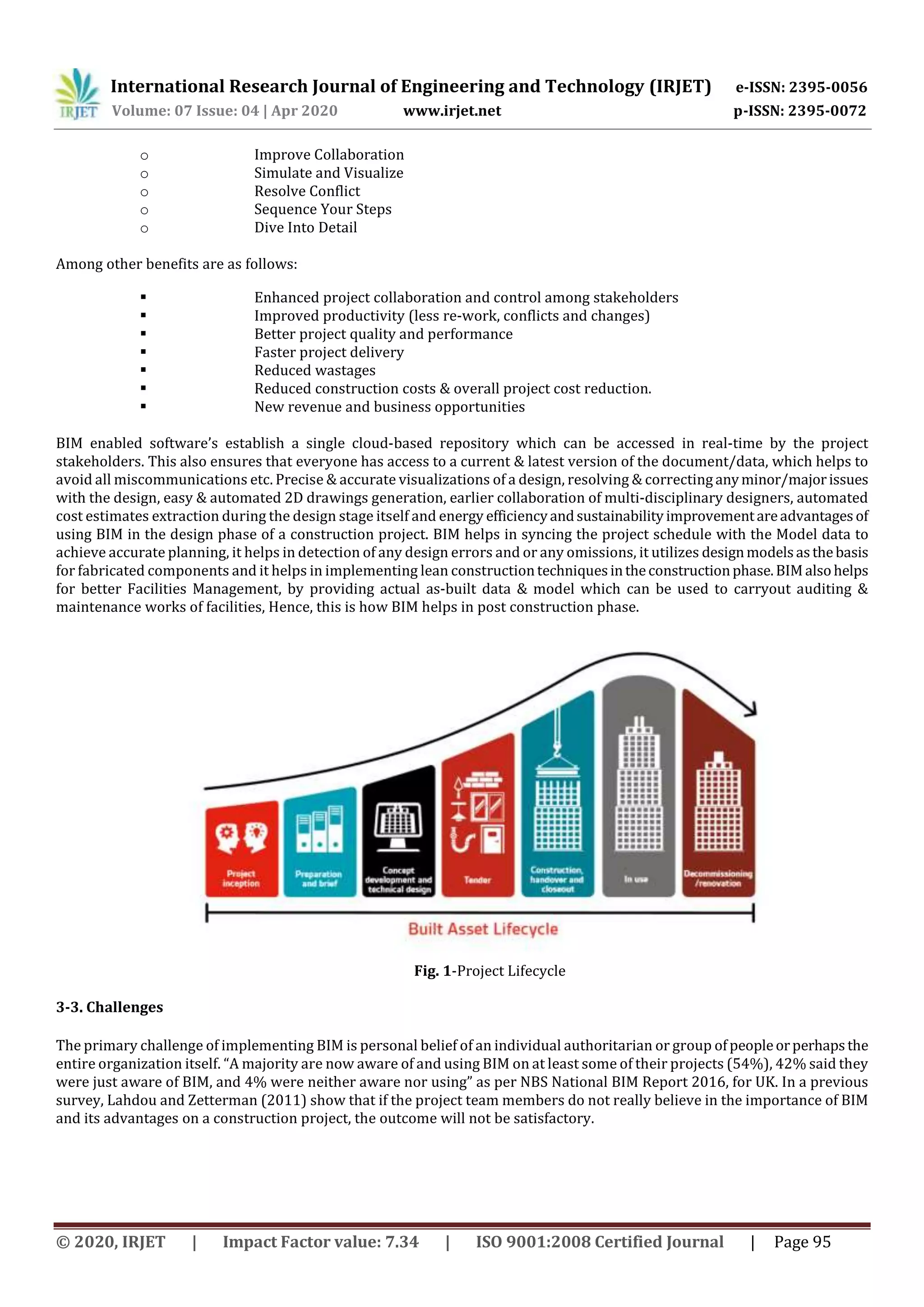
Fig. 1-Project Lifecycle
3-3. Challenges
The primary challenge of implementing BIM is personal belief of an individual authoritarian or group ofpeopleorperhaps the
entire organization itself. “A majority are now aware of and using BIM on at least some of their projects (54%), 42% said they
were just aware of BIM, and 4% were neither aware nor using” as per NBS National BIM Report 2016, for UK. In a previous
survey, Lahdou and Zetterman (2011) show that if the project team members do not really believe in the importance of BIM
and its advantages on a construction project, the outcome will not be satisfactory.
International Research Journal of Engineering and Technology (IRJET) e-ISSN: 2395-0056
Volume: 07 Issue: 04 | Apr 2020 www.irjet.net p-ISSN: 2395-0072
© 2020, IRJET | Impact Factor value: 7.34 | ISO 9001:2008 Certified Journal | Page 96
Fig. 2-BIM Adoption overtime in the UK.
As per Brewer et. al. (2012) state that the challenges for using BIM on construction projects can be grouped and presented as:
1) Technical Challenges-These are generally conflictsandissuesregardingdata sharingamongteamparties
and BIM software’s’ problems.
2) Skills and Training Challenges-These are mainly about the training project team members and
improving their skills.
3) Legal and Procedural Challenges-These refer to the lack of a standard and legal definition for BIM
professional responsibilities;
4) Cost Challenges-These are the preliminary issues which sometimes hinder the construction firms from
changing and upgrading their current systems to a BIM oriented system.
4. Solutions
4-1. Project Management Office’(PMO) Knowledge & Adaptability
The essence of BIM is based on effective collaboration, the characteristics of project stakeholders greatly influence the
implementation of BIM. Hence, attitudes of teams’ members should be considered as an effective factor, specifically, project
managers & the project management office as the coreof communicationchannels.Theadaptability &knowledgeofPMOinthe
changing technologies & BIM enabled tools & software’s will make the transition of project from traditional project
management to digital project management much easier. Thus, considering that BIM knowledge is an excessive capability for
construction project managers & project management organizations should possess. The organization hiring strategies must
focus on BIM knowledge & experience of the project managers & other team members.
4-2. Training & Skill development
The basis of professional development can be said in the education system. It would be much easier to have young adaptive
minds taking Project Management education be taught BIM & other advancements of Digital Engineering, so that the project
management industry gains trained/knowledgeable characters as potential employees & future Project Managers. The
universities in U.S. are pioneers in this regard. There are BIM-related courses offered mainly in construction engineering and
management programs. Within these courses, the concept of BIM and the related software trainings are being taught. The
Universities in UK & Canada are not further behind who have incorporated BIM in their Construction & Construction Project
Management courses. Some of these Universities even offer independent BIM courses for working professionals to enhance
their skills. The introduction of BIM-based project management tools has helped students to develop more realistic project-
based class assignments. This method enables students to utilize different formal project management methods in real-world
project management problems. Despiteofall theseeffortsthereissomehowstill a gapbetweentraditional project management
& current & rapidly changing digital engineering & project management systems being introduced every changing day. The
education system across the globe needs to adapt the changing technologies & inculcate them in thesyllabusinordertocreate
potential project managers for the future.
International Research Journal of Engineering and Technology (IRJET) e-ISSN: 2395-0056
Volume: 07 Issue: 04 | Apr 2020 www.irjet.net p-ISSN: 2395-0072
© 2020, IRJET | Impact Factor value: 7.34 | ISO 9001:2008 Certified Journal | Page 97
5. Conclusion
This paper shows the main aspects of BIM such as Clash detection, Design Review, MultipleDisciplinedesignintegration,Time
& Cost (4D,5D BIM) aspect, automated estimation, easier 2D Drawing generation. Due to all these capabilities BIM can be
identified as new Project Management Tool/System.Thoughthis beinga newsystem ofProjectManagementunderpinnedwith
Digital tools & technologies, its results/benefits depend upon the efficiency of the Project Managers & team using it. The
essence of PMBOK & the capabilities of BIM are found to be similar. Therefore, despite of being accompanied by digital
technologies BIM can be said a new generation Project Management system. There is a similarity in the duties of a Project
Manager & or the PMO for a construction project. To reap the complete benefitsofBIMtheProjectManager&perhapstheteam
at PMO must posses a detailed knowledge & experience in knowing the capabilities of BIM its digital technologies,tools&most
importantly the software’s. It is vital that BIM is included in the curricula of the students pursuing Construction Management,
Project Management along with the basic fundamentals of Project Management, which will help generate new league of BIM
aware & BIM capable Project Managers.
References
BSI Little Book of BIM-2018 Edition (bsigroup.com/bim-uk bimlevel2.org), DTI-WEF 2018
(http://reports.weforum.org/digital-transformation), Building Information Modeling in Project Management: Necessities,
Challenges and Outcomes-Saeed Rokooei, University of Nebraska-Lincoln, Nebraska, USA (2015), NBS-National BIM Report
2018 & 2019(www.thenbs.com/knowledge/national-bim-report-2019)Alagarsamy,K.,(2000).BuildingInformationModeling
– A Quick Walk Through For Project Managers, Auburn University. Autodesk, (2003). Building Information Modeling. San
Rafael, CA, Autodesk, Inc. Autodesk, (2013). Autodesk BIM for Architecture, Engineering, and Construction Management
Curriculum, Autodesk. Retrieved from http://bimcurriculum.autodesk.com/unit/unit-1-%E2%80%93-bim-modeling-basics
Brewer, G., Gajendran, T., & Goff, R., (2012). Building Information Modelling (BIM): an Introduction and International
Perspectives, The University of Newcastle. Dey, R., (2010). The History oftheBIMandtheSuccess StoryTill Date,BIM:Building
Information Modeling Blog. Retrieved on 8/6/13 from http://bim-modeling.blogspot.com/2010/12/history-of-bim-and-
success-story-till.html. Eastman, C., Teicholz, P., Sacks, R., & Liston, K. (2008). BIM Handbook: A Guide to BuildingInformation
Modeling for Owners, Managers, Designers, Engineers, and Contractors. John Wiley & Sonic, Inc., Hoboken, New Jersey.

IRJET- Digital Engineering & Project Management for AEC Industry using BIM

  • 1.
    International Research Journalof Engineering and Technology (IRJET) e-ISSN: 2395-0056 Volume: 07 Issue: 04 | Apr 2020 www.irjet.net p-ISSN: 2395-0072 © 2020, IRJET | Impact Factor value: 7.34 | ISO 9001:2008 Certified Journal | Page 92 Digital Engineering & Project Management for AEC industry using BIM. Tejas S Bavadekar1, Anup S Kshirsagar2 1Tejas S Bavadekar: Student, M.Tech Construction Management, Dept. of Construction Project Managament, MITCOM, MIT-ADT University, Pune, Maharshtra, India. 2Anup S Kshirsagar: Student, M.Tech Construction Management, Dept. of Construction Project Management, MITCOM, MIT-ADT University, Pune, Maharashtra, India ---------------------------------------------------------------------***---------------------------------------------------------------------- Abstract - In the recent years there has been tremendous use of Building Information Modeling (BIM) across the AEC (Architecture, Engineering, Construction) Industry. BIM can bedefinedasacollaborativewayofworkingunderpinnedwithdigital technologies. BIM helps in creating a common language between all Project Stakeholders and system divisions involved a project and make them an integrated team. The approach of BIM can be said similar to that of Integrated Project Delivery (IPD) systems. The duties of a Project Management Office (PMO) are now with BIM implementors & BIM enablers. TheProjectManagersarenow known by the role of Project BIM Co-Ordinator. BIM helps in various activities involved in a project such as Clash-Free Design, Integrated Inter Disciplinary information & drawings, Easier Quantity Take-off, Project Scheduling, Visualization of the entire project before its actual execution. In short, it helps in integrating the entire Project Lifecycle. This paper aims to show how the rapid use of Digital Technologies such as BIM can transform the Project Management for AEC industry. It emphasizes the importance BIM & its effective use to achieve results. This paper also discusses how in the coming years the dynamics of Project Management will change for the AEC Industry. Key Words: Building Information Modelling (BIM), AEC (Architecture, Engineering, Construction) Industry, Project Management, Integrated Project Delivery (IPD) systems, Project Lifecycle, Project Management Office (PMO). 1. INTRODUCTION Building Information Modelling (BIM) is a collaborative way of working underpinned by digital technologies, which allow for more efficient methods of designing, delivering and maintaining physical built assets throughout their entire lifecycle. Greater efficiencies can be realized due to significant pre-planning during the design and construction phases, providing comprehensive information at handover stage. (BSI-Little Book of BIM-2018 Edition). BS 1192:2007+A2:2016 – Collaborative production of architectural, engineering and construction information. Code of practice. PAS 1192-2:2013 – Specification for information management for the capital/delivery phase of construction projects using Building Information Modelling. Pioneering the BIM Standard. PAS 1192-3:2014 – Specification for information management for the operational phase of assets using Building Information Modelling. The National Building Information Model Standard Project Committee defined the BIM as following: “A BIM is a digital representation of physical and functional characteristics of a facility.Assuchitservesasa sharedknowledge resource for information about a facility forming a reliable basis for decisions during its lifecycle from inception onward.” The use of BIM helps in Design Optimization, Precise decision making, anticipating the Potential Project Road-Blocks if any, Estimation & Quantity Take-off in automated ways, Data Analytics, most importantly complete visualization of the entire project before its execution. 1.1 History The concept of BIM theoretically emerged and was developed at Georgia Institute of Technology in the late 1970s and grew rapidly after that. It grew tremendously since because of the increasing attention paid to the entire process of handling a project. The big Construction Firms started seeing the merits of implementing BIM in their projects. The term Building Information Modeling was first used in 2002 to describe virtual design, constructionandfacilities management(Harris,2010). Graphisoft in 1986 introduced its new software as a solution for virtual building. This software, ArchiCAD, was reallya drastic improvement in CAD programs of that time since ArchiCAD allowed the creation of three dimensional (3D) modelsofprojects (Dey, 2010). The terms Building Information Modeling and Building Information Model and the acronym of BIM were widespread when Autodesk released the "Building Information Modeling” (Autodesk, 2003).
  • 2.
    International Research Journalof Engineering and Technology (IRJET) e-ISSN: 2395-0056 Volume: 07 Issue: 04 | Apr 2020 www.irjet.net p-ISSN: 2395-0072 © 2020, IRJET | Impact Factor value: 7.34 | ISO 9001:2008 Certified Journal | Page 93 1.2 Construction Project Management A Construction Project consists of multiple disciplines. This means involvement of multiple disciplinary stakeholders, who work in their respective offices acting as silos. It also means they contributetoanyprojectinthreebroadaspectsi.e.Time,Cost, Decisions. “A combination of favorable demographic trends and the implementation of legislative reforms are generating a wide range of infrastructure investment opportunities. Total infrastructure spending isprojectedtoreachUSD142.5billionin 2019 and USD 175.8 billion in 2020” as per the report Global powers of Construction 2018, by Deloitte. No matter the scale of the project, there is a need to manage the construction project & this means requirement of an efficient project management system & or Project Management Office (PMO) with a capable team to run it. To manage a constructionproject,itisessential to know the fundamentals of project management & thoroughly understanding the construction processes. As per the Project Management Body of Knowledge (PMBOK) definitions, the construction project manager is the one who handles project management planning,cost management,timemanagement, qualitymanagement,contractadministration,safety management and risk management. The project management office (PMO) or the project manager is responsible for clear & smooth communication between all of the Project Stakeholders involved in the project, this includes owner, designers, engineers, professional crew and administrative staffs. These Activities are typically involved in all of the projects big or small scale. Hence, we can say these are typical functions involved in Project Management. 2. Building Information Modeling Aspects The aspects of BIM are explained in detail in the points mentioned below: 2-1. Integrated Project Delivery System Integrated project delivery (IPD) is a growing approach for delivering projects that unites all the different disciplines & their efforts, then integrates all project stakeholders including project managers, designers, engineers, systems, data and practices into a collaborative process. IPD focuses on value aspect of the project by optimizing the efficiency of all the activities/processes involved in the project. IPD essentially combines all of the project stakeholders to form one big team. It helps all of the project stakeholders to think outside of their own design/discipline & analyze the impacts of interdisciplinary design. The use of digital technologies which are BIM enabled help the stakeholders to clearly visualize, analyze & simulate project in a holistic way. This also helps in the minute details of the project, which helps in better delivery of the project & its management as well. This integrated collaboration approach helps the projectteamtoeffectivelytrack data,assessandreview the project, make precise decisions when necessary, resolve conflict and discrepancies and execute the project successfully. IPD is an integrating approach for project management, and BIM is the technological interface that facilitates this process. These benefits of BIM enabled IPD can be seen throughout the entire lifecycle of the project. 2-2. Technical Aspects of BIM Project Management using BIM has some key features, these features are summarized below: Clash Detection The most common problem of multiple disciplines’ plans for a construction project is the geometrical design inconsistencies. These issues happen when there is an overlap between the plans of different disciplines. Using BIM, it would be possible to bring the plans together and detect the clashes between multiple disciplines say, MEP vs Structural etc. The Aesthetics of any project can also be revised & or optimized because of this process. Constructability Review BIM It is possible for project stakeholders, engineers & the construction team to review the technicalities froma constructionpoint of view & revise or make necessary changes if any. This not only provides a visualization perspective but also give analytics from any point needed. It helps the team to raise more efficient & precise RFI’s in real time. This real time RFI resolution helps in early risk mitigation. Data Science & Analytics BIM helps to take precise decisions running the model through various simulations & runanalytics ofall sorts,all inthebenefit of the project. By using appropriate tools, it’s possible to analyze the energy consumption/auditing, changing materials and orientation, mass and space, renders & aesthetics etc.
  • 3.
    International Research Journalof Engineering and Technology (IRJET) e-ISSN: 2395-0056 Volume: 07 Issue: 04 | Apr 2020 www.irjet.net p-ISSN: 2395-0072 © 2020, IRJET | Impact Factor value: 7.34 | ISO 9001:2008 Certified Journal | Page 94 Time & Cost Estimation (4D & 5D BIM) Time and cost estimation are referred to as 4th & 5th Dimensions of BIM, hence, 4D & 5D BIM. BIM enabled software’s can be used to determine the critical activities, road-blocks, bottlenecks etc. beforehand to achieve the delivery of project in the stipulated time. Cost Estimation can now be done at a click. It can be automated rather than having an estimation team to calculate manually & apply thumb rules etc. Furthermore, BIM tools allow us to simulate the various alternatives for a construction project and hence helps project managers and executives to reliablypredicttheconsequencesoftheirdecisions & evaluate them in a very detailed manner, thereby helping to achieve cost optimization. Integration The Project Stakeholders or essentially the project team can collaborate in real-time on a single cloud-based platform. It can allow multi-disciplinary models to truly integrate & help achieve a true digital model of the real building/project. It can help evaluate the details of each design discipline. Asset Management BIM being useful for the entire Project Lifecycle is Asset Management. It is useful for the maintenance, auditing, analysis, perhaps even for demolition of an existing building/asset. Thismeans ithelpsinproducinganas-builtModel which canprovide detailed as-built drawings, it can also provide with as built data. This depends upon the accuracy to which the model has been done. BIM enabled machines & tools also help in Modelling an existing facility/asset. Element Based Models BIM models consists of objects and not geometries, such as line, surface, etc. – the whole model can be easily divided into a specific number of smaller objects. The type & discipline elements areverydistinctly&clearlydefined whichinturnresults ina better management, optimized design, detailed & automated estimate and faster construction. Transparency Due to a centralized & common model to input, modify and analyze the data with clear tracking of each inputs, means an efficient, clear communication between the Project Stakeholders. This helps to facilitate the communication throughout the project lifecycle and lessen the disputes between different parties. The entire Project communication is now transparent & there is clear ownership of Data. 3. Role of BIM in Project Management 3-1. Comparing BIM with PMBOK knowledge areas The capabilities & functions of BIM are similar/correspond to the PMBOK knowledge areas. Hence, BIM is sought after for implementation in the project management industry. Integration management which is the first area of PMBOK, has the same function as BIM. BIM integrates traditional project management such as checklists, document management, tracking deliverables, plan vs actual, theories etc. using digital tools. BIM being a clear & transparent way of working, assures clear deliverables & their effective tracking. It also helps in clear scope definitionforeachstakeholder.AnotherBIMaspectisTime& Cost which is similar to project cost and time management areas in PMBOK. The use of constructability review may be overlooked but it helps in mitigating almost all of the major risks associated with a Construction Project. BIM allows for clash detection which enables in clear & detail visualization of clashes between disciplines, this alsohelpsforefficientcollaboration. Collaboration and team building with BIM is the human resource management as per project management area. Efficient Communication is the essential feature of BIM which enables real-time, precise communication between projectstakeholders such as designers, project manager, engineers, construction team, owners, contractors etc. The automated & easier Quantity take-offs using BIM enabled digital technologies helps in optimized procurement & this is similar to the Procurement management area of knowledge areas. 3-2. The Benefits & Advantages of implementing BIM Different sources of construction project management identify key advantages of using BIM (in Autodesk by Matt Ball- Architecture - Apr 11 2018) are as follows: o Capture Reality o Maintain Control
  • 4.
    International Research Journalof Engineering and Technology (IRJET) e-ISSN: 2395-0056 Volume: 07 Issue: 04 | Apr 2020 www.irjet.net p-ISSN: 2395-0072 © 2020, IRJET | Impact Factor value: 7.34 | ISO 9001:2008 Certified Journal | Page 95 o Improve Collaboration o Simulate and Visualize o Resolve Conflict o Sequence Your Steps o Dive Into Detail Among other benefits are as follows:  Enhanced project collaboration and control among stakeholders  Improved productivity (less re-work, conflicts and changes)  Better project quality and performance  Faster project delivery  Reduced wastages  Reduced construction costs & overall project cost reduction.  New revenue and business opportunities BIM enabled software’s establish a single cloud-based repository which can be accessed in real-time by the project stakeholders. This also ensures that everyone has access to a current & latest version of the document/data, which helps to avoid all miscommunications etc. Precise & accurate visualizations of a design, resolving & correcting anyminor/majorissues with the design, easy & automated 2D drawings generation, earlier collaboration of multi-disciplinary designers, automated cost estimates extraction during the design stage itself and energy efficiencyandsustainability improvementareadvantages of using BIM in the design phase of a construction project. BIM helps in syncing the project schedule with the Model data to achieve accurate planning, it helps in detection of any design errors and or any omissions, it utilizes designmodelsasthebasis for fabricated components and it helps in implementing lean constructiontechniquesintheconstructionphase.BIM alsohelps for better Facilities Management, by providing actual as-built data & model which can be used to carryout auditing & maintenance works of facilities, Hence, this is how BIM helps in post construction phase. Fig. 1-Project Lifecycle 3-3. Challenges The primary challenge of implementing BIM is personal belief of an individual authoritarian or group ofpeopleorperhaps the entire organization itself. “A majority are now aware of and using BIM on at least some of their projects (54%), 42% said they were just aware of BIM, and 4% were neither aware nor using” as per NBS National BIM Report 2016, for UK. In a previous survey, Lahdou and Zetterman (2011) show that if the project team members do not really believe in the importance of BIM and its advantages on a construction project, the outcome will not be satisfactory.
  • 5.
    International Research Journalof Engineering and Technology (IRJET) e-ISSN: 2395-0056 Volume: 07 Issue: 04 | Apr 2020 www.irjet.net p-ISSN: 2395-0072 © 2020, IRJET | Impact Factor value: 7.34 | ISO 9001:2008 Certified Journal | Page 96 Fig. 2-BIM Adoption overtime in the UK. As per Brewer et. al. (2012) state that the challenges for using BIM on construction projects can be grouped and presented as: 1) Technical Challenges-These are generally conflictsandissuesregardingdata sharingamongteamparties and BIM software’s’ problems. 2) Skills and Training Challenges-These are mainly about the training project team members and improving their skills. 3) Legal and Procedural Challenges-These refer to the lack of a standard and legal definition for BIM professional responsibilities; 4) Cost Challenges-These are the preliminary issues which sometimes hinder the construction firms from changing and upgrading their current systems to a BIM oriented system. 4. Solutions 4-1. Project Management Office’(PMO) Knowledge & Adaptability The essence of BIM is based on effective collaboration, the characteristics of project stakeholders greatly influence the implementation of BIM. Hence, attitudes of teams’ members should be considered as an effective factor, specifically, project managers & the project management office as the coreof communicationchannels.Theadaptability &knowledgeofPMOinthe changing technologies & BIM enabled tools & software’s will make the transition of project from traditional project management to digital project management much easier. Thus, considering that BIM knowledge is an excessive capability for construction project managers & project management organizations should possess. The organization hiring strategies must focus on BIM knowledge & experience of the project managers & other team members. 4-2. Training & Skill development The basis of professional development can be said in the education system. It would be much easier to have young adaptive minds taking Project Management education be taught BIM & other advancements of Digital Engineering, so that the project management industry gains trained/knowledgeable characters as potential employees & future Project Managers. The universities in U.S. are pioneers in this regard. There are BIM-related courses offered mainly in construction engineering and management programs. Within these courses, the concept of BIM and the related software trainings are being taught. The Universities in UK & Canada are not further behind who have incorporated BIM in their Construction & Construction Project Management courses. Some of these Universities even offer independent BIM courses for working professionals to enhance their skills. The introduction of BIM-based project management tools has helped students to develop more realistic project- based class assignments. This method enables students to utilize different formal project management methods in real-world project management problems. Despiteofall theseeffortsthereissomehowstill a gapbetweentraditional project management & current & rapidly changing digital engineering & project management systems being introduced every changing day. The education system across the globe needs to adapt the changing technologies & inculcate them in thesyllabusinordertocreate potential project managers for the future.
  • 6.
    International Research Journalof Engineering and Technology (IRJET) e-ISSN: 2395-0056 Volume: 07 Issue: 04 | Apr 2020 www.irjet.net p-ISSN: 2395-0072 © 2020, IRJET | Impact Factor value: 7.34 | ISO 9001:2008 Certified Journal | Page 97 5. Conclusion This paper shows the main aspects of BIM such as Clash detection, Design Review, MultipleDisciplinedesignintegration,Time & Cost (4D,5D BIM) aspect, automated estimation, easier 2D Drawing generation. Due to all these capabilities BIM can be identified as new Project Management Tool/System.Thoughthis beinga newsystem ofProjectManagementunderpinnedwith Digital tools & technologies, its results/benefits depend upon the efficiency of the Project Managers & team using it. The essence of PMBOK & the capabilities of BIM are found to be similar. Therefore, despite of being accompanied by digital technologies BIM can be said a new generation Project Management system. There is a similarity in the duties of a Project Manager & or the PMO for a construction project. To reap the complete benefitsofBIMtheProjectManager&perhapstheteam at PMO must posses a detailed knowledge & experience in knowing the capabilities of BIM its digital technologies,tools&most importantly the software’s. It is vital that BIM is included in the curricula of the students pursuing Construction Management, Project Management along with the basic fundamentals of Project Management, which will help generate new league of BIM aware & BIM capable Project Managers. References BSI Little Book of BIM-2018 Edition (bsigroup.com/bim-uk bimlevel2.org), DTI-WEF 2018 (http://reports.weforum.org/digital-transformation), Building Information Modeling in Project Management: Necessities, Challenges and Outcomes-Saeed Rokooei, University of Nebraska-Lincoln, Nebraska, USA (2015), NBS-National BIM Report 2018 & 2019(www.thenbs.com/knowledge/national-bim-report-2019)Alagarsamy,K.,(2000).BuildingInformationModeling – A Quick Walk Through For Project Managers, Auburn University. Autodesk, (2003). Building Information Modeling. San Rafael, CA, Autodesk, Inc. Autodesk, (2013). Autodesk BIM for Architecture, Engineering, and Construction Management Curriculum, Autodesk. Retrieved from http://bimcurriculum.autodesk.com/unit/unit-1-%E2%80%93-bim-modeling-basics Brewer, G., Gajendran, T., & Goff, R., (2012). Building Information Modelling (BIM): an Introduction and International Perspectives, The University of Newcastle. Dey, R., (2010). The History oftheBIMandtheSuccess StoryTill Date,BIM:Building Information Modeling Blog. Retrieved on 8/6/13 from http://bim-modeling.blogspot.com/2010/12/history-of-bim-and- success-story-till.html. Eastman, C., Teicholz, P., Sacks, R., & Liston, K. (2008). BIM Handbook: A Guide to BuildingInformation Modeling for Owners, Managers, Designers, Engineers, and Contractors. John Wiley & Sonic, Inc., Hoboken, New Jersey.