International Research Journal of Engineering and Technology (IRJET) e-ISSN: 2395-0056
Volume: 05 Issue: 11 | Nov 2018 www.irjet.net p-ISSN: 2395-0072
© 2018, IRJET | Impact Factor value: 7.211 | ISO 9001:2008 Certified Journal | Page 1588
4D Simulation of MEP using BIM for Residential Building Project
Amruta Salunkhe Patil, Pro. R.D. Shinde, Pro. A.K. Kanase3
1Post graduate student, Department of Civil Engineering, RMD Sinhgad School of Engineering, Warje, Pune,
Maharashtra, India
2Head of the Department of Civil Engineering, RMD Sinhgad School of Engineering, Warje, Pune,
maharashtra, India
3Professor, Department of Civil Engineering, Sinhgad Institute of Technology & Science, Narhe, Pune,
Maharashtra, India
---------------------------------------------------------------------***----------------------------------------------------------------------
ABSTRACT - Project management is a major part of any
project in the world. A better project management leads any
project to its optimum output. For better projectmanagement
we should know different techniques used for project
completion and must have thorough knowledge of all aspects
of resource management.
Different methods were used for project management, for
example, use of Bar Chart, Milestone Chart, Gantt Chart etc.
and project planning was done accordingly. In the meantime,
the whole work was divided in different segments like Plan,
Design, Bid and Build, whichrequiredthroughspecificationsof
concerned work. To achieve the same use of 2D drawings,
contract documents, specifications, codes and manuals were
prepared.
BIM reflects the development and use of computer generated
n-dimensional models. It helps to simulate the planning,
design, construction and operation of a facility. It helps
architects, engineers and constructorstoforecastwhatistobe
built in simulated environment and to identify potential
design, construction or operational problems. This report
focuses on 4D simulation of MEP using BIM on a residential
building
Key Words: BIM, MEP, Scheduling, Navisworks,
Simulation.
1. INTRODUCTION
Project management is a vital part of any project in the
world. A better project management leads any project to its
optimum output. For better project management it is
necessary to know different techniques used for project
completion and musthavethoroughknowledgeofall aspects
of resource management.
Different methods were used for project management, for
example, use of Bar Chart, Milestone Chart, Gantt Chart etc.
and project planning was doneaccordingly.Inthemeantime,
the whole work was divided in different segments like Plan,
Design, Bid and Build, which requiredthroughspecifications
of concerned work. To achieve the same use of 2D drawings,
contract documents, specifications, codesandmanualswere
prepared.
1.1 Aim of the Project & Paper
The purpose of this project is to simulate project scheduling
with its 3D model to obtain 4D model and working Building
Information Modeling, MEP designing, Time scheduling and
4D simulation in a residential building project.
1.2 Objective of the Project & Paper
The objective of this project & paper is
i. To study conventional method of preparing 2D/3D
drawing and project scheduling.
ii. To study BIM (Building Information Modelling) for
preparing 3D model in Revit Autodesk
iii. To study MEP for detailed drawing of Mechanical,
Electrical & Plumbing.
iv. To study the Autodesk Nevisworks for the
simulation of prepared 3D model with MEP
detailing and its scheduling.
v. To study the benefits of BIM applications forproject
scheduling and additional requirementsifany,to
be put in to the model to get more benefits in
terms of project scheduling.
vi. To compare the conventional methods and BIM
applications for project scheduling.
vii. To study the barriers ofaneffectiveimplementation
of BIM application for project scheduling.
2. LITURATURE REVIEW
Following is the list of researchers who have worked in the
same area
Saeed Rokooei (2015) in his paper proposed differentviews
of BIM including time, cost, wastage reduction and time
reduction of a project. It also shows the similarities between
BIM and project manager.
Roshana Takim, Mohd Harris, Abdul Hadi Nawawi (2013)in
their paper they clears the use of computergeneratedmodel
in simulation and also use of BIM in construction industry
can make the industry more efficient.
International Research Journal of Engineering and Technology (IRJET) e-ISSN: 2395-0056
Volume: 05 Issue: 11 | Nov 2018 www.irjet.net p-ISSN: 2395-0072
© 2018, IRJET | Impact Factor value: 7.211 | ISO 9001:2008 Certified Journal | Page 1589
Pawel Nowak, Mariola Ksiazek, Marcin Draps, Jacek
Zawistowski (2016) they have introduced a paper on
decision making with use of Building Information Modeling.
In which they state that BIM allows for fast and easy access
to different and almost all characteristicsofcomponentsand
energy analysis.
Ireneusz Czmocha, Adam Pekala (2014) This paper is based
on the traditional design versus BIM. In which history and
development of traditional work and idea and practical
benefits of BIM are defined. Paper also states difficulties
during implementation of BIM and its benefits also.
Zbigniew Kacprzyka, Tomasz Kepa (2014) introduces 4D
Modeling Technology which shows the project made by
using 4D BIM. 4D is 3D modelinginadditionwithscheduling.
4D schedule ispreparedinAutodesk Navisworks.Scheduling
starts by importing data from Revit model.
Dr. Kihong Ku and Thomas Mills haveintroducedtheirpaper
on research on BIM for construction safety. There is lack of
resources.
3. PROBLEM STATEMENT
i. Lack of communication, rework, time and cost
overrun are the major problems faced by
construction firms. Timely andaccuratefeedback of
actual project enables project managers to take
appropriate correct actions that would minimize
time overrun in timely manner & is possible by
using BIM.
ii. As project progresses, the process of construction
monitoring & control get more complex due to the
huge amount of information that need to be
measured and analyzed.
4. METHODOLOGY
The objectives of the research will be achieved by
implementing the following steps:
i. Studying Building Information Modeling and its
framework.
ii. Comparing Building Information Modeling and
traditional methods used in construction work
iii. Studying Autodesk Revit and preparing 3D model
for building
iv. Applying MEP to the 3D modeling of the proposed
building.
v. Studying Autodesk Navisworks manage and
simulation.
vi. Detection of clashes
There is no universal definition of BIM and
definitions continue to evolve. However BIM is not
software .It I much more than 3D-modelling .It is a
business process ,and there fore you cannot go out
and “buy BIM”. BIM is a digital representation of the
physical and functional characteristics of a facility in
order to work out problems, and simulate and analyze
the potential impacts. BIM is both technology and a new
way of working, i.e. tools which improve delivery of
outputs, and implementation of a collaborative
culture. BIM is about information, communication and
delivery, with greater emphasis on “information”.
BIM is a shared knowledge resource, forming are liable
basis for decisions during a facility’s
Life cycle.
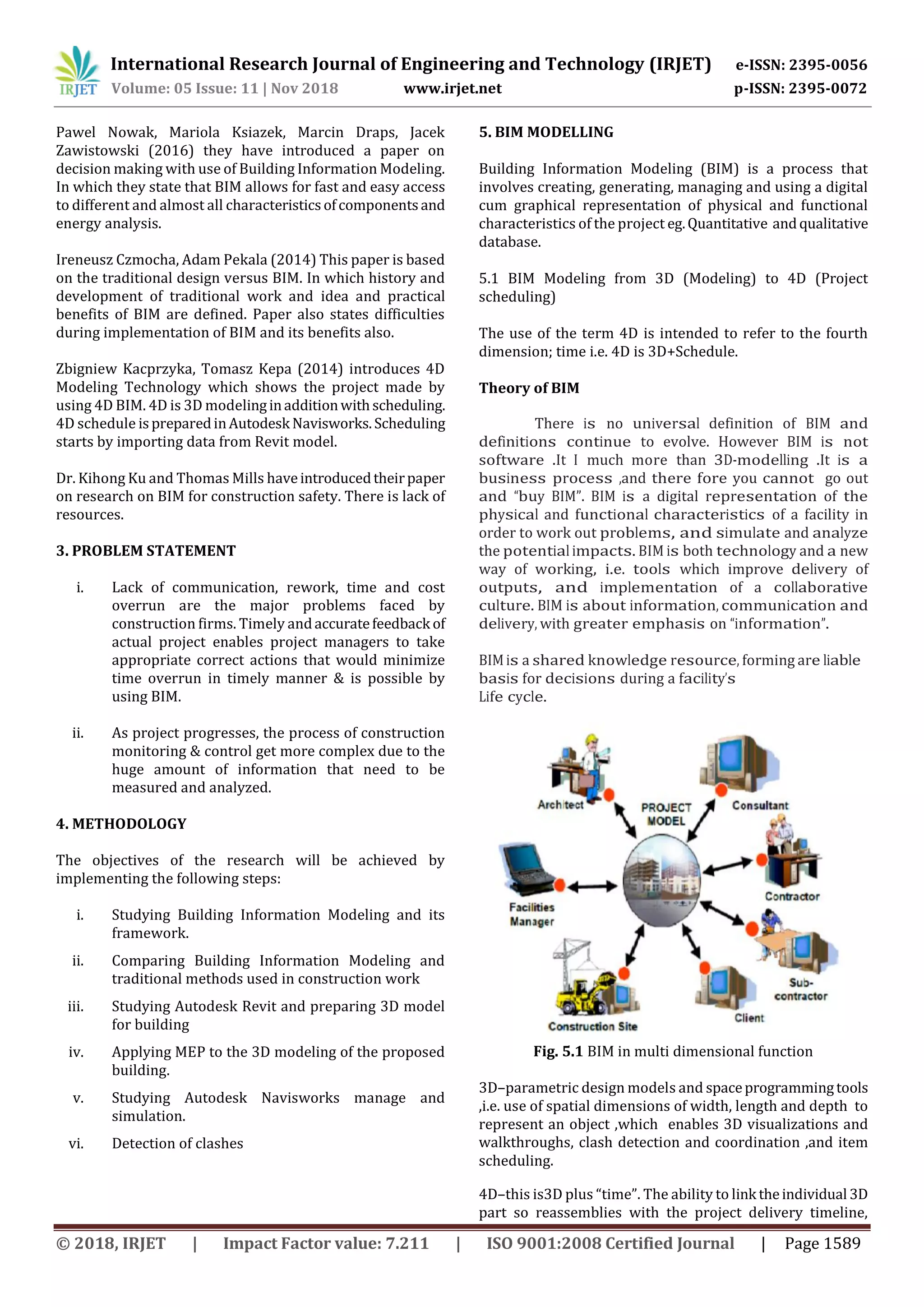
Fig. 5.1 BIM in multi dimensional function
3D–parametric design models and spaceprogrammingtools
,i.e. use of spatial dimensions of width, length and depth to
represent an object ,which enables 3D visualizations and
walkthroughs, clash detection and coordination ,and item
scheduling.
4D–this is3D plus “time”. The ability to link theindividual 3D
part so reassemblies with the project delivery timeline,
5. BIM MODELLING
Building Information Modeling (BIM) is a process that
involves creating, generating, managing and using a digital
cum graphical representation of physical and functional
characteristics of the project eg.Quantitative andqualitative
database.
5.1 BIM Modeling from 3D (Modeling) to 4D (Project
scheduling)
The use of the term 4D is intended to refer to the fourth
dimension; time i.e. 4D is 3D+Schedule.
Theory of BIM
International Research Journal of Engineering and Technology (IRJET) e-ISSN: 2395-0056
Volume: 05 Issue: 11 | Nov 2018 www.irjet.net p-ISSN: 2395-0072
© 2018, IRJET | Impact Factor value: 7.211 | ISO 9001:2008 Certified Journal | Page 1590
including scheduling of resources and quantities, and
modular prefabrication to assist tracking and project
phasing. In addition to collaboration, 4D simulations
function as communication tools to reveal potential
bottlenecks. Both planners and contractors can use BIM
onsite for verification, guidance and trackingofconstruction
activities.
A- Introduction to Autodesk Revit:
 Autodesk
John Walker, one of the inventors of AutoCAD, found
Autodesk in 1982. AutoCAD was their first product and
remains the most popular one. But in last threedecadesthey
have developed several notable products including
Sketchbook, Pixlr and Revit. Except CAD and Building
Information Modeling platforms AutoCAD produce also
media and entertainment software like Maya, 3D animation
software.
 Revit
After introducing the most popular Building Information
Modeling software and Autodesk as company that develops
Revit, the spotlight will move now to Revit itself. In 1997
ReonidRaiz and IrwinJungreisfoundedthecompanyCharles
River Software, which startedbuildingRevit.Theirmain goal
was to include parametric modelling to existing idea of CAD,
and to allow the user to determine the parametric
components graphically, instead of having to use a
programming language.
This idea of bidirectional associativity is the concept that
distinguished Revit from other Building Information
Modeling software platforms for a certain period of time,
until the competition caught up. Bidirectional associativity
means that when u change a certain component of your
model (for example wall) all componentsinrelation with the
modified one will automaticallyadjustthemselvestoapplied
changes. For example if a floor level is moved further up all
walls connecting it with the lower level will become higher,
the ceiling of the lower level will move up, walls of the
current level will shorten and etc. This concept of bi-
directional associativity makes the software more intuitive
and therefore easier to work with for the user. It also saves
enormous amount of time when applying changes to an
existing model.
In order to satisfy the different needs of types of specialist
using Revit, Autodesk divided the product in to three main
branches- Revit Architecture, Revit Structure, Revit MEP.
 Revit Architecture
As the name suggests this branch of Revit is specifically
designed to support the work of architects and building
designers. The architecture section is mostlya CADplatform
that facilitates building and site planning.
 Revit Structure
This part is focused on aiding structural engineers and
designers. Here the user has the possibility to perform
analysis on the structure, plan structural reinforcement and
generally perform all necessary actions to guarantee the
structural stability and reliability of the building.
 Revit MEP
Mechanical, Electrical and Plumbing (MEP) section of Revit
allows mechanical electrical and other similar types of
engineers to design and simulate different kinds oftechnical
systems. Piping and electrical systems can be modelled and
integrated into a building with Revit MEP. Energyanalysisof
a construction can also be performed in MEP Revit.
B- Introduction to Autodesk Navisworks Manage
Navisworks helps architecture, engineers and construction
teams to improve and gain control over the outcome of AEC
projects. By utilizing theapplicationsolution,detaileddesign
models can be aggregated and reviewed by all project
stakeholders, helping users to benefit from the competitive
advantages of BIM workflows. Used primarily in the
construction industries to compliment 3D design packages
such as Autodesk Revit, AutoCAD, Navisworks allows users
to open and combine 3D models, Navigate around them in
real time and review the model using the set of tools
including comments, redlining, viewpoint, and
measurements. A selection of plug-ins enhancesthepackage
adding interference detection, 4D time simulation,
photorealistic and PDF-like publishing.
Navisworks is a viewer of BIM models and has many useful
applications in almost all phases of the deployment of a BIM
model. The application work much like a video game and
since it is not a modeller it also limits the severity and
number of things that can go wrong in a BIM analysis.
Autodesk Navisworks Freedom is the free
counterpart to the expensive Autodesk NavisworksManage.
It allows to visualise the 3D model and to see the collision
mark-ups created with Navisworks Manage. Navisworks
Manage is the most expensive of all the Navisworks family
packages. However it is also the one that is capable of
performing all functions (combining files, simulation,
animation, visualization), but also interface checking
provides the ability to detect not only hard clashes between
objects, but also check for items or objects that interface
with required clearances around objects.
C- Introduction to Autodesk Revit MEP
 What is Autodesk Revit MEP
Autodesk RevitMEPis BuildingInformation
Modeling (BIM) software created by Autodesk for
professionals who engage in MEPengineering.MEP stansfor
Mechanical, Electrical, Plumbing, which are the three
engineering disciplines that Revit MEP addresses. By
International Research Journal of Engineering and Technology (IRJET) e-ISSN: 2395-0056
Volume: 05 Issue: 11 | Nov 2018 www.irjet.net p-ISSN: 2395-0072
© 2018, IRJET | Impact Factor value: 7.211 | ISO 9001:2008 Certified Journal | Page 1591
utilising BIM as opposed to computer-aided drafting (CAD),
Revit MEP is able to leverage dynamic information in
intelligent models – allowing complexbuildingsystemsto be
accurately designed and documented in a shorter amount of
time. Each intelligent model created with Revit MEP
represents an entire project and is stored in a single
database file. This allow changes made in one part of the
model to be automatically propagated to other parts of the
model, thus enhancing the workflow for Revit MEP users.
6. SOFTWARES USED
The following are the software used for the sample
preparation of case study for BIM integration 3D with 4D
i. Autodesk Revit Architecture- For 4D
ii. Autodesk Revit MEP
iii. Autodesk Navisworks
7. SAMPLE CASE STUDY
A proposed B+G+11 residential building (Cleveland Park)
situated at off NIBM road, opp. Coriathians Club, Undri,
Pune- 411060 has been selected for project study. Total
construction area is about 133000 sq. ft. This has alternate
floor designing is same. Framing is RCC and wall structureis
in light weight concrete bricks. Designing is done in 2D
AutoCAD drawings, scheduling is in Microsoft project
software.
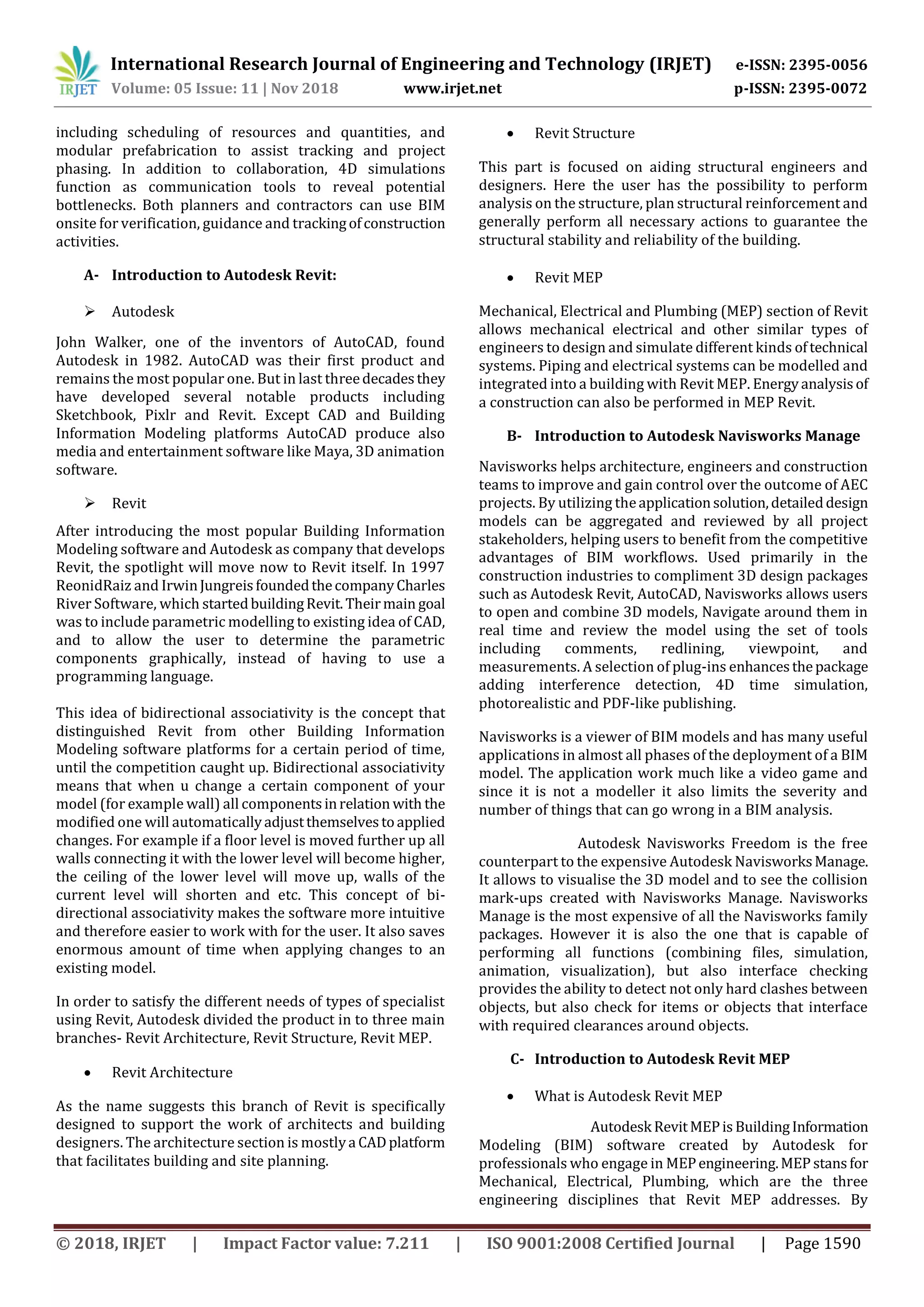
Fig. 1 Architectural Building Information Model
For construction of Architectural Building Information
Model detailed AutoCAD drawing are referred with the help
of Revit Architecture 2014 software and another details are
completed.
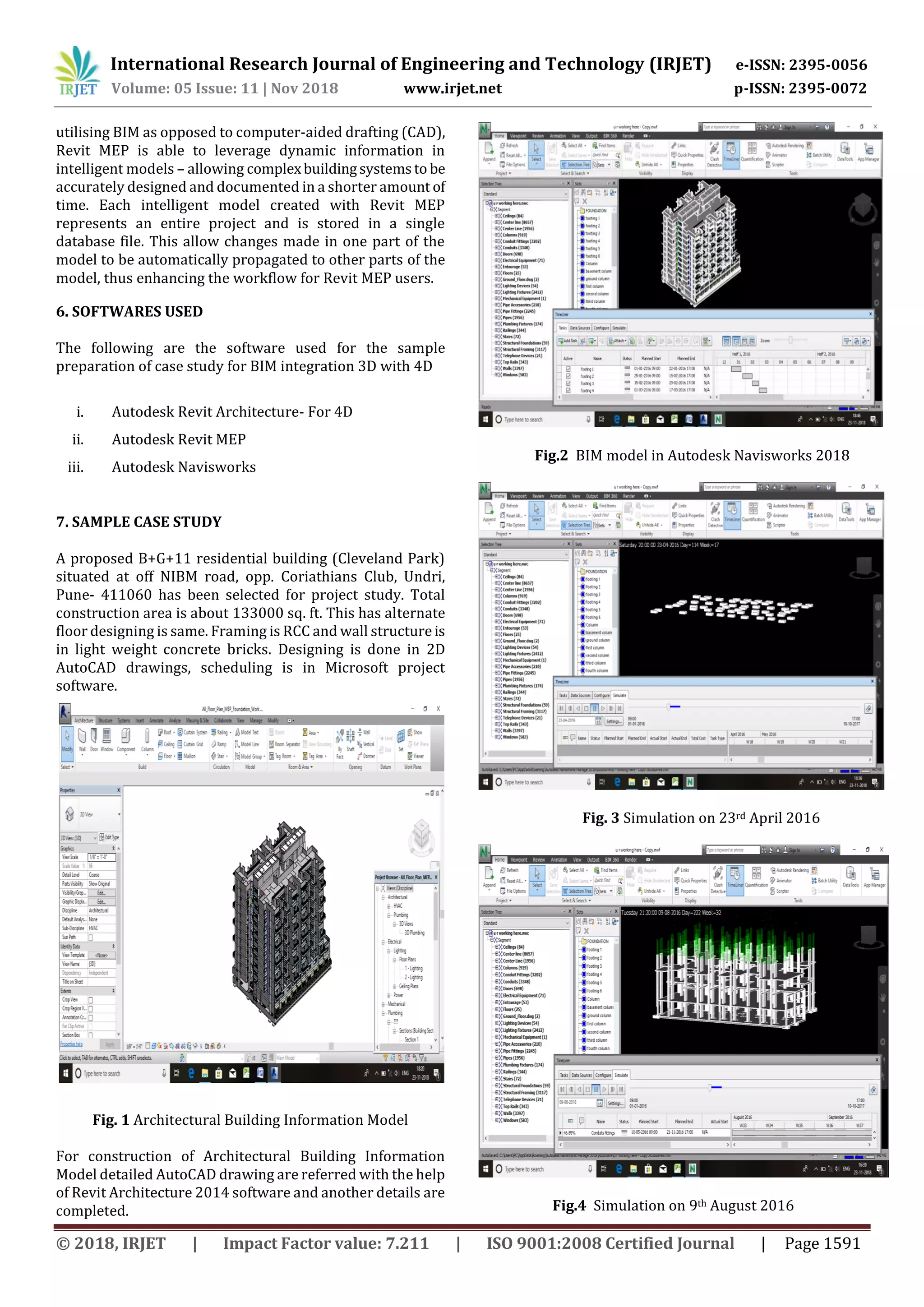
Fig.2 BIM model in Autodesk Navisworks 2018
Fig. 3 Simulation on 23rd April 2016
Fig.4 Simulation on 9th August 2016
International Research Journal of Engineering and Technology (IRJET) e-ISSN: 2395-0056
Volume: 05 Issue: 11 | Nov 2018 www.irjet.net p-ISSN: 2395-0072
© 2018, IRJET | Impact Factor value: 7.211 | ISO 9001:2008 Certified Journal | Page 1592
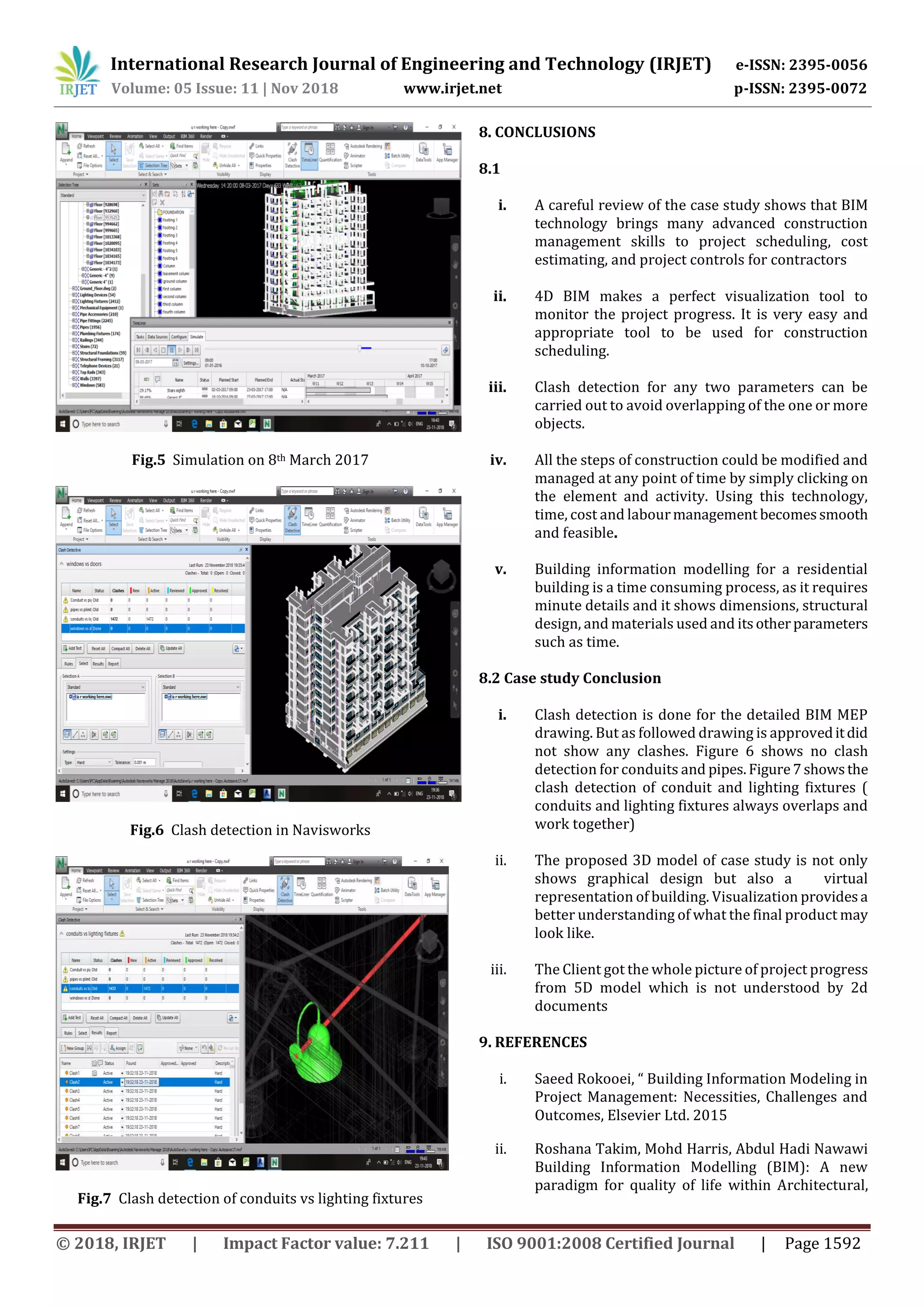
Fig.5 Simulation on 8th March 2017
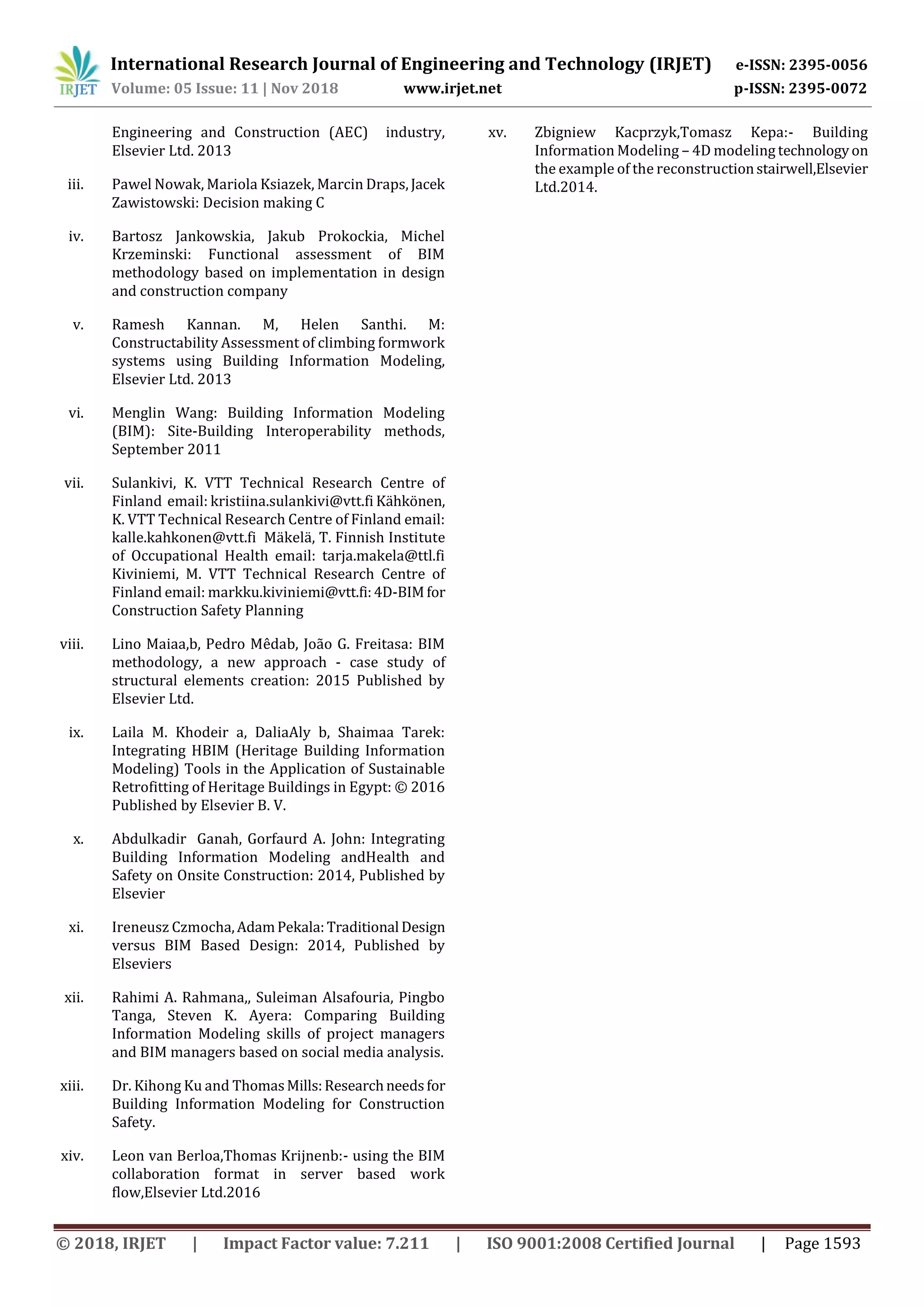
Fig.6 Clash detection in Navisworks
Fig.7 Clash detection of conduits vs lighting fixtures
8. CONCLUSIONS
8.1
i. A careful review of the case study shows that BIM
technology brings many advanced construction
management skills to project scheduling, cost
estimating, and project controls for contractors
ii. 4D BIM makes a perfect visualization tool to
monitor the project progress. It is very easy and
appropriate tool to be used for construction
scheduling.
iii. Clash detection for any two parameters can be
carried out to avoid overlapping of the one or more
objects.
iv. All the steps of construction could be modified and
managed at any point of time by simply clicking on
the element and activity. Using this technology,
time, cost and labourmanagement becomessmooth
and feasible.
v. Building information modelling for a residential
building is a time consuming process, as it requires
minute details and it shows dimensions, structural
design, and materials used and itsotherparameters
such as time.
8.2 Case study Conclusion
i. Clash detection is done for the detailed BIM MEP
drawing. But as followed drawing is approveditdid
not show any clashes. Figure 6 shows no clash
detection for conduits and pipes. Figure7showsthe
clash detection of conduit and lighting fixtures (
conduits and lighting fixtures always overlaps and
work together)
ii. The proposed 3D model of case study is not only
shows graphical design but also a virtual
representation of building. Visualization providesa
better understanding of what the final product may
look like.
iii. The Client got the whole picture of project progress
from 5D model which is not understood by 2d
documents
9. REFERENCES
i. Saeed Rokooei, “ Building Information Modeling in
Project Management: Necessities, Challenges and
Outcomes, Elsevier Ltd. 2015
ii. Roshana Takim, Mohd Harris, Abdul Hadi Nawawi
Building Information Modelling (BIM): A new
paradigm for quality of life within Architectural,
International Research Journal of Engineering and Technology (IRJET) e-ISSN: 2395-0056
Volume: 05 Issue: 11 | Nov 2018 www.irjet.net p-ISSN: 2395-0072
© 2018, IRJET | Impact Factor value: 7.211 | ISO 9001:2008 Certified Journal | Page 1593
Engineering and Construction (AEC) industry,
Elsevier Ltd. 2013
iii. Pawel Nowak, Mariola Ksiazek, Marcin Draps,Jacek
Zawistowski: Decision making C
iv. Bartosz Jankowskia, Jakub Prokockia, Michel
Krzeminski: Functional assessment of BIM
methodology based on implementation in design
and construction company
v. Ramesh Kannan. M, Helen Santhi. M:
Constructability Assessment of climbing formwork
systems using Building Information Modeling,
Elsevier Ltd. 2013
vi. Menglin Wang: Building Information Modeling
(BIM): Site-Building Interoperability methods,
September 2011
vii. Sulankivi, K. VTT Technical Research Centre of
Finland email: kristiina.sulankivi@vtt.fi Kähkönen,
K. VTT Technical Research Centre of Finland email:
kalle.kahkonen@vtt.fi Mäkelä, T. Finnish Institute
of Occupational Health email: tarja.makela@ttl.fi
Kiviniemi, M. VTT Technical Research Centre of
Finland email: markku.kiviniemi@vtt.fi:4D-BIMfor
Construction Safety Planning
viii. Lino Maiaa,b, Pedro Mêdab, João G. Freitasa: BIM
methodology, a new approach - case study of
structural elements creation: 2015 Published by
Elsevier Ltd.
ix. Laila M. Khodeir a, DaliaAly b, Shaimaa Tarek:
Integrating HBIM (Heritage Building Information
Modeling) Tools in the Application of Sustainable
Retrofitting of Heritage Buildings in Egypt: © 2016
Published by Elsevier B. V.
x. Abdulkadir Ganah, Gorfaurd A. John: Integrating
Building Information Modeling andHealth and
Safety on Onsite Construction: 2014, Published by
Elsevier
xi. Ireneusz Czmocha,AdamPekala:Traditional Design
versus BIM Based Design: 2014, Published by
Elseviers
xii. Rahimi A. Rahmana,, Suleiman Alsafouria, Pingbo
Tanga, Steven K. Ayera: Comparing Building
Information Modeling skills of project managers
and BIM managers based on social media analysis.
xiii. Dr. Kihong Ku and ThomasMills:Researchneedsfor
Building Information Modeling for Construction
Safety.
xiv. Leon van Berloa,Thomas Krijnenb:- using the BIM
collaboration format in server based work
flow,Elsevier Ltd.2016
xv. Zbigniew Kacprzyk,Tomasz Kepa:- Building
Information Modeling – 4D modeling technologyon
the example of the reconstructionstairwell,Elsevier
Ltd.2014.

IRJET- 4D Simulation of MEP using Bim for Residential Building Project

  • 1.
    International Research Journalof Engineering and Technology (IRJET) e-ISSN: 2395-0056 Volume: 05 Issue: 11 | Nov 2018 www.irjet.net p-ISSN: 2395-0072 © 2018, IRJET | Impact Factor value: 7.211 | ISO 9001:2008 Certified Journal | Page 1588 4D Simulation of MEP using BIM for Residential Building Project Amruta Salunkhe Patil, Pro. R.D. Shinde, Pro. A.K. Kanase3 1Post graduate student, Department of Civil Engineering, RMD Sinhgad School of Engineering, Warje, Pune, Maharashtra, India 2Head of the Department of Civil Engineering, RMD Sinhgad School of Engineering, Warje, Pune, maharashtra, India 3Professor, Department of Civil Engineering, Sinhgad Institute of Technology & Science, Narhe, Pune, Maharashtra, India ---------------------------------------------------------------------***---------------------------------------------------------------------- ABSTRACT - Project management is a major part of any project in the world. A better project management leads any project to its optimum output. For better projectmanagement we should know different techniques used for project completion and must have thorough knowledge of all aspects of resource management. Different methods were used for project management, for example, use of Bar Chart, Milestone Chart, Gantt Chart etc. and project planning was done accordingly. In the meantime, the whole work was divided in different segments like Plan, Design, Bid and Build, whichrequiredthroughspecificationsof concerned work. To achieve the same use of 2D drawings, contract documents, specifications, codes and manuals were prepared. BIM reflects the development and use of computer generated n-dimensional models. It helps to simulate the planning, design, construction and operation of a facility. It helps architects, engineers and constructorstoforecastwhatistobe built in simulated environment and to identify potential design, construction or operational problems. This report focuses on 4D simulation of MEP using BIM on a residential building Key Words: BIM, MEP, Scheduling, Navisworks, Simulation. 1. INTRODUCTION Project management is a vital part of any project in the world. A better project management leads any project to its optimum output. For better project management it is necessary to know different techniques used for project completion and musthavethoroughknowledgeofall aspects of resource management. Different methods were used for project management, for example, use of Bar Chart, Milestone Chart, Gantt Chart etc. and project planning was doneaccordingly.Inthemeantime, the whole work was divided in different segments like Plan, Design, Bid and Build, which requiredthroughspecifications of concerned work. To achieve the same use of 2D drawings, contract documents, specifications, codesandmanualswere prepared. 1.1 Aim of the Project & Paper The purpose of this project is to simulate project scheduling with its 3D model to obtain 4D model and working Building Information Modeling, MEP designing, Time scheduling and 4D simulation in a residential building project. 1.2 Objective of the Project & Paper The objective of this project & paper is i. To study conventional method of preparing 2D/3D drawing and project scheduling. ii. To study BIM (Building Information Modelling) for preparing 3D model in Revit Autodesk iii. To study MEP for detailed drawing of Mechanical, Electrical & Plumbing. iv. To study the Autodesk Nevisworks for the simulation of prepared 3D model with MEP detailing and its scheduling. v. To study the benefits of BIM applications forproject scheduling and additional requirementsifany,to be put in to the model to get more benefits in terms of project scheduling. vi. To compare the conventional methods and BIM applications for project scheduling. vii. To study the barriers ofaneffectiveimplementation of BIM application for project scheduling. 2. LITURATURE REVIEW Following is the list of researchers who have worked in the same area Saeed Rokooei (2015) in his paper proposed differentviews of BIM including time, cost, wastage reduction and time reduction of a project. It also shows the similarities between BIM and project manager. Roshana Takim, Mohd Harris, Abdul Hadi Nawawi (2013)in their paper they clears the use of computergeneratedmodel in simulation and also use of BIM in construction industry can make the industry more efficient.
  • 2.
    International Research Journalof Engineering and Technology (IRJET) e-ISSN: 2395-0056 Volume: 05 Issue: 11 | Nov 2018 www.irjet.net p-ISSN: 2395-0072 © 2018, IRJET | Impact Factor value: 7.211 | ISO 9001:2008 Certified Journal | Page 1589 Pawel Nowak, Mariola Ksiazek, Marcin Draps, Jacek Zawistowski (2016) they have introduced a paper on decision making with use of Building Information Modeling. In which they state that BIM allows for fast and easy access to different and almost all characteristicsofcomponentsand energy analysis. Ireneusz Czmocha, Adam Pekala (2014) This paper is based on the traditional design versus BIM. In which history and development of traditional work and idea and practical benefits of BIM are defined. Paper also states difficulties during implementation of BIM and its benefits also. Zbigniew Kacprzyka, Tomasz Kepa (2014) introduces 4D Modeling Technology which shows the project made by using 4D BIM. 4D is 3D modelinginadditionwithscheduling. 4D schedule ispreparedinAutodesk Navisworks.Scheduling starts by importing data from Revit model. Dr. Kihong Ku and Thomas Mills haveintroducedtheirpaper on research on BIM for construction safety. There is lack of resources. 3. PROBLEM STATEMENT i. Lack of communication, rework, time and cost overrun are the major problems faced by construction firms. Timely andaccuratefeedback of actual project enables project managers to take appropriate correct actions that would minimize time overrun in timely manner & is possible by using BIM. ii. As project progresses, the process of construction monitoring & control get more complex due to the huge amount of information that need to be measured and analyzed. 4. METHODOLOGY The objectives of the research will be achieved by implementing the following steps: i. Studying Building Information Modeling and its framework. ii. Comparing Building Information Modeling and traditional methods used in construction work iii. Studying Autodesk Revit and preparing 3D model for building iv. Applying MEP to the 3D modeling of the proposed building. v. Studying Autodesk Navisworks manage and simulation. vi. Detection of clashes There is no universal definition of BIM and definitions continue to evolve. However BIM is not software .It I much more than 3D-modelling .It is a business process ,and there fore you cannot go out and “buy BIM”. BIM is a digital representation of the physical and functional characteristics of a facility in order to work out problems, and simulate and analyze the potential impacts. BIM is both technology and a new way of working, i.e. tools which improve delivery of outputs, and implementation of a collaborative culture. BIM is about information, communication and delivery, with greater emphasis on “information”. BIM is a shared knowledge resource, forming are liable basis for decisions during a facility’s Life cycle. Fig. 5.1 BIM in multi dimensional function 3D–parametric design models and spaceprogrammingtools ,i.e. use of spatial dimensions of width, length and depth to represent an object ,which enables 3D visualizations and walkthroughs, clash detection and coordination ,and item scheduling. 4D–this is3D plus “time”. The ability to link theindividual 3D part so reassemblies with the project delivery timeline, 5. BIM MODELLING Building Information Modeling (BIM) is a process that involves creating, generating, managing and using a digital cum graphical representation of physical and functional characteristics of the project eg.Quantitative andqualitative database. 5.1 BIM Modeling from 3D (Modeling) to 4D (Project scheduling) The use of the term 4D is intended to refer to the fourth dimension; time i.e. 4D is 3D+Schedule. Theory of BIM
  • 3.
    International Research Journalof Engineering and Technology (IRJET) e-ISSN: 2395-0056 Volume: 05 Issue: 11 | Nov 2018 www.irjet.net p-ISSN: 2395-0072 © 2018, IRJET | Impact Factor value: 7.211 | ISO 9001:2008 Certified Journal | Page 1590 including scheduling of resources and quantities, and modular prefabrication to assist tracking and project phasing. In addition to collaboration, 4D simulations function as communication tools to reveal potential bottlenecks. Both planners and contractors can use BIM onsite for verification, guidance and trackingofconstruction activities. A- Introduction to Autodesk Revit:  Autodesk John Walker, one of the inventors of AutoCAD, found Autodesk in 1982. AutoCAD was their first product and remains the most popular one. But in last threedecadesthey have developed several notable products including Sketchbook, Pixlr and Revit. Except CAD and Building Information Modeling platforms AutoCAD produce also media and entertainment software like Maya, 3D animation software.  Revit After introducing the most popular Building Information Modeling software and Autodesk as company that develops Revit, the spotlight will move now to Revit itself. In 1997 ReonidRaiz and IrwinJungreisfoundedthecompanyCharles River Software, which startedbuildingRevit.Theirmain goal was to include parametric modelling to existing idea of CAD, and to allow the user to determine the parametric components graphically, instead of having to use a programming language. This idea of bidirectional associativity is the concept that distinguished Revit from other Building Information Modeling software platforms for a certain period of time, until the competition caught up. Bidirectional associativity means that when u change a certain component of your model (for example wall) all componentsinrelation with the modified one will automaticallyadjustthemselvestoapplied changes. For example if a floor level is moved further up all walls connecting it with the lower level will become higher, the ceiling of the lower level will move up, walls of the current level will shorten and etc. This concept of bi- directional associativity makes the software more intuitive and therefore easier to work with for the user. It also saves enormous amount of time when applying changes to an existing model. In order to satisfy the different needs of types of specialist using Revit, Autodesk divided the product in to three main branches- Revit Architecture, Revit Structure, Revit MEP.  Revit Architecture As the name suggests this branch of Revit is specifically designed to support the work of architects and building designers. The architecture section is mostlya CADplatform that facilitates building and site planning.  Revit Structure This part is focused on aiding structural engineers and designers. Here the user has the possibility to perform analysis on the structure, plan structural reinforcement and generally perform all necessary actions to guarantee the structural stability and reliability of the building.  Revit MEP Mechanical, Electrical and Plumbing (MEP) section of Revit allows mechanical electrical and other similar types of engineers to design and simulate different kinds oftechnical systems. Piping and electrical systems can be modelled and integrated into a building with Revit MEP. Energyanalysisof a construction can also be performed in MEP Revit. B- Introduction to Autodesk Navisworks Manage Navisworks helps architecture, engineers and construction teams to improve and gain control over the outcome of AEC projects. By utilizing theapplicationsolution,detaileddesign models can be aggregated and reviewed by all project stakeholders, helping users to benefit from the competitive advantages of BIM workflows. Used primarily in the construction industries to compliment 3D design packages such as Autodesk Revit, AutoCAD, Navisworks allows users to open and combine 3D models, Navigate around them in real time and review the model using the set of tools including comments, redlining, viewpoint, and measurements. A selection of plug-ins enhancesthepackage adding interference detection, 4D time simulation, photorealistic and PDF-like publishing. Navisworks is a viewer of BIM models and has many useful applications in almost all phases of the deployment of a BIM model. The application work much like a video game and since it is not a modeller it also limits the severity and number of things that can go wrong in a BIM analysis. Autodesk Navisworks Freedom is the free counterpart to the expensive Autodesk NavisworksManage. It allows to visualise the 3D model and to see the collision mark-ups created with Navisworks Manage. Navisworks Manage is the most expensive of all the Navisworks family packages. However it is also the one that is capable of performing all functions (combining files, simulation, animation, visualization), but also interface checking provides the ability to detect not only hard clashes between objects, but also check for items or objects that interface with required clearances around objects. C- Introduction to Autodesk Revit MEP  What is Autodesk Revit MEP Autodesk RevitMEPis BuildingInformation Modeling (BIM) software created by Autodesk for professionals who engage in MEPengineering.MEP stansfor Mechanical, Electrical, Plumbing, which are the three engineering disciplines that Revit MEP addresses. By
  • 4.
    International Research Journalof Engineering and Technology (IRJET) e-ISSN: 2395-0056 Volume: 05 Issue: 11 | Nov 2018 www.irjet.net p-ISSN: 2395-0072 © 2018, IRJET | Impact Factor value: 7.211 | ISO 9001:2008 Certified Journal | Page 1591 utilising BIM as opposed to computer-aided drafting (CAD), Revit MEP is able to leverage dynamic information in intelligent models – allowing complexbuildingsystemsto be accurately designed and documented in a shorter amount of time. Each intelligent model created with Revit MEP represents an entire project and is stored in a single database file. This allow changes made in one part of the model to be automatically propagated to other parts of the model, thus enhancing the workflow for Revit MEP users. 6. SOFTWARES USED The following are the software used for the sample preparation of case study for BIM integration 3D with 4D i. Autodesk Revit Architecture- For 4D ii. Autodesk Revit MEP iii. Autodesk Navisworks 7. SAMPLE CASE STUDY A proposed B+G+11 residential building (Cleveland Park) situated at off NIBM road, opp. Coriathians Club, Undri, Pune- 411060 has been selected for project study. Total construction area is about 133000 sq. ft. This has alternate floor designing is same. Framing is RCC and wall structureis in light weight concrete bricks. Designing is done in 2D AutoCAD drawings, scheduling is in Microsoft project software. Fig. 1 Architectural Building Information Model For construction of Architectural Building Information Model detailed AutoCAD drawing are referred with the help of Revit Architecture 2014 software and another details are completed. Fig.2 BIM model in Autodesk Navisworks 2018 Fig. 3 Simulation on 23rd April 2016 Fig.4 Simulation on 9th August 2016
  • 5.
    International Research Journalof Engineering and Technology (IRJET) e-ISSN: 2395-0056 Volume: 05 Issue: 11 | Nov 2018 www.irjet.net p-ISSN: 2395-0072 © 2018, IRJET | Impact Factor value: 7.211 | ISO 9001:2008 Certified Journal | Page 1592 Fig.5 Simulation on 8th March 2017 Fig.6 Clash detection in Navisworks Fig.7 Clash detection of conduits vs lighting fixtures 8. CONCLUSIONS 8.1 i. A careful review of the case study shows that BIM technology brings many advanced construction management skills to project scheduling, cost estimating, and project controls for contractors ii. 4D BIM makes a perfect visualization tool to monitor the project progress. It is very easy and appropriate tool to be used for construction scheduling. iii. Clash detection for any two parameters can be carried out to avoid overlapping of the one or more objects. iv. All the steps of construction could be modified and managed at any point of time by simply clicking on the element and activity. Using this technology, time, cost and labourmanagement becomessmooth and feasible. v. Building information modelling for a residential building is a time consuming process, as it requires minute details and it shows dimensions, structural design, and materials used and itsotherparameters such as time. 8.2 Case study Conclusion i. Clash detection is done for the detailed BIM MEP drawing. But as followed drawing is approveditdid not show any clashes. Figure 6 shows no clash detection for conduits and pipes. Figure7showsthe clash detection of conduit and lighting fixtures ( conduits and lighting fixtures always overlaps and work together) ii. The proposed 3D model of case study is not only shows graphical design but also a virtual representation of building. Visualization providesa better understanding of what the final product may look like. iii. The Client got the whole picture of project progress from 5D model which is not understood by 2d documents 9. REFERENCES i. Saeed Rokooei, “ Building Information Modeling in Project Management: Necessities, Challenges and Outcomes, Elsevier Ltd. 2015 ii. Roshana Takim, Mohd Harris, Abdul Hadi Nawawi Building Information Modelling (BIM): A new paradigm for quality of life within Architectural,
  • 6.
    International Research Journalof Engineering and Technology (IRJET) e-ISSN: 2395-0056 Volume: 05 Issue: 11 | Nov 2018 www.irjet.net p-ISSN: 2395-0072 © 2018, IRJET | Impact Factor value: 7.211 | ISO 9001:2008 Certified Journal | Page 1593 Engineering and Construction (AEC) industry, Elsevier Ltd. 2013 iii. Pawel Nowak, Mariola Ksiazek, Marcin Draps,Jacek Zawistowski: Decision making C iv. Bartosz Jankowskia, Jakub Prokockia, Michel Krzeminski: Functional assessment of BIM methodology based on implementation in design and construction company v. Ramesh Kannan. M, Helen Santhi. M: Constructability Assessment of climbing formwork systems using Building Information Modeling, Elsevier Ltd. 2013 vi. Menglin Wang: Building Information Modeling (BIM): Site-Building Interoperability methods, September 2011 vii. Sulankivi, K. VTT Technical Research Centre of Finland email: kristiina.sulankivi@vtt.fi Kähkönen, K. VTT Technical Research Centre of Finland email: kalle.kahkonen@vtt.fi Mäkelä, T. Finnish Institute of Occupational Health email: tarja.makela@ttl.fi Kiviniemi, M. VTT Technical Research Centre of Finland email: markku.kiviniemi@vtt.fi:4D-BIMfor Construction Safety Planning viii. Lino Maiaa,b, Pedro Mêdab, João G. Freitasa: BIM methodology, a new approach - case study of structural elements creation: 2015 Published by Elsevier Ltd. ix. Laila M. Khodeir a, DaliaAly b, Shaimaa Tarek: Integrating HBIM (Heritage Building Information Modeling) Tools in the Application of Sustainable Retrofitting of Heritage Buildings in Egypt: © 2016 Published by Elsevier B. V. x. Abdulkadir Ganah, Gorfaurd A. John: Integrating Building Information Modeling andHealth and Safety on Onsite Construction: 2014, Published by Elsevier xi. Ireneusz Czmocha,AdamPekala:Traditional Design versus BIM Based Design: 2014, Published by Elseviers xii. Rahimi A. Rahmana,, Suleiman Alsafouria, Pingbo Tanga, Steven K. Ayera: Comparing Building Information Modeling skills of project managers and BIM managers based on social media analysis. xiii. Dr. Kihong Ku and ThomasMills:Researchneedsfor Building Information Modeling for Construction Safety. xiv. Leon van Berloa,Thomas Krijnenb:- using the BIM collaboration format in server based work flow,Elsevier Ltd.2016 xv. Zbigniew Kacprzyk,Tomasz Kepa:- Building Information Modeling – 4D modeling technologyon the example of the reconstructionstairwell,Elsevier Ltd.2014.