

Market Segmentation
Dr. Gopal Thapa
Tribhuvan University
Fundamentals of New Marketing
Concept
Target market focus,
 Customer orientation,
 Integrated marketing and
 Profitability/ objective achievement
3/9/2022 Copy right reserved 2
Market Segmentation
 Market segmentation is the subdividing of a
market into homogeneous subsets of customers,
where any subset may conceivable be selected as a
market target to be reached with a distinct
marketing mix. - Kotler
 Market segmentation is the process of taking the
total heterogeneous market for a product and
dividing it into several sub-markets or segments,
each of which tends to be homogeneous in all
significant aspects. - Stanton
3/9/2022 Copy right reserved 3
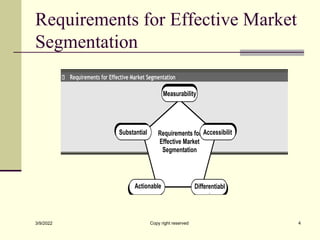
Requirements for Effective Market
Segmentation
Requirements for Effective Market Segmentation
Requirements for
Effective Market
Segmentation
Accessibilit
y
Differentiabl
e
Actionable
Substantial
Measurability
3/9/2022 Copy right reserved 4
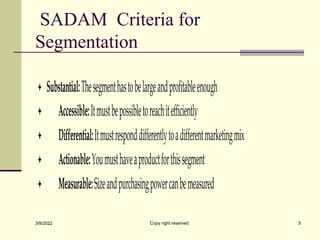
SADAM Criteria for
Segmentation
 Substantial:Thesegmenthastobelargeandprofitableenough
 A Accessible:Itmustbepossibletoreachitefficiently
 D Differential:Itmustresponddifferentlytoadifferentmarketingmix
 A Actionable:Youmusthaveaproductforthissegment
 M Measurable:Sizeandpurchasingpowercanbemeasured
3/9/2022 Copy right reserved 5
Market Segmentation Process
 Market survey
 Segment identification
 Segment profiling
 Segment selection
 Product positioning
3/9/2022 Copy right reserved 6
Bases for Consumer Markets
 Geographic variables
 Demographic variables
 Psychographic variables
 Behavioral variables
3/9/2022 Copy right reserved 7
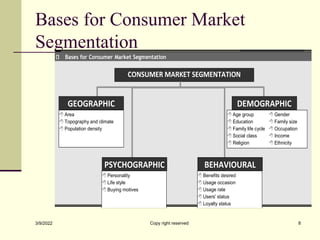
Bases for Consumer Market
Segmentation
Bases for Consumer Market Segmentation
CONSUMER MARKET SEGMENTATION
DEMOGRAPHIC
GEOGRAPHIC
BEHAVIOURAL
PSYCHOGRAPHIC
 Area
 Topography and climate
 Population density
 Age group  Gender
 Education  Family size
 Family life cycle  Occupation
 Social class  Income
 Religion  Ethnicity
 Personality
 Life style
 Buying motives
 Benefits desired
 Usage occasion
 Usage rate
 Users' status
 Loyalty status
3/9/2022 Copy right reserved 8
Geographic Variables
 Area
 Development region, zone, district
 Topography/climate
 Mountain, hills, terai
 Temperate, alpine, tropical
 Population density
 Urban, sub-urban, rural market
3/9/2022 Copy right reserved 9
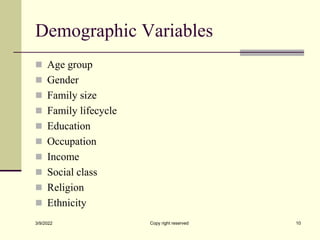
Demographic Variables
 Age group
 Gender
 Family size
 Family lifecycle
 Education
 Occupation
 Income
 Social class
 Religion
 Ethnicity
3/9/2022 Copy right reserved 10
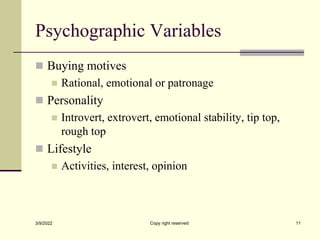
Psychographic Variables
 Buying motives
 Rational, emotional or patronage
 Personality
 Introvert, extrovert, emotional stability, tip top,
rough top
 Lifestyle
 Activities, interest, opinion
3/9/2022 Copy right reserved 11
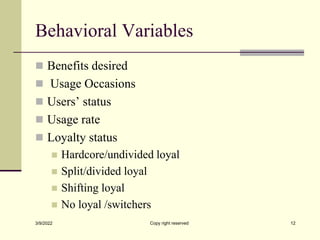
Behavioral Variables
 Benefits desired
 Usage Occasions
 Users’ status
 Usage rate
 Loyalty status
 Hardcore/undivided loyal
 Split/divided loyal
 Shifting loyal
 No loyal /switchers
3/9/2022 Copy right reserved 12
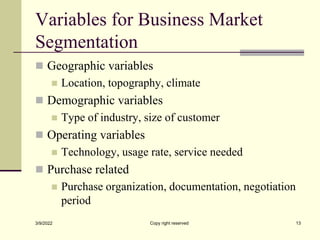
Variables for Business Market
Segmentation
 Geographic variables
 Location, topography, climate
 Demographic variables
 Type of industry, size of customer
 Operating variables
 Technology, usage rate, service needed
 Purchase related
 Purchase organization, documentation, negotiation
period
3/9/2022 Copy right reserved 13
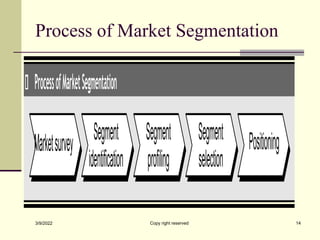
Process of Market Segmentation
ProcessofMarketSegmentation
Marketsurvey Segment
identification
Segment
profiling
Segment
selection
Positioning
3/9/2022 Copy right reserved 14
Market Segmentation Process
 Market survey
 Segment identification
 Segment profiling
 Segment selection
 Product positioning
3/9/2022 Copy right reserved 15
Evaluation of Market Segments
 Segment attractiveness
 Size and growth, profitability ,competition
,technology, customer loyalty, risks
 Organizational objectives and resources
 Government rules and regulations
3/9/2022 Copy right reserved 16
Segment Attractiveness (Michael Porter’s Five
Factor Model)
 Threat of intense segment rivalry
 Threat of new entrants
 Threat of substitute products
 Threat of buyers’ growing bargaining power
 Threat of suppliers’ growing bargaining power
3/9/2022 Copy right reserved 17
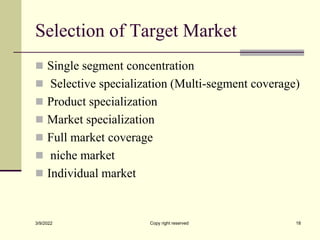
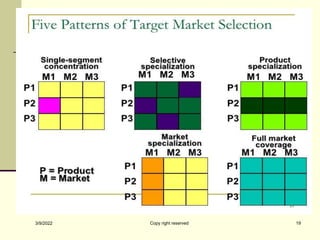
Selection of Target Market
 Single segment concentration
 Selective specialization (Multi-segment coverage)
 Product specialization
 Market specialization
 Full market coverage
 niche market
 Individual market
3/9/2022 Copy right reserved 18
3/9/2022 Copy right reserved 19
Positioning
 Act of designing the company’s offer and image
so that it occupies a distinct and value place in the
target customer’s mind
3/9/2022 Copy right reserved 20
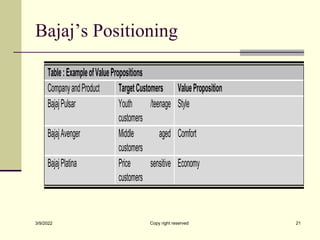
Bajaj’s Positioning
Table:ExampleofValuePropositions
CompanyandProduct TargetCustomers ValueProposition
BajajPulsar Youth /teenage
customers
Style
BajajAvenger Middle aged
customers
Comfort
BajajPlatina Price sensitive
customers
Economy
3/9/2022 Copy right reserved 21
Positioning Process
 choosing a frame of reference by identifying the
target market and relevant competition
 identifying the optimal points-of-parity and
points-of- difference brand associations given
that frame of reference, including emotional
branding, and
 creating a brand mantra summarizing the brand’s
positioning and essence.
3/9/2022 Copy right reserved 22
Choosing a Competitive Frame of
Reference
 The competitive frame of reference defines which
other brands a brand competes with and which
should thus be the focus of competitive analysis.
 A good starting point in defining a competitive
frame of reference for brand positioning is
category membership, the products or sets of
products with which a brand competes and that
function as close substitutes.
3/9/2022 Copy right reserved 23
Choosing a Competitive Frame of
Reference
 It would seem a simple task for a company to
identify its competitors.
 Pepsi knows Coca-Cola is a major competitor for
its non-alcoholic carbonated beverage ;
 NABIL bank knows Standard Chartered Bank
is a major competitor.
3/9/2022 Copy right reserved 24
Kotler’s view while monitoring
Competitors
 Share of market: The competitor’s share of
the target market.
 Share of mind: The percentage of customers who
named the competitor in responding to the
statement “Name the first company that comes to
mind in this industry.”
 Share of heart: The percentage of customers who
named the competitor in responding to the
statement “Name the company from which you
would prefer to buy the product.”
3/9/2022 Copy right reserved 25
Identifying PODs and POPs
Point of Parity
Point of Difference
3/9/2022 Copy right reserved 26
PODs
 Points-of-difference (PODs) are attributes or
benefits that consumers strongly associate with a
brand, positively evaluate, and believe they could
not find to the same extent with a competitive
brand.
 Strong brands often have multiple points-of-
difference.
 Two examples are Nike (performance, innovative
technology, and winning) and Southwest Airlines
(value, reliability, and fun personality
3/9/2022 Copy right reserved 27
PODs
 In the view of Keller, three criteria determine
whether a brand association can truly function as a
point-of-difference: desirability, deliverability,
and differentiability.
3/9/2022 Copy right reserved 28
PODs
 Desirable to consumer. Consumers must see the brand
association as personally relevant to them.
 Deliverable by the company. The company must have the
resources and commitment to feasibly and profitably create
and maintain the brand association in the minds of
consumers. The ideal brand association is preemptive,
defensible, and difficult to attack.
 Differentiating from competitors. Consumers must see
the brand association as distinctive and superior to relevant
competitors
3/9/2022 Copy right reserved 29
POPs
 Points-of-parity (POPs) are attribute or benefit
associations that are not necessarily unique to the
brand but may in fact be shared with other brands.
 These types of associations come in three basic
forms: category, correlational, and competitive.
3/9/2022 Copy right reserved 30
Category points-of-parity
 Category points-of-parity are attributes or
benefits that consumers view as essential to a
legitimate and credible offering within a certain
category, although not necessarily sufficient
conditions for brand choice.
 Category points-of-parity may change over time
due to technological advances, legal
developments, or consumer trends.
3/9/2022 Copy right reserved 31
Correlational points-of-parity
 Correlational points-of-parity are potentially
negative associations that arise from the existence
of positive associations for the brand.
 One challenge for marketers is that many
attributes or benefits that make up their POPs or
PODs are inversely related.
 In other words, if your brand is good at one thing,
such as being inexpensive, consumers can’t see it
as also good at something else, like being “of the
highest quality.”
3/9/2022 Copy right reserved 32
Competitive points-of-parity
 Competitive points-of-parity are associations designed to
overcome perceived weaknesses of the brand considering
competitors’ points-of-difference.
 One good way to uncover key competitive points-of-parity
is to role-play competitors’ positioning and infer their
intended points-of- difference.
 Competitor’s PODs will, in turn, suggest the brand’s
POPs.
 For an offering to achieve a point-of-parity on a particular
attribute or benefit, a sufficient number of consumers must
believe the brand is “good enough” on that dimension
3/9/2022 Copy right reserved 33
Choosing Specific POPs and
PODs
 Marketers typically focus on brand benefits in
choosing the points-of-parity and points- of-
difference that make up their brand positioning.
 Brand attributes generally play more of a
supporting role by providing “reasons to believe”
or “proof points” as to why a brand can credibly
claim it offers certain benefits.
 Multiple attributes may support a certain benefit,
and they may change over time.
3/9/2022 Copy right reserved 34
Emotional Branding
 Many marketing experts believe a brand positioning
should have both rational and emotional components.
 It should contain points-of-difference and points-of-parity
that appeal to both the head and the heart.
 A person’s emotional response to a brand and its
marketing will depend on many factors.
 An increasingly important one is the brand’s authenticity.
 Brands such as Wai wai, Mayos, Rara, Rumpum, and Jo jo
that are seen as authentic and genuine can evoke trust,
affection, and strong loyalty.
3/9/2022 Copy right reserved 35
Emotional Branding
 Authenticity also has functional value.
 Lifebouy is seen by consumers as “wholesome,
authentic, and real.”
 The brand reinforces those credentials by focusing
on its ingredients, increasingly important for
consumers who want healthy life.
3/9/2022 Copy right reserved 36
Brand Mantra
 To further focus brand positioning and guide the way their
marketers help consumers think about the brand, firms can
define a brand mantra.
 A brand mantra is a three- to five-word articulation of the
brand’s heart and soul, closely related to other branding
concepts like “brand essence” and “core brand promise.”
 Brand mantras must economically communicate what the
brand is and what it is not.
 What makes a good brand mantra?
 Dabur Glucose’s “Instant energy” captures its brand
essence and core brand promise.
3/9/2022 Copy right reserved 37
Brand Mantra
 A good brand mantra should communicate the category
and clarify what is unique about the brand.
 It should also be vivid and memorable and stake out
ground that is personally meaningful and relevant.
 For brands anticipating rapid growth, it is helpful to define
the product or benefit space in which the brand would like
to compete,
 as Nike did with “athletic performance” and Disney with
“family entertainment.” But for it to be effective, no other
brand should singularly excel on all dimensions.
3/9/2022
Copy right reserved
38
Types of Positioning
 Attribute positioning
 Benefit positioning
 Image positioning
 Usage occasion positioning
 User positioning
 Competitive positioning
 Product class positioning
3/9/2022 Copy right reserved 39
Positioning Error
 Over positioning
 Under positioning
 Confused positioning
3/9/2022 Copy right reserved 40
Positioning and Branding a Small
Business
 Find a compelling Product or service performance
advantage
 Focus on building one or two strong brands based
on one or two key associations
 Encourage product or service trail in any way
possible
 Develop cohesive digital strategy to make the
brand “bigger and better”
3/9/2022 Copy right reserved 41
Positioning and Branding a Small
Business
 Create buzz and a loyal brand community
 Employ a well-integrated set of brand elements
 Leverage as many secondary associations as
possible
 Creatively conduct low cost marketing research
3/9/2022 Copy right reserved 42
Product Differentiation
 Differentiation is the act of designing a set of
meaningful differences to distinguish the
company’s offering from competitor’s offerings.
 - Philip Kotler
 Product differentiation is a strategy which
attempts (through innovative design, packaging,
positioning etc.) to make a clear distinction
between products serving the same market
segments.
 Dictionary of Marketing
Product Differentiation Variables
 Physical parameter differentiation
 Service differentiation
 Personnel differentiation
 Channel differentiation
 Promotion differentiation
 Image differentiation
Physical Parameter Differentiation
 Form
 Features
 Quality
 Durability
 Reliability
 Design
Service Differentiation
 Ordering ease
 Delivery
 Installation
 Customer training
 Repairability
Personnel Differentiation
 Competence
 Courtesy
 Credibility
 Reliability
 Responsive
 Communicative
Channel Differentiation
 Design
 Coverage
 Expertise
 Performance
Promotion Differentiation
 Advertising
 Sales promotion
 Public relations
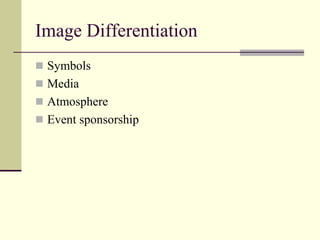
Image Differentiation
 Symbols
 Media
 Atmosphere
 Event sponsorship
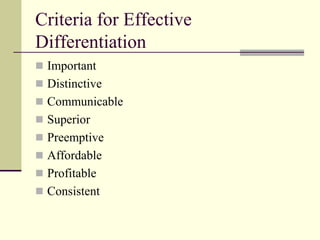
Criteria for Effective
Differentiation
 Important
 Distinctive
 Communicable
 Superior
 Preemptive
 Affordable
 Profitable
 Consistent
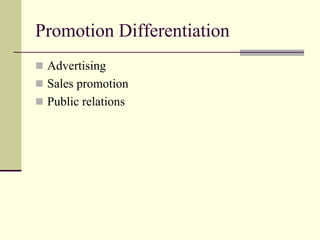
Promotion Differentiation
 Advertising
 Sales promotion
 Public relations
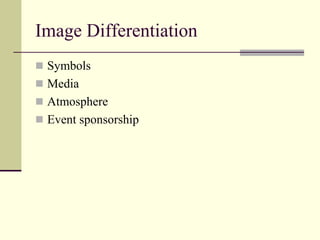
Image Differentiation
 Symbols
 Media
 Atmosphere
 Event sponsorship
Any Queries?
Thank You
3/9/2022 Copy right reserved 54

Segmenation targeting and positioning

  • 1.
    Market Segmentation Dr. GopalThapa Tribhuvan University
  • 2.
    Fundamentals of NewMarketing Concept Target market focus,  Customer orientation,  Integrated marketing and  Profitability/ objective achievement 3/9/2022 Copy right reserved 2
  • 3.
    Market Segmentation  Marketsegmentation is the subdividing of a market into homogeneous subsets of customers, where any subset may conceivable be selected as a market target to be reached with a distinct marketing mix. - Kotler  Market segmentation is the process of taking the total heterogeneous market for a product and dividing it into several sub-markets or segments, each of which tends to be homogeneous in all significant aspects. - Stanton 3/9/2022 Copy right reserved 3
  • 4.
    Requirements for EffectiveMarket Segmentation Requirements for Effective Market Segmentation Requirements for Effective Market Segmentation Accessibilit y Differentiabl e Actionable Substantial Measurability 3/9/2022 Copy right reserved 4
  • 5.
    SADAM Criteria for Segmentation Substantial:Thesegmenthastobelargeandprofitableenough  A Accessible:Itmustbepossibletoreachitefficiently  D Differential:Itmustresponddifferentlytoadifferentmarketingmix  A Actionable:Youmusthaveaproductforthissegment  M Measurable:Sizeandpurchasingpowercanbemeasured 3/9/2022 Copy right reserved 5
  • 6.
    Market Segmentation Process Market survey  Segment identification  Segment profiling  Segment selection  Product positioning 3/9/2022 Copy right reserved 6
  • 7.
    Bases for ConsumerMarkets  Geographic variables  Demographic variables  Psychographic variables  Behavioral variables 3/9/2022 Copy right reserved 7
  • 8.
    Bases for ConsumerMarket Segmentation Bases for Consumer Market Segmentation CONSUMER MARKET SEGMENTATION DEMOGRAPHIC GEOGRAPHIC BEHAVIOURAL PSYCHOGRAPHIC  Area  Topography and climate  Population density  Age group  Gender  Education  Family size  Family life cycle  Occupation  Social class  Income  Religion  Ethnicity  Personality  Life style  Buying motives  Benefits desired  Usage occasion  Usage rate  Users' status  Loyalty status 3/9/2022 Copy right reserved 8
  • 9.
    Geographic Variables  Area Development region, zone, district  Topography/climate  Mountain, hills, terai  Temperate, alpine, tropical  Population density  Urban, sub-urban, rural market 3/9/2022 Copy right reserved 9
  • 10.
    Demographic Variables  Agegroup  Gender  Family size  Family lifecycle  Education  Occupation  Income  Social class  Religion  Ethnicity 3/9/2022 Copy right reserved 10
  • 11.
    Psychographic Variables  Buyingmotives  Rational, emotional or patronage  Personality  Introvert, extrovert, emotional stability, tip top, rough top  Lifestyle  Activities, interest, opinion 3/9/2022 Copy right reserved 11
  • 12.
    Behavioral Variables  Benefitsdesired  Usage Occasions  Users’ status  Usage rate  Loyalty status  Hardcore/undivided loyal  Split/divided loyal  Shifting loyal  No loyal /switchers 3/9/2022 Copy right reserved 12
  • 13.
    Variables for BusinessMarket Segmentation  Geographic variables  Location, topography, climate  Demographic variables  Type of industry, size of customer  Operating variables  Technology, usage rate, service needed  Purchase related  Purchase organization, documentation, negotiation period 3/9/2022 Copy right reserved 13
  • 14.
    Process of MarketSegmentation ProcessofMarketSegmentation Marketsurvey Segment identification Segment profiling Segment selection Positioning 3/9/2022 Copy right reserved 14
  • 15.
    Market Segmentation Process Market survey  Segment identification  Segment profiling  Segment selection  Product positioning 3/9/2022 Copy right reserved 15
  • 16.
    Evaluation of MarketSegments  Segment attractiveness  Size and growth, profitability ,competition ,technology, customer loyalty, risks  Organizational objectives and resources  Government rules and regulations 3/9/2022 Copy right reserved 16
  • 17.
    Segment Attractiveness (MichaelPorter’s Five Factor Model)  Threat of intense segment rivalry  Threat of new entrants  Threat of substitute products  Threat of buyers’ growing bargaining power  Threat of suppliers’ growing bargaining power 3/9/2022 Copy right reserved 17
  • 18.
    Selection of TargetMarket  Single segment concentration  Selective specialization (Multi-segment coverage)  Product specialization  Market specialization  Full market coverage  niche market  Individual market 3/9/2022 Copy right reserved 18
  • 19.
  • 20.
    Positioning  Act ofdesigning the company’s offer and image so that it occupies a distinct and value place in the target customer’s mind 3/9/2022 Copy right reserved 20
  • 21.
    Bajaj’s Positioning Table:ExampleofValuePropositions CompanyandProduct TargetCustomersValueProposition BajajPulsar Youth /teenage customers Style BajajAvenger Middle aged customers Comfort BajajPlatina Price sensitive customers Economy 3/9/2022 Copy right reserved 21
  • 22.
    Positioning Process  choosinga frame of reference by identifying the target market and relevant competition  identifying the optimal points-of-parity and points-of- difference brand associations given that frame of reference, including emotional branding, and  creating a brand mantra summarizing the brand’s positioning and essence. 3/9/2022 Copy right reserved 22
  • 23.
    Choosing a CompetitiveFrame of Reference  The competitive frame of reference defines which other brands a brand competes with and which should thus be the focus of competitive analysis.  A good starting point in defining a competitive frame of reference for brand positioning is category membership, the products or sets of products with which a brand competes and that function as close substitutes. 3/9/2022 Copy right reserved 23
  • 24.
    Choosing a CompetitiveFrame of Reference  It would seem a simple task for a company to identify its competitors.  Pepsi knows Coca-Cola is a major competitor for its non-alcoholic carbonated beverage ;  NABIL bank knows Standard Chartered Bank is a major competitor. 3/9/2022 Copy right reserved 24
  • 25.
    Kotler’s view whilemonitoring Competitors  Share of market: The competitor’s share of the target market.  Share of mind: The percentage of customers who named the competitor in responding to the statement “Name the first company that comes to mind in this industry.”  Share of heart: The percentage of customers who named the competitor in responding to the statement “Name the company from which you would prefer to buy the product.” 3/9/2022 Copy right reserved 25
  • 26.
    Identifying PODs andPOPs Point of Parity Point of Difference 3/9/2022 Copy right reserved 26
  • 27.
    PODs  Points-of-difference (PODs)are attributes or benefits that consumers strongly associate with a brand, positively evaluate, and believe they could not find to the same extent with a competitive brand.  Strong brands often have multiple points-of- difference.  Two examples are Nike (performance, innovative technology, and winning) and Southwest Airlines (value, reliability, and fun personality 3/9/2022 Copy right reserved 27
  • 28.
    PODs  In theview of Keller, three criteria determine whether a brand association can truly function as a point-of-difference: desirability, deliverability, and differentiability. 3/9/2022 Copy right reserved 28
  • 29.
    PODs  Desirable toconsumer. Consumers must see the brand association as personally relevant to them.  Deliverable by the company. The company must have the resources and commitment to feasibly and profitably create and maintain the brand association in the minds of consumers. The ideal brand association is preemptive, defensible, and difficult to attack.  Differentiating from competitors. Consumers must see the brand association as distinctive and superior to relevant competitors 3/9/2022 Copy right reserved 29
  • 30.
    POPs  Points-of-parity (POPs)are attribute or benefit associations that are not necessarily unique to the brand but may in fact be shared with other brands.  These types of associations come in three basic forms: category, correlational, and competitive. 3/9/2022 Copy right reserved 30
  • 31.
    Category points-of-parity  Categorypoints-of-parity are attributes or benefits that consumers view as essential to a legitimate and credible offering within a certain category, although not necessarily sufficient conditions for brand choice.  Category points-of-parity may change over time due to technological advances, legal developments, or consumer trends. 3/9/2022 Copy right reserved 31
  • 32.
    Correlational points-of-parity  Correlationalpoints-of-parity are potentially negative associations that arise from the existence of positive associations for the brand.  One challenge for marketers is that many attributes or benefits that make up their POPs or PODs are inversely related.  In other words, if your brand is good at one thing, such as being inexpensive, consumers can’t see it as also good at something else, like being “of the highest quality.” 3/9/2022 Copy right reserved 32
  • 33.
    Competitive points-of-parity  Competitivepoints-of-parity are associations designed to overcome perceived weaknesses of the brand considering competitors’ points-of-difference.  One good way to uncover key competitive points-of-parity is to role-play competitors’ positioning and infer their intended points-of- difference.  Competitor’s PODs will, in turn, suggest the brand’s POPs.  For an offering to achieve a point-of-parity on a particular attribute or benefit, a sufficient number of consumers must believe the brand is “good enough” on that dimension 3/9/2022 Copy right reserved 33
  • 34.
    Choosing Specific POPsand PODs  Marketers typically focus on brand benefits in choosing the points-of-parity and points- of- difference that make up their brand positioning.  Brand attributes generally play more of a supporting role by providing “reasons to believe” or “proof points” as to why a brand can credibly claim it offers certain benefits.  Multiple attributes may support a certain benefit, and they may change over time. 3/9/2022 Copy right reserved 34
  • 35.
    Emotional Branding  Manymarketing experts believe a brand positioning should have both rational and emotional components.  It should contain points-of-difference and points-of-parity that appeal to both the head and the heart.  A person’s emotional response to a brand and its marketing will depend on many factors.  An increasingly important one is the brand’s authenticity.  Brands such as Wai wai, Mayos, Rara, Rumpum, and Jo jo that are seen as authentic and genuine can evoke trust, affection, and strong loyalty. 3/9/2022 Copy right reserved 35
  • 36.
    Emotional Branding  Authenticityalso has functional value.  Lifebouy is seen by consumers as “wholesome, authentic, and real.”  The brand reinforces those credentials by focusing on its ingredients, increasingly important for consumers who want healthy life. 3/9/2022 Copy right reserved 36
  • 37.
    Brand Mantra  Tofurther focus brand positioning and guide the way their marketers help consumers think about the brand, firms can define a brand mantra.  A brand mantra is a three- to five-word articulation of the brand’s heart and soul, closely related to other branding concepts like “brand essence” and “core brand promise.”  Brand mantras must economically communicate what the brand is and what it is not.  What makes a good brand mantra?  Dabur Glucose’s “Instant energy” captures its brand essence and core brand promise. 3/9/2022 Copy right reserved 37
  • 38.
    Brand Mantra  Agood brand mantra should communicate the category and clarify what is unique about the brand.  It should also be vivid and memorable and stake out ground that is personally meaningful and relevant.  For brands anticipating rapid growth, it is helpful to define the product or benefit space in which the brand would like to compete,  as Nike did with “athletic performance” and Disney with “family entertainment.” But for it to be effective, no other brand should singularly excel on all dimensions. 3/9/2022 Copy right reserved 38
  • 39.
    Types of Positioning Attribute positioning  Benefit positioning  Image positioning  Usage occasion positioning  User positioning  Competitive positioning  Product class positioning 3/9/2022 Copy right reserved 39
  • 40.
    Positioning Error  Overpositioning  Under positioning  Confused positioning 3/9/2022 Copy right reserved 40
  • 41.
    Positioning and Brandinga Small Business  Find a compelling Product or service performance advantage  Focus on building one or two strong brands based on one or two key associations  Encourage product or service trail in any way possible  Develop cohesive digital strategy to make the brand “bigger and better” 3/9/2022 Copy right reserved 41
  • 42.
    Positioning and Brandinga Small Business  Create buzz and a loyal brand community  Employ a well-integrated set of brand elements  Leverage as many secondary associations as possible  Creatively conduct low cost marketing research 3/9/2022 Copy right reserved 42
  • 43.
    Product Differentiation  Differentiationis the act of designing a set of meaningful differences to distinguish the company’s offering from competitor’s offerings.  - Philip Kotler  Product differentiation is a strategy which attempts (through innovative design, packaging, positioning etc.) to make a clear distinction between products serving the same market segments.  Dictionary of Marketing
  • 44.
    Product Differentiation Variables Physical parameter differentiation  Service differentiation  Personnel differentiation  Channel differentiation  Promotion differentiation  Image differentiation
  • 45.
    Physical Parameter Differentiation Form  Features  Quality  Durability  Reliability  Design
  • 46.
    Service Differentiation  Orderingease  Delivery  Installation  Customer training  Repairability
  • 47.
    Personnel Differentiation  Competence Courtesy  Credibility  Reliability  Responsive  Communicative
  • 48.
    Channel Differentiation  Design Coverage  Expertise  Performance
  • 49.
    Promotion Differentiation  Advertising Sales promotion  Public relations
  • 50.
    Image Differentiation  Symbols Media  Atmosphere  Event sponsorship
  • 51.
    Criteria for Effective Differentiation Important  Distinctive  Communicable  Superior  Preemptive  Affordable  Profitable  Consistent
  • 52.
    Promotion Differentiation  Advertising Sales promotion  Public relations
  • 53.
    Image Differentiation  Symbols Media  Atmosphere  Event sponsorship
  • 54.
    Any Queries? Thank You 3/9/2022Copy right reserved 54