Marketing
An Introduction
Dr. Gopal Thapa
Tribhuvan University
Marketing
 Telling and selling
or
 Satisfying needs profitably
or
 Relationship building
or
 Creating, communicating or delivering value
7/19/2021 2
Copy right reserved
Definition of Marketing
 The systematic planning, implementation and control of a
mix of business activities intended to bring together buyers
and sellers for the mutually advantageous exchange or
transfer of products.
 Dictionary of Marketing
7/19/2021 Copy right reserved 3
Definition of Marketing
 Marketing is a societal process by which
individuals and groups obtain what they need and
want through creating, offering, and freely
exchanging products and services of value with
others.
 Philip Kotler & Kevin Lane Keller
7/19/2021 Copy right reserved 4
Definition of Marketing
 Marketing is the management process responsible
for identifying, anticipating and satisfying
customer requirements profitably.
 Chartered Institute of Marketing
7/19/2021 Copy right reserved 5
Definition of Marketing
 Marketing is a total system of business activities
designed to plan, price, promote and distribute
want satisfying products to target markets in order
to achieve organizational objectives.
 Stanton, Etzel & Walker
7/19/2021 Copy right reserved 6
Definition by AMA
 Marketing is the activity, set of institutions, and processes
for creating, communicating, delivering, and exchanging
offerings that have value for customers, clients, partners,
and society at large. (New definition, July 2013)
 Marketing is the process of planning and executing the
conception, pricing, promotion and distribution of ideas,
goods and services to create exchanges that satisfy
individual and organizational objectives. (Old definition)
 American Marketing Association
7/19/2021 Copy right reserved 7
Conclusions
 Marketing is a societal process.
 Marketing deals with customer needs, wants, products, pricing,
distribution, and promotion.
 Marketing focuses on delivering value and satisfaction to customers
through products, services, ideas, etc.
 Marketing facilitates satisfying exchange relationships.
 Marketing takes place in a dynamic environment.
 Marketing is used in both for-profit and not-for-profit organizations.
 Marketing is extremely important to businesses and the economy of a
country.
 Thus, in conclusion, marketing is meeting needs
profitably.
7/19/2021 Copy right reserved 8
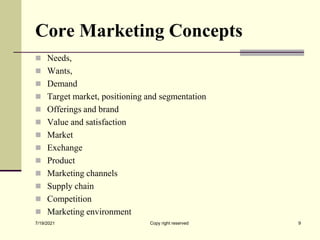
Core Marketing Concepts
 Needs,
 Wants,
 Demand
 Target market, positioning and segmentation
 Offerings and brand
 Value and satisfaction
 Market
 Exchange
 Product
 Marketing channels
 Supply chain
 Competition
 Marketing environment
7/19/2021 9
Copy right reserved
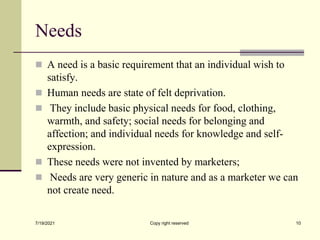
Needs
 A need is a basic requirement that an individual wish to
satisfy.
 Human needs are state of felt deprivation.
 They include basic physical needs for food, clothing,
warmth, and safety; social needs for belonging and
affection; and individual needs for knowledge and self-
expression.
 These needs were not invented by marketers;
 Needs are very generic in nature and as a marketer we can
not create need.
7/19/2021 Copy right reserved 10
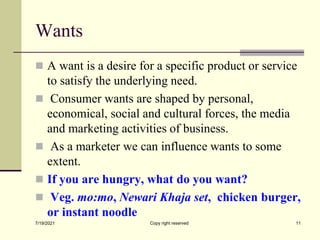
Wants
 A want is a desire for a specific product or service
to satisfy the underlying need.
 Consumer wants are shaped by personal,
economical, social and cultural forces, the media
and marketing activities of business.
 As a marketer we can influence wants to some
extent.
 If you are hungry, what do you want?
 Veg. mo:mo, Newari Khaja set, chicken burger,
or instant noodle
7/19/2021 Copy right reserved 11
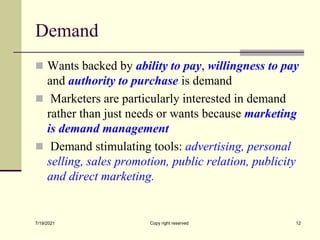
Demand
 Wants backed by ability to pay, willingness to pay
and authority to purchase is demand
 Marketers are particularly interested in demand
rather than just needs or wants because marketing
is demand management
 Demand stimulating tools: advertising, personal
selling, sales promotion, public relation, publicity
and direct marketing.
7/19/2021 Copy right reserved 12
Conclusions: Needs, wants and
demand
 Needs – states of felt deprivation
 Wants – specific satisfiers of needs shaped by
culture, economic condition as well as individual
personality
 Demand – human wants that are backed by
willingness, buying power and authority to
purchase.
7/19/2021 13
Copy right reserved
Product: No product, no marketing
 Product is need satisfying entity.
 It is a set of tangible and intangible attributes, which may
include packaging, colour, price, quality and brand plus the
seller’s services and reputation.
 Product can be goods, services, ideas, places, experience,
events, person, properties, organization, etc.
 A Product is much more than a set of physical attributes.
 It consists of physical characteristics, product quality, price,
brand, packaging, design, colour, sellers’ reputation, sellers’
services, product warranty, etc.
 It is believed in marketing that no product no marketing.
7/19/2021 14
Copy right reserved
Product
 Physical goods
 Service
 Idea
 Event
 Experience
 People
 Organization
 Information
 Property
 Place
7/19/2021 Copy right reserved 15
Product
 Anything offered by the marketer for customer’s
satisfaction
 A product is anything that can be offered to a
market to satisfy a want or need.
 Philip Kotler
7/19/2021 Copy right reserved 16
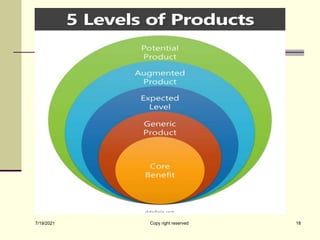
Levels of Product
 There are five levels of products
 Core product
 Actual product
 Augmented product
 Expected product
 Potential product
7/19/2021 17
Copy right reserved
7/19/2021 Copy right reserved 18
Types of Product
 Consumer product
 Industrial product
7/19/2021 Copy right reserved 19
Value and Satisfaction
 Value – relationship between benefit and cost
 Satisfaction – Comparison between customer’s
expectation and product performance
 Expectation = performance
 Expectation < performance
 Expectation > Performance
7/19/2021 20
Copy right reserved
Exchange: The heart of marketing
 Exchange is the act of obtaining a desired product
from someone by offering something in return
 Although people can satisfy their needs by self-
production, begging or theft, only one feasible
way to satisfy the needs of customer in marketing
is exchange.
7/19/2021 21
Copy right reserved
Transaction
 Transaction is the deal between buyer and the seller.
 These dealings or transactions may be cash or credit.
 The rule is not “cash and carry”, instead “enjoy now and
pay later”.
 Thus, buying a car or a motor bike, flat or house, is within
the reach of middle and lower middle class.
 The concept of “EMI” (Equal monthly instalment) has
turned everybody to enjoy now and pay later.
7/19/2021 Copy right reserved 22
Distribution
 Distribution includes all the various activities the company
undertakes to make the product accessible and available to
target customers.
 It involves the marketing channel and physical
distribution.
 Marketing channel makes the product available to the
customers.
 Physical distribution makes the product accessible to the
channel members and customers.
 Distribution is also called the “the other half of
marketing.” It fulfils the gap between the producer and
consumer.
7/19/2021 Copy right reserved 23
Supply Chain
 The supply chain is a longer channel stretching from raw materials to
components to finished products carried to final buyers.
 The supply chain for coffee produced in Gulmi district of Nepal may
start with farmers who plant, tend, and pick the coffee beans and sell
their harvest.
 After farmers sell their harvest to wholesalers or perhaps a coffee
cooperative, the beans are prepared and then transported to the
developed world for sale through wholesale or retail channels
 Each company in the chain captures only a certain percentage of the
total value generated by the supply chain’s value delivery system
7/19/2021 Copy right reserved 24
Marketing Channel
 Communication channel – Radio, TV, newspaper,
magazine etc
 Distribution channel – Agent, wholesaler, retailer
etc.
 Service channel – transport co., warehouse, bank
and insurance co. etc.
7/19/2021 25
Copy right reserved
Supply Chain
 Supply chain is a longer channel stretching from
raw materials to components to final products that
are carried to final buyers.

7/19/2021 26
Copy right reserved
Media
 Paid media: TV, newspaper, magazine
 Owned media: website, blog, face book page
 Earned media: Consumers, press, other outsiders
by word of mouth, buzz or viral marketing
methods
7/19/2021 Copy right reserved 27
Marketing Environment
 The actors and forces outside marketing that affect
marketing management’s ability to build and
maintain successful relationships with target
customers.
 It includes: Micro environment and macro
environment
7/19/2021 28
Copy right reserved
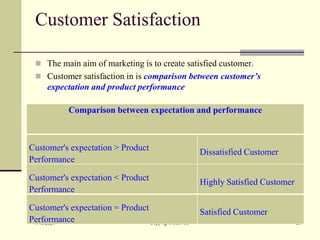
Customer Satisfaction
 The main aim of marketing is to create satisfied customer.
 Customer satisfaction in is comparison between customer’s
expectation and product performance
7/19/2021 Copy right reserved 29
Comparison between expectation and performance
Customer's expectation > Product
Performance
Dissatisfied Customer
Customer's expectation < Product
Performance
Highly Satisfied Customer
Customer's expectation = Product
Performance
Satisfied Customer
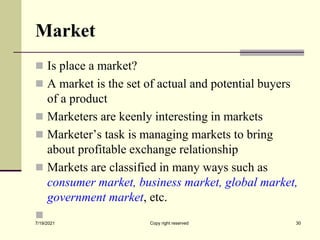
Market
 Is place a market?
 A market is the set of actual and potential buyers
of a product
 Marketers are keenly interesting in markets
 Marketer’s task is managing markets to bring
about profitable exchange relationship
 Markets are classified in many ways such as
consumer market, business market, global market,
government market, etc.

7/19/2021 30
Copy right reserved
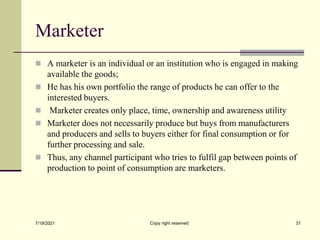
Marketer
 A marketer is an individual or an institution who is engaged in making
available the goods;
 He has his own portfolio the range of products he can offer to the
interested buyers.
 Marketer creates only place, time, ownership and awareness utility
 Marketer does not necessarily produce but buys from manufacturers
and producers and sells to buyers either for final consumption or for
further processing and sale.
 Thus, any channel participant who tries to fulfil gap between points of
production to point of consumption are marketers.
7/19/2021 Copy right reserved 31
Prospects
 Prospect is a person or an organization which is
ready and willing to buy and pay for the goods and
services.
 It is not to undermine the marketers because a
“clap” is possible with two hands and not one.
 As a marketer we must qualify prospects and
should try to convert that prospect to partner in
long-run by implementing relationship marketing.
7/19/2021 Copy right reserved 32
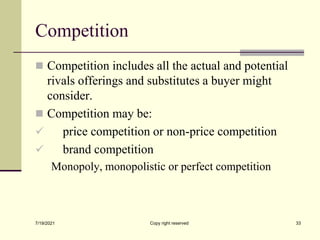
Competition
 Competition includes all the actual and potential
rivals offerings and substitutes a buyer might
consider.
 Competition may be:
 price competition or non-price competition
 brand competition
Monopoly, monopolistic or perfect competition
7/19/2021 33
Copy right reserved
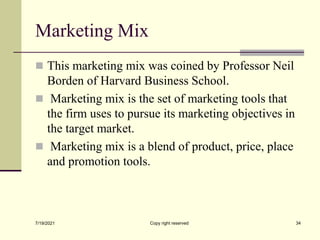
Marketing Mix
 This marketing mix was coined by Professor Neil
Borden of Harvard Business School.
 Marketing mix is the set of marketing tools that
the firm uses to pursue its marketing objectives in
the target market.
 Marketing mix is a blend of product, price, place
and promotion tools.
7/19/2021 Copy right reserved 34
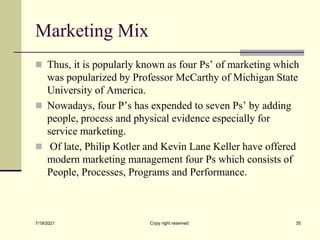
Marketing Mix
 Thus, it is popularly known as four Ps’ of marketing which
was popularized by Professor McCarthy of Michigan State
University of America.
 Nowadays, four P’s has expended to seven Ps’ by adding
people, process and physical evidence especially for
service marketing.
 Of late, Philip Kotler and Kevin Lane Keller have offered
modern marketing management four Ps which consists of
People, Processes, Programs and Performance.
7/19/2021 Copy right reserved 35
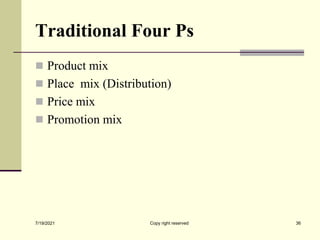
Traditional Four Ps
 Product mix
 Place mix (Distribution)
 Price mix
 Promotion mix
7/19/2021 Copy right reserved 36
7 P’s (Service marketing Strategy)
 Product
 Place
 Price
 Promotion
 People : Internal marketing and interactive
marketing
 Process
 Physical Evidence
7/19/2021 Copy right reserved 37
Modern Marketing Management
four Ps (The new four Ps)
 People
 Process
 Programs (Product, place, price, promotion)
 Performance
7/19/2021 Copy right reserved 38
Four C’s
 Customers’ solution (Product)
 Cost (Price)
 Convenience (Place)
 Communication (Promotion)
7/19/2021 Copy right reserved 39
Marketing Environment
 The actors and forces outside marketing that affect
marketing management’s ability to build and
maintain successful relationships with target
customers.
 It includes: Micro environment and macro
environment
7/19/2021 40
Copy right reserved
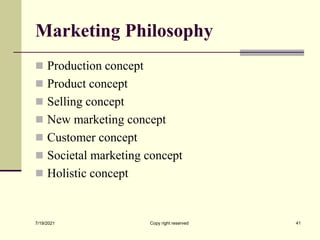
Marketing Philosophy
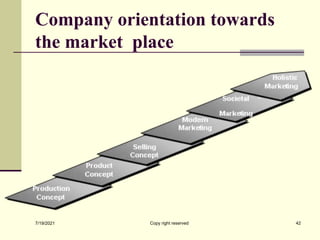
 Production concept
 Product concept
 Selling concept
 New marketing concept
 Customer concept
 Societal marketing concept
 Holistic concept
7/19/2021 Copy right reserved 41
Company orientation towards
the market place
7/19/2021 Copy right reserved 42
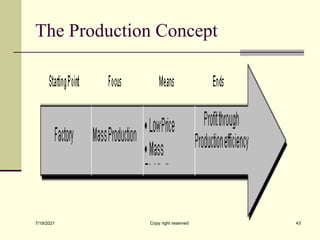
The Production Concept
7/19/2021 Copy right reserved 43
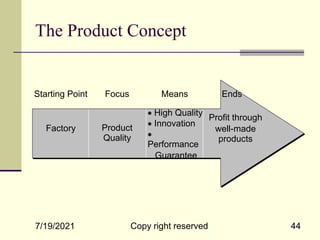
The Product Concept
7/19/2021 Copy right reserved 44
Product
Quality
Starting Point Focus Means Ends
Factory
 High Quality
 Innovation

Performance
Guarantee
Profit through
well-made
products
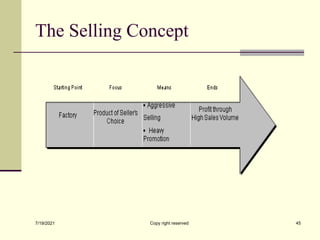
The Selling Concept
7/19/2021 Copy right reserved 45
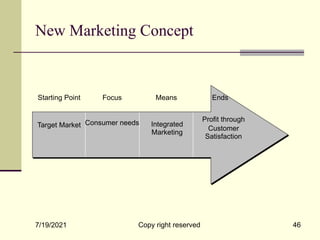
New Marketing Concept
7/19/2021 Copy right reserved 46
Consumer needs
Starting Point Focus Means Ends
Target Market Integrated
Marketing
Profit through
Customer
Satisfaction
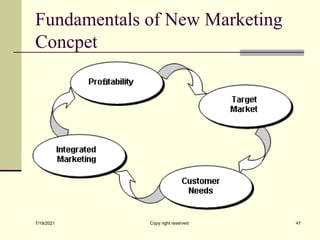
Fundamentals of New Marketing
Concpet
7/19/2021 Copy right reserved 47
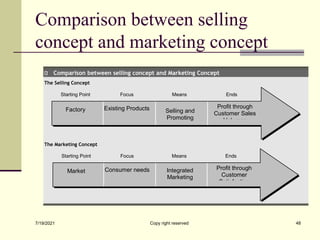
Comparison between selling
concept and marketing concept
Comparison between selling concept and Marketing Concept
The Selling Concept
The Marketing Concept
Existing Products
Starting Point Focus Means Ends
Factory Selling and
Promoting
Profit through
Customer Sales
Volumes
Consumer needs
Starting Point Focus Means Ends
Market Integrated
Marketing
Profit through
Customer
Satisfaction
7/19/2021 Copy right reserved 48
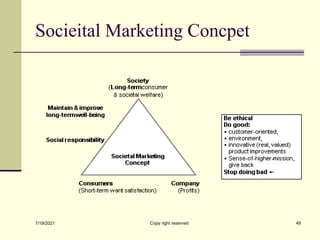
Socieital Marketing Concpet
7/19/2021 Copy right reserved 49
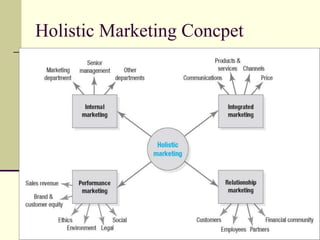
Holistic Marketing Concpet
7/19/2021 Copy right reserved 50
Marketing Management
 Marketing management is the art and science of
choosing target markets and getting, keeping, and
growing customers through creating, delivering,
and communicating superior customer value
 Marketing in action is marketing Management.
7/19/2021 Prepared by Gopal Thapa 51
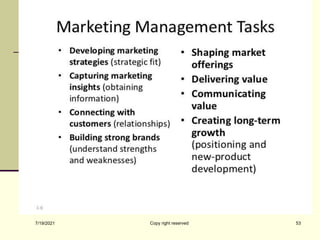
Marketing Management Task
 Developing marketing strategies and plans
 Capture marketing insights & performance
 Connect with customers
 Build strong brands
 Shape the market offering
 Deliver value
 Communicate value
 Create successful long-term growth
7/19/2021 Copy right reserved 52
7/19/2021 Copy right reserved 53
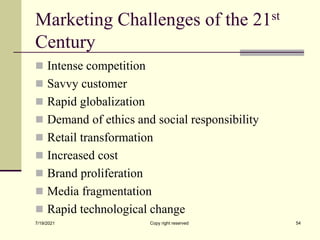
Marketing Challenges of the 21st
Century
 Intense competition
 Savvy customer
 Rapid globalization
 Demand of ethics and social responsibility
 Retail transformation
 Increased cost
 Brand proliferation
 Media fragmentation
 Rapid technological change
7/19/2021 Copy right reserved 54
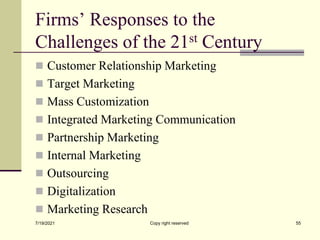
Firms’ Responses to the
Challenges of the 21st Century
 Customer Relationship Marketing
 Target Marketing
 Mass Customization
 Integrated Marketing Communication
 Partnership Marketing
 Internal Marketing
 Outsourcing
 Digitalization
 Marketing Research
7/19/2021 Copy right reserved 55
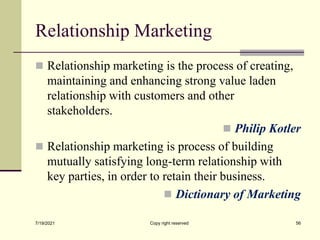
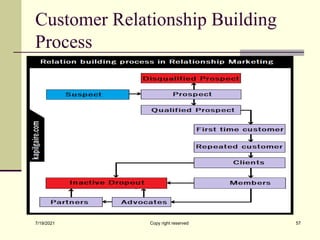
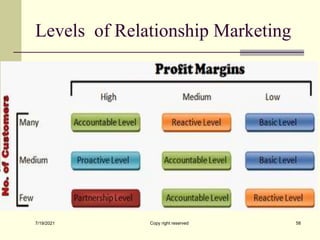
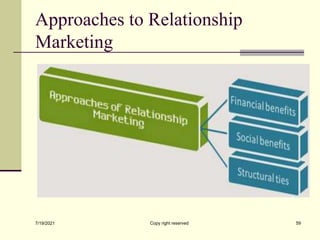
Relationship Marketing
 Relationship marketing is the process of creating,
maintaining and enhancing strong value laden
relationship with customers and other
stakeholders.
 Philip Kotler
 Relationship marketing is process of building
mutually satisfying long-term relationship with
key parties, in order to retain their business.
 Dictionary of Marketing
7/19/2021 Copy right reserved 56
Customer Relationship Building
Process
7/19/2021 Copy right reserved 57
Levels of Relationship Marketing
7/19/2021 Copy right reserved 58
Approaches to Relationship
Marketing
7/19/2021 Copy right reserved 59
Green Marketing
 Green marketing is the integrated business
practices and products that are friendly to the
environment.
 It is also known as environmental marketing or
ecological marketing.
 It is the holistic management for identifying,
anticipating, and satisfying the requirements of
customers and society in a profitable and
sustainable manner
7/19/2021 Copy right reserved 60
Green Marketing
 Green marketing is the marketing of products that
are presumed to be environmentally safe.
 American Marketing Association
7/19/2021 Copy right reserved 61
Reasons for Adopting Green
Marketing
 Grab Opportunities
 Government pressure
 Competitive pressure
 Social responsibility
 Costs and profit related issues
7/19/2021 Copy right reserved 62
Practices of Green Marketing
 Top management commitment
 Pollution control
 Eco-friendly technology
 Use of recyclable materials
 Legal framework
 Consumer awareness program
7/19/2021 Copy right reserved 63
E-marketing
 E-marketing in the process of marketing a brand
or product or service using the internet.
 It refers to the application of marketing principles
and technique by electronic media and more
specifically the internet.
 It is a type of direct digital marketing that uses the
electronic device as the marketing communication
delivery method.
7/19/2021 Copy right reserved 64
E-marketing
 E-marketing is the fusion of information
technology with traditional marketing.
 It uses information technology in the process of
creating, communicating, and delivering value to
the customers.
7/19/2021 Copy right reserved 65
E-marketing
 It uses the internet to do one or more of the
following:
 to communicate a company's message about
itself, its products and services,
 to conduct research as to the nature of existing and
potential customers,
 and to sell products or services.
7/19/2021 Copy right reserved 66
Features of e-marketing
 Online selling
 Elimination of middleman
 Data depository
 Enhance promotion
 Global Alliance
 Long-term relationships
 Lower costs
7/19/2021 Copy right reserved 67
Any Queries?
Thank You!
7/19/2021 Copy right reserved 68

Dr. Gopal Thapa's Marketing for bba

  • 1.
    Marketing An Introduction Dr. GopalThapa Tribhuvan University
  • 2.
    Marketing  Telling andselling or  Satisfying needs profitably or  Relationship building or  Creating, communicating or delivering value 7/19/2021 2 Copy right reserved
  • 3.
    Definition of Marketing The systematic planning, implementation and control of a mix of business activities intended to bring together buyers and sellers for the mutually advantageous exchange or transfer of products.  Dictionary of Marketing 7/19/2021 Copy right reserved 3
  • 4.
    Definition of Marketing Marketing is a societal process by which individuals and groups obtain what they need and want through creating, offering, and freely exchanging products and services of value with others.  Philip Kotler & Kevin Lane Keller 7/19/2021 Copy right reserved 4
  • 5.
    Definition of Marketing Marketing is the management process responsible for identifying, anticipating and satisfying customer requirements profitably.  Chartered Institute of Marketing 7/19/2021 Copy right reserved 5
  • 6.
    Definition of Marketing Marketing is a total system of business activities designed to plan, price, promote and distribute want satisfying products to target markets in order to achieve organizational objectives.  Stanton, Etzel & Walker 7/19/2021 Copy right reserved 6
  • 7.
    Definition by AMA Marketing is the activity, set of institutions, and processes for creating, communicating, delivering, and exchanging offerings that have value for customers, clients, partners, and society at large. (New definition, July 2013)  Marketing is the process of planning and executing the conception, pricing, promotion and distribution of ideas, goods and services to create exchanges that satisfy individual and organizational objectives. (Old definition)  American Marketing Association 7/19/2021 Copy right reserved 7
  • 8.
    Conclusions  Marketing isa societal process.  Marketing deals with customer needs, wants, products, pricing, distribution, and promotion.  Marketing focuses on delivering value and satisfaction to customers through products, services, ideas, etc.  Marketing facilitates satisfying exchange relationships.  Marketing takes place in a dynamic environment.  Marketing is used in both for-profit and not-for-profit organizations.  Marketing is extremely important to businesses and the economy of a country.  Thus, in conclusion, marketing is meeting needs profitably. 7/19/2021 Copy right reserved 8
  • 9.
    Core Marketing Concepts Needs,  Wants,  Demand  Target market, positioning and segmentation  Offerings and brand  Value and satisfaction  Market  Exchange  Product  Marketing channels  Supply chain  Competition  Marketing environment 7/19/2021 9 Copy right reserved
  • 10.
    Needs  A needis a basic requirement that an individual wish to satisfy.  Human needs are state of felt deprivation.  They include basic physical needs for food, clothing, warmth, and safety; social needs for belonging and affection; and individual needs for knowledge and self- expression.  These needs were not invented by marketers;  Needs are very generic in nature and as a marketer we can not create need. 7/19/2021 Copy right reserved 10
  • 11.
    Wants  A wantis a desire for a specific product or service to satisfy the underlying need.  Consumer wants are shaped by personal, economical, social and cultural forces, the media and marketing activities of business.  As a marketer we can influence wants to some extent.  If you are hungry, what do you want?  Veg. mo:mo, Newari Khaja set, chicken burger, or instant noodle 7/19/2021 Copy right reserved 11
  • 12.
    Demand  Wants backedby ability to pay, willingness to pay and authority to purchase is demand  Marketers are particularly interested in demand rather than just needs or wants because marketing is demand management  Demand stimulating tools: advertising, personal selling, sales promotion, public relation, publicity and direct marketing. 7/19/2021 Copy right reserved 12
  • 13.
    Conclusions: Needs, wantsand demand  Needs – states of felt deprivation  Wants – specific satisfiers of needs shaped by culture, economic condition as well as individual personality  Demand – human wants that are backed by willingness, buying power and authority to purchase. 7/19/2021 13 Copy right reserved
  • 14.
    Product: No product,no marketing  Product is need satisfying entity.  It is a set of tangible and intangible attributes, which may include packaging, colour, price, quality and brand plus the seller’s services and reputation.  Product can be goods, services, ideas, places, experience, events, person, properties, organization, etc.  A Product is much more than a set of physical attributes.  It consists of physical characteristics, product quality, price, brand, packaging, design, colour, sellers’ reputation, sellers’ services, product warranty, etc.  It is believed in marketing that no product no marketing. 7/19/2021 14 Copy right reserved
  • 15.
    Product  Physical goods Service  Idea  Event  Experience  People  Organization  Information  Property  Place 7/19/2021 Copy right reserved 15
  • 16.
    Product  Anything offeredby the marketer for customer’s satisfaction  A product is anything that can be offered to a market to satisfy a want or need.  Philip Kotler 7/19/2021 Copy right reserved 16
  • 17.
    Levels of Product There are five levels of products  Core product  Actual product  Augmented product  Expected product  Potential product 7/19/2021 17 Copy right reserved
  • 18.
  • 19.
    Types of Product Consumer product  Industrial product 7/19/2021 Copy right reserved 19
  • 20.
    Value and Satisfaction Value – relationship between benefit and cost  Satisfaction – Comparison between customer’s expectation and product performance  Expectation = performance  Expectation < performance  Expectation > Performance 7/19/2021 20 Copy right reserved
  • 21.
    Exchange: The heartof marketing  Exchange is the act of obtaining a desired product from someone by offering something in return  Although people can satisfy their needs by self- production, begging or theft, only one feasible way to satisfy the needs of customer in marketing is exchange. 7/19/2021 21 Copy right reserved
  • 22.
    Transaction  Transaction isthe deal between buyer and the seller.  These dealings or transactions may be cash or credit.  The rule is not “cash and carry”, instead “enjoy now and pay later”.  Thus, buying a car or a motor bike, flat or house, is within the reach of middle and lower middle class.  The concept of “EMI” (Equal monthly instalment) has turned everybody to enjoy now and pay later. 7/19/2021 Copy right reserved 22
  • 23.
    Distribution  Distribution includesall the various activities the company undertakes to make the product accessible and available to target customers.  It involves the marketing channel and physical distribution.  Marketing channel makes the product available to the customers.  Physical distribution makes the product accessible to the channel members and customers.  Distribution is also called the “the other half of marketing.” It fulfils the gap between the producer and consumer. 7/19/2021 Copy right reserved 23
  • 24.
    Supply Chain  Thesupply chain is a longer channel stretching from raw materials to components to finished products carried to final buyers.  The supply chain for coffee produced in Gulmi district of Nepal may start with farmers who plant, tend, and pick the coffee beans and sell their harvest.  After farmers sell their harvest to wholesalers or perhaps a coffee cooperative, the beans are prepared and then transported to the developed world for sale through wholesale or retail channels  Each company in the chain captures only a certain percentage of the total value generated by the supply chain’s value delivery system 7/19/2021 Copy right reserved 24
  • 25.
    Marketing Channel  Communicationchannel – Radio, TV, newspaper, magazine etc  Distribution channel – Agent, wholesaler, retailer etc.  Service channel – transport co., warehouse, bank and insurance co. etc. 7/19/2021 25 Copy right reserved
  • 26.
    Supply Chain  Supplychain is a longer channel stretching from raw materials to components to final products that are carried to final buyers.  7/19/2021 26 Copy right reserved
  • 27.
    Media  Paid media:TV, newspaper, magazine  Owned media: website, blog, face book page  Earned media: Consumers, press, other outsiders by word of mouth, buzz or viral marketing methods 7/19/2021 Copy right reserved 27
  • 28.
    Marketing Environment  Theactors and forces outside marketing that affect marketing management’s ability to build and maintain successful relationships with target customers.  It includes: Micro environment and macro environment 7/19/2021 28 Copy right reserved
  • 29.
    Customer Satisfaction  Themain aim of marketing is to create satisfied customer.  Customer satisfaction in is comparison between customer’s expectation and product performance 7/19/2021 Copy right reserved 29 Comparison between expectation and performance Customer's expectation > Product Performance Dissatisfied Customer Customer's expectation < Product Performance Highly Satisfied Customer Customer's expectation = Product Performance Satisfied Customer
  • 30.
    Market  Is placea market?  A market is the set of actual and potential buyers of a product  Marketers are keenly interesting in markets  Marketer’s task is managing markets to bring about profitable exchange relationship  Markets are classified in many ways such as consumer market, business market, global market, government market, etc.  7/19/2021 30 Copy right reserved
  • 31.
    Marketer  A marketeris an individual or an institution who is engaged in making available the goods;  He has his own portfolio the range of products he can offer to the interested buyers.  Marketer creates only place, time, ownership and awareness utility  Marketer does not necessarily produce but buys from manufacturers and producers and sells to buyers either for final consumption or for further processing and sale.  Thus, any channel participant who tries to fulfil gap between points of production to point of consumption are marketers. 7/19/2021 Copy right reserved 31
  • 32.
    Prospects  Prospect isa person or an organization which is ready and willing to buy and pay for the goods and services.  It is not to undermine the marketers because a “clap” is possible with two hands and not one.  As a marketer we must qualify prospects and should try to convert that prospect to partner in long-run by implementing relationship marketing. 7/19/2021 Copy right reserved 32
  • 33.
    Competition  Competition includesall the actual and potential rivals offerings and substitutes a buyer might consider.  Competition may be:  price competition or non-price competition  brand competition Monopoly, monopolistic or perfect competition 7/19/2021 33 Copy right reserved
  • 34.
    Marketing Mix  Thismarketing mix was coined by Professor Neil Borden of Harvard Business School.  Marketing mix is the set of marketing tools that the firm uses to pursue its marketing objectives in the target market.  Marketing mix is a blend of product, price, place and promotion tools. 7/19/2021 Copy right reserved 34
  • 35.
    Marketing Mix  Thus,it is popularly known as four Ps’ of marketing which was popularized by Professor McCarthy of Michigan State University of America.  Nowadays, four P’s has expended to seven Ps’ by adding people, process and physical evidence especially for service marketing.  Of late, Philip Kotler and Kevin Lane Keller have offered modern marketing management four Ps which consists of People, Processes, Programs and Performance. 7/19/2021 Copy right reserved 35
  • 36.
    Traditional Four Ps Product mix  Place mix (Distribution)  Price mix  Promotion mix 7/19/2021 Copy right reserved 36
  • 37.
    7 P’s (Servicemarketing Strategy)  Product  Place  Price  Promotion  People : Internal marketing and interactive marketing  Process  Physical Evidence 7/19/2021 Copy right reserved 37
  • 38.
    Modern Marketing Management fourPs (The new four Ps)  People  Process  Programs (Product, place, price, promotion)  Performance 7/19/2021 Copy right reserved 38
  • 39.
    Four C’s  Customers’solution (Product)  Cost (Price)  Convenience (Place)  Communication (Promotion) 7/19/2021 Copy right reserved 39
  • 40.
    Marketing Environment  Theactors and forces outside marketing that affect marketing management’s ability to build and maintain successful relationships with target customers.  It includes: Micro environment and macro environment 7/19/2021 40 Copy right reserved
  • 41.
    Marketing Philosophy  Productionconcept  Product concept  Selling concept  New marketing concept  Customer concept  Societal marketing concept  Holistic concept 7/19/2021 Copy right reserved 41
  • 42.
    Company orientation towards themarket place 7/19/2021 Copy right reserved 42
  • 43.
    The Production Concept 7/19/2021Copy right reserved 43
  • 44.
    The Product Concept 7/19/2021Copy right reserved 44 Product Quality Starting Point Focus Means Ends Factory  High Quality  Innovation  Performance Guarantee Profit through well-made products
  • 45.
    The Selling Concept 7/19/2021Copy right reserved 45
  • 46.
    New Marketing Concept 7/19/2021Copy right reserved 46 Consumer needs Starting Point Focus Means Ends Target Market Integrated Marketing Profit through Customer Satisfaction
  • 47.
    Fundamentals of NewMarketing Concpet 7/19/2021 Copy right reserved 47
  • 48.
    Comparison between selling conceptand marketing concept Comparison between selling concept and Marketing Concept The Selling Concept The Marketing Concept Existing Products Starting Point Focus Means Ends Factory Selling and Promoting Profit through Customer Sales Volumes Consumer needs Starting Point Focus Means Ends Market Integrated Marketing Profit through Customer Satisfaction 7/19/2021 Copy right reserved 48
  • 49.
  • 50.
  • 51.
    Marketing Management  Marketingmanagement is the art and science of choosing target markets and getting, keeping, and growing customers through creating, delivering, and communicating superior customer value  Marketing in action is marketing Management. 7/19/2021 Prepared by Gopal Thapa 51
  • 52.
    Marketing Management Task Developing marketing strategies and plans  Capture marketing insights & performance  Connect with customers  Build strong brands  Shape the market offering  Deliver value  Communicate value  Create successful long-term growth 7/19/2021 Copy right reserved 52
  • 53.
  • 54.
    Marketing Challenges ofthe 21st Century  Intense competition  Savvy customer  Rapid globalization  Demand of ethics and social responsibility  Retail transformation  Increased cost  Brand proliferation  Media fragmentation  Rapid technological change 7/19/2021 Copy right reserved 54
  • 55.
    Firms’ Responses tothe Challenges of the 21st Century  Customer Relationship Marketing  Target Marketing  Mass Customization  Integrated Marketing Communication  Partnership Marketing  Internal Marketing  Outsourcing  Digitalization  Marketing Research 7/19/2021 Copy right reserved 55
  • 56.
    Relationship Marketing  Relationshipmarketing is the process of creating, maintaining and enhancing strong value laden relationship with customers and other stakeholders.  Philip Kotler  Relationship marketing is process of building mutually satisfying long-term relationship with key parties, in order to retain their business.  Dictionary of Marketing 7/19/2021 Copy right reserved 56
  • 57.
  • 58.
    Levels of RelationshipMarketing 7/19/2021 Copy right reserved 58
  • 59.
  • 60.
    Green Marketing  Greenmarketing is the integrated business practices and products that are friendly to the environment.  It is also known as environmental marketing or ecological marketing.  It is the holistic management for identifying, anticipating, and satisfying the requirements of customers and society in a profitable and sustainable manner 7/19/2021 Copy right reserved 60
  • 61.
    Green Marketing  Greenmarketing is the marketing of products that are presumed to be environmentally safe.  American Marketing Association 7/19/2021 Copy right reserved 61
  • 62.
    Reasons for AdoptingGreen Marketing  Grab Opportunities  Government pressure  Competitive pressure  Social responsibility  Costs and profit related issues 7/19/2021 Copy right reserved 62
  • 63.
    Practices of GreenMarketing  Top management commitment  Pollution control  Eco-friendly technology  Use of recyclable materials  Legal framework  Consumer awareness program 7/19/2021 Copy right reserved 63
  • 64.
    E-marketing  E-marketing inthe process of marketing a brand or product or service using the internet.  It refers to the application of marketing principles and technique by electronic media and more specifically the internet.  It is a type of direct digital marketing that uses the electronic device as the marketing communication delivery method. 7/19/2021 Copy right reserved 64
  • 65.
    E-marketing  E-marketing isthe fusion of information technology with traditional marketing.  It uses information technology in the process of creating, communicating, and delivering value to the customers. 7/19/2021 Copy right reserved 65
  • 66.
    E-marketing  It usesthe internet to do one or more of the following:  to communicate a company's message about itself, its products and services,  to conduct research as to the nature of existing and potential customers,  and to sell products or services. 7/19/2021 Copy right reserved 66
  • 67.
    Features of e-marketing Online selling  Elimination of middleman  Data depository  Enhance promotion  Global Alliance  Long-term relationships  Lower costs 7/19/2021 Copy right reserved 67
  • 68.
    Any Queries? Thank You! 7/19/2021Copy right reserved 68