Defining Marketing for 21st Century
Dr. Gopal Thapa
Associate Professor
Tribhuvan University
thapazee@gmail.com
Marketing
Copy right reserved 2
4/23/2017
◼ Telling and selling
or
◼ Satisfying needs profitably
or
◼ Relationship building
Definition of Marketing
Copy right reserved 3
4/23/2017
◼ A social and managerial and process by which
individuals and groups obtain what they need and
want through creating and exchanging value with
others
---- Philip Kotler
◼ The systematic planning, implementation and control
of a mix of business activities intended to bring
together buyers and sellers for the mutually
advantageous exchange or transfer of products.
------------- Dictionary of Marketing
What is marketed?
◼ Physical goods
◼ Services
◼ Events
◼ Experiences
◼ Persons
◼ Places
◼ Properties
◼ Organizations
◼ Information
4/
◼
23/20I
17
deas 4
Copy right reserved
Core Marketing Concepts
◼ Needs, wants, demand
◼ Target market, positioning and segmentation
◼ Offerings and brand
◼ Value and satisfaction
◼ Market
◼ Exchange
◼ Product
◼ Marketing channels
◼ Supply chain
4
◼
/23/2C
017 ompetition 5
Copy right reserved
Needs, wants and demand
◼ Needs – states of felt deprivation
◼ Wants – specific satisfiers of needs shaped
by culture, economic condition as well as
individual personality
◼ Demand – human wants that are backed by
willingness, buying power and authority to
purchase.
4/23/2017 6
Copy right reserved
Segmentation, targeting & Positioning
◼ Market Segmentation: Dividing a market into
distinct groups with distinct needs
characteristics or behaviors who might
require separate products or marketing
mixes.
◼ Target Marketing: The Process of
evaluating each market segment’s
attractiveness and selecting one or more
segments to enter.
◼ Positioning: Arranging for a product to
occupy a clear, distinctive and desirable
products in the 7
4/23/p
201
l7ace relative to com
Copy
p
rig
e
ht rt
es
ie
n
rveg
d
Marketing offer and brand
Copy right reserved 8
4/23/2017
◼ Marketing offer: Some combination of
products, services, information or
experiences offered to a market to satisfy
customer.
◼ Brand : Any word, sign, symbol etc. for
identification and differentiation of product. It
includes brand name, brand mark and trade
mark.
Value and Satisfaction
Copy right reserved 9
4/23/2017
◼ Value – relationship between benefit and cost
◼ Satisfaction – Comparison between
customer’s expectation and product
performance
◼ Expectation = performance
◼ Expectation < performance
◼ Expectation > Performance
Market
Copy right reserved 10
4/23/2017
◼ Is place a market?
◼ A market is the set of actual and potential
buyers of a product
◼ Marketers are keenly interesting in markets
◼ Marketer’s task is managing markets to bring
about profitable exchange relationship
Exchange
Copy right reserved 11
4/23/2017
◼ Exchange is the act of obtaining a desired
product from someone by offering something
in return
◼ Transaction is marketer’s unit of
measurement
◼ A transaction consists of a trade of values
between two parties.
Product
Copy right reserved 12
4/23/2017
◼ Anything offered by the marketer for
customer’s satisfaction
◼ There are five levels of products
1. Core product
2. Actual product
3. Augmented product
4. Expected product
5. Potential product
Marketing Channel
Copy right reserved 13
4/23/2017
◼ Communication channel – Radio, TV,
newspaper, magazine etc
◼ Distribution channel – Agent, wholesaler,
retailer etc.
◼ Service channel – transport co., warehouse,
bank and insurance co. etc
Supply Chain
Copy right reserved 14
4/23/2017
◼ Supply chain is a longer channel stretching
from raw materials to components to final
products that are carried to final buyers.
◼
Competition
Copy right reserved 15
4/23/2017
◼ Competition includes all the actual and
potential rivals offerings and substitutes a
buyer might consider.
◼ Competition may be:
✓ price competition or non-price competition
✓ brand competition
Monopoly, monopolistic or perfect competition
Marketing Environment
Copy right reserved 16
4/23/2017
◼ The actors and forces outside marketing that
affect marketing management’s ability to build
and maintain successful relationships with
target customers.
◼ It includes: Micro environment and macro
environment
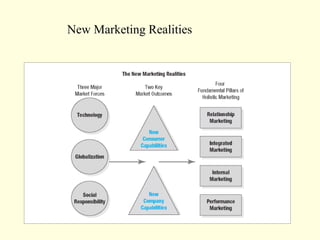
New Marketing Realities
Copy right reserved 17
4/23/2017
•Technology
•Globalization
•Social Responsibility
New Marketing Realities
Dr. Gopal Thapa, Tribhuvan University, Kathmandu, Nepal
Company orientation towards the market place
• Production concept
• Product concept
• Selling concept
• New marketing concept
• Customer concept
• Societal marketing concept
• Holistic concept
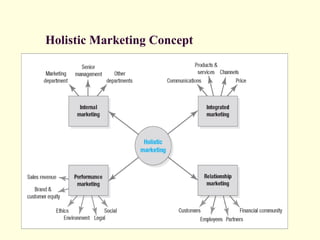
Holistic Marketing Concept
Dr. Gopal Thapa, Tribhuvan University, Kathmandu, Nepal
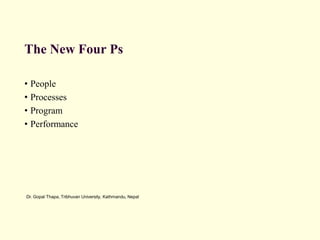
The New Four Ps
• People
• Processes
• Program
• Performance
Dr. Gopal Thapa, Tribhuvan University, Kathmandu, Nepal
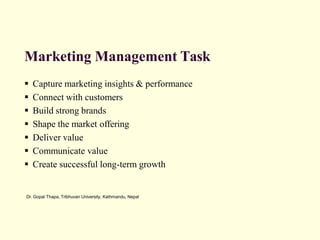
Marketing Management Task
▪ Capture marketing insights & performance
▪ Connect with customers
▪ Build strong brands
▪ Shape the market offering
▪ Deliver value
▪ Communicate value
▪ Create successful long-term growth

Defining marketing

  • 1.
    Defining Marketing for21st Century Dr. Gopal Thapa Associate Professor Tribhuvan University thapazee@gmail.com
  • 2.
    Marketing Copy right reserved2 4/23/2017 ◼ Telling and selling or ◼ Satisfying needs profitably or ◼ Relationship building
  • 3.
    Definition of Marketing Copyright reserved 3 4/23/2017 ◼ A social and managerial and process by which individuals and groups obtain what they need and want through creating and exchanging value with others ---- Philip Kotler ◼ The systematic planning, implementation and control of a mix of business activities intended to bring together buyers and sellers for the mutually advantageous exchange or transfer of products. ------------- Dictionary of Marketing
  • 4.
    What is marketed? ◼Physical goods ◼ Services ◼ Events ◼ Experiences ◼ Persons ◼ Places ◼ Properties ◼ Organizations ◼ Information 4/ ◼ 23/20I 17 deas 4 Copy right reserved
  • 5.
    Core Marketing Concepts ◼Needs, wants, demand ◼ Target market, positioning and segmentation ◼ Offerings and brand ◼ Value and satisfaction ◼ Market ◼ Exchange ◼ Product ◼ Marketing channels ◼ Supply chain 4 ◼ /23/2C 017 ompetition 5 Copy right reserved
  • 6.
    Needs, wants anddemand ◼ Needs – states of felt deprivation ◼ Wants – specific satisfiers of needs shaped by culture, economic condition as well as individual personality ◼ Demand – human wants that are backed by willingness, buying power and authority to purchase. 4/23/2017 6 Copy right reserved
  • 7.
    Segmentation, targeting &Positioning ◼ Market Segmentation: Dividing a market into distinct groups with distinct needs characteristics or behaviors who might require separate products or marketing mixes. ◼ Target Marketing: The Process of evaluating each market segment’s attractiveness and selecting one or more segments to enter. ◼ Positioning: Arranging for a product to occupy a clear, distinctive and desirable products in the 7 4/23/p 201 l7ace relative to com Copy p rig e ht rt es ie n rveg d
  • 8.
    Marketing offer andbrand Copy right reserved 8 4/23/2017 ◼ Marketing offer: Some combination of products, services, information or experiences offered to a market to satisfy customer. ◼ Brand : Any word, sign, symbol etc. for identification and differentiation of product. It includes brand name, brand mark and trade mark.
  • 9.
    Value and Satisfaction Copyright reserved 9 4/23/2017 ◼ Value – relationship between benefit and cost ◼ Satisfaction – Comparison between customer’s expectation and product performance ◼ Expectation = performance ◼ Expectation < performance ◼ Expectation > Performance
  • 10.
    Market Copy right reserved10 4/23/2017 ◼ Is place a market? ◼ A market is the set of actual and potential buyers of a product ◼ Marketers are keenly interesting in markets ◼ Marketer’s task is managing markets to bring about profitable exchange relationship
  • 11.
    Exchange Copy right reserved11 4/23/2017 ◼ Exchange is the act of obtaining a desired product from someone by offering something in return ◼ Transaction is marketer’s unit of measurement ◼ A transaction consists of a trade of values between two parties.
  • 12.
    Product Copy right reserved12 4/23/2017 ◼ Anything offered by the marketer for customer’s satisfaction ◼ There are five levels of products 1. Core product 2. Actual product 3. Augmented product 4. Expected product 5. Potential product
  • 13.
    Marketing Channel Copy rightreserved 13 4/23/2017 ◼ Communication channel – Radio, TV, newspaper, magazine etc ◼ Distribution channel – Agent, wholesaler, retailer etc. ◼ Service channel – transport co., warehouse, bank and insurance co. etc
  • 14.
    Supply Chain Copy rightreserved 14 4/23/2017 ◼ Supply chain is a longer channel stretching from raw materials to components to final products that are carried to final buyers. ◼
  • 15.
    Competition Copy right reserved15 4/23/2017 ◼ Competition includes all the actual and potential rivals offerings and substitutes a buyer might consider. ◼ Competition may be: ✓ price competition or non-price competition ✓ brand competition Monopoly, monopolistic or perfect competition
  • 16.
    Marketing Environment Copy rightreserved 16 4/23/2017 ◼ The actors and forces outside marketing that affect marketing management’s ability to build and maintain successful relationships with target customers. ◼ It includes: Micro environment and macro environment
  • 17.
    New Marketing Realities Copyright reserved 17 4/23/2017 •Technology •Globalization •Social Responsibility
  • 18.
  • 19.
    Dr. Gopal Thapa,Tribhuvan University, Kathmandu, Nepal Company orientation towards the market place • Production concept • Product concept • Selling concept • New marketing concept • Customer concept • Societal marketing concept • Holistic concept
  • 20.
  • 21.
    Dr. Gopal Thapa,Tribhuvan University, Kathmandu, Nepal The New Four Ps • People • Processes • Program • Performance
  • 22.
    Dr. Gopal Thapa,Tribhuvan University, Kathmandu, Nepal Marketing Management Task ▪ Capture marketing insights & performance ▪ Connect with customers ▪ Build strong brands ▪ Shape the market offering ▪ Deliver value ▪ Communicate value ▪ Create successful long-term growth