Customer Value and
Satisfaction
Dr. Gopal Thapa
Tribhuvan University
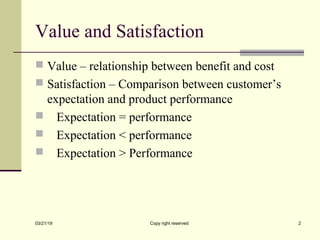
Value and Satisfaction
 Value – relationship between benefit and cost
 Satisfaction – Comparison between customer’s
expectation and product performance
 Expectation = performance
 Expectation < performance
 Expectation > Performance
03/21/19 2Copy right reserved
03/21/19 Copy right reserved 3
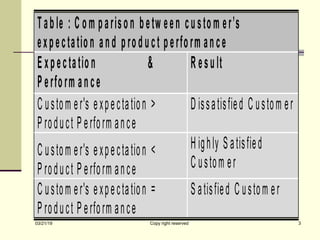
Table : C om parison betw een custom er’s
expectation and product perform ance
E xpectation &
P erform ance
R esult
C ustom er's expectation >
P roduct P erform ance
D issatisfied C ustom er
C ustom er's expectation <
P roduct P erform ance
H ighly S atisfied
C ustom er
C ustom er's expectation =
P roduct P erform ance
S atisfied C ustom er
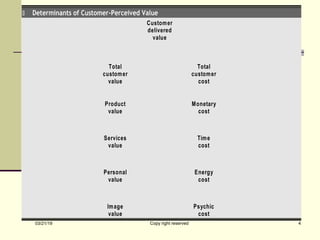
 Determinants of Customer-Perceived Value
Customer
delivered
value
Total
customer
value
Product
value
Services
value
Personal
value
Image
value
Total
customer
cost
Monetary
cost
Time
cost
Energy
cost
Psychic
cost
03/21/19 Copy right reserved 4
Monitoring Satisfaction
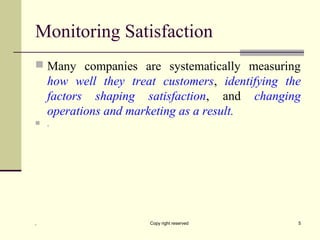
 Many companies are systematically measuring
how well they treat customers, identifying the
factors shaping satisfaction, and changing
operations and marketing as a result.
 .
, Copy right reserved 5
Monitoring Satisfaction
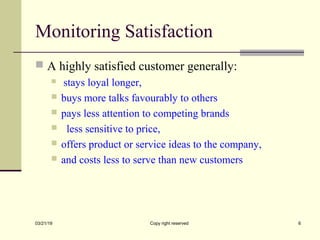
 A highly satisfied customer generally:
 stays loyal longer,
 buys more talks favourably to others
 pays less attention to competing brands
 less sensitive to price,
 offers product or service ideas to the company,
 and costs less to serve than new customers
03/21/19 Copy right reserved 6
Monitoring Satisfaction
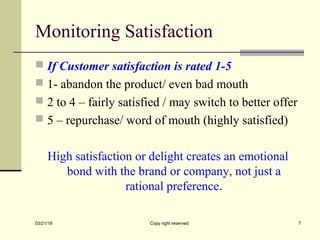
 If Customer satisfaction is rated 1-5
 1- abandon the product/ even bad mouth
 2 to 4 – fairly satisfied / may switch to better offer
 5 – repurchase/ word of mouth (highly satisfied)
High satisfaction or delight creates an emotional
bond with the brand or company, not just a
rational preference.
03/21/19 Copy right reserved 7
Monitoring Satisfaction
 Companies use a variety of methods to
measure customer satisfaction.
 some companies think they’re getting a sense of customer
satisfaction by tallying complaints, but studies show that while
customers are dissatisfied with their purchases about 25
percent of the time, only about 5 percent complain.
 The other 95 percent either feel complaining is not worth the
effort or don’t know how or to whom to complain.
 They just stop buying.
03/21/19 Copy right reserved 8
Monitoring Satisfaction
 Of the customers who complain, 54 percent to 70
percent will do business with the organization
again if their complaint is resolved.
 Customers whose complaints are satisfactorily
resolved tell an average of five people about the
good treatment they received.
 The average dissatisfied customer, however,
gripes to 11 people.
03/21/19 Copy right reserved 9
Satisfaction Depends on: Product
& Service Quality
 Quality is:
 Fitness for use
 Conformance to requirements
 Freedom from variation
03/21/19 Copy right reserved 10
Product and Service Quality
 Quality is the totality of features and
characteristics of a product or service that bear on
its ability to satisfy stated or implied needs. The
seller has delivered quality whenever its product
or service meets or exceeds the customers’
expectations.
- American Society for Quality
03/21/19 Copy right reserved 11
Marketing helps to deliver high-
quality goods by:
 correctly identifying customers’ needs
 communicating customer expectations properly to product
designers;
 making sure that customers’ orders are filled correctly
and on time;
 checking that customers have received proper instructions,
training, and technical assistance for product usage;
 staying in touch after the sale to ensure customers are and
remain satisfied;
 gathering customer ideas for improvements and conveying
them to the appropriate departments.
03/21/19 Copy right reserved 12
Maximizing Customer Lifetime
Value
 Marketing is the art of attracting and keeping
profitable customers
 Every company loses money on some of its
customers.
 The well-known 80–20 rule states that 80 percent
or more of the company’s profits come from the
top 20 percent of its customers.
03/21/19 Copy right reserved 13
Maximizing Customer Lifetime
Value
 The least profitable 10 percent to 20 percent, on
the other hand, can actually reduce profits between
50 percent and 200 percent per account, with the
middle 60 percent to 70 percent breaking even.
 The implication is that a company could improve
its profits by ā€œfiringā€ its worst customers.
03/21/19 Copy right reserved 14
Maximizing Customer Lifetime
Value
 It’s not always the company’s largest customers
who yield the most profit.
 The smallest customers pay full price and receive
minimal service, but the costs of transacting with
them can reduce their profitability.
 Midsize customers who receive good service and
pay nearly full price are often the most profitable
03/21/19 Copy right reserved 15
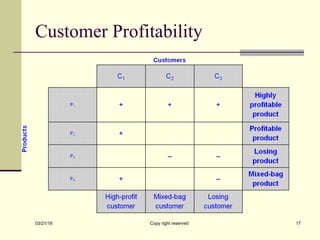
Customer Profitability
 A profitable customer is a person, household, or company
that over time yields a revenue stream exceeding by an
acceptable amount the company’s cost stream for
attracting, selling, and serving that customer.
 Note the emphasis is on the lifetime stream of revenue and
cost, not the profit from a particular transaction.
 Marketers can assess customer profitability individually,
by market segment, or by channel.
 Many companies measure customer satisfaction, but few
measure individual customer profitability.
03/21/19 Copy right reserved 16
Customer Profitability
03/21/19 Copy right reserved 17
Measuring Customer Lifetime
Value
 Customer life time value is the present value
of the future cash flows attributed to the
customer during his/her entire relationship
with the company.
 The case for maximizing long-term customer
profitability is captured in the concept of
customer lifetime value
03/21/19 Copy right reserved 18
Measuring Customer Lifetime
Value
 Customer lifetime value (CLV) describes the net present
value of the stream of future profits expected over the
customer’s lifetime purchases.
 The company must subtract from its expected revenues the
expected costs of attracting, selling, and servicing the
account of that customer, applying the appropriate
discount rate (say, between 10 percent and 20 percent,
depending on cost of capital and risk attitudes).
 Lifetime value calculations for a product or service can
add up to tens of thousands of dollars or even run to six
figures.
03/21/19 Copy right reserved 19
Cultivating Customer Relationship
 Customer relationship management (CRM) is the process
of carefully managing detailed information about
individual customers and all customer ā€œtouch pointsā€ to
maximize loyalty.
 CRM is important because a major driver of company
profitability is the aggregate value of the company’s
customer base.
 A touch point is any occasion when a customer encounters
the brand and product—from actual experience to personal
or mass communications to casual observation
03/21/19 Copy right reserved 20
Cultivating Customer Relationship
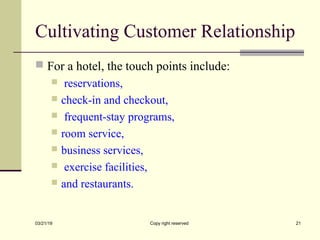
 For a hotel, the touch points include:
 reservations,
 check-in and checkout,
 frequent-stay programs,
 room service,
 business services,
 exercise facilities,
 and restaurants.
03/21/19 Copy right reserved 21
Attracting and Retaining Customers
 Companies seeking to expand profits and sales
must invest time and resources searching for new
customers
 To generate leads, they advertise in media that
will reach new prospects, send direct mail and e-
mails to possible new prospects, send their
salespeople to participate in trade shows where
they might find new leads, purchase names from
list brokers, and so on.
03/21/19 Copy right reserved 22
Attracting and Retaining Customers
 Different acquisition methods yield customers
with varying CLVs.
 One study showed that customers acquired
through the offer of a 35 percent discount had
about one-half the long-term value of customers
acquired without any discount
03/21/19 Copy right reserved 23
Attracting and Retaining Customers
 It is not enough to attract new customers; the
company must also keep them and increase their
business.
 Too many companies suffer from high customer
churn or defection.
03/21/19 Copy right reserved 24
Attracting and Retaining Customers
 To reduce the defection rate, the company
must first define and measure its retention
rate, distinguish the causes of customer
attrition and identify those that can be
managed better,
 And compare the lost customer’s CLV to the
costs of reducing the defection rate.
 If the cost to discourage defection is lower
than the lost profit, spend the money to try to
retain the customer.
03/21/19 Copy right reserved 25
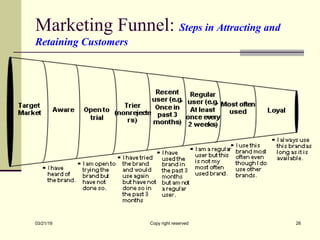
Marketing Funnel: Steps in Attracting and
Retaining Customers
03/21/19 Copy right reserved 26
Customer Profitability and
Marketing Funnel
 Customer profitability analysis and the marketing
funnel help marketers decide how to manage
groups of customers that vary in loyalty,
profitability, risk, and other factors.
 Winning companies know
 how to reduce the rate of customer defection;
 increase the longevity of the customer relationship;
 enhance the growth of each customer through ā€œshare of wallet,ā€ cross-
selling, and up-selling;
 make low-profit customers more profitable or terminate them;
 and treat high-profit customers in a special way.
03/21/19 Copy right reserved 27
Building Loyalty
 Companies should strive to build loyalty for
strong, enduring connections with customers.
 One set of researchers sees retention-building
activities as adding financial benefits, social
benefits, or structural ties.
03/21/19 Copy right reserved 28
Building Loyalty
 Marketing activities that improve loyalty and
retention:
 Interact closely with customers
 Develop loyalty programs
 Club membership programs
 Create institutional ties
 Create value with brand communities
03/21/19 Copy right reserved 29
Win-Backs
 Regardless of how hard companies may try, some
customers inevitably become inactive or drop out.
 The challenge is to reactivate them through win-
back strategies.
 It’s often easier to reattract ex-customers (because
the company knows their names and histories)
than to find new ones.
 Exit interviews and lost-customer surveys can
uncover sources of dissatisfaction and help win
back only those with strong profit potential.
03/21/19 Copy right reserved 30

Customer value, satisfaction and loyalty

  • 1.
    Customer Value and Satisfaction Dr.Gopal Thapa Tribhuvan University
  • 2.
    Value and Satisfaction Value – relationship between benefit and cost  Satisfaction – Comparison between customer’s expectation and product performance  Expectation = performance  Expectation < performance  Expectation > Performance 03/21/19 2Copy right reserved
  • 3.
    03/21/19 Copy rightreserved 3 Table : C om parison betw een custom er’s expectation and product perform ance E xpectation & P erform ance R esult C ustom er's expectation > P roduct P erform ance D issatisfied C ustom er C ustom er's expectation < P roduct P erform ance H ighly S atisfied C ustom er C ustom er's expectation = P roduct P erform ance S atisfied C ustom er
  • 4.
     Determinants ofCustomer-Perceived Value Customer delivered value Total customer value Product value Services value Personal value Image value Total customer cost Monetary cost Time cost Energy cost Psychic cost 03/21/19 Copy right reserved 4
  • 5.
    Monitoring Satisfaction  Manycompanies are systematically measuring how well they treat customers, identifying the factors shaping satisfaction, and changing operations and marketing as a result.  . , Copy right reserved 5
  • 6.
    Monitoring Satisfaction  Ahighly satisfied customer generally:  stays loyal longer,  buys more talks favourably to others  pays less attention to competing brands  less sensitive to price,  offers product or service ideas to the company,  and costs less to serve than new customers 03/21/19 Copy right reserved 6
  • 7.
    Monitoring Satisfaction  IfCustomer satisfaction is rated 1-5  1- abandon the product/ even bad mouth  2 to 4 – fairly satisfied / may switch to better offer  5 – repurchase/ word of mouth (highly satisfied) High satisfaction or delight creates an emotional bond with the brand or company, not just a rational preference. 03/21/19 Copy right reserved 7
  • 8.
    Monitoring Satisfaction  Companiesuse a variety of methods to measure customer satisfaction.  some companies think they’re getting a sense of customer satisfaction by tallying complaints, but studies show that while customers are dissatisfied with their purchases about 25 percent of the time, only about 5 percent complain.  The other 95 percent either feel complaining is not worth the effort or don’t know how or to whom to complain.  They just stop buying. 03/21/19 Copy right reserved 8
  • 9.
    Monitoring Satisfaction  Ofthe customers who complain, 54 percent to 70 percent will do business with the organization again if their complaint is resolved.  Customers whose complaints are satisfactorily resolved tell an average of five people about the good treatment they received.  The average dissatisfied customer, however, gripes to 11 people. 03/21/19 Copy right reserved 9
  • 10.
    Satisfaction Depends on:Product & Service Quality  Quality is:  Fitness for use  Conformance to requirements  Freedom from variation 03/21/19 Copy right reserved 10
  • 11.
    Product and ServiceQuality  Quality is the totality of features and characteristics of a product or service that bear on its ability to satisfy stated or implied needs. The seller has delivered quality whenever its product or service meets or exceeds the customers’ expectations. - American Society for Quality 03/21/19 Copy right reserved 11
  • 12.
    Marketing helps todeliver high- quality goods by:  correctly identifying customers’ needs  communicating customer expectations properly to product designers;  making sure that customers’ orders are filled correctly and on time;  checking that customers have received proper instructions, training, and technical assistance for product usage;  staying in touch after the sale to ensure customers are and remain satisfied;  gathering customer ideas for improvements and conveying them to the appropriate departments. 03/21/19 Copy right reserved 12
  • 13.
    Maximizing Customer Lifetime Value Marketing is the art of attracting and keeping profitable customers  Every company loses money on some of its customers.  The well-known 80–20 rule states that 80 percent or more of the company’s profits come from the top 20 percent of its customers. 03/21/19 Copy right reserved 13
  • 14.
    Maximizing Customer Lifetime Value The least profitable 10 percent to 20 percent, on the other hand, can actually reduce profits between 50 percent and 200 percent per account, with the middle 60 percent to 70 percent breaking even.  The implication is that a company could improve its profits by ā€œfiringā€ its worst customers. 03/21/19 Copy right reserved 14
  • 15.
    Maximizing Customer Lifetime Value It’s not always the company’s largest customers who yield the most profit.  The smallest customers pay full price and receive minimal service, but the costs of transacting with them can reduce their profitability.  Midsize customers who receive good service and pay nearly full price are often the most profitable 03/21/19 Copy right reserved 15
  • 16.
    Customer Profitability  Aprofitable customer is a person, household, or company that over time yields a revenue stream exceeding by an acceptable amount the company’s cost stream for attracting, selling, and serving that customer.  Note the emphasis is on the lifetime stream of revenue and cost, not the profit from a particular transaction.  Marketers can assess customer profitability individually, by market segment, or by channel.  Many companies measure customer satisfaction, but few measure individual customer profitability. 03/21/19 Copy right reserved 16
  • 17.
  • 18.
    Measuring Customer Lifetime Value Customer life time value is the present value of the future cash flows attributed to the customer during his/her entire relationship with the company.  The case for maximizing long-term customer profitability is captured in the concept of customer lifetime value 03/21/19 Copy right reserved 18
  • 19.
    Measuring Customer Lifetime Value Customer lifetime value (CLV) describes the net present value of the stream of future profits expected over the customer’s lifetime purchases.  The company must subtract from its expected revenues the expected costs of attracting, selling, and servicing the account of that customer, applying the appropriate discount rate (say, between 10 percent and 20 percent, depending on cost of capital and risk attitudes).  Lifetime value calculations for a product or service can add up to tens of thousands of dollars or even run to six figures. 03/21/19 Copy right reserved 19
  • 20.
    Cultivating Customer Relationship Customer relationship management (CRM) is the process of carefully managing detailed information about individual customers and all customer ā€œtouch pointsā€ to maximize loyalty.  CRM is important because a major driver of company profitability is the aggregate value of the company’s customer base.  A touch point is any occasion when a customer encounters the brand and product—from actual experience to personal or mass communications to casual observation 03/21/19 Copy right reserved 20
  • 21.
    Cultivating Customer Relationship For a hotel, the touch points include:  reservations,  check-in and checkout,  frequent-stay programs,  room service,  business services,  exercise facilities,  and restaurants. 03/21/19 Copy right reserved 21
  • 22.
    Attracting and RetainingCustomers  Companies seeking to expand profits and sales must invest time and resources searching for new customers  To generate leads, they advertise in media that will reach new prospects, send direct mail and e- mails to possible new prospects, send their salespeople to participate in trade shows where they might find new leads, purchase names from list brokers, and so on. 03/21/19 Copy right reserved 22
  • 23.
    Attracting and RetainingCustomers  Different acquisition methods yield customers with varying CLVs.  One study showed that customers acquired through the offer of a 35 percent discount had about one-half the long-term value of customers acquired without any discount 03/21/19 Copy right reserved 23
  • 24.
    Attracting and RetainingCustomers  It is not enough to attract new customers; the company must also keep them and increase their business.  Too many companies suffer from high customer churn or defection. 03/21/19 Copy right reserved 24
  • 25.
    Attracting and RetainingCustomers  To reduce the defection rate, the company must first define and measure its retention rate, distinguish the causes of customer attrition and identify those that can be managed better,  And compare the lost customer’s CLV to the costs of reducing the defection rate.  If the cost to discourage defection is lower than the lost profit, spend the money to try to retain the customer. 03/21/19 Copy right reserved 25
  • 26.
    Marketing Funnel: Stepsin Attracting and Retaining Customers 03/21/19 Copy right reserved 26
  • 27.
    Customer Profitability and MarketingFunnel  Customer profitability analysis and the marketing funnel help marketers decide how to manage groups of customers that vary in loyalty, profitability, risk, and other factors.  Winning companies know  how to reduce the rate of customer defection;  increase the longevity of the customer relationship;  enhance the growth of each customer through ā€œshare of wallet,ā€ cross- selling, and up-selling;  make low-profit customers more profitable or terminate them;  and treat high-profit customers in a special way. 03/21/19 Copy right reserved 27
  • 28.
    Building Loyalty  Companiesshould strive to build loyalty for strong, enduring connections with customers.  One set of researchers sees retention-building activities as adding financial benefits, social benefits, or structural ties. 03/21/19 Copy right reserved 28
  • 29.
    Building Loyalty  Marketingactivities that improve loyalty and retention:  Interact closely with customers  Develop loyalty programs  Club membership programs  Create institutional ties  Create value with brand communities 03/21/19 Copy right reserved 29
  • 30.
    Win-Backs  Regardless ofhow hard companies may try, some customers inevitably become inactive or drop out.  The challenge is to reactivate them through win- back strategies.  It’s often easier to reattract ex-customers (because the company knows their names and histories) than to find new ones.  Exit interviews and lost-customer surveys can uncover sources of dissatisfaction and help win back only those with strong profit potential. 03/21/19 Copy right reserved 30