Defining Marketing
for 21st Century
Dr. Gopal Thapa
Tribhuvan University
Marketing
 Telling and selling
or
 Satisfying needs profitably
or
 Managing profitable customer relationship
or
 Creating, communicating and delivering value
5/29/2022 2
Copy right reserved
What is marketing?
 The systematic planning, implementation and control of a
mix of business activities intended to bring together buyers
and sellers for the mutually advantageous exchange or
transfer of products. (Dictionary of Marketing)
 Marketing is a societal process by which individuals and
groups obtain what they need and want through creating,
offering, and freely exchanging products and services of
value with others. (Kotler and Keller)
5/29/2022 Copy right reserved 3
What is marketing?
 Marketing is the activity, set of institutions and
processes for creating, communicating, delivering
and exchanging offerings that have value for the
customers, clients, partners and society at large.
(American Marketing Association)
5/29/2022 Copy right reserved 4
Marketing Management
 Marketing management is the art and science of
choosing target markets and getting, keeping, and
growing customers through creating, delivering
and communicating superior customer value.
 Philip Kotler and Kevin Lane Keller
Importance of Marketing
 Financial success depends on marketing
 No demand - no business
 Marketing decisions tough
 – What to design
 – What prices to offer
 – Where to sell
 – How much to spend on advertising…
5/29/2022 Copy right reserved 6
What is marketed?
 Physical goods
 Services
 Events
 Experiences
 Persons
 Places
 Properties
 Organizations
 Information
 Ideas
5/29/2022 7
Copy right reserved
Who markets?
 Marketers and Prospects
 A marketer is someone who seeks a response –
attention, a purchase, a vote, a donation – from
another party called prospect
 If two parties are seeking to sell something to each
other, we call them both marketers.
5/29/2022 Copy right reserved 8
Core Marketing Concepts
 Needs, wants, demand
 Target market, positioning and segmentation
 Offerings and brand
 Value and satisfaction
 Market
 Exchange
 Product
 Marketing channels
 Media
 Supply chain
 Competition
 Marketing environment
5/29/2022 9
Copy right reserved
Needs, wants and demand
 Needs – states of felt deprivation
 Wants – specific satisfiers of needs shaped
by culture, economic condition as well as
individual personality
 Demand – human wants that are backed by
willingness, buying power and authority to
purchase.
5/29/2022 10
Copy right reserved
Segmentation, Targeting &
Positioning
 Market Segmentation: Dividing a market into distinct
groups with distinct needs characteristics or behaviors who
might require separate products or marketing mixes.
 Target Marketing: The Process of evaluating each market
segment’s attractiveness and selecting one or more
segments to enter.
 Positioning: Arranging for a product to occupy a clear,
distinctive and desirable place relative to competing
products in the minds of target customers.
5/29/2022 11
Copy right reserved
Marketing offer and brand
 Marketing offer: Some combination of products,
services, information or experiences offered to a
market to satisfy customer.
 Brand : Any word, sign, symbol etc. for
identification and differentiation of product. It
includes brand name, brand mark and trade mark.
5/29/2022 12
Copy right reserved
Value and Satisfaction
 Value – relationship between benefit and cost
 Satisfaction – Comparison between customer’s
expectation and product performance
 Expectation = performance
 Expectation < performance
 Expectation > Performance
5/29/2022 13
Copy right reserved
Market
 Is place a market?
 A market is the set of actual and potential buyers
of a product
 Marketers are keenly interesting in markets
 Marketer’s task is managing markets to bring
about profitable exchange relationship
5/29/2022 14
Copy right reserved
Exchange
 Exchange is the act of obtaining a desired product
from someone by offering something in return
 Transaction is marketer’s unit of measurement
 A transaction consists of a trade of values between
two parties.
5/29/2022 15
Copy right reserved
Product
 Anything offered by the marketer for customer’s
satisfaction
 There are five levels of products
 Core product
 Actual product
 Augmented product
 Expected product
 Potential product
5/29/2022 16
Copy right reserved
Marketing Channel
 Communication channel – Radio, TV, newspaper,
magazine etc
 Distribution channel – Agent, wholesaler, retailer
etc.
 Service channel – transport co., warehouse, bank
and insurance co. etc.
5/29/2022 17
Copy right reserved
Supply Chain
 Supply chain is a longer channel stretching
from raw materials to components to final
products that are carried to final buyers.

5/29/2022 18
Copy right reserved
Competition
 Competition includes all the actual and
potential rivals offerings and substitutes a
buyer might consider.
 Competition may be:
 price competition or non-price competition
 brand competition
Monopoly, monopolistic or perfect competition
5/29/2022 19
Copy right reserved
Marketing Environment
 The actors and forces outside marketing that affect
marketing management’s ability to build and
maintain successful relationships with target
customers.
 It includes: Micro environment and macro
environment
5/29/2022 20
Copy right reserved
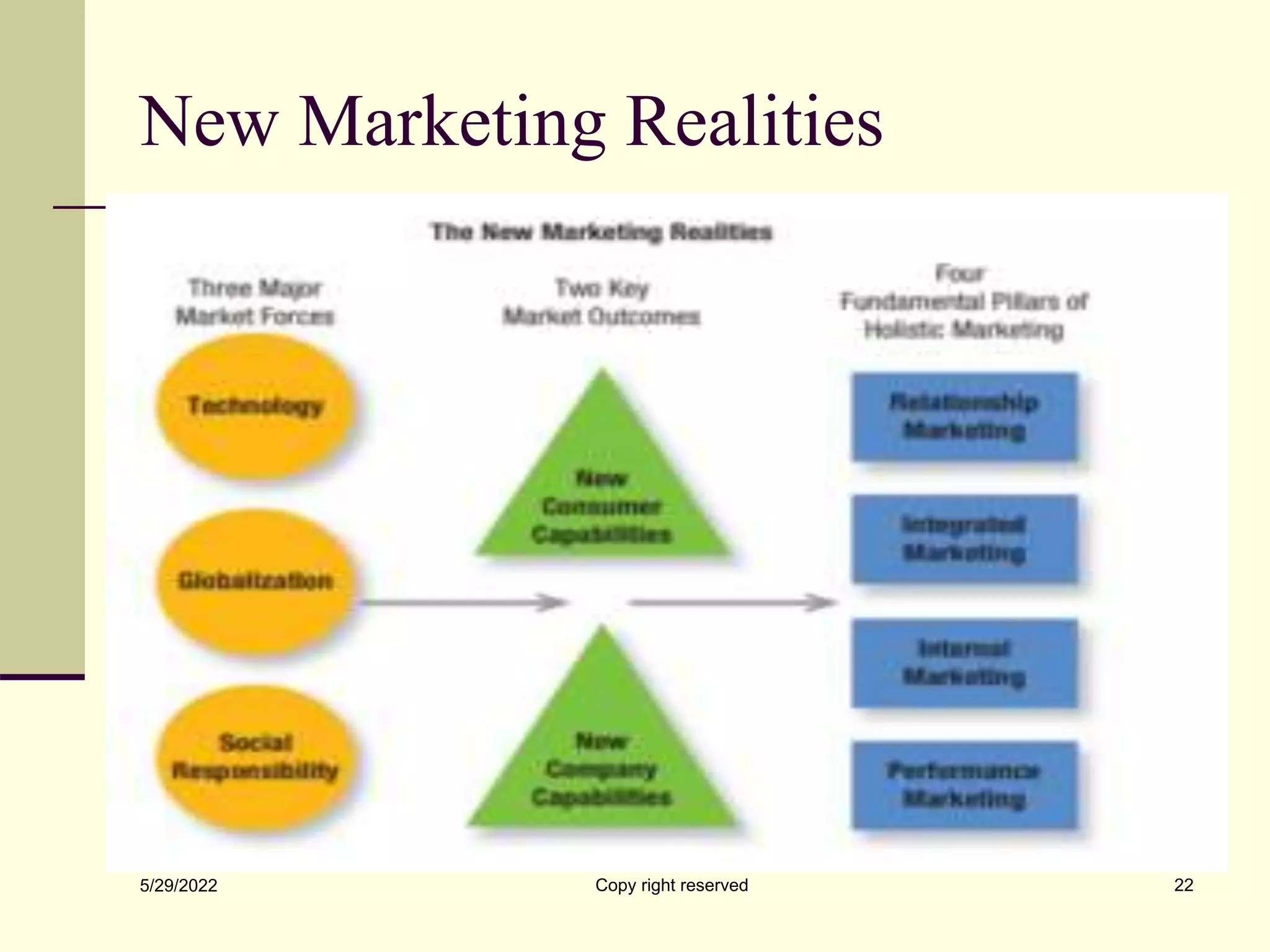
The New Marketing Realities
 Technology
 Globalization
 Social Responsibility
5/29/2022 Copy right reserved 21
New Marketing Realities
5/29/2022 Copy right reserved 22
Company orientation towards
the market place
 Production concept
 Product concept
 Selling concept
 New marketing concept
 Customer concept
 Societal marketing concept
 Holistic concept
5/29/2022 Copy right reserved 23
Holistic Marketing Concept
5/29/2022 Copy right reserved 24
Traditional Four Ps
 Product
 Place
 Price
 Promotion
5/29/2022 Copy right reserved 25
Modern Marketing Management
four Ps (The new four Ps)
 People
 Process
 Programs
 Performance
5/29/2022 Copy right reserved 26
Marketing Management
 Marketing management is the art and science of
choosing target markets and getting, keeping, and
growing customers through creating, delivering
and communicating superior customer value.
 Philip Kotler and Kevin Lane Keller
Marketing Management Task
 Developing marketing strategies and plans
 Capture marketing insights & performance
 Connect with customers
 Build strong brands
 Shape the market offering
 Deliver value
 Communicate value
 Create successful long-term growth
5/29/2022 Copy right reserved 28
Customer Perceived Value (CPV)
 CPV is the difference between the prospective
customer’s evaluation of all the benefits and costs
of an offering and the perceived alternatives.
Total Customer Benefits
 Total customer benefit is the perceived monetary
value of the bundle of economic, functional, and
psychological benefits customers expect from a
given market offering because of the product,
service, people or image.
Total Customer Cost
 Total customer cost is the perceived bundle of
costs customers expect to incur in evaluating,
obtaining, using, and disposing of the given
marketing offering, including monetary, time,
energy and psychological costs.
Any Queries?
Thank you
5/29/2022 Copy right reserved 33

Defining Marketing for the 21st Century.ppt

  • 1.
    Defining Marketing for 21stCentury Dr. Gopal Thapa Tribhuvan University
  • 2.
    Marketing  Telling andselling or  Satisfying needs profitably or  Managing profitable customer relationship or  Creating, communicating and delivering value 5/29/2022 2 Copy right reserved
  • 3.
    What is marketing? The systematic planning, implementation and control of a mix of business activities intended to bring together buyers and sellers for the mutually advantageous exchange or transfer of products. (Dictionary of Marketing)  Marketing is a societal process by which individuals and groups obtain what they need and want through creating, offering, and freely exchanging products and services of value with others. (Kotler and Keller) 5/29/2022 Copy right reserved 3
  • 4.
    What is marketing? Marketing is the activity, set of institutions and processes for creating, communicating, delivering and exchanging offerings that have value for the customers, clients, partners and society at large. (American Marketing Association) 5/29/2022 Copy right reserved 4
  • 5.
    Marketing Management  Marketingmanagement is the art and science of choosing target markets and getting, keeping, and growing customers through creating, delivering and communicating superior customer value.  Philip Kotler and Kevin Lane Keller
  • 6.
    Importance of Marketing Financial success depends on marketing  No demand - no business  Marketing decisions tough  – What to design  – What prices to offer  – Where to sell  – How much to spend on advertising… 5/29/2022 Copy right reserved 6
  • 7.
    What is marketed? Physical goods  Services  Events  Experiences  Persons  Places  Properties  Organizations  Information  Ideas 5/29/2022 7 Copy right reserved
  • 8.
    Who markets?  Marketersand Prospects  A marketer is someone who seeks a response – attention, a purchase, a vote, a donation – from another party called prospect  If two parties are seeking to sell something to each other, we call them both marketers. 5/29/2022 Copy right reserved 8
  • 9.
    Core Marketing Concepts Needs, wants, demand  Target market, positioning and segmentation  Offerings and brand  Value and satisfaction  Market  Exchange  Product  Marketing channels  Media  Supply chain  Competition  Marketing environment 5/29/2022 9 Copy right reserved
  • 10.
    Needs, wants anddemand  Needs – states of felt deprivation  Wants – specific satisfiers of needs shaped by culture, economic condition as well as individual personality  Demand – human wants that are backed by willingness, buying power and authority to purchase. 5/29/2022 10 Copy right reserved
  • 11.
    Segmentation, Targeting & Positioning Market Segmentation: Dividing a market into distinct groups with distinct needs characteristics or behaviors who might require separate products or marketing mixes.  Target Marketing: The Process of evaluating each market segment’s attractiveness and selecting one or more segments to enter.  Positioning: Arranging for a product to occupy a clear, distinctive and desirable place relative to competing products in the minds of target customers. 5/29/2022 11 Copy right reserved
  • 12.
    Marketing offer andbrand  Marketing offer: Some combination of products, services, information or experiences offered to a market to satisfy customer.  Brand : Any word, sign, symbol etc. for identification and differentiation of product. It includes brand name, brand mark and trade mark. 5/29/2022 12 Copy right reserved
  • 13.
    Value and Satisfaction Value – relationship between benefit and cost  Satisfaction – Comparison between customer’s expectation and product performance  Expectation = performance  Expectation < performance  Expectation > Performance 5/29/2022 13 Copy right reserved
  • 14.
    Market  Is placea market?  A market is the set of actual and potential buyers of a product  Marketers are keenly interesting in markets  Marketer’s task is managing markets to bring about profitable exchange relationship 5/29/2022 14 Copy right reserved
  • 15.
    Exchange  Exchange isthe act of obtaining a desired product from someone by offering something in return  Transaction is marketer’s unit of measurement  A transaction consists of a trade of values between two parties. 5/29/2022 15 Copy right reserved
  • 16.
    Product  Anything offeredby the marketer for customer’s satisfaction  There are five levels of products  Core product  Actual product  Augmented product  Expected product  Potential product 5/29/2022 16 Copy right reserved
  • 17.
    Marketing Channel  Communicationchannel – Radio, TV, newspaper, magazine etc  Distribution channel – Agent, wholesaler, retailer etc.  Service channel – transport co., warehouse, bank and insurance co. etc. 5/29/2022 17 Copy right reserved
  • 18.
    Supply Chain  Supplychain is a longer channel stretching from raw materials to components to final products that are carried to final buyers.  5/29/2022 18 Copy right reserved
  • 19.
    Competition  Competition includesall the actual and potential rivals offerings and substitutes a buyer might consider.  Competition may be:  price competition or non-price competition  brand competition Monopoly, monopolistic or perfect competition 5/29/2022 19 Copy right reserved
  • 20.
    Marketing Environment  Theactors and forces outside marketing that affect marketing management’s ability to build and maintain successful relationships with target customers.  It includes: Micro environment and macro environment 5/29/2022 20 Copy right reserved
  • 21.
    The New MarketingRealities  Technology  Globalization  Social Responsibility 5/29/2022 Copy right reserved 21
  • 22.
    New Marketing Realities 5/29/2022Copy right reserved 22
  • 23.
    Company orientation towards themarket place  Production concept  Product concept  Selling concept  New marketing concept  Customer concept  Societal marketing concept  Holistic concept 5/29/2022 Copy right reserved 23
  • 24.
  • 25.
    Traditional Four Ps Product  Place  Price  Promotion 5/29/2022 Copy right reserved 25
  • 26.
    Modern Marketing Management fourPs (The new four Ps)  People  Process  Programs  Performance 5/29/2022 Copy right reserved 26
  • 27.
    Marketing Management  Marketingmanagement is the art and science of choosing target markets and getting, keeping, and growing customers through creating, delivering and communicating superior customer value.  Philip Kotler and Kevin Lane Keller
  • 28.
    Marketing Management Task Developing marketing strategies and plans  Capture marketing insights & performance  Connect with customers  Build strong brands  Shape the market offering  Deliver value  Communicate value  Create successful long-term growth 5/29/2022 Copy right reserved 28
  • 29.
    Customer Perceived Value(CPV)  CPV is the difference between the prospective customer’s evaluation of all the benefits and costs of an offering and the perceived alternatives.
  • 31.
    Total Customer Benefits Total customer benefit is the perceived monetary value of the bundle of economic, functional, and psychological benefits customers expect from a given market offering because of the product, service, people or image.
  • 32.
    Total Customer Cost Total customer cost is the perceived bundle of costs customers expect to incur in evaluating, obtaining, using, and disposing of the given marketing offering, including monetary, time, energy and psychological costs.
  • 33.
    Any Queries? Thank you 5/29/2022Copy right reserved 33