Market Segmentation
Dr. Gopal Thapa
Tribhuvan University
Market Segmentation
 Market Segmentation divides a market into well-
defined slices.
 A market segment consists of a group of
customers who share a similar set of needs and
wants.
 Marketer’s task is to identify the appropriate
number and nature of market segments and decide
which one(s) to target.
04/08/19 Copy right reserved 2
Market Segmentation
 Market consists of buyers and buyers differ in ore
or more ways.
 They may differ in their wants, resources,
locations, buying attitudes, and buying practices.
 Through market segmentation, companies divide
large, heterogeneous markets into smaller
segments that can be reached more efficiently and
effectively with products and services that match
their unique needs.
04/08/19 Copy right reserved 3
Segmentation, Targeting &
Positioning (STP)
 Market segmentation is dividing a market into
distinct groups with distinct needs, characteristics, or
behavior who might require separate products or
marketing mix.
 Target marketing is the process of evaluating each
market segment’s attractiveness and selecting one or
more segments to enter.
 Market positioning is arranging for a product to
occupy a clear, distinctive and desirable place relative
to competing products in the mind of target customers
04/08/19 Copy right reserved 4
Market Segmentation Process
 Market survey
 Segment identification
 Segment profiling
 Segment selection
 Product positioning
04/08/19 Copy right reserved 5
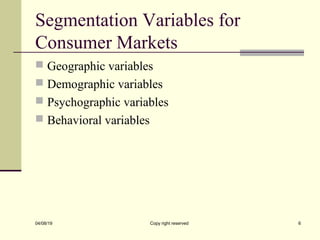
Segmentation Variables for
Consumer Markets
 Geographic variables
 Demographic variables
 Psychographic variables
 Behavioral variables
04/08/19 Copy right reserved 6
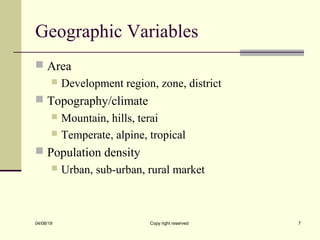
Geographic Variables
 Area
 Development region, zone, district
 Topography/climate
 Mountain, hills, terai
 Temperate, alpine, tropical
 Population density
 Urban, sub-urban, rural market
04/08/19 Copy right reserved 7
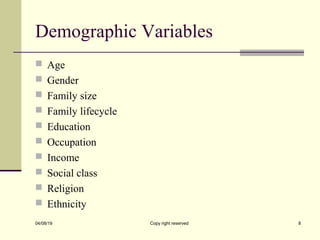
Demographic Variables
 Age
 Gender
 Family size
 Family lifecycle
 Education
 Occupation
 Income
 Social class
 Religion
 Ethnicity
04/08/19 Copy right reserved 8
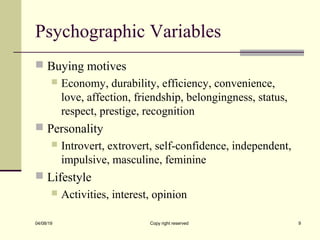
Psychographic Variables
 Buying motives
 Economy, durability, efficiency, convenience,
love, affection, friendship, belongingness, status,
respect, prestige, recognition
 Personality
 Introvert, extrovert, self-confidence, independent,
impulsive, masculine, feminine
 Lifestyle
 Activities, interest, opinion
04/08/19 Copy right reserved 9
Behavioral Variables
 Product benefits
 Occasions
 User status
 Usage rate
 Loyalty status
 Marketing factor sensitivity
 Buyer-readiness stage
 Attitude
04/08/19 Copy right reserved 10
Variables for Business Market
Segmentation
 Geographic variables
 Location, topography, climate
 Demographic variables
 Type of industry, size of customer
 Operating variables
 Technology, usage rate, service needed
 Purchase related
 Purchase organization, documentation, negotiation
period
04/08/19 Copy right reserved 11
Evaluation of Market Segments
 Segment attractiveness
 Size and growth, profitability ,competition
,technology, customer loyalty, risks
 Organizational objectives and resources
 Segment Relations
 Inter-relationship
 Cooperation
 Ethical Considerations
 Government Policies
04/08/19 Copy right reserved 12
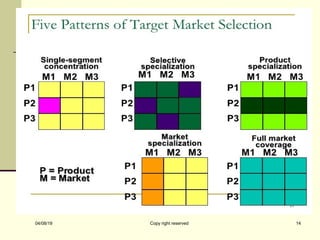
Segment selection (Target
Marketing)
 Single segment coverage
 Multi-segment coverage
 Product specialization
 Market specialization
 Full market coverage
 Niche marketing
 Individual marketing
04/08/19 Copy right reserved 13
04/08/19 Copy right reserved 14
Effective Segmentation Criteria
 Measurable
 Substantial
 Accessible
 Actionable
 Differentiable
04/08/19 Copy right reserved 15
Positioning
 Act of designing the company’s offer and image
so that it occupies a distinct and value place in the
target customer’s mind
04/08/19 Copy right reserved 16
Types of Positioning
 Attribute positioning
 Benefit positioning
 Image positioning
 Usage occasion positioning
 User positioning
 Competitive positioning
 Product class positioning
04/08/19 Copy right reserved 17

Market segmentation

  • 1.
    Market Segmentation Dr. GopalThapa Tribhuvan University
  • 2.
    Market Segmentation  MarketSegmentation divides a market into well- defined slices.  A market segment consists of a group of customers who share a similar set of needs and wants.  Marketer’s task is to identify the appropriate number and nature of market segments and decide which one(s) to target. 04/08/19 Copy right reserved 2
  • 3.
    Market Segmentation  Marketconsists of buyers and buyers differ in ore or more ways.  They may differ in their wants, resources, locations, buying attitudes, and buying practices.  Through market segmentation, companies divide large, heterogeneous markets into smaller segments that can be reached more efficiently and effectively with products and services that match their unique needs. 04/08/19 Copy right reserved 3
  • 4.
    Segmentation, Targeting & Positioning(STP)  Market segmentation is dividing a market into distinct groups with distinct needs, characteristics, or behavior who might require separate products or marketing mix.  Target marketing is the process of evaluating each market segment’s attractiveness and selecting one or more segments to enter.  Market positioning is arranging for a product to occupy a clear, distinctive and desirable place relative to competing products in the mind of target customers 04/08/19 Copy right reserved 4
  • 5.
    Market Segmentation Process Market survey  Segment identification  Segment profiling  Segment selection  Product positioning 04/08/19 Copy right reserved 5
  • 6.
    Segmentation Variables for ConsumerMarkets  Geographic variables  Demographic variables  Psychographic variables  Behavioral variables 04/08/19 Copy right reserved 6
  • 7.
    Geographic Variables  Area Development region, zone, district  Topography/climate  Mountain, hills, terai  Temperate, alpine, tropical  Population density  Urban, sub-urban, rural market 04/08/19 Copy right reserved 7
  • 8.
    Demographic Variables  Age Gender  Family size  Family lifecycle  Education  Occupation  Income  Social class  Religion  Ethnicity 04/08/19 Copy right reserved 8
  • 9.
    Psychographic Variables  Buyingmotives  Economy, durability, efficiency, convenience, love, affection, friendship, belongingness, status, respect, prestige, recognition  Personality  Introvert, extrovert, self-confidence, independent, impulsive, masculine, feminine  Lifestyle  Activities, interest, opinion 04/08/19 Copy right reserved 9
  • 10.
    Behavioral Variables  Productbenefits  Occasions  User status  Usage rate  Loyalty status  Marketing factor sensitivity  Buyer-readiness stage  Attitude 04/08/19 Copy right reserved 10
  • 11.
    Variables for BusinessMarket Segmentation  Geographic variables  Location, topography, climate  Demographic variables  Type of industry, size of customer  Operating variables  Technology, usage rate, service needed  Purchase related  Purchase organization, documentation, negotiation period 04/08/19 Copy right reserved 11
  • 12.
    Evaluation of MarketSegments  Segment attractiveness  Size and growth, profitability ,competition ,technology, customer loyalty, risks  Organizational objectives and resources  Segment Relations  Inter-relationship  Cooperation  Ethical Considerations  Government Policies 04/08/19 Copy right reserved 12
  • 13.
    Segment selection (Target Marketing) Single segment coverage  Multi-segment coverage  Product specialization  Market specialization  Full market coverage  Niche marketing  Individual marketing 04/08/19 Copy right reserved 13
  • 14.
  • 15.
    Effective Segmentation Criteria Measurable  Substantial  Accessible  Actionable  Differentiable 04/08/19 Copy right reserved 15
  • 16.
    Positioning  Act ofdesigning the company’s offer and image so that it occupies a distinct and value place in the target customer’s mind 04/08/19 Copy right reserved 16
  • 17.
    Types of Positioning Attribute positioning  Benefit positioning  Image positioning  Usage occasion positioning  User positioning  Competitive positioning  Product class positioning 04/08/19 Copy right reserved 17