





WEL - COME 1
Basavaraj Panjagal
University of Horticultural Sciences Bagalkot
K R C College of Horticulture , Arabhavi
Department of Vegetable Science
Topic ; Seed Health testing .
Presented by
Basavaraj S Panjagal
Ph.D Research Scholar
2
Basavaraj Panjagal
Seed
• Seed is the basic input in agriculture upon
which other inputs are applied .
• Seed is a ripened ovule containing embryo
which has developed after fertilisation.
• seed is any part or organ of plant which has
capability to regenerate a new vareity.
3
Basavaraj Panjagal
Seed testing
• It includes ;
✓Germination test
✓ genetic purity
✓Physical purity
✓ seed viability
✓seedling vigour
4
Basavaraj Panjagal
Objective of Seed Testing
• To identify the quality problem and their probable cause
• To determine their quality, that is, their suitability for
planting
• To determine the need for drying and processing and
specific procedures that should be used
• To determine if seed meets established quality standards or
labelling specifications.
• To establish quality and provide a basis for price and
consumer discrimination among lots in the market..
5
Basavaraj Panjagal
• What is a germination test?
A test which is done to determine what proportion of seeds in an
accession will germinate under favourable conditions and produce
normal seedlings (seedlings that have the essential structures: roots,
shoots and sufficient food reserves) capable of development into
reproductively mature plants.
Methods;
1. Top-of-paper method
2. Between-paper method
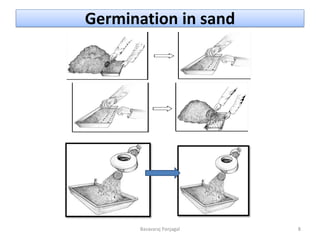
3. Germination in sand
4. Agar method
6
Basavaraj Panjagal
Top paper method
7
Basavaraj Panjagal
Germination in sand
8
Basavaraj Panjagal
Between-paper method
9
Basavaraj Panjagal
Agar method
• Agar is an alternative substrate to paper, particularly for
testing germination in small and medium-sized seeds. Agar
dissolves slowly in hot water and forms a viscous solution,
which forms a stiff jelly upon cooling. Arrange the seeds
equidistantly on the surface of the agar.
• Cover the dishes with their lids and place them in an
incubator maintained at the recommended temperature for
the species
• Run the test for the recommended period and count the
number of seeds that have germinated.
10
Basavaraj Panjagal
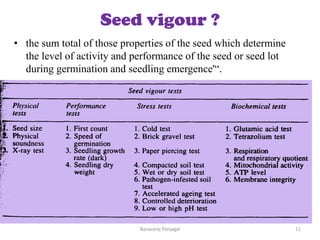
Seed vigour ?
• the sum total of those properties of the seed which determine
the level of activity and performance of the seed or seed lot
during germination and seedling emergence'“.
11
Basavaraj Panjagal
Seed Health Testing
• Seed Health Testing is a Science of
determining the presence or absence of disease
causing agents, such as fungi, bacteria and
viruses.
• Animal pests like eelworms, insects in the seed
samples.
12
Basavaraj Panjagal
Objectives of Seed health testing
• 1. Seed health testing is necessary for the improvement of
seed stock in certification scheme.
• 2. It is necessary to satisfy quarantine requirement of a
country.
• 3. It is done to know the planting value of a given seed lot in
order to forecast the field emergence and predict the health
of the mature crop.
• 4. It is necessary to know the storage quality or feeding
value of a seed lot.
• 5. It is necessary for checking the advisability of treatment.
• 6. It is done to know the efficacy of seed treating chemicals.
13
Basavaraj Panjagal
• Methodologies required for seed health testing must fulfill certain
criteria. An ideal seed health testing method should have :
(a) Specificity :- that is the method should have the ability to distinguish
the target pathogen from all organisms likely to occur on seeds.
(b) Sensitivity : means that the method must be sensitive enough to detect
organism even in the low incidence in seed stocks.
(c) Simplicity : that the methodology should be simple so as to minimize
the number of stages to reduce room for error and to enable tests to be
performed by simpal technicians and not require high qualified staff.
(d) Cost effectiveness : that the methodology should be cheap and the test
costs should form part of acceptable production margins of each crop
and
(e) Reliability : that is the method must be sufficiently robust so that
results are repeatable with in and between samples of the same stock
regardless of who performs the test.
14
Basavaraj Panjagal
General Methods of Seed Health
testing :-
1. Inspection Of Dry Seeds.
2. Washing Test
3. Incubation Methods
4. Seedling symptom test.
5. Test Tube Agar method
6. Grow-On Test.
7. Pathogenicity Test.
8. Indicator Plant test.
9. Hypersensitive Test.
10.Serological Tests.
11.Polymerase Chain Reaction.
15
Basavaraj Panjagal
Washing test
• The washing test is a seed health testing method which is used
solely to test seeds for seed-borne pathogens, the inoculum of which
is present loosely on the seed surface.
Procedure:
• Two g of seed is taken in a test tube with 10 ml of water and shaken
for 10 mins. on a mechanical shaker.
• The suspension is examined at such or the suspended spores are
concentrated by centrifuging at 3000 rpm for 15-20 mts.
• The supernatant is discarded and the spores are again suspended in 2
ml of lactophenol (a mixture of tactic acid, phenol, water and
glycerol in the ratio of 1:1:1:2).
• This suspension is then examined under the microscope for the
presence of spores, conidia and other fructifications.
16
Basavaraj Panjagal
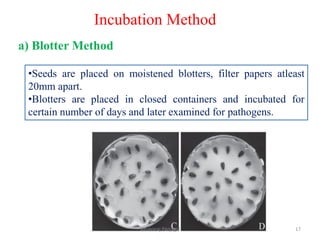
a) Blotter Method
•Seeds are placed on moistened blotters, filter papers atleast
20mm apart.
•Blotters are placed in closed containers and incubated for
certain number of days and later examined for pathogens.
Incubation Method
17
Basavaraj Panjagal
Contn...
b) Agar plate method
• In the agar plate method generally surface disinfected seed are
plated on an agar medium and the plated seeds are usually
incubated for 5-7 days at 22-25˚C under 12 hr alternating
cycles of light and darkness.
• At the end of incubation period fungi growing out form the
seed on the medium are examined and identified.
• Identification is based on colony character and morphology of
sporulating structures under a compound microscope.
18
Basavaraj Panjagal
Seedling symptom test
• Some of the seed-borne fungi are capable of attacking seeds, making
them ungerminable resulting in rotting of seeds, and in producing
symptoms on young seedlings or even killing the affected seedlings.
E.g., Alternaria, Biploris, Fusarium, Colletotrichum,
Macrophomina and Pyricularia
• Recording of the symptoms in the seedlings are taken as a measure
of infection present in the seed. Symptoms can some times be seen
on the seedlings in the blotter and agar plate methods, as well.
• Infected seeds, under optimal conditions of temperature, light and
humidity may develop symptoms comparable with those produced
under field conditions. The seedling symptom test, for certain types
of pathogens, will provide information pertaining to field
performance of the seed lot.
19
Basavaraj Panjagal
Test tube agar method
• A test tube agar method is used to study the particular
symptoms on seedlings raised from Infected seeds. This helps in
identifying the pathogens in question on the basis of symptoms
produced by them on the germinating seedlings.
• Incubate the tubes at 20°C ± 2°C for 14 days under 12h
alternating cycles of artificial daylight and darkness. The
aluminum foil/cotton plugs must be removed the day seedlings
start touching them.
• Inspect all tubes and separate them into three groups: (1)
healthy-looking seedlings (2) seedlings showing symptoms and
(3) seeds that have not germinated. 20
Basavaraj Panjagal
Grow-On Test
• Greenhouse germination is an important test for
evaluating
• seed viability and Detecting the absence or presence
of seed-transmitted pathogens.
• Growing on test is generally performed for seed
borne bacteria and viruses.
• Testing of seed by growing-on test is generally
accomplished by visual observation, indictor plant,
Serology, and cDNA tests.
21
Basavaraj Panjagal
Pathogenicity test
• For many seed borne disease this test is the only method for confirming of
negating the initial presumptive diagnosis of plant disease. It is a test used
for confirmation of an organism to be pathogenic on host plat.
Procedure:
• A required conc. Of the inoculums is prepared using pure culture of
pathogen in question.
• Inoculums may be applied as a fine mist spray on foliar plant parts.
• Inoculated plants are incubated for 48 hrs.
• After incubation transfer the plant in glass house or growth chamber at
25-30˚C at high RH with 12-16 hrs. Light.
• Observe periodically the symptoms on the plant.
22
Basavaraj Panjagal
Indicator test
• Working seed sample is sterilized with (2.6%) sodium-
hypochlorite for 15 min, and rinsed with sterile water.
• The seed sample is incubated for 18-24 h in sterile water.
• The water suspension is inoculated by infiltration into
the primary leaf node of 10 day old bean seedlings.
• The appearance of lesions followed systemic necrosis is
positive reaction.
23
Basavaraj Panjagal
Hypersensitive Test
• Most bacterial plant pathogens can induce a
hypersensitive response when injected into the tissue
of non host plant
• A variety of plants may be used but for many
bacteria tobacco is the preferred plant, since it is easy
to cultivate and maintain.
• Its large cavities beside leaf veins make it relatively
easy to infiltrate inoculums and its reaction towards
many pathogen is well known but for Xanthomonas,
tomato is preferred.
24
Basavaraj Panjagal
Serological Technique
• Serological tests are based on ‘In vitro’ reactions
between antigens and antibodies.
• This specific recognition of antigens by antibody has
offered the basic principle for the development of
various serological methods for detection and
identification of phytobacteria.
• The washing of the working seed samples are cultured
for 36 hr using sterile distilled water.
• The supernatant is tested with antiserum of the
suspected pathogen.
25
Basavaraj Panjagal
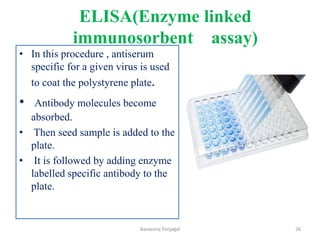
ELISA(Enzyme linked
immunosorbent assay)
• In this procedure , antiserum
specific for a given virus is used
to coat the polystyrene plate.
• Antibody molecules become
absorbed.
• Then seed sample is added to the
plate.
• It is followed by adding enzyme
labelled specific antibody to the
plate.
26
Basavaraj Panjagal
Contn…
• The enzyme alkaline phosphates is conjugated to the antibody
molecules specific for the virus under examination.
• Finally enzyme substrate is added to the plate.
• Hydrolyzed substrate is determined by measuring the
extinction spectrophotometrically or by visual observation.
27
Basavaraj Panjagal
PCR Method
• PCR is a promising tool for distinguishing specific
sequences from a complex mixture of DNA and
therefore is useful for determining the presence and
quantity of pathogen-specific or other unique
sequences within a sample.
• It is a Molecular method and it used widely used in
present day.
28
Basavaraj Panjagal
29
Basavaraj Panjagal

Seed health testing

  • 1.
    WEL - COME1 Basavaraj Panjagal
  • 2.
    University of HorticulturalSciences Bagalkot K R C College of Horticulture , Arabhavi Department of Vegetable Science Topic ; Seed Health testing . Presented by Basavaraj S Panjagal Ph.D Research Scholar 2 Basavaraj Panjagal
  • 3.
    Seed • Seed isthe basic input in agriculture upon which other inputs are applied . • Seed is a ripened ovule containing embryo which has developed after fertilisation. • seed is any part or organ of plant which has capability to regenerate a new vareity. 3 Basavaraj Panjagal
  • 4.
    Seed testing • Itincludes ; ✓Germination test ✓ genetic purity ✓Physical purity ✓ seed viability ✓seedling vigour 4 Basavaraj Panjagal
  • 5.
    Objective of SeedTesting • To identify the quality problem and their probable cause • To determine their quality, that is, their suitability for planting • To determine the need for drying and processing and specific procedures that should be used • To determine if seed meets established quality standards or labelling specifications. • To establish quality and provide a basis for price and consumer discrimination among lots in the market.. 5 Basavaraj Panjagal
  • 6.
    • What isa germination test? A test which is done to determine what proportion of seeds in an accession will germinate under favourable conditions and produce normal seedlings (seedlings that have the essential structures: roots, shoots and sufficient food reserves) capable of development into reproductively mature plants. Methods; 1. Top-of-paper method 2. Between-paper method 3. Germination in sand 4. Agar method 6 Basavaraj Panjagal
  • 7.
  • 8.
  • 9.
  • 10.
    Agar method • Agaris an alternative substrate to paper, particularly for testing germination in small and medium-sized seeds. Agar dissolves slowly in hot water and forms a viscous solution, which forms a stiff jelly upon cooling. Arrange the seeds equidistantly on the surface of the agar. • Cover the dishes with their lids and place them in an incubator maintained at the recommended temperature for the species • Run the test for the recommended period and count the number of seeds that have germinated. 10 Basavaraj Panjagal
  • 11.
    Seed vigour ? •the sum total of those properties of the seed which determine the level of activity and performance of the seed or seed lot during germination and seedling emergence'“. 11 Basavaraj Panjagal
  • 12.
    Seed Health Testing •Seed Health Testing is a Science of determining the presence or absence of disease causing agents, such as fungi, bacteria and viruses. • Animal pests like eelworms, insects in the seed samples. 12 Basavaraj Panjagal
  • 13.
    Objectives of Seedhealth testing • 1. Seed health testing is necessary for the improvement of seed stock in certification scheme. • 2. It is necessary to satisfy quarantine requirement of a country. • 3. It is done to know the planting value of a given seed lot in order to forecast the field emergence and predict the health of the mature crop. • 4. It is necessary to know the storage quality or feeding value of a seed lot. • 5. It is necessary for checking the advisability of treatment. • 6. It is done to know the efficacy of seed treating chemicals. 13 Basavaraj Panjagal
  • 14.
    • Methodologies requiredfor seed health testing must fulfill certain criteria. An ideal seed health testing method should have : (a) Specificity :- that is the method should have the ability to distinguish the target pathogen from all organisms likely to occur on seeds. (b) Sensitivity : means that the method must be sensitive enough to detect organism even in the low incidence in seed stocks. (c) Simplicity : that the methodology should be simple so as to minimize the number of stages to reduce room for error and to enable tests to be performed by simpal technicians and not require high qualified staff. (d) Cost effectiveness : that the methodology should be cheap and the test costs should form part of acceptable production margins of each crop and (e) Reliability : that is the method must be sufficiently robust so that results are repeatable with in and between samples of the same stock regardless of who performs the test. 14 Basavaraj Panjagal
  • 15.
    General Methods ofSeed Health testing :- 1. Inspection Of Dry Seeds. 2. Washing Test 3. Incubation Methods 4. Seedling symptom test. 5. Test Tube Agar method 6. Grow-On Test. 7. Pathogenicity Test. 8. Indicator Plant test. 9. Hypersensitive Test. 10.Serological Tests. 11.Polymerase Chain Reaction. 15 Basavaraj Panjagal
  • 16.
    Washing test • Thewashing test is a seed health testing method which is used solely to test seeds for seed-borne pathogens, the inoculum of which is present loosely on the seed surface. Procedure: • Two g of seed is taken in a test tube with 10 ml of water and shaken for 10 mins. on a mechanical shaker. • The suspension is examined at such or the suspended spores are concentrated by centrifuging at 3000 rpm for 15-20 mts. • The supernatant is discarded and the spores are again suspended in 2 ml of lactophenol (a mixture of tactic acid, phenol, water and glycerol in the ratio of 1:1:1:2). • This suspension is then examined under the microscope for the presence of spores, conidia and other fructifications. 16 Basavaraj Panjagal
  • 17.
    a) Blotter Method •Seedsare placed on moistened blotters, filter papers atleast 20mm apart. •Blotters are placed in closed containers and incubated for certain number of days and later examined for pathogens. Incubation Method 17 Basavaraj Panjagal
  • 18.
    Contn... b) Agar platemethod • In the agar plate method generally surface disinfected seed are plated on an agar medium and the plated seeds are usually incubated for 5-7 days at 22-25˚C under 12 hr alternating cycles of light and darkness. • At the end of incubation period fungi growing out form the seed on the medium are examined and identified. • Identification is based on colony character and morphology of sporulating structures under a compound microscope. 18 Basavaraj Panjagal
  • 19.
    Seedling symptom test •Some of the seed-borne fungi are capable of attacking seeds, making them ungerminable resulting in rotting of seeds, and in producing symptoms on young seedlings or even killing the affected seedlings. E.g., Alternaria, Biploris, Fusarium, Colletotrichum, Macrophomina and Pyricularia • Recording of the symptoms in the seedlings are taken as a measure of infection present in the seed. Symptoms can some times be seen on the seedlings in the blotter and agar plate methods, as well. • Infected seeds, under optimal conditions of temperature, light and humidity may develop symptoms comparable with those produced under field conditions. The seedling symptom test, for certain types of pathogens, will provide information pertaining to field performance of the seed lot. 19 Basavaraj Panjagal
  • 20.
    Test tube agarmethod • A test tube agar method is used to study the particular symptoms on seedlings raised from Infected seeds. This helps in identifying the pathogens in question on the basis of symptoms produced by them on the germinating seedlings. • Incubate the tubes at 20°C ± 2°C for 14 days under 12h alternating cycles of artificial daylight and darkness. The aluminum foil/cotton plugs must be removed the day seedlings start touching them. • Inspect all tubes and separate them into three groups: (1) healthy-looking seedlings (2) seedlings showing symptoms and (3) seeds that have not germinated. 20 Basavaraj Panjagal
  • 21.
    Grow-On Test • Greenhousegermination is an important test for evaluating • seed viability and Detecting the absence or presence of seed-transmitted pathogens. • Growing on test is generally performed for seed borne bacteria and viruses. • Testing of seed by growing-on test is generally accomplished by visual observation, indictor plant, Serology, and cDNA tests. 21 Basavaraj Panjagal
  • 22.
    Pathogenicity test • Formany seed borne disease this test is the only method for confirming of negating the initial presumptive diagnosis of plant disease. It is a test used for confirmation of an organism to be pathogenic on host plat. Procedure: • A required conc. Of the inoculums is prepared using pure culture of pathogen in question. • Inoculums may be applied as a fine mist spray on foliar plant parts. • Inoculated plants are incubated for 48 hrs. • After incubation transfer the plant in glass house or growth chamber at 25-30˚C at high RH with 12-16 hrs. Light. • Observe periodically the symptoms on the plant. 22 Basavaraj Panjagal
  • 23.
    Indicator test • Workingseed sample is sterilized with (2.6%) sodium- hypochlorite for 15 min, and rinsed with sterile water. • The seed sample is incubated for 18-24 h in sterile water. • The water suspension is inoculated by infiltration into the primary leaf node of 10 day old bean seedlings. • The appearance of lesions followed systemic necrosis is positive reaction. 23 Basavaraj Panjagal
  • 24.
    Hypersensitive Test • Mostbacterial plant pathogens can induce a hypersensitive response when injected into the tissue of non host plant • A variety of plants may be used but for many bacteria tobacco is the preferred plant, since it is easy to cultivate and maintain. • Its large cavities beside leaf veins make it relatively easy to infiltrate inoculums and its reaction towards many pathogen is well known but for Xanthomonas, tomato is preferred. 24 Basavaraj Panjagal
  • 25.
    Serological Technique • Serologicaltests are based on ‘In vitro’ reactions between antigens and antibodies. • This specific recognition of antigens by antibody has offered the basic principle for the development of various serological methods for detection and identification of phytobacteria. • The washing of the working seed samples are cultured for 36 hr using sterile distilled water. • The supernatant is tested with antiserum of the suspected pathogen. 25 Basavaraj Panjagal
  • 26.
    ELISA(Enzyme linked immunosorbent assay) •In this procedure , antiserum specific for a given virus is used to coat the polystyrene plate. • Antibody molecules become absorbed. • Then seed sample is added to the plate. • It is followed by adding enzyme labelled specific antibody to the plate. 26 Basavaraj Panjagal
  • 27.
    Contn… • The enzymealkaline phosphates is conjugated to the antibody molecules specific for the virus under examination. • Finally enzyme substrate is added to the plate. • Hydrolyzed substrate is determined by measuring the extinction spectrophotometrically or by visual observation. 27 Basavaraj Panjagal
  • 28.
    PCR Method • PCRis a promising tool for distinguishing specific sequences from a complex mixture of DNA and therefore is useful for determining the presence and quantity of pathogen-specific or other unique sequences within a sample. • It is a Molecular method and it used widely used in present day. 28 Basavaraj Panjagal
  • 29.