Seed production of pigeon pea ( Arhar )
Ranjeet Maurya
INTDODUCTION
Scientific name :- Cajanus cajan
Family :- Fabaceae
Chromosome no. :- 2n = 22
Origin place :- Africa
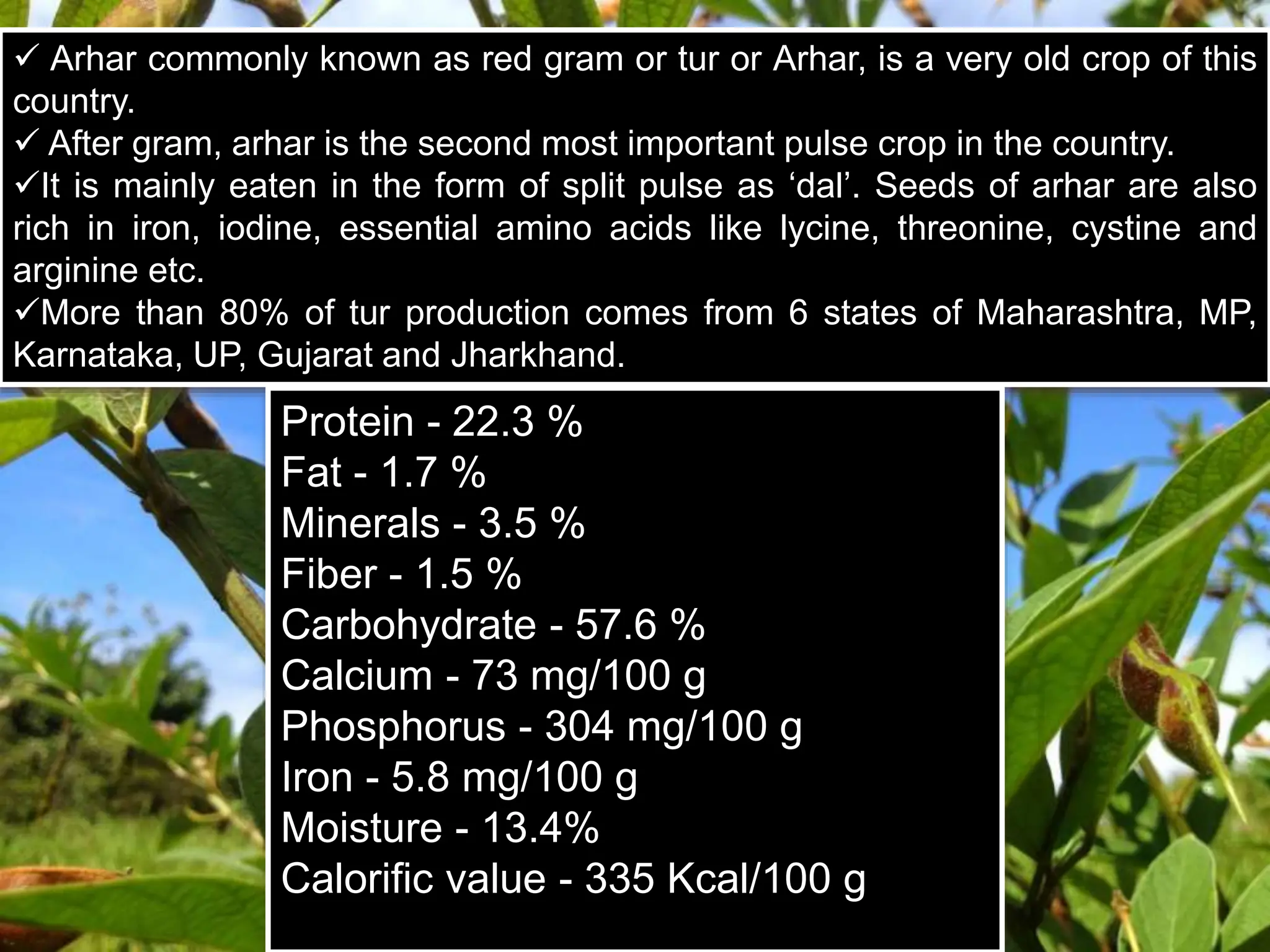
 Arhar commonly known as red gram or tur or Arhar, is a very old crop of this
country.
 After gram, arhar is the second most important pulse crop in the country.
It is mainly eaten in the form of split pulse as ‘dal’. Seeds of arhar are also
rich in iron, iodine, essential amino acids like lycine, threonine, cystine and
arginine etc.
More than 80% of tur production comes from 6 states of Maharashtra, MP,
Karnataka, UP, Gujarat and Jharkhand.
Protein - 22.3 %
Fat - 1.7 %
Minerals - 3.5 %
Fiber - 1.5 %
Carbohydrate - 57.6 %
Calcium - 73 mg/100 g
Phosphorus - 304 mg/100 g
Iron - 5.8 mg/100 g
Moisture - 13.4%
Calorific value - 335 Kcal/100 g
Pigeonpea is predominantly a crop of tropical areas
mainly cultivated in semi arid regions of India.
Pigeonpea can be grown with a temperature
ranging from 260C to 300C in the rainy season
(June to October) and 170C to 220C in the post
rainy (November to March) season
CLIMATE
SOIL
It is successfully grown in black cotton soils, well
drained with a p H ranging from 7.0 - 8.5.
Pigeonpea responds well to properly tilled and we ll
drained seedbed
Sowing Time and Method
Early Maturing varieties - First fortnight of June;
Medium & Late Maturing Varieties - Second fortnight of
June.
 Line sowing by seed drill or desi plough or by dibbling
on the ridge and beds, both are recommended as per
the area.
Seed Rate and Spacing
Early Maturing Var. - 20 - 25 k g/ha (Row to Row - 45 -
60 cm & Plant to Plant - 10 - 15 cm)
Medium/Late Maturing Var. - 15 - 20 k g/ha (Row to Row
- 60 - 75 & Plant to Plant - 15 - 20 cm)
Hybrid seed production
Foundation seed Certifide seed
50 meter 10 meter
Varaity
UPAS -120 , PRABHAT , ICPH -8 ,
Wilt disease
Symptoms: Xylem gradually develops black
streaks, dark purple bands appear on the stem
surface plants extending upwards from the base.
Control Measures
Seed Treatment with Trichoderma viride @ 10
g/kg of seed or Thirum (2 gm) + Carbendazim
(1gm) / kg of seed;
Wilt disease
Symptoms: Xylem gradually develops
black streaks, dark purple bands
appear on the stem surface plants
extending upwards from the base.
Control Measures
Seed Treatment with Trichoderma
viride @ 10 g/kg of seed or Thirum (2
gm) + Carbendazim (1gm) / kg of seed;
Wilt disease
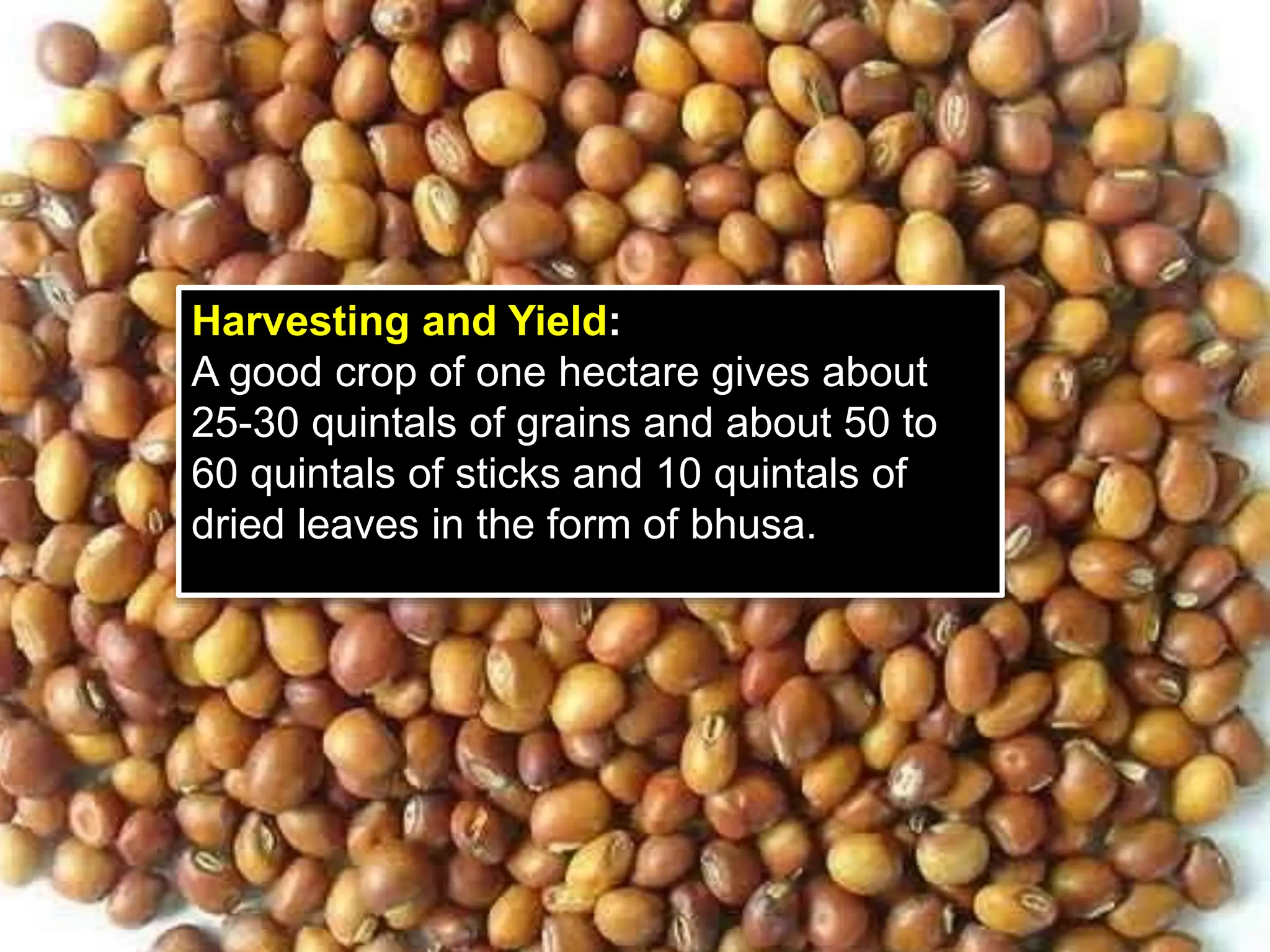
Harvesting and Yield:
A good crop of one hectare gives about
25-30 quintals of grains and about 50 to
60 quintals of sticks and 10 quintals of
dried leaves in the form of bhusa.
Harvesting
seed production of Arahar ( RANJEET MAURYA)

seed production of Arahar ( RANJEET MAURYA)

  • 1.
    Seed production ofpigeon pea ( Arhar ) Ranjeet Maurya
  • 2.
    INTDODUCTION Scientific name :-Cajanus cajan Family :- Fabaceae Chromosome no. :- 2n = 22 Origin place :- Africa
  • 3.
     Arhar commonlyknown as red gram or tur or Arhar, is a very old crop of this country.  After gram, arhar is the second most important pulse crop in the country. It is mainly eaten in the form of split pulse as ‘dal’. Seeds of arhar are also rich in iron, iodine, essential amino acids like lycine, threonine, cystine and arginine etc. More than 80% of tur production comes from 6 states of Maharashtra, MP, Karnataka, UP, Gujarat and Jharkhand. Protein - 22.3 % Fat - 1.7 % Minerals - 3.5 % Fiber - 1.5 % Carbohydrate - 57.6 % Calcium - 73 mg/100 g Phosphorus - 304 mg/100 g Iron - 5.8 mg/100 g Moisture - 13.4% Calorific value - 335 Kcal/100 g
  • 4.
    Pigeonpea is predominantlya crop of tropical areas mainly cultivated in semi arid regions of India. Pigeonpea can be grown with a temperature ranging from 260C to 300C in the rainy season (June to October) and 170C to 220C in the post rainy (November to March) season CLIMATE SOIL It is successfully grown in black cotton soils, well drained with a p H ranging from 7.0 - 8.5. Pigeonpea responds well to properly tilled and we ll drained seedbed
  • 5.
    Sowing Time andMethod Early Maturing varieties - First fortnight of June; Medium & Late Maturing Varieties - Second fortnight of June.  Line sowing by seed drill or desi plough or by dibbling on the ridge and beds, both are recommended as per the area. Seed Rate and Spacing Early Maturing Var. - 20 - 25 k g/ha (Row to Row - 45 - 60 cm & Plant to Plant - 10 - 15 cm) Medium/Late Maturing Var. - 15 - 20 k g/ha (Row to Row - 60 - 75 & Plant to Plant - 15 - 20 cm)
  • 6.
    Hybrid seed production Foundationseed Certifide seed 50 meter 10 meter Varaity UPAS -120 , PRABHAT , ICPH -8 ,
  • 7.
    Wilt disease Symptoms: Xylemgradually develops black streaks, dark purple bands appear on the stem surface plants extending upwards from the base. Control Measures Seed Treatment with Trichoderma viride @ 10 g/kg of seed or Thirum (2 gm) + Carbendazim (1gm) / kg of seed;
  • 8.
    Wilt disease Symptoms: Xylemgradually develops black streaks, dark purple bands appear on the stem surface plants extending upwards from the base. Control Measures Seed Treatment with Trichoderma viride @ 10 g/kg of seed or Thirum (2 gm) + Carbendazim (1gm) / kg of seed;
  • 9.
  • 10.
    Harvesting and Yield: Agood crop of one hectare gives about 25-30 quintals of grains and about 50 to 60 quintals of sticks and 10 quintals of dried leaves in the form of bhusa.
  • 11.