TOPIC :- SOMACLONAL VARIATION AND
IT,S CAUSES IN CROP
Ranjeet mauurya
Somaclonal Variation
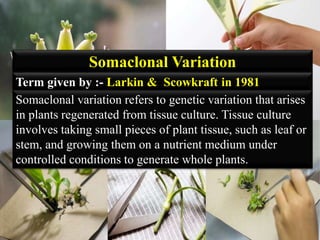
Somaclonal variation refers to genetic variation that arises
in plants regenerated from tissue culture. Tissue culture
involves taking small pieces of plant tissue, such as leaf or
stem, and growing them on a nutrient medium under
controlled conditions to generate whole plants.
Term given by :- Larkin & Scowkraft in 1981
Basic Features of Somaclonal Variations
i. Variations in number and structure of chromosomes are
commonly observed.
ii. Regenerated plants with altered chromosomal changes often show
changes in leaf shape and colour, growth rate and habit, and sexual
fertility.
iii. It is generally heritable mutations and persist in plant population
even after plantation into the field.
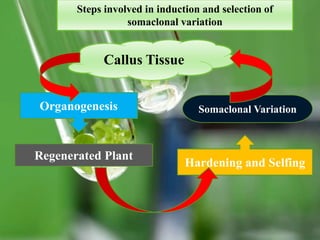
Steps involved in induction and selection of
somaclonal variation
Callus Tissue
Organogenesis
Regenerated Plant
Hardening and Selfing
Somaclonal Variation
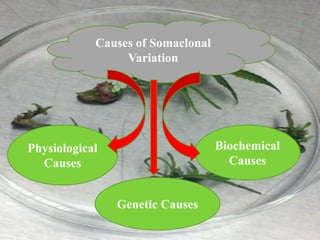
Causes of Somaclonal
Variation
Physiological
Causes
Genetic Causes
Biochemical
Causes
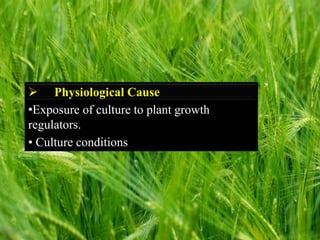
 Physiological Cause
•Exposure of culture to plant growth
regulators.
• Culture conditions
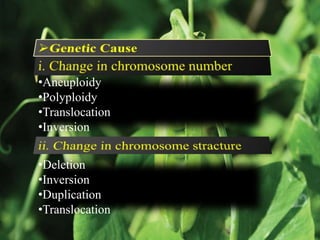
•Aneuploidy
•Polyploidy
•Translocation
•Inversion
•Deletion
•Inversion
•Duplication
•Translocation
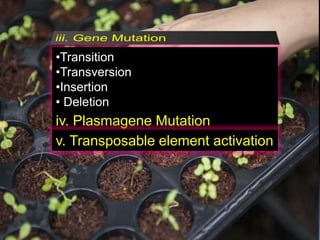
•Transition
•Transversion
•Insertion
• Deletion
iv. Plasmagene Mutation
v. Transposable element activation
Biochemical Cause
•Lack of photosynthetic ability due to
alteration in carbon metabolism
•Biosynthesis of starch via carotenoid
pathway
•Nitrogen metabolism
•Antibiotic resistance.
1. Analysis of morphological characters
2. Variant detection by cytological Studies
3. Detection of disease resistance variant.
4. Detection of herbicide resistance
variant.
5. Variant detection by DNA contents
6. Variant detection by gel electrophoresis
7. Detection of environmental stress
tolerant variant
Wheat Varieties:'Cham1' (Cham1al): Developed
in Australia
Rice Varieties: 'IR64‘BRRI dhan29'
Maize (Corn) Varieties: Pioneer® Brand Hybrid
Corn Varieties
Tomato Varieties:'UC82B'
The release variety of somaclonal variation
Improvement of existing clonal cultures
sugarcane-selections for higher yield & disease
resistance
potatoes-yield & disease resistance
Improved geraniums (esp. scented varieties)
woody ornamentals (e.g., Paulownia-selection
Help in crop improvement
Creation of additional genetic variations
Increased and improved production of
secondary metabolites
Selection of plants resistant to various toxins,
herbicides, high salt concentration and mineral
toxicity
Suitable for breeding of tree species
• A serious disadvantage occurs in operations which require
clonal uniformity, as in the horticulture and forestry industries
where tissue culture is employed for rapid propagation of elite
genotypes
•Sometime leads to undesirable results
•Selected variants are random and genetically unstable
•Require extensive and extended field trials
•Not suitable for complex agronomic traits like yield, quality etc.
•May develop variants with pleiotropic effects which are not true
somaclonal_variation  it,s crop improvment

somaclonal_variation it,s crop improvment

  • 2.
    TOPIC :- SOMACLONALVARIATION AND IT,S CAUSES IN CROP Ranjeet mauurya
  • 3.
    Somaclonal Variation Somaclonal variationrefers to genetic variation that arises in plants regenerated from tissue culture. Tissue culture involves taking small pieces of plant tissue, such as leaf or stem, and growing them on a nutrient medium under controlled conditions to generate whole plants. Term given by :- Larkin & Scowkraft in 1981
  • 4.
    Basic Features ofSomaclonal Variations i. Variations in number and structure of chromosomes are commonly observed. ii. Regenerated plants with altered chromosomal changes often show changes in leaf shape and colour, growth rate and habit, and sexual fertility. iii. It is generally heritable mutations and persist in plant population even after plantation into the field.
  • 5.
    Steps involved ininduction and selection of somaclonal variation Callus Tissue Organogenesis Regenerated Plant Hardening and Selfing Somaclonal Variation
  • 6.
  • 7.
     Physiological Cause •Exposureof culture to plant growth regulators. • Culture conditions
  • 8.
  • 9.
  • 10.
    Biochemical Cause •Lack ofphotosynthetic ability due to alteration in carbon metabolism •Biosynthesis of starch via carotenoid pathway •Nitrogen metabolism •Antibiotic resistance.
  • 11.
    1. Analysis ofmorphological characters 2. Variant detection by cytological Studies 3. Detection of disease resistance variant. 4. Detection of herbicide resistance variant. 5. Variant detection by DNA contents 6. Variant detection by gel electrophoresis 7. Detection of environmental stress tolerant variant
  • 12.
    Wheat Varieties:'Cham1' (Cham1al):Developed in Australia Rice Varieties: 'IR64‘BRRI dhan29' Maize (Corn) Varieties: Pioneer® Brand Hybrid Corn Varieties Tomato Varieties:'UC82B' The release variety of somaclonal variation
  • 13.
    Improvement of existingclonal cultures sugarcane-selections for higher yield & disease resistance potatoes-yield & disease resistance Improved geraniums (esp. scented varieties) woody ornamentals (e.g., Paulownia-selection
  • 14.
    Help in cropimprovement Creation of additional genetic variations Increased and improved production of secondary metabolites Selection of plants resistant to various toxins, herbicides, high salt concentration and mineral toxicity Suitable for breeding of tree species
  • 15.
    • A seriousdisadvantage occurs in operations which require clonal uniformity, as in the horticulture and forestry industries where tissue culture is employed for rapid propagation of elite genotypes •Sometime leads to undesirable results •Selected variants are random and genetically unstable •Require extensive and extended field trials •Not suitable for complex agronomic traits like yield, quality etc. •May develop variants with pleiotropic effects which are not true