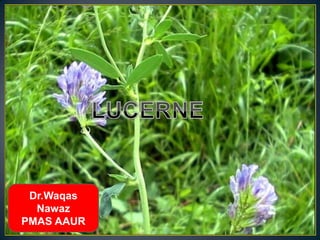
Dr.Waqas
  Nawaz
PMAS AAUR
• Scientific name: Medicago sativa
• Common name: In Arab known as alfalfa
                   In Europe called as lucerne

• Belongs to Leguminosae family ( soluble CHO & CP)
• Origin: Introduced from the Mediterranean
 region                                     LUCERNE was
                                              probably the
• It is called as
                                            first crop to be
        “Queen of forage crops”              cultivated for
                 WHILE                             hay

        “King of fodder crops” is berseem
First cut after 3
                                          month of
                                          sowing.(March)
                                          Later cuts after
                                          interval of 5-6
•   Perennial forage                      weeks.
•   Nitrogen-fixer
•   Highly palatable                       Because of its high
                                           level of
•   Digestible and nutritious
                                           PROTEIN
•   Lucerne probably the world’s best fodder
                                           ENERGY
•   Extremely drought tolerant             MINERALS
•   Fast growing (can be cut after 30 days VITAMINS
                                            of 1st cutting)
•   Frost tolerant
•   Susceptible to a range of pests and diseases
•   Rabi fodder crop(sown in winter, october to november)
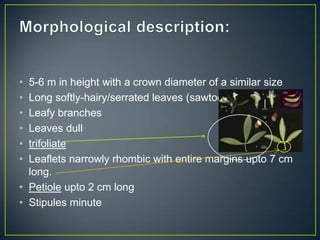
• 5-6 m in height with a crown diameter of a similar size
• Long softly-hairy/serrated leaves (sawtooth)
• Leafy branches
• Leaves dull
• trifoliate
• Leaflets narrowly rhombic with entire margins upto 7 cm
  long.
• Petiole upto 2 cm long
• Stipules minute
Plants –
•   An erect
•   2-3 ft tall
•   Multi-branched perennial plant with a very deep tap root
•   Plants develop a woody crown at ground level
•   Stems rising from the crown to around 1 m height.


Flowers –
• Flower blue but can purple or yellow (while Barseem has
  white)
• Flowers are a typical pea shape 12 – 15 mm long
• Develop in dense clusters of 20 – 30 flowers at the tips of
  the branches
Soil –
• Deep loamy soils rich in phosphorus, calcium and potash
  are very good for lucerne crop
• Upland sandy soils are not suitable for it as they have low
  water holding capacity
• Well drained soil with PH 6.5 to 7.00
• It cannot thrive on alkaline soils
• But can be grown on acid soils with lime application
Climate -
• Lucerne crop is highly sensitive to climatic changes
• During seedling stage a cool and dry weather is
  conducive for their development
• while hot, dry conditions with normal soil moisture
  contents are required for quick vegetative growth
• Therefore, its cultivation extends from sea level to lower
  hills up to an elevation of 2500 meter
• It tolerates short spell of drought
• Sowing the seeds at proper time, rate and method increases
  the yield

1. Time of sowing:
• The optimum time of sowing of lucerne is from 1st week , of
   October to middle of November
• However, middle of October is the best time for sowing
   lucerne.

2. Seed rate:
• In case of broadcasting, 20-25 kg per hectare of seed should
   be sown
• while for line sowing 12-15 kg per hectare is sufficient.

3. Sowing method:
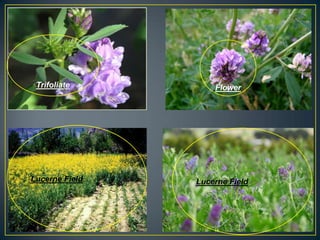
Trifoliate         Flower


Lucerne Field   Lucerne Field
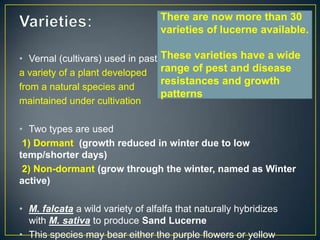
There are now more than 30
                                    varieties of lucerne available.

• Vernal (cultivars) used in past   These varieties have a wide
a variety of a plant developed      range of pest and disease
                                    resistances and growth
from a natural species and
                                    patterns
maintained under cultivation

• Two types are used
 1) Dormant (growth reduced in winter due to low
temp/shorter days)
 2) Non-dormant (grow through the winter, named as Winter
active)

• M. falcata a wild variety of alfalfa that naturally hybridizes
  with M. sativa to produce Sand Lucerne
• This species may bear either the purple flowers or yellow
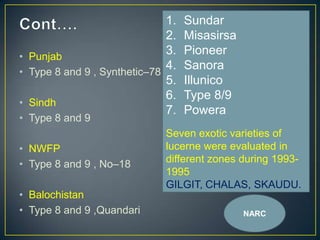
1.   Sundar
                              2.   Misasirsa
• Punjab
                              3.   Pioneer
• Type 8 and 9 , Synthetic–78
                              4.   Sanora
                              5.   Illunico
                              6.   Type 8/9
• Sindh
                              7.   Powera
• Type 8 and 9
                             Seven exotic varieties of
• NWFP                       lucerne were evaluated in
• Type 8 and 9 , No–18       different zones during 1993-
                             1995
                             GILGIT, CHALAS, SKAUDU.
• Balochistan
• Type 8 and 9 ,Quandari                       NARC
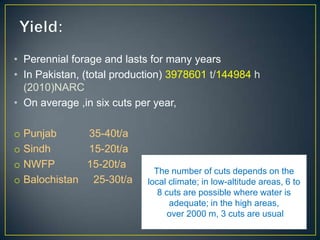
• Perennial forage and lasts for many years
• In Pakistan, (total production) 3978601 t/144984 h
  (2010)NARC
• On average ,in six cuts per year,

o   Punjab      35-40t/a
o   Sindh       15-20t/a
o   NWFP        15-20t/a
                              The number of cuts depends on the
o   Balochistan 25-30t/a    local climate; in low-altitude areas, 6 to
                               8 cuts are possible where water is
                                  adequate; in the high areas,
                                  over 2000 m, 3 cuts are usual
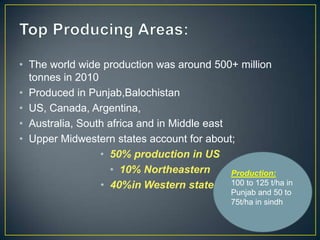
• The world wide production was around 500+ million
  tonnes in 2010
• Produced in Punjab,Balochistan
• US, Canada, Argentina,
• Australia, South africa and in Middle east
• Upper Midwestern states account for about;
                 • 50% production in US
                   • 10% Northeastern        Production:
                 • 40%in Western states 100 to 125 t/ha in
                                            Punjab and 50 to
                                            75t/ha in sindh
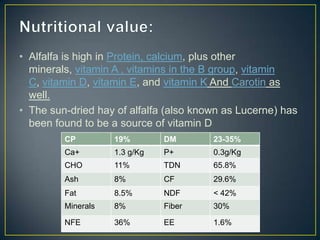
• Alfalfa is high in Protein, calcium, plus other
  minerals, vitamin A , vitamins in the B group, vitamin
  C, vitamin D, vitamin E, and vitamin K And Carotin as
  well.
• The sun-dried hay of alfalfa (also known as Lucerne) has
  been found to be a source of vitamin D
           CP         19%(On DM DMbasis)    23-35%
         Ca+        1.3 g/Kg   P+       0.3g/Kg
         CHO        11%        TDN      65.8%
         Ash        8%         CF       29.6%
         Fat        8.5%       NDF      < 42%
         Minerals   8%         Fiber    30%

         NFE        36%        EE       1.6%
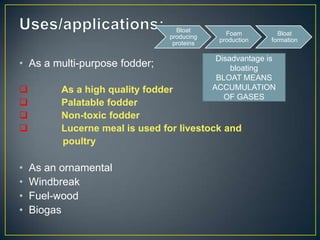
Bloat
                                               Foam         Bloat
                                producing
                                             production   formation
                                 proteins

                                             Disadvantage is
• As a multi-purpose fodder;                     bloating
                                             BLOAT MEANS
         As a high quality fodder          ACCUMULATION
                                               OF GASES
         Palatable fodder
         Non-toxic fodder
         Lucerne meal is used for livestock and
          poultry

•   As an ornamental
•   Windbreak
•   Fuel-wood
•   Biogas
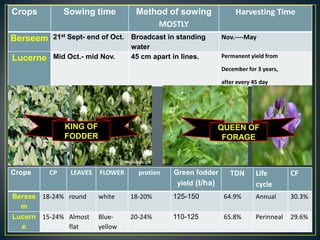
Crops          Sowing time         Method of sowing                Harvesting Time
                                       MOSTLY
Berseem   21st Sept- end of Oct. Broadcast in standing        Nov.----May
                                 water
Lucerne   Mid Oct.- mid Nov.     45 cm apart in lines.        Permanent yield from

                                                              December for 3 years,

                                                              after every 45 day


               KING OF                                        QUEEN OF
               FODDER                                          FORAGE


Crops     CP    LEAVES   FLOWER     protien   Green fodder       TDN       Life        CF
                                               yield (t/ha)                cycle
Bersee 18-24% round      white    18-20%      125-150          64.9%       Annual      30.3%
  m
Lucern 15-24% Almost     Blue-    20-24%      110-125          65.8%       Perinneal   29.6%
  e           flat       yellow
• NARC
• Prof. Dr. Talat Naseer Pasha, (Dean, Faculty of Animal
  Production and Technology, University of Veterinary
  and Animal Sciences, Lahore::::FODDER)
• Poineer::::: Manual of livestock form operations
  (supervised by Dr. Tanveer & Dr. Kashif)
• www.Pakistan agriculture.com
• Crop Production by Shafi Nazir
• Animal Husbandry by S. Iqbal Shah
• Notes on lucerne varities written by Dr. M.dost &
  Dr.afzal
• Some others....
Lucerne
Lucerne
Lucerne

Lucerne

  • 2.
  • 3.
    • Scientific name:Medicago sativa • Common name: In Arab known as alfalfa In Europe called as lucerne • Belongs to Leguminosae family ( soluble CHO & CP) • Origin: Introduced from the Mediterranean region LUCERNE was probably the • It is called as first crop to be “Queen of forage crops” cultivated for WHILE hay “King of fodder crops” is berseem
  • 4.
    First cut after3 month of sowing.(March) Later cuts after interval of 5-6 • Perennial forage weeks. • Nitrogen-fixer • Highly palatable Because of its high level of • Digestible and nutritious PROTEIN • Lucerne probably the world’s best fodder ENERGY • Extremely drought tolerant MINERALS • Fast growing (can be cut after 30 days VITAMINS of 1st cutting) • Frost tolerant • Susceptible to a range of pests and diseases • Rabi fodder crop(sown in winter, october to november)
  • 5.
    • 5-6 min height with a crown diameter of a similar size • Long softly-hairy/serrated leaves (sawtooth) • Leafy branches • Leaves dull • trifoliate • Leaflets narrowly rhombic with entire margins upto 7 cm long. • Petiole upto 2 cm long • Stipules minute
  • 6.
    Plants – • An erect • 2-3 ft tall • Multi-branched perennial plant with a very deep tap root • Plants develop a woody crown at ground level • Stems rising from the crown to around 1 m height. Flowers – • Flower blue but can purple or yellow (while Barseem has white) • Flowers are a typical pea shape 12 – 15 mm long • Develop in dense clusters of 20 – 30 flowers at the tips of the branches
  • 7.
    Soil – • Deeploamy soils rich in phosphorus, calcium and potash are very good for lucerne crop • Upland sandy soils are not suitable for it as they have low water holding capacity • Well drained soil with PH 6.5 to 7.00 • It cannot thrive on alkaline soils • But can be grown on acid soils with lime application Climate - • Lucerne crop is highly sensitive to climatic changes • During seedling stage a cool and dry weather is conducive for their development • while hot, dry conditions with normal soil moisture contents are required for quick vegetative growth • Therefore, its cultivation extends from sea level to lower hills up to an elevation of 2500 meter • It tolerates short spell of drought
  • 8.
    • Sowing theseeds at proper time, rate and method increases the yield 1. Time of sowing: • The optimum time of sowing of lucerne is from 1st week , of October to middle of November • However, middle of October is the best time for sowing lucerne. 2. Seed rate: • In case of broadcasting, 20-25 kg per hectare of seed should be sown • while for line sowing 12-15 kg per hectare is sufficient. 3. Sowing method:
  • 9.
    Trifoliate Flower Lucerne Field Lucerne Field
  • 10.
    There are nowmore than 30 varieties of lucerne available. • Vernal (cultivars) used in past These varieties have a wide a variety of a plant developed range of pest and disease resistances and growth from a natural species and patterns maintained under cultivation • Two types are used 1) Dormant (growth reduced in winter due to low temp/shorter days) 2) Non-dormant (grow through the winter, named as Winter active) • M. falcata a wild variety of alfalfa that naturally hybridizes with M. sativa to produce Sand Lucerne • This species may bear either the purple flowers or yellow
  • 11.
    1. Sundar 2. Misasirsa • Punjab 3. Pioneer • Type 8 and 9 , Synthetic–78 4. Sanora 5. Illunico 6. Type 8/9 • Sindh 7. Powera • Type 8 and 9 Seven exotic varieties of • NWFP lucerne were evaluated in • Type 8 and 9 , No–18 different zones during 1993- 1995 GILGIT, CHALAS, SKAUDU. • Balochistan • Type 8 and 9 ,Quandari NARC
  • 12.
    • Perennial forageand lasts for many years • In Pakistan, (total production) 3978601 t/144984 h (2010)NARC • On average ,in six cuts per year, o Punjab 35-40t/a o Sindh 15-20t/a o NWFP 15-20t/a The number of cuts depends on the o Balochistan 25-30t/a local climate; in low-altitude areas, 6 to 8 cuts are possible where water is adequate; in the high areas, over 2000 m, 3 cuts are usual
  • 13.
    • The worldwide production was around 500+ million tonnes in 2010 • Produced in Punjab,Balochistan • US, Canada, Argentina, • Australia, South africa and in Middle east • Upper Midwestern states account for about; • 50% production in US • 10% Northeastern Production: • 40%in Western states 100 to 125 t/ha in Punjab and 50 to 75t/ha in sindh
  • 14.
    • Alfalfa ishigh in Protein, calcium, plus other minerals, vitamin A , vitamins in the B group, vitamin C, vitamin D, vitamin E, and vitamin K And Carotin as well. • The sun-dried hay of alfalfa (also known as Lucerne) has been found to be a source of vitamin D CP 19%(On DM DMbasis) 23-35% Ca+ 1.3 g/Kg P+ 0.3g/Kg CHO 11% TDN 65.8% Ash 8% CF 29.6% Fat 8.5% NDF < 42% Minerals 8% Fiber 30% NFE 36% EE 1.6%
  • 15.
    Bloat Foam Bloat producing production formation proteins Disadvantage is • As a multi-purpose fodder; bloating BLOAT MEANS  As a high quality fodder ACCUMULATION OF GASES  Palatable fodder  Non-toxic fodder  Lucerne meal is used for livestock and poultry • As an ornamental • Windbreak • Fuel-wood • Biogas
  • 17.
    Crops Sowing time Method of sowing Harvesting Time MOSTLY Berseem 21st Sept- end of Oct. Broadcast in standing Nov.----May water Lucerne Mid Oct.- mid Nov. 45 cm apart in lines. Permanent yield from December for 3 years, after every 45 day KING OF QUEEN OF FODDER FORAGE Crops CP LEAVES FLOWER protien Green fodder TDN Life CF yield (t/ha) cycle Bersee 18-24% round white 18-20% 125-150 64.9% Annual 30.3% m Lucern 15-24% Almost Blue- 20-24% 110-125 65.8% Perinneal 29.6% e flat yellow
  • 18.
    • NARC • Prof.Dr. Talat Naseer Pasha, (Dean, Faculty of Animal Production and Technology, University of Veterinary and Animal Sciences, Lahore::::FODDER) • Poineer::::: Manual of livestock form operations (supervised by Dr. Tanveer & Dr. Kashif) • www.Pakistan agriculture.com • Crop Production by Shafi Nazir • Animal Husbandry by S. Iqbal Shah • Notes on lucerne varities written by Dr. M.dost & Dr.afzal • Some others....