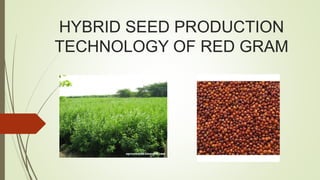
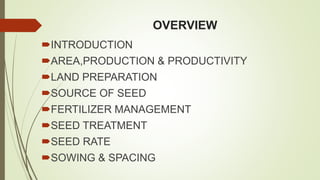

HYBRID SEED PRODUCTION
TECHNOLOGY OF RED GRAM
OVERVIEW
INTRODUCTION
AREA,PRODUCTION & PRODUCTIVITY
LAND PREPARATION
SOURCE OF SEED
FERTILIZER MANAGEMENT
SEED TREATMENT
SEED RATE
SOWING & SPACING
ANTHESIS & FLOWERING
FLOWERING MORPHOLOGY
EMASCULATION & POLLINATION
PEST & DISEASE
HARVESTING
SEED STANDARDS
FIELD STANDARDS
NEW HYBRID & VARIETIES IMPORTANCE
RECENT WORKS
SCIENTIFIC CLASSIFICATION
KINGDOM : PLANTAE
ORDER: FABALES
FAMILY: FABACEAE
GENUS: CAJANUS
SPECIES: CAJAN
CHROMOSOME No.:2n:22
INTRODUCTION
It contains:
• Protein: 22.3%
• Fat: 1.7%
 It is a protein-rich staple food
 It is a perennial legume crop
 It is a second important pulse crop in the country
 It is a drought resistant crop
 It is rich in lysine, riboflavin, thiamine, niacin and iron
 It also plays an important role in sustaining soil
fertility by improving physical properties of soil
 Wild relatives like Mansi occur in tropical deciduous
woodlands
 Red gram crop is used as food crop and
forage/cover crop
 It is the primary accompaniment to rice/roti
AREA, PRODUCTION AND
PRODUCTIVITY
AREA: 4.01 Million Hectares
PRODUCTION: 2.65 Million Tonnes
PRODUCTIVITY: 661 Kg/Hectare
Area: Maharashtra (32.37%) > Karnataka (18.76%)
> Andhra Pradesh (12.75%)
Production: Maharashtra (39.24%) > Karnataka
(17.57%) > Andhra Pradesh (10.94%)
Productivity: Andhra Pradesh (652.2) > Madhya
Pradesh (620)
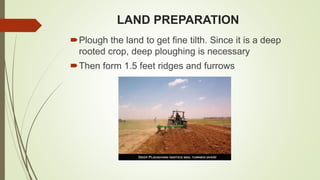
LAND PREPARATION
Plough the land to get fine tilth. Since it is a deep
rooted crop, deep ploughing is necessary
Then form 1.5 feet ridges and furrows
FERTILIZERS
 Apply fertilizers basally before sowing
 Rainfed:12.5kg N:25kg p2o5:12.5kg k2o
 Irrigated:25kg N:50kg p2o5:25kg k2o
 Apply FYM @ 10-12 tonnes/ha at time of last ploughing
SELECTION OF LAND
Red sandy loam soils, well drained black soils are
suitable
Saline, saline-alkaline soils prone for inundation
during crop period is not suitable
Neutral pH
Deep loam soil
Higher organic matter will lead to production of
vigorous seed
SEED TREATMENT
During germination the fungus present in the soil
effect the germination percent by causing seed
decay
To control this, treat the seed with capton/thiram 2
gm/kg seed
Rhizobial seed treatment
SEED RATE
The seeding rate of Pigeon pea depends on the
desired plant density for a genotype, cropping
system, germination rate and mass of the seed
Early maturing varieties - 20 to 25 kg/hectare
Medium/Late maturing varieties – 15 to 20
kg/hectare
SOWING AND SPACING
Sowing time and method:
 Early maturing varieties: First fortnight of June
 Medium/Late maturing varieties: Second fortnight
of June
• Line sowing by seed-drill or desi plough
• By dibbling on the ridge and bed
Spacing:
 Early maturing varieties: 45 - 60 * 10 - 15 cm
 Medium/Late maturing varieties: 60 - 75 * 15 - 20
cm
ROGUING
Done at flowering, pod formation stage, prior to harvest
Remove the male fertile plants by examining the color of
the anther in the female rows at the time of first flower
formation
One day before flower opening, the plants with
translucent white anther alone are retained in the female
rows
The above operation should be completed in 7 – 10 days
time by daily visit to the field. Incase of male parent,
remove immature pods set in the plant from time to time
to induce continuous flowering to ensure pollen
availability for a longer period
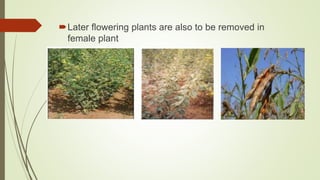
Later flowering plants are also to be removed in
female plant
ANTHESIS AND FLOWERING
Anthesis: Flowers start opening early in the morning
in the summer and by noon during winter, continuous
opening throughout the day. The length of time flower
remains open is influenced by the weather
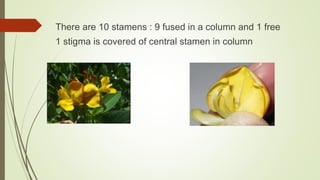
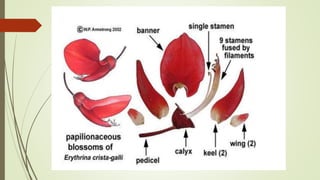
Flowering: Individual flower consists of calyx with 5
sepals and corolla with a standard petal, 2 wings,
petals and a keel petal
There are 10 stamens : 9 fused in a column and 1 free
1 stigma is covered of central stamen in column
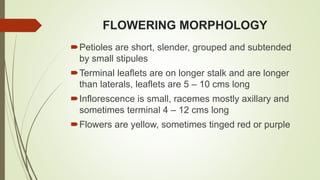
FLOWERING MORPHOLOGY
Petioles are short, slender, grouped and subtended
by small stipules
Terminal leaflets are on longer stalk and are longer
than laterals, leaflets are 5 – 10 cms long
Inflorescence is small, racemes mostly axillary and
sometimes terminal 4 – 12 cms long
Flowers are yellow, sometimes tinged red or purple
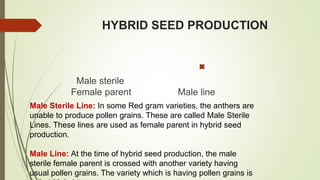
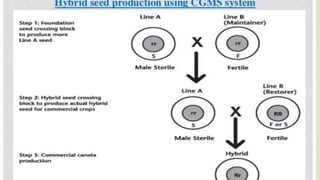
HYBRID SEED PRODUCTION
Male sterile
Female parent Male line
Male Sterile Line: In some Red gram varieties, the anthers are
unable to produce pollen grains. These are called Male Sterile
Lines. These lines are used as female parent in hybrid seed
production.
Male Line: At the time of hybrid seed production, the male
sterile female parent is crossed with another variety having
usual pollen grains. The variety which is having pollen grains is
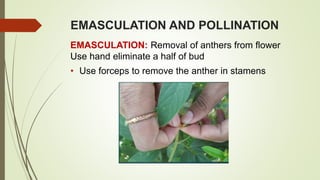
EMASCULATION AND POLLINATION
EMASCULATION: Removal of anthers from flower
Use hand eliminate a half of bud
• Use forceps to remove the anther in stamens
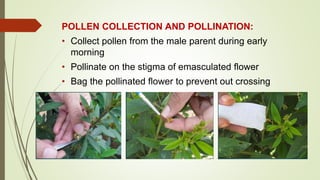
POLLEN COLLECTION AND POLLINATION:
• Collect pollen from the male parent during early
morning
• Pollinate on the stigma of emasculated flower
• Bag the pollinated flower to prevent out crossing
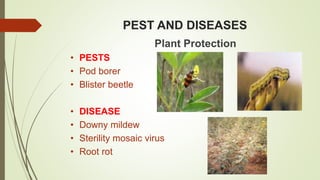
PEST AND DISEASES
Plant Protection
• PESTS
• Pod borer
• Blister beetle
• DISEASE
• Downy mildew
• Sterility mosaic virus
• Root rot
DISEASE:
 WILT: Dark purpel bands appear on the stem surface extending upwards
From the base
 Main stem of such plants is split open ,intensive blackening of the xylem can be
seen
 In humid weather, a pinkish mycelium growth is commonly observed at the basal
portions of the wilted plants
 CONTROL MEASURES: Seed treatment with Trichoderma viride @10g/kg of
seed
 Soil application –trichoderma viride -2.5kg/ha+50kg of well decomposed FYM
 Sterility mosaic disease : It is caused by mosaic virus and spread from plant
to plant under field conditions through Eriophyid mite
 Leaves become small and cluster near branch tips and reduce in size
 It is seen in vegetative growth and pre-flowers stage
 CONTROL MEASURES: Spray Fenazaquin 10EC @1ml/lit of water on 45
and 60 DAS
 Rogue out the infected plants in the early stages of growth
 :Phytophthara blight : symptoms are circular or irregular water soaked
lesions on leaves
 The lesions on the stem and branches increases rapidly, gridles, cracks and
dries the stem
 Infected stem and branches break easily in the wind
 CONTROL MEASURES: Seed treated with metalaxyl 35WS @ 3g/kg of seed
PESTS:
 POD BORERS: The larvae, after hatching, feed on tender leaves and twings
but a pod formation they punctuer pods and feed on developing grains
 CONTROL MEASURES: Spray indoxacarb 15.8%sc @333ml/ha
 TUR POD FLY: stripes can be seen on the surface of the effected grains, while
the attacked pods are somewhat twisted or deformed
 CONTROL MEASURES: Pest can be controlled by spraying monocrotophos
36 SL 1 liter in 800-1000 liters of water per hacter
 PLUME MOTH: The larvae damaged seeds as well cause flowers, buds, pods
to drop
 CONTROL MEASURES: Apply the neem oil 2%
 POD-SUCKING BUGS: Damaged seeds become shriveled and develop dark
patches
 CONTROL MEASURES: Soil application of carbofuron 3G @15kg/ha at
sowing
HARVESTING AND THRESHING
With two-third to three-fourth pods at maturity judged
by changing their color to brown is the best
harvesting time
Plants are usually cut with a sickle with in 75 cms
above the ground
Harvested plants should be left in the field for sun
drying for 3 – 6 days depending on season
Threshing is done either by beating the pods with
stick or using Pullman thresher
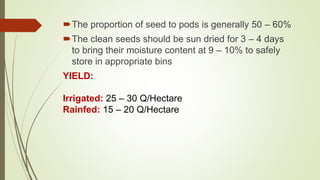
The proportion of seed to pods is generally 50 – 60%
The clean seeds should be sun dried for 3 – 4 days
to bring their moisture content at 9 – 10% to safely
store in appropriate bins
YIELD:
Irrigated: 25 – 30 Q/Hectare
Rainfed: 15 – 20 Q/Hectare
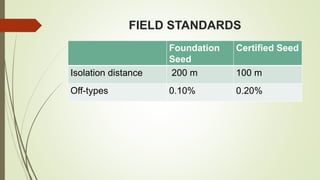
FIELD STANDARDS
Foundation
Seed
Certified Seed
Isolation distance 200 m 100 m
Off-types 0.10% 0.20%
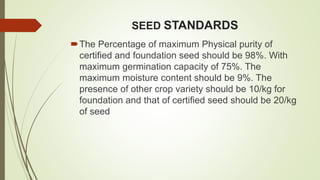
SEED STANDARDS
The Percentage of maximum Physical purity of
certified and foundation seed should be 98%. With
maximum germination capacity of 75%. The
maximum moisture content should be 9%. The
presence of other crop variety should be 10/kg for
foundation and that of certified seed should be 20/kg
of seed
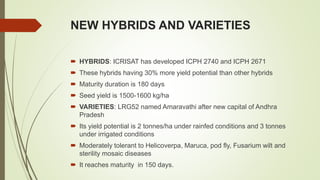
NEW HYBRIDS AND VARIETIES
 HYBRIDS: ICRISAT has developed ICPH 2740 and ICPH 2671
 These hybrids having 30% more yield potential than other hybrids
 Maturity duration is 180 days
 Seed yield is 1500-1600 kg/ha
 VARIETIES: LRG52 named Amaravathi after new capital of Andhra
Pradesh
 Its yield potential is 2 tonnes/ha under rainfed conditions and 3 tonnes
under irrigated conditions
 Moderately tolerant to Helicoverpa, Maruca, pod fly, Fusarium wilt and
sterility mosaic diseases
 It reaches maturity in 150 days.
RECENT WORKS:
 The productivity of pigeon pea has low over the last few decades
 ICRISAT and IIPR are working on number of innovative ideas such as
 Genome sequencing , development of CGMS hybrids with 30 to 40%
yields advantage over traditional varieties , development of photo
insensitive super early maturing lines , introgression of cleistogamous
flower structure to maintain genetic purity of elite lines , use of obcordate
leaf shape as NEP to assess genetic purity of hybrid parental lines and
development of disease resistant hybrids and elite breeding lines.
THANK YOU
UID:111718012026
UID:111718012034

Redgram ppt

  • 1.
  • 2.
    OVERVIEW INTRODUCTION AREA,PRODUCTION & PRODUCTIVITY LANDPREPARATION SOURCE OF SEED FERTILIZER MANAGEMENT SEED TREATMENT SEED RATE SOWING & SPACING
  • 3.
    ANTHESIS & FLOWERING FLOWERINGMORPHOLOGY EMASCULATION & POLLINATION PEST & DISEASE HARVESTING SEED STANDARDS FIELD STANDARDS NEW HYBRID & VARIETIES IMPORTANCE RECENT WORKS
  • 4.
    SCIENTIFIC CLASSIFICATION KINGDOM :PLANTAE ORDER: FABALES FAMILY: FABACEAE GENUS: CAJANUS SPECIES: CAJAN CHROMOSOME No.:2n:22
  • 5.
    INTRODUCTION It contains: • Protein:22.3% • Fat: 1.7%  It is a protein-rich staple food  It is a perennial legume crop  It is a second important pulse crop in the country  It is a drought resistant crop  It is rich in lysine, riboflavin, thiamine, niacin and iron
  • 6.
     It alsoplays an important role in sustaining soil fertility by improving physical properties of soil  Wild relatives like Mansi occur in tropical deciduous woodlands  Red gram crop is used as food crop and forage/cover crop  It is the primary accompaniment to rice/roti
  • 7.
    AREA, PRODUCTION AND PRODUCTIVITY AREA:4.01 Million Hectares PRODUCTION: 2.65 Million Tonnes PRODUCTIVITY: 661 Kg/Hectare Area: Maharashtra (32.37%) > Karnataka (18.76%) > Andhra Pradesh (12.75%) Production: Maharashtra (39.24%) > Karnataka (17.57%) > Andhra Pradesh (10.94%) Productivity: Andhra Pradesh (652.2) > Madhya Pradesh (620)
  • 8.
    LAND PREPARATION Plough theland to get fine tilth. Since it is a deep rooted crop, deep ploughing is necessary Then form 1.5 feet ridges and furrows
  • 9.
    FERTILIZERS  Apply fertilizersbasally before sowing  Rainfed:12.5kg N:25kg p2o5:12.5kg k2o  Irrigated:25kg N:50kg p2o5:25kg k2o  Apply FYM @ 10-12 tonnes/ha at time of last ploughing
  • 10.
    SELECTION OF LAND Redsandy loam soils, well drained black soils are suitable Saline, saline-alkaline soils prone for inundation during crop period is not suitable Neutral pH Deep loam soil Higher organic matter will lead to production of vigorous seed
  • 11.
    SEED TREATMENT During germinationthe fungus present in the soil effect the germination percent by causing seed decay To control this, treat the seed with capton/thiram 2 gm/kg seed Rhizobial seed treatment
  • 12.
    SEED RATE The seedingrate of Pigeon pea depends on the desired plant density for a genotype, cropping system, germination rate and mass of the seed Early maturing varieties - 20 to 25 kg/hectare Medium/Late maturing varieties – 15 to 20 kg/hectare
  • 13.
    SOWING AND SPACING Sowingtime and method:  Early maturing varieties: First fortnight of June  Medium/Late maturing varieties: Second fortnight of June • Line sowing by seed-drill or desi plough • By dibbling on the ridge and bed Spacing:  Early maturing varieties: 45 - 60 * 10 - 15 cm  Medium/Late maturing varieties: 60 - 75 * 15 - 20 cm
  • 14.
    ROGUING Done at flowering,pod formation stage, prior to harvest Remove the male fertile plants by examining the color of the anther in the female rows at the time of first flower formation One day before flower opening, the plants with translucent white anther alone are retained in the female rows The above operation should be completed in 7 – 10 days time by daily visit to the field. Incase of male parent, remove immature pods set in the plant from time to time to induce continuous flowering to ensure pollen availability for a longer period
  • 15.
    Later flowering plantsare also to be removed in female plant
  • 16.
    ANTHESIS AND FLOWERING Anthesis:Flowers start opening early in the morning in the summer and by noon during winter, continuous opening throughout the day. The length of time flower remains open is influenced by the weather Flowering: Individual flower consists of calyx with 5 sepals and corolla with a standard petal, 2 wings, petals and a keel petal
  • 17.
    There are 10stamens : 9 fused in a column and 1 free 1 stigma is covered of central stamen in column
  • 18.
    FLOWERING MORPHOLOGY Petioles areshort, slender, grouped and subtended by small stipules Terminal leaflets are on longer stalk and are longer than laterals, leaflets are 5 – 10 cms long Inflorescence is small, racemes mostly axillary and sometimes terminal 4 – 12 cms long Flowers are yellow, sometimes tinged red or purple
  • 20.
    HYBRID SEED PRODUCTION Malesterile Female parent Male line Male Sterile Line: In some Red gram varieties, the anthers are unable to produce pollen grains. These are called Male Sterile Lines. These lines are used as female parent in hybrid seed production. Male Line: At the time of hybrid seed production, the male sterile female parent is crossed with another variety having usual pollen grains. The variety which is having pollen grains is
  • 22.
    EMASCULATION AND POLLINATION EMASCULATION:Removal of anthers from flower Use hand eliminate a half of bud • Use forceps to remove the anther in stamens
  • 23.
    POLLEN COLLECTION ANDPOLLINATION: • Collect pollen from the male parent during early morning • Pollinate on the stigma of emasculated flower • Bag the pollinated flower to prevent out crossing
  • 24.
    PEST AND DISEASES PlantProtection • PESTS • Pod borer • Blister beetle • DISEASE • Downy mildew • Sterility mosaic virus • Root rot
  • 25.
    DISEASE:  WILT: Darkpurpel bands appear on the stem surface extending upwards From the base  Main stem of such plants is split open ,intensive blackening of the xylem can be seen  In humid weather, a pinkish mycelium growth is commonly observed at the basal portions of the wilted plants  CONTROL MEASURES: Seed treatment with Trichoderma viride @10g/kg of seed  Soil application –trichoderma viride -2.5kg/ha+50kg of well decomposed FYM
  • 26.
     Sterility mosaicdisease : It is caused by mosaic virus and spread from plant to plant under field conditions through Eriophyid mite  Leaves become small and cluster near branch tips and reduce in size  It is seen in vegetative growth and pre-flowers stage  CONTROL MEASURES: Spray Fenazaquin 10EC @1ml/lit of water on 45 and 60 DAS  Rogue out the infected plants in the early stages of growth  :Phytophthara blight : symptoms are circular or irregular water soaked lesions on leaves  The lesions on the stem and branches increases rapidly, gridles, cracks and dries the stem  Infected stem and branches break easily in the wind  CONTROL MEASURES: Seed treated with metalaxyl 35WS @ 3g/kg of seed
  • 27.
    PESTS:  POD BORERS:The larvae, after hatching, feed on tender leaves and twings but a pod formation they punctuer pods and feed on developing grains  CONTROL MEASURES: Spray indoxacarb 15.8%sc @333ml/ha  TUR POD FLY: stripes can be seen on the surface of the effected grains, while the attacked pods are somewhat twisted or deformed  CONTROL MEASURES: Pest can be controlled by spraying monocrotophos 36 SL 1 liter in 800-1000 liters of water per hacter  PLUME MOTH: The larvae damaged seeds as well cause flowers, buds, pods to drop  CONTROL MEASURES: Apply the neem oil 2%  POD-SUCKING BUGS: Damaged seeds become shriveled and develop dark patches  CONTROL MEASURES: Soil application of carbofuron 3G @15kg/ha at sowing
  • 28.
    HARVESTING AND THRESHING Withtwo-third to three-fourth pods at maturity judged by changing their color to brown is the best harvesting time Plants are usually cut with a sickle with in 75 cms above the ground Harvested plants should be left in the field for sun drying for 3 – 6 days depending on season Threshing is done either by beating the pods with stick or using Pullman thresher
  • 29.
    The proportion ofseed to pods is generally 50 – 60% The clean seeds should be sun dried for 3 – 4 days to bring their moisture content at 9 – 10% to safely store in appropriate bins YIELD: Irrigated: 25 – 30 Q/Hectare Rainfed: 15 – 20 Q/Hectare
  • 30.
    FIELD STANDARDS Foundation Seed Certified Seed Isolationdistance 200 m 100 m Off-types 0.10% 0.20%
  • 31.
    SEED STANDARDS The Percentageof maximum Physical purity of certified and foundation seed should be 98%. With maximum germination capacity of 75%. The maximum moisture content should be 9%. The presence of other crop variety should be 10/kg for foundation and that of certified seed should be 20/kg of seed
  • 32.
    NEW HYBRIDS ANDVARIETIES  HYBRIDS: ICRISAT has developed ICPH 2740 and ICPH 2671  These hybrids having 30% more yield potential than other hybrids  Maturity duration is 180 days  Seed yield is 1500-1600 kg/ha  VARIETIES: LRG52 named Amaravathi after new capital of Andhra Pradesh  Its yield potential is 2 tonnes/ha under rainfed conditions and 3 tonnes under irrigated conditions  Moderately tolerant to Helicoverpa, Maruca, pod fly, Fusarium wilt and sterility mosaic diseases  It reaches maturity in 150 days.
  • 33.
    RECENT WORKS:  Theproductivity of pigeon pea has low over the last few decades  ICRISAT and IIPR are working on number of innovative ideas such as  Genome sequencing , development of CGMS hybrids with 30 to 40% yields advantage over traditional varieties , development of photo insensitive super early maturing lines , introgression of cleistogamous flower structure to maintain genetic purity of elite lines , use of obcordate leaf shape as NEP to assess genetic purity of hybrid parental lines and development of disease resistant hybrids and elite breeding lines.
  • 34.