Sedimentary
Rocks
What Do We See
J only 5% of Earth’s crust
J cover about 75% of surface
J raw material (sediment) of
sedimentary rocks - weathering
or erosion of pre-existing rock
J basic sources:
detrital
non-detrital
Sediments and Sedimentary Rocks
detrital - mineral/rock fragments
detritus or clasts - produced by
mechanical weathering or
erosion
detrital sedimentary rocks
sandstone
shale
mudstone
Sediments and Sedimentary Rocks
non-detrital - precipitate from
solution (chemical weathering)
inorganic or biochemical
processes
chemical sedimentary rocks
limestone
halite
gypsum
Sediments and Sedimentary Rocks
... what’s
involved in the
physical
transport of
sediment?
place of weathering to place of
deposition:
angular particles become rounded
 sorted by size and composition
agents of sediment transport
 water (primary mechanism),
gravity, wind, and ice
sediment deposition processes
(sedimentation):
 loss of velocity, evaporation and/
or chemical interactions
Transport and Deposition
carried in suspension by:
ice: any size particle
water: small gravel and
smaller size particles
wind: sand and smaller sizes
abrasion and rounding
removes corners
sorting separates like-sized
particles
Detrital Transport
deposition = decrease in
energy or velocity
settling rate depends on:
particle size
density
Detrital Deposition
... what
about
chemical
transport of
sediment?
results from saturation
due to:
increase of available
ions through
oversupply or
evaporation
change in
temperature or other
chemical conditions
Chemical Deposition
... in what
types of
environments
is sediment
deposited?
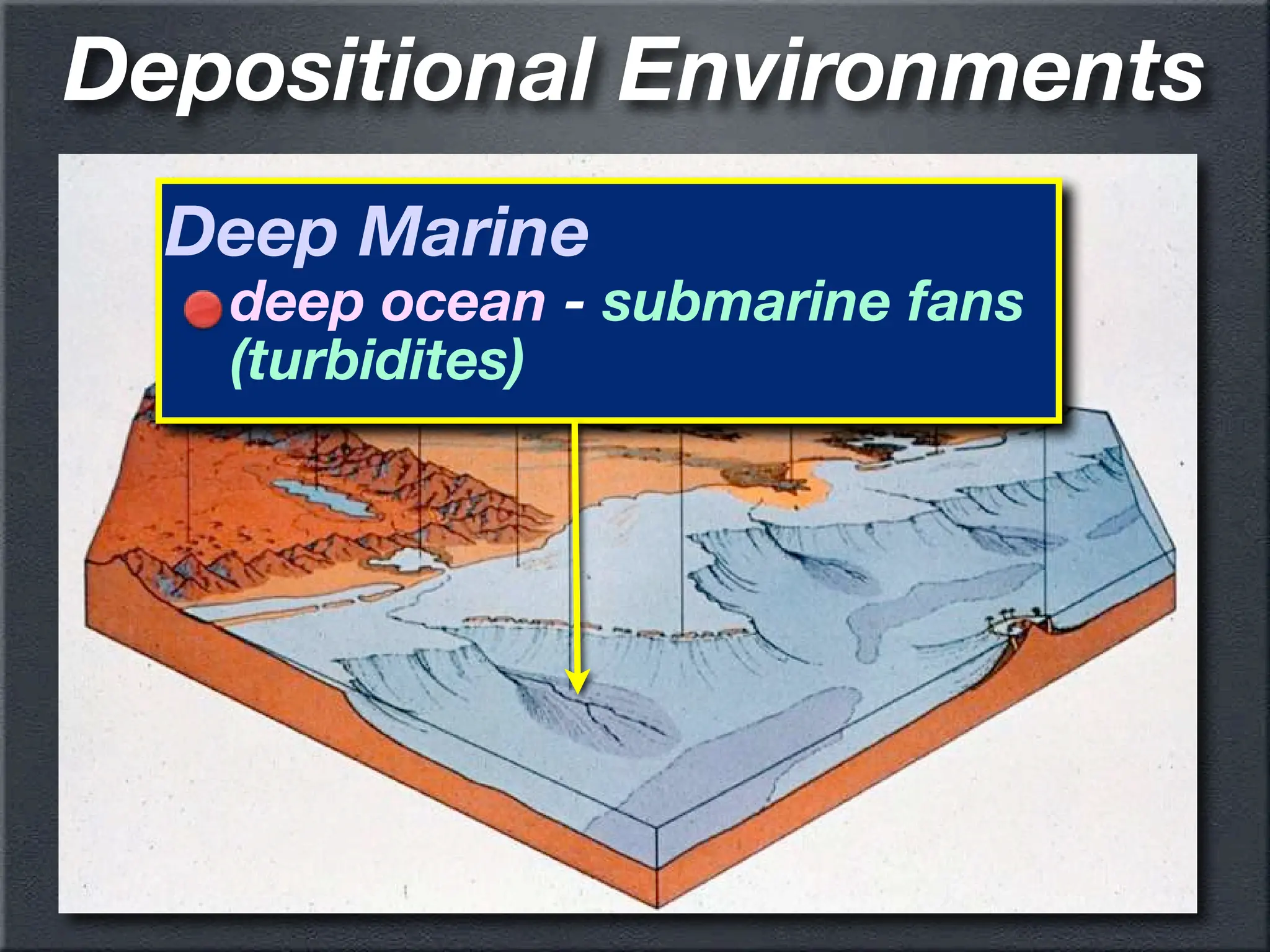
Deep Marine
deep ocean - submarine fans
(turbidites)
Depositional Environments
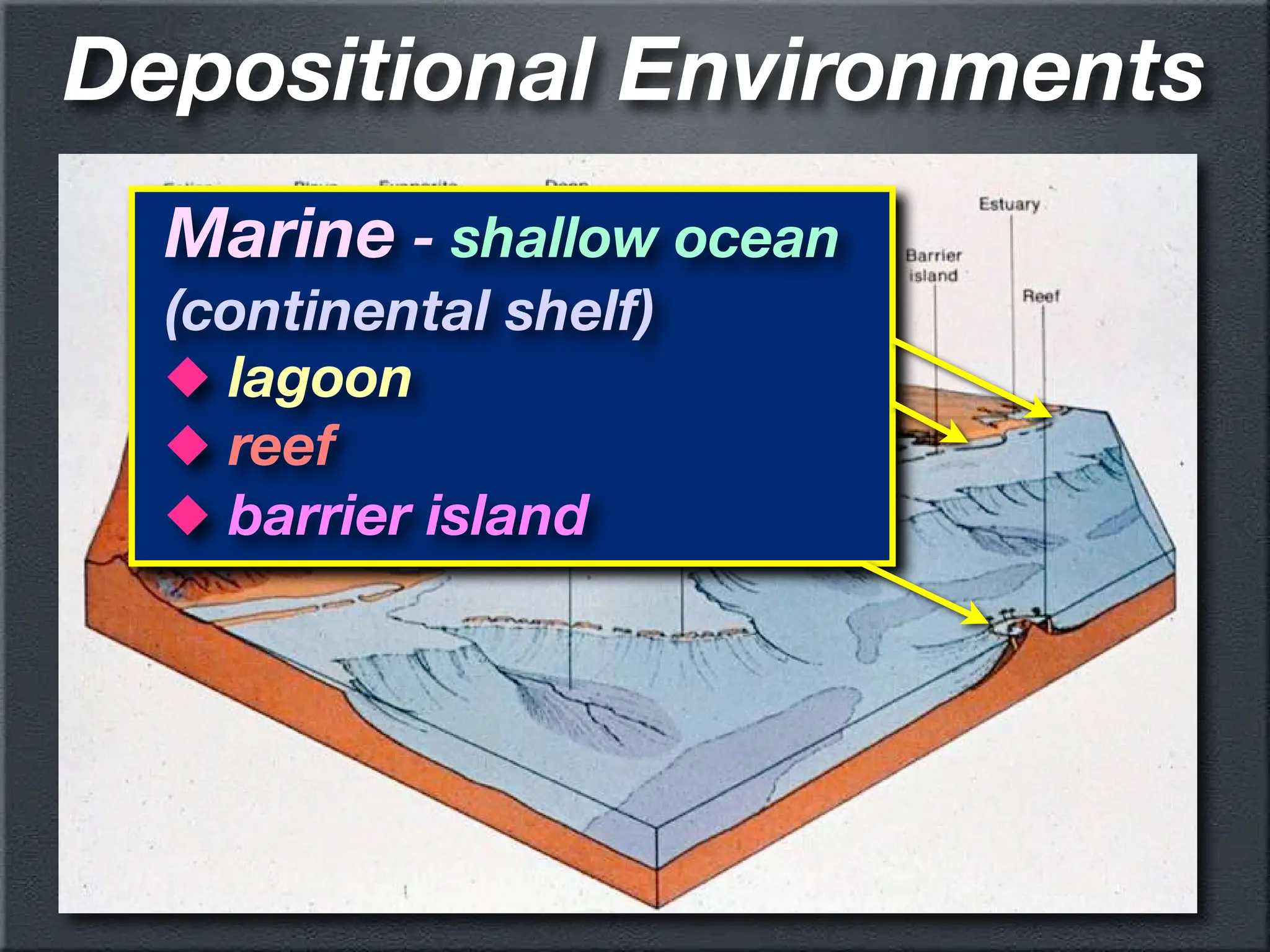
Marine - shallow ocean
(continental shelf)
 lagoon
 reef
 barrier island
Depositional Environments
Transitional
 Beach
 Delta
Depositional Environments
Continental
(terrestrial)
 fluvial (streams)
 eolian (deserts)
 lacustrine (lakes)
 glacial
... how is
sediment
converted into
solid rock?
conversion of sediment
into rock results from:
1. Compaction
2. Desiccation
3. Cementation
4. Crystallization
Lithification
1) Compaction - sediment grains
packed together through burial
reduction in volume by up
to 40%
results from pressure or
weight of overlying
sediments
Lithification
2) Desiccation - loss of water
from sediment pore spaces
results from compaction and
evaporation in air
Lithification
3)Cementation - minerals
precipitated from sediment
pore fluids bind particles
common cements - calcite
(CaCO3) and quartz (SiO2),
dolomite [(CaMg)CO3], iron
oxides (Fe2O3) and hydroxides
[FeO(OH)]
Lithification
4)Crystallization - formation of
interlocking crystals in
chemical sediments
Lithification
... what
special
features
characterize
sedimentary
rocks?
both detrital and
chemical sedimentary
rocks can show
fragmented texture
separated by clast size
Wentworth Scale of
particle size commonly
used:
gravel > 2 mm
sand 1/16 to 2 mm
silt 1/256 to 1/16 mm
clay < 1/256 mm
Grain Sizes
degree to which clast or
particle sizes similar
Sorting
occurs during transport with
particles separated by:
a) grain size - largest particles
settle first
b) composition - densest minerals
settle first
Sorting
 poorly-sorted -
mix of particle
sizes
Sorting
 well-sorted - if
primarily one
particle size
angularity or roundness depends
on how far rock transported:
a) Roundness -
degree of edge
and corner
removal
b) Sphericity -
degree to which
fragment
approaches
spheroid shape
Clast Shape
Non-clastic Textures
subdivided according to crystal
size :
fine-grained (< 1 mm)
medium-grained (1-5 mm)
coarse-grained (> 5 mm)
interlocking crystals shown only
by chemical sedimentary rocks
... what are
the different
types of
sedimentary
rocks?
Clastic Sedimentary Rocks
conglomerate - gravel-sized
rounded particles (>2 mm)
surrounded by fine-grained
material:
deposition in high-energy
environment
characteristic of streams and
beaches
Clastic Sedimentary Rocks
Conglomerate
material not transported great
distances
sedimentary breccia -
particles > 64 mm and angular:
Clastic Sedimentary Rocks
Sedimentary Breccia
sandstones - sand-sized particles
(0.06-2 mm):
mainly quartz, some feldspar and
rock fragments:
1) Quartz Sandstone - almost pure quartz
2) Arkose - quartz and more than 25%
feldspar
3) Graywacke - “Dirty” sandstone containing
quartz, feldspar, rock, and clay
both arkose and graywacke lack of
transport
Clastic Sedimentary Rocks
Mudrocks - low-energy environment:
1) Siltstones
silt-sized quartz and feldspar particles (≤ 0.06
mm)
2) Mudstones
silt- and clay-sized particles (≤ 0.004 mm)
clay, quartz, feldspar, calcite, and dolomite
3) Claystones - mostly clay
4) Shales
most abundant detrital rock
rock breaks into layers (parallel to bedding)
Clastic Sedimentary Rocks
Rounded rock fragments Conglomerate
Angular rock fragments Breccia
Quartz predominates Quartz
sandstone
Quartz with considerable
feldspar
Arkose
Dark color, quartz with
considerable feldspar, clay and
rock fragments
Graywacke
Splits into thin layers Shale
Breaks into clumps or blocks Mudstone
Clastic Sedimentary Rocks
organic (biochemical) or inorganic
activity
1) limestone/dolostone (carbonate rock) -
biochemical or inorganic rock of calcite or
dolomite
2) evaporite (rock salt, rock gypsum) - halite,
sylvite, or gypsum inorganically precipitated
3) chert - microscopic quartz deposited by
biochemical or inorganic processes
4) coal - biochemical material (land plants that
grew in swamps)
Chemical Sedimentary Rocks
Clastic or
non-clastic
Calcite, CaCO3 Limestone
Clastic or
non-clastic
Dolomite,
CaMg(CO3)2
Dolomite
(dolostone)
Inorganic Non-clastic Microcrystalline
quartz, SiO2
Chert
Non-clastic Halite, NaCl Rock salt
Non-clastic Gypsum
CaSO4•2H2O
Rock gypsum
Clastic or
non-clastic
Calcite, CaCO3 Limestone
Biochemical Non-clastic Microcrystalline
quartz, SiO2
Chert
Non-clastic Altered plant remains Coal
Chemical Sedimentary Rocks
... what can
sedimentary
rocks tell us
anyway?
evidence preserved in sedimentary
rocks allows events and processes
which formed them to be inferred
specific depositional environment of
ancient sedimentary rocks indicated
by sedimentary structures
Sedimentary Structures
usually horizontal
or sub-horizontal
layering
Bedding or Stratification
Laminated Bedding
closely spaced parallel layering
Sedimentary Structures
Graded Bedding
progressive
decrease in
grain size
upward
through
bed
rapid
deposition
top of bed
indicator
Sedimentary Structures
non-
horizontal
bedding
Cross-Bedding
wind or water
currents
indicate top
of bed and
paleocurrent
directions
Sedimentary Structures
small waves on surface
of sediment caused by
water or wind
movement
used as top of bed
indicator
two forms:
a) wave-formed ripple
marks
b) current-formed
ripple marks
Sedimentary Structures
Ripple Marks
 symmetric
ripples
 formed in surf
zone
Wave-formed Ripple Marks
Sedimentary Structures
water or air
moves in one
direction
current indicator
Sedimentary Structures
Current Ripple Marks
polygonal
cracks
contraction
during
desiccation of
silt- and clay-
sized sediment
shallow water
deposition
top indicator
Sedimentary Structures
Mud Cracks
provide no clues about
deposition:
nodules
concretions
geodes
Sedimentary Structures
Secondary Structures
form long after rock formation
 parallel
bedding
 irregular,
knobby-
surfaced
mineral body
 different
composition
than
surroundings
Sedimentary Structures
Nodules
dehydration
cracks filled
by material
of different
composition
Sedimentary Structures
Septarian Nodules
Concretions
usually spherical
characterized by
concentric
layering
composed of
silicic material
Sedimentary Structures
 in limestone and
shale
 roughly spherical
hollow structures
 pocket of water
surrounded by
silica deposition
 large quartz or
calcite crystals
grow inward
Sedimentary Structures
Geodes
preserved plant and animal
remains
clues about ancient life, evolution,
and depositional environment
basis for constructing geologic
calendar
allow rocks to be correlated in time
two types
Fossils
most dissolved
and replaced
silica and pyrite
(e.g., petrified
wood):
mold - cavity
cast - filled
mold
Fossils
…. so what do
these structures
tell us about how
and where
sediments are
deposited?
different sedimentary rocks deposited
in different places at same time
change in composition and nature
laterally due to changes in depositional
environment
rock assemblages reflect particular
depositional environment
Sedimentary Facies
may result from sea level fluctuations:
1) Marine Regressions
sediment deposition during falling sea
level
deep marine deposits overlain by
shallower marine and nearshore deposits
2) Marine Transgressions
sediment deposition during sea level rise
sandstone (nearshore) overlain by shale
(shallow marine) and limestone (deeper
marine)
Sedimentary Facies
why are such
variations important
and why worry
about where
sediments are
deposited anyway?
Petroleum/
Natural Gas/
Oil Shales/
Tar Sands
migrate upward
until reach surface
or trapped
petroleum trap -
permeable
reservoir rock and
impermeable cap
rock
Sedimentary Hosted Resources
Uranium ores
 occur in fluvial sandstones containing
organic matter
 uranium transported in groundwater
until reducing conditions cause
precipitation
Banded iron formations
 largest source of iron ore
 deposited in shallow seas
 iron precipitated from
seawater by oxygen
addition from algae
(photosynthesis) or
bacteria (respiration)
Sedimentary Hosted Resources
other sediment or sedimentary
rock derived resources:
building materials
sand and gravel - construction
limestone - cement
gypsum - wallboard and plaster
clay - bricks
quartz - glass
Sedimentary Hosted Resources
halite - seasoning and preservative
clay - ceramics and kitty litter
phosphates - fertilizers, matches,
and preservatives
diatomite - filtration
coal - energy and coke in steel
production
Sedimentary Hosted Resources
other sediment or sedimentary
rock derived resources:

Sedimentary rock’s geology ppt science ppt

  • 1.
  • 33.
    J only 5%of Earth’s crust J cover about 75% of surface J raw material (sediment) of sedimentary rocks - weathering or erosion of pre-existing rock J basic sources: detrital non-detrital Sediments and Sedimentary Rocks
  • 34.
    detrital - mineral/rockfragments detritus or clasts - produced by mechanical weathering or erosion detrital sedimentary rocks sandstone shale mudstone Sediments and Sedimentary Rocks
  • 35.
    non-detrital - precipitatefrom solution (chemical weathering) inorganic or biochemical processes chemical sedimentary rocks limestone halite gypsum Sediments and Sedimentary Rocks
  • 36.
    ... what’s involved inthe physical transport of sediment?
  • 37.
    place of weatheringto place of deposition: angular particles become rounded  sorted by size and composition agents of sediment transport  water (primary mechanism), gravity, wind, and ice sediment deposition processes (sedimentation):  loss of velocity, evaporation and/ or chemical interactions Transport and Deposition
  • 38.
    carried in suspensionby: ice: any size particle water: small gravel and smaller size particles wind: sand and smaller sizes abrasion and rounding removes corners sorting separates like-sized particles Detrital Transport
  • 39.
    deposition = decreasein energy or velocity settling rate depends on: particle size density Detrital Deposition
  • 40.
  • 41.
    results from saturation dueto: increase of available ions through oversupply or evaporation change in temperature or other chemical conditions Chemical Deposition
  • 42.
    ... in what typesof environments is sediment deposited?
  • 43.
    Deep Marine deep ocean- submarine fans (turbidites) Depositional Environments
  • 44.
    Marine - shallowocean (continental shelf)  lagoon  reef  barrier island Depositional Environments
  • 45.
  • 46.
    Depositional Environments Continental (terrestrial)  fluvial(streams)  eolian (deserts)  lacustrine (lakes)  glacial
  • 47.
  • 48.
    conversion of sediment intorock results from: 1. Compaction 2. Desiccation 3. Cementation 4. Crystallization Lithification
  • 49.
    1) Compaction -sediment grains packed together through burial reduction in volume by up to 40% results from pressure or weight of overlying sediments Lithification
  • 50.
    2) Desiccation -loss of water from sediment pore spaces results from compaction and evaporation in air Lithification
  • 51.
    3)Cementation - minerals precipitatedfrom sediment pore fluids bind particles common cements - calcite (CaCO3) and quartz (SiO2), dolomite [(CaMg)CO3], iron oxides (Fe2O3) and hydroxides [FeO(OH)] Lithification
  • 52.
    4)Crystallization - formationof interlocking crystals in chemical sediments Lithification
  • 53.
  • 54.
    both detrital and chemicalsedimentary rocks can show fragmented texture separated by clast size Wentworth Scale of particle size commonly used: gravel > 2 mm sand 1/16 to 2 mm silt 1/256 to 1/16 mm clay < 1/256 mm Grain Sizes
  • 55.
    degree to whichclast or particle sizes similar Sorting
  • 56.
    occurs during transportwith particles separated by: a) grain size - largest particles settle first b) composition - densest minerals settle first Sorting
  • 57.
     poorly-sorted - mixof particle sizes Sorting  well-sorted - if primarily one particle size
  • 58.
    angularity or roundnessdepends on how far rock transported: a) Roundness - degree of edge and corner removal b) Sphericity - degree to which fragment approaches spheroid shape Clast Shape
  • 59.
    Non-clastic Textures subdivided accordingto crystal size : fine-grained (< 1 mm) medium-grained (1-5 mm) coarse-grained (> 5 mm) interlocking crystals shown only by chemical sedimentary rocks
  • 60.
    ... what are thedifferent types of sedimentary rocks?
  • 61.
  • 62.
    conglomerate - gravel-sized roundedparticles (>2 mm) surrounded by fine-grained material: deposition in high-energy environment characteristic of streams and beaches Clastic Sedimentary Rocks
  • 63.
  • 64.
    material not transportedgreat distances sedimentary breccia - particles > 64 mm and angular: Clastic Sedimentary Rocks
  • 65.
  • 66.
    sandstones - sand-sizedparticles (0.06-2 mm): mainly quartz, some feldspar and rock fragments: 1) Quartz Sandstone - almost pure quartz 2) Arkose - quartz and more than 25% feldspar 3) Graywacke - “Dirty” sandstone containing quartz, feldspar, rock, and clay both arkose and graywacke lack of transport Clastic Sedimentary Rocks
  • 67.
    Mudrocks - low-energyenvironment: 1) Siltstones silt-sized quartz and feldspar particles (≤ 0.06 mm) 2) Mudstones silt- and clay-sized particles (≤ 0.004 mm) clay, quartz, feldspar, calcite, and dolomite 3) Claystones - mostly clay 4) Shales most abundant detrital rock rock breaks into layers (parallel to bedding) Clastic Sedimentary Rocks
  • 68.
    Rounded rock fragmentsConglomerate Angular rock fragments Breccia Quartz predominates Quartz sandstone Quartz with considerable feldspar Arkose Dark color, quartz with considerable feldspar, clay and rock fragments Graywacke Splits into thin layers Shale Breaks into clumps or blocks Mudstone Clastic Sedimentary Rocks
  • 69.
    organic (biochemical) orinorganic activity 1) limestone/dolostone (carbonate rock) - biochemical or inorganic rock of calcite or dolomite 2) evaporite (rock salt, rock gypsum) - halite, sylvite, or gypsum inorganically precipitated 3) chert - microscopic quartz deposited by biochemical or inorganic processes 4) coal - biochemical material (land plants that grew in swamps) Chemical Sedimentary Rocks
  • 70.
  • 71.
    Clastic or non-clastic Calcite, CaCO3Limestone Clastic or non-clastic Dolomite, CaMg(CO3)2 Dolomite (dolostone) Inorganic Non-clastic Microcrystalline quartz, SiO2 Chert Non-clastic Halite, NaCl Rock salt Non-clastic Gypsum CaSO4•2H2O Rock gypsum Clastic or non-clastic Calcite, CaCO3 Limestone Biochemical Non-clastic Microcrystalline quartz, SiO2 Chert Non-clastic Altered plant remains Coal Chemical Sedimentary Rocks
  • 72.
  • 73.
    evidence preserved insedimentary rocks allows events and processes which formed them to be inferred specific depositional environment of ancient sedimentary rocks indicated by sedimentary structures Sedimentary Structures
  • 74.
    Sedimentary Structures usually horizontal orsub-horizontal layering Bedding or Stratification
  • 75.
    Laminated Bedding closely spacedparallel layering Sedimentary Structures
  • 76.
    Graded Bedding progressive decrease in grainsize upward through bed rapid deposition top of bed indicator Sedimentary Structures
  • 77.
    non- horizontal bedding Cross-Bedding wind or water currents indicatetop of bed and paleocurrent directions Sedimentary Structures
  • 78.
    small waves onsurface of sediment caused by water or wind movement used as top of bed indicator two forms: a) wave-formed ripple marks b) current-formed ripple marks Sedimentary Structures Ripple Marks
  • 79.
     symmetric ripples  formedin surf zone Wave-formed Ripple Marks Sedimentary Structures
  • 80.
    water or air movesin one direction current indicator Sedimentary Structures Current Ripple Marks
  • 81.
    polygonal cracks contraction during desiccation of silt- andclay- sized sediment shallow water deposition top indicator Sedimentary Structures Mud Cracks
  • 82.
    provide no cluesabout deposition: nodules concretions geodes Sedimentary Structures Secondary Structures form long after rock formation
  • 83.
     parallel bedding  irregular, knobby- surfaced mineralbody  different composition than surroundings Sedimentary Structures Nodules
  • 84.
    dehydration cracks filled by material ofdifferent composition Sedimentary Structures Septarian Nodules
  • 85.
  • 86.
     in limestoneand shale  roughly spherical hollow structures  pocket of water surrounded by silica deposition  large quartz or calcite crystals grow inward Sedimentary Structures Geodes
  • 87.
    preserved plant andanimal remains clues about ancient life, evolution, and depositional environment basis for constructing geologic calendar allow rocks to be correlated in time two types Fossils
  • 88.
    most dissolved and replaced silicaand pyrite (e.g., petrified wood): mold - cavity cast - filled mold Fossils
  • 89.
    …. so whatdo these structures tell us about how and where sediments are deposited?
  • 90.
    different sedimentary rocksdeposited in different places at same time change in composition and nature laterally due to changes in depositional environment rock assemblages reflect particular depositional environment Sedimentary Facies
  • 91.
    may result fromsea level fluctuations: 1) Marine Regressions sediment deposition during falling sea level deep marine deposits overlain by shallower marine and nearshore deposits 2) Marine Transgressions sediment deposition during sea level rise sandstone (nearshore) overlain by shale (shallow marine) and limestone (deeper marine) Sedimentary Facies
  • 92.
    why are such variationsimportant and why worry about where sediments are deposited anyway?
  • 93.
    Petroleum/ Natural Gas/ Oil Shales/ TarSands migrate upward until reach surface or trapped petroleum trap - permeable reservoir rock and impermeable cap rock Sedimentary Hosted Resources
  • 94.
    Uranium ores  occurin fluvial sandstones containing organic matter  uranium transported in groundwater until reducing conditions cause precipitation Banded iron formations  largest source of iron ore  deposited in shallow seas  iron precipitated from seawater by oxygen addition from algae (photosynthesis) or bacteria (respiration) Sedimentary Hosted Resources
  • 95.
    other sediment orsedimentary rock derived resources: building materials sand and gravel - construction limestone - cement gypsum - wallboard and plaster clay - bricks quartz - glass Sedimentary Hosted Resources
  • 96.
    halite - seasoningand preservative clay - ceramics and kitty litter phosphates - fertilizers, matches, and preservatives diatomite - filtration coal - energy and coke in steel production Sedimentary Hosted Resources other sediment or sedimentary rock derived resources: