SEDIMENTARY ROCKS
• Sedimentary rocks
form from various types
of sediment.
• Sedimentary rocks make up 90% of
SURFACE rocks and only about 1% of
Earth’s crust.
How are Sedimentary Rocks
Formed
• Sedimentary rock forms when sediments are
combined to form solid rock
• “Lithification” is the fancy name for forming rocks.
• Sedimentary rock is formed in two ways:
– Compaction
• Formed by pressure compacting the sediments
together
AND/OR
– Cementation
• Pressure forces water out of the sediments, the
dissolved mineral crystallize, cementing the
sediments together
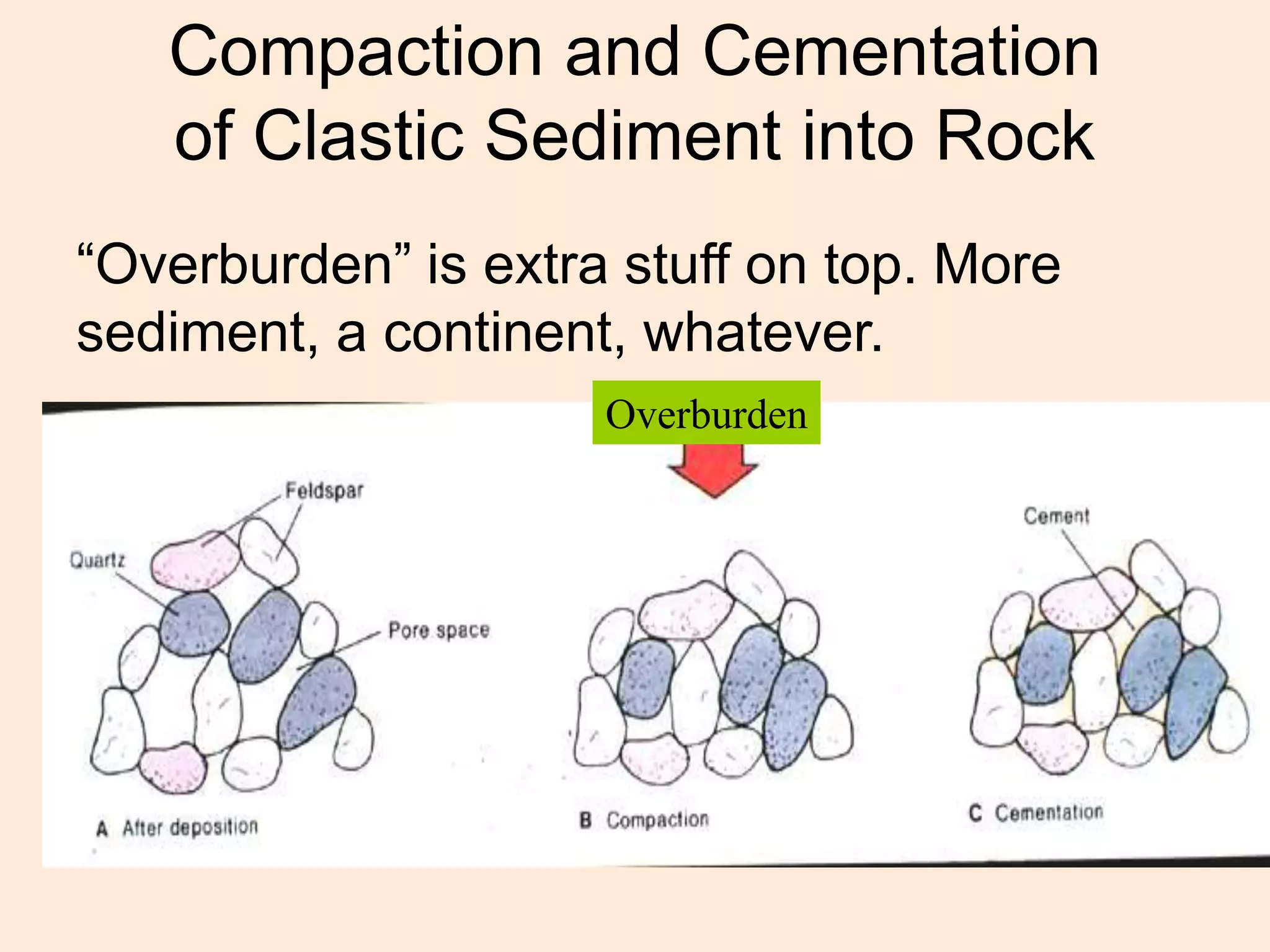
“Overburden” is extra stuff on top. More
sediment, a continent, whatever.
Compaction and Cementation
of Clastic Sediment into Rock
Overburden
Three Kinds of Sedimentary Rocks
• 1. Clastic – fragments of other rocks. For
example: shale, sandstone, conglomerate
• 2. Crystalline – formed from mineral grains that
fall out of solution by chemical action or
evaporation. For example: Rock salt and
chemical limestone.
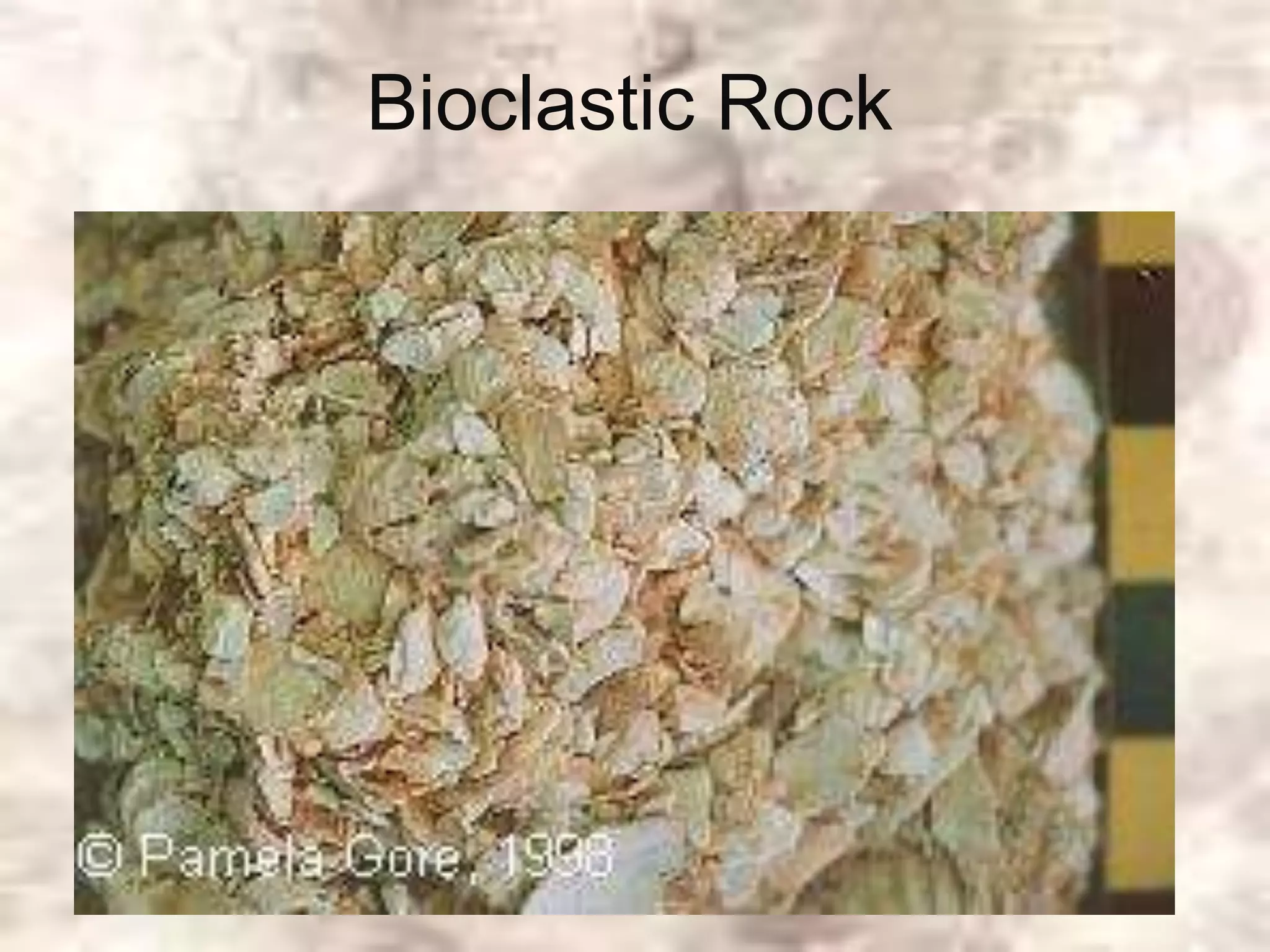
• 3. Bioclastic – formed from remains of plants
or animals. For example: Coal and limestone
from shells (coquina).
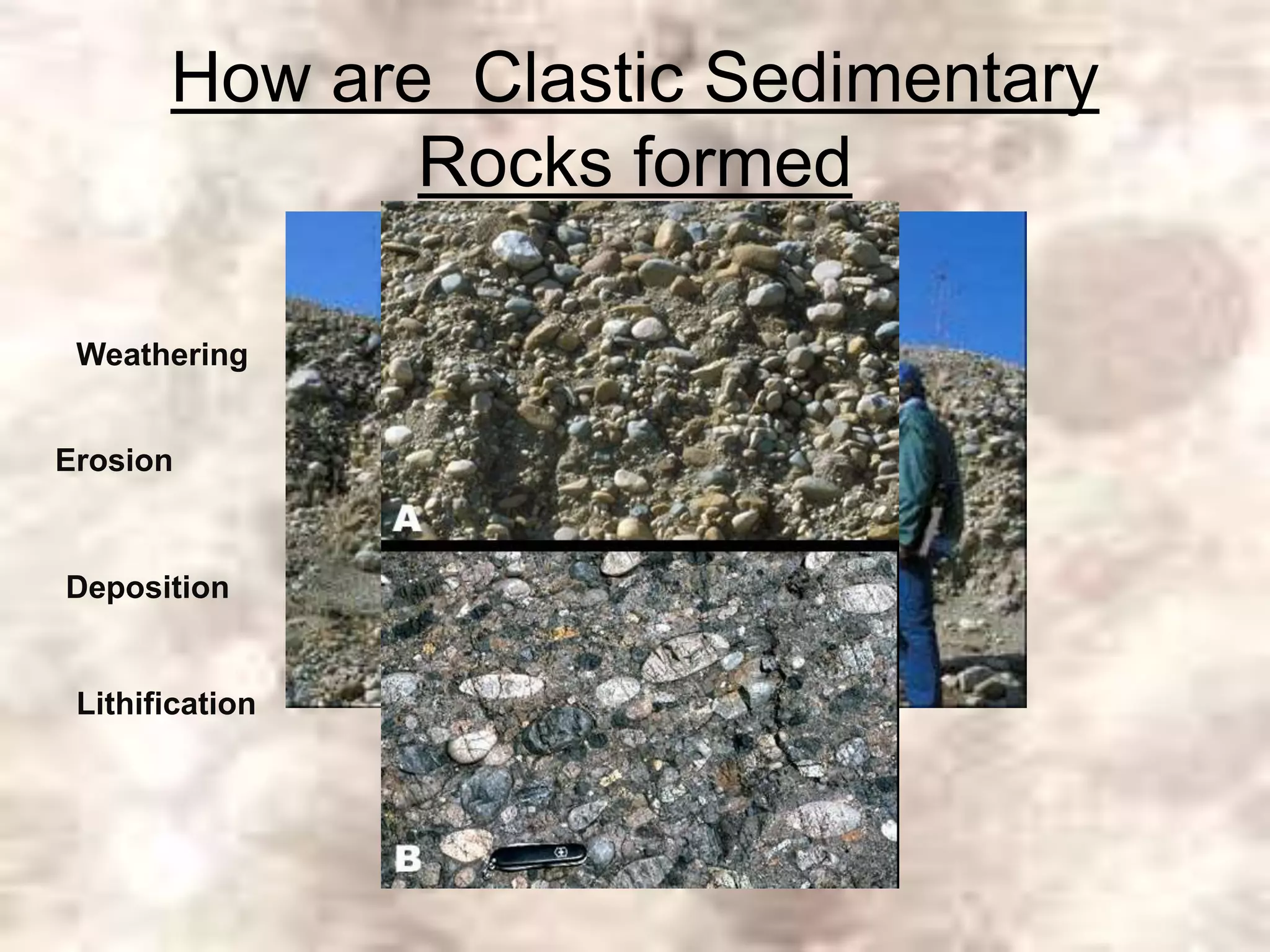
How are Clastic Sedimentary
Rocks formed
• Sediment is deposited and then
goes through the process of
lithification (forming sediment into
sedimentary rocks)
How are Clastic Sedimentary
Rocks formed
Weathering
Erosion
Deposition
Lithification
Clastic Sedimentary Rocks
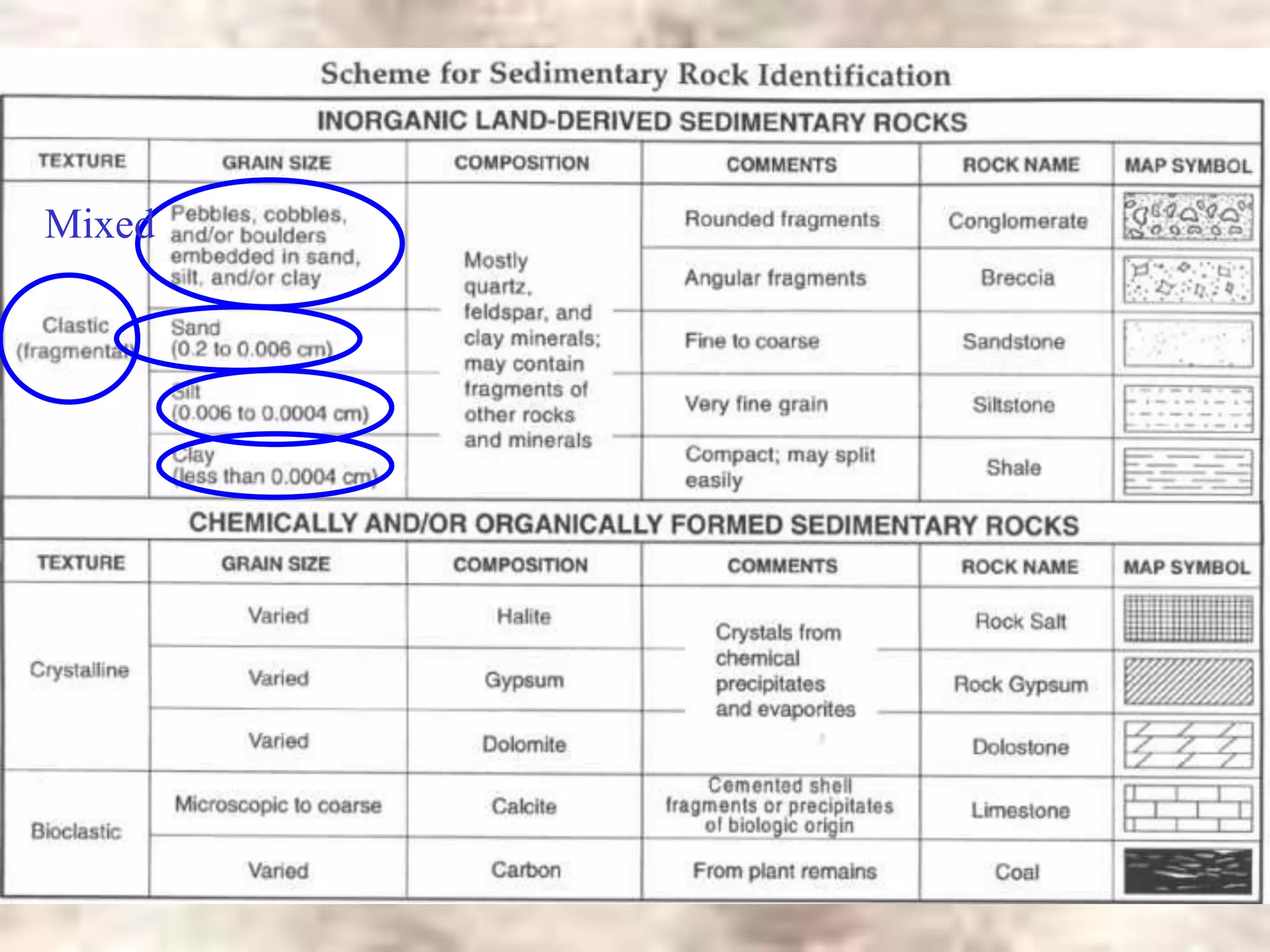
• Clastic sedimentary rocks are characterized
based on their grain size.
How are Clastic Sedimentary
Rocks formed.
• Grain sizes vary from Coarse (pebbles,
cobbles, boulders) to Medium (sand) to
Fine (silt and clay).
Grain Sizes
Boulders
Cobbles
Coarse Gravel
Fine Gravel
Coarse / Medium Sand
Fine Sand – Powdered Sugar
Silt - Powder
Mixed
How Does The Sediment Get
Sorted Into Different Sizes?
• Running water (rivers, streams, creeks) pick up
sediment and carry it along its travels.
• The faster the water is moving, the larger the
particle that can be carried, and vice-versa.
• When a river hits a larger body of water, like a
lake or ocean, it’s like hitting a brick wall. This
results in the river “dumping it’s load” – dropping
all the sediment it’s been carrying.
• The sediment gets dumped according to size!
How Does The Sediment Get
Sorted Into Different Sizes?
• The bigger sediment gets deposited
FIRST, since it’s bigger, heavier and sinks
first.
• Then, the sediment gets gradually
SMALLER the farther you go from where
the river hits the lake or ocean.
• Therefore, coarse clastic rocks get made
where the larger sediment gets deposited
and the medium to fine clastic rocks get
made further away from that point.
Clastic Sedimentary Rocks
Conglomerate
– made of pebbles
and/or cobbles
cemented together
by sand, silt and
clay. Coarse-
grained
Sandstone –
sand that has
been cemented
together.
Medium-grained
Shale – made
from clay. Fine-
grained
Crystalline Sedimentary Rocks
• Also called chemical sedimentary rocks.
• Chemical action or evaporation causes
minerals to drop out of solution.
• This process creates chemical or crystalline
sedimentary rocks.
• For example: Calcite will precipitate out of
water and build-up to form chemical
limestone (it will fizz with acid since it has
calcite in it!)
Crystalline (Chemical) Sedimentary
Rocks
Gypsum Rock –
made when the mineral
gypsum precipitates out
of water.
Chemical
Limestone
What happens when salty water
evaporates and just salt is left
behind?
Bonneville Salt Flats of the Great Salt
Lake, Utah. The lake bed is covered
with rock salt which gives it the white
color. The salt is mined by the Morton
Salt Company.
Bioclastic (Organic) Sedimentary
Rocks
• Also called Organic sedimentary rocks.
• Formed from once-living things like plants
and animals.
• For example: Plants die and decay and
form coal.
• Another example: Shells can get broken
up and cemented back together to form
organic limestone (also called coquina).
Bioclastic (Organic) Sedimentary
Rocks
Coal
Organic Limestone
or Coquina
Bioclastic Rock
Answers
1. Define Clastic-
2. Define bioclastic-
3. What type of rock is made of particle .05 cm?
4. What type of rock is made of particle .1 cm?
5. What is the chemical composition of bituminous
coal?
Made from fragments of other rocks
Formed from remains of plants or animals
Sandstone
Sandstone
Carbon

SEDIMENTARY ROCKS.ppt

  • 1.
    SEDIMENTARY ROCKS • Sedimentaryrocks form from various types of sediment. • Sedimentary rocks make up 90% of SURFACE rocks and only about 1% of Earth’s crust.
  • 2.
    How are SedimentaryRocks Formed • Sedimentary rock forms when sediments are combined to form solid rock • “Lithification” is the fancy name for forming rocks. • Sedimentary rock is formed in two ways: – Compaction • Formed by pressure compacting the sediments together AND/OR – Cementation • Pressure forces water out of the sediments, the dissolved mineral crystallize, cementing the sediments together
  • 3.
    “Overburden” is extrastuff on top. More sediment, a continent, whatever. Compaction and Cementation of Clastic Sediment into Rock Overburden
  • 4.
    Three Kinds ofSedimentary Rocks • 1. Clastic – fragments of other rocks. For example: shale, sandstone, conglomerate • 2. Crystalline – formed from mineral grains that fall out of solution by chemical action or evaporation. For example: Rock salt and chemical limestone. • 3. Bioclastic – formed from remains of plants or animals. For example: Coal and limestone from shells (coquina).
  • 5.
    How are ClasticSedimentary Rocks formed • Sediment is deposited and then goes through the process of lithification (forming sediment into sedimentary rocks)
  • 6.
    How are ClasticSedimentary Rocks formed Weathering Erosion Deposition Lithification
  • 7.
    Clastic Sedimentary Rocks •Clastic sedimentary rocks are characterized based on their grain size.
  • 8.
    How are ClasticSedimentary Rocks formed. • Grain sizes vary from Coarse (pebbles, cobbles, boulders) to Medium (sand) to Fine (silt and clay).
  • 9.
    Grain Sizes Boulders Cobbles Coarse Gravel FineGravel Coarse / Medium Sand Fine Sand – Powdered Sugar Silt - Powder
  • 10.
  • 11.
    How Does TheSediment Get Sorted Into Different Sizes? • Running water (rivers, streams, creeks) pick up sediment and carry it along its travels. • The faster the water is moving, the larger the particle that can be carried, and vice-versa. • When a river hits a larger body of water, like a lake or ocean, it’s like hitting a brick wall. This results in the river “dumping it’s load” – dropping all the sediment it’s been carrying. • The sediment gets dumped according to size!
  • 12.
    How Does TheSediment Get Sorted Into Different Sizes? • The bigger sediment gets deposited FIRST, since it’s bigger, heavier and sinks first. • Then, the sediment gets gradually SMALLER the farther you go from where the river hits the lake or ocean. • Therefore, coarse clastic rocks get made where the larger sediment gets deposited and the medium to fine clastic rocks get made further away from that point.
  • 14.
    Clastic Sedimentary Rocks Conglomerate –made of pebbles and/or cobbles cemented together by sand, silt and clay. Coarse- grained Sandstone – sand that has been cemented together. Medium-grained Shale – made from clay. Fine- grained
  • 16.
    Crystalline Sedimentary Rocks •Also called chemical sedimentary rocks. • Chemical action or evaporation causes minerals to drop out of solution. • This process creates chemical or crystalline sedimentary rocks. • For example: Calcite will precipitate out of water and build-up to form chemical limestone (it will fizz with acid since it has calcite in it!)
  • 17.
    Crystalline (Chemical) Sedimentary Rocks GypsumRock – made when the mineral gypsum precipitates out of water. Chemical Limestone
  • 18.
    What happens whensalty water evaporates and just salt is left behind? Bonneville Salt Flats of the Great Salt Lake, Utah. The lake bed is covered with rock salt which gives it the white color. The salt is mined by the Morton Salt Company.
  • 20.
    Bioclastic (Organic) Sedimentary Rocks •Also called Organic sedimentary rocks. • Formed from once-living things like plants and animals. • For example: Plants die and decay and form coal. • Another example: Shells can get broken up and cemented back together to form organic limestone (also called coquina).
  • 21.
  • 22.
  • 24.
    Answers 1. Define Clastic- 2.Define bioclastic- 3. What type of rock is made of particle .05 cm? 4. What type of rock is made of particle .1 cm? 5. What is the chemical composition of bituminous coal? Made from fragments of other rocks Formed from remains of plants or animals Sandstone Sandstone Carbon