
Sediment and Sedimentary Rocks
Intro to Sedimentary Rocks
• Produced from weathering products of pre-existing rocks or
accumulated biological matter
– Detrital (clastic) rocks produced from rock fragments
– Chemical rocks produced by precipitation of dissolved
ions in water
– Organic rocks produced by accumulation of biological
debris, such as in swamps
• Sedimentary rock types and sedimentary structures within
the rocks give clues to past environments
• Fossils in sedimentary rocks give clues to the history of life
• Important resources (coal, oil) are found in sedimentary
rocks
Sediment
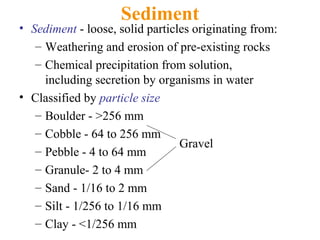
• Sediment - loose, solid particles originating from:
– Weathering and erosion of pre-existing rocks
– Chemical precipitation from solution,
including secretion by organisms in water
• Classified by particle size
– Boulder - >256 mm
– Cobble - 64 to 256 mm
– Pebble - 4 to 64 mm
– Granule- 2 to 4 mm
– Sand - 1/16 to 2 mm
– Silt - 1/256 to 1/16 mm
– Clay - <1/256 mm
Gravel
Major processes for Sedimentary Rock
• Weathering and erosion of pre-existing rocks
• Transportation
– Movement of sediment away from its source, typically by water,
wind, or ice
• Deposition
– Deposited the transported material
– Accumulation of chemical or organic sediments in water
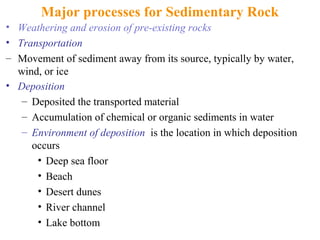
– Environment of deposition is the location in which deposition
occurs
• Deep sea floor
• Beach
• Desert dunes
• River channel
• Lake bottom
• Preservation
– Sediment must be preserved, as by burial in order to
become a sedimentary rock
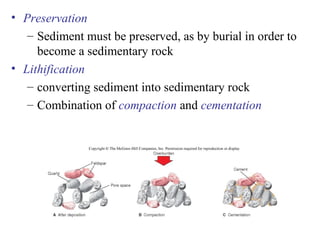
• Lithification
– converting sediment into sedimentary rock
– Combination of compaction and cementation
Types of Sedimentary Rocks
1) Detrital (clastic) sedimentary rocks
– Most common sedimentary rock type
– Form from cemented sediment grains that come from
pre-existing rocks
2) Non- clastic sedimentary rocks include:
a) Chemical sedimentary rocks: Form basically from CaCO3
– both by chemical leaching and by organic source
(biochemical) eg. Limestone; dolomite
b) Organic sedimentary rocks: Form due to decomposition
of organic remains under temperature and pressure eg.
Coal etc.
Clastic Sedimentary Rocks
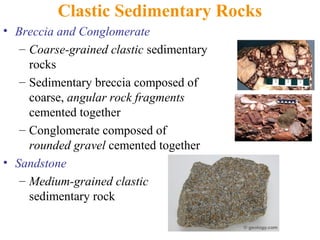
• Breccia and Conglomerate
– Coarse-grained clastic sedimentary
rocks
– Sedimentary breccia composed of
coarse, angular rock fragments
cemented together
– Conglomerate composed of
rounded gravel cemented together
• Sandstone
– Medium-grained clastic
sedimentary rock
• Shale
– Fine-grained clastic sedimentary rock
– Splits into thin layers (fissile)
– Silt- and clay-sized grains
– Sediment deposited in lake bottoms, river deltas,
floodplains, and on deep ocean floor
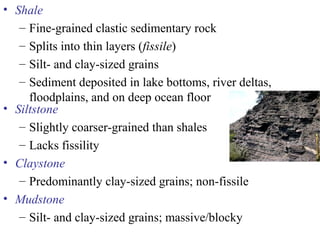
• Siltstone
– Slightly coarser-grained than shales
– Lacks fissility
• Claystone
– Predominantly clay-sized grains; non-fissile
• Mudstone
– Silt- and clay-sized grains; massive/blocky
Chemical Sedimentary Rocks
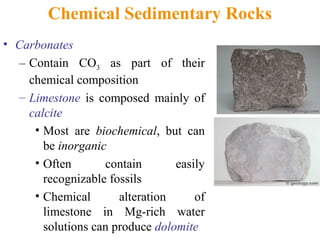
• Carbonates
– Contain CO3 as part of their
chemical composition
– Limestone is composed mainly of
calcite
• Most are biochemical, but can
be inorganic
• Often contain easily
recognizable fossils
• Chemical alteration of
limestone in Mg-rich water
solutions can produce dolomite
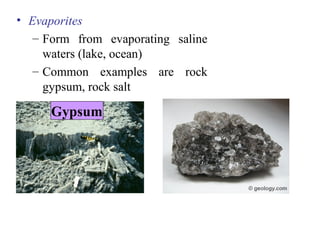
• Evaporites
– Form from evaporating saline
waters (lake, ocean)
– Common examples are rock
gypsum, rock salt
Gypsum
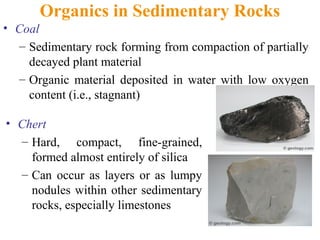
Organics in Sedimentary Rocks
• Coal
– Sedimentary rock forming from compaction of partially
decayed plant material
– Organic material deposited in water with low oxygen
content (i.e., stagnant)
• Chert
– Hard, compact, fine-grained,
formed almost entirely of silica
– Can occur as layers or as lumpy
nodules within other sedimentary
rocks, especially limestones
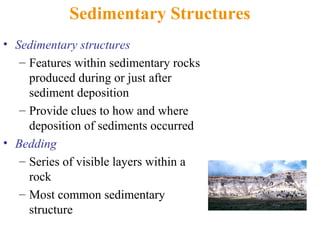
Sedimentary Structures
• Sedimentary structures
– Features within sedimentary rocks
produced during or just after
sediment deposition
– Provide clues to how and where
deposition of sediments occurred
• Bedding
– Series of visible layers within a
rock
– Most common sedimentary
structure
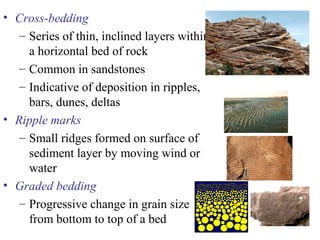
• Cross-bedding
– Series of thin, inclined layers within
a horizontal bed of rock
– Common in sandstones
– Indicative of deposition in ripples,
bars, dunes, deltas
• Ripple marks
– Small ridges formed on surface of
sediment layer by moving wind or
water
• Graded bedding
– Progressive change in grain size
from bottom to top of a bed
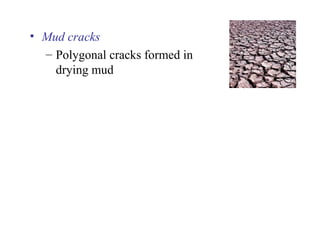
• Mud cracks
– Polygonal cracks formed in
drying mud

Sedimentary rocks

  • 1.
  • 2.
    Intro to SedimentaryRocks • Produced from weathering products of pre-existing rocks or accumulated biological matter – Detrital (clastic) rocks produced from rock fragments – Chemical rocks produced by precipitation of dissolved ions in water – Organic rocks produced by accumulation of biological debris, such as in swamps • Sedimentary rock types and sedimentary structures within the rocks give clues to past environments • Fossils in sedimentary rocks give clues to the history of life • Important resources (coal, oil) are found in sedimentary rocks
  • 3.
    Sediment • Sediment -loose, solid particles originating from: – Weathering and erosion of pre-existing rocks – Chemical precipitation from solution, including secretion by organisms in water • Classified by particle size – Boulder - >256 mm – Cobble - 64 to 256 mm – Pebble - 4 to 64 mm – Granule- 2 to 4 mm – Sand - 1/16 to 2 mm – Silt - 1/256 to 1/16 mm – Clay - <1/256 mm Gravel
  • 4.
    Major processes forSedimentary Rock • Weathering and erosion of pre-existing rocks • Transportation – Movement of sediment away from its source, typically by water, wind, or ice • Deposition – Deposited the transported material – Accumulation of chemical or organic sediments in water – Environment of deposition is the location in which deposition occurs • Deep sea floor • Beach • Desert dunes • River channel • Lake bottom
  • 5.
    • Preservation – Sedimentmust be preserved, as by burial in order to become a sedimentary rock • Lithification – converting sediment into sedimentary rock – Combination of compaction and cementation
  • 6.
    Types of SedimentaryRocks 1) Detrital (clastic) sedimentary rocks – Most common sedimentary rock type – Form from cemented sediment grains that come from pre-existing rocks 2) Non- clastic sedimentary rocks include: a) Chemical sedimentary rocks: Form basically from CaCO3 – both by chemical leaching and by organic source (biochemical) eg. Limestone; dolomite b) Organic sedimentary rocks: Form due to decomposition of organic remains under temperature and pressure eg. Coal etc.
  • 7.
    Clastic Sedimentary Rocks •Breccia and Conglomerate – Coarse-grained clastic sedimentary rocks – Sedimentary breccia composed of coarse, angular rock fragments cemented together – Conglomerate composed of rounded gravel cemented together • Sandstone – Medium-grained clastic sedimentary rock
  • 8.
    • Shale – Fine-grainedclastic sedimentary rock – Splits into thin layers (fissile) – Silt- and clay-sized grains – Sediment deposited in lake bottoms, river deltas, floodplains, and on deep ocean floor • Siltstone – Slightly coarser-grained than shales – Lacks fissility • Claystone – Predominantly clay-sized grains; non-fissile • Mudstone – Silt- and clay-sized grains; massive/blocky
  • 9.
    Chemical Sedimentary Rocks •Carbonates – Contain CO3 as part of their chemical composition – Limestone is composed mainly of calcite • Most are biochemical, but can be inorganic • Often contain easily recognizable fossils • Chemical alteration of limestone in Mg-rich water solutions can produce dolomite
  • 10.
    • Evaporites – Formfrom evaporating saline waters (lake, ocean) – Common examples are rock gypsum, rock salt Gypsum
  • 11.
    Organics in SedimentaryRocks • Coal – Sedimentary rock forming from compaction of partially decayed plant material – Organic material deposited in water with low oxygen content (i.e., stagnant) • Chert – Hard, compact, fine-grained, formed almost entirely of silica – Can occur as layers or as lumpy nodules within other sedimentary rocks, especially limestones
  • 12.
    Sedimentary Structures • Sedimentarystructures – Features within sedimentary rocks produced during or just after sediment deposition – Provide clues to how and where deposition of sediments occurred • Bedding – Series of visible layers within a rock – Most common sedimentary structure
  • 13.
    • Cross-bedding – Seriesof thin, inclined layers within a horizontal bed of rock – Common in sandstones – Indicative of deposition in ripples, bars, dunes, deltas • Ripple marks – Small ridges formed on surface of sediment layer by moving wind or water • Graded bedding – Progressive change in grain size from bottom to top of a bed
  • 14.
    • Mud cracks –Polygonal cracks formed in drying mud