Click to edit Master title style
1
Security Threats and
Attacks in Cyber Security
Presented By: AJIT KUMAR
Course :MCA-Ist year
Click to edit Master title style
2
Security Threats
S u b t i t l e
2
Click to edit Master title style
3
Section Header02
S u b t i t l e
3
Click to edit Master title style
4
Types of Threat:
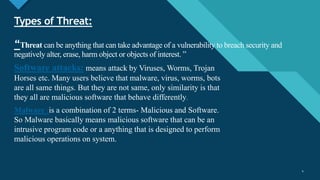
“Threat can be anything that can take advantage of a vulnerability to breach security and
negatively alter, erase, harm object or objects of interest. ”
Software attacks: means attack by Viruses, Worms, Trojan
Horses etc. Many users believe that malware, virus, worms, bots
are all same things. But they are not same, only similarity is that
they all are malicious software that behave differently.
Malware :is a combination of 2 terms- Malicious and Software.
So Malware basically means malicious software that can be an
intrusive program code or a anything that is designed to perform
malicious operations on system.
4
Click to edit Master title style
5
Malware can be divided in 2 categories:
Malware on the basis of Infection Method are following:
5
• Virus – They have the ability to replicate themselves by hooking them
to the program on the host computer like songs, videos etc and then
they travel all over the Internet. The Creeper Virus was first detected
on ARPANET. Examples include File Virus, Macro Virus, Boot Sector
Virus, Stealth Virus etc.
• Worms – Worms are also self replicating in nature but they don’t
hook themselves to the program on host computer. Biggest difference
between virus and worms is that worms are network aware. They can
easily travel from one computer to another if network is available and
on the target machine they will not do much harm, they will for
example consume hard disk space thus slowing down the computer.
Click to edit Master title style
6
Customize this Template
6
Trojan – The Concept of Trojan is completely different from the viruses and worms. The name Trojan derived
from the ‘Trojan Horse’ tale in Greek mythology, which explains how the Greeks were able to enter the
fortified city of Troy by hiding their soldiers in a big wooden horse given to the Trojans as a gift. The Trojans
were very fond of horses and trusted the gift blindly. In the night, the soldiers emerged and attacked the city
from the inside. Their purpose is to conceal themselves inside the software that seem legitimate and when
that software is executed they will do their task of either stealing information or any other purpose for which
they are designed.
They often provide backdoor gateway for malicious programs or malevolent users to enter your system and
steal your valuable data without your knowledge and permission. Examples include FTP Trojans, Proxy
Trojans, Remote Access Trojans etc.
Bots –: can be seen as advanced form of worms. They are automated processes that are designed to
interact over the internet without the need of human interaction. They can be good or bad. Malicious bot can
infect one host and after infecting will create connection to the central server which will provide commands to
all infected hosts attached to that network called Botnet.
Click to edit Master title style
7
Malware on the basis of Actions:
7
Adware – Adware is not exactly malicious but they do breach privacy of the
users. They display ads on computer’s desktop or inside individual programs.
They come attached with free to use software, thus main source of revenue for
such developers. They monitor your interests and display relevant ads. An
attacker can embed malicious code inside the software and adware can monitor
your system activities and can even compromise your machine.
Spyware – It is a program or we can say a software that monitors your activities
on computer and reveal collected information to interested party. Spyware are
generally dropped by Trojans, viruses or worms. Once dropped they installs
themselves and sits silently to avoid detection. One of the most common example
of spyware is KEYLOGGER. The basic job of keylogger is to record user
keystrokes with timestamp. Thus capturing interesting information like username,
passwords, credit card details etc.
Click to edit Master title style
8
Customize this Template
8
Ransomware – It is type of malware that will either
encrypt your files or will lock your computer making it
inaccessible either partially or wholly. Then a screen will
be displayed asking for money i.e. ransom in exchange.
Scareware – It masquerades as a tool to help fix your
system but when the software is executed it will infect
your system or completely destroy it. The software will
display a message to frighten you and force to take
some action like pay them to fix your system.
Click to edit Master title style
9
Customize this Template
9
Rootkits – are designed to gain root access or we can
say administrative privileges in the user system. Once
gained the root access, the exploiter can do anything
from stealing private files to private data.
Zombies – They work similar to Spyware. Infection
mechanism is same but they don’t spy and steal
information rather they wait for the command from
hackers
Click to edit Master title style
10
Customize this Template
10
Template Editing
Instructions and Feedback
Click to edit Master title style
11
Thank You 1
Click to edit Master title style
12
Thank You 2

Security threats and attacks in cyber security

  • 1.
    Click to editMaster title style 1 Security Threats and Attacks in Cyber Security Presented By: AJIT KUMAR Course :MCA-Ist year
  • 2.
    Click to editMaster title style 2 Security Threats S u b t i t l e 2
  • 3.
    Click to editMaster title style 3 Section Header02 S u b t i t l e 3
  • 4.
    Click to editMaster title style 4 Types of Threat: “Threat can be anything that can take advantage of a vulnerability to breach security and negatively alter, erase, harm object or objects of interest. ” Software attacks: means attack by Viruses, Worms, Trojan Horses etc. Many users believe that malware, virus, worms, bots are all same things. But they are not same, only similarity is that they all are malicious software that behave differently. Malware :is a combination of 2 terms- Malicious and Software. So Malware basically means malicious software that can be an intrusive program code or a anything that is designed to perform malicious operations on system. 4
  • 5.
    Click to editMaster title style 5 Malware can be divided in 2 categories: Malware on the basis of Infection Method are following: 5 • Virus – They have the ability to replicate themselves by hooking them to the program on the host computer like songs, videos etc and then they travel all over the Internet. The Creeper Virus was first detected on ARPANET. Examples include File Virus, Macro Virus, Boot Sector Virus, Stealth Virus etc. • Worms – Worms are also self replicating in nature but they don’t hook themselves to the program on host computer. Biggest difference between virus and worms is that worms are network aware. They can easily travel from one computer to another if network is available and on the target machine they will not do much harm, they will for example consume hard disk space thus slowing down the computer.
  • 6.
    Click to editMaster title style 6 Customize this Template 6 Trojan – The Concept of Trojan is completely different from the viruses and worms. The name Trojan derived from the ‘Trojan Horse’ tale in Greek mythology, which explains how the Greeks were able to enter the fortified city of Troy by hiding their soldiers in a big wooden horse given to the Trojans as a gift. The Trojans were very fond of horses and trusted the gift blindly. In the night, the soldiers emerged and attacked the city from the inside. Their purpose is to conceal themselves inside the software that seem legitimate and when that software is executed they will do their task of either stealing information or any other purpose for which they are designed. They often provide backdoor gateway for malicious programs or malevolent users to enter your system and steal your valuable data without your knowledge and permission. Examples include FTP Trojans, Proxy Trojans, Remote Access Trojans etc. Bots –: can be seen as advanced form of worms. They are automated processes that are designed to interact over the internet without the need of human interaction. They can be good or bad. Malicious bot can infect one host and after infecting will create connection to the central server which will provide commands to all infected hosts attached to that network called Botnet.
  • 7.
    Click to editMaster title style 7 Malware on the basis of Actions: 7 Adware – Adware is not exactly malicious but they do breach privacy of the users. They display ads on computer’s desktop or inside individual programs. They come attached with free to use software, thus main source of revenue for such developers. They monitor your interests and display relevant ads. An attacker can embed malicious code inside the software and adware can monitor your system activities and can even compromise your machine. Spyware – It is a program or we can say a software that monitors your activities on computer and reveal collected information to interested party. Spyware are generally dropped by Trojans, viruses or worms. Once dropped they installs themselves and sits silently to avoid detection. One of the most common example of spyware is KEYLOGGER. The basic job of keylogger is to record user keystrokes with timestamp. Thus capturing interesting information like username, passwords, credit card details etc.
  • 8.
    Click to editMaster title style 8 Customize this Template 8 Ransomware – It is type of malware that will either encrypt your files or will lock your computer making it inaccessible either partially or wholly. Then a screen will be displayed asking for money i.e. ransom in exchange. Scareware – It masquerades as a tool to help fix your system but when the software is executed it will infect your system or completely destroy it. The software will display a message to frighten you and force to take some action like pay them to fix your system.
  • 9.
    Click to editMaster title style 9 Customize this Template 9 Rootkits – are designed to gain root access or we can say administrative privileges in the user system. Once gained the root access, the exploiter can do anything from stealing private files to private data. Zombies – They work similar to Spyware. Infection mechanism is same but they don’t spy and steal information rather they wait for the command from hackers
  • 10.
    Click to editMaster title style 10 Customize this Template 10 Template Editing Instructions and Feedback
  • 11.
    Click to editMaster title style 11 Thank You 1
  • 12.
    Click to editMaster title style 12 Thank You 2