By: Gonzalo Linares, Diana Barbed & Víctor Medina
 Viruses
 Worms
 Trojans
 Spyware
 Adware
 Backdoors
 Rootkits
 Keylogger
 Malware is any software intentionally designed to
cause damage to a computer, server or computer
network. Malware does the damage after it is
implanted or introduced in some way into a
target’s computer and can take the form
of executable code, scripts, active content, and
other software.
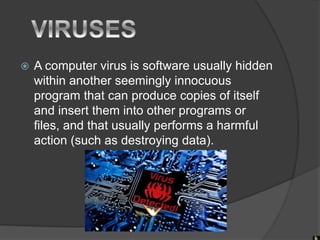
 A computer virus is software usually hidden
within another seemingly innocuous
program that can produce copies of itself
and insert them into other programs or
files, and that usually performs a harmful
action (such as destroying data).
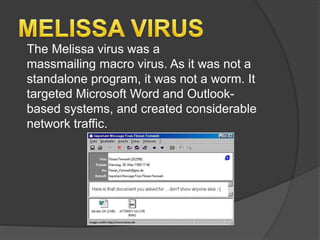
The Melissa virus was a
massmailing macro virus. As it was not a
standalone program, it was not a worm. It
targeted Microsoft Word and Outlook-
based systems, and created considerable
network traffic.
 A computer worm is a
standalone malware computer program that
replicates itself in order to spread to other
computers. Often, it uses a computer network to
spread itself, relying on security failures on the
target computer to access it. Worms almost
always cause at least some harm to the network,
even if only by consuming bandwidth, whereas
viruses almost always corrupt or modify files on a
targeted computer.
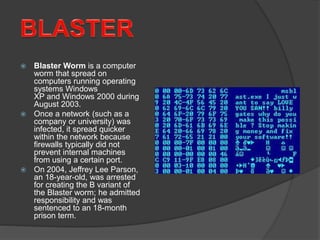
 Blaster Worm is a computer
worm that spread on
computers running operating
systems Windows
XP and Windows 2000 during
August 2003.
 Once a network (such as a
company or university) was
infected, it spread quicker
within the network because
firewalls typically did not
prevent internal machines
from using a certain port.
 On 2004, Jeffrey Lee Parson,
an 18-year-old, was arrested
for creating the B variant of
the Blaster worm; he admitted
responsibility and was
sentenced to an 18-month
prison term.
 A Trojan horse is a harmful program that
misrepresents itself to masquerade as a
regular, benign program or utility in order to
persuade a victim to install it. A Trojan
horse usually carries a hidden destructive
function that is activated when the
application is started.
 Spyware is malware that collects
information from a computer and then
transmits this information to an outside
entity without the knowledge or consent
of the computer owner.
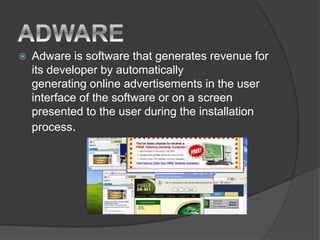
 Adware is software that generates revenue for
its developer by automatically
generating online advertisements in the user
interface of the software or on a screen
presented to the user during the installation
process.
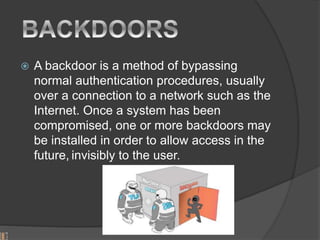
 A backdoor is a method of bypassing
normal authentication procedures, usually
over a connection to a network such as the
Internet. Once a system has been
compromised, one or more backdoors may
be installed in order to allow access in the
future, invisibly to the user.
 Once malicious software is installed on a
system, it is essential that it stays concealed,
to avoid detection. Software packages known
as rootkits allow this concealment, by
modifying the host's operating system so that
the malware is hidden from the user. Rootkits
can prevent a harmful process from being
visible in the system's list of processes, or
keep its files from being read.
 Keyboard capturing is the action of recording the
keys struck on a keyboard, typically covertly, so
that the person using the keyboard is unaware that
their actions are being monitored. Data can then
be retrieved by the person operating the logging
program. A keylogger can be
either software or hardware.
 Magic Lantern is keystroke logging software developed by
the United States' FBI.
 Also called Tinba, is a malware program that targets financial
institution websites. It is a modified form of Banker Trojans, yet it is
much smaller in size and more powerful. It works by
establishing man-in-the-browser attacks and network sniffing.
 DarkComet was a program that was discontinued, partially due to
its use in the Syrian civil war to monitor activists. It allows a user to
control the system with a Graphical User Interface.

Dickmaster

  • 1.
    By: Gonzalo Linares,Diana Barbed & Víctor Medina
  • 2.
     Viruses  Worms Trojans  Spyware  Adware  Backdoors  Rootkits  Keylogger
  • 3.
     Malware isany software intentionally designed to cause damage to a computer, server or computer network. Malware does the damage after it is implanted or introduced in some way into a target’s computer and can take the form of executable code, scripts, active content, and other software.
  • 4.
     A computervirus is software usually hidden within another seemingly innocuous program that can produce copies of itself and insert them into other programs or files, and that usually performs a harmful action (such as destroying data).
  • 5.
    The Melissa viruswas a massmailing macro virus. As it was not a standalone program, it was not a worm. It targeted Microsoft Word and Outlook- based systems, and created considerable network traffic.
  • 6.
     A computerworm is a standalone malware computer program that replicates itself in order to spread to other computers. Often, it uses a computer network to spread itself, relying on security failures on the target computer to access it. Worms almost always cause at least some harm to the network, even if only by consuming bandwidth, whereas viruses almost always corrupt or modify files on a targeted computer.
  • 7.
     Blaster Wormis a computer worm that spread on computers running operating systems Windows XP and Windows 2000 during August 2003.  Once a network (such as a company or university) was infected, it spread quicker within the network because firewalls typically did not prevent internal machines from using a certain port.  On 2004, Jeffrey Lee Parson, an 18-year-old, was arrested for creating the B variant of the Blaster worm; he admitted responsibility and was sentenced to an 18-month prison term.
  • 8.
     A Trojanhorse is a harmful program that misrepresents itself to masquerade as a regular, benign program or utility in order to persuade a victim to install it. A Trojan horse usually carries a hidden destructive function that is activated when the application is started.
  • 9.
     Spyware ismalware that collects information from a computer and then transmits this information to an outside entity without the knowledge or consent of the computer owner.
  • 10.
     Adware issoftware that generates revenue for its developer by automatically generating online advertisements in the user interface of the software or on a screen presented to the user during the installation process.
  • 11.
     A backdooris a method of bypassing normal authentication procedures, usually over a connection to a network such as the Internet. Once a system has been compromised, one or more backdoors may be installed in order to allow access in the future, invisibly to the user.
  • 12.
     Once malicioussoftware is installed on a system, it is essential that it stays concealed, to avoid detection. Software packages known as rootkits allow this concealment, by modifying the host's operating system so that the malware is hidden from the user. Rootkits can prevent a harmful process from being visible in the system's list of processes, or keep its files from being read.
  • 13.
     Keyboard capturingis the action of recording the keys struck on a keyboard, typically covertly, so that the person using the keyboard is unaware that their actions are being monitored. Data can then be retrieved by the person operating the logging program. A keylogger can be either software or hardware.
  • 14.
     Magic Lanternis keystroke logging software developed by the United States' FBI.  Also called Tinba, is a malware program that targets financial institution websites. It is a modified form of Banker Trojans, yet it is much smaller in size and more powerful. It works by establishing man-in-the-browser attacks and network sniffing.  DarkComet was a program that was discontinued, partially due to its use in the Syrian civil war to monitor activists. It allows a user to control the system with a Graphical User Interface.