About Me
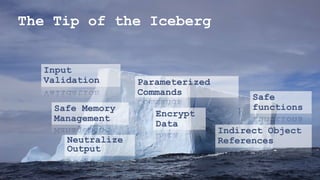
The Tip of the Iceberg
Input
Validation Parameterized
Commands
Safe
functions
Indirect Object
References
Encrypt
Data
Safe Memory
Management
Neutralize
Output
Input Validation
• Only allow input that you are expecting
• Wouldyou letsomeonein your house ifyou thoughttheyshouldnot bethere?
• Block lists are inefficient
• Wouldyou maintaina block listofpeoplethatcannot cometoyour house?
• Block listing-likegiving keys toyour house toeveryone excepta fewunwanted
visitors.

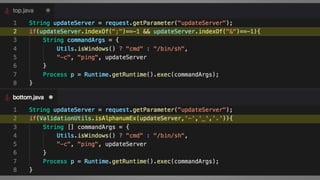
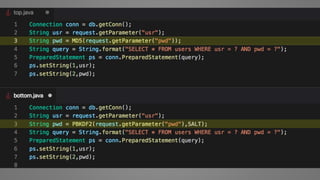
LET'S PLAY,
SPOT THE
VALIDATION
PROBLEM!
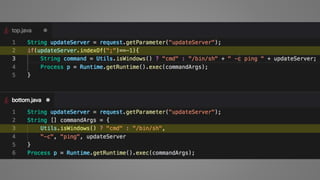
Answer: Both
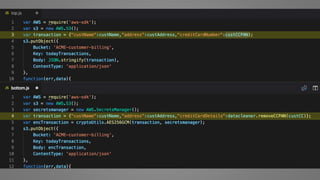
Answer: Top
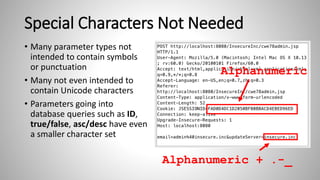
Special Characters Not Needed
• Many parameter types not
intended to contain symbols
or punctuation
• Many not even intended to
contain Unicode characters
• Parameters going into
database queries such as ID,
true/false, asc/desc have even
a smaller character set
Alphanumeric
Alphanumeric + .-_
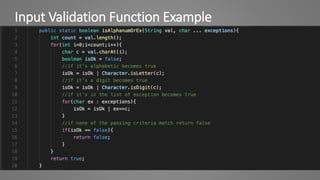
Input Validation Function Example
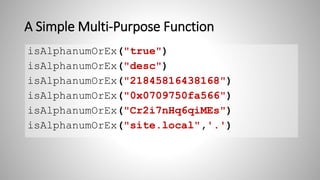
A Simple Multi-Purpose Function
isAlphanumOrEx("true")
isAlphanumOrEx("desc")
isAlphanumOrEx("21845816438168")
isAlphanumOrEx("0x0709750fa566")
isAlphanumOrEx("Cr2i7nHq6qiMEs")
isAlphanumOrEx("site.local",'.')
𝑽𝒖𝒍𝒏𝒆𝒓𝒂𝒃𝒊𝒍𝒊𝒕𝒊𝒆𝒔 = 𝑭(
𝑰𝒏𝒑𝒖𝒕
𝟏 + 𝑽𝒂𝒍𝒊𝒅𝒂𝒕𝒊𝒐𝒏
)
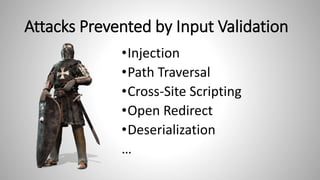
Attacks Prevented by Input Validation
•Injection
•Path Traversal
•Cross-Site Scripting
•Open Redirect
•Deserialization
…
How About the Irish?
•Names, comments, articles, free text require
quotes:
•O'Brien, don't, "putting things in quotes"
•While input validation reduces the attack
surface, it cannot prevent all attacks
To sum all it up…
•Input Validation reduces the attack
surface and prevents many attack types
•Block-listing is a bad practice
•Many input types are alphanumeric
•For those input types that need special
characters we need different defenses
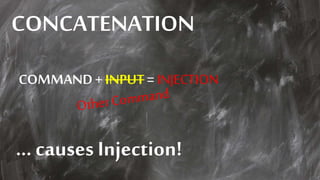
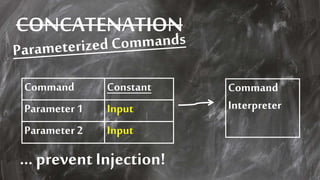
CONCATENATION
… causes Injection!
COMMAND +INPUT= INJECTION
CONCATENATION
Command Constant
Parameter 1 Input
Parameter 2 Input
Command
Interpreter
… prevent Injection!
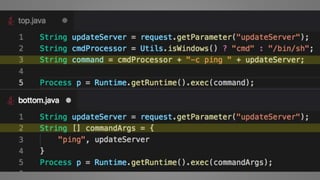
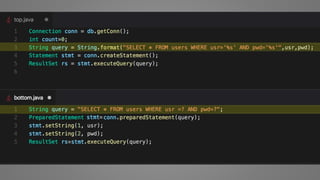
LET'S PLAY,
SPOT THE
INJECTION!
Answer: Top
Answer: Top
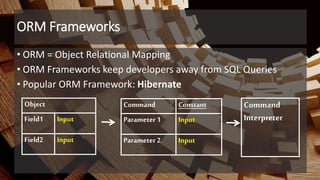
ORM Frameworks
• ORM = Object Relational Mapping
• ORM Frameworks keep developers away from SQL Queries
• Popular ORM Framework: Hibernate
Command Constant
Parameter 1 Input
Parameter 2 Input
Command
Interpreter
Object
Field1 Input
Field2 Input
To sum all it up…
•Parameterized Commands handle
situations where hazardous chars are
needed
•ORM Frameworks prevent mistakes
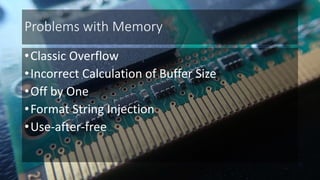
Problems with Memory
•Classic Overflow
•Incorrect Calculation of Buffer Size
•Off by One
•Format String Injection
•Use-after-free
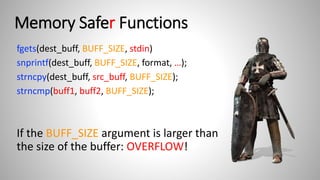
Memory Safer Functions
fgets(dest_buff, BUFF_SIZE, stdin)
snprintf(dest_buff, BUFF_SIZE, format, …);
strncpy(dest_buff, src_buff, BUFF_SIZE);
strncmp(buff1, buff2, BUFF_SIZE);
If the BUFF_SIZE argument is larger than
the size of the buffer: OVERFLOW!
Check Boundaries
•A simple comparison against a known limit constant
can go a long way to prevent serious logical attacks.
•Pay special attention to comparison operators
• < vs <=, <= can lead to off by one
•Make sure the same constant is used to define
buffer size and check boundaries
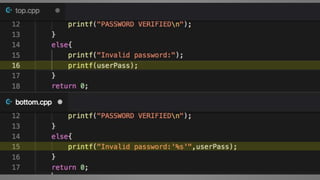
• Format String Injection is a type of memory flaw caused by
concatenating or using user input in a format parameter.
Memory Injection?
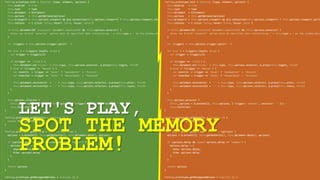
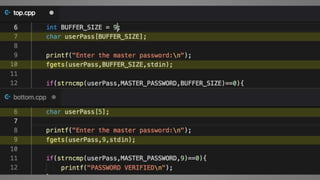
LET'S PLAY,
SPOT THE MEMORY
PROBLEM!
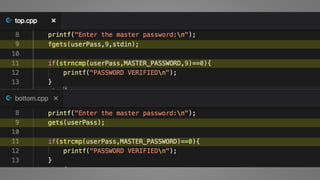
Answer: Bottom
(use of dangerous
functions)
Answer: Bottom
(incorrect calculation
of buffer size)
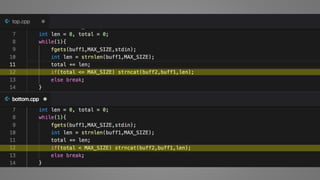
Answer: Top
(Format String
Injection)
Answer: Top
(Off by One)
To sum all it up…
•Safer functions allow limiting the number of bytes
read into the buffer
•Even with safe functions special attention should be
paid to size specified, very important to use constants
to prevent mistakes
•Do not allow user input in format strings
•Careful with <= operator
Securing Data
• The General Data Privacy Regulation (GDPR) has put additional emphasis on
maintaining the security and privacy of data
• Data should be transmitted and stored securely
• Cryptography is one critical way to achieve this mandate
• Secure protocols: TLS 1.2, TLS 1.3
• Secure ciphers: ECDHE
• Strong digital signatures: SHA-2
• Reject invalid certificates and even more, enforce certificate pinning
• Strong authenticated symmetric encryption in transit and at rest: AES 256 GCM
• Other ways:
• Anonymize private data
• Do not collect or send private data
• Short data retention
• Ensure customer control over own data
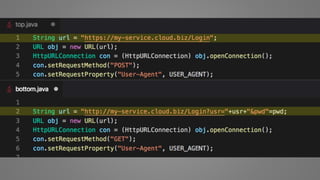
LET'S PLAY,
SPOT THE
DATA BREACH!
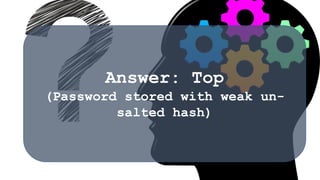
Answer: Top
(Password stored with weak un-
salted hash)
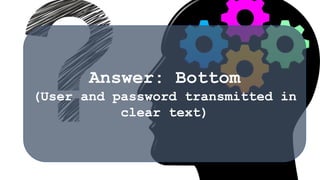
Answer: Bottom
(User and password transmitted in
clear text)
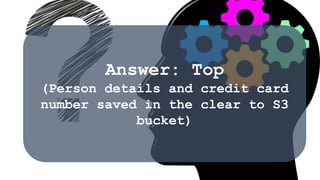
Answer: Top
(Person details and credit card
number saved in the clear to S3
bucket)
To sum all it up…
•Avoid collecting data for individuals
•Pseudonymize the data. Strong salted hashes
can be used, replace key data with *
•Use strong cryptographic algorithms
•All communication should be encrypted.
•Data classification is risky so when in doubt,
encrypt all data
Protect the Web UIs
• Enterprise applications are using Web UIs
• HTML is good looking, platform independent and powerful
• JavaScript libraries such as jQuery, React and Angular make
UIs responsive and versatile
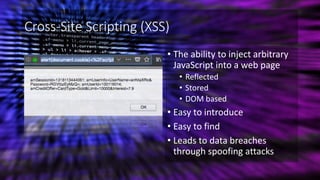
Cross-Site Scripting (XSS)
• The ability to inject arbitrary
JavaScript into a web page
• Reflected
• Stored
• DOM based
• Easy to introduce
• Easy to find
• Leads to data breaches
through spoofing attacks
Defending against XSS
• Input validation ;)
• Neutralize Output
• Server Pages -> HTML Encoding (Escaping)
• < becomes &lt;
• > becomes &gt;
• " becomes &quot;
• JavaScript (DOM XSS)
• Dangerous Attributes
• innerHTML
• src
• onLoad, onClick, etc…
• Dangerous Functions
• eval
• setTimeout
• setInterval
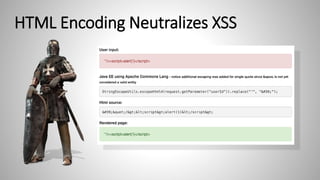
HTML Encoding Neutralizes XSS
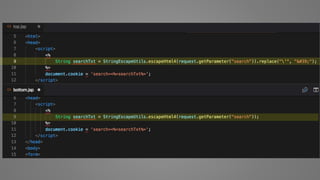
LET'S PLAY,
SPOT THE
XSS!
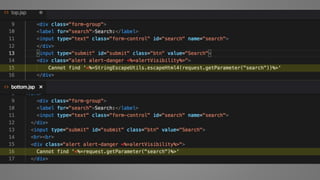
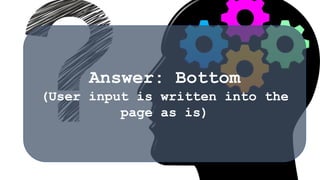
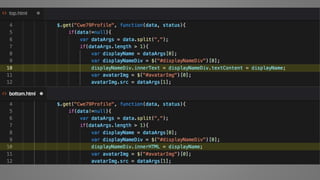
Answer: Bottom
(User input is written into the
page as is)
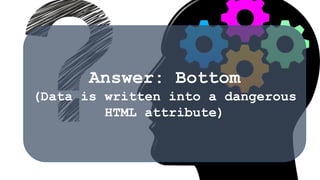
Answer: Bottom
(Data is written into a dangerous
HTML attribute)
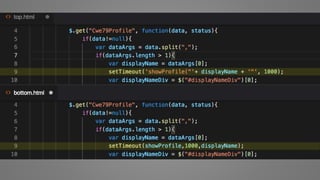
Answer: Top
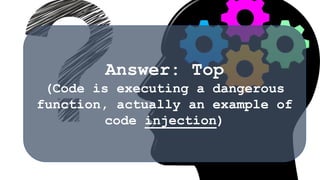
(Code is executing a dangerous
function, actually an example of
code injection)
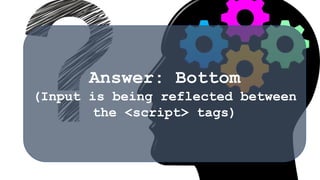
Answer: Bottom
(Input is being reflected between
the <script> tags)
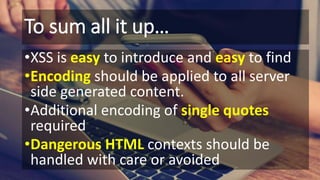
To sum all it up…
•XSS is easy to introduce and easy to find
•Encoding should be applied to all server
side generated content.
•Additional encoding of single quotes
required
•Dangerous HTML contexts should be
handled with care or avoided
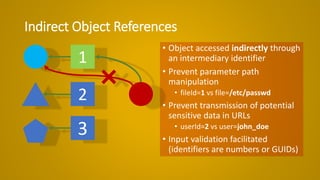
Indirect Object References
• Object accessed indirectly through
an intermediary identifier
• Prevent parameter path
manipulation
• fileId=1 vs file=/etc/passwd
• Prevent transmission of potential
sensitive data in URLs
• userId=2 vs user=john_doe
• Input validation facilitated
(identifiers are numbers or GUIDs)
1
2
3
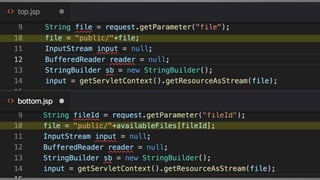
LET'S PLAY,
SPOT THE PATH
TRAVERSAL!
Answer: Top
(Input is concatenated to a
system path allowing
manipulation)
To sum all it up…
•Reduce the attack surface by enforcing
accessing objects through identifiers
rather than actual representation
•Identifiers can be input validated easier,
also solve encoding issues
Security Code Review 101

Security Code Review 101

  • 2.
  • 3.
    The Tip ofthe Iceberg Input Validation Parameterized Commands Safe functions Indirect Object References Encrypt Data Safe Memory Management Neutralize Output
  • 4.
    Input Validation • Onlyallow input that you are expecting • Wouldyou letsomeonein your house ifyou thoughttheyshouldnot bethere? • Block lists are inefficient • Wouldyou maintaina block listofpeoplethatcannot cometoyour house? • Block listing-likegiving keys toyour house toeveryone excepta fewunwanted visitors.
  • 5.
  • 7.
  • 9.
  • 10.
    Special Characters NotNeeded • Many parameter types not intended to contain symbols or punctuation • Many not even intended to contain Unicode characters • Parameters going into database queries such as ID, true/false, asc/desc have even a smaller character set Alphanumeric Alphanumeric + .-_
  • 11.
  • 12.
    A Simple Multi-PurposeFunction isAlphanumOrEx("true") isAlphanumOrEx("desc") isAlphanumOrEx("21845816438168") isAlphanumOrEx("0x0709750fa566") isAlphanumOrEx("Cr2i7nHq6qiMEs") isAlphanumOrEx("site.local",'.')
  • 13.
  • 14.
    Attacks Prevented byInput Validation •Injection •Path Traversal •Cross-Site Scripting •Open Redirect •Deserialization …
  • 15.
    How About theIrish? •Names, comments, articles, free text require quotes: •O'Brien, don't, "putting things in quotes" •While input validation reduces the attack surface, it cannot prevent all attacks
  • 16.
    To sum allit up… •Input Validation reduces the attack surface and prevents many attack types •Block-listing is a bad practice •Many input types are alphanumeric •For those input types that need special characters we need different defenses
  • 17.
  • 18.
    CONCATENATION Command Constant Parameter 1Input Parameter 2 Input Command Interpreter … prevent Injection!
  • 19.
  • 21.
  • 23.
  • 24.
    ORM Frameworks • ORM= Object Relational Mapping • ORM Frameworks keep developers away from SQL Queries • Popular ORM Framework: Hibernate Command Constant Parameter 1 Input Parameter 2 Input Command Interpreter Object Field1 Input Field2 Input
  • 25.
    To sum allit up… •Parameterized Commands handle situations where hazardous chars are needed •ORM Frameworks prevent mistakes
  • 26.
    Problems with Memory •ClassicOverflow •Incorrect Calculation of Buffer Size •Off by One •Format String Injection •Use-after-free
  • 27.
    Memory Safer Functions fgets(dest_buff,BUFF_SIZE, stdin) snprintf(dest_buff, BUFF_SIZE, format, …); strncpy(dest_buff, src_buff, BUFF_SIZE); strncmp(buff1, buff2, BUFF_SIZE); If the BUFF_SIZE argument is larger than the size of the buffer: OVERFLOW!
  • 28.
    Check Boundaries •A simplecomparison against a known limit constant can go a long way to prevent serious logical attacks. •Pay special attention to comparison operators • < vs <=, <= can lead to off by one •Make sure the same constant is used to define buffer size and check boundaries
  • 29.
    • Format StringInjection is a type of memory flaw caused by concatenating or using user input in a format parameter. Memory Injection?
  • 30.
    LET'S PLAY, SPOT THEMEMORY PROBLEM!
  • 32.
    Answer: Bottom (use ofdangerous functions)
  • 34.
  • 36.
  • 38.
  • 39.
    To sum allit up… •Safer functions allow limiting the number of bytes read into the buffer •Even with safe functions special attention should be paid to size specified, very important to use constants to prevent mistakes •Do not allow user input in format strings •Careful with <= operator
  • 40.
    Securing Data • TheGeneral Data Privacy Regulation (GDPR) has put additional emphasis on maintaining the security and privacy of data • Data should be transmitted and stored securely • Cryptography is one critical way to achieve this mandate • Secure protocols: TLS 1.2, TLS 1.3 • Secure ciphers: ECDHE • Strong digital signatures: SHA-2 • Reject invalid certificates and even more, enforce certificate pinning • Strong authenticated symmetric encryption in transit and at rest: AES 256 GCM • Other ways: • Anonymize private data • Do not collect or send private data • Short data retention • Ensure customer control over own data
  • 41.
  • 43.
    Answer: Top (Password storedwith weak un- salted hash)
  • 45.
    Answer: Bottom (User andpassword transmitted in clear text)
  • 47.
    Answer: Top (Person detailsand credit card number saved in the clear to S3 bucket)
  • 48.
    To sum allit up… •Avoid collecting data for individuals •Pseudonymize the data. Strong salted hashes can be used, replace key data with * •Use strong cryptographic algorithms •All communication should be encrypted. •Data classification is risky so when in doubt, encrypt all data
  • 49.
    Protect the WebUIs • Enterprise applications are using Web UIs • HTML is good looking, platform independent and powerful • JavaScript libraries such as jQuery, React and Angular make UIs responsive and versatile
  • 50.
    Cross-Site Scripting (XSS) •The ability to inject arbitrary JavaScript into a web page • Reflected • Stored • DOM based • Easy to introduce • Easy to find • Leads to data breaches through spoofing attacks
  • 51.
    Defending against XSS •Input validation ;) • Neutralize Output • Server Pages -> HTML Encoding (Escaping) • < becomes &lt; • > becomes &gt; • " becomes &quot; • JavaScript (DOM XSS) • Dangerous Attributes • innerHTML • src • onLoad, onClick, etc… • Dangerous Functions • eval • setTimeout • setInterval
  • 52.
  • 53.
  • 55.
    Answer: Bottom (User inputis written into the page as is)
  • 57.
    Answer: Bottom (Data iswritten into a dangerous HTML attribute)
  • 59.
    Answer: Top (Code isexecuting a dangerous function, actually an example of code injection)
  • 61.
    Answer: Bottom (Input isbeing reflected between the <script> tags)
  • 62.
    To sum allit up… •XSS is easy to introduce and easy to find •Encoding should be applied to all server side generated content. •Additional encoding of single quotes required •Dangerous HTML contexts should be handled with care or avoided
  • 63.
    Indirect Object References •Object accessed indirectly through an intermediary identifier • Prevent parameter path manipulation • fileId=1 vs file=/etc/passwd • Prevent transmission of potential sensitive data in URLs • userId=2 vs user=john_doe • Input validation facilitated (identifiers are numbers or GUIDs) 1 2 3
  • 64.
    LET'S PLAY, SPOT THEPATH TRAVERSAL!
  • 66.
    Answer: Top (Input isconcatenated to a system path allowing manipulation)
  • 67.
    To sum allit up… •Reduce the attack surface by enforcing accessing objects through identifiers rather than actual representation •Identifiers can be input validated easier, also solve encoding issues