
Security as Code:
A SecDevOps Use Case
DOES15 October 21,2015
Ed Bellis, Kenna Cofounder & CTO
About Me
Ed Bellis: Kenna Cofounder & CTO | @ebellis
★ Cofounder & CTO of Kenna
★ Former CISO of Orbitz, VP InfoSec at Bank of America
★ Recognized Security Expert & Evangelist: Black Hat, OWASP,
Gartner, IANS, SaaScon, InfoSec World & SecTor
★ Contributing Author: Beautiful Security by O’Reilly Media; Writer/
Blogger: CSO Magazine, CSO Online, InfoSec Island
Are You In The Right Room?
• InfoSec Value of Automation
• Automation Top Concerns
• Applying SecDevOps Principles at Kenna via Automation
• Security Automation Use Case
• Q & A
Security Value
or
“why are we doing this?”
To Those Who Came Before Us
We Salute You
Justin Collins, Neil Matatall & Alex Smolen from Twitter
• Decouple feature releases from code deployments
• Deploy features in a disabled state, using feature flags
• Require all developers to check code into trunk daily
• Integrate security testing at each code check
• The result is code always being in a secure, deployable state
• Practice deploying smaller changes, which dramatically reduces
risk and improves MTTR
Source: http://www.facebook.com/note.php?note_id=14218138919
Deploy Smaller Changes, More Frequently
Inject Failures Often
The Netflix Tech Blog
Five Lessons We’ve Learned Using AWS
We’ve sometimes referred to the Netflix software architecture in AWS as our Rambo Architecture. Each
system has to be able to succeed, no matter what, even all on its own. We’re designing each distributed
system to expect and tolerate failure from other systems on which it depends.
One of the first systems our engineers built in AWS is called the Chaos Monkey. The Chaos Monkey’s job is
to randomly kill instances & services within our architecture. If we aren’t constantly testing our ability to
succeed despite failure, then it isn’t likely to work when it matters most - in the event of an unexpected
outage.
With a Little Help from our Friends (at Netflix)
Break Things Before Production
• Enforce consistency in code, environments and
configurations across the environments
• Add your ASSERTs to find misconfigurations, enforce https,
etc.
• Add static code analysis to automated continuous
integration and testing process
SecDevOps At Kenna
…or…
“what every CISO should know”
Small, Frequent Changes ARE
your security friends.
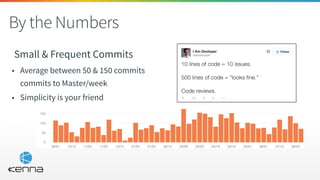
By the Numbers
Small & Frequent Commits
• Average between 50 & 150 commits
commits to Master/week
• Simplicity is your friend
By the Numbers
Always Be Deploying (EVERY day, MANY times per day)
Static Security Requirements Are
Stuck In the Stone Ages
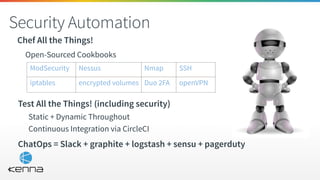
Security Automation
Chef All the Things!
Test All the Things! (including security)
Static + Dynamic Throughout
Continuous Integration via CircleCI
Open-Sourced Cookbooks
ModSecurity Nessus Nmap SSH
iptables encrypted volumes Duo 2FA openVPN
ChatOps = Slack + graphite + logstash + sensu + pagerduty
A SecDevOps Use Case
Continuous Security Testing
• Brakeman Static Analysis
• Dynamic Application Scanning
• Paid Penetration Testing Service
• Open Bug Bounty Program
• Continuous Infrastructure Scanning
All Results Loaded into Kenna via API
DevOps as a Compliance Enabler
Automation as Evidence & Doc
Cookbooks
Leveraging the ELK Stack
Elasticsearch
Logstash
Kibana
Github + Code Climate + Dogfood
Compliance Automation Extra Credit: https://telekomlabs.github.io/
API’s For Your Protection
The Kenna API
EndPoints:
Vulnerabilities
Assets
Tagging (metadata)
Patches
Connectors (integration & scanner control)
Threat Processing & Risk Meters
But what about
segregation of
duties?
There’s a DevOps for that
Dev checks in code
Ops team deploys to QA/Staging
QA Tests
Source & Results are documented
Management Sign Off
Deploy to Production
Fix or Rollback
Dev checks in code
Automated Tests (including security)
Pull Request / Code Review
Continuous Integration / Deployment
“Pull requests are the new
segregation of duties.”
Experiment: 626
Because Auditors
Our Auditor Told Us “you must scan”
Can Be Slow
Can Be Intrusive
Requiring Scanning during Maintenance Windows :(
A Lot Can Happen In A Week
Depends On Timely Vulnerability Definition Updates
What About Ours?
1. Built On Automation
2. Made of Composable Ingredients
3. It Should be Non-Intrusive
4. It Should be Close to Real-Time
5. It Should Support Multiple Sources for Definitions
6. It Should Only Take ~3.14 Days to Create
(have I mentioned it’s NOT a scanner)
Our Base Ingredients
Automation
(Chef, Ansible, Docker + stuff, cron + SSH)
Reliable Software + Version Info
Vulnerability Definitions
NVD/CVE feed with CPE included
“cpe:/a:google:chrome:8.0.552.215" is vulnerable to something
Eggs, Milk, Flour and Salt
These are not security related
Gather host: software+version
Automation Framework + Scripting
we used chef + tattle
XYZ Monitoring Services
opsmatic, logstash, splunk…
System Packager
rpm, dkpkg, pacman…
Dockerfiles
What is tattle?
Ridiculously simple way to store and regurgitate data
tattle update software myapp --version 1.2.3 --installer ubuntu
tattle report software
> {“myapp”:{“version":"1.2.3","installer":"ubuntu"}}
# on github soon
Vulnerability Definitions
NVD CVE Feed with CPE data
https://nvd.nist.gov/download.cfm
<entry id="CVE-2011-0001">
...<vuln:cve-id>CVE-2011-0001</vuln:cve-id>
...<vuln:vulnerable-software-list>
<vuln:product>cpe:/a:zaal:tgt:1.0.1</vuln:product>
<vuln:product>cpe:/a:zaal:tgt:1.0.0</vuln:product>
...<vuln:summary>Double free vulnerability in ...
Mix It Together
Parse Some XML
$ cat nvdcve-2.0-2014.xml | ruby -e 'require "ox"; p
Ox.parse(ARGF.read).nvd.locate("entry").select {|x| x.locate("*/
vuln:product/*").member? "cpe:/a:oracle:mysql:5.5.26" }.map(&:id)’
["CVE-2014-0384", "CVE-2014-0386", "CVE-AWW-YEAH",...]
What was that?
• We have mysql 5.5.26 installed
• Searching for it’s most specific CPE locator
• We found that there are a bunch of Vulnerabilities for it from 2014
What We Did
Extend Our Kenna API to Allow Software+Version (we already had the data anyway…)
curl -H "Content-type: application/json" 
https://api.kennasecurity.com/assets/63/software -X PUT -d "{
‘asset’: {
‘software’: $(tattle report software)
}
}"
On Upload of Software Data
• Update Assets & Create Associated Vulnerabilities
• Close Vulnerabilities for Software that’s been Updated
Cake!
Icing on the Cake
Also Known As Next Steps…
• Integrate Existing 0 Day Feeds
• Extend upgrade/uninstall tracking to build a timeline
• Alert when new Vulnerabilities match Assets
(The Real-Time Thing)
The Cake Is A Lie
Reliability of CPEs for all data sources
needs further study
Vendor/Product/Version mismatches
dpkg says “zlib1g”, you say “zlib”
Packager whitelists / Packager specific CPEs
“Ubuntu fixed this with USN-1337-1”
In Summary
DevOps
❤
InfoSec
Resources
• https://puppetlabs.com/2015-devops-report
• https://api.kennasecurity.com
• https://telekomlabs.github.io/
• https://github.com/jro/automated_security
• https://github.com/joeyschoblaska/brakeman-risk-io
• tattle on github - coming soon
Special Thanks to Gene Kim
We Are Hiring!
kennasecurity.com/jobs
@ebellis

Security as Code: DOES15

  • 1.
    Security as Code: ASecDevOps Use Case DOES15 October 21,2015 Ed Bellis, Kenna Cofounder & CTO
  • 2.
    About Me Ed Bellis:Kenna Cofounder & CTO | @ebellis ★ Cofounder & CTO of Kenna ★ Former CISO of Orbitz, VP InfoSec at Bank of America ★ Recognized Security Expert & Evangelist: Black Hat, OWASP, Gartner, IANS, SaaScon, InfoSec World & SecTor ★ Contributing Author: Beautiful Security by O’Reilly Media; Writer/ Blogger: CSO Magazine, CSO Online, InfoSec Island
  • 3.
    Are You InThe Right Room? • InfoSec Value of Automation • Automation Top Concerns • Applying SecDevOps Principles at Kenna via Automation • Security Automation Use Case • Q & A
  • 4.
  • 5.
    To Those WhoCame Before Us We Salute You
  • 6.
    Justin Collins, NeilMatatall & Alex Smolen from Twitter
  • 7.
    • Decouple featurereleases from code deployments • Deploy features in a disabled state, using feature flags • Require all developers to check code into trunk daily • Integrate security testing at each code check • The result is code always being in a secure, deployable state • Practice deploying smaller changes, which dramatically reduces risk and improves MTTR Source: http://www.facebook.com/note.php?note_id=14218138919 Deploy Smaller Changes, More Frequently
  • 8.
    Inject Failures Often TheNetflix Tech Blog Five Lessons We’ve Learned Using AWS We’ve sometimes referred to the Netflix software architecture in AWS as our Rambo Architecture. Each system has to be able to succeed, no matter what, even all on its own. We’re designing each distributed system to expect and tolerate failure from other systems on which it depends. One of the first systems our engineers built in AWS is called the Chaos Monkey. The Chaos Monkey’s job is to randomly kill instances & services within our architecture. If we aren’t constantly testing our ability to succeed despite failure, then it isn’t likely to work when it matters most - in the event of an unexpected outage.
  • 9.
    With a LittleHelp from our Friends (at Netflix)
  • 10.
    Break Things BeforeProduction • Enforce consistency in code, environments and configurations across the environments • Add your ASSERTs to find misconfigurations, enforce https, etc. • Add static code analysis to automated continuous integration and testing process
  • 11.
    SecDevOps At Kenna …or… “whatevery CISO should know”
  • 12.
    Small, Frequent ChangesARE your security friends.
  • 13.
    By the Numbers Small& Frequent Commits • Average between 50 & 150 commits commits to Master/week • Simplicity is your friend
  • 14.
    By the Numbers AlwaysBe Deploying (EVERY day, MANY times per day)
  • 15.
    Static Security RequirementsAre Stuck In the Stone Ages
  • 16.
    Security Automation Chef Allthe Things! Test All the Things! (including security) Static + Dynamic Throughout Continuous Integration via CircleCI Open-Sourced Cookbooks ModSecurity Nessus Nmap SSH iptables encrypted volumes Duo 2FA openVPN ChatOps = Slack + graphite + logstash + sensu + pagerduty
  • 17.
    A SecDevOps UseCase Continuous Security Testing • Brakeman Static Analysis • Dynamic Application Scanning • Paid Penetration Testing Service • Open Bug Bounty Program • Continuous Infrastructure Scanning All Results Loaded into Kenna via API
  • 18.
    DevOps as aCompliance Enabler Automation as Evidence & Doc Cookbooks Leveraging the ELK Stack Elasticsearch Logstash Kibana Github + Code Climate + Dogfood Compliance Automation Extra Credit: https://telekomlabs.github.io/
  • 19.
    API’s For YourProtection The Kenna API EndPoints: Vulnerabilities Assets Tagging (metadata) Patches Connectors (integration & scanner control) Threat Processing & Risk Meters
  • 20.
  • 21.
    There’s a DevOpsfor that Dev checks in code Ops team deploys to QA/Staging QA Tests Source & Results are documented Management Sign Off Deploy to Production Fix or Rollback Dev checks in code Automated Tests (including security) Pull Request / Code Review Continuous Integration / Deployment “Pull requests are the new segregation of duties.”
  • 22.
  • 24.
    Our Auditor ToldUs “you must scan” Can Be Slow Can Be Intrusive Requiring Scanning during Maintenance Windows :( A Lot Can Happen In A Week Depends On Timely Vulnerability Definition Updates
  • 25.
    What About Ours? 1.Built On Automation 2. Made of Composable Ingredients 3. It Should be Non-Intrusive 4. It Should be Close to Real-Time 5. It Should Support Multiple Sources for Definitions 6. It Should Only Take ~3.14 Days to Create (have I mentioned it’s NOT a scanner)
  • 26.
    Our Base Ingredients Automation (Chef,Ansible, Docker + stuff, cron + SSH) Reliable Software + Version Info Vulnerability Definitions NVD/CVE feed with CPE included “cpe:/a:google:chrome:8.0.552.215" is vulnerable to something Eggs, Milk, Flour and Salt These are not security related
  • 27.
    Gather host: software+version AutomationFramework + Scripting we used chef + tattle XYZ Monitoring Services opsmatic, logstash, splunk… System Packager rpm, dkpkg, pacman… Dockerfiles
  • 28.
    What is tattle? Ridiculouslysimple way to store and regurgitate data tattle update software myapp --version 1.2.3 --installer ubuntu tattle report software > {“myapp”:{“version":"1.2.3","installer":"ubuntu"}} # on github soon
  • 29.
    Vulnerability Definitions NVD CVEFeed with CPE data https://nvd.nist.gov/download.cfm <entry id="CVE-2011-0001"> ...<vuln:cve-id>CVE-2011-0001</vuln:cve-id> ...<vuln:vulnerable-software-list> <vuln:product>cpe:/a:zaal:tgt:1.0.1</vuln:product> <vuln:product>cpe:/a:zaal:tgt:1.0.0</vuln:product> ...<vuln:summary>Double free vulnerability in ...
  • 30.
    Mix It Together ParseSome XML $ cat nvdcve-2.0-2014.xml | ruby -e 'require "ox"; p Ox.parse(ARGF.read).nvd.locate("entry").select {|x| x.locate("*/ vuln:product/*").member? "cpe:/a:oracle:mysql:5.5.26" }.map(&:id)’ ["CVE-2014-0384", "CVE-2014-0386", "CVE-AWW-YEAH",...] What was that? • We have mysql 5.5.26 installed • Searching for it’s most specific CPE locator • We found that there are a bunch of Vulnerabilities for it from 2014
  • 31.
    What We Did ExtendOur Kenna API to Allow Software+Version (we already had the data anyway…) curl -H "Content-type: application/json" https://api.kennasecurity.com/assets/63/software -X PUT -d "{ ‘asset’: { ‘software’: $(tattle report software) } }" On Upload of Software Data • Update Assets & Create Associated Vulnerabilities • Close Vulnerabilities for Software that’s been Updated
  • 32.
  • 33.
    Icing on theCake Also Known As Next Steps… • Integrate Existing 0 Day Feeds • Extend upgrade/uninstall tracking to build a timeline • Alert when new Vulnerabilities match Assets (The Real-Time Thing)
  • 34.
    The Cake IsA Lie Reliability of CPEs for all data sources needs further study Vendor/Product/Version mismatches dpkg says “zlib1g”, you say “zlib” Packager whitelists / Packager specific CPEs “Ubuntu fixed this with USN-1337-1”
  • 35.
  • 36.
    Resources • https://puppetlabs.com/2015-devops-report • https://api.kennasecurity.com •https://telekomlabs.github.io/ • https://github.com/jro/automated_security • https://github.com/joeyschoblaska/brakeman-risk-io • tattle on github - coming soon Special Thanks to Gene Kim
  • 37.