Chaos Engineering
Hamburg
Marvin Hoffmann | Computer Scientist
15.12.2015
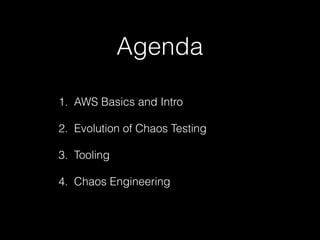
1. AWS Basics and Intro
2. Evolution of Chaos Testing
3. Tooling
4. Chaos Engineering
Agenda
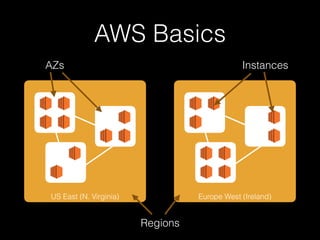
Europe West (Ireland)US East (N. Virginia)
Regions
AZs Instances
AWS Basics
Chaos? -
What do we mean?
“A way to improve availability is
to install proven hardware and
software, and then leave it alone”
Jim Gray
Why Do Computers Stop and What Can Be Done About It?
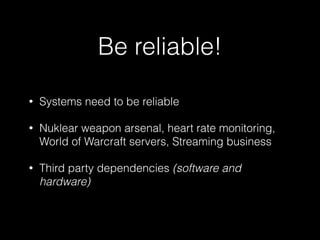
• Systems need to be reliable
• Nuklear weapon arsenal, heart rate monitoring,
World of Warcraft servers, Streaming business
• Third party dependencies (software and
hardware)
Be reliable!
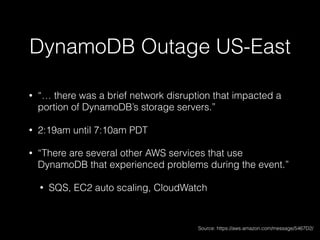
DynamoDB Outage US-East
• “… there was a brief network disruption that impacted a
portion of DynamoDB’s storage servers.”
• 2:19am until 7:10am PDT
• “There are several other AWS services that use
DynamoDB that experienced problems during the event.”
• SQS, EC2 auto scaling, CloudWatch
Source: https://aws.amazon.com/message/5467D2/
• Deployments themselves may cause issues
• Unpredicted behaviour after a change has been
rolled out
• Issues during rollback
• Change in client / user behaviour
It’s not always the infrastructure
Evolution of
Chaos Testing
Do the simplest thing first
• Prepare for your machines to die
• “Cattle, not pets” (Adrian Cockcroft)
• Resilience through redundancy
• Stateless machines
Deal with infrastructure issues
• Latency between instances
• Package loss
• Ports blocked
• or even outages of an entire AZ
Think big!
• Remember that DynamoDB failure?
• Outage of an entire AWS region!
• You’ll need more than one region in the first place
• Re-routing of entire traffic from one region to another
• Any region needs to be able to scale to take the load of
two regions
Tooling
(meet the Monkeys)
Chaos Monkey
Kills random instances in your account
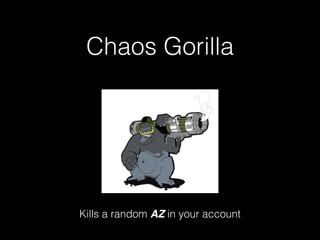
Chaos Gorilla
Kills a random AZ in your account
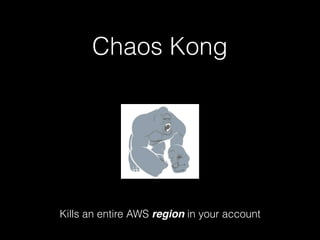
Chaos Kong
Kills an entire AWS region in your account
What’s in it?
• A compilation of scripts
• Scripts mess with your AWS account
• Thus, they are very AWS specific
• If not on AWS, get inspired and build your toolset around
these ideas
• Not a comprehensive toolset
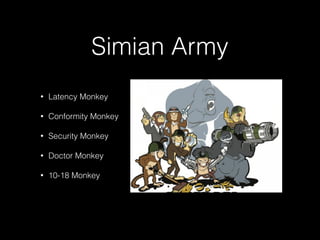
• Latency Monkey
• Conformity Monkey
• Security Monkey
• Doctor Monkey
• 10-18 Monkey
Simian Army
Chaos
Engineering
• Systematic approach to Chaos Testing
• Started by Netflix
• Talk about it a lot to attract talent
• Many other companies doing similar things in that field
• Want to grow a community around it
Chaos Engineering
“Experiment on a distributed system
in order to build confidence in the
system’s capability to withstand
turbulent conditions in production.”
Netflix
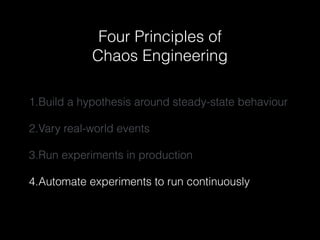
Four Principles of
Chaos Engineering
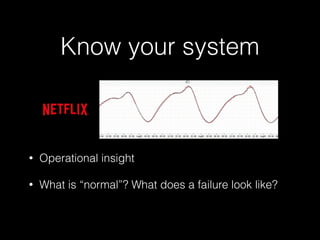
Know your system
• Operational insight
• What is “normal”? What does a failure look like?
Four Principles of
Chaos Engineering
1.Build a hypothesis around steady-state behaviour
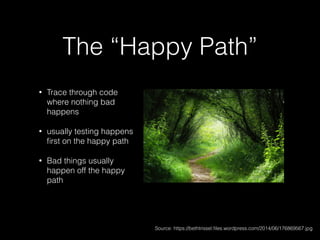
The “Happy Path”
• Trace through code
where nothing bad
happens
• usually testing happens
first on the happy path
• Bad things usually
happen off the happy
path
Source: https://bethtrissel.files.wordpress.com/2014/06/176869567.jpg
Four Principles of
Chaos Engineering
1.Build a hypothesis around steady-state behaviour
2.Vary real-world events
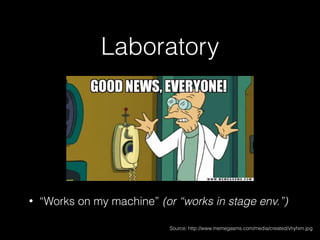
Laboratory
• “Works on my machine” (or “works in stage env.”)
Source: http://www.memegasms.com/media/created/vhyfxm.jpg
Four Principles of
Chaos Engineering
1.Build a hypothesis around steady-state behaviour
2.Vary real-world events
3.Run experiments in production
Four Principles of
Chaos Engineering
1.Build a hypothesis around steady-state behaviour
2.Vary real-world events
3.Run experiments in production
4.Automate experiments to run continuously
Chaos Engineering Culture
• http://principlesofchaos.com
• More resources:
• https://github.com/Netflix/SimianArmy
• https://github.com/Netflix/atlas
• https://www.youtube.com/watch?v=vq4QZ4_YDok

Principles of Chaos Engineering

  • 1.
    Chaos Engineering Hamburg Marvin Hoffmann| Computer Scientist 15.12.2015
  • 2.
    1. AWS Basicsand Intro 2. Evolution of Chaos Testing 3. Tooling 4. Chaos Engineering Agenda
  • 3.
    Europe West (Ireland)USEast (N. Virginia) Regions AZs Instances AWS Basics
  • 4.
  • 5.
    “A way toimprove availability is to install proven hardware and software, and then leave it alone” Jim Gray Why Do Computers Stop and What Can Be Done About It?
  • 6.
    • Systems needto be reliable • Nuklear weapon arsenal, heart rate monitoring, World of Warcraft servers, Streaming business • Third party dependencies (software and hardware) Be reliable!
  • 7.
    DynamoDB Outage US-East •“… there was a brief network disruption that impacted a portion of DynamoDB’s storage servers.” • 2:19am until 7:10am PDT • “There are several other AWS services that use DynamoDB that experienced problems during the event.” • SQS, EC2 auto scaling, CloudWatch Source: https://aws.amazon.com/message/5467D2/
  • 8.
    • Deployments themselvesmay cause issues • Unpredicted behaviour after a change has been rolled out • Issues during rollback • Change in client / user behaviour It’s not always the infrastructure
  • 9.
  • 10.
    Do the simplestthing first • Prepare for your machines to die • “Cattle, not pets” (Adrian Cockcroft) • Resilience through redundancy • Stateless machines
  • 11.
    Deal with infrastructureissues • Latency between instances • Package loss • Ports blocked • or even outages of an entire AZ
  • 12.
    Think big! • Rememberthat DynamoDB failure? • Outage of an entire AWS region! • You’ll need more than one region in the first place • Re-routing of entire traffic from one region to another • Any region needs to be able to scale to take the load of two regions
  • 13.
  • 14.
    Chaos Monkey Kills randominstances in your account
  • 15.
    Chaos Gorilla Kills arandom AZ in your account
  • 16.
    Chaos Kong Kills anentire AWS region in your account
  • 17.
    What’s in it? •A compilation of scripts • Scripts mess with your AWS account • Thus, they are very AWS specific • If not on AWS, get inspired and build your toolset around these ideas • Not a comprehensive toolset
  • 18.
    • Latency Monkey •Conformity Monkey • Security Monkey • Doctor Monkey • 10-18 Monkey Simian Army
  • 19.
  • 20.
    • Systematic approachto Chaos Testing • Started by Netflix • Talk about it a lot to attract talent • Many other companies doing similar things in that field • Want to grow a community around it Chaos Engineering
  • 21.
    “Experiment on adistributed system in order to build confidence in the system’s capability to withstand turbulent conditions in production.” Netflix
  • 22.
  • 23.
    Know your system •Operational insight • What is “normal”? What does a failure look like?
  • 24.
    Four Principles of ChaosEngineering 1.Build a hypothesis around steady-state behaviour
  • 25.
    The “Happy Path” •Trace through code where nothing bad happens • usually testing happens first on the happy path • Bad things usually happen off the happy path Source: https://bethtrissel.files.wordpress.com/2014/06/176869567.jpg
  • 26.
    Four Principles of ChaosEngineering 1.Build a hypothesis around steady-state behaviour 2.Vary real-world events
  • 27.
    Laboratory • “Works onmy machine” (or “works in stage env.”) Source: http://www.memegasms.com/media/created/vhyfxm.jpg
  • 28.
    Four Principles of ChaosEngineering 1.Build a hypothesis around steady-state behaviour 2.Vary real-world events 3.Run experiments in production
  • 29.
    Four Principles of ChaosEngineering 1.Build a hypothesis around steady-state behaviour 2.Vary real-world events 3.Run experiments in production 4.Automate experiments to run continuously
  • 30.
    Chaos Engineering Culture •http://principlesofchaos.com • More resources: • https://github.com/Netflix/SimianArmy • https://github.com/Netflix/atlas • https://www.youtube.com/watch?v=vq4QZ4_YDok