Cloud Application Security: Lessons Learned
Houston OWASP – 2/21/2013
Jason Chan - chan@netflix.com
Netflix, Inc.


 “Netflix is the world’s leading Internet television
  network with more than 33 million members in
   40 countries enjoying more than one billion
   hours of TV shows and movies per month,
            including original series . . .”

Source: http://ir.netflix.com
Me
 Director of Engineering @ Netflix
 Responsible for:
   Cloud app, product, infrastructure, ops security
 Previously:
   Led security team @ VMware
   Earlier, primarily security consulting at @stake, iSEC Partners
AppSec Challenges
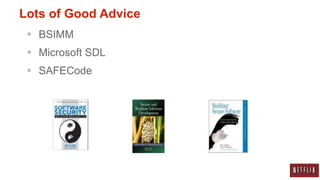
Lots of Good Advice
  BSIMM
  Microsoft SDL
  SAFECode
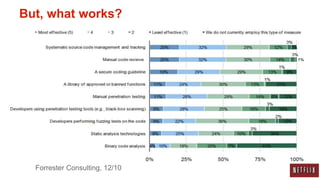
But, what works?


  Forrester Consulting, 12/10
Especially, given phenomena such as DevOps,
cloud, agile, and the unique characteristics of an
                   organization?
Engineering @ Netflix
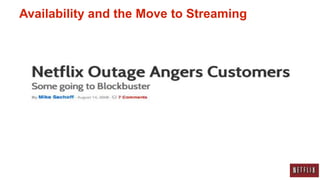
Availability and the Move to Streaming
“Undifferentiated Heavy Lifting”
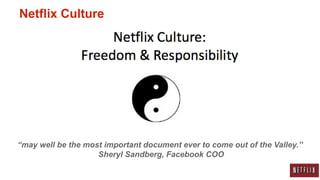
Netflix Culture


“may well be the most important document ever to come out of the Valley.”
                    Sheryl Sandberg, Facebook COO
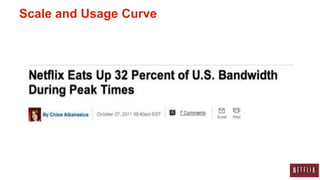
Scale and Usage Curve
Netflix is now ~99% in the cloud
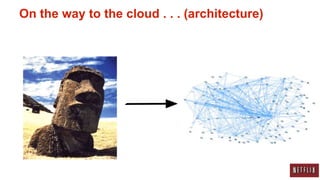
On the way to the cloud . . . (architecture)
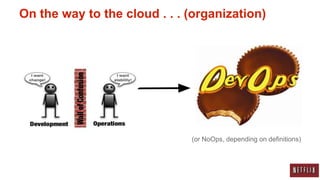
On the way to the cloud . . . (organization)


                              (or NoOps, depending on definitions)
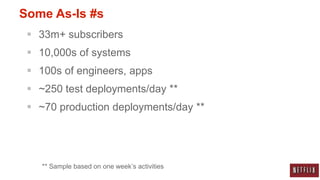
Some As-Is #s
  33m+ subscribers
  10,000s of systems
  100s of engineers, apps
  ~250 test deployments/day **
  ~70 production deployments/day **


    ** Sample based on one week‟s activities
Deploying Code at Netflix
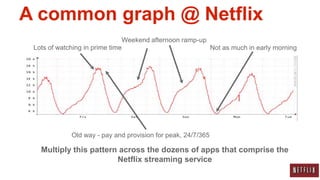
A common graph @ Netflix
                               Weekend afternoon ramp-up
 Lots of watching in prime time                          Not as much in early morning


             Old way - pay and provision for peak, 24/7/365

   Multiply this pattern across the dozens of apps that comprise the
                        Netflix streaming service
Solution: Load-Based Autoscaling
Autoscaling
 Goals:
   # of systems matches load requirements
   Load per server is constant
   Happens without intervention (the „auto‟ in autoscaling)
 Results:
   Clusters continuously add & remove nodes
   New nodes must mirror existing
Every change requires a new cluster push
(not an incremental change to existing systems)
Deploying code must be easy
           (it is)
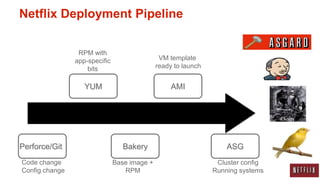
Netflix Deployment Pipeline


                 RPM with
                app-specific                   VM template
                    bits                      ready to launch


                   YUM                             AMI


Perforce/Git                      Bakery                            ASG
Code change                    Base image +                      Cluster config
Config change                     RPM                           Running systems
Operational Impact
 No changes to running systems
 No systems mgmt infrastructure (Puppet, Chef, etc.)
 Fewer logins to prod
 No snowflakes
 Trivial “rollback”
Security Impact
 Need to think differently on:
    Vulnerability management
    Patch management
    User activity monitoring
    File integrity monitoring
    Forensic investigations
Architecture, organization, deployment
            are all different.
         What about security?
We‟ve adapted too.
Some principles we‟ve found useful.
Cloud Application Security: What We Emphasize
Points of Emphasis
 Integrate                  Two contexts:
                               1. Integration with your
 Make the right way easy         engineering ecosystem
 Self-service, with           2. Integration of your security
  exceptions                      controls
                             Organization
 Trust, but verify
                             SCM, build and release
                             Monitoring and alerting


                                                                 29
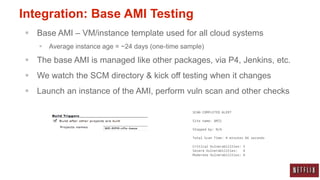
Integration: Base AMI Testing
 Base AMI – VM/instance template used for all cloud systems
      Average instance age = ~24 days (one-time sample)

 The base AMI is managed like other packages, via P4, Jenkins, etc.
 We watch the SCM directory & kick off testing when it changes
 Launch an instance of the AMI, perform vuln scan and other checks

                                                    SCAN COMPLETED ALERT

                                                    Site name: AMI1

                                                    Stopped by: N/A

                                                    Total Scan Time: 4 minutes 46 seconds

                                                    Critical Vulnerabilities: 5
                                                    Severe Vulnerabilities:   4
                                                    Moderate Vulnerabilities: 4
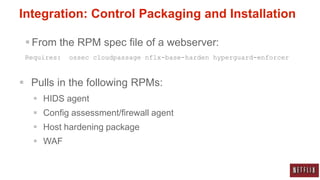
Integration: Control Packaging and Installation

  From the RPM spec file of a webserver:
 Requires:   ossec cloudpassage nflx-base-harden hyperguard-enforcer


 Pulls in the following RPMs:
    HIDS agent
    Config assessment/firewall agent
    Host hardening package
    WAF
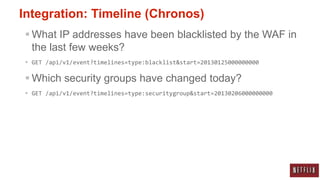
Integration: Timeline (Chronos)
 What IP addresses have been blacklisted by the WAF in
  the last few weeks?
 GET /api/v1/event?timelines=type:blacklist&start=20130125000000000

 Which security groups have changed today?
 GET /api/v1/event?timelines=type:securitygroup&start=20130206000000000
Integration: Static Analysis
  Available self-service through build environment
    FindBugs, PMD
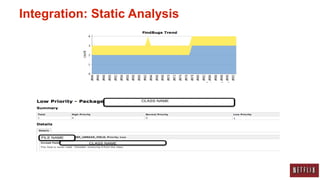
  Jenkins plugin to display graphs and support drill
   through to results
Integration: Static Analysis
Integration: Alerting (Central Alerting Gateway)
 Single place to generate and deliver alerts
 Python, Java libraries (or JSON post)
 Ties in to PagerDuty notification/escalation system
 Permits stateful alerting and some response
 A prerequisite that our security tools will leverage
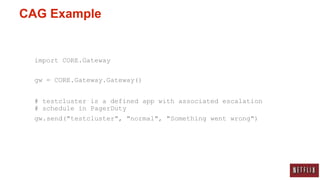
CAG Example


  import CORE.Gateway

  gw = CORE.Gateway.Gateway()


  # testcluster is a defined app with associated escalation
  # schedule in PagerDuty
  gw.send("testcluster", "normal", "Something went wrong")
Points of Emphasis
 Integrate                  Developers are lazy

 Make the right way easy
 Self-service, with
  exceptions
 Trust, but verify
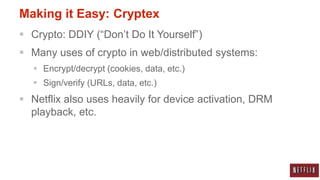
Making it Easy: Cryptex
 Crypto: DDIY (“Don‟t Do It Yourself”)
 Many uses of crypto in web/distributed systems:
   Encrypt/decrypt (cookies, data, etc.)
   Sign/verify (URLs, data, etc.)
 Netflix also uses heavily for device activation, DRM
  playback, etc.
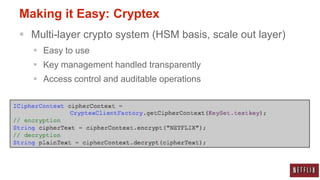
Making it Easy: Cryptex
 Multi-layer crypto system (HSM basis, scale out layer)
   Easy to use
   Key management handled transparently
   Access control and auditable operations
Making it Easy: Cloud-Based SSO
 In the AWS cloud, access to data center services is
  problematic
   Examples: AD, LDAP, DNS
 But, many cloud-based systems require authN, authZ
   Examples: Dashboards, admin UIs
 Asking developers to securely handle/accept credentials
  is also problematic
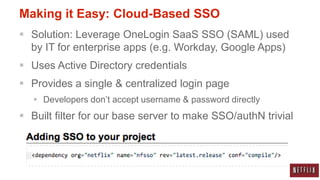
Making it Easy: Cloud-Based SSO
 Solution: Leverage OneLogin SaaS SSO (SAML) used
  by IT for enterprise apps (e.g. Workday, Google Apps)
 Uses Active Directory credentials
 Provides a single & centralized login page
    Developers don‟t accept username & password directly
 Built filter for our base server to make SSO/authN trivial
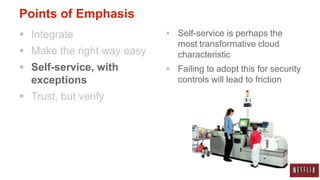
Points of Emphasis
 Integrate                  Self-service is perhaps the
                              most transformative cloud
 Make the right way easy     characteristic
 Self-service, with         Failing to adopt this for security
  exceptions                  controls will lead to friction
 Trust, but verify
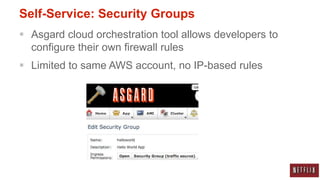
Self-Service: Security Groups
 Asgard cloud orchestration tool allows developers to
  configure their own firewall rules
 Limited to same AWS account, no IP-based rules
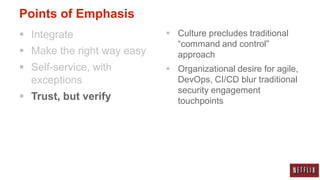
Points of Emphasis
 Integrate                  Culture precludes traditional
                              “command and control”
 Make the right way easy     approach
 Self-service, with         Organizational desire for agile,
  exceptions                  DevOps, CI/CD blur traditional
                              security engagement
 Trust, but verify           touchpoints
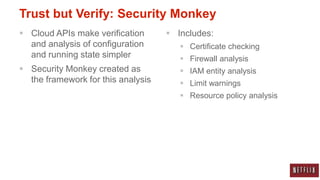
Trust but Verify: Security Monkey
 Cloud APIs make verification       Includes:
  and analysis of configuration         Certificate checking
  and running state simpler             Firewall analysis
 Security Monkey created as            IAM entity analysis
  the framework for this analysis       Limit warnings
                                        Resource policy analysis
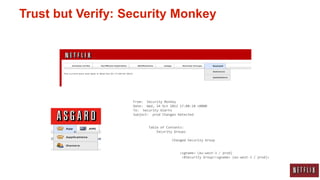
Trust but Verify: Security Monkey


                   From: Security Monkey
                   Date: Wed, 24 Oct 2012 17:08:18 +0000
                   To: Security Alerts
                   Subject: prod Changes Detected


                          Table of Contents:
                              Security Groups

                                      Changed Security Group


                                          <sgname> (eu-west-1 / prod)
                                           <#Security Group/<sgname> (eu-west-1 / prod)>
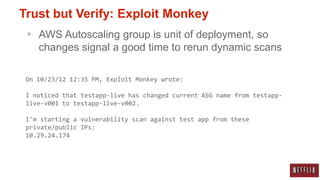
Trust but Verify: Exploit Monkey
  AWS Autoscaling group is unit of deployment, so
   changes signal a good time to rerun dynamic scans

 On 10/23/12 12:35 PM, Exploit Monkey wrote:

 I noticed that testapp-live has changed current ASG name from testapp-
 live-v001 to testapp-live-v002.

 I'm starting a vulnerability scan against test app from these
 private/public IPs:
 10.29.24.174
Trust but Verify: ELB Checker (gauntlt)
 AWS Elastic Load Balancer (ELB) provides cross-
  datacenter traffic balancing, but no security controls
    If your cluster is attached to an ELB, it is available to the Internet
 Engineers may misunderstand:
    ELB use cases (and alternatives)
    Security features
    Other measures used to protect ELB-fronted clusters
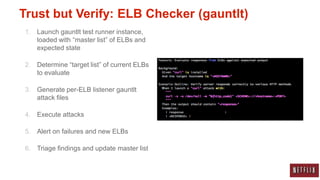
Trust but Verify: ELB Checker (gauntlt)
1. Launch gauntlt test runner instance,
   loaded with “master list” of ELBs and
   expected state

2. Determine “target list” of current ELBs
   to evaluate

3. Generate per-ELB listener gauntlt
   attack files

4. Execute attacks

5. Alert on failures and new ELBs

6. Triage findings and update master list
Takeaways
  Netflix runs a large, dynamic service in AWS

  Newer concepts like cloud & DevOps need an
   updated approach to application security

  Specific context can help jumpstart a pragmatic
   and effective security program

  Don‟t swim upstream - integrate and collaborate
   with your engineering partners
Netflix References
 http://netflix.github.com
 http://techblog.netflix.com
 http://slideshare.net/netflix
Other References
 http://www.webpronews.com/netflix-outage-angers-customers-2008-
  08
 http://www.pcmag.com/article2/0,2817,2395372,00.asp
 http://www.readwriteweb.com/archives/etech_amazon_cto_aws.php
 http://bsimm.com/online/
 http://www.microsoft.com/en-
  us/download/confirmation.aspx?id=29884
 http://www.slideshare.net/reed2001/culture-1798664
 http://techcrunch.com/2013/01/31/read-what-facebooks-sandberg-
  calls-maybe-the-most-important-document-ever-to-come-out-of-the-
  valley/
 http://www.gauntlt.org
Questions?


             chan@netflix.com

Cloud Application Security: Lessons Learned

  • 1.
    Cloud Application Security:Lessons Learned Houston OWASP – 2/21/2013 Jason Chan - chan@netflix.com
  • 2.
    Netflix, Inc. “Netflixis the world’s leading Internet television network with more than 33 million members in 40 countries enjoying more than one billion hours of TV shows and movies per month, including original series . . .” Source: http://ir.netflix.com
  • 3.
    Me  Director ofEngineering @ Netflix  Responsible for:  Cloud app, product, infrastructure, ops security  Previously:  Led security team @ VMware  Earlier, primarily security consulting at @stake, iSEC Partners
  • 4.
  • 5.
    Lots of GoodAdvice  BSIMM  Microsoft SDL  SAFECode
  • 6.
    But, what works? Forrester Consulting, 12/10
  • 7.
    Especially, given phenomenasuch as DevOps, cloud, agile, and the unique characteristics of an organization?
  • 8.
  • 9.
    Availability and theMove to Streaming
  • 10.
  • 11.
    Netflix Culture “may wellbe the most important document ever to come out of the Valley.” Sheryl Sandberg, Facebook COO
  • 12.
  • 13.
    Netflix is now~99% in the cloud
  • 14.
    On the wayto the cloud . . . (architecture)
  • 15.
    On the wayto the cloud . . . (organization) (or NoOps, depending on definitions)
  • 16.
    Some As-Is #s  33m+ subscribers  10,000s of systems  100s of engineers, apps  ~250 test deployments/day **  ~70 production deployments/day ** ** Sample based on one week‟s activities
  • 17.
  • 18.
    A common graph@ Netflix Weekend afternoon ramp-up Lots of watching in prime time Not as much in early morning Old way - pay and provision for peak, 24/7/365 Multiply this pattern across the dozens of apps that comprise the Netflix streaming service
  • 19.
  • 20.
    Autoscaling  Goals:  # of systems matches load requirements  Load per server is constant  Happens without intervention (the „auto‟ in autoscaling)  Results:  Clusters continuously add & remove nodes  New nodes must mirror existing
  • 21.
    Every change requiresa new cluster push (not an incremental change to existing systems)
  • 22.
    Deploying code mustbe easy (it is)
  • 23.
    Netflix Deployment Pipeline RPM with app-specific VM template bits ready to launch YUM AMI Perforce/Git Bakery ASG Code change Base image + Cluster config Config change RPM Running systems
  • 24.
    Operational Impact  Nochanges to running systems  No systems mgmt infrastructure (Puppet, Chef, etc.)  Fewer logins to prod  No snowflakes  Trivial “rollback”
  • 25.
    Security Impact  Needto think differently on:  Vulnerability management  Patch management  User activity monitoring  File integrity monitoring  Forensic investigations
  • 26.
    Architecture, organization, deployment are all different. What about security?
  • 27.
    We‟ve adapted too. Someprinciples we‟ve found useful.
  • 28.
    Cloud Application Security:What We Emphasize
  • 29.
    Points of Emphasis Integrate  Two contexts: 1. Integration with your  Make the right way easy engineering ecosystem  Self-service, with 2. Integration of your security exceptions controls  Organization  Trust, but verify  SCM, build and release  Monitoring and alerting 29
  • 30.
    Integration: Base AMITesting  Base AMI – VM/instance template used for all cloud systems  Average instance age = ~24 days (one-time sample)  The base AMI is managed like other packages, via P4, Jenkins, etc.  We watch the SCM directory & kick off testing when it changes  Launch an instance of the AMI, perform vuln scan and other checks SCAN COMPLETED ALERT Site name: AMI1 Stopped by: N/A Total Scan Time: 4 minutes 46 seconds Critical Vulnerabilities: 5 Severe Vulnerabilities: 4 Moderate Vulnerabilities: 4
  • 31.
    Integration: Control Packagingand Installation  From the RPM spec file of a webserver: Requires: ossec cloudpassage nflx-base-harden hyperguard-enforcer  Pulls in the following RPMs:  HIDS agent  Config assessment/firewall agent  Host hardening package  WAF
  • 32.
    Integration: Timeline (Chronos) What IP addresses have been blacklisted by the WAF in the last few weeks?  GET /api/v1/event?timelines=type:blacklist&start=20130125000000000  Which security groups have changed today?  GET /api/v1/event?timelines=type:securitygroup&start=20130206000000000
  • 33.
    Integration: Static Analysis  Available self-service through build environment  FindBugs, PMD  Jenkins plugin to display graphs and support drill through to results
  • 34.
  • 35.
    Integration: Alerting (CentralAlerting Gateway)  Single place to generate and deliver alerts  Python, Java libraries (or JSON post)  Ties in to PagerDuty notification/escalation system  Permits stateful alerting and some response  A prerequisite that our security tools will leverage
  • 36.
    CAG Example import CORE.Gateway gw = CORE.Gateway.Gateway() # testcluster is a defined app with associated escalation # schedule in PagerDuty gw.send("testcluster", "normal", "Something went wrong")
  • 37.
    Points of Emphasis Integrate  Developers are lazy  Make the right way easy  Self-service, with exceptions  Trust, but verify
  • 38.
    Making it Easy:Cryptex  Crypto: DDIY (“Don‟t Do It Yourself”)  Many uses of crypto in web/distributed systems:  Encrypt/decrypt (cookies, data, etc.)  Sign/verify (URLs, data, etc.)  Netflix also uses heavily for device activation, DRM playback, etc.
  • 39.
    Making it Easy:Cryptex  Multi-layer crypto system (HSM basis, scale out layer)  Easy to use  Key management handled transparently  Access control and auditable operations
  • 40.
    Making it Easy:Cloud-Based SSO  In the AWS cloud, access to data center services is problematic  Examples: AD, LDAP, DNS  But, many cloud-based systems require authN, authZ  Examples: Dashboards, admin UIs  Asking developers to securely handle/accept credentials is also problematic
  • 41.
    Making it Easy:Cloud-Based SSO  Solution: Leverage OneLogin SaaS SSO (SAML) used by IT for enterprise apps (e.g. Workday, Google Apps)  Uses Active Directory credentials  Provides a single & centralized login page  Developers don‟t accept username & password directly  Built filter for our base server to make SSO/authN trivial
  • 42.
    Points of Emphasis Integrate  Self-service is perhaps the most transformative cloud  Make the right way easy characteristic  Self-service, with  Failing to adopt this for security exceptions controls will lead to friction  Trust, but verify
  • 43.
    Self-Service: Security Groups Asgard cloud orchestration tool allows developers to configure their own firewall rules  Limited to same AWS account, no IP-based rules
  • 44.
    Points of Emphasis Integrate  Culture precludes traditional “command and control”  Make the right way easy approach  Self-service, with  Organizational desire for agile, exceptions DevOps, CI/CD blur traditional security engagement  Trust, but verify touchpoints
  • 45.
    Trust but Verify:Security Monkey  Cloud APIs make verification  Includes: and analysis of configuration  Certificate checking and running state simpler  Firewall analysis  Security Monkey created as  IAM entity analysis the framework for this analysis  Limit warnings  Resource policy analysis
  • 46.
    Trust but Verify:Security Monkey From: Security Monkey Date: Wed, 24 Oct 2012 17:08:18 +0000 To: Security Alerts Subject: prod Changes Detected Table of Contents: Security Groups Changed Security Group <sgname> (eu-west-1 / prod) <#Security Group/<sgname> (eu-west-1 / prod)>
  • 47.
    Trust but Verify:Exploit Monkey  AWS Autoscaling group is unit of deployment, so changes signal a good time to rerun dynamic scans On 10/23/12 12:35 PM, Exploit Monkey wrote: I noticed that testapp-live has changed current ASG name from testapp- live-v001 to testapp-live-v002. I'm starting a vulnerability scan against test app from these private/public IPs: 10.29.24.174
  • 48.
    Trust but Verify:ELB Checker (gauntlt)  AWS Elastic Load Balancer (ELB) provides cross- datacenter traffic balancing, but no security controls  If your cluster is attached to an ELB, it is available to the Internet  Engineers may misunderstand:  ELB use cases (and alternatives)  Security features  Other measures used to protect ELB-fronted clusters
  • 49.
    Trust but Verify:ELB Checker (gauntlt) 1. Launch gauntlt test runner instance, loaded with “master list” of ELBs and expected state 2. Determine “target list” of current ELBs to evaluate 3. Generate per-ELB listener gauntlt attack files 4. Execute attacks 5. Alert on failures and new ELBs 6. Triage findings and update master list
  • 50.
    Takeaways  Netflixruns a large, dynamic service in AWS  Newer concepts like cloud & DevOps need an updated approach to application security  Specific context can help jumpstart a pragmatic and effective security program  Don‟t swim upstream - integrate and collaborate with your engineering partners
  • 51.
    Netflix References  http://netflix.github.com http://techblog.netflix.com  http://slideshare.net/netflix
  • 52.
    Other References  http://www.webpronews.com/netflix-outage-angers-customers-2008- 08  http://www.pcmag.com/article2/0,2817,2395372,00.asp  http://www.readwriteweb.com/archives/etech_amazon_cto_aws.php  http://bsimm.com/online/  http://www.microsoft.com/en- us/download/confirmation.aspx?id=29884  http://www.slideshare.net/reed2001/culture-1798664  http://techcrunch.com/2013/01/31/read-what-facebooks-sandberg- calls-maybe-the-most-important-document-ever-to-come-out-of-the- valley/  http://www.gauntlt.org
  • 53.
    Questions? chan@netflix.com