

Join the conversation #DevSecCon
BY TIM MACKEY – BLACK DUCK SOFTWARE
A Question of Trust – When
Good Containers Go Bad
#whoami – Tim Mackey
• Current roles: Senior Technical Evangelist; Occasional coder
• Former XenServer Community Manager in Citrix Open Source Business
Office
• Cool things I’ve done
• Designed laser communication systems
• Early designer of retail self-checkout machines
• Embedded special relativity algorithms into industrial control system
• Find me
• Twitter: @TimInTech ( https://twitter.com/TimInTech )
• SlideShare: slideshare.net/TimMackey
• LinkedIn: www.linkedin.com/in/mackeytim
Security Driven Development and Deployment
• Developers are empowered with security information
• Clear security driven release policies exist
• Trusted components are used as dependencies
• CI processes incorporate security testing
• Binary artifacts are only created when release policies are met
• Releasable binaries are digitally signed
• Container images are built from trusted base images
• Produced images are stored in trusted container registries
• Containers are only deployed from trusted registries
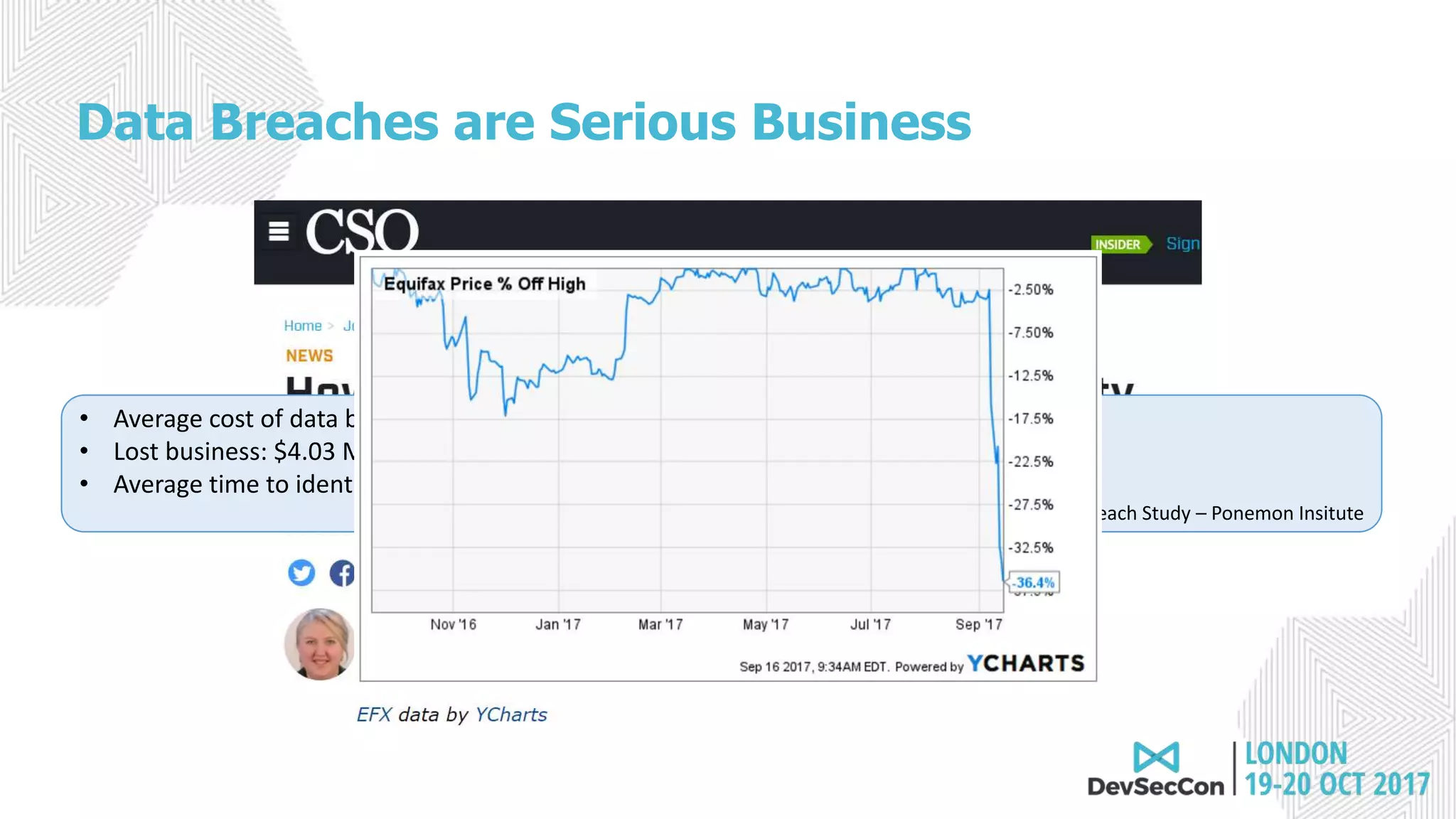
Data Breaches are Serious Business
• Average cost of data breach: $7.35 Million
• Lost business: $4.03 Million
• Average time to identify and contain a breach: 206 days
Source: 2017 Cost of Data Breach Study – Ponemon Insitute
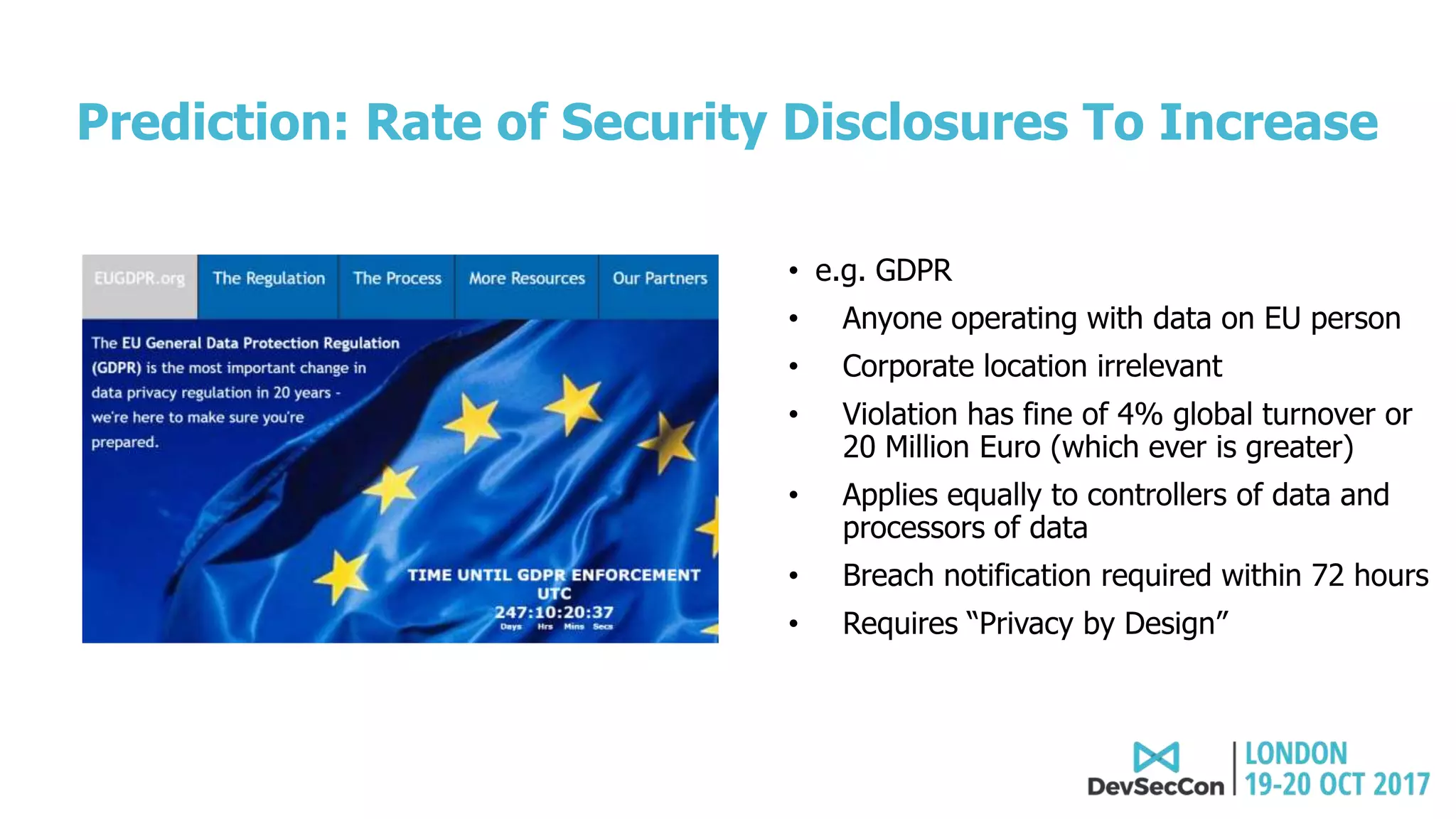
Prediction: Rate of Security Disclosures To Increase
• e.g. GDPR
• Anyone operating with data on EU person
• Corporate location irrelevant
• Violation has fine of 4% global turnover or
20 Million Euro (which ever is greater)
• Applies equally to controllers of data and
processors of data
• Breach notification required within 72 hours
• Requires “Privacy by Design”
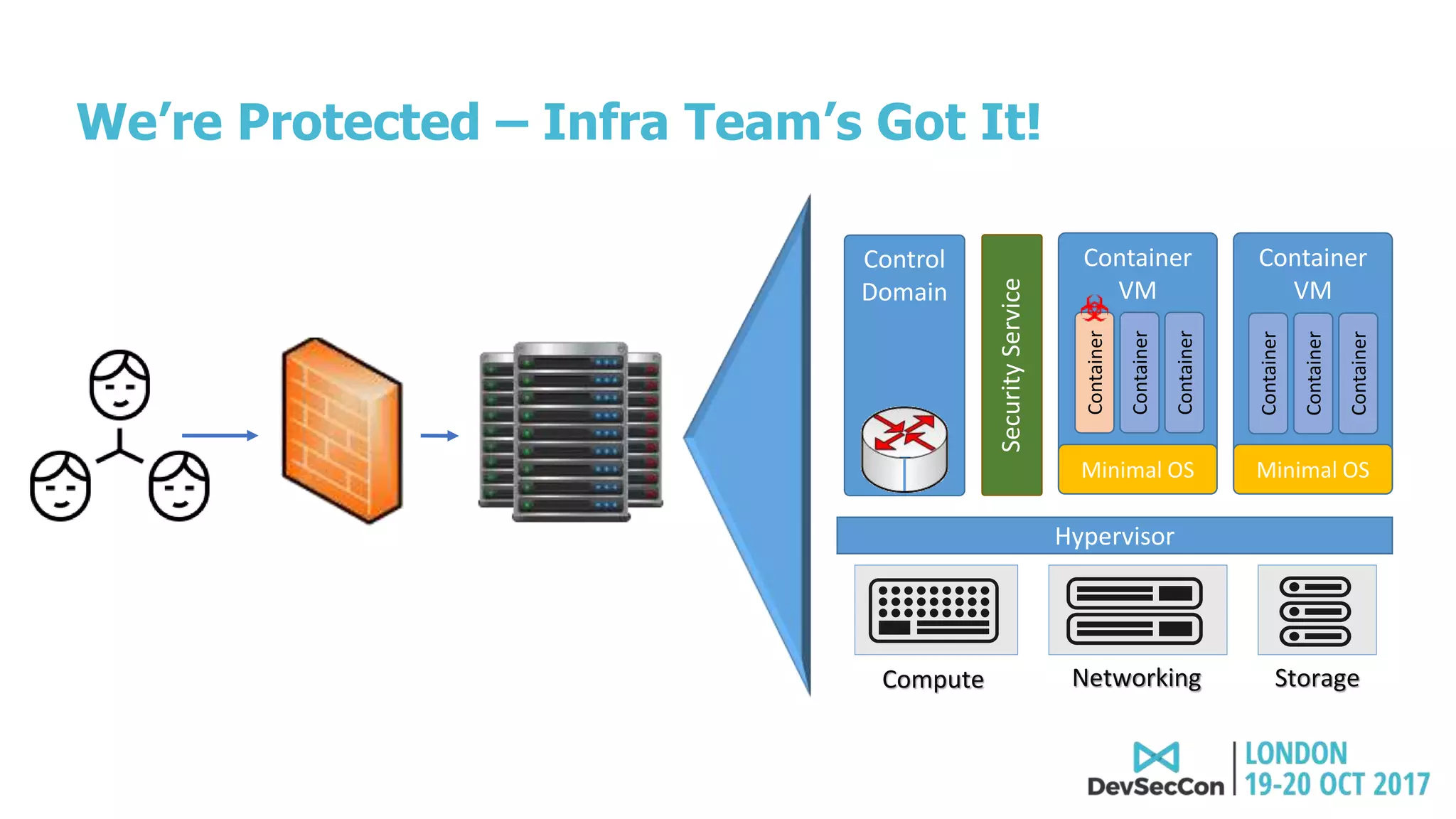
Control
Domain
NetworkingCompute Storage
Hypervisor
Container
VM
Minimal OS
We’re Protected – Infra Team’s Got It!
Container
Container
Container
Container
VM
Minimal OS
Container
Container
Container
SecurityService
Container
Control
Domain
NetworkingCompute Storage
Hypervisor
Container
VM
Minimal OS
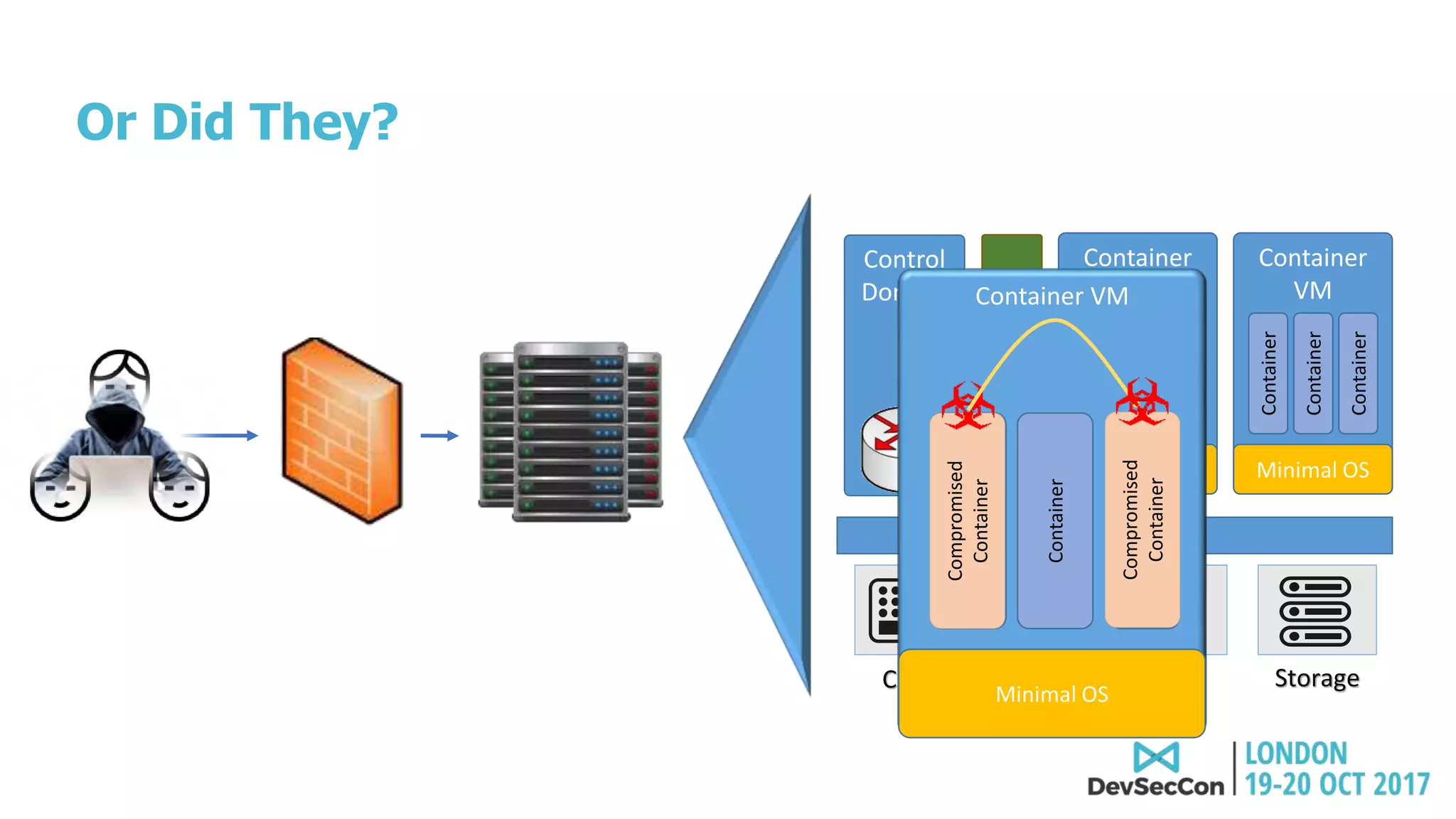
Or Did They?
Container
Container
Container
Container
VM
Minimal OS
Container
Container
Container
SecurityService
Container
Container VM
Minimal OS
Vulnerable
Container
Container
Container
Compromised
Container
Compromised
Container
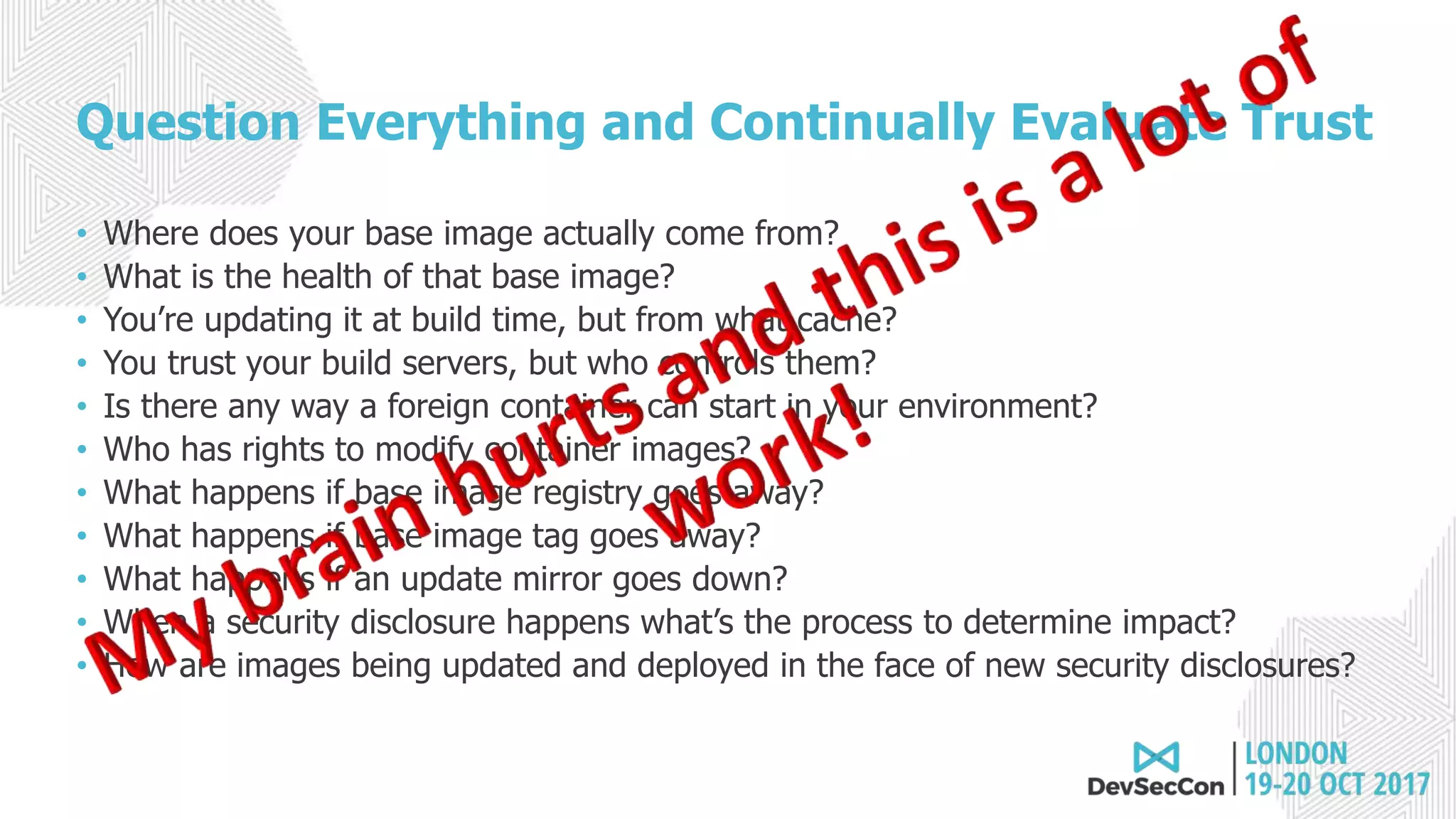
Question Everything and Continually Evaluate Trust
• Where does your base image actually come from?
• What is the health of that base image?
• You’re updating it at build time, but from what cache?
• You trust your build servers, but who controls them?
• Is there any way a foreign container can start in your environment?
• Who has rights to modify container images?
• What happens if base image registry goes away?
• What happens if base image tag goes away?
• What happens if an update mirror goes down?
• When a security disclosure happens what’s the process to determine impact?
• How are images being updated and deployed in the face of new security disclosures?
Join the conversation #DevSecCon
Why all this matters
i.e. Please don’t get sacked
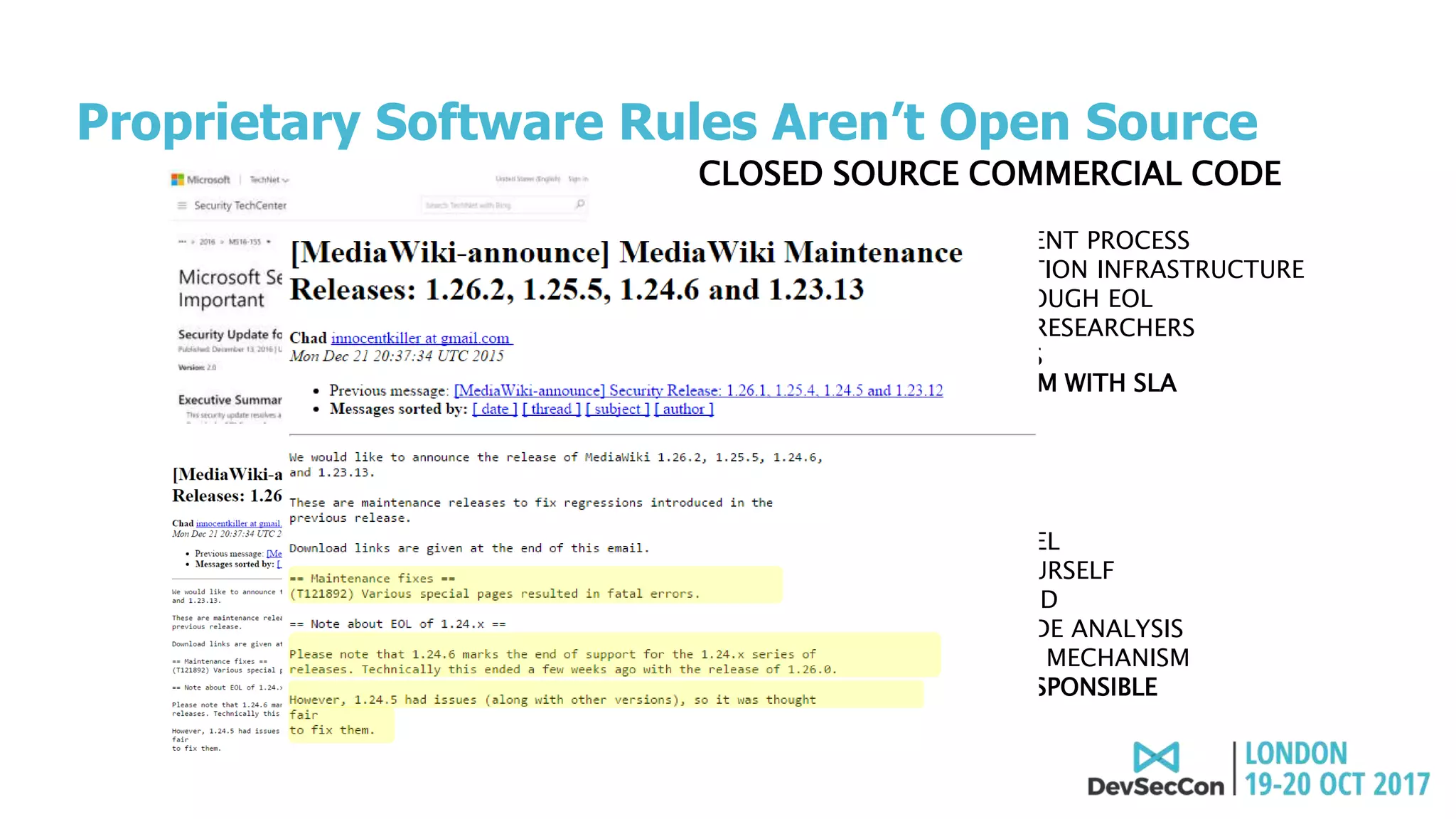
CLOSED SOURCE COMMERCIAL CODE
• TRADITIONAL PROCUREMENT PROCESS
• ALERTING AND NOTIFICATION INFRASTRUCTURE
• SUPPORT AVAILABLE THROUGH EOL
• STAFFED WITH SECURITY RESEARCHERS
• REGULAR PATCH UPDATES
• DEDICATED SUPPORT TEAM WITH SLA
OPEN SOURCE CODE
• AD-HOC ADOPTION MODEL
• MONITOR NEWSFEEDS YOURSELF
• EOL MAY CREATE DEADEND
• “COMMUNITY”-BASED CODE ANALYSIS
• NO STANDARD PATCHING MECHANISM
• ULTIMATELY, YOU ARE RESPONSIBLE
Proprietary Software Rules Aren’t Open Source
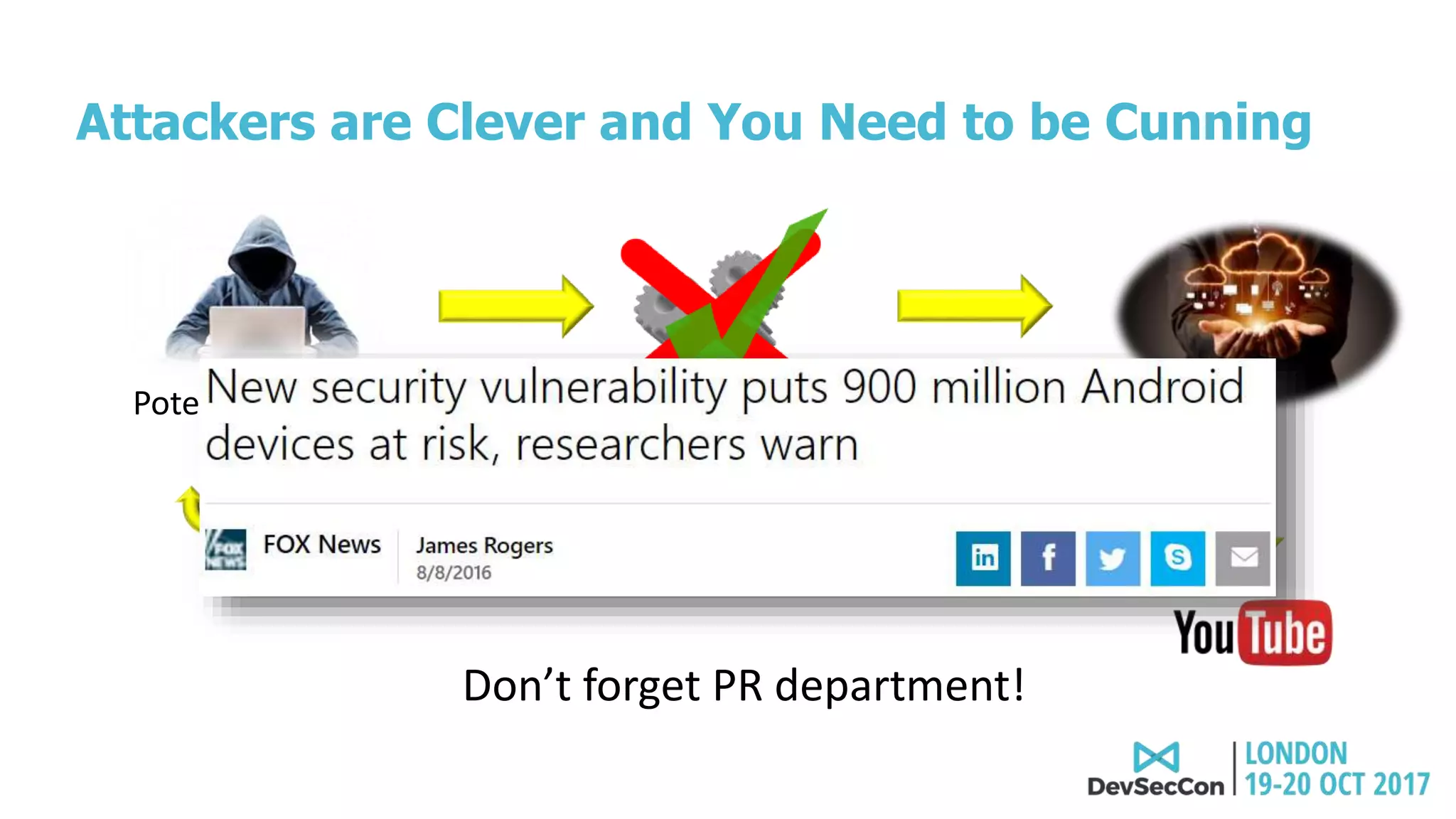
Attackers are Clever and You Need to be Cunning
Potential Attack
Iterate
Test against platforms
Document
Don’t forget PR department!
Deploy
Join the conversation #DevSecCon
Let’s Make it Real – Decompose a
Vulnerability
Media
Coverage
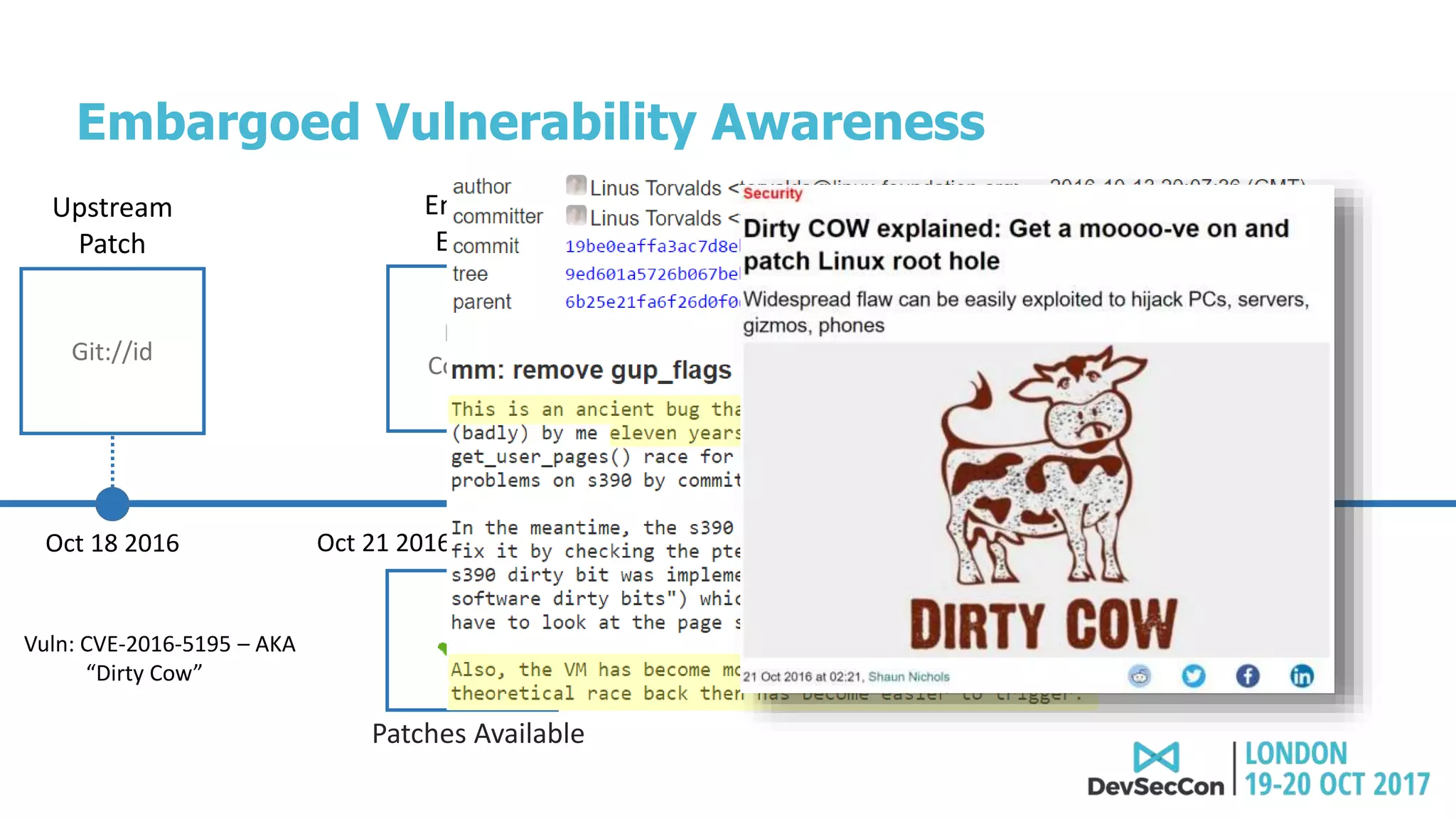
Embargo
Expires
Oct 21 2016
Git://id
Upstream
Patch
Vuln: CVE-2016-5195 – AKA
“Dirty Cow”
Oct 18 2016
Patches Available
Embargoed Vulnerability Awareness
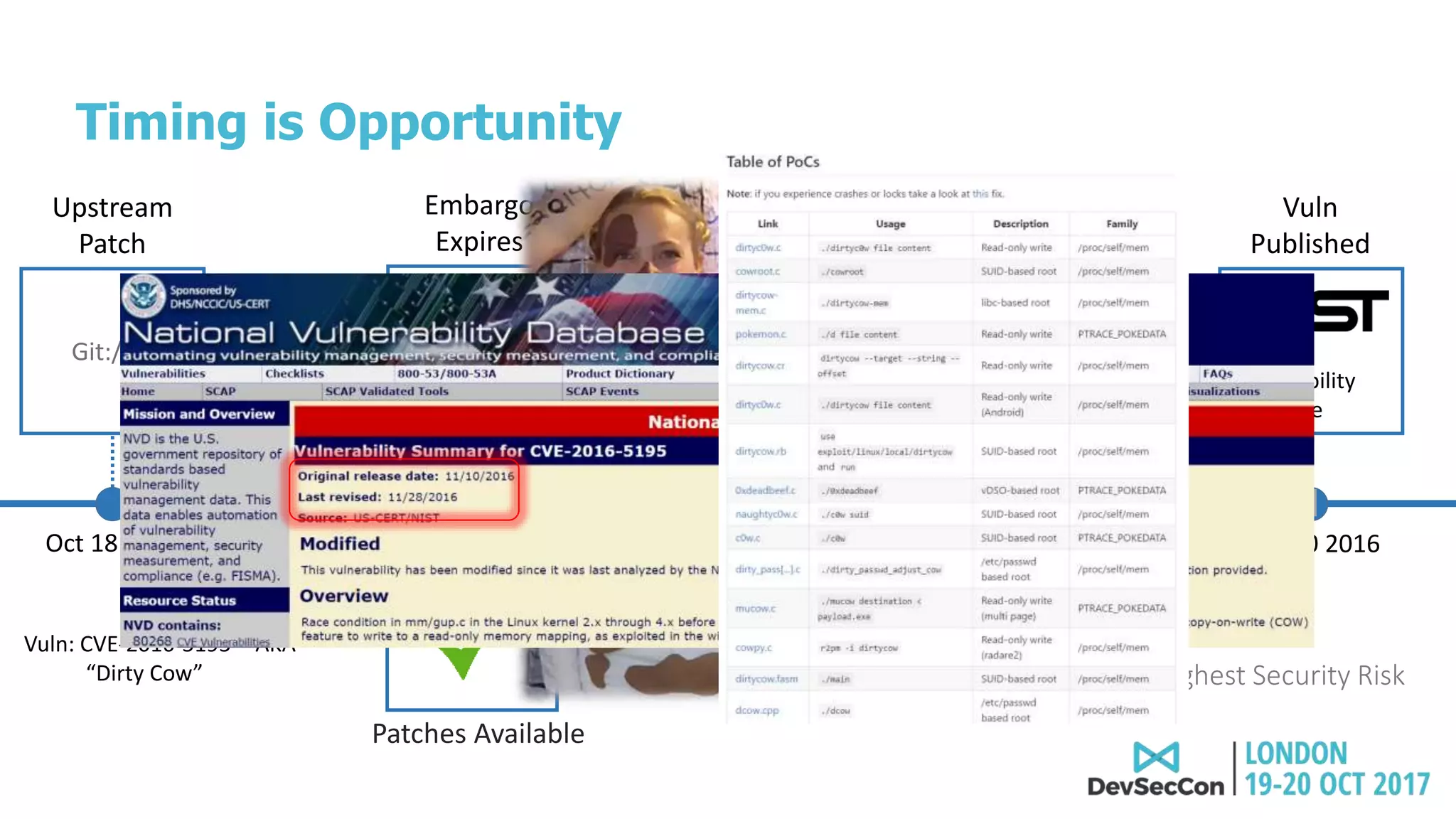
Patches Available
Media
Coverage
Embargo
Expires
Oct 21 2016
Git://id
Upstream
Patch
Vuln: CVE-2016-5195 – AKA
“Dirty Cow”
Oct 18 2016
National
Vulnerability
Database
Vuln
Published
Nov 10 2016
Highest Security Risk
Timing is Opportunity
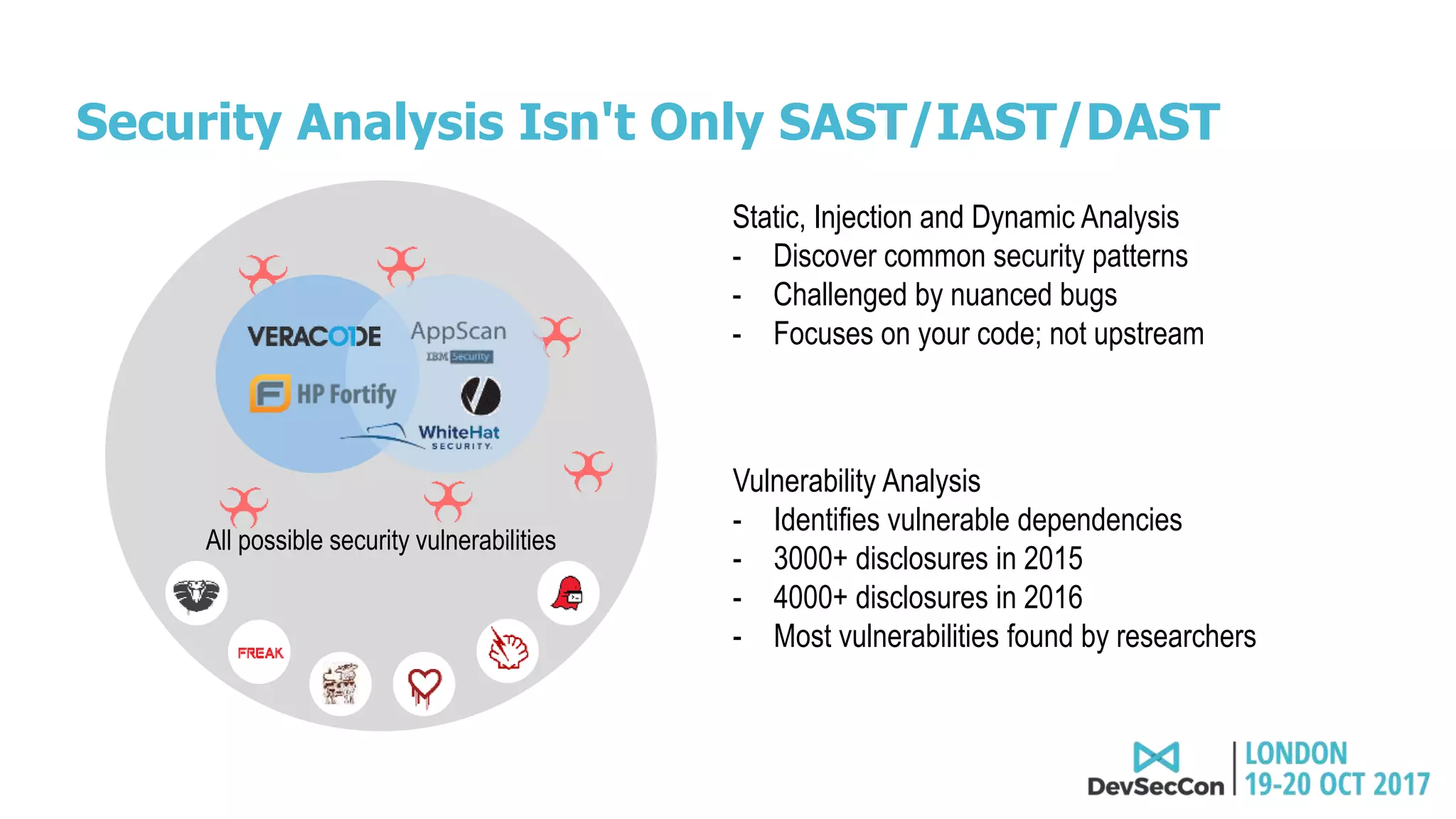
Security Analysis Isn't Only SAST/IAST/DAST
All possible security vulnerabilities
Static, Injection and Dynamic Analysis
- Discover common security patterns
- Challenged by nuanced bugs
- Focuses on your code; not upstream
Vulnerability Analysis
- Identifies vulnerable dependencies
- 3000+ disclosures in 2015
- 4000+ disclosures in 2016
- Most vulnerabilities found by researchers
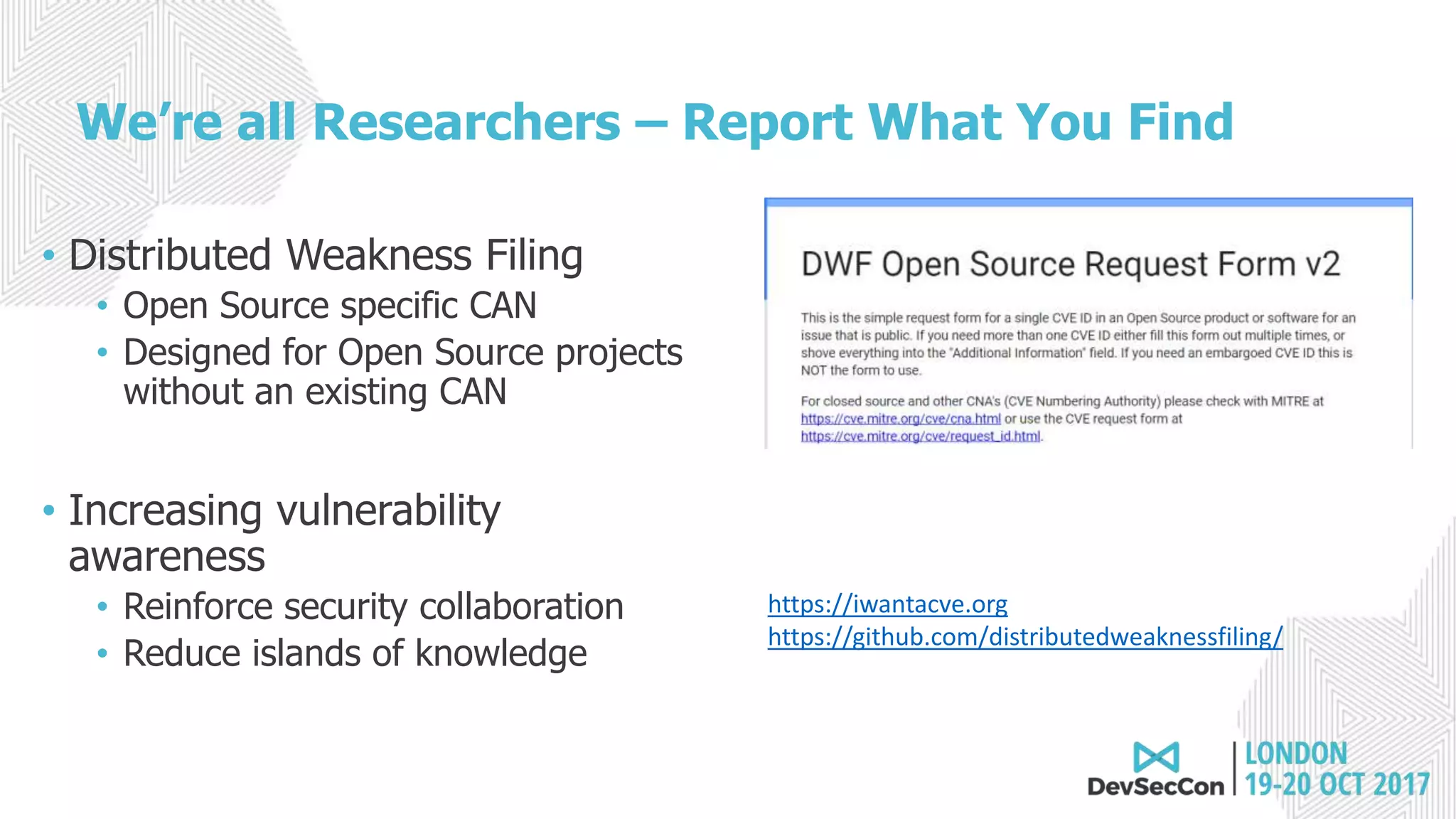
We’re all Researchers – Report What You Find
• Distributed Weakness Filing
• Open Source specific CAN
• Designed for Open Source projects
without an existing CAN
• Increasing vulnerability
awareness
• Reinforce security collaboration
• Reduce islands of knowledge
https://iwantacve.org
https://github.com/distributedweaknessfiling/
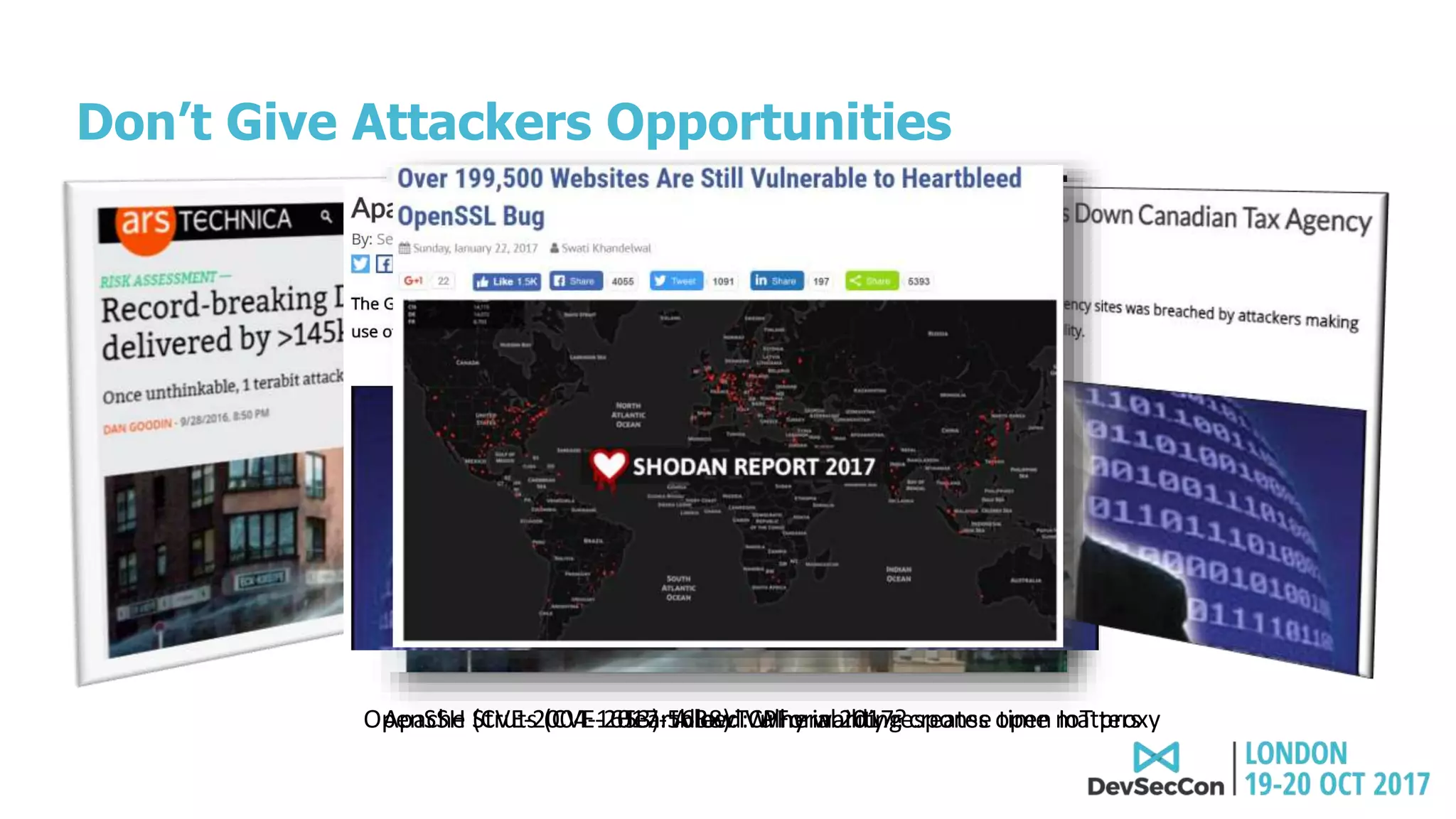
Heartbleed: Why in 2017?
Don’t Give Attackers Opportunities
OpenSSH (CVE-2004-1653): AllowTCPForwarding creates open IoT proxyApache Struts (CVE-2017-5638): Vulnerability response time matters
1649 Days 144 Days7 Days
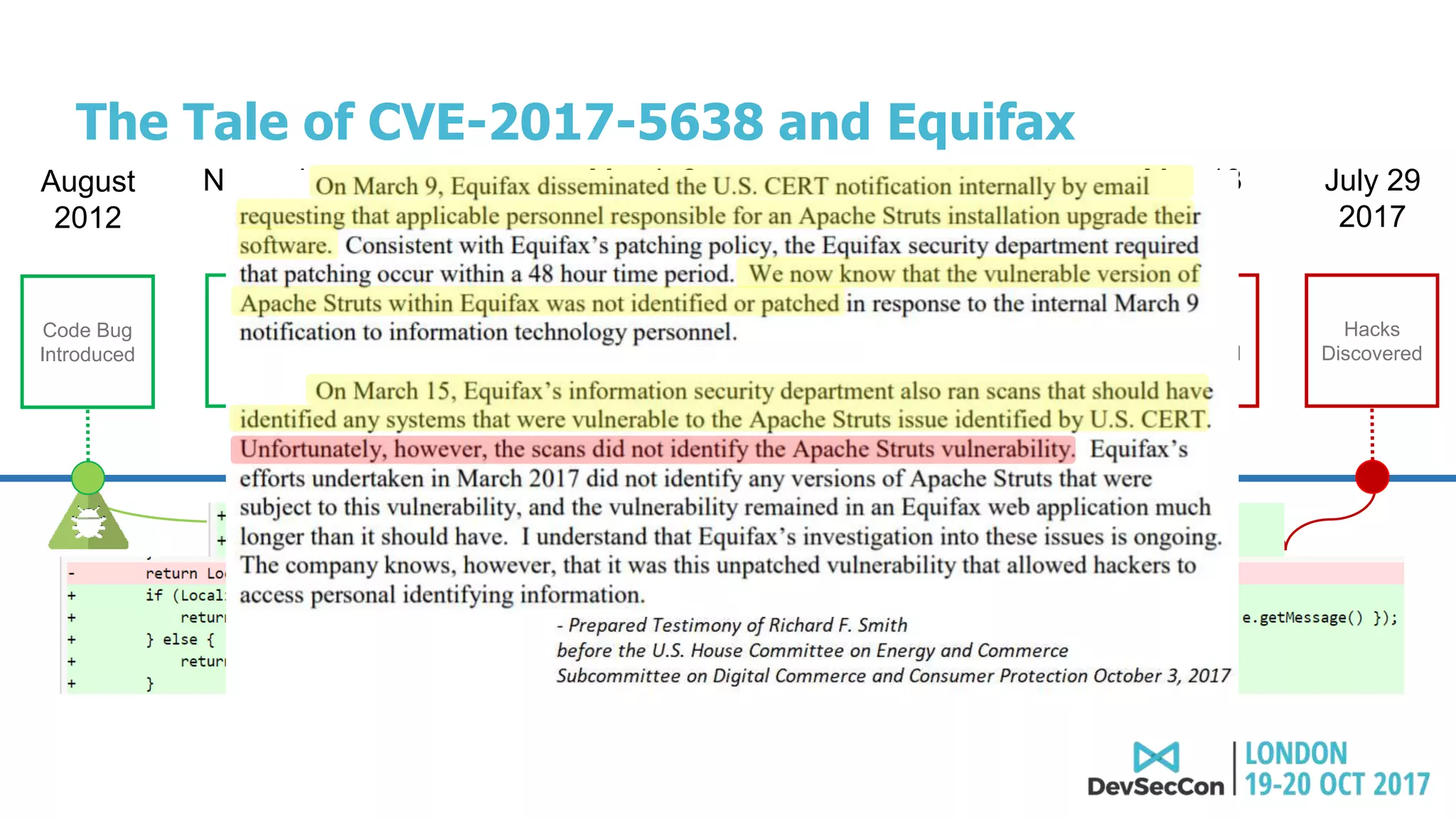
The Tale of CVE-2017-5638 and Equifax
Code Bug
Introduced
August
2012
Struts 2.3
Released
November
2012
Struts 2.5
Released
May
2016
Patches
Available
March 6
2017
March 7
2017
Disclosure
Published
NVD
Details
March 14
2017
Hacks
Successful
May 13
2017
Hacks
Discovered
July 29
2017
Join the conversation #DevSecCon
Open Source Risk Maturity Model
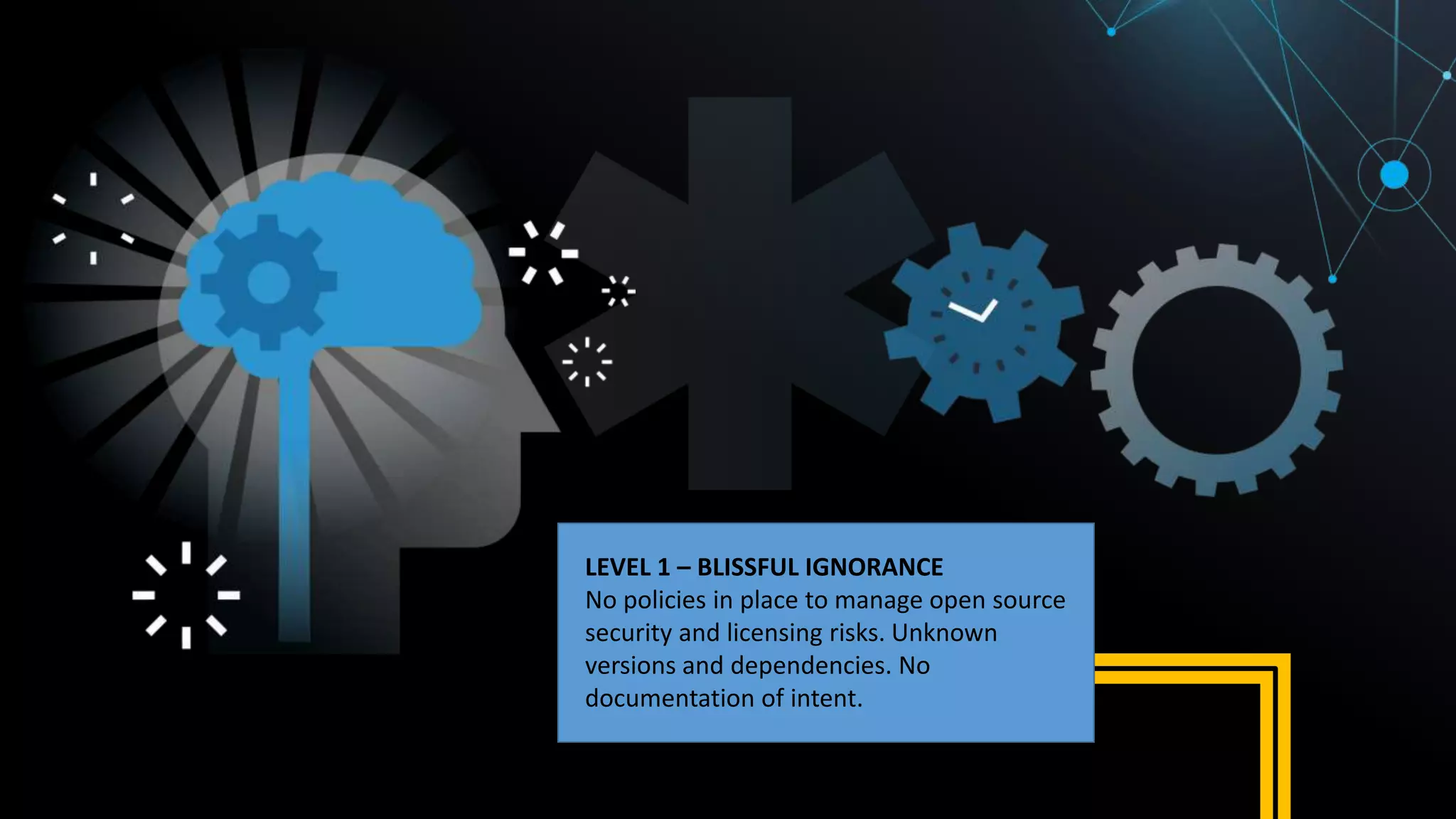
LEVEL 1 – BLISSFUL IGNORANCE
No policies in place to manage open source
security and licensing risks. Unknown
versions and dependencies. No
documentation of intent.
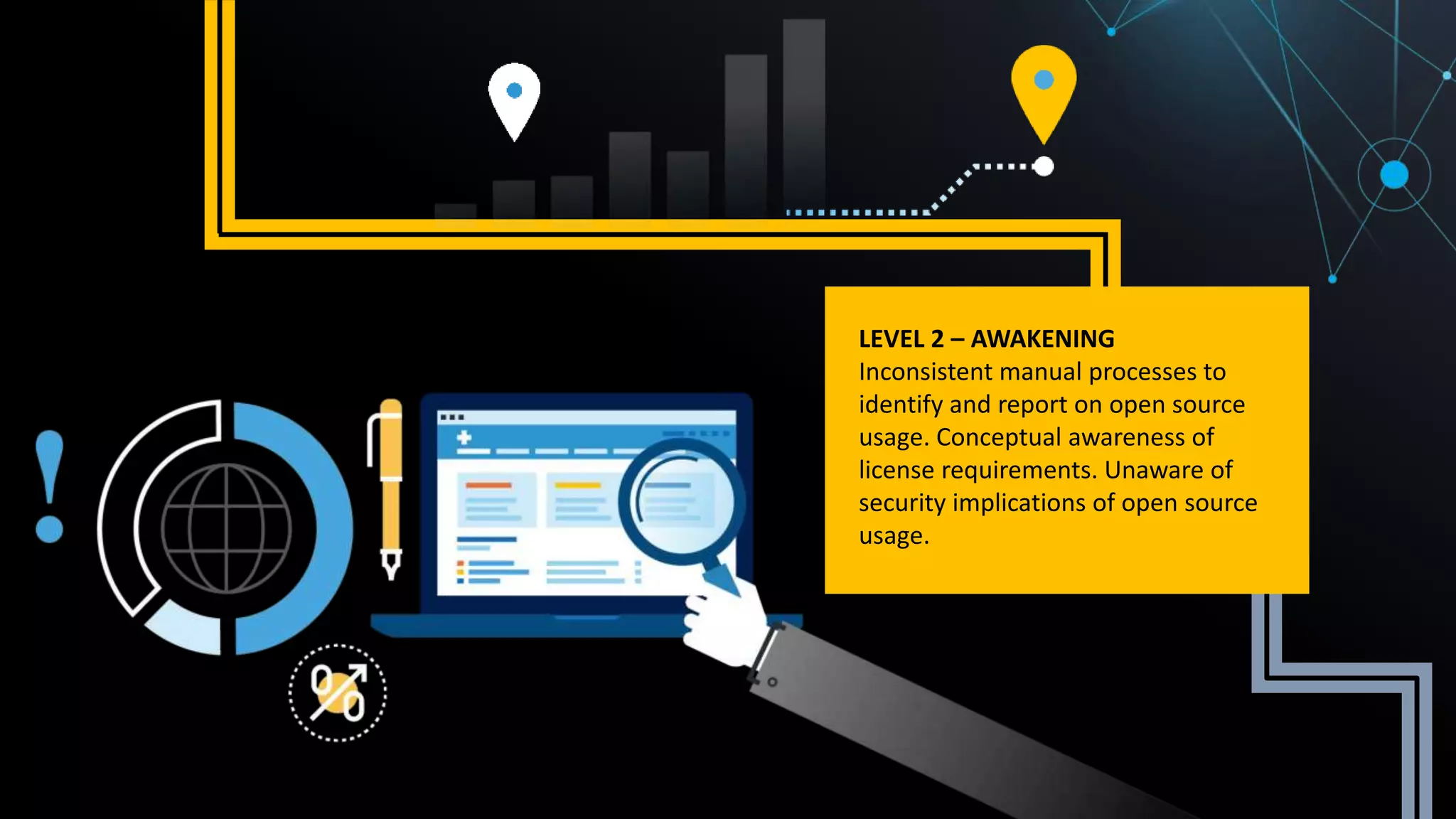
LEVEL 2 – AWAKENING
Inconsistent manual processes to
identify and report on open source
usage. Conceptual awareness of
license requirements. Unaware of
security implications of open source
usage.
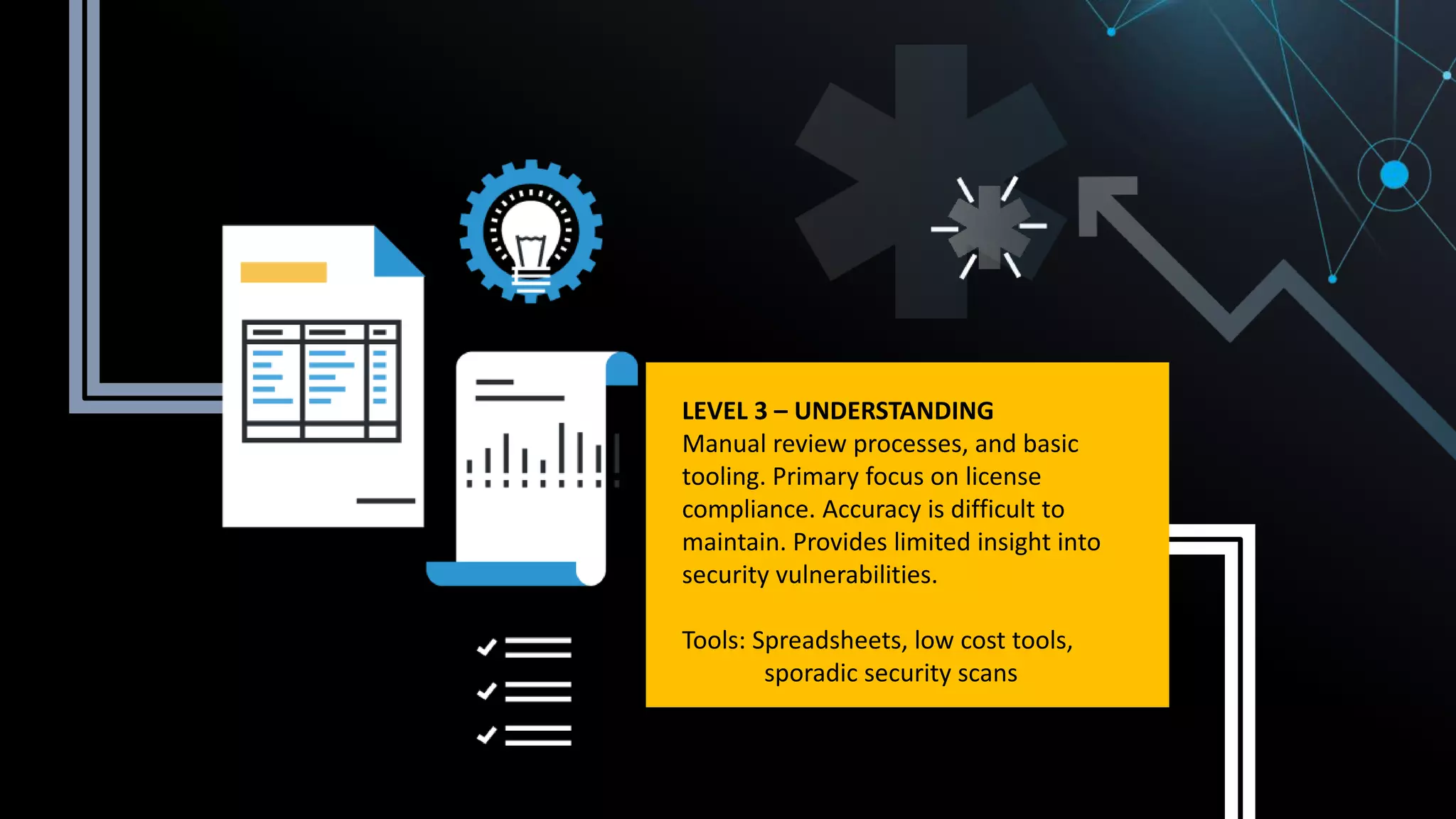
LEVEL 3 – UNDERSTANDING
Manual review processes, and basic
tooling. Primary focus on license
compliance. Accuracy is difficult to
maintain. Provides limited insight into
security vulnerabilities.
Tools: Spreadsheets, low cost tools,
sporadic security scans
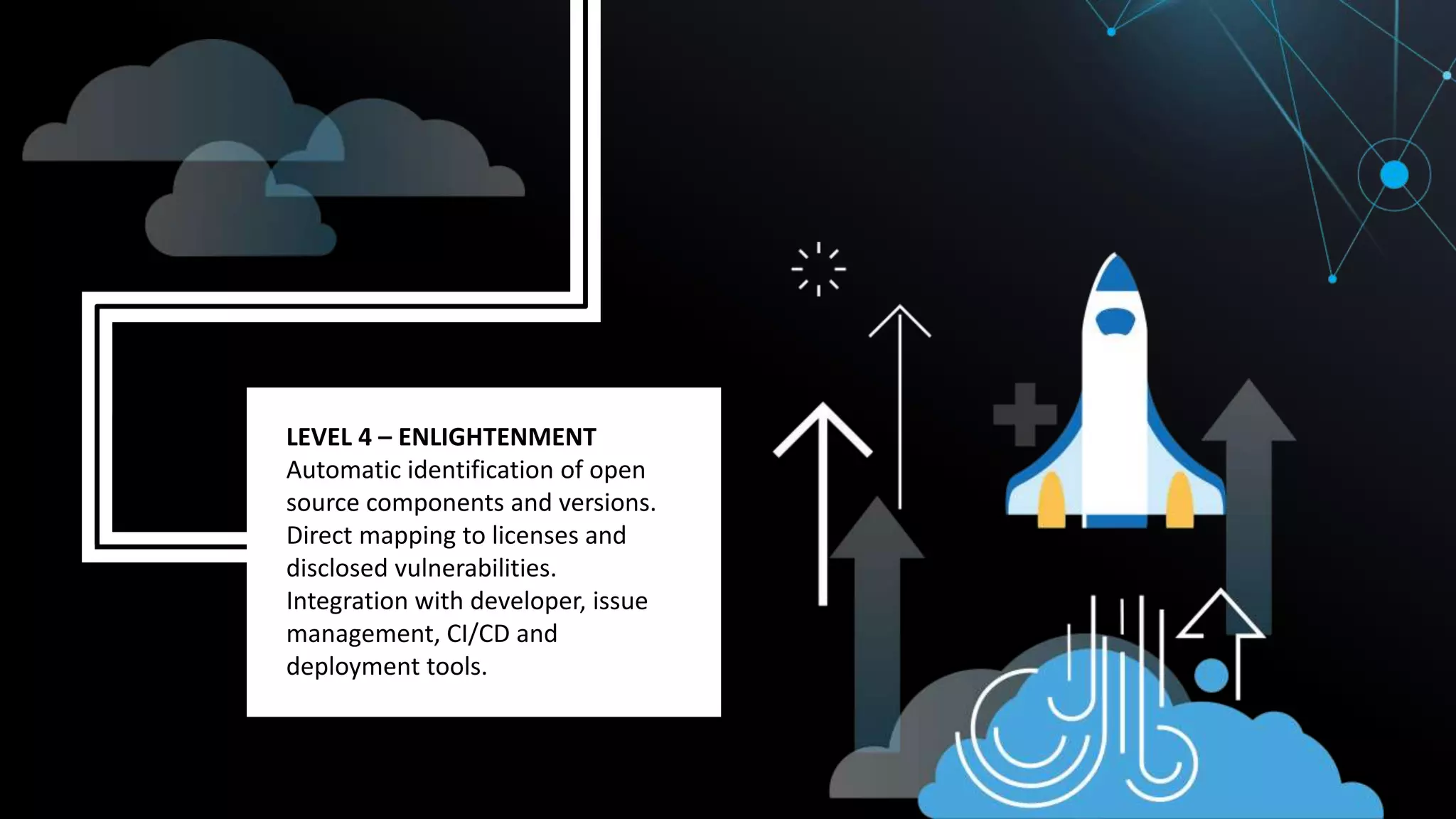
LEVEL 4 – ENLIGHTENMENT
Automatic identification of open
source components and versions.
Direct mapping to licenses and
disclosed vulnerabilities.
Integration with developer, issue
management, CI/CD and
deployment tools.
Join the conversation #DevSecCon
We Need to Automate This – Don’t
We?
Obtain Enlightenment
and make information flow your friend
Focus on Factors Impacting Risk
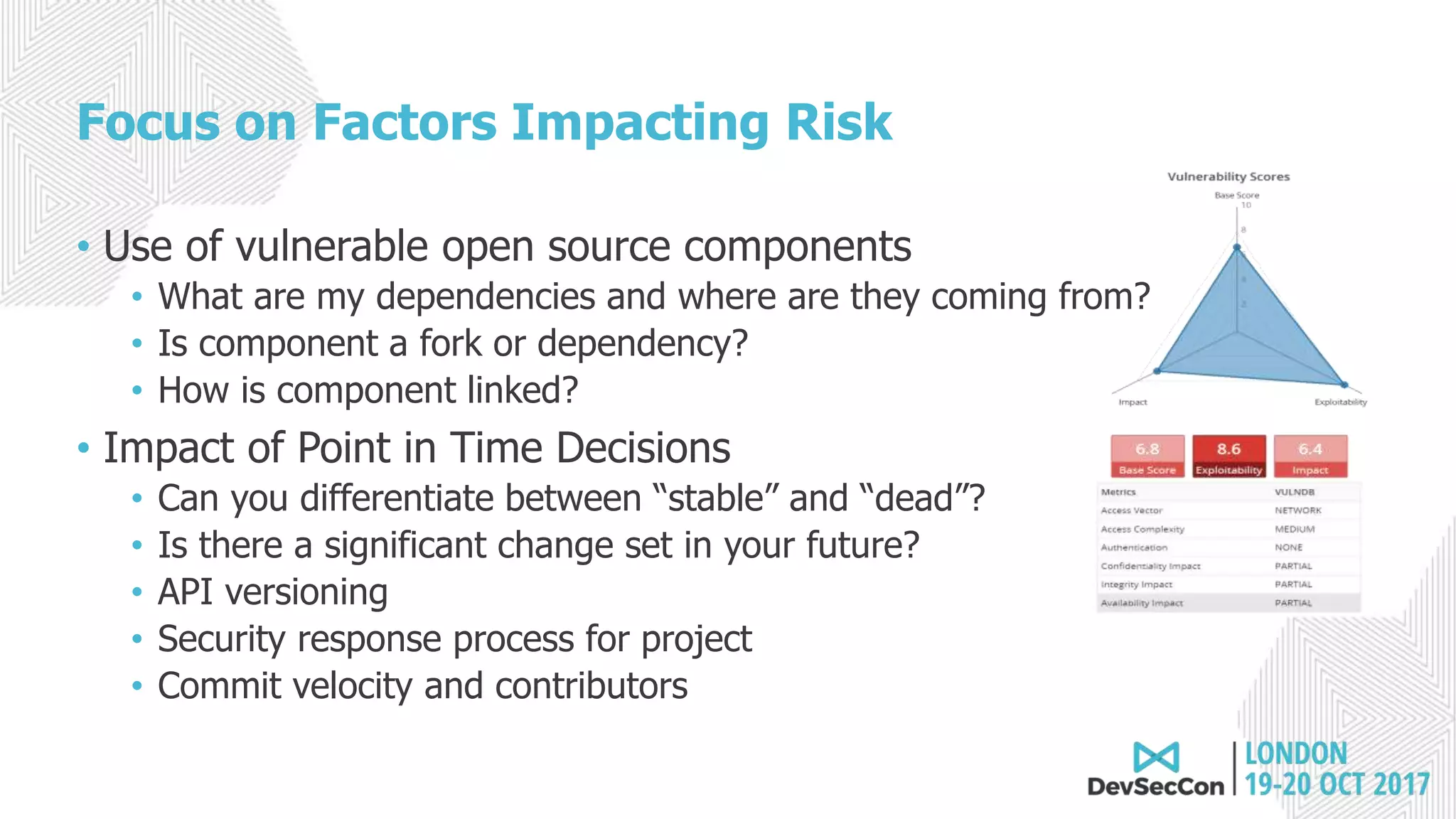
• Use of vulnerable open source components
• What are my dependencies and where are they coming from?
• Is component a fork or dependency?
• How is component linked?
• Impact of Point in Time Decisions
• Can you differentiate between “stable” and “dead”?
• Is there a significant change set in your future?
• API versioning
• Security response process for project
• Commit velocity and contributors
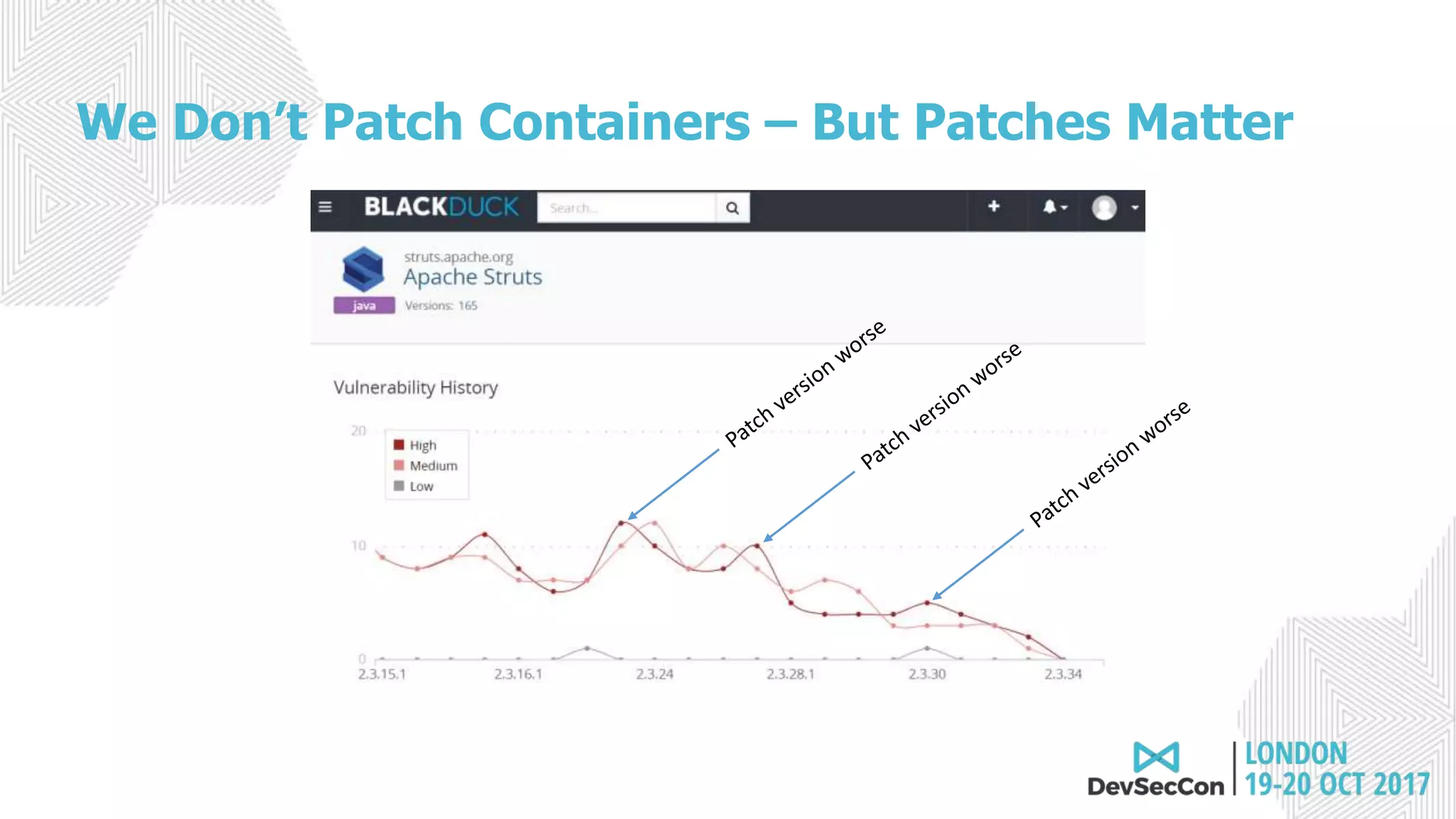
We Don’t Patch Containers – But Patches Matter
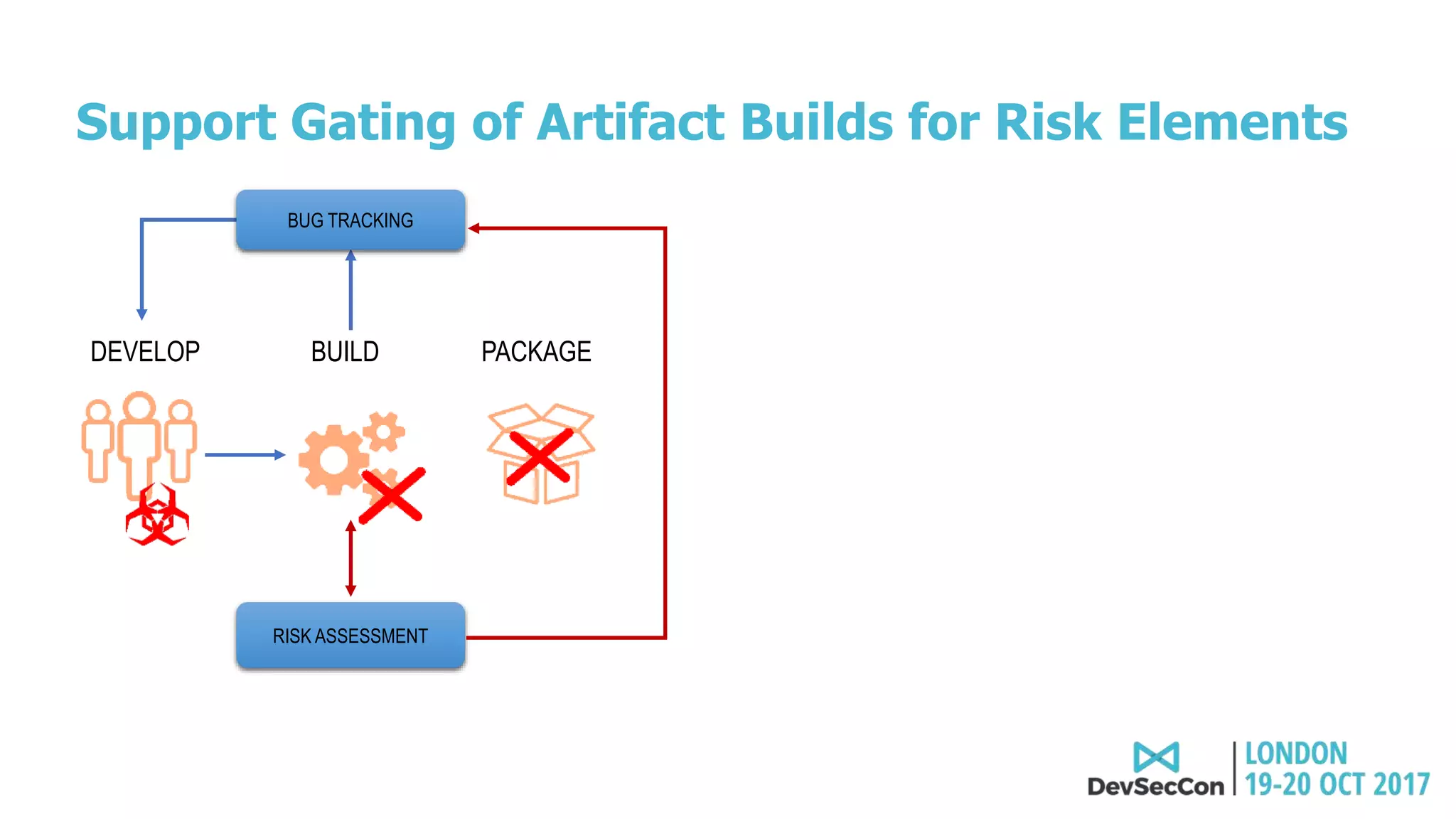
Support Gating of Artifact Builds for Risk Elements
DEVELOP BUILD PACKAGE
RISK ASSESSMENT
BUG TRACKING
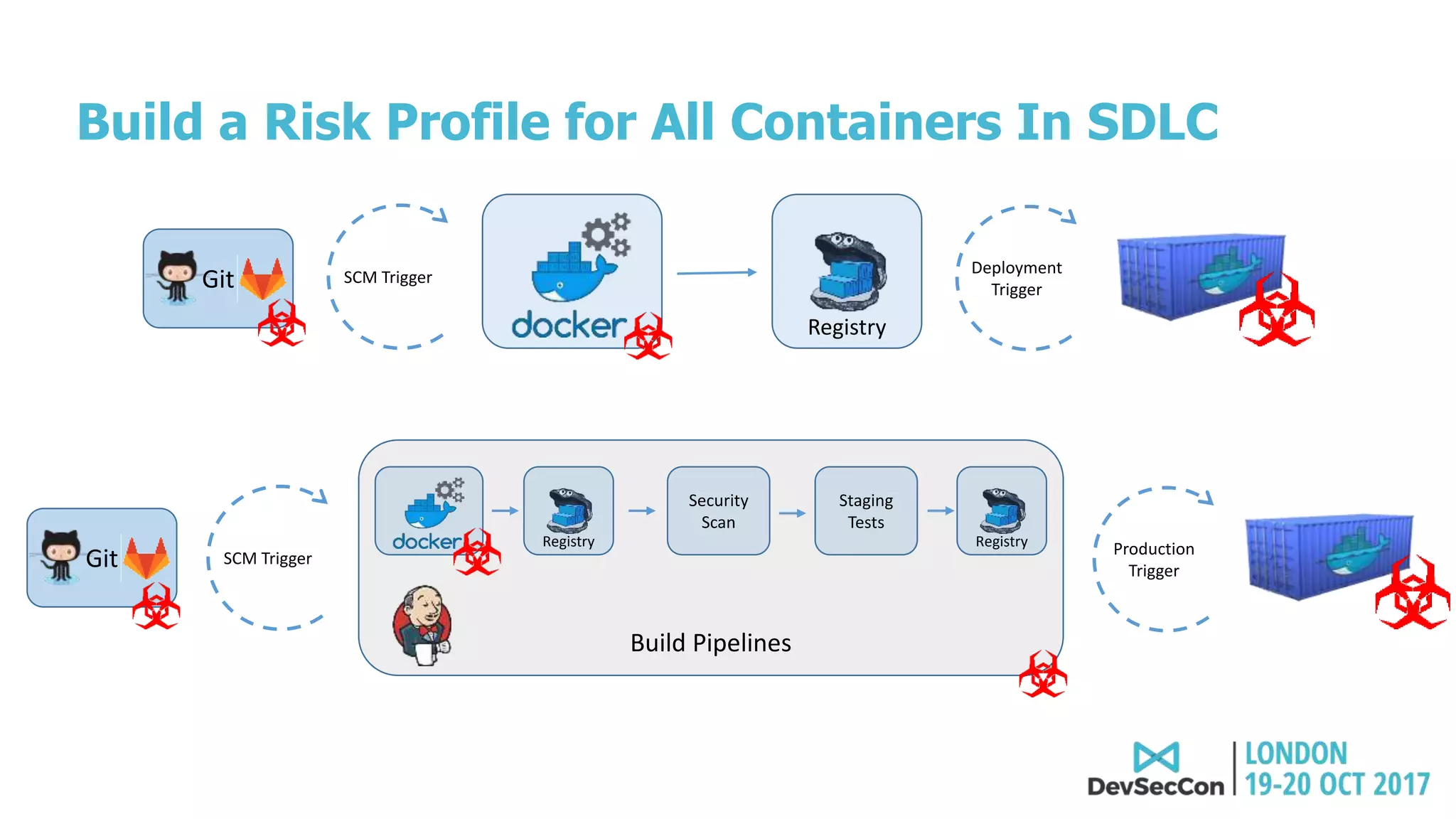
Build a Risk Profile for All Containers In SDLC
Registry
SCM Trigger
Deployment
TriggerGit
Build Pipelines
Production
Trigger
Registry Registry
Security
Scan
Staging
Tests
SCM TriggerGit
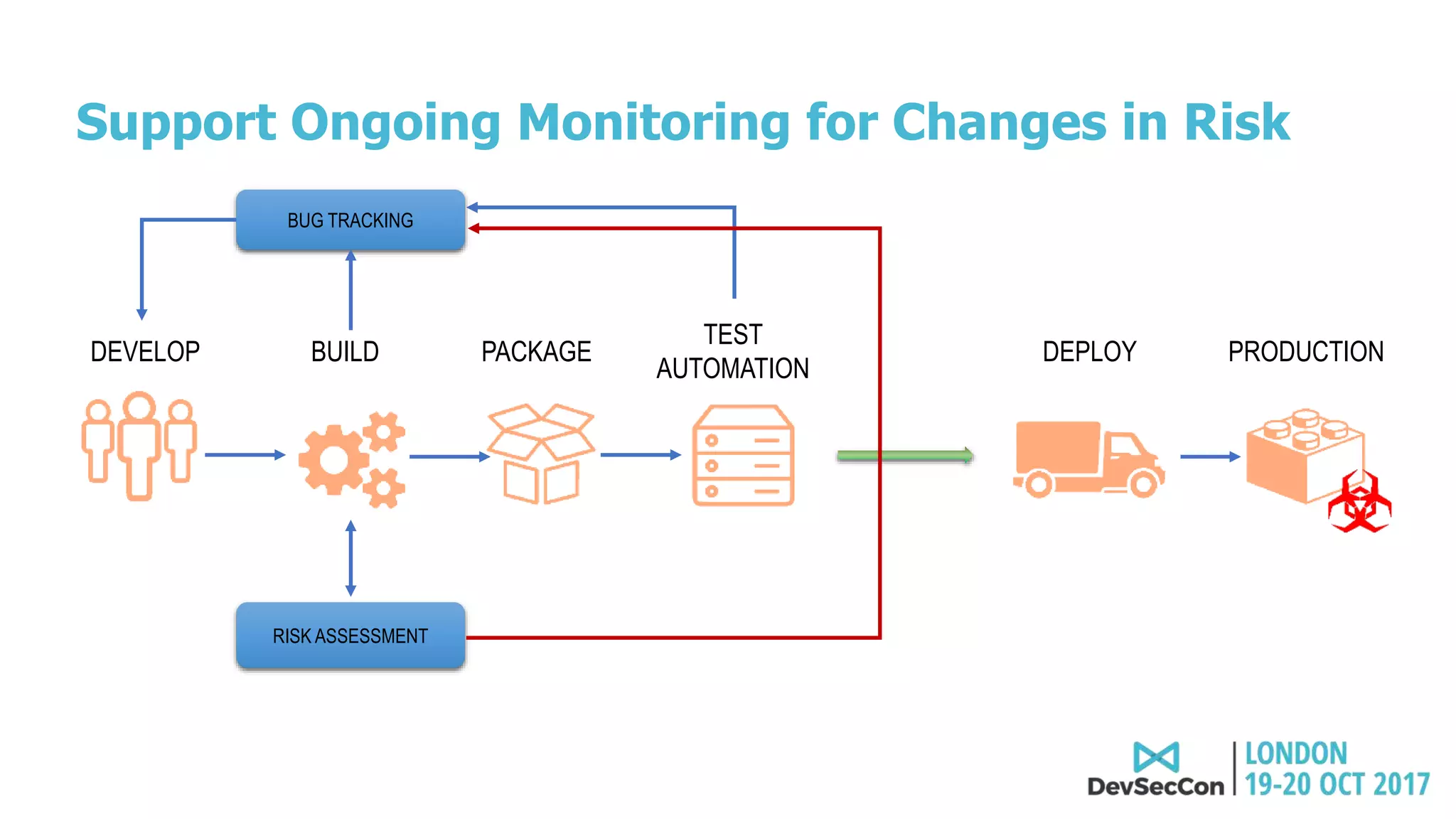
Support Ongoing Monitoring for Changes in Risk
DEVELOP BUILD PACKAGE DEPLOY PRODUCTION
BUG TRACKING
TEST
AUTOMATION
RISK ASSESSMENT
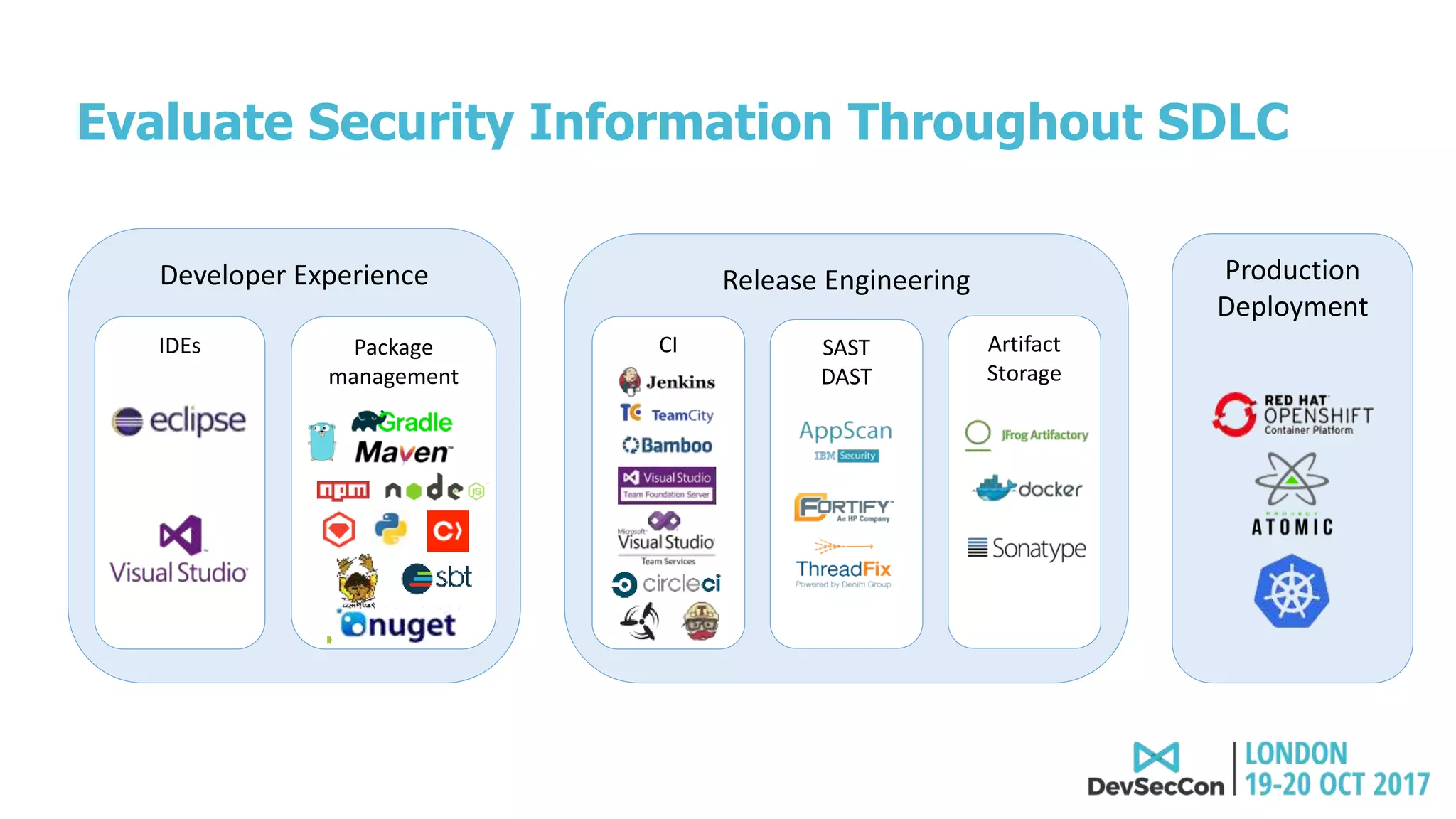
Evaluate Security Information Throughout SDLC
Developer Experience
IDEs
Release Engineering
SAST
DAST
Artifact
Storage
Production
Deployment
Package
management
CI
Problem:
Security response times are too long
Automate awareness of open source
dependencies while operating at DevOps speed
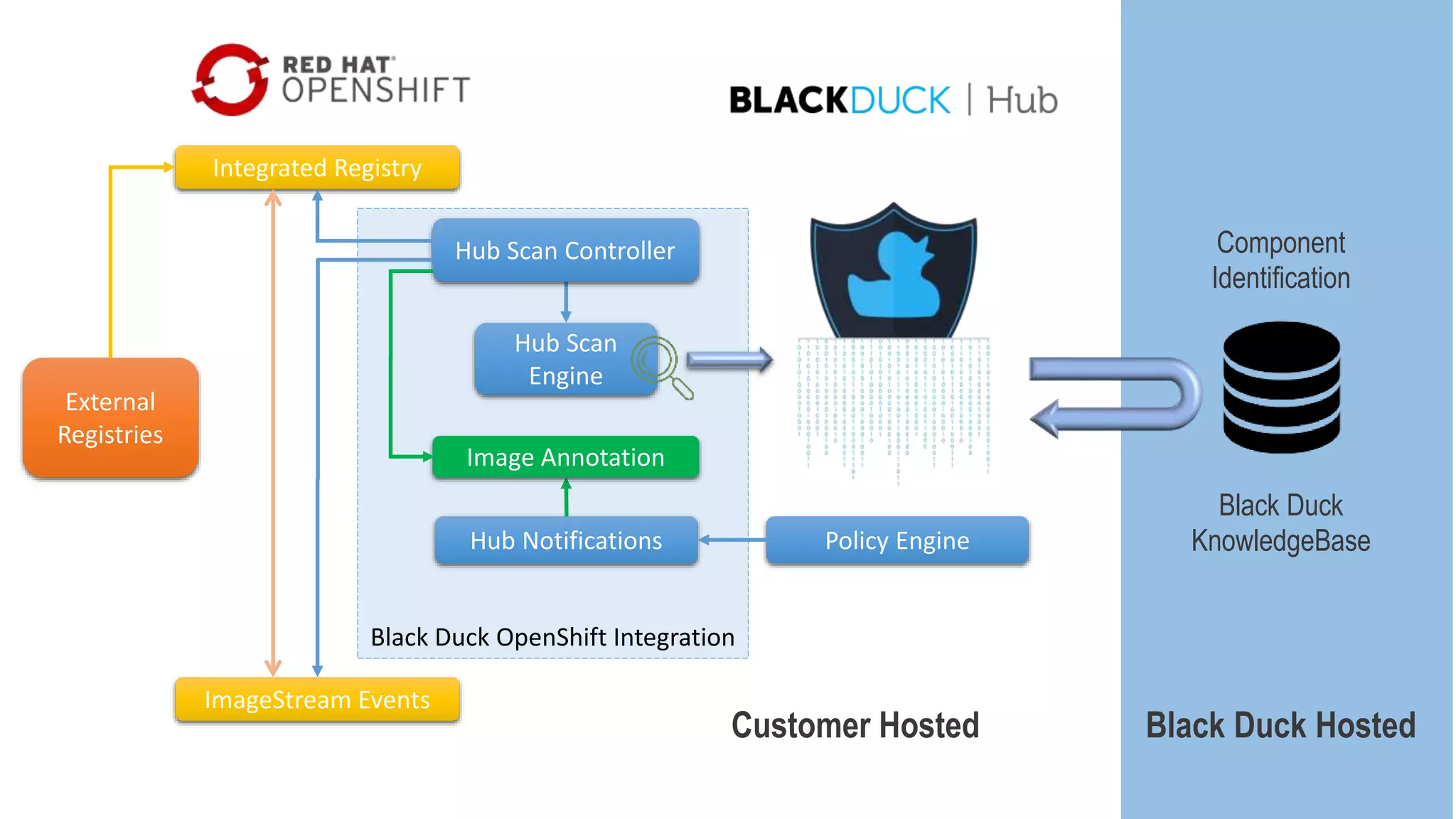
Black Duck OpenShift Integration
Component
Identification
Black Duck
KnowledgeBase
Customer Hosted Black Duck Hosted
Integrated Registry
ImageStream Events
Policy Engine
Hub Scan
Engine
Hub Scan Controller
Hub Notifications
Image Annotation
External
Registries
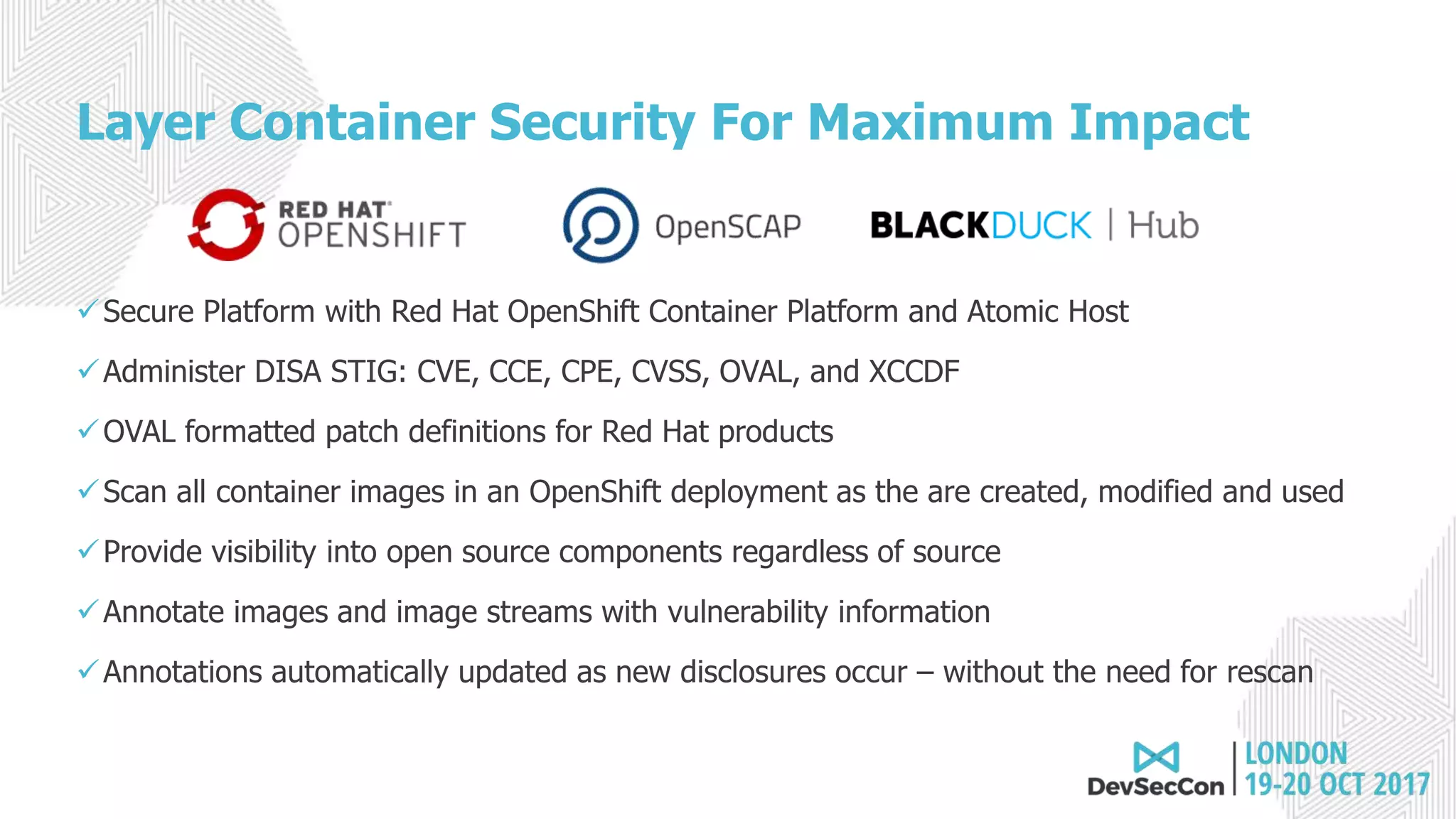
Layer Container Security For Maximum Impact
Secure Platform with Red Hat OpenShift Container Platform and Atomic Host
Administer DISA STIG: CVE, CCE, CPE, CVSS, OVAL, and XCCDF
OVAL formatted patch definitions for Red Hat products
Scan all container images in an OpenShift deployment as the are created, modified and used
Provide visibility into open source components regardless of source
Annotate images and image streams with vulnerability information
Annotations automatically updated as new disclosures occur – without the need for rescan
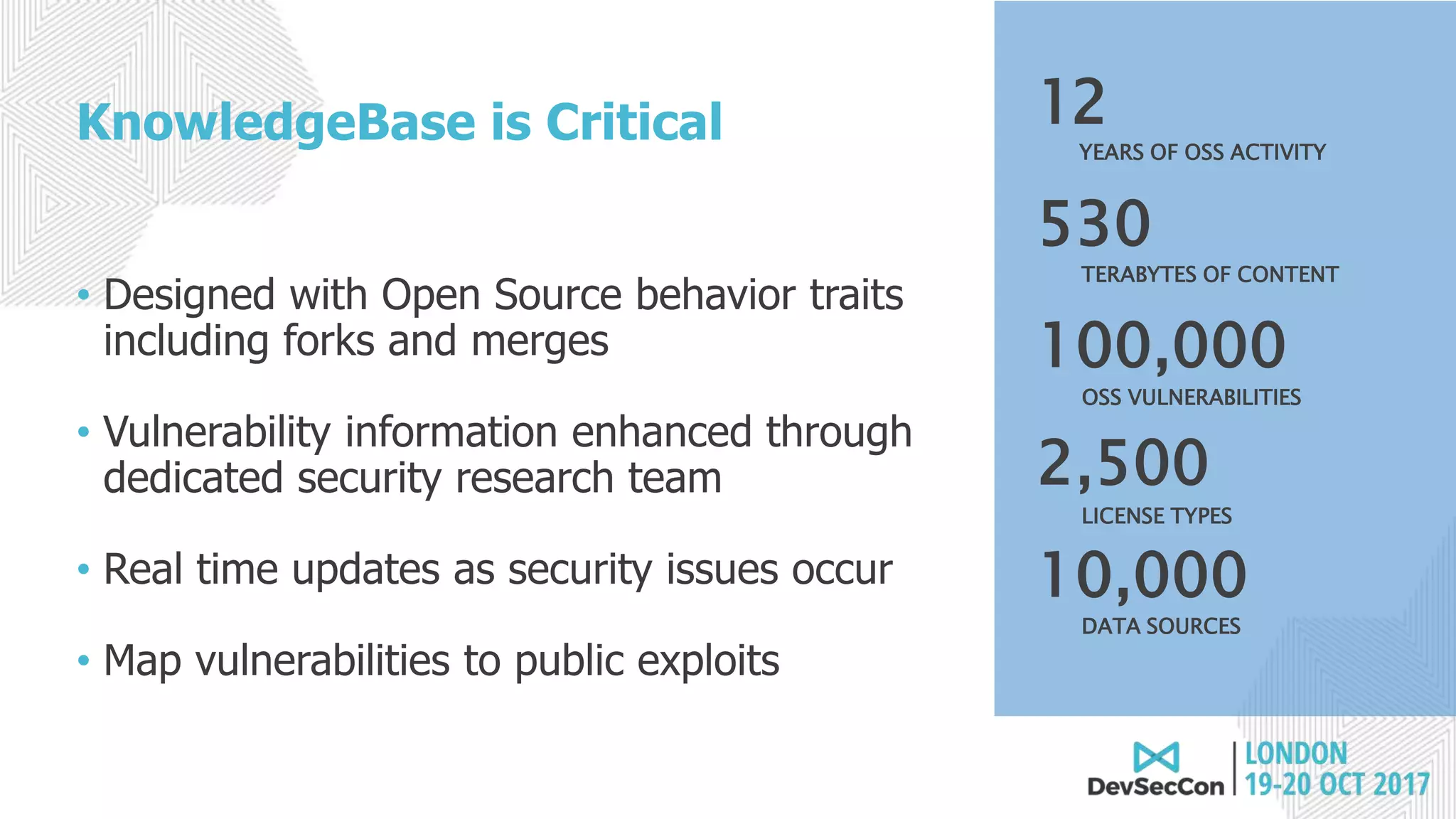
10,000
DATA SOURCES
530
TERABYTES OF CONTENT
2,500
LICENSE TYPES
12
YEARS OF OSS ACTIVITY
100,000
OSS VULNERABILITIES
KnowledgeBase is Critical
• Designed with Open Source behavior traits
including forks and merges
• Vulnerability information enhanced through
dedicated security research team
• Real time updates as security issues occur
• Map vulnerabilities to public exploits
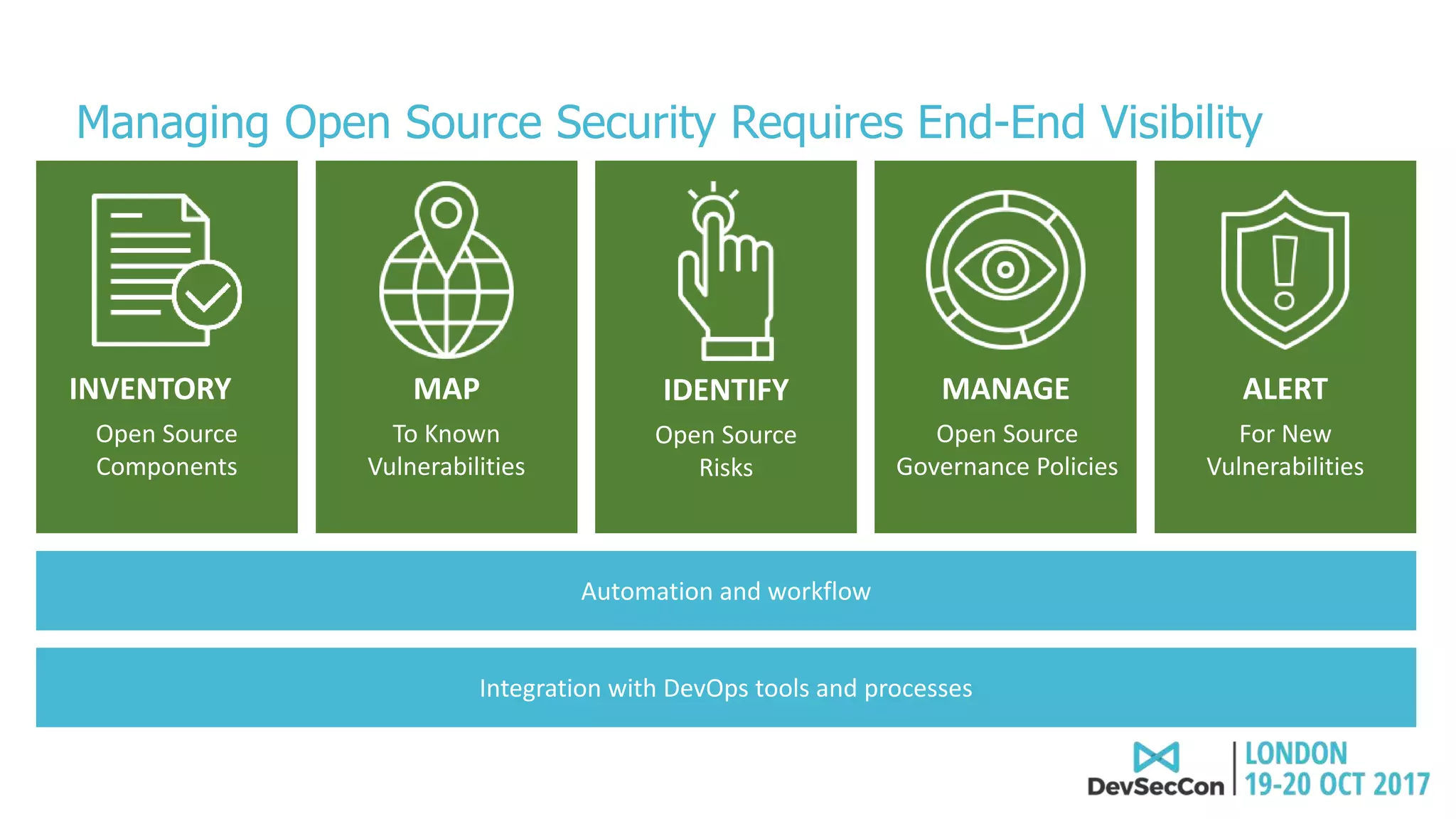
Managing Open Source Security Requires End-End Visibility
INVENTORY
Open Source
Components
MAP
To Known
Vulnerabilities
IDENTIFY
Open Source
Risks
MANAGE
Open Source
Governance Policies
ALERT
For New
Vulnerabilities
Automation and workflow
Integration with DevOps tools and processes
Stay Out of the News for the Wrong Reasons
• 2 ½ days of keynotes, breakout sessions, and networking
• Four conference tracks: Dev & DevOps, Security,
Legal & Compliance, Research & Innovation
Register at: https://www.blackducksoftware.com/flight
FLIGHT 2017
Join us at the Boston Seaport Hotel & World Trade Center
November 7-9, 2017
Register using the code TIM99 to
save $1196 on the conference price
Join the conversation #DevSecCon
Thank You!

DevSecCon London 2017: when good containers go bad by Tim Mackey

  • 1.
    Join the conversation#DevSecCon BY TIM MACKEY – BLACK DUCK SOFTWARE A Question of Trust – When Good Containers Go Bad
  • 2.
    #whoami – TimMackey • Current roles: Senior Technical Evangelist; Occasional coder • Former XenServer Community Manager in Citrix Open Source Business Office • Cool things I’ve done • Designed laser communication systems • Early designer of retail self-checkout machines • Embedded special relativity algorithms into industrial control system • Find me • Twitter: @TimInTech ( https://twitter.com/TimInTech ) • SlideShare: slideshare.net/TimMackey • LinkedIn: www.linkedin.com/in/mackeytim
  • 3.
    Security Driven Developmentand Deployment • Developers are empowered with security information • Clear security driven release policies exist • Trusted components are used as dependencies • CI processes incorporate security testing • Binary artifacts are only created when release policies are met • Releasable binaries are digitally signed • Container images are built from trusted base images • Produced images are stored in trusted container registries • Containers are only deployed from trusted registries
  • 4.
    Data Breaches areSerious Business • Average cost of data breach: $7.35 Million • Lost business: $4.03 Million • Average time to identify and contain a breach: 206 days Source: 2017 Cost of Data Breach Study – Ponemon Insitute
  • 5.
    Prediction: Rate ofSecurity Disclosures To Increase • e.g. GDPR • Anyone operating with data on EU person • Corporate location irrelevant • Violation has fine of 4% global turnover or 20 Million Euro (which ever is greater) • Applies equally to controllers of data and processors of data • Breach notification required within 72 hours • Requires “Privacy by Design”
  • 6.
    Control Domain NetworkingCompute Storage Hypervisor Container VM Minimal OS We’reProtected – Infra Team’s Got It! Container Container Container Container VM Minimal OS Container Container Container SecurityService Container
  • 7.
    Control Domain NetworkingCompute Storage Hypervisor Container VM Minimal OS OrDid They? Container Container Container Container VM Minimal OS Container Container Container SecurityService Container Container VM Minimal OS Vulnerable Container Container Container Compromised Container Compromised Container
  • 8.
    Question Everything andContinually Evaluate Trust • Where does your base image actually come from? • What is the health of that base image? • You’re updating it at build time, but from what cache? • You trust your build servers, but who controls them? • Is there any way a foreign container can start in your environment? • Who has rights to modify container images? • What happens if base image registry goes away? • What happens if base image tag goes away? • What happens if an update mirror goes down? • When a security disclosure happens what’s the process to determine impact? • How are images being updated and deployed in the face of new security disclosures?
  • 9.
    Join the conversation#DevSecCon Why all this matters i.e. Please don’t get sacked
  • 10.
    CLOSED SOURCE COMMERCIALCODE • TRADITIONAL PROCUREMENT PROCESS • ALERTING AND NOTIFICATION INFRASTRUCTURE • SUPPORT AVAILABLE THROUGH EOL • STAFFED WITH SECURITY RESEARCHERS • REGULAR PATCH UPDATES • DEDICATED SUPPORT TEAM WITH SLA OPEN SOURCE CODE • AD-HOC ADOPTION MODEL • MONITOR NEWSFEEDS YOURSELF • EOL MAY CREATE DEADEND • “COMMUNITY”-BASED CODE ANALYSIS • NO STANDARD PATCHING MECHANISM • ULTIMATELY, YOU ARE RESPONSIBLE Proprietary Software Rules Aren’t Open Source
  • 11.
    Attackers are Cleverand You Need to be Cunning Potential Attack Iterate Test against platforms Document Don’t forget PR department! Deploy
  • 12.
    Join the conversation#DevSecCon Let’s Make it Real – Decompose a Vulnerability
  • 13.
    Media Coverage Embargo Expires Oct 21 2016 Git://id Upstream Patch Vuln:CVE-2016-5195 – AKA “Dirty Cow” Oct 18 2016 Patches Available Embargoed Vulnerability Awareness
  • 14.
    Patches Available Media Coverage Embargo Expires Oct 212016 Git://id Upstream Patch Vuln: CVE-2016-5195 – AKA “Dirty Cow” Oct 18 2016 National Vulnerability Database Vuln Published Nov 10 2016 Highest Security Risk Timing is Opportunity
  • 15.
    Security Analysis Isn'tOnly SAST/IAST/DAST All possible security vulnerabilities Static, Injection and Dynamic Analysis - Discover common security patterns - Challenged by nuanced bugs - Focuses on your code; not upstream Vulnerability Analysis - Identifies vulnerable dependencies - 3000+ disclosures in 2015 - 4000+ disclosures in 2016 - Most vulnerabilities found by researchers
  • 16.
    We’re all Researchers– Report What You Find • Distributed Weakness Filing • Open Source specific CAN • Designed for Open Source projects without an existing CAN • Increasing vulnerability awareness • Reinforce security collaboration • Reduce islands of knowledge https://iwantacve.org https://github.com/distributedweaknessfiling/
  • 17.
    Heartbleed: Why in2017? Don’t Give Attackers Opportunities OpenSSH (CVE-2004-1653): AllowTCPForwarding creates open IoT proxyApache Struts (CVE-2017-5638): Vulnerability response time matters
  • 18.
    1649 Days 144Days7 Days The Tale of CVE-2017-5638 and Equifax Code Bug Introduced August 2012 Struts 2.3 Released November 2012 Struts 2.5 Released May 2016 Patches Available March 6 2017 March 7 2017 Disclosure Published NVD Details March 14 2017 Hacks Successful May 13 2017 Hacks Discovered July 29 2017
  • 19.
    Join the conversation#DevSecCon Open Source Risk Maturity Model
  • 20.
    LEVEL 1 –BLISSFUL IGNORANCE No policies in place to manage open source security and licensing risks. Unknown versions and dependencies. No documentation of intent.
  • 21.
    LEVEL 2 –AWAKENING Inconsistent manual processes to identify and report on open source usage. Conceptual awareness of license requirements. Unaware of security implications of open source usage.
  • 22.
    LEVEL 3 –UNDERSTANDING Manual review processes, and basic tooling. Primary focus on license compliance. Accuracy is difficult to maintain. Provides limited insight into security vulnerabilities. Tools: Spreadsheets, low cost tools, sporadic security scans
  • 23.
    LEVEL 4 –ENLIGHTENMENT Automatic identification of open source components and versions. Direct mapping to licenses and disclosed vulnerabilities. Integration with developer, issue management, CI/CD and deployment tools.
  • 24.
    Join the conversation#DevSecCon We Need to Automate This – Don’t We? Obtain Enlightenment and make information flow your friend
  • 25.
    Focus on FactorsImpacting Risk • Use of vulnerable open source components • What are my dependencies and where are they coming from? • Is component a fork or dependency? • How is component linked? • Impact of Point in Time Decisions • Can you differentiate between “stable” and “dead”? • Is there a significant change set in your future? • API versioning • Security response process for project • Commit velocity and contributors
  • 26.
    We Don’t PatchContainers – But Patches Matter
  • 27.
    Support Gating ofArtifact Builds for Risk Elements DEVELOP BUILD PACKAGE RISK ASSESSMENT BUG TRACKING
  • 28.
    Build a RiskProfile for All Containers In SDLC Registry SCM Trigger Deployment TriggerGit Build Pipelines Production Trigger Registry Registry Security Scan Staging Tests SCM TriggerGit
  • 29.
    Support Ongoing Monitoringfor Changes in Risk DEVELOP BUILD PACKAGE DEPLOY PRODUCTION BUG TRACKING TEST AUTOMATION RISK ASSESSMENT
  • 30.
    Evaluate Security InformationThroughout SDLC Developer Experience IDEs Release Engineering SAST DAST Artifact Storage Production Deployment Package management CI
  • 31.
    Problem: Security response timesare too long Automate awareness of open source dependencies while operating at DevOps speed
  • 32.
    Black Duck OpenShiftIntegration Component Identification Black Duck KnowledgeBase Customer Hosted Black Duck Hosted Integrated Registry ImageStream Events Policy Engine Hub Scan Engine Hub Scan Controller Hub Notifications Image Annotation External Registries
  • 33.
    Layer Container SecurityFor Maximum Impact Secure Platform with Red Hat OpenShift Container Platform and Atomic Host Administer DISA STIG: CVE, CCE, CPE, CVSS, OVAL, and XCCDF OVAL formatted patch definitions for Red Hat products Scan all container images in an OpenShift deployment as the are created, modified and used Provide visibility into open source components regardless of source Annotate images and image streams with vulnerability information Annotations automatically updated as new disclosures occur – without the need for rescan
  • 34.
    10,000 DATA SOURCES 530 TERABYTES OFCONTENT 2,500 LICENSE TYPES 12 YEARS OF OSS ACTIVITY 100,000 OSS VULNERABILITIES KnowledgeBase is Critical • Designed with Open Source behavior traits including forks and merges • Vulnerability information enhanced through dedicated security research team • Real time updates as security issues occur • Map vulnerabilities to public exploits
  • 35.
    Managing Open SourceSecurity Requires End-End Visibility INVENTORY Open Source Components MAP To Known Vulnerabilities IDENTIFY Open Source Risks MANAGE Open Source Governance Policies ALERT For New Vulnerabilities Automation and workflow Integration with DevOps tools and processes
  • 36.
    Stay Out ofthe News for the Wrong Reasons
  • 37.
    • 2 ½days of keynotes, breakout sessions, and networking • Four conference tracks: Dev & DevOps, Security, Legal & Compliance, Research & Innovation Register at: https://www.blackducksoftware.com/flight FLIGHT 2017 Join us at the Boston Seaport Hotel & World Trade Center November 7-9, 2017 Register using the code TIM99 to save $1196 on the conference price
  • 38.
    Join the conversation#DevSecCon Thank You!

Editor's Notes

  • #11 https://www.cesg.gov.uk/guidance/open-source-software-%E2%80%93-exploring-risk-good-practice-guide-38 If you’re using commercial software, the vendor is responsible for best practice deployment guidance, the notification of any security vulnerabilities and ultimately patches and workarounds for disclosed vulnerabilities. This is part of the deliverable they provide in return for their license fee. If you’re using open source software, that process becomes partly your responsibility. To illustrate the level of information you have to work with, let’s look at a media-wiki maintenance release from December 2015. “various special pages resulted in fata errors” – this clearly is something which needs resolution, but which pages? How do you test? “1.24.6 marks the end of support for 1.24.x” – this is good to know, but I hope it was published elsewhere. “However, 1.24.5 had issues (along with other versions) so it was thought fair to fix them” – This is a good thing, but can we expect this treatment in the future? From the title, we also have a fix for 1.23.x, but what other versions?
  • #12 Let’s take a little bit of time and look at how an attack is created. Potential attackers have a number of tools at their disposal, and use a number of different tactics. In this case, the attacker wishes to create an attack on a given component. In order to be effective, they have two primary models. First they can actively contribute code in a highly active area of the component with an objective of planting a back door of some form. The hope being that their code will fail to be recognized as suspect given how quickly the area of code is evolving. Second they can look for areas of code which are stable, and the longer they’ve bene stable, the better. The reason for this is simple, old code is likely written by someone who isn’t with the project any longer, or perhaps doesn’t recall all assumptions present at the time the code was written. After all, its been long understood that even with the best developers, assumptions change and old code doesn’t keep up. The goal in both cases being to create an attack against the component, so they test, and fail, and iterate against the component until they’re successful or move on. Assuming they’re successful, they create a deployment tool and document the tool for others. Of course, given the publicity received by some recent vulnerabilities, a little PR goes a long way. Now there are responsible researchers who follow a similar workflow, and they legitimately attempt to work with component creators to disclose vulnerabilities. They too will publish results, but are less interested in creating the an attack beyond a proof of concept. http://www.istockphoto.com/photo/person-in-hooded-sweater-using-a-laptop-on-wooden-table-gm464503138-58544934?st=cf78f31 http://www.istockphoto.com/photo/cloud-computing-gm518556682-90104967
  • #14 https://sourceware.org/ml/libc-alpha/2016-02/msg00416.html https://sourceware.org/bugzilla/show_bug.cgi?id=18665 https://security.googleblog.com/2016/02/cve-2015-7547-glibc-getaddrinfo-stack.html https://web.nvd.nist.gov/view/vuln/detail?vulnId=CVE-2015-7547 (published via US-CERT) http://cve.mitre.org/cve/cna.html https://openclipart.org/detail/200681/primary-patch https://www.youtube.com/watch?v=hkryI6eapOA
  • #15 https://sourceware.org/ml/libc-alpha/2016-02/msg00416.html https://sourceware.org/bugzilla/show_bug.cgi?id=18665 https://security.googleblog.com/2016/02/cve-2015-7547-glibc-getaddrinfo-stack.html https://web.nvd.nist.gov/view/vuln/detail?vulnId=CVE-2015-7547 (published via US-CERT) http://cve.mitre.org/cve/cna.html https://openclipart.org/detail/200681/primary-patch https://www.youtube.com/watch?v=hkryI6eapOA