DEFINITION OF 'SECURITIZATION'
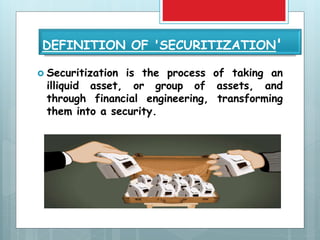
 Securitization is the process of taking an
illiquid asset, or group of assets, and
through financial engineering, transforming
them into a security.
The process through which an issuer
creates a financial instrument by
combining other financial assets and
then marketing different tiers of the
repackaged instruments to investors.
The process can encompass any type
of financial asset and promotes
liquidity in the marketplace.
Example
A typical example of securitization is
a mortgage-backed security (MBS).
Process
 First, a regulated and authorized financial
institution originates numerous mortgages, which are
secured by claims against the various properties the
mortgagors purchase. Then, all of the individual
mortgages are bundled together into a mortgage
pool, which is held in trust as the collateral for an
MBS. The MBS can be issued by a third-party
financial company, such a large investment banking
firm, or by the same bank that originated the
mortgages in the first place. Mortgage-backed
securities are also issued by aggregators such as
Fannie Mae or Freddie Mac.
 Regardless, the result is the same: a new
security is created, backed up by the
claims against the mortgagors' assets. This
security can be sold to participants in the
secondary mortgage market. This market is
extremely large, providing a significant
amount of liquidity to the group of
mortgages, which otherwise would have
been quite illiquid on their own.
 Furthermore, at the time the MBS is being
created, the issuer will often choose to break
the mortgage pool into a number of different
parts, referred to as tranches. These
tranches can be structured in virtually any
way the issuer sees fit, allowing the issuer to
tailor a single MBS for a variety of risk
tolerances. Pension funds will typically invest
in high-credit rated mortgage-backed
securities, while hedge funds will seek higher
returns by investing in those with low credit
ratings.
What can be securitization
 Auto loan
 Student loan
 Mortgages
 Credit and receivables
 Lease payment
 Account receivables
Example of securitization in India
 First securitization deal in India between
Citibank and GIC Mutual fund in 1991 for Rs
160 million.
 L&T raised Rs. 4090 million through the
securitization of future lease rentals to raise
capital for its power plant in 1990.
 Securitization of aircraft receivables by Jet
Airways for Rs. 16000 million in 2001 through
offshore SPV
 India's largest securitization deal by ICICI
bank of Rs. 19,299 million in 2007. the
underlying asset pool was auto loan receivables.
Securitization

Securitization

  • 1.
    DEFINITION OF 'SECURITIZATION' Securitization is the process of taking an illiquid asset, or group of assets, and through financial engineering, transforming them into a security.
  • 2.
    The process throughwhich an issuer creates a financial instrument by combining other financial assets and then marketing different tiers of the repackaged instruments to investors. The process can encompass any type of financial asset and promotes liquidity in the marketplace.
  • 3.
    Example A typical exampleof securitization is a mortgage-backed security (MBS).
  • 4.
  • 5.
     First, aregulated and authorized financial institution originates numerous mortgages, which are secured by claims against the various properties the mortgagors purchase. Then, all of the individual mortgages are bundled together into a mortgage pool, which is held in trust as the collateral for an MBS. The MBS can be issued by a third-party financial company, such a large investment banking firm, or by the same bank that originated the mortgages in the first place. Mortgage-backed securities are also issued by aggregators such as Fannie Mae or Freddie Mac.
  • 6.
     Regardless, theresult is the same: a new security is created, backed up by the claims against the mortgagors' assets. This security can be sold to participants in the secondary mortgage market. This market is extremely large, providing a significant amount of liquidity to the group of mortgages, which otherwise would have been quite illiquid on their own.
  • 7.
     Furthermore, atthe time the MBS is being created, the issuer will often choose to break the mortgage pool into a number of different parts, referred to as tranches. These tranches can be structured in virtually any way the issuer sees fit, allowing the issuer to tailor a single MBS for a variety of risk tolerances. Pension funds will typically invest in high-credit rated mortgage-backed securities, while hedge funds will seek higher returns by investing in those with low credit ratings.
  • 8.
    What can besecuritization  Auto loan  Student loan  Mortgages  Credit and receivables  Lease payment  Account receivables
  • 9.
    Example of securitizationin India  First securitization deal in India between Citibank and GIC Mutual fund in 1991 for Rs 160 million.  L&T raised Rs. 4090 million through the securitization of future lease rentals to raise capital for its power plant in 1990.  Securitization of aircraft receivables by Jet Airways for Rs. 16000 million in 2001 through offshore SPV  India's largest securitization deal by ICICI bank of Rs. 19,299 million in 2007. the underlying asset pool was auto loan receivables.