Money Market
&
Capital Market
Presented by.
Pratik Nepal
 It is the market for sale and purchase of stocks (shares), bonds, bills
of exchange, commodities, foreign currency etc which works as liquid
assets.
Financial market is of two types:
Financial Market
FINANCIAL
MARKETS
MONEY
MARKET
CAPITAL
MARKET
MONEY MARKET
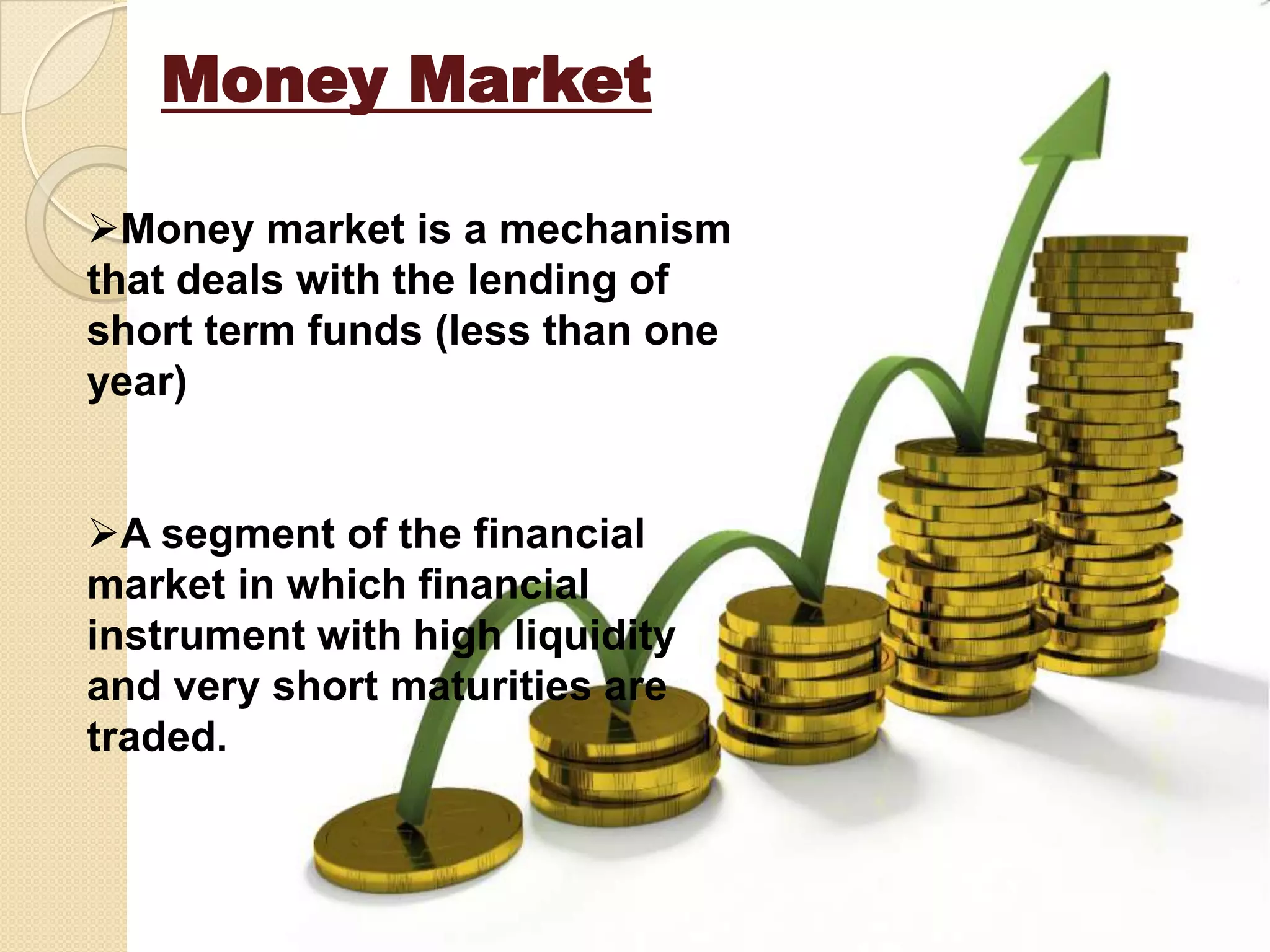
Money Market
Money market is a mechanism
that deals with the lending of
short term funds (less than one
year)
A segment of the financial
market in which financial
instrument with high liquidity
and very short maturities are
traded.
Feature of money market
 Constituents of Money Market
Heterogeneous Market
Dealers of Money Market
Short-term Loans
Different from Capital Market
Association with Big Cities
Change with Place and Time
Characteristics of A Developed Money Market
Existence of Central Bank
 Highly organized commercial Banking
System
Existence of sub-markets
Integrated structure of money market
 Availability of proper credit instruments
 Adequacy and Elasticity of funds
 International attraction
 Uniformity of interest rates
Stability of prices and
 Highly developed Industrial system
Importance of Money Market
Financing Industry
Financing trade
Self sufficiency of banks
Effective implementation of
monetary policy
Encourages economic growth
Help to government
Proper allocation of resources
Instrument of Money Market
Treasury bills
Commercial bills
Money at call
Promissory notes
Some new Instruments are:
Money
Market
Commercial
Papers
Certificate
of deposit
Repo
instrument
Repurchase
Agreement
Banker's
Acceptance
Mutual
Fund
The market where investment instruments like
bonds and equities are traded is known as the
capital market.
The primal role of this market is to make
investment from investors who have surplus funds
to the ones who are running a deficit
 The capital market offers both long term and
overnight funds.
The different types of financial instruments that
are traded in the capital markets are:
> equity instruments
> insurance instruments,
> foreign exchange instruments,
> hybrid instruments
CAPITAL MARKET
Nature of capital market
The nature of capital market is brought
out by the following facts:
It Has Two Segments
It Deals In Long-Term Securities
It Performs Trade-off Function
It Creates Dispersion In Business
Ownership
It Helps In Capital Formation
It Helps In Creating Liquidity
T
Y
P
E
S
O
F
C
A
P
I
T
A
L
M
A
R
K
E
T
Primary Market
Secondary Market
Primary Market
 It is that market in which shares, debentures and
other securities are sold for the first time for
collecting long-term capital.
 This market is concerned with new issues.
Therefore, the primary market is also called NEW
ISSUE MARKET.In this market, the flow of funds is from savers to
borrowers (industries), hence, it helps directly in the
capital formation of the country.
The money collected from this market is generally
used by the companies to modernize the plant,
machinery and buildings, for extending business,
and for setting up new business unit.
Features of Primary Market
It Is Related With New Issues
It Has No Particular Place
It Has Various Methods Of Float Capital:
Following are the methods of raising capital in
the primary market:
i) Public Issue
ii) Offer For Sale
iii) Private Placement
iv) Right Issue
v) Electronic-Initial Public Offer
It comes before Secondary Market
Secondary Market
 The secondary market is that market in which the
buying and selling of the previously issued
securities is done.
The transactions of the secondary market are
generally done through the medium of stock
exchange.
The chief purpose of the secondary market is to
create liquidity in securities.
 If an individual has bought some security and he
now wants to sell it, he can do so through the
medium of stock exchange to sell or purchase
through the medium of stock exchange requires the
Features of Secondary Market
It Creates Liquidity
It Comes After Primary Market
It Has A Particular Place
It Encourage New Investments

money market and capital market

  • 1.
  • 2.
     It isthe market for sale and purchase of stocks (shares), bonds, bills of exchange, commodities, foreign currency etc which works as liquid assets. Financial market is of two types: Financial Market FINANCIAL MARKETS MONEY MARKET CAPITAL MARKET
  • 3.
  • 4.
    Money Market Money marketis a mechanism that deals with the lending of short term funds (less than one year) A segment of the financial market in which financial instrument with high liquidity and very short maturities are traded.
  • 5.
    Feature of moneymarket  Constituents of Money Market Heterogeneous Market Dealers of Money Market Short-term Loans Different from Capital Market Association with Big Cities Change with Place and Time
  • 6.
    Characteristics of ADeveloped Money Market Existence of Central Bank  Highly organized commercial Banking System Existence of sub-markets Integrated structure of money market  Availability of proper credit instruments  Adequacy and Elasticity of funds  International attraction  Uniformity of interest rates Stability of prices and  Highly developed Industrial system
  • 7.
    Importance of MoneyMarket Financing Industry Financing trade Self sufficiency of banks Effective implementation of monetary policy Encourages economic growth Help to government Proper allocation of resources
  • 8.
    Instrument of MoneyMarket Treasury bills Commercial bills Money at call Promissory notes
  • 9.
    Some new Instrumentsare: Money Market Commercial Papers Certificate of deposit Repo instrument Repurchase Agreement Banker's Acceptance Mutual Fund
  • 11.
    The market whereinvestment instruments like bonds and equities are traded is known as the capital market. The primal role of this market is to make investment from investors who have surplus funds to the ones who are running a deficit  The capital market offers both long term and overnight funds. The different types of financial instruments that are traded in the capital markets are: > equity instruments > insurance instruments, > foreign exchange instruments, > hybrid instruments CAPITAL MARKET
  • 12.
    Nature of capitalmarket The nature of capital market is brought out by the following facts: It Has Two Segments It Deals In Long-Term Securities It Performs Trade-off Function It Creates Dispersion In Business Ownership It Helps In Capital Formation It Helps In Creating Liquidity
  • 13.
  • 14.
    Primary Market  Itis that market in which shares, debentures and other securities are sold for the first time for collecting long-term capital.  This market is concerned with new issues. Therefore, the primary market is also called NEW ISSUE MARKET.In this market, the flow of funds is from savers to borrowers (industries), hence, it helps directly in the capital formation of the country. The money collected from this market is generally used by the companies to modernize the plant, machinery and buildings, for extending business, and for setting up new business unit.
  • 15.
    Features of PrimaryMarket It Is Related With New Issues It Has No Particular Place It Has Various Methods Of Float Capital: Following are the methods of raising capital in the primary market: i) Public Issue ii) Offer For Sale iii) Private Placement iv) Right Issue v) Electronic-Initial Public Offer It comes before Secondary Market
  • 16.
    Secondary Market  Thesecondary market is that market in which the buying and selling of the previously issued securities is done. The transactions of the secondary market are generally done through the medium of stock exchange. The chief purpose of the secondary market is to create liquidity in securities.  If an individual has bought some security and he now wants to sell it, he can do so through the medium of stock exchange to sell or purchase through the medium of stock exchange requires the
  • 17.
    Features of SecondaryMarket It Creates Liquidity It Comes After Primary Market It Has A Particular Place It Encourage New Investments