
Capturing India’s
Percolating
Coffee Market
COFFEE-STORY
Previously only a South-Indian drink
Confined to the Rich Brahmin class
Places for lawyers and educated class to hold
discussion.
The drink has now become more of a concept
COFFEE-STORY
Café bars have flocked like CCD, Barista, Mocha,
Qwiky’s etc
Became famous and even 5 star hotels started
cashing on it.
Coffee house started emerging at various places in
the country.
COFFEE SECTOR IN INDIA
The 6th largest producer of the coffee in the world.
Indian coffee has created a niche for itself in the
international market.
Arabica coffee from India is also well received in
international market.
Coffee production in India: Karnataka, Kerala and
Tamilnadu.
which contributes about 99% of total coffee production
CASE OVERVIEW
Untapped market
Targeting and positioning of market
Increasing the coffee consumption
Creating a new entry point
Expanding network
Road block of ahead
COFFEE CONSUMPTION
12
10
9 8.7 8.4 8.2 7.9
6.8
6
4.5 4.6 4.4
0.085
0
2
4
6
8
10
12
14
KilogramsTitle
Country
COFFEE CONSUMPTION
Per capita consumption of coffee is just 85 grams
in compare to other countries.
In the annual output of 300,000 tons, domestic
consumption is only a third(100,000 tons)
India is predominantly a tea drinking nation.
Coffee is a staple only in the southern part of the
country
GLOBAL COFFEE GIANTS EYES ON INDIA
Market expansion on a faster rate
Urbanization is expanding
Coffee drinking – Fashion
Growth in the disposable income
MARKETING SITUATION
Niche coffee retail formal is growing at 10 to 12
percent a year
Organized coffee retail business-Rs 25 bn
Coffee consumption in India has increased from
55,000 tones to 75,000 tones in the last three years
3 % of the world coffee production
Export 80 % of the total produce.
“ I may be young, But please
take me Seriously”
Youth – between 15-35 years
Students form a majority of customer base
Likes to be in group
Likes to sit, talk and relax
Drinks a cup of Gourmet coffee with added flavours
prefers snacks rather than meals
TOP COFFEE BRANDS IN INDIA
• Nescafe
• Tata Coffee
• BRU
MAJOR COFFEE PLAYERS IN INDIA
MARKET SHARE IN INDIA
34%
40%
20%
4% 2%
Barista
CCD
Mocha
Qwicky
Georgia
(Source: from case study)
RICH QUALITYQ POOR QUALITY
LOW PRICE
HIGH PRICE
COMPETITIVE STRATEGY
STRATEGY BEHIND EXPANDING THE
NETWORK
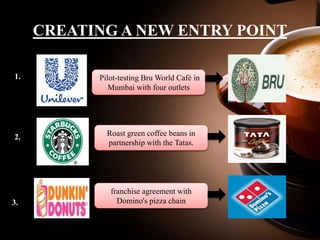
CREATING A NEW ENTRY POINT
1. Pilot-testing Bru World Café in
Mumbai with four outlets
2. Roast green coffee beans in
partnership with the Tatas.
3.
franchise agreement with
Domino's pizza chain
CREATING A NEW ENTRY
POINT
deals with leading oil companies like
HP,BP Indian oil for setting up
cafes in gas stations across India.
4.
5. Java Green from the Reliance Group
began life as a cyber café in 2003
CHARTS OF OUTLETS
• RETAILERS
• PRESENT
• FUTURE
• Dunkin Store
• 1 ( by 1
st
Quarter 2012)
• 30
• Gloria Jeans
• 16
• 200
• Costa Coffee
• 73
• 300
• The Chocolate Room
• 2
• 40
• CCD
• 1132
• 4000
RETAILERS PRESENT FUTURE
Dunkin Store 1(by 1 quarter 2012) 30
Gloria Jeans 16 200
Costa coffee 73 300
The chocolate Room 2 40
Café coffee Day(CCD) 1132 400
HURDELS
1. Huge real estate cost
2.High rent cost
3.Low menu price
4.Manpower
5.High turnover
TIPS TO IMPROVE THE COFFEE SHOP
REVENUE
Eliminate low-margin item
Prepaid gift card program
Discount coupons and discounts
Control waste and theft
Evaluate hours of operation
Eliminate bottlenecks in the ordering process
Run employee sales contests
Raise prices to bolster your company’s brand image
CONCLUSION
Coffee market focus on promotion rather than
expansion of outlets.
Tapped the market with new outlets and offering new
services.
Capture the upper segment of the middle class
Strives to deliver the best international standard of
cafe experience
With more players entering the arena, the challenges
around managing costs
WEBLIOGRAPHY
• www.indiacoffee.org
• www.casestudyinc.com
• www.coffee.wikia.com
• www.slideshare.net
• www.youtube.com
THANK
YOU
Sahim Khan
Khan.sahim@gmail.com

Coffee Market In India

  • 1.
  • 2.
    COFFEE-STORY Previously only aSouth-Indian drink Confined to the Rich Brahmin class Places for lawyers and educated class to hold discussion. The drink has now become more of a concept
  • 3.
    COFFEE-STORY Café bars haveflocked like CCD, Barista, Mocha, Qwiky’s etc Became famous and even 5 star hotels started cashing on it. Coffee house started emerging at various places in the country.
  • 4.
    COFFEE SECTOR ININDIA The 6th largest producer of the coffee in the world. Indian coffee has created a niche for itself in the international market. Arabica coffee from India is also well received in international market. Coffee production in India: Karnataka, Kerala and Tamilnadu. which contributes about 99% of total coffee production
  • 5.
    CASE OVERVIEW Untapped market Targetingand positioning of market Increasing the coffee consumption Creating a new entry point Expanding network Road block of ahead
  • 6.
    COFFEE CONSUMPTION 12 10 9 8.78.4 8.2 7.9 6.8 6 4.5 4.6 4.4 0.085 0 2 4 6 8 10 12 14 KilogramsTitle Country
  • 7.
    COFFEE CONSUMPTION Per capitaconsumption of coffee is just 85 grams in compare to other countries. In the annual output of 300,000 tons, domestic consumption is only a third(100,000 tons) India is predominantly a tea drinking nation. Coffee is a staple only in the southern part of the country
  • 8.
    GLOBAL COFFEE GIANTSEYES ON INDIA Market expansion on a faster rate Urbanization is expanding Coffee drinking – Fashion Growth in the disposable income
  • 9.
    MARKETING SITUATION Niche coffeeretail formal is growing at 10 to 12 percent a year Organized coffee retail business-Rs 25 bn Coffee consumption in India has increased from 55,000 tones to 75,000 tones in the last three years 3 % of the world coffee production Export 80 % of the total produce.
  • 10.
    “ I maybe young, But please take me Seriously” Youth – between 15-35 years Students form a majority of customer base Likes to be in group Likes to sit, talk and relax Drinks a cup of Gourmet coffee with added flavours prefers snacks rather than meals
  • 11.
    TOP COFFEE BRANDSIN INDIA • Nescafe • Tata Coffee • BRU
  • 12.
  • 13.
    MARKET SHARE ININDIA 34% 40% 20% 4% 2% Barista CCD Mocha Qwicky Georgia (Source: from case study)
  • 14.
    RICH QUALITYQ POORQUALITY LOW PRICE HIGH PRICE COMPETITIVE STRATEGY
  • 15.
  • 16.
    CREATING A NEWENTRY POINT 1. Pilot-testing Bru World Café in Mumbai with four outlets 2. Roast green coffee beans in partnership with the Tatas. 3. franchise agreement with Domino's pizza chain
  • 17.
    CREATING A NEWENTRY POINT deals with leading oil companies like HP,BP Indian oil for setting up cafes in gas stations across India. 4. 5. Java Green from the Reliance Group began life as a cyber café in 2003
  • 18.
    CHARTS OF OUTLETS •RETAILERS • PRESENT • FUTURE • Dunkin Store • 1 ( by 1 st Quarter 2012) • 30 • Gloria Jeans • 16 • 200 • Costa Coffee • 73 • 300 • The Chocolate Room • 2 • 40 • CCD • 1132 • 4000 RETAILERS PRESENT FUTURE Dunkin Store 1(by 1 quarter 2012) 30 Gloria Jeans 16 200 Costa coffee 73 300 The chocolate Room 2 40 Café coffee Day(CCD) 1132 400
  • 19.
    HURDELS 1. Huge realestate cost 2.High rent cost 3.Low menu price 4.Manpower 5.High turnover
  • 20.
    TIPS TO IMPROVETHE COFFEE SHOP REVENUE Eliminate low-margin item Prepaid gift card program Discount coupons and discounts Control waste and theft Evaluate hours of operation Eliminate bottlenecks in the ordering process Run employee sales contests Raise prices to bolster your company’s brand image
  • 21.
    CONCLUSION Coffee market focuson promotion rather than expansion of outlets. Tapped the market with new outlets and offering new services. Capture the upper segment of the middle class Strives to deliver the best international standard of cafe experience With more players entering the arena, the challenges around managing costs
  • 22.
    WEBLIOGRAPHY • www.indiacoffee.org • www.casestudyinc.com •www.coffee.wikia.com • www.slideshare.net • www.youtube.com
  • 23.