Molecular Biology
What Is DNA and How Does It
Work?
DNA Structure Must Be Compatible
with Its Four Roles
• DNA makes copies of itself.
– Occurs during S phase of the cell cycle before
mitosis or meiosis.
• DNA encloses information.
– Information that gives rise to discernible traits
in organisms.
DNA Structure Must Be Compatible
with Its Four Roles
• DNA controls cells and tells them what to
do.
– Determines function of the cell.
• DNA changes by mutation.
– Structure must be able to change.
Building Blocks of DNA
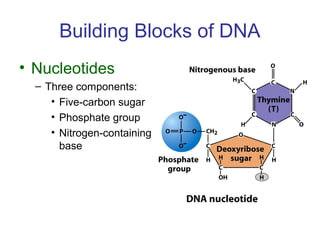
• Nucleotides
– Three components:
• Five-carbon sugar
• Phosphate group
• Nitrogen-containing
base
Building Blocks of DNA
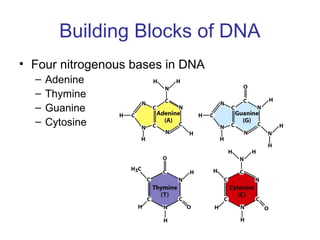
• Four nitrogenous bases in DNA
– Adenine
– Thymine
– Guanine
– Cytosine
Structure of DNA
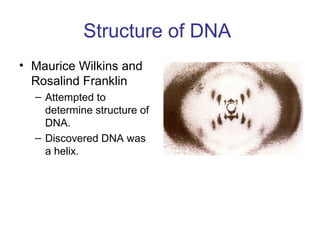
• Maurice Wilkins and
Rosalind Franklin
– Attempted to
determine structure of
DNA.
– Discovered DNA was
a helix.
Chargaff’s Ratios
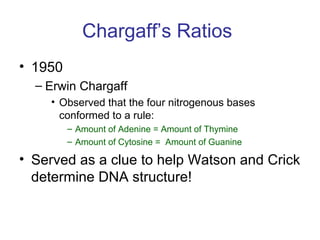
• 1950
– Erwin Chargaff
• Observed that the four nitrogenous bases
conformed to a rule:
– Amount of Adenine = Amount of Thymine
– Amount of Cytosine = Amount of Guanine
• Served as a clue to help Watson and Crick
determine DNA structure!
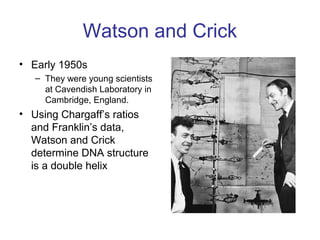
Watson and Crick
• Early 1950s
– They were young scientists
at Cavendish Laboratory in
Cambridge, England.
• Using Chargaff’s ratios
and Franklin’s data,
Watson and Crick
determine DNA structure
is a double helix
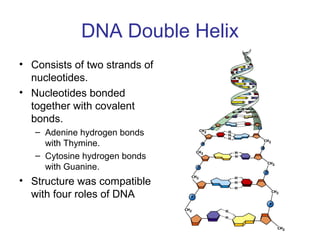
DNA Double Helix
• Consists of two strands of
nucleotides.
• Nucleotides bonded
together with covalent
bonds.
– Adenine hydrogen bonds
with Thymine.
– Cytosine hydrogen bonds
with Guanine.
• Structure was compatible
with four roles of DNA
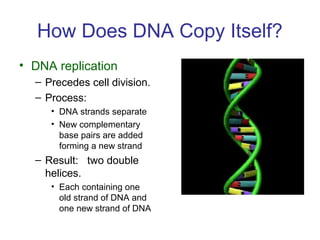
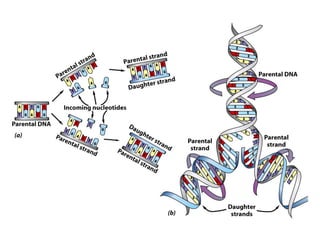
How Does DNA Copy Itself?
• DNA replication
– Precedes cell division.
– Process:
• DNA strands separate
• New complementary
base pairs are added
forming a new strand
– Result: two double
helices.
• Each containing one
old strand of DNA and
one new strand of DNA
Meselson and Stahl
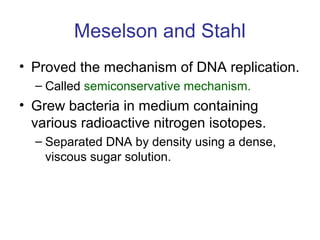
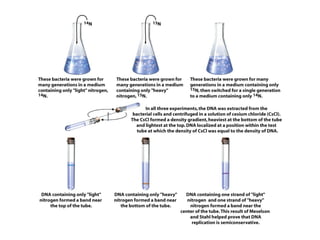
• Proved the mechanism of DNA replication.
– Called semiconservative mechanism.
• Grew bacteria in medium containing
various radioactive nitrogen isotopes.
– Separated DNA by density using a dense,
viscous sugar solution.
How is the information in DNA
expressed?
• Genome
– Information to make proteins stored in all of
the DNA of a single set of chromosomes.
• Gene: blueprint for the synthesis of a protein.
• Proteins
– Polymers made of amino acids connected
end-to-end
• Similar to beads on a string.
How is the information in DNA
expressed?
• Chromosomes containing DNA contained
in nucleus.
• DNA codes for the construction of proteins
using an intermediary molecule:
– Ribonucleic acid or RNA.
• Decoding information in DNA requires two
processes:
– Transcription.
– Translation.
DNA vs. RNA
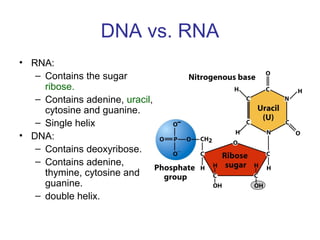
• RNA:
– Contains the sugar
ribose.
– Contains adenine, uracil,
cytosine and guanine.
– Single helix
• DNA:
– Contains deoxyribose.
– Contains adenine,
thymine, cytosine and
guanine.
– double helix.
DNA vs. RNA
• RNA:
– Smaller, mobile.
– Degrades easily.
– Travels form nucleus to cytoplasm.
• DNA:
– Larger, immobile.
– Lasts the life of cell.
– Resides in nucleus.
Types of RNA
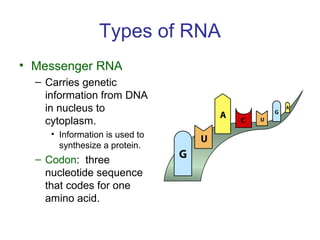
• Messenger RNA
– Carries genetic
information from DNA
in nucleus to
cytoplasm.
• Information is used to
synthesize a protein.
– Codon: three
nucleotide sequence
that codes for one
amino acid.
Types of RNA
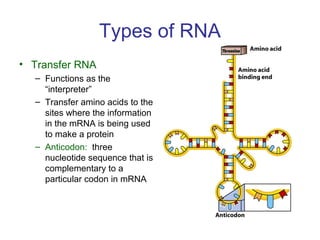
• Transfer RNA
– Functions as the
“interpreter”
– Transfer amino acids to the
sites where the information
in the mRNA is being used
to make a protein
– Anticodon: three
nucleotide sequence that is
complementary to a
particular codon in mRNA
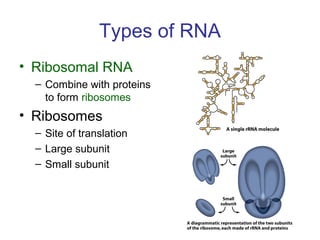
Types of RNA
• Ribosomal RNA
– Combine with proteins
to form ribosomes
• Ribosomes
– Site of translation
– Large subunit
– Small subunit
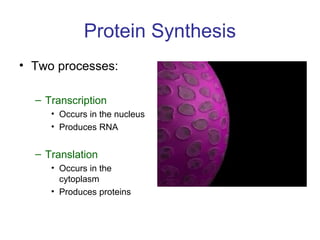
Protein Synthesis
• Two processes:
– Transcription
• Occurs in the nucleus
• Produces RNA
– Translation
• Occurs in the
cytoplasm
• Produces proteins
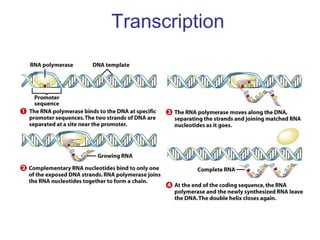
Transcription
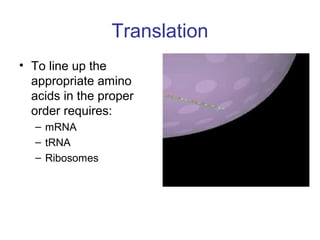
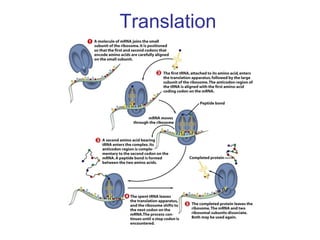
Translation
• To line up the
appropriate amino
acids in the proper
order requires:
– mRNA
– tRNA
– Ribosomes
Translation
Translation
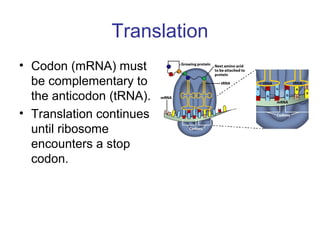
• Codon (mRNA) must
be complementary to
the anticodon (tRNA).
• Translation continues
until ribosome
encounters a stop
codon.
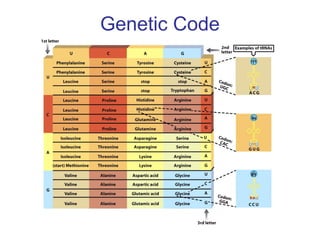
Genetic Code
• Three nucleotides in mRNA (codon) code
for one amino acid.
• Some sequences serve as starting points.
• AUG codes for the amino acid methionine which
also indicates to start translation.
• Some sequences do not have
complementary tRNA.
– Indicate to the ribosome to stop translation.
Genetic Code
What Makes Cells Different From
Each Other?
• Due to the information in the DNA, a cell
could manufacture 50,000 different
proteins, but it doesn’t.
• The proteins a cell produces influences its
function.
– Example: red blood cells and hemoglobin
Gene Expression
• Some genes are always transcribed and
translated.
– Others can be turned on or off by
environmental signals
• Gene expression is highly regulated.
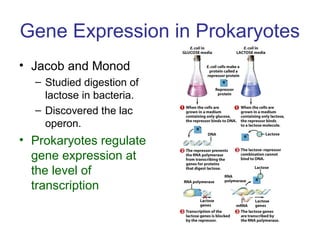
Gene Expression in Prokaryotes
• Jacob and Monod
– Studied digestion of
lactose in bacteria.
– Discovered the lac
operon.
• Prokaryotes regulate
gene expression at
the level of
transcription
Gene Expression in Eukaryotes
• Regulated at the level of transcription.
– Transcription requires transcription factors.
• They recognize and bind to DNA sequences called
regulatory sequences
• Transcription factors can increase or decrease the
rate of transcription
• Longevity of RNA molecule also
influences gene expression.
How Does DNA Change Over
Time?
• Mutations: a permanent change in the
genetic material of a cell or organism.
– Can be inherited.
– Can involve whole chromosomes or changes
in DNA sequences.
Whole Chromosome Mutations
• Polyploid: organism or cell containing
three or more sets of chromosomes.
– Occurs due to a cell division error.
– Frequently seen in plants, rare in animals.
– Can have advantageous results.
Whole Chromosome Mutations
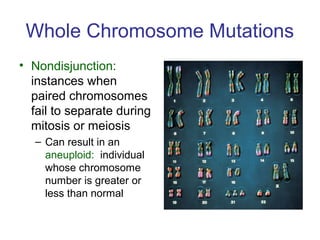
• Nondisjunction:
instances when
paired chromosomes
fail to separate during
mitosis or meiosis
– Can result in an
aneuploid: individual
whose chromosome
number is greater or
less than normal
Whole Chromosome Mutations
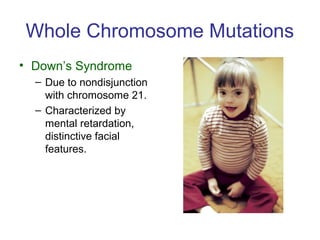
• Down’s Syndrome
– Due to nondisjunction
with chromosome 21.
– Characterized by
mental retardation,
distinctive facial
features.
Whole Chromosome Mutations
• Transposons:
– Variety of DNA sequences that can randomly
insert themselves by transposition in various
non-homologous regions on chromosomes
and other DNA.
– Can generate new gene combinations
– Can also induce genetic errors
Mutations Involving Single DNA
Nucleotides
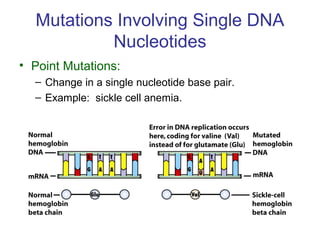
• Point Mutations:
– Change in a single nucleotide base pair.
– Example: sickle cell anemia.
Mutations Involving Single DNA
Nucleotides
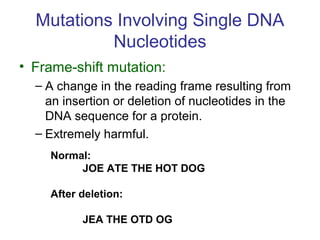
• Frame-shift mutation:
– A change in the reading frame resulting from
an insertion or deletion of nucleotides in the
DNA sequence for a protein.
– Extremely harmful.
Normal:
JOE ATE THE HOT DOG
After deletion:
JEA THE OTD OG

Pruitt ppt ch06

  • 1.
    Molecular Biology What IsDNA and How Does It Work?
  • 2.
    DNA Structure MustBe Compatible with Its Four Roles • DNA makes copies of itself. – Occurs during S phase of the cell cycle before mitosis or meiosis. • DNA encloses information. – Information that gives rise to discernible traits in organisms.
  • 3.
    DNA Structure MustBe Compatible with Its Four Roles • DNA controls cells and tells them what to do. – Determines function of the cell. • DNA changes by mutation. – Structure must be able to change.
  • 4.
    Building Blocks ofDNA • Nucleotides – Three components: • Five-carbon sugar • Phosphate group • Nitrogen-containing base
  • 5.
    Building Blocks ofDNA • Four nitrogenous bases in DNA – Adenine – Thymine – Guanine – Cytosine
  • 6.
    Structure of DNA •Maurice Wilkins and Rosalind Franklin – Attempted to determine structure of DNA. – Discovered DNA was a helix.
  • 7.
    Chargaff’s Ratios • 1950 –Erwin Chargaff • Observed that the four nitrogenous bases conformed to a rule: – Amount of Adenine = Amount of Thymine – Amount of Cytosine = Amount of Guanine • Served as a clue to help Watson and Crick determine DNA structure!
  • 8.
    Watson and Crick •Early 1950s – They were young scientists at Cavendish Laboratory in Cambridge, England. • Using Chargaff’s ratios and Franklin’s data, Watson and Crick determine DNA structure is a double helix
  • 9.
    DNA Double Helix •Consists of two strands of nucleotides. • Nucleotides bonded together with covalent bonds. – Adenine hydrogen bonds with Thymine. – Cytosine hydrogen bonds with Guanine. • Structure was compatible with four roles of DNA
  • 10.
    How Does DNACopy Itself? • DNA replication – Precedes cell division. – Process: • DNA strands separate • New complementary base pairs are added forming a new strand – Result: two double helices. • Each containing one old strand of DNA and one new strand of DNA
  • 12.
    Meselson and Stahl •Proved the mechanism of DNA replication. – Called semiconservative mechanism. • Grew bacteria in medium containing various radioactive nitrogen isotopes. – Separated DNA by density using a dense, viscous sugar solution.
  • 14.
    How is theinformation in DNA expressed? • Genome – Information to make proteins stored in all of the DNA of a single set of chromosomes. • Gene: blueprint for the synthesis of a protein. • Proteins – Polymers made of amino acids connected end-to-end • Similar to beads on a string.
  • 15.
    How is theinformation in DNA expressed? • Chromosomes containing DNA contained in nucleus. • DNA codes for the construction of proteins using an intermediary molecule: – Ribonucleic acid or RNA. • Decoding information in DNA requires two processes: – Transcription. – Translation.
  • 16.
    DNA vs. RNA •RNA: – Contains the sugar ribose. – Contains adenine, uracil, cytosine and guanine. – Single helix • DNA: – Contains deoxyribose. – Contains adenine, thymine, cytosine and guanine. – double helix.
  • 17.
    DNA vs. RNA •RNA: – Smaller, mobile. – Degrades easily. – Travels form nucleus to cytoplasm. • DNA: – Larger, immobile. – Lasts the life of cell. – Resides in nucleus.
  • 18.
    Types of RNA •Messenger RNA – Carries genetic information from DNA in nucleus to cytoplasm. • Information is used to synthesize a protein. – Codon: three nucleotide sequence that codes for one amino acid.
  • 19.
    Types of RNA •Transfer RNA – Functions as the “interpreter” – Transfer amino acids to the sites where the information in the mRNA is being used to make a protein – Anticodon: three nucleotide sequence that is complementary to a particular codon in mRNA
  • 20.
    Types of RNA •Ribosomal RNA – Combine with proteins to form ribosomes • Ribosomes – Site of translation – Large subunit – Small subunit
  • 21.
    Protein Synthesis • Twoprocesses: – Transcription • Occurs in the nucleus • Produces RNA – Translation • Occurs in the cytoplasm • Produces proteins
  • 22.
  • 23.
    Translation • To lineup the appropriate amino acids in the proper order requires: – mRNA – tRNA – Ribosomes
  • 24.
  • 25.
    Translation • Codon (mRNA)must be complementary to the anticodon (tRNA). • Translation continues until ribosome encounters a stop codon.
  • 26.
    Genetic Code • Threenucleotides in mRNA (codon) code for one amino acid. • Some sequences serve as starting points. • AUG codes for the amino acid methionine which also indicates to start translation. • Some sequences do not have complementary tRNA. – Indicate to the ribosome to stop translation.
  • 27.
  • 28.
    What Makes CellsDifferent From Each Other? • Due to the information in the DNA, a cell could manufacture 50,000 different proteins, but it doesn’t. • The proteins a cell produces influences its function. – Example: red blood cells and hemoglobin
  • 29.
    Gene Expression • Somegenes are always transcribed and translated. – Others can be turned on or off by environmental signals • Gene expression is highly regulated.
  • 30.
    Gene Expression inProkaryotes • Jacob and Monod – Studied digestion of lactose in bacteria. – Discovered the lac operon. • Prokaryotes regulate gene expression at the level of transcription
  • 31.
    Gene Expression inEukaryotes • Regulated at the level of transcription. – Transcription requires transcription factors. • They recognize and bind to DNA sequences called regulatory sequences • Transcription factors can increase or decrease the rate of transcription • Longevity of RNA molecule also influences gene expression.
  • 32.
    How Does DNAChange Over Time? • Mutations: a permanent change in the genetic material of a cell or organism. – Can be inherited. – Can involve whole chromosomes or changes in DNA sequences.
  • 33.
    Whole Chromosome Mutations •Polyploid: organism or cell containing three or more sets of chromosomes. – Occurs due to a cell division error. – Frequently seen in plants, rare in animals. – Can have advantageous results.
  • 34.
    Whole Chromosome Mutations •Nondisjunction: instances when paired chromosomes fail to separate during mitosis or meiosis – Can result in an aneuploid: individual whose chromosome number is greater or less than normal
  • 35.
    Whole Chromosome Mutations •Down’s Syndrome – Due to nondisjunction with chromosome 21. – Characterized by mental retardation, distinctive facial features.
  • 36.
    Whole Chromosome Mutations •Transposons: – Variety of DNA sequences that can randomly insert themselves by transposition in various non-homologous regions on chromosomes and other DNA. – Can generate new gene combinations – Can also induce genetic errors
  • 37.
    Mutations Involving SingleDNA Nucleotides • Point Mutations: – Change in a single nucleotide base pair. – Example: sickle cell anemia.
  • 38.
    Mutations Involving SingleDNA Nucleotides • Frame-shift mutation: – A change in the reading frame resulting from an insertion or deletion of nucleotides in the DNA sequence for a protein. – Extremely harmful. Normal: JOE ATE THE HOT DOG After deletion: JEA THE OTD OG