

Presented by:
Abhinav Thakur
Adil Garg
Ajil Jalhotra
Ankur Aggarwal
Ayush Jain
Introduction
• Established by Government of India in 1988.
• Statutory powers given in January 30, 1992 with SEBI Act 1992.
• Headquarters in Bandra Kurla complex in Mumbai.
• Regulator for capital markets in india.
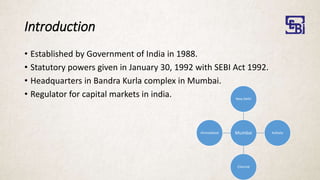
Mumbai
New Delhi
Kolkata
Chennai
Ahmedabad
SEBI - Preamble
The Preamble of the Securities and Exchange Board of India describes
the basic functions of the Securities and Exchange Board of India as
"...to protect the interests of investors in securities and to promote
the development of, and to regulate the securities market and for
matters connected therewith or incidental thereto"
Powers of SEBI
• Powers Relating to stock exchanges and intermediaries
• Powers Relating to Monetary penalties
• Powers under Securities Contract act
• Powers to regulate business of stock exchanges.
• Powers relating Insider Trading.
Functions of SEBI
• Protective Functions
• Developmental Functions
• Regulatory Functions etc.
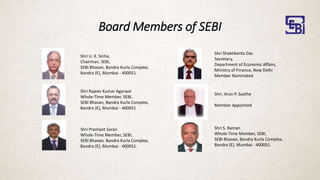
Board Members of SEBI
Shri U. K. Sinha,
Chairman, SEBI,
SEBI Bhavan, Bandra Kurla Complex,
Bandra (E), Mumbai - 400051
Shri Rajeev Kumar Agarwal
Whole-Time Member, SEBI,
SEBI Bhavan, Bandra Kurla Complex,
Bandra (E), Mumbai - 400051
Shri Prashant Saran
Whole-Time Member, SEBI,
SEBI Bhavan, Bandra Kurla Complex,
Bandra (E), Mumbai - 400051.
Shri Shaktikanta Das
Secretary,
Department of Economic Affairs,
Ministry of Finance, New Delhi
Member Nominated
Shri. Arun P. Saathe
Member Appointed
Shri S. Raman
Whole-Time Member, SEBI,
SEBI Bhavan, Bandra Kurla Complex,
Bandra (E), Mumbai - 400051.
Insider Trading Case
HLL – BBLIL Merger Case
Case Overview
• Planned merger of HLL with sister concern BBLIL
• Merger was to be carried by HLL Acquiring shares of BBLIL
• HLL acquires 8 lakh shares of BBLIL, on March 25, 1996, before the
HLL-BBLIL merger was announced on April 19, 1996
SEBI action
SEBI penalized HLL by Rs. 34 crores & initiated criminal proceedings against
directors of HLL & BBLIL
Who is an insider?
An insider means any person who is, or was,
• Connected with the company, and
• who is reasonably expected to have access, by virtue of such
connection, to unpublished price-sensitive information
Was HLL connected?
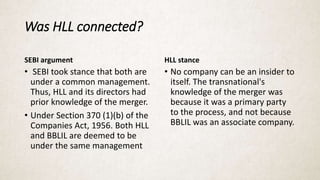
SEBI argument
• SEBI took stance that both are
under a common management.
Thus, HLL and its directors had
prior knowledge of the merger.
• Under Section 370 (1)(b) of the
Companies Act, 1956. Both HLL
and BBLIL are deemed to be
under the same management
HLL stance
• No company can be an insider to
itself. The transnational's
knowledge of the merger was
because it was a primary party
to the process, and not because
BBLIL was an associate company.
Was HLL connected?
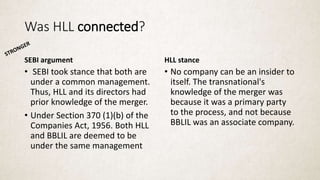
SEBI argument
• SEBI took stance that both are
under a common management.
Thus, HLL and its directors had
prior knowledge of the merger.
• Under Section 370 (1)(b) of the
Companies Act, 1956. Both HLL
and BBLIL are deemed to be
under the same management
HLL stance
• No company can be an insider to
itself. The transnational's
knowledge of the merger was
because it was a primary party
to the process, and not because
BBLIL was an associate company.
Was the pre merger information HLL had
‘Unpublished’?
SEBI’s Argument
• Information about merger was
speculative & only HLL could
sufficiently understand the
technicality involve or can use
the information
HLL’S Argument
• Merger was generally known
information :
HLL defended that before
transaction took place, price of BBLIL
moved from Rs.242 to Rs. 320
• It was not possible that UTI to
remain ignorant about widespread
speculation in the market
Was the pre merger information HLL had
‘Unpublished’?
SEBI’s Argument
• Information about merger was
speculative & only HLL could
sufficiently understand the
technicality involve or can use
the information
HLL’S Argument
• Merger was generally known
information :
HLL defended that before
transaction took place, price of BBLIL
moved from Rs.242 to Rs. 320
• It was not possible that UTI to
remain ignorant about widespread
speculation in the market
Did HLL had any price sensitive information?
SEBI argument
As per SEBI merger is a price
sensitive information
&
HLL had information of merger
HLL argument
HLL argued that merger itself was
not a price sensitive information
untill
the swap ratio is known
HLL did not know the swap ratio
Price sensitive information don’t have any
material effect?
HLL and BBLIL
• are sister concerns
• having common board of directors
• Under same holding company
Would not create any ripples across the market. It would not create
excessive trading on part of investors
However market would certainly react if SWAP ratio is favourable to
one company
Did HLL had gained any unfair advantage out
of transaction?
SEBI’ argument
• Making profit or not is a legal
requirement under regulation to
establish insider trading
HLL’s argument
• As per HLL all the shares
purchased were cancelled plus
they have paid 10% premium to
UTI for sharers
&
• Their ULTIMATE GOAL was to
consolidate shareholdings of
uniliver i.e. 51% in both
companies
SEBI action
SEBI penalized HLL by Rs. 34 crores & initiated criminal proceedings against
directors of HLL & BBLIL
HLL appealed to SAT
• SEBI’s findings on insider trading were set aside by the Securities’
Appellate Tribunal (SAT), which held that there was no trade involved,
based on inside information, not being price sensitive, as it was
available in the public domain.
• The definition of ‘Insider’ was subsequently amended and the
Regulations re-vamped to include any person who “has received or
has had access to such unpublished price sensitive information”, and
not just a person who is or was connected with the company. A
criterion of “deemed connected person” was introduced to include
relatives of the connected person(s).
• Inability of SEBI in proving its cases.
• Wide definition of Insider Trader as defined in the 1992 Act.
• Proving Insider Trading – a bizarrely difficult task.
• Lack of assistance from Central Economic Intelligence Bureau (CEIB) to investigate the
cases.
• Absence of an adequate remedy available to the investors at large
SEBI has come with more specific revised regulations in 2015 regarding Insider Trading
SEBI – NSE Circuit Breaker Case
Overview
• On October 2012, the benchmark NSE Nifty had crashed 920 points.
Nifty was crashed by 16% in 15 minutes
• NSE was found failing to meet Sebi requirements, as the trading didn't
halt at the 10 per cent circuit limit, the order
SEBI findings
• Found NSE Liable
• NSE failed to follow regulator rules
• Ordered an independent comprehensive review of its processes and
systems to ensure overall market stability
• Told Exchanges have systems which are robust enough to withstand
individual failures
Request of Emkay Global for annulment of trades
• SAT rejected the request as trades are executed due to negligence or
breach of duty they cannot be considered material mistake and therefore
not qualify for annulment
Outcome of case
• SEBI prescribes rules for annulment of trades
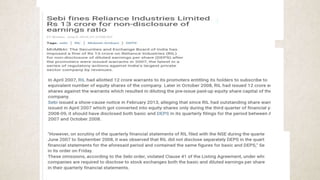
SEBI NDTV CASE
Overview
• Non disclosure of material information to the stock exchanges.
• This happened in February 2014
• Failed to comply with clause 36 of the listing agreement
• Case filed in May 2014
Sarada Pleasure Case
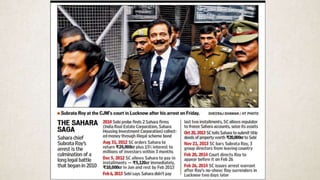
• The company had raised about Rs 22.21 crore by way of
issuance of Redeemable Preference Shares (RPS) to more than
8,000 investors between 2008-09 and 2012-13, without
complying with the public issue norms.
• Sebi has ordered Sarada Pleasure & Adventure Ltd and its
directors to refund the money collected through issuance of
preference shares to the investors.
• Sebi also directed the company to pay 15 per cent interest
annually along with the refund amount.
Thank you

Sebi Act. 1992 Presentation

  • 1.
    Presented by: Abhinav Thakur AdilGarg Ajil Jalhotra Ankur Aggarwal Ayush Jain
  • 2.
    Introduction • Established byGovernment of India in 1988. • Statutory powers given in January 30, 1992 with SEBI Act 1992. • Headquarters in Bandra Kurla complex in Mumbai. • Regulator for capital markets in india. Mumbai New Delhi Kolkata Chennai Ahmedabad
  • 3.
    SEBI - Preamble ThePreamble of the Securities and Exchange Board of India describes the basic functions of the Securities and Exchange Board of India as "...to protect the interests of investors in securities and to promote the development of, and to regulate the securities market and for matters connected therewith or incidental thereto"
  • 4.
    Powers of SEBI •Powers Relating to stock exchanges and intermediaries • Powers Relating to Monetary penalties • Powers under Securities Contract act • Powers to regulate business of stock exchanges. • Powers relating Insider Trading.
  • 5.
    Functions of SEBI •Protective Functions • Developmental Functions • Regulatory Functions etc.
  • 6.
    Board Members ofSEBI Shri U. K. Sinha, Chairman, SEBI, SEBI Bhavan, Bandra Kurla Complex, Bandra (E), Mumbai - 400051 Shri Rajeev Kumar Agarwal Whole-Time Member, SEBI, SEBI Bhavan, Bandra Kurla Complex, Bandra (E), Mumbai - 400051 Shri Prashant Saran Whole-Time Member, SEBI, SEBI Bhavan, Bandra Kurla Complex, Bandra (E), Mumbai - 400051. Shri Shaktikanta Das Secretary, Department of Economic Affairs, Ministry of Finance, New Delhi Member Nominated Shri. Arun P. Saathe Member Appointed Shri S. Raman Whole-Time Member, SEBI, SEBI Bhavan, Bandra Kurla Complex, Bandra (E), Mumbai - 400051.
  • 7.
  • 8.
    HLL – BBLILMerger Case
  • 9.
    Case Overview • Plannedmerger of HLL with sister concern BBLIL • Merger was to be carried by HLL Acquiring shares of BBLIL • HLL acquires 8 lakh shares of BBLIL, on March 25, 1996, before the HLL-BBLIL merger was announced on April 19, 1996
  • 10.
    SEBI action SEBI penalizedHLL by Rs. 34 crores & initiated criminal proceedings against directors of HLL & BBLIL
  • 11.
    Who is aninsider? An insider means any person who is, or was, • Connected with the company, and • who is reasonably expected to have access, by virtue of such connection, to unpublished price-sensitive information
  • 12.
    Was HLL connected? SEBIargument • SEBI took stance that both are under a common management. Thus, HLL and its directors had prior knowledge of the merger. • Under Section 370 (1)(b) of the Companies Act, 1956. Both HLL and BBLIL are deemed to be under the same management HLL stance • No company can be an insider to itself. The transnational's knowledge of the merger was because it was a primary party to the process, and not because BBLIL was an associate company.
  • 13.
    Was HLL connected? SEBIargument • SEBI took stance that both are under a common management. Thus, HLL and its directors had prior knowledge of the merger. • Under Section 370 (1)(b) of the Companies Act, 1956. Both HLL and BBLIL are deemed to be under the same management HLL stance • No company can be an insider to itself. The transnational's knowledge of the merger was because it was a primary party to the process, and not because BBLIL was an associate company.
  • 14.
    Was the premerger information HLL had ‘Unpublished’? SEBI’s Argument • Information about merger was speculative & only HLL could sufficiently understand the technicality involve or can use the information HLL’S Argument • Merger was generally known information : HLL defended that before transaction took place, price of BBLIL moved from Rs.242 to Rs. 320 • It was not possible that UTI to remain ignorant about widespread speculation in the market
  • 15.
    Was the premerger information HLL had ‘Unpublished’? SEBI’s Argument • Information about merger was speculative & only HLL could sufficiently understand the technicality involve or can use the information HLL’S Argument • Merger was generally known information : HLL defended that before transaction took place, price of BBLIL moved from Rs.242 to Rs. 320 • It was not possible that UTI to remain ignorant about widespread speculation in the market
  • 16.
    Did HLL hadany price sensitive information? SEBI argument As per SEBI merger is a price sensitive information & HLL had information of merger HLL argument HLL argued that merger itself was not a price sensitive information untill the swap ratio is known HLL did not know the swap ratio
  • 17.
    Price sensitive informationdon’t have any material effect? HLL and BBLIL • are sister concerns • having common board of directors • Under same holding company Would not create any ripples across the market. It would not create excessive trading on part of investors However market would certainly react if SWAP ratio is favourable to one company
  • 18.
    Did HLL hadgained any unfair advantage out of transaction? SEBI’ argument • Making profit or not is a legal requirement under regulation to establish insider trading HLL’s argument • As per HLL all the shares purchased were cancelled plus they have paid 10% premium to UTI for sharers & • Their ULTIMATE GOAL was to consolidate shareholdings of uniliver i.e. 51% in both companies
  • 19.
    SEBI action SEBI penalizedHLL by Rs. 34 crores & initiated criminal proceedings against directors of HLL & BBLIL
  • 20.
    HLL appealed toSAT • SEBI’s findings on insider trading were set aside by the Securities’ Appellate Tribunal (SAT), which held that there was no trade involved, based on inside information, not being price sensitive, as it was available in the public domain.
  • 21.
    • The definitionof ‘Insider’ was subsequently amended and the Regulations re-vamped to include any person who “has received or has had access to such unpublished price sensitive information”, and not just a person who is or was connected with the company. A criterion of “deemed connected person” was introduced to include relatives of the connected person(s).
  • 22.
    • Inability ofSEBI in proving its cases. • Wide definition of Insider Trader as defined in the 1992 Act. • Proving Insider Trading – a bizarrely difficult task. • Lack of assistance from Central Economic Intelligence Bureau (CEIB) to investigate the cases. • Absence of an adequate remedy available to the investors at large SEBI has come with more specific revised regulations in 2015 regarding Insider Trading
  • 23.
    SEBI – NSECircuit Breaker Case
  • 24.
    Overview • On October2012, the benchmark NSE Nifty had crashed 920 points. Nifty was crashed by 16% in 15 minutes • NSE was found failing to meet Sebi requirements, as the trading didn't halt at the 10 per cent circuit limit, the order
  • 25.
    SEBI findings • FoundNSE Liable • NSE failed to follow regulator rules • Ordered an independent comprehensive review of its processes and systems to ensure overall market stability • Told Exchanges have systems which are robust enough to withstand individual failures
  • 26.
    Request of EmkayGlobal for annulment of trades • SAT rejected the request as trades are executed due to negligence or breach of duty they cannot be considered material mistake and therefore not qualify for annulment
  • 27.
    Outcome of case •SEBI prescribes rules for annulment of trades
  • 29.
  • 30.
    Overview • Non disclosureof material information to the stock exchanges. • This happened in February 2014 • Failed to comply with clause 36 of the listing agreement • Case filed in May 2014
  • 31.
  • 32.
    • The companyhad raised about Rs 22.21 crore by way of issuance of Redeemable Preference Shares (RPS) to more than 8,000 investors between 2008-09 and 2012-13, without complying with the public issue norms. • Sebi has ordered Sarada Pleasure & Adventure Ltd and its directors to refund the money collected through issuance of preference shares to the investors. • Sebi also directed the company to pay 15 per cent interest annually along with the refund amount.
  • 35.

Editor's Notes