






Project on
NBFC
Group Members:
Adil Garg
Ankur Agarwal
Anshul Gupta
Ayush Jain
Siddhant Kumar
Varsha Maheshwari
 A Non-Banking Financial
Company (NBFC) is a financial
institution registered under
company act 1956 that
provides banking services but
do not hold banking license.
 Restricted from taking
deposits from public.
 Generally NBFCs are engaged
in :
• Loans & Credit facilities.
• Private Education funding.
• Retirement Planning.
• Trading in Money Market.
• Wealth Management
What is NBFC?
Regulators of NBFC
NBFCs registered with RBI :
Regulation, supervision,
surveillance under RBI.
National Housing Bank :
Housing Finance Institutions
SEBI :
Merchant Banking Company
MCA:
Nidhi & Mutual Benefit Companies.
IRDA: Insurance Company
Categories of NBFC’S
Registered with RBI
1. Asset Finance Company(AFC)
2. Investment Company(IC)
3. Loan Company(LC)
4. Infrastructure Finance
Company(IFC)
• Net owned funds of at least Rs.
300 Crore.
• Deploy at least 75 % of its total
assets in infrastructure loans.
• Minimum credit rating of ‘A ‘or
equivalent.
• CRAR of 15%.
5. Systematically Important Core
Investment Company(CIC-ND-SI)
• NBFC carrying on the business
of acquisition of shares and
securities
• Asset size >=Rs 100 crore
• holds not less than 90% of its
Assets in the form of
investment in equity shares,
preference shares, debt or
loans in group companies
• Out of the 90%, 60% should be
invested in equity shares or
those instruments which can
be compulsorily converted into
equity shares.
6. Infrastructure Debt Fund: Non-
Banking Financial Company(IDF-
NBFC)
• facilitates the flow of long term
debt into infrastructure
projects
• raises resources through issue
of Rupee or Dollar
denominated bonds of
minimum 5 year maturity.
7. Micro Finance
Institution(NBFC- MFI)
• non-deposit taking NBFC which has
at least 85% of its assets in the
form of microfinance
• loan amount does not exceed Rs.
50,000 in the first cycle and Rs.
1,00,000 in subsequent cycles
• total indebtedness of the borrower
does not exceed Rs. 1,00,000
• tenure of the loan not to be less
than 24 months for loan amount in
excess of Rs. 15,000 with
prepayment without penalty
• loan has to be given without
collateral
8. Factor
• The financial assets should constitute
at least 50 percent of its total assets .
9. Mortgage Guarantee Company(MGC)
• At least 90% of the business turnover
is mortgage guarantee business or at
least 90% of the gross income is from
mortgage guarantee business .
10. Non-Operative Financial Holding
Company(NOFHC)
• promoter / promoter groups will be
permitted to set up a new bank.
11. Residuary Non-Banking
Company(RNBCs)
• business of receiving the deposits,
under any scheme or arrangement or
in any other manner
• required to invest 100 per cent of their
deposit liability into highly liquid and
secure instruments
Rules Governing NBFCs
• 50-50 Principal Business Criteria
for NBFC:
Following conditions are required to be
fulfilled to be eligible for NBFC:
 Financial assets should
constitutes more than 50%
of a NBFC’s total assets
 Income from financial assets
constitute more than 50 per
cent of the gross income.
• Owned fund’ and ‘net owned
fund’ in relation to NBFCs:
‘Owned Fund’ = Equity Shareholders
funds + Convertible Preference shares
• NBFC Entities which can legally
accept deposits from public
• Housing Finance
Companies
• Cooperative Credit
services
• Other requirements for
accepting deposits
• Limit on Deposits
• Interest Rate on
Deposits
• Tenure of deposits
Growth parameters
 Increasing size and systemic
importance
 Stronger Regulatory
Environment leads to higher
capital cover and Better
Risk Management
 Move towards Secured
Lending
 Lower Liquidity Risk
 Stronger Lending
Infrastructure
 Rising number of large
players – backed by big
corporate houses
 Diversification and
Mortgage Based lending
 Changing Order
Key Performance
Trends
• Capital Adequacy remains
comfortable.
• Asset quality under pressure
due to economic stress.
• Profitability impacted on
account of slowdown in growth
and asset quality pressure.
• Resource profile continues to
be stable.
• Rise in Total Assets.
Other Issues &
Suggestions
• High cost of raising
funds & inaccessibility
to cheap sources
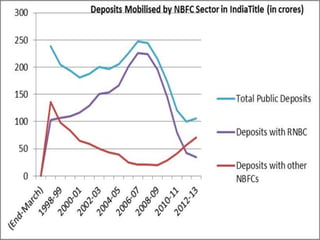
• Limit on deposit
acceptance
• NBFCs cannot accept
deposits from public.
• Requirement of
Minimum net worth for
conversion into bank
• Entry barrier-Minimum
net owned funds of Rs.
2 crore is required for
registration.
Suggestions
• Simplification of Structure
complexities
• Differential risk weights
for capital adequacy ratio
• Access to refinancing
schemes
• Extension of tax benefits
to NBFCs similar to that
currently available to
banks
Thank you

Non Banking Financing Companies Presentation

  • 1.
    Project on NBFC Group Members: AdilGarg Ankur Agarwal Anshul Gupta Ayush Jain Siddhant Kumar Varsha Maheshwari
  • 2.
     A Non-BankingFinancial Company (NBFC) is a financial institution registered under company act 1956 that provides banking services but do not hold banking license.  Restricted from taking deposits from public.  Generally NBFCs are engaged in : • Loans & Credit facilities. • Private Education funding. • Retirement Planning. • Trading in Money Market. • Wealth Management What is NBFC?
  • 3.
    Regulators of NBFC NBFCsregistered with RBI : Regulation, supervision, surveillance under RBI. National Housing Bank : Housing Finance Institutions SEBI : Merchant Banking Company MCA: Nidhi & Mutual Benefit Companies. IRDA: Insurance Company
  • 4.
    Categories of NBFC’S Registeredwith RBI 1. Asset Finance Company(AFC) 2. Investment Company(IC) 3. Loan Company(LC) 4. Infrastructure Finance Company(IFC) • Net owned funds of at least Rs. 300 Crore. • Deploy at least 75 % of its total assets in infrastructure loans. • Minimum credit rating of ‘A ‘or equivalent. • CRAR of 15%.
  • 5.
    5. Systematically ImportantCore Investment Company(CIC-ND-SI) • NBFC carrying on the business of acquisition of shares and securities • Asset size >=Rs 100 crore • holds not less than 90% of its Assets in the form of investment in equity shares, preference shares, debt or loans in group companies • Out of the 90%, 60% should be invested in equity shares or those instruments which can be compulsorily converted into equity shares.
  • 6.
    6. Infrastructure DebtFund: Non- Banking Financial Company(IDF- NBFC) • facilitates the flow of long term debt into infrastructure projects • raises resources through issue of Rupee or Dollar denominated bonds of minimum 5 year maturity.
  • 7.
    7. Micro Finance Institution(NBFC-MFI) • non-deposit taking NBFC which has at least 85% of its assets in the form of microfinance • loan amount does not exceed Rs. 50,000 in the first cycle and Rs. 1,00,000 in subsequent cycles • total indebtedness of the borrower does not exceed Rs. 1,00,000 • tenure of the loan not to be less than 24 months for loan amount in excess of Rs. 15,000 with prepayment without penalty • loan has to be given without collateral
  • 8.
    8. Factor • Thefinancial assets should constitute at least 50 percent of its total assets . 9. Mortgage Guarantee Company(MGC) • At least 90% of the business turnover is mortgage guarantee business or at least 90% of the gross income is from mortgage guarantee business . 10. Non-Operative Financial Holding Company(NOFHC) • promoter / promoter groups will be permitted to set up a new bank. 11. Residuary Non-Banking Company(RNBCs) • business of receiving the deposits, under any scheme or arrangement or in any other manner • required to invest 100 per cent of their deposit liability into highly liquid and secure instruments
  • 9.
    Rules Governing NBFCs •50-50 Principal Business Criteria for NBFC: Following conditions are required to be fulfilled to be eligible for NBFC:  Financial assets should constitutes more than 50% of a NBFC’s total assets  Income from financial assets constitute more than 50 per cent of the gross income. • Owned fund’ and ‘net owned fund’ in relation to NBFCs: ‘Owned Fund’ = Equity Shareholders funds + Convertible Preference shares
  • 10.
    • NBFC Entitieswhich can legally accept deposits from public • Housing Finance Companies • Cooperative Credit services • Other requirements for accepting deposits • Limit on Deposits • Interest Rate on Deposits • Tenure of deposits
  • 11.
    Growth parameters  Increasingsize and systemic importance  Stronger Regulatory Environment leads to higher capital cover and Better Risk Management  Move towards Secured Lending  Lower Liquidity Risk  Stronger Lending Infrastructure  Rising number of large players – backed by big corporate houses  Diversification and Mortgage Based lending  Changing Order
  • 12.
    Key Performance Trends • CapitalAdequacy remains comfortable. • Asset quality under pressure due to economic stress. • Profitability impacted on account of slowdown in growth and asset quality pressure. • Resource profile continues to be stable. • Rise in Total Assets.
  • 13.
    Other Issues & Suggestions •High cost of raising funds & inaccessibility to cheap sources • Limit on deposit acceptance • NBFCs cannot accept deposits from public.
  • 15.
    • Requirement of Minimumnet worth for conversion into bank • Entry barrier-Minimum net owned funds of Rs. 2 crore is required for registration.
  • 16.
    Suggestions • Simplification ofStructure complexities • Differential risk weights for capital adequacy ratio • Access to refinancing schemes • Extension of tax benefits to NBFCs similar to that currently available to banks
  • 17.