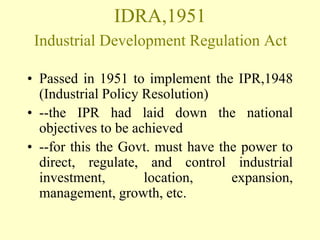
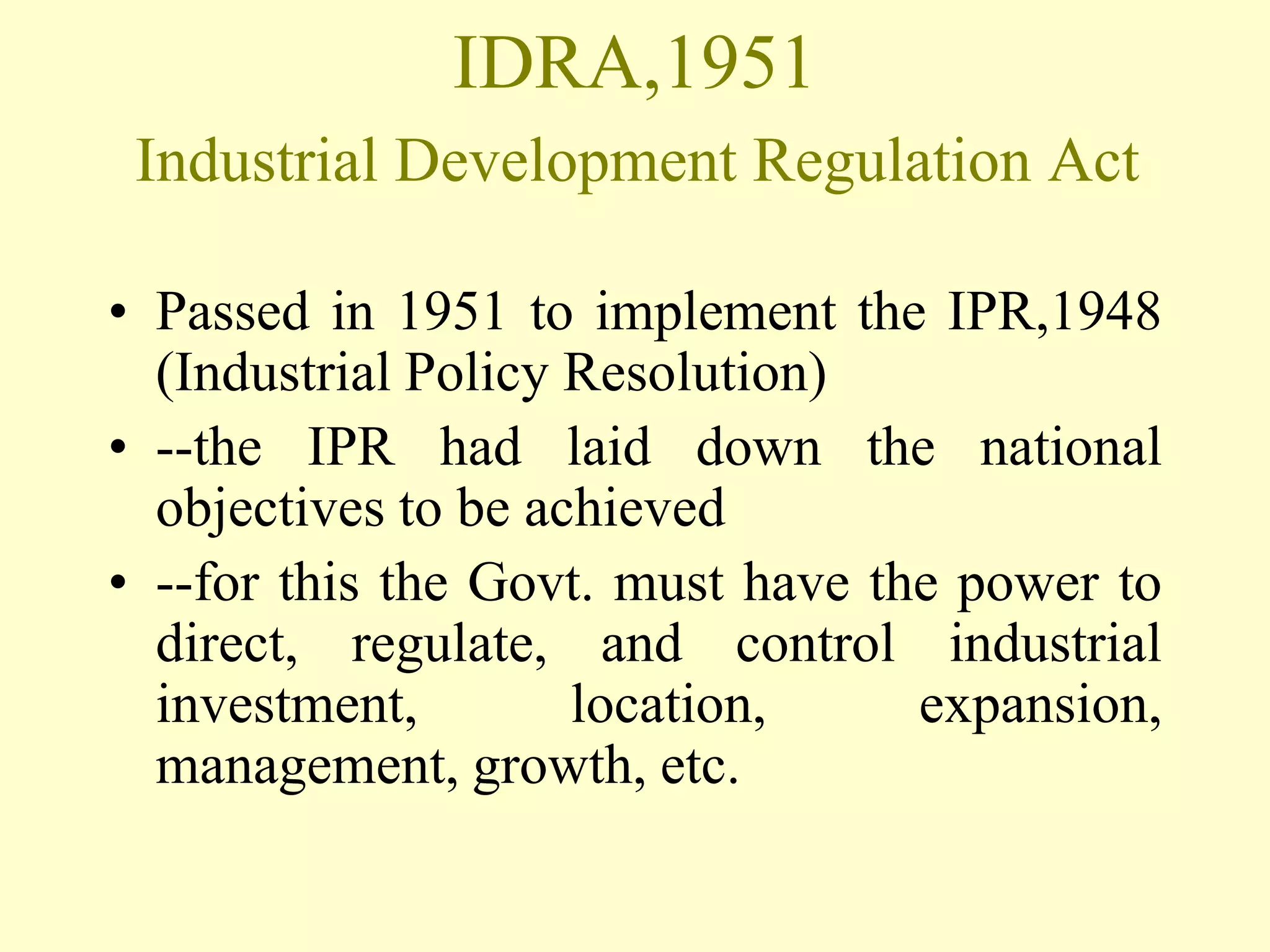
IDRA,1951
 Industrial Development Regulation Act

• Passed in 1951 to implement the IPR,1948
  (Industrial Policy Resolution)
• --the IPR had laid down the national
  objectives to be achieved
• --for this the Govt. must have the power to
  direct, regulate, and control industrial
  investment,        location,     expansion,
  management, growth, etc.
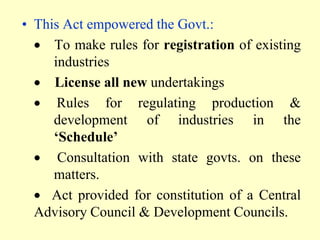
• This Act empowered the Govt.:
     To make rules for registration of existing
     industries
     License all new undertakings
      Rules for regulating production &
     development of industries in the
     ‘Schedule’
      Consultation with state govts. on these
     matters.
     Act provided for constitution of a Central
  Advisory Council & Development Councils.
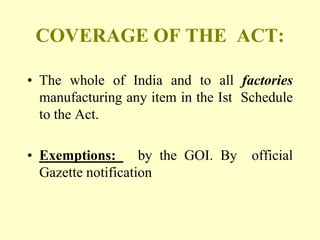
COVERAGE OF THE ACT:

• The whole of India and to all factories
  manufacturing any item in the Ist Schedule
  to the Act.

• Exemptions:       by the GOI. By   official
  Gazette notification
• CENTRAL ADVISORY COUNCIL                            &
  DEVELOPMENT COUNCILS:
• CAC:
    By GOI to advise on matters of development and
 regulation of Sch.inds.
    Chairman and all members to be appointed by GOI
    Max.number of members = 30
    To represent interests of owners, employees,
 consumers, primary suppliers etc., of the sch.industries
    Also sub committees of the CAC
• DEVELOPMENT COUNCIL: May perform any
  of the following:
  Recommending targets for production, co-coordinating
 production programmes, and reviewing progress
 Suggesting efficiency norms
 Measures for max.utilization of installed capacity
    Better marketing and distribution
    Standardization of products
    Distribution of controlled materials
    Work study, O&M study etc.
    Training and re-training of workers
•   Scientific and industrial research ( also
      industrial psychology)
    Standardization of accounting and costing
    methods
     Statistics
    Decentralization and subcontracting—for
    SSIs
REGULATION OF SCHEDULED
        INDUSTRIES

• Registration of Existing Undertakings:
• Incl. PSUs


• + get certificate with installed capacity and
  other details
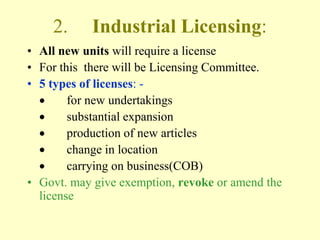
2.     Industrial Licensing:
• All new units will require a license
• For this there will be Licensing Committee.
• 5 types of licenses: -
        for new undertakings
        substantial expansion
        production of new articles
        change in location
        carrying on business(COB)
• Govt. may give exemption, revoke or amend the
  license
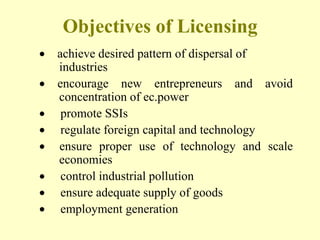
Objectives of Licensing
achieve desired pattern of dispersal of
industries
encourage new entrepreneurs and avoid
concentration of ec.power
 promote SSIs
 regulate foreign capital and technology
ensure proper use of technology and scale
economies
 control industrial pollution
 ensure adequate supply of goods
 employment generation
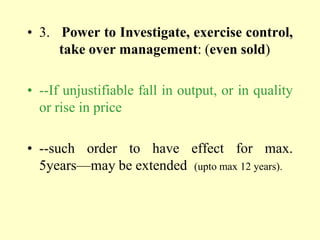
• 3. Power to Investigate, exercise control,
     take over management: (even sold)

• --If unjustifiable fall in output, or in quality
  or rise in price

• --such order to have effect for max.
  5years—may be extended (upto max 12 years).
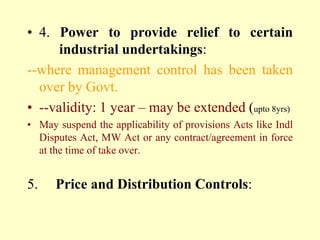
• 4. Power to provide relief to certain
      industrial undertakings:
--where management control has been taken
  over by Govt.
• --validity: 1 year – may be extended (upto 8yrs)
• May suspend the applicability of provisions Acts like Indl
  Disputes Act, MW Act or any contract/agreement in force
  at the time of take over.


5.    Price and Distribution Controls:
• LICENSE:
• A written permission from GOI to
  manufacture specified articles in the Schedule
•     --contains particulars: name, location,
  articles to be manufactured, capacity etc.
• --if the application is approved and no further
  clearances required: then Industrial License

Idra,1951

  • 1.
    IDRA,1951 Industrial DevelopmentRegulation Act • Passed in 1951 to implement the IPR,1948 (Industrial Policy Resolution) • --the IPR had laid down the national objectives to be achieved • --for this the Govt. must have the power to direct, regulate, and control industrial investment, location, expansion, management, growth, etc.
  • 2.
    • This Actempowered the Govt.: To make rules for registration of existing industries License all new undertakings Rules for regulating production & development of industries in the ‘Schedule’ Consultation with state govts. on these matters. Act provided for constitution of a Central Advisory Council & Development Councils.
  • 3.
    COVERAGE OF THEACT: • The whole of India and to all factories manufacturing any item in the Ist Schedule to the Act. • Exemptions: by the GOI. By official Gazette notification
  • 4.
    • CENTRAL ADVISORYCOUNCIL & DEVELOPMENT COUNCILS: • CAC: By GOI to advise on matters of development and regulation of Sch.inds. Chairman and all members to be appointed by GOI Max.number of members = 30 To represent interests of owners, employees, consumers, primary suppliers etc., of the sch.industries Also sub committees of the CAC
  • 5.
    • DEVELOPMENT COUNCIL:May perform any of the following: Recommending targets for production, co-coordinating production programmes, and reviewing progress Suggesting efficiency norms Measures for max.utilization of installed capacity Better marketing and distribution Standardization of products Distribution of controlled materials Work study, O&M study etc. Training and re-training of workers
  • 6.
    • Scientific and industrial research ( also industrial psychology) Standardization of accounting and costing methods Statistics Decentralization and subcontracting—for SSIs
  • 7.
    REGULATION OF SCHEDULED INDUSTRIES • Registration of Existing Undertakings: • Incl. PSUs • + get certificate with installed capacity and other details
  • 8.
    2. Industrial Licensing: • All new units will require a license • For this there will be Licensing Committee. • 5 types of licenses: - for new undertakings substantial expansion production of new articles change in location carrying on business(COB) • Govt. may give exemption, revoke or amend the license
  • 9.
    Objectives of Licensing achievedesired pattern of dispersal of industries encourage new entrepreneurs and avoid concentration of ec.power promote SSIs regulate foreign capital and technology ensure proper use of technology and scale economies control industrial pollution ensure adequate supply of goods employment generation
  • 10.
    • 3. Powerto Investigate, exercise control, take over management: (even sold) • --If unjustifiable fall in output, or in quality or rise in price • --such order to have effect for max. 5years—may be extended (upto max 12 years).
  • 11.
    • 4. Powerto provide relief to certain industrial undertakings: --where management control has been taken over by Govt. • --validity: 1 year – may be extended (upto 8yrs) • May suspend the applicability of provisions Acts like Indl Disputes Act, MW Act or any contract/agreement in force at the time of take over. 5. Price and Distribution Controls:
  • 12.
    • LICENSE: • Awritten permission from GOI to manufacture specified articles in the Schedule • --contains particulars: name, location, articles to be manufactured, capacity etc. • --if the application is approved and no further clearances required: then Industrial License