SEBI : Functions, Powers and Objectives
SEBI (Securities and Exchange Board of India) is an apex institution for
investment in India.
Before SEBI it was the capital issue control Act 1947
But it was insufficient to monitor check the malpractices of the stock
market as a result the need for a properly regulated securities market
was felt
Therefore the government through a resolution constituted SEBI to
promote healthy and growth oriented securities in the market.
OBJECTIVES OF SEBI:
To protect the interest of investors in securities
To promote development of the securities market
To regulate securities market
For matters considered therewith
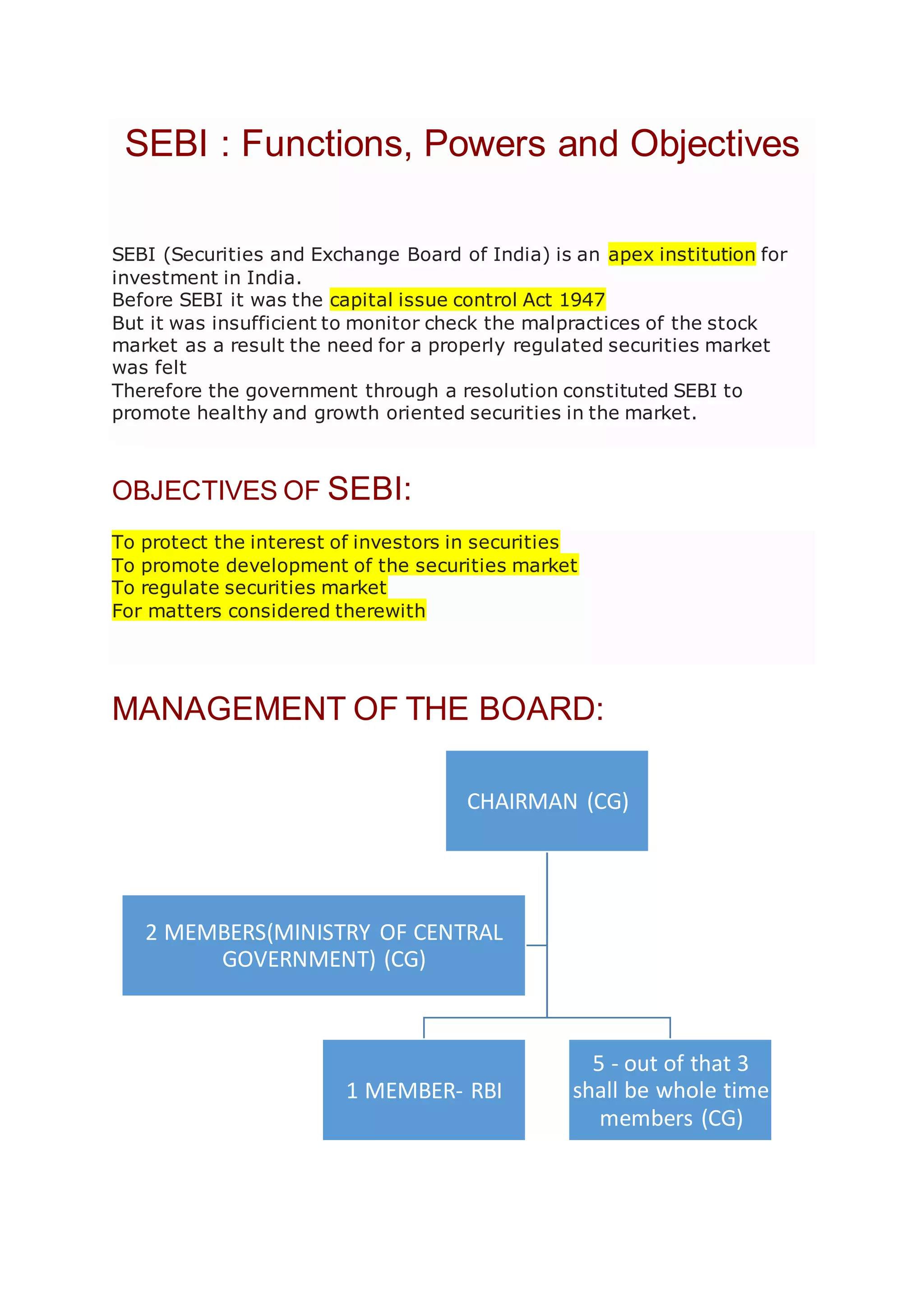
MANAGEMENT OF THE BOARD:
CHAIRMAN (CG)
1 MEMBER- RBI
5 - out of that 3
shall be whole time
members (CG)
2 MEMBERS(MINISTRY OF CENTRAL
GOVERNMENT) (CG)
FUNCTIONS OF SEBI:
We can classify the functions of SEBI in three categories :-
1. Protective functions
2. Developmental functions
3. Regulatory functions.
1. Protective Functions:
As the name suggests, the main focus of this function of SEBI is to
protect the interest of investor and security of their investment
As protective functions SEBI performs following functions:
(i) SEBI checks Price Rigging:
Price Rigging means some people manipulate the prices of securities for
inflation or depressing the market price of securities. SEBI prohibits such
practice to avoid fraud and cheating which can happen to any investor.
(ii) SEBI prohibits Insider trading:
Any person which is connected with company such as directors,
promoters, workers etc are called Insider. Due to working in the company
they have sensitive information which affects the prices of the
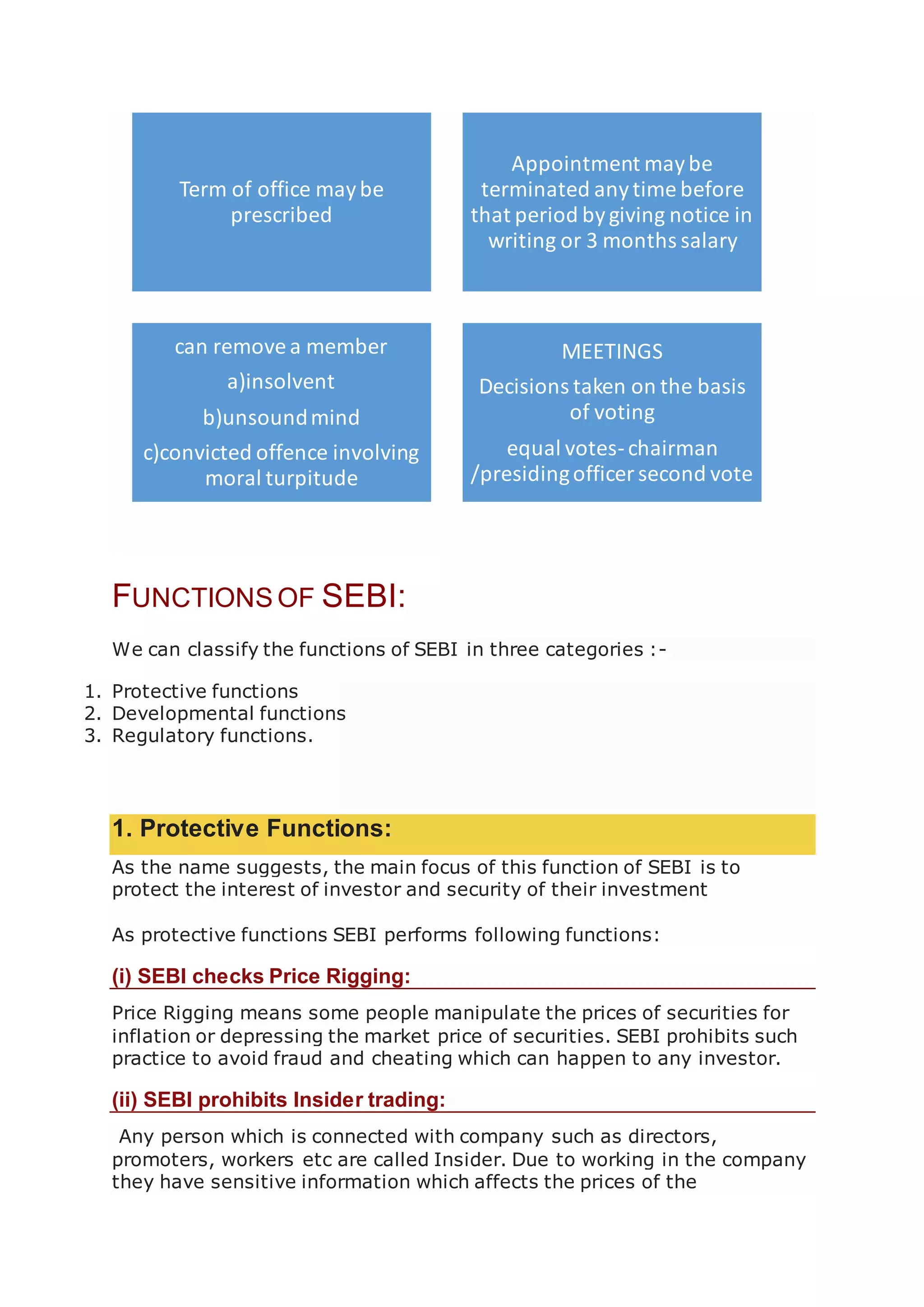
Term of office maybe
prescribed
Appointment maybe
terminated anytime before
that period bygiving notice in
writing or 3 months salary
can removea member
a)insolvent
b)unsoundmind
c)convicted offence involving
moral turpitude
MEETINGS
Decisions taken on the basis
of voting
equal votes-chairman
/presidingofficer second vote
securities.Such information is not available to people at large but Insider
get this key ful knowledge by working in such company. Insider can use
this information for their personal benefits or make profit from it, such
process is known as Insider Trading.
For Example - Managers or Directors of a company may know that
company will issue Bonus shares to its shareholders at particular time and
they purchase shares from market to make profit with bonus issue.
SEBI always restricts these types of practices when Insider are buying
securities of the company and take strict action to avoid this in future.
(iii) SEBI prohibits fraudulent and Unfair Trade Practices:
SEBI always restricts the companies which make misleading statements
which are likely to induce the sale or purchase of securities by any other
person.
(iv) SEBI sometimes educate the investors so that become able to
evaluate the securities and always invest in profitable securities.
(v) SEBI issues guidelines to protect the interest of debenture holders.
(vi) SEBI is empowered to investigate cases of insider trading and has
provision for stiff fine and imprisonment.
(vii) SEBI has stopped the practice of allotment of preferential shares
unrelated to market prices.
(vii) SEBI has stopped the practice of making preferential allotment of
shares unrelated to market prices.
2. Developmental Functions:
Under developmental categories following functions are performed by
SEBI:
(i) SEBI promotes training of intermediaries of the securities market.
(ii) SEBI tries to promote activities of stock exchange by adopting flexible
and adoptable approach in following way:
(a) SEBI has permitted internet trading through registered stock
brokers.
(b) SEBI has made underwriting optional to reduce the cost of issue.
(c) Even initial public offer of primary market is permitted through stock
exchange.
3. Regulatory Functions:
These functions are performed by SEBI to regulate the business in stock
exchange. To regulate the activities of stock exchange following functions
are performed:
(i) SEBI has framed rules and regulations and a code of conduct to
regulate the intermediaries such as merchant bankers, brokers,
underwriters, etc.
(ii) These intermediaries have been brought under the regulatory purview
and private placement has been made more restrictive.
(iii) SEBI registers and regulates the working of stock brokers, sub-
brokers, share transfer agents, trustees, merchant bankers and all those
who are associated with stock exchange in any manner.
(iv) SEBI registers and regulates the working of mutual funds etc.
(v) SEBI regulates takeover of the companies.
(vi) SEBI conducts inquiries and audit of stock exchanges.
Other Functions
1. Registering and regulating working of stock brokers, sub - brokers,
share transfer agents, bankers to issue, trustees of trust deed, registrars
to an issue, merchant bankers, underwriters, portfolio managers,
investment adviser and such other intermediaries who may be associated
with securities markets in any manner.
2. SEBI also perform the function of registering and regulating working of
depositories, custodians of securities. Foreign Institutional Investors,
credit rating agencies etc.
3. Registering and regulating working of Venture Capital Funds and
collective investments schemes including mutual funds.
4. Promoting and regulating self - regulatory organizations.
5. Calling for information form, undertaking inspection, conducting
inquiries and audits of stock exchange, mutual funds and intermediaries
and self - regulatory organizations in the securities market.
6. Calling for information and record from any bank or any other authority
or boars or corporation established or constituted by or under any
Central, State or Provincial Act in respect of any transaction in securities
which are under investigation or inquiry by the Board.
7. Conduct research for any matter described if any.
8. Calling information from any agency, institution, banks etc.

Sebi

  • 1.
    SEBI : Functions,Powers and Objectives SEBI (Securities and Exchange Board of India) is an apex institution for investment in India. Before SEBI it was the capital issue control Act 1947 But it was insufficient to monitor check the malpractices of the stock market as a result the need for a properly regulated securities market was felt Therefore the government through a resolution constituted SEBI to promote healthy and growth oriented securities in the market. OBJECTIVES OF SEBI: To protect the interest of investors in securities To promote development of the securities market To regulate securities market For matters considered therewith MANAGEMENT OF THE BOARD: CHAIRMAN (CG) 1 MEMBER- RBI 5 - out of that 3 shall be whole time members (CG) 2 MEMBERS(MINISTRY OF CENTRAL GOVERNMENT) (CG)
  • 2.
    FUNCTIONS OF SEBI: Wecan classify the functions of SEBI in three categories :- 1. Protective functions 2. Developmental functions 3. Regulatory functions. 1. Protective Functions: As the name suggests, the main focus of this function of SEBI is to protect the interest of investor and security of their investment As protective functions SEBI performs following functions: (i) SEBI checks Price Rigging: Price Rigging means some people manipulate the prices of securities for inflation or depressing the market price of securities. SEBI prohibits such practice to avoid fraud and cheating which can happen to any investor. (ii) SEBI prohibits Insider trading: Any person which is connected with company such as directors, promoters, workers etc are called Insider. Due to working in the company they have sensitive information which affects the prices of the Term of office maybe prescribed Appointment maybe terminated anytime before that period bygiving notice in writing or 3 months salary can removea member a)insolvent b)unsoundmind c)convicted offence involving moral turpitude MEETINGS Decisions taken on the basis of voting equal votes-chairman /presidingofficer second vote
  • 3.
    securities.Such information isnot available to people at large but Insider get this key ful knowledge by working in such company. Insider can use this information for their personal benefits or make profit from it, such process is known as Insider Trading. For Example - Managers or Directors of a company may know that company will issue Bonus shares to its shareholders at particular time and they purchase shares from market to make profit with bonus issue. SEBI always restricts these types of practices when Insider are buying securities of the company and take strict action to avoid this in future. (iii) SEBI prohibits fraudulent and Unfair Trade Practices: SEBI always restricts the companies which make misleading statements which are likely to induce the sale or purchase of securities by any other person. (iv) SEBI sometimes educate the investors so that become able to evaluate the securities and always invest in profitable securities. (v) SEBI issues guidelines to protect the interest of debenture holders. (vi) SEBI is empowered to investigate cases of insider trading and has provision for stiff fine and imprisonment. (vii) SEBI has stopped the practice of allotment of preferential shares unrelated to market prices. (vii) SEBI has stopped the practice of making preferential allotment of shares unrelated to market prices. 2. Developmental Functions: Under developmental categories following functions are performed by SEBI: (i) SEBI promotes training of intermediaries of the securities market. (ii) SEBI tries to promote activities of stock exchange by adopting flexible and adoptable approach in following way: (a) SEBI has permitted internet trading through registered stock brokers. (b) SEBI has made underwriting optional to reduce the cost of issue.
  • 4.
    (c) Even initialpublic offer of primary market is permitted through stock exchange. 3. Regulatory Functions: These functions are performed by SEBI to regulate the business in stock exchange. To regulate the activities of stock exchange following functions are performed: (i) SEBI has framed rules and regulations and a code of conduct to regulate the intermediaries such as merchant bankers, brokers, underwriters, etc. (ii) These intermediaries have been brought under the regulatory purview and private placement has been made more restrictive. (iii) SEBI registers and regulates the working of stock brokers, sub- brokers, share transfer agents, trustees, merchant bankers and all those who are associated with stock exchange in any manner. (iv) SEBI registers and regulates the working of mutual funds etc. (v) SEBI regulates takeover of the companies. (vi) SEBI conducts inquiries and audit of stock exchanges. Other Functions 1. Registering and regulating working of stock brokers, sub - brokers, share transfer agents, bankers to issue, trustees of trust deed, registrars to an issue, merchant bankers, underwriters, portfolio managers, investment adviser and such other intermediaries who may be associated with securities markets in any manner. 2. SEBI also perform the function of registering and regulating working of depositories, custodians of securities. Foreign Institutional Investors, credit rating agencies etc. 3. Registering and regulating working of Venture Capital Funds and collective investments schemes including mutual funds. 4. Promoting and regulating self - regulatory organizations. 5. Calling for information form, undertaking inspection, conducting inquiries and audits of stock exchange, mutual funds and intermediaries
  • 5.
    and self -regulatory organizations in the securities market. 6. Calling for information and record from any bank or any other authority or boars or corporation established or constituted by or under any Central, State or Provincial Act in respect of any transaction in securities which are under investigation or inquiry by the Board. 7. Conduct research for any matter described if any. 8. Calling information from any agency, institution, banks etc.