


Seattle Monthly Hadoop / Scalability /
           NoSQLMeetup

        Ted Dunning, MapR..
Agenda
•   Lightning talks / community announcements
•   Main Speaker
•   Bier @ Feierabend - 422 Yale Ave North
•   Hashtags #Seattle #Hadoop
Fast & Frugal: Running a Lean Startup
   with AWS – Oct 27th 10am-2pm
http://aws.amazon.com/about-aws/events/
Seattle AWS User Group November
         9th, 2011 – 6:30 -9pm
• November we're going to hear from Amy
  Woodward from EngineYard about keeping
  your systems live through outages and other
  problems using EngineYard atop AWS. Come
  check out this great talk and learn a thing or
  three about EngineYard& keeping high
  availability for your systems!
• http://www.nwcloud.org
www.mapr.com
• MapR is an amazing new distributed
  filesystem modeled after Hadoop. It maintains
  API compatibility with Hadoop, but far
  exceeds it in performance, manageability, and
  more.
MapR, Scaling, Machine Learning
Outline
• Philosophy
• Architecture
• Applications
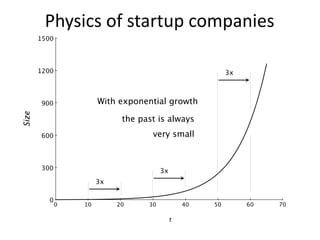
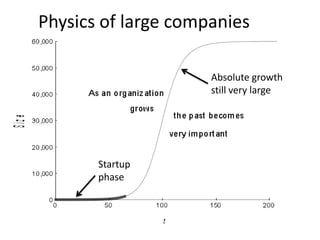
Physics of startup companies
For startups
•   History is always small
•   The future is huge
•   Must adopt new technology to survive
•   Compatibility is not as important
    – In fact, incompatibility is assumed
Physics of large companies

                     Absolute growth
                     still very large


       Startup
       phase
For large businesses
•   Present state is always large
•   Relative growth is much smaller
•   Absolute growth rate can be very large
•   Must adopt new technology to survive
    – Cautiously!
    – But must integrate technology with legacy
• Compatibility is crucial
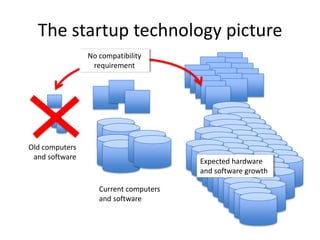
The startup technology picture
                No compatibility
                 requirement


Old computers
 and software
                                       Expected hardware
                                       and software growth

                   Current computers
                   and software
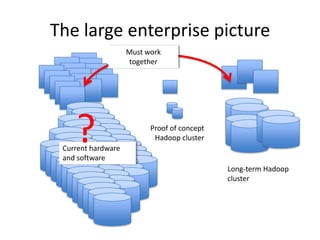
The large enterprise picture
                    Must work
                    together


    ?
 Current hardware
 and software
                          Proof of concept
                           Hadoop cluster


                                             Long-term Hadoop
                                             cluster
What does this mean?
• Hadoop is very, very good at streaming
  through things in batch jobs
• Hbase is good at persisting data in very write-
  heavy workloads
• Unfortunately, the foundation of both systems
  is HDFS which does not export or import well
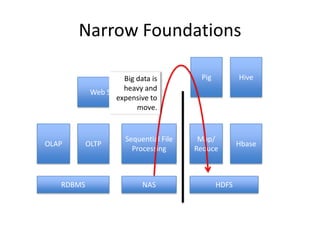
Narrow Foundations

                     Big data is         Pig          Hive
            Web Services and
                     heavy
                   expensive to
                         move.


                      Sequential File    Map/
OLAP       OLTP                                       Hbase
                        Processing      Reduce


   RDBMS                   NAS                 HDFS
Narrow Foundations
• Because big data has inertia, it is difficult to
  move
   – It costs time to move
   – It costs reliability because of more moving parts
• The result is many duplicate copies
One Possible Answer
• Widen the foundation
• Use standard communication protocols
• Allow conventional processing to share with
  parallel processing
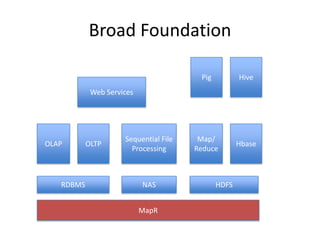
Broad Foundation

                                        Pig          Hive
            Web Services


                     Sequential File    Map/
OLAP       OLTP                                      Hbase
                       Processing      Reduce


   RDBMS                   NAS                HDFS


                           MapR
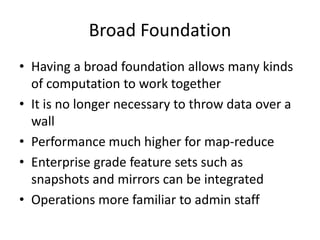
Broad Foundation
• Having a broad foundation allows many kinds
  of computation to work together
• It is no longer necessary to throw data over a
  wall
• Performance much higher for map-reduce
• Enterprise grade feature sets such as
  snapshots and mirrors can be integrated
• Operations more familiar to admin staff
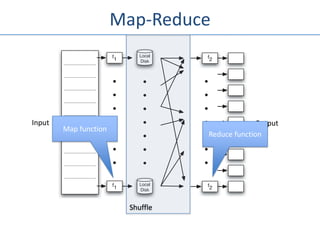
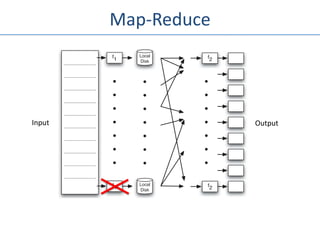
Map-Reduce


Input                                          Output
        Map function
                                  Reduce function


                        Shuffle
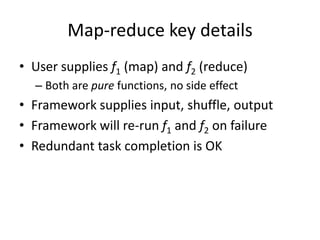
Map-reduce key details
• User supplies f1 (map) and f2 (reduce)
  – Both are pure functions, no side effect
• Framework supplies input, shuffle, output
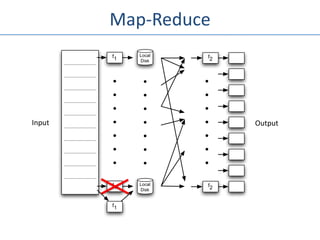
• Framework will re-run f1 and f2 on failure
• Redundant task completion is OK
Map-Reduce


Input                Output
Map-Reduce
        f1   Local   f2
             Disk


Input                     Output


        f1   Local   f2
             Disk


        f1
Example – WordCount
• Mapper
  – read line, tokenize into words
  – emit (word, 1)
• Reducer
  – read (word, [k1, … , kn])
  – Emit (word, Σki)
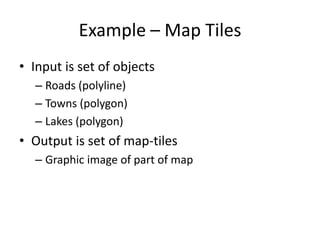
Example – Map Tiles
• Input is set of objects
  – Roads (polyline)
  – Towns (polygon)
  – Lakes (polygon)
• Output is set of map-tiles
  – Graphic image of part of map
Bottlenecks and Issues
• Read-only files
• Many copies in I/O path
• Shuffle based on HTTP
   – Can’t use new technologies
   – Eats file descriptors
• Spills go to local file space
   – Bad for skewed distribution of sizes
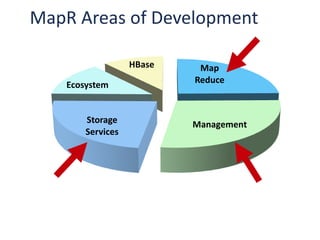
MapR Areas of Development

                   HBase    Map
                           Reduce
    Ecosystem


        Storage            Management
        Services
MapR Improvements
• Faster file system
  – Fewer copies
  – Multiple NICS
  – No file descriptor or page-buf competition
• Faster map-reduce
  – Uses distributed file system
  – Direct RPC to receiver
  – Very wide merges
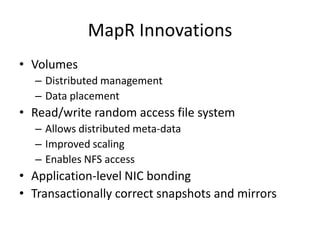
MapR Innovations
• Volumes
  – Distributed management
  – Data placement
• Read/write random access file system
  – Allows distributed meta-data
  – Improved scaling
  – Enables NFS access
• Application-level NIC bonding
• Transactionally correct snapshots and mirrors
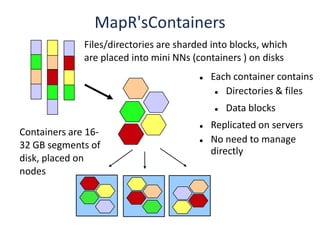
MapR'sContainers
              Files/directories are sharded into blocks, which
              are placed into mini NNs (containers ) on disks
                                            Each container contains
                                               Directories & files
                                                Data blocks
                                            Replicated on servers
Containers are 16-
                                            No need to manage
32 GB segments of
                                             directly
disk, placed on
nodes
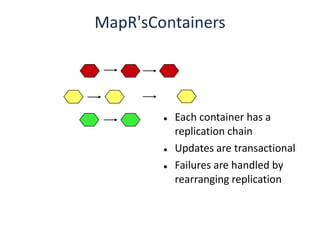
MapR'sContainers


           Each container has a
            replication chain
           Updates are transactional
           Failures are handled by
            rearranging replication
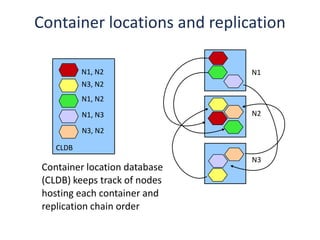
Container locations and replication

           N1, N2              N1
           N3, N2
           N1, N2
           N1, N3              N2

           N3, N2

    CLDB
                               N3
 Container location database
 (CLDB) keeps track of nodes
 hosting each container and
 replication chain order
MapR Scaling
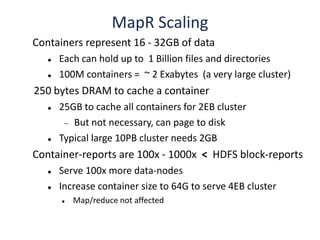
Containers represent 16 - 32GB of data
      Each can hold up to 1 Billion files and directories
      100M containers = ~ 2 Exabytes (a very large cluster)
250 bytes DRAM to cache a container
      25GB to cache all containers for 2EB cluster
          But not necessary, can page to disk
      Typical large 10PB cluster needs 2GB
Container-reports are 100x - 1000x < HDFS block-reports
      Serve 100x more data-nodes
      Increase container size to 64G to serve 4EB cluster
          Map/reduce not affected
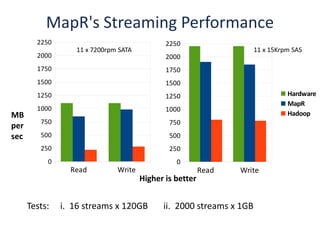
MapR's Streaming Performance
        2250                                 2250
                  11 x 7200rpm SATA                                  11 x 15Krpm SAS
        2000                                 2000
        1750                                 1750
        1500                                 1500
        1250                                 1250                              Hardware
                                                                               MapR
        1000                                 1000
MB                                                                             Hadoop
         750                                  750
per
sec      500                                  500
         250                                  250
           0                                    0
                 Read         Write                      Read   Write
                                      Higher is better


      Tests:   i. 16 streams x 120GB        ii. 2000 streams x 1GB
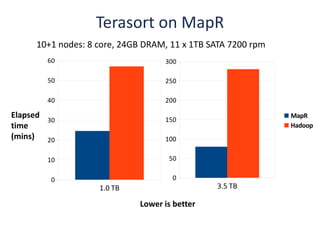
Terasort on MapR
      10+1 nodes: 8 core, 24GB DRAM, 11 x 1TB SATA 7200 rpm
          60                       300

          50                       250

          40                       200

Elapsed                            150
                                                              MapR
          30
time                                                          Hadoop
(mins)    20                       100

          10                        50


           0                         0
                    1.0 TB                     3.5 TB

                             Lower is better
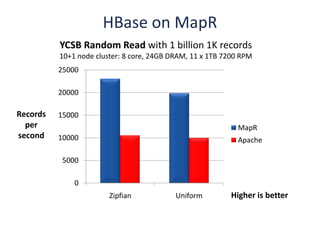
HBase on MapR
          YCSB Random Read with 1 billion 1K records
          10+1 node cluster: 8 core, 24GB DRAM, 11 x 1TB 7200 RPM
          25000

          20000

Records   15000
  per                                                       MapR
second    10000                                             Apache

          5000

              0
                        Zipfian            Uniform        Higher is better
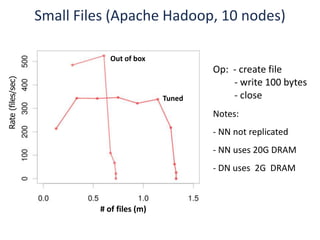
Small Files (Apache Hadoop, 10 nodes)

                               Out of box
                                                     Op: - create file
Rate (files/sec)


                                                         - write 100 bytes
                                             Tuned       - close
                                                     Notes:
                                                     - NN not replicated
                                                     - NN uses 20G DRAM
                                                     - DN uses 2G DRAM


                            # of files (m)
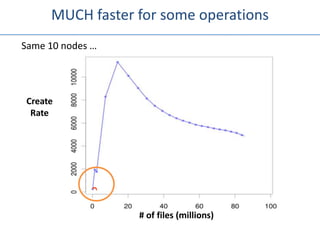
MUCH faster for some operations
Same 10 nodes …


Create
 Rate


                  # of files (millions)
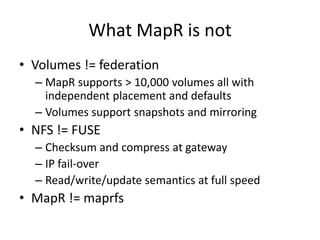
What MapR is not
• Volumes != federation
  – MapR supports > 10,000 volumes all with
    independent placement and defaults
  – Volumes support snapshots and mirroring
• NFS != FUSE
  – Checksum and compress at gateway
  – IP fail-over
  – Read/write/update semantics at full speed
• MapR != maprfs
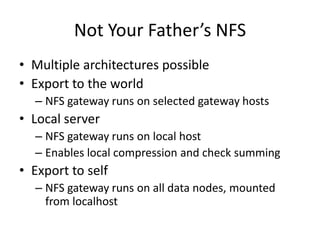
Not Your Father’s NFS
• Multiple architectures possible
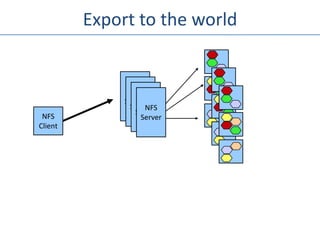
• Export to the world
  – NFS gateway runs on selected gateway hosts
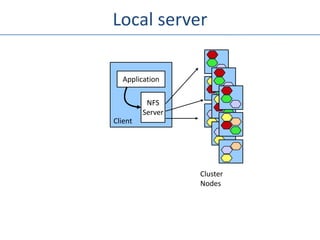
• Local server
  – NFS gateway runs on local host
  – Enables local compression and check summing
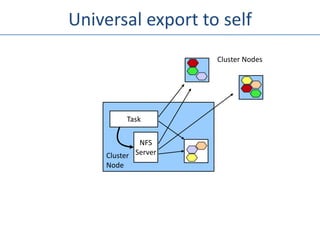
• Export to self
  – NFS gateway runs on all data nodes, mounted
    from localhost
Export to the world


               NFS
                 NFS
              Server
                  NFS
               Server
                    NFS
                 Server
 NFS              Server
Client
Local server

  Application

          NFS
         Server
Client


                  Cluster
                  Nodes
Universal export to self
                     Cluster Nodes


         Task

             NFS
    Cluster Server
    Node
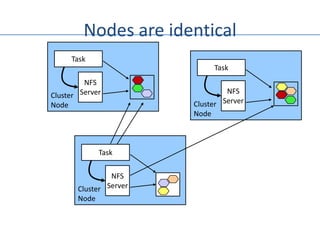
Nodes are identical
     Task
                             Task
         NFS
                                 NFS
Cluster Server
Node                    Cluster Server
                        Node


             Task

                NFS
       Cluster Server
       Node
Application architecture
• High performance map-reduce is nice


• But algorithmic flexibility is even nicer
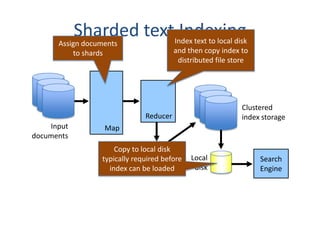
Sharded textIndex text to local disk
                          Indexing
      Assign documents
          to shards                     and then copy index to
                                         distributed file store


                                                             Clustered
                              Reducer                        index storage
    Input         Map
documents
                     Copy to local disk
                         Local
                 typically disk
                           required before   Local                Search
                   index can be loaded        disk                Engine
Shardedtext indexing
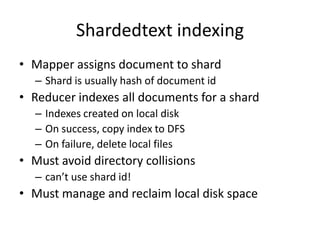
• Mapper assigns document to shard
  – Shard is usually hash of document id
• Reducer indexes all documents for a shard
  – Indexes created on local disk
  – On success, copy index to DFS
  – On failure, delete local files
• Must avoid directory collisions
  – can’t use shard id!
• Must manage and reclaim local disk space
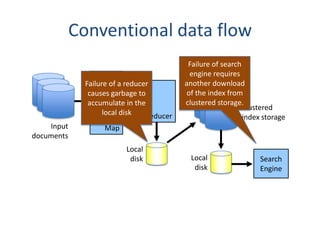
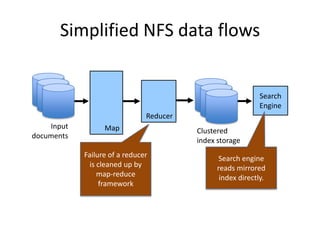
Conventional data flow
                                            Failure of search
                                             engine requires
              Failure of a reducer         another download
               causes garbage to            of the index from
               accumulate in the           clustered storage.
                                                              Clustered
                    local disk   Reducer                      index storage
    Input          Map
documents
                          Local
                           disk              Local                Search
                                              disk                Engine
Simplified NFS data flows


                                                             Search
                                                             Engine
                               Reducer
    Input         Map                    Clustered
documents
                                         index storage
            Failure of a reducer                Search engine
              is cleaned up by                 reads mirrored
                 map-reduce                     index directly.
                 framework
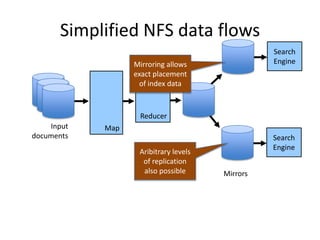
Simplified NFS data flows
                                                 Search
                  Mirroring allows               Engine
                  exact placement
                   of index data


                   Reducer
    Input   Map
documents                                        Search
                                                 Engine
                   Aribitrary levels
                    of replication
                    also possible      Mirrors
How about another one?
K-means
• Classic E-M based algorithm
• Given cluster centroids,
  – Assign each data point to nearest centroid
  – Accumulate new centroids
  – Rinse, lather, repeat
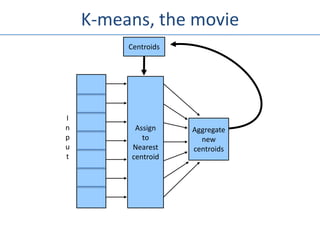
K-means, the movie
         Centroids


I
n         Assign     Aggregate
p           to         new
u        Nearest     centroids
t        centroid
But …
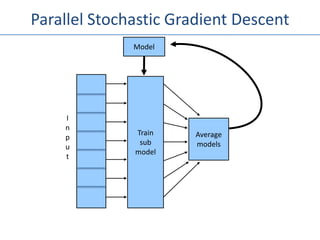
Parallel Stochastic Gradient Descent
              Model


    I
    n
              Train   Average
    p
               sub    models
    u
              model
    t
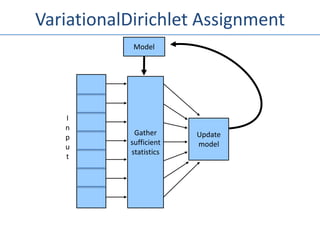
VariationalDirichlet Assignment
            Model


   I
   n
            Gather      Update
   p
           sufficient   model
   u
           statistics
   t
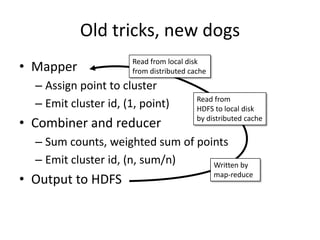
Old tricks, new dogs
                       Read from local disk
• Mapper               from distributed cache
  – Assign point to cluster
                                          Read from
  – Emit cluster id, (1, point)           HDFS to local disk
• Combiner and reducer                    by distributed cache


  – Sum counts, weighted sum of points
  – Emit cluster id, (n, sum/n)    Written by

• Output to HDFS                                map-reduce
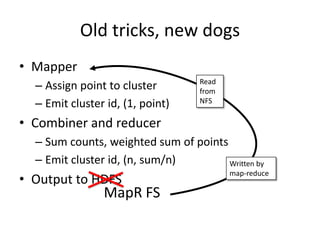
Old tricks, new dogs
• Mapper
  – Assign point to cluster        Read
                                   from
  – Emit cluster id, (1, point)    NFS

• Combiner and reducer
  – Sum counts, weighted sum of points
  – Emit cluster id, (n, sum/n)        Written by
                                          map-reduce
• Output to HDFS
                MapR FS
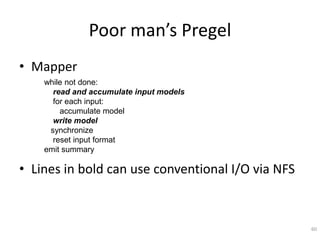
Poor man’s Pregel
• Mapper
    while not done:
      read and accumulate input models
      for each input:
        accumulate model
      write model
     synchronize
      reset input format
    emit summary

• Lines in bold can use conventional I/O via NFS


                                                   60
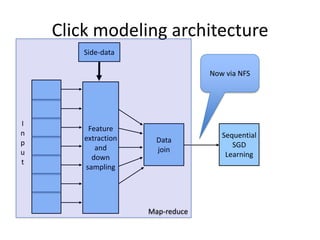
Click modeling architecture
        Side-data

                                  Now via NFS


I
         Feature
n                                    Sequential
        extraction     Data
p                                       SGD
           and         join
u                                     Learning
          down
t
        sampling


                     Map-reduce
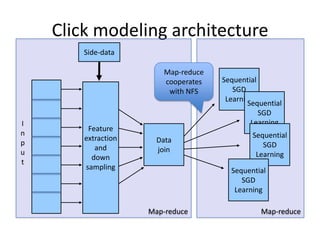
Click modeling architecture
        Side-data

                         Map-reduce
                         cooperates   Sequential
                          with NFS       SGD
                                       Learning
                                             Sequential
                                                 SGD
I                                             Learning
         Feature
n                                             Sequential
        extraction     Data
p                                                SGD
           and         join
u                                              Learning
          down
t
        sampling                        Sequential
                                           SGD
                                         Learning

                     Map-reduce                  Map-reduce
And another…
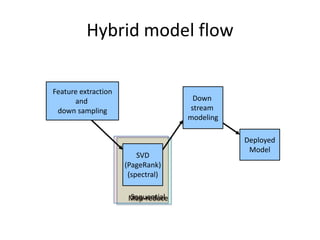
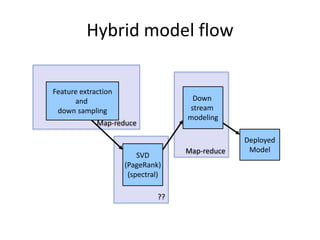
Hybrid model flow

Feature extraction
      and                            Down
 down sampling                      stream
                                    modeling
             Map-reduce

                                                 Deployed
                                    Map-reduce    Model
                         SVD
                     (PageRank)
                      (spectral)

                               ??
Hybrid model flow

Feature extraction
      and                           Down
 down sampling                     stream
                                   modeling

                                              Deployed
                                               Model
                         SVD
                     (PageRank)
                      (spectral)

                      Sequential
                      Map-reduce
And visualization…
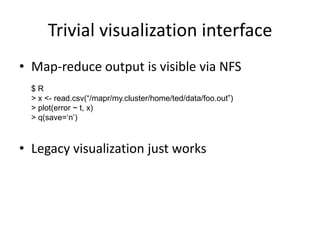
Trivial visualization interface
• Map-reduce output is visible via NFS
  $R
  > x <- read.csv(“/mapr/my.cluster/home/ted/data/foo.out”)
  > plot(error ~ t, x)
  > q(save=„n‟)


• Legacy visualization just works
Conclusions
• We used to know all this
• Tab completion used to work
• 5 years of work-arounds have clouded our
  memories

• We just have to remember the future

Seattle Scalability Meetup - Ted Dunning - MapR

  • 1.
    Seattle Monthly Hadoop/ Scalability / NoSQLMeetup Ted Dunning, MapR..
  • 2.
    Agenda • Lightning talks / community announcements • Main Speaker • Bier @ Feierabend - 422 Yale Ave North • Hashtags #Seattle #Hadoop
  • 3.
    Fast & Frugal:Running a Lean Startup with AWS – Oct 27th 10am-2pm http://aws.amazon.com/about-aws/events/
  • 4.
    Seattle AWS UserGroup November 9th, 2011 – 6:30 -9pm • November we're going to hear from Amy Woodward from EngineYard about keeping your systems live through outages and other problems using EngineYard atop AWS. Come check out this great talk and learn a thing or three about EngineYard& keeping high availability for your systems! • http://www.nwcloud.org
  • 5.
    www.mapr.com • MapR isan amazing new distributed filesystem modeled after Hadoop. It maintains API compatibility with Hadoop, but far exceeds it in performance, manageability, and more.
  • 6.
  • 7.
  • 8.
  • 9.
    For startups • History is always small • The future is huge • Must adopt new technology to survive • Compatibility is not as important – In fact, incompatibility is assumed
  • 10.
    Physics of largecompanies Absolute growth still very large Startup phase
  • 11.
    For large businesses • Present state is always large • Relative growth is much smaller • Absolute growth rate can be very large • Must adopt new technology to survive – Cautiously! – But must integrate technology with legacy • Compatibility is crucial
  • 12.
    The startup technologypicture No compatibility requirement Old computers and software Expected hardware and software growth Current computers and software
  • 13.
    The large enterprisepicture Must work together ? Current hardware and software Proof of concept Hadoop cluster Long-term Hadoop cluster
  • 14.
    What does thismean? • Hadoop is very, very good at streaming through things in batch jobs • Hbase is good at persisting data in very write- heavy workloads • Unfortunately, the foundation of both systems is HDFS which does not export or import well
  • 15.
    Narrow Foundations Big data is Pig Hive Web Services and heavy expensive to move. Sequential File Map/ OLAP OLTP Hbase Processing Reduce RDBMS NAS HDFS
  • 16.
    Narrow Foundations • Becausebig data has inertia, it is difficult to move – It costs time to move – It costs reliability because of more moving parts • The result is many duplicate copies
  • 17.
    One Possible Answer •Widen the foundation • Use standard communication protocols • Allow conventional processing to share with parallel processing
  • 18.
    Broad Foundation Pig Hive Web Services Sequential File Map/ OLAP OLTP Hbase Processing Reduce RDBMS NAS HDFS MapR
  • 19.
    Broad Foundation • Havinga broad foundation allows many kinds of computation to work together • It is no longer necessary to throw data over a wall • Performance much higher for map-reduce • Enterprise grade feature sets such as snapshots and mirrors can be integrated • Operations more familiar to admin staff
  • 20.
    Map-Reduce Input Output Map function Reduce function Shuffle
  • 21.
    Map-reduce key details •User supplies f1 (map) and f2 (reduce) – Both are pure functions, no side effect • Framework supplies input, shuffle, output • Framework will re-run f1 and f2 on failure • Redundant task completion is OK
  • 22.
  • 23.
    Map-Reduce f1 Local f2 Disk Input Output f1 Local f2 Disk f1
  • 24.
    Example – WordCount •Mapper – read line, tokenize into words – emit (word, 1) • Reducer – read (word, [k1, … , kn]) – Emit (word, Σki)
  • 25.
    Example – MapTiles • Input is set of objects – Roads (polyline) – Towns (polygon) – Lakes (polygon) • Output is set of map-tiles – Graphic image of part of map
  • 26.
    Bottlenecks and Issues •Read-only files • Many copies in I/O path • Shuffle based on HTTP – Can’t use new technologies – Eats file descriptors • Spills go to local file space – Bad for skewed distribution of sizes
  • 27.
    MapR Areas ofDevelopment HBase Map Reduce Ecosystem Storage Management Services
  • 28.
    MapR Improvements • Fasterfile system – Fewer copies – Multiple NICS – No file descriptor or page-buf competition • Faster map-reduce – Uses distributed file system – Direct RPC to receiver – Very wide merges
  • 29.
    MapR Innovations • Volumes – Distributed management – Data placement • Read/write random access file system – Allows distributed meta-data – Improved scaling – Enables NFS access • Application-level NIC bonding • Transactionally correct snapshots and mirrors
  • 30.
    MapR'sContainers Files/directories are sharded into blocks, which are placed into mini NNs (containers ) on disks  Each container contains  Directories & files  Data blocks  Replicated on servers Containers are 16-  No need to manage 32 GB segments of directly disk, placed on nodes
  • 31.
    MapR'sContainers  Each container has a replication chain  Updates are transactional  Failures are handled by rearranging replication
  • 32.
    Container locations andreplication N1, N2 N1 N3, N2 N1, N2 N1, N3 N2 N3, N2 CLDB N3 Container location database (CLDB) keeps track of nodes hosting each container and replication chain order
  • 33.
    MapR Scaling Containers represent16 - 32GB of data  Each can hold up to 1 Billion files and directories  100M containers = ~ 2 Exabytes (a very large cluster) 250 bytes DRAM to cache a container  25GB to cache all containers for 2EB cluster But not necessary, can page to disk  Typical large 10PB cluster needs 2GB Container-reports are 100x - 1000x < HDFS block-reports  Serve 100x more data-nodes  Increase container size to 64G to serve 4EB cluster  Map/reduce not affected
  • 34.
    MapR's Streaming Performance 2250 2250 11 x 7200rpm SATA 11 x 15Krpm SAS 2000 2000 1750 1750 1500 1500 1250 1250 Hardware MapR 1000 1000 MB Hadoop 750 750 per sec 500 500 250 250 0 0 Read Write Read Write Higher is better Tests: i. 16 streams x 120GB ii. 2000 streams x 1GB
  • 35.
    Terasort on MapR 10+1 nodes: 8 core, 24GB DRAM, 11 x 1TB SATA 7200 rpm 60 300 50 250 40 200 Elapsed 150 MapR 30 time Hadoop (mins) 20 100 10 50 0 0 1.0 TB 3.5 TB Lower is better
  • 36.
    HBase on MapR YCSB Random Read with 1 billion 1K records 10+1 node cluster: 8 core, 24GB DRAM, 11 x 1TB 7200 RPM 25000 20000 Records 15000 per MapR second 10000 Apache 5000 0 Zipfian Uniform Higher is better
  • 37.
    Small Files (ApacheHadoop, 10 nodes) Out of box Op: - create file Rate (files/sec) - write 100 bytes Tuned - close Notes: - NN not replicated - NN uses 20G DRAM - DN uses 2G DRAM # of files (m)
  • 38.
    MUCH faster forsome operations Same 10 nodes … Create Rate # of files (millions)
  • 39.
    What MapR isnot • Volumes != federation – MapR supports > 10,000 volumes all with independent placement and defaults – Volumes support snapshots and mirroring • NFS != FUSE – Checksum and compress at gateway – IP fail-over – Read/write/update semantics at full speed • MapR != maprfs
  • 40.
    Not Your Father’sNFS • Multiple architectures possible • Export to the world – NFS gateway runs on selected gateway hosts • Local server – NFS gateway runs on local host – Enables local compression and check summing • Export to self – NFS gateway runs on all data nodes, mounted from localhost
  • 41.
    Export to theworld NFS NFS Server NFS Server NFS Server NFS Server Client
  • 42.
    Local server Application NFS Server Client Cluster Nodes
  • 43.
    Universal export toself Cluster Nodes Task NFS Cluster Server Node
  • 44.
    Nodes are identical Task Task NFS NFS Cluster Server Node Cluster Server Node Task NFS Cluster Server Node
  • 45.
    Application architecture • Highperformance map-reduce is nice • But algorithmic flexibility is even nicer
  • 46.
    Sharded textIndex textto local disk Indexing Assign documents to shards and then copy index to distributed file store Clustered Reducer index storage Input Map documents Copy to local disk Local typically disk required before Local Search index can be loaded disk Engine
  • 47.
    Shardedtext indexing • Mapperassigns document to shard – Shard is usually hash of document id • Reducer indexes all documents for a shard – Indexes created on local disk – On success, copy index to DFS – On failure, delete local files • Must avoid directory collisions – can’t use shard id! • Must manage and reclaim local disk space
  • 48.
    Conventional data flow Failure of search engine requires Failure of a reducer another download causes garbage to of the index from accumulate in the clustered storage. Clustered local disk Reducer index storage Input Map documents Local disk Local Search disk Engine
  • 49.
    Simplified NFS dataflows Search Engine Reducer Input Map Clustered documents index storage Failure of a reducer Search engine is cleaned up by reads mirrored map-reduce index directly. framework
  • 50.
    Simplified NFS dataflows Search Mirroring allows Engine exact placement of index data Reducer Input Map documents Search Engine Aribitrary levels of replication also possible Mirrors
  • 51.
  • 52.
    K-means • Classic E-Mbased algorithm • Given cluster centroids, – Assign each data point to nearest centroid – Accumulate new centroids – Rinse, lather, repeat
  • 53.
    K-means, the movie Centroids I n Assign Aggregate p to new u Nearest centroids t centroid
  • 54.
  • 55.
    Parallel Stochastic GradientDescent Model I n Train Average p sub models u model t
  • 56.
    VariationalDirichlet Assignment Model I n Gather Update p sufficient model u statistics t
  • 57.
    Old tricks, newdogs Read from local disk • Mapper from distributed cache – Assign point to cluster Read from – Emit cluster id, (1, point) HDFS to local disk • Combiner and reducer by distributed cache – Sum counts, weighted sum of points – Emit cluster id, (n, sum/n) Written by • Output to HDFS map-reduce
  • 58.
    Old tricks, newdogs • Mapper – Assign point to cluster Read from – Emit cluster id, (1, point) NFS • Combiner and reducer – Sum counts, weighted sum of points – Emit cluster id, (n, sum/n) Written by map-reduce • Output to HDFS MapR FS
  • 59.
    Poor man’s Pregel •Mapper while not done: read and accumulate input models for each input: accumulate model write model synchronize reset input format emit summary • Lines in bold can use conventional I/O via NFS 60
  • 60.
    Click modeling architecture Side-data Now via NFS I Feature n Sequential extraction Data p SGD and join u Learning down t sampling Map-reduce
  • 61.
    Click modeling architecture Side-data Map-reduce cooperates Sequential with NFS SGD Learning Sequential SGD I Learning Feature n Sequential extraction Data p SGD and join u Learning down t sampling Sequential SGD Learning Map-reduce Map-reduce
  • 62.
  • 63.
    Hybrid model flow Featureextraction and Down down sampling stream modeling Map-reduce Deployed Map-reduce Model SVD (PageRank) (spectral) ??
  • 65.
    Hybrid model flow Featureextraction and Down down sampling stream modeling Deployed Model SVD (PageRank) (spectral) Sequential Map-reduce
  • 66.
  • 67.
    Trivial visualization interface •Map-reduce output is visible via NFS $R > x <- read.csv(“/mapr/my.cluster/home/ted/data/foo.out”) > plot(error ~ t, x) > q(save=„n‟) • Legacy visualization just works
  • 68.
    Conclusions • We usedto know all this • Tab completion used to work • 5 years of work-arounds have clouded our memories • We just have to remember the future

Editor's Notes

  • #9 Constant time implies constantfactor of growth. Thus the accumulation of all of history before 10 time units ago is less than half the accumulation in the last 10 units alone. This is true at all time.
  • #10 Startups use this fact to their advantage and completely change everything to allow time-efficient development initially with conversion to computer-efficient systems later.
  • #11 Here the later history is shown after the initial exponential growth phase. This changes the economics of the company dramatically.
  • #13 The startup can throw away history because it is so small. That means that the startup has almost no compatibility requirement because the data lost due to lack of compatibility is a small fraction of the total data.
  • #14 A large enterprise cannot do that. They have to have access to the old data and have to share between old data and Hadoop accessible data.This doesn’t have to happen with the proof of concept level, but it really must happen when hadoop first goes to production.
  • #15 But stock Hadoop does not handle this well.
  • #16 This is because Hadoop and other data silos have different foundations. What is worse, there is a semantic wall that separates HDFS from normal resources.
  • #19 Here is a picture that shows how MapR can replace the foundation and provide compatibility. Of course, MapR provide much more than just the base, but the foundation is what provides the fundamental limitation or lack of limit in MapR’s case.