
Mrs. Degl 1
Reasons for Seasons
The seasons on Earth change every 3 months. There are two
main causes for the change of seasons:
1. The axis of the Earth is tilted 23.5º
2. The Earth revolves around the Sun once a year
If the Earth stopped revolving around the Sun, the seasons would
never change. We would remain in what ever season we were in
when the Earth stopped revolving.
If the Earth tipped over a few more degrees, the seasons would be
more extreme (winter would be colder and summer would be much
hotter). If the Earth was tipped less, the seasons would be less
extreme. If the Earth stood straight up, the Earth would have never
have seasons again, and every place would have the same climate
all of the time. However, each location would have a different
climate.
Mrs. Degl 2
The First Day of Each Season.
The first day of winter is called the Winter Solstice. It is usually
between December 20 and 22.
The first day of spring is the Vernal Equinox. It is usually between
March 20-23.
The first day of summer is called the Summer Solstice. It is usually
between June 20 and 22.
The first day of autumn (fall) is called the Autumnal Equinox. It is
usually between September 20 and 23.
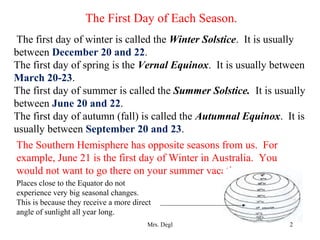
The Southern Hemisphere has opposite seasons from us. For
example, June 21 is the first day of Winter in Australia. You
would not want to go there on your summer vacation.
Places close to the Equator do not
experience very big seasonal changes.
This is because they receive a more direct
angle of sunlight all year long.
Mrs. Degl 3
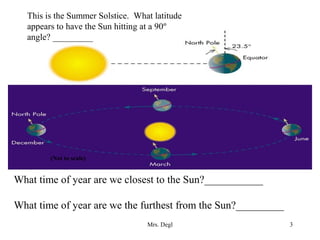
This is the Summer Solstice. What latitude
appears to have the Sun hitting at a 90º
angle? _________
What time of year are we closest to the Sun?___________
What time of year are we the furthest from the Sun?_________
(Not to scale)
Mrs. Degl 4
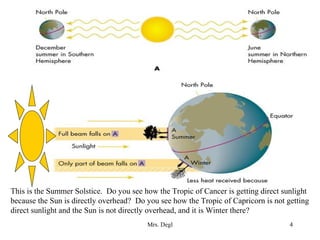
This is the Summer Solstice. Do you see how the Tropic of Cancer is getting direct sunlight
because the Sun is directly overhead? Do you see how the Tropic of Capricorn is not getting
direct sunlight and the Sun is not directly overhead, and it is Winter there?
Mrs. Degl 5
Seasonal Facts
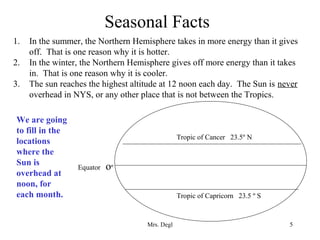
1. In the summer, the Northern Hemisphere takes in more energy than it gives
off. That is one reason why it is hotter.
2. In the winter, the Northern Hemisphere gives off more energy than it takes
in. That is one reason why it is cooler.
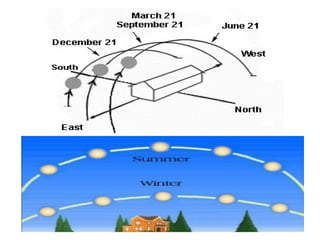
3. The sun reaches the highest altitude at 12 noon each day. The Sun is never
overhead in NYS, or any other place that is not between the Tropics.
Tropic of Cancer 23.5º N
Tropic of Capricorn 23.5 º S
Equator oº
We are going
to fill in the
locations
where the
Sun is
overhead at
noon, for
each month.
Mrs. Degl 6
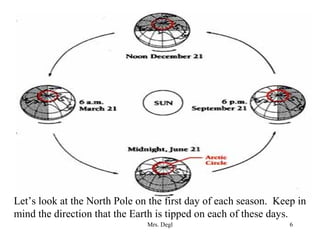
Let’s look at the North Pole on the first day of each season. Keep in
mind the direction that the Earth is tipped on each of these days.
Mrs. Degl 7
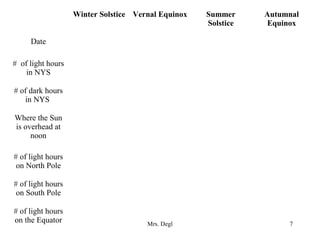
Winter Solstice Vernal Equinox Summer
Solstice
Autumnal
Equinox
Date
# of light hours
in NYS
# of dark hours
in NYS
Where the Sun
is overhead at
noon
# of light hours
on North Pole
# of light hours
on South Pole
# of light hours
on the Equator
Mrs. Degl 8
Daily Heat/Temperature
Lag Even though the Sun is the highest of the day at 12 noon,
which means that it is the strongest at noon, that is not the
hottest time of day. Actually, the hottest time of day is
around 2 pm. This is because it takes a while for the light
to turn into heat and be re-radiated back into our
atmosphere. That is when we feel the heat. (Remember, the
Earth takes in light, and gives off heat (infrared)).
Yearly Heat/Temperature Lag
Even though the Sun is the highest and strongest between
June 20 to 22 each year, the hottest time of year is in late
July into early August. This is because it takes a while
for the light that hits the Earth to turn into infrared heat and
be re-radiated back into the atmosphere. Everything
catches up in about July/August, which is when you feel
the warmest.
Mrs. Degl 9
Angle of Insolation
Intensity of Insolation
Duration of Insolation
Terrestrial Radiation
Lets fill in some vocab!
Mrs. Degl 10
Mrs. Degl 11
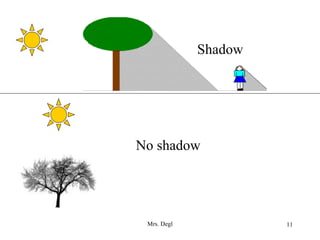
Shadow
No shadow

Reasons for Seasons

  • 1.
    Mrs. Degl 1 Reasonsfor Seasons The seasons on Earth change every 3 months. There are two main causes for the change of seasons: 1. The axis of the Earth is tilted 23.5º 2. The Earth revolves around the Sun once a year If the Earth stopped revolving around the Sun, the seasons would never change. We would remain in what ever season we were in when the Earth stopped revolving. If the Earth tipped over a few more degrees, the seasons would be more extreme (winter would be colder and summer would be much hotter). If the Earth was tipped less, the seasons would be less extreme. If the Earth stood straight up, the Earth would have never have seasons again, and every place would have the same climate all of the time. However, each location would have a different climate.
  • 2.
    Mrs. Degl 2 TheFirst Day of Each Season. The first day of winter is called the Winter Solstice. It is usually between December 20 and 22. The first day of spring is the Vernal Equinox. It is usually between March 20-23. The first day of summer is called the Summer Solstice. It is usually between June 20 and 22. The first day of autumn (fall) is called the Autumnal Equinox. It is usually between September 20 and 23. The Southern Hemisphere has opposite seasons from us. For example, June 21 is the first day of Winter in Australia. You would not want to go there on your summer vacation. Places close to the Equator do not experience very big seasonal changes. This is because they receive a more direct angle of sunlight all year long.
  • 3.
    Mrs. Degl 3 Thisis the Summer Solstice. What latitude appears to have the Sun hitting at a 90º angle? _________ What time of year are we closest to the Sun?___________ What time of year are we the furthest from the Sun?_________ (Not to scale)
  • 4.
    Mrs. Degl 4 Thisis the Summer Solstice. Do you see how the Tropic of Cancer is getting direct sunlight because the Sun is directly overhead? Do you see how the Tropic of Capricorn is not getting direct sunlight and the Sun is not directly overhead, and it is Winter there?
  • 5.
    Mrs. Degl 5 SeasonalFacts 1. In the summer, the Northern Hemisphere takes in more energy than it gives off. That is one reason why it is hotter. 2. In the winter, the Northern Hemisphere gives off more energy than it takes in. That is one reason why it is cooler. 3. The sun reaches the highest altitude at 12 noon each day. The Sun is never overhead in NYS, or any other place that is not between the Tropics. Tropic of Cancer 23.5º N Tropic of Capricorn 23.5 º S Equator oº We are going to fill in the locations where the Sun is overhead at noon, for each month.
  • 6.
    Mrs. Degl 6 Let’slook at the North Pole on the first day of each season. Keep in mind the direction that the Earth is tipped on each of these days.
  • 7.
    Mrs. Degl 7 WinterSolstice Vernal Equinox Summer Solstice Autumnal Equinox Date # of light hours in NYS # of dark hours in NYS Where the Sun is overhead at noon # of light hours on North Pole # of light hours on South Pole # of light hours on the Equator
  • 8.
    Mrs. Degl 8 DailyHeat/Temperature Lag Even though the Sun is the highest of the day at 12 noon, which means that it is the strongest at noon, that is not the hottest time of day. Actually, the hottest time of day is around 2 pm. This is because it takes a while for the light to turn into heat and be re-radiated back into our atmosphere. That is when we feel the heat. (Remember, the Earth takes in light, and gives off heat (infrared)). Yearly Heat/Temperature Lag Even though the Sun is the highest and strongest between June 20 to 22 each year, the hottest time of year is in late July into early August. This is because it takes a while for the light that hits the Earth to turn into infrared heat and be re-radiated back into the atmosphere. Everything catches up in about July/August, which is when you feel the warmest.
  • 9.
    Mrs. Degl 9 Angleof Insolation Intensity of Insolation Duration of Insolation Terrestrial Radiation Lets fill in some vocab!
  • 10.
  • 11.