

Search Engine Optimization
ContentsWhat is a Search Engine?How Do Search Engines Work?Why Search Engine Marketing?What is Search Engine Optimization?SEO Process? What to watch out for?Role of Social Bookmarking in SEOPPC vis a vis SEO
What is a Search Engine?Def: An internet-based tool that searches an index of documents for a particular term, phrase or text specified by the user. Commonly used to refer to large web-based search engines that search through billions of pages on the internet.Different than a DirectoryCommon Characteristics:Spider, Indexer, Database, AlgorithmFind matching documents and display them according to relevanceFrequent updates to documents searched and ranking algorithmStrive to produce “better”, more relevant results than competitors
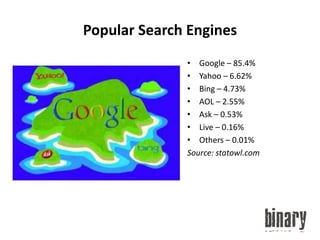
Popular Search EnginesGoogle – 85.4%Yahoo – 6.62%Bing – 4.73%AOL – 2.55%Ask – 0.53%Live – 0.16%Others – 0.01%Source: statowl.com
How Do Search Engines Work?Spider “crawls” the web to find new documents (web pages, other documents) typically by following hyperlinks from websites already in the databaseSearch engine indexes the content (text, code) in these documents by adding it to their huge databases and periodically updates this contentSearch engine searches its own database when user enters in a search to find related documents (not searching web pages in real-time)Search engine ranks resulting documents using an algorithm (mathematical formula) that assigns various weights to various ranking factors
Why Search Engine Marketing?85% of all traffic on the internet is referred from a search engine90% of all users don't look past the first 30 results (most only view top 10)Many websites aren't even indexed, most are poorly optimized and get very little traffic from the search enginesCost-effective advertisingClear and measurable ROIOperates under this assumption:More (relevant) traffic + Good Conv. Rate = More Sales/Leads
Ranking FactorsOn-Page Factors (Code & Content)		Title tags <title>		Header tags <h1>		ALT image tags		Content, Content, Content (Body text) <body>		Hyperlink text		Keyword frequency & densityOff-Page Factors	Link Popularity (“votes” for your site) – adds credibility	Anchor text
And Something else too….
So What is the Algorithm?Top Secret! Only select employees of the actual search engines know for certainReverse engineering, research and experiments gives SEOs (search engine optimization professionals) a “pretty good” idea of major factors and approximate weight assignmentsConstantly changing, tweaking, updating is done to the algorithmWebsites and documents being searched are also constantly changingVaries by Search Engine – some give more weight to on-page factors, some to link popularity
What is Search Engine Optimization?Search engine optimization (SEO) is the process of improving the volume or quality of traffic to a web site from search engines via search results. SEO aims to improve rankings for relevant keywords in search resultsWhy are search engines so important?Search engines are the biggest source of a website trafficTypically, the earlier (or higher) a site appears in the search results list, the more visitors it will receive from the search engineMore visitors means more customers and higher profit
What SEO is NOTSearch Engine Submission only“Submit your website to 5,000 search engines”An overnight process (typically takes 3-4 months to showsignificantresults)Restricted to a finite number of keywordsA one-time process (in many cases requires a continual, long-term focus for best results)Guaranteed first page rankings (only Sergey Brin and Larry Paige can ensure that)A INR 50K one-time fee!
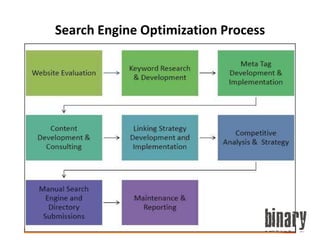
Search Engine Optimization Process
Website EvaluationSearch Engine Accessibility: Recommending modifications on website with W3C standards that will allow better accessibility to various search engines.Link Validity Check: Checking inbound and outbound links on your website.Link Popularity Check: Checking relevant linking to various websites.Meta Check: Unique meta tags for web pages of website.Checking Download Time: Check download time with different browsers and internet connection speed.
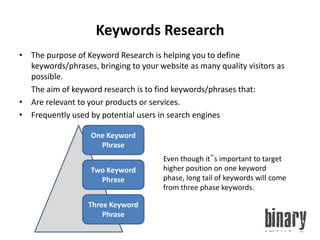
Keywords ResearchThe purpose of Keyword Research is helping you to define keywords/phrases, bringing to your website as many quality visitors as possible.	The aim of keyword research is to find keywords/phrases that:Are relevant to your products or services.Frequently used by potential users in search enginesOne KeywordPhraseEven though it‟s important to target higher position on one keyword phase, long tail of keywords will come from three phase keywords.Two KeywordPhraseThree KeywordPhrase
Meta Tags DevelopmentMeta Tags are the first to be read by search engines. Each of the inner pages should be targeted for the keywords that it is promoting. The title tag for all the pages of website needs to optimized for the related content of particular webpage. The page title is displayed in the search engine listings as a visible link to the website, thus making it extremely important to have relevant keywords. The page titles should be unique on each page, matching the most frequently appearing keywords.Few Important Meta Tags are: Title, Description, Keyword, Comment, ALT Tag
Content ConsultingEach portal needs to write content / title of stories in a particular format. Writers need to be educated on „How‟ to write effective stories / titles for every story and article. For Eg: if someone is writing a story on Tendulkar hitting a century. Two ways of doing same would be: Little Master Did It Again! (Not recommended: Does Not have Tendulkar in Title)Tendulkar hit yet another century. (Recommended: Has Tendulkar in Title)
Linking Strategy Development	Various Search Engines base part of their ranking algorithms on how many their websites link to yours. We visit websites/ directories/ portals in similar market sectors to yours and either email the website owner direct and ask for a link or fill out any necessary on-line form to have a link placed.Link PlacementLink ExchangeDirectory Submission	Manual Search Engine / Directory SubmissionManual submission to Auto-Submit Tools because Manual Submission is “more effective” and submit only "when necessary.“Choosing most relevant directory for your website is important.
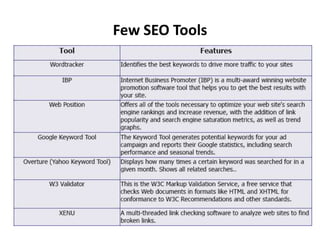
Few SEO Tools
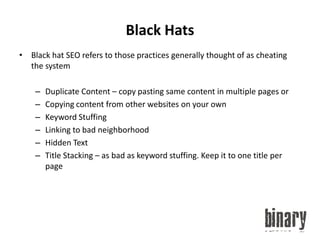
Black HatsBlack hat SEO refers to those practices generally thought of as cheating the systemDuplicate Content – copy pasting same content in multiple pages orCopying content from other websites on your ownKeyword StuffingLinking to bad neighborhoodHidden TextTitle Stacking – as bad as keyword stuffing. Keep it to one title per page
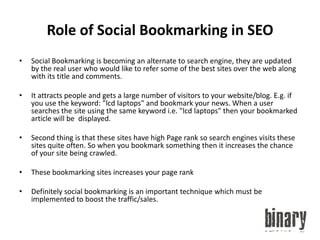
Role of Social Bookmarking in SEOSocial Bookmarking is becoming an alternate to search engine, they are updated by the real user who would like to refer some of the best sites over the web along with its title and comments.It attracts people and gets a large number of visitors to your website/blog. E.g. if you use the keyword: "lcd laptops" and bookmark your news. When a user searches the site using the same keyword i.e. "lcd laptops" then your bookmarked article will be  displayed.Second thing is that these sites have high Page rank so search engines visits these sites quite often. So when you bookmark something then it increases the chance of your site being crawled.These bookmarking sites increases your page rankDefinitely social bookmarking is an important technique which must be implemented to boost the traffic/sales.
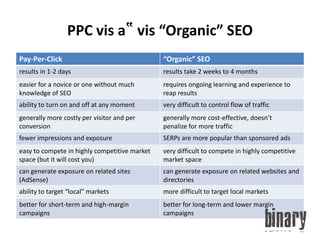
PPC vis a‟ vis “Organic” SEO
SEO

SEO

  • 1.
  • 2.
    ContentsWhat is aSearch Engine?How Do Search Engines Work?Why Search Engine Marketing?What is Search Engine Optimization?SEO Process? What to watch out for?Role of Social Bookmarking in SEOPPC vis a vis SEO
  • 3.
    What is aSearch Engine?Def: An internet-based tool that searches an index of documents for a particular term, phrase or text specified by the user. Commonly used to refer to large web-based search engines that search through billions of pages on the internet.Different than a DirectoryCommon Characteristics:Spider, Indexer, Database, AlgorithmFind matching documents and display them according to relevanceFrequent updates to documents searched and ranking algorithmStrive to produce “better”, more relevant results than competitors
  • 4.
    Popular Search EnginesGoogle– 85.4%Yahoo – 6.62%Bing – 4.73%AOL – 2.55%Ask – 0.53%Live – 0.16%Others – 0.01%Source: statowl.com
  • 5.
    How Do SearchEngines Work?Spider “crawls” the web to find new documents (web pages, other documents) typically by following hyperlinks from websites already in the databaseSearch engine indexes the content (text, code) in these documents by adding it to their huge databases and periodically updates this contentSearch engine searches its own database when user enters in a search to find related documents (not searching web pages in real-time)Search engine ranks resulting documents using an algorithm (mathematical formula) that assigns various weights to various ranking factors
  • 6.
    Why Search EngineMarketing?85% of all traffic on the internet is referred from a search engine90% of all users don't look past the first 30 results (most only view top 10)Many websites aren't even indexed, most are poorly optimized and get very little traffic from the search enginesCost-effective advertisingClear and measurable ROIOperates under this assumption:More (relevant) traffic + Good Conv. Rate = More Sales/Leads
  • 7.
    Ranking FactorsOn-Page Factors(Code & Content) Title tags <title> Header tags <h1> ALT image tags Content, Content, Content (Body text) <body> Hyperlink text Keyword frequency & densityOff-Page Factors Link Popularity (“votes” for your site) – adds credibility Anchor text
  • 8.
  • 9.
    So What isthe Algorithm?Top Secret! Only select employees of the actual search engines know for certainReverse engineering, research and experiments gives SEOs (search engine optimization professionals) a “pretty good” idea of major factors and approximate weight assignmentsConstantly changing, tweaking, updating is done to the algorithmWebsites and documents being searched are also constantly changingVaries by Search Engine – some give more weight to on-page factors, some to link popularity
  • 10.
    What is SearchEngine Optimization?Search engine optimization (SEO) is the process of improving the volume or quality of traffic to a web site from search engines via search results. SEO aims to improve rankings for relevant keywords in search resultsWhy are search engines so important?Search engines are the biggest source of a website trafficTypically, the earlier (or higher) a site appears in the search results list, the more visitors it will receive from the search engineMore visitors means more customers and higher profit
  • 11.
    What SEO isNOTSearch Engine Submission only“Submit your website to 5,000 search engines”An overnight process (typically takes 3-4 months to showsignificantresults)Restricted to a finite number of keywordsA one-time process (in many cases requires a continual, long-term focus for best results)Guaranteed first page rankings (only Sergey Brin and Larry Paige can ensure that)A INR 50K one-time fee!
  • 12.
  • 13.
    Website EvaluationSearch EngineAccessibility: Recommending modifications on website with W3C standards that will allow better accessibility to various search engines.Link Validity Check: Checking inbound and outbound links on your website.Link Popularity Check: Checking relevant linking to various websites.Meta Check: Unique meta tags for web pages of website.Checking Download Time: Check download time with different browsers and internet connection speed.
  • 14.
    Keywords ResearchThe purposeof Keyword Research is helping you to define keywords/phrases, bringing to your website as many quality visitors as possible. The aim of keyword research is to find keywords/phrases that:Are relevant to your products or services.Frequently used by potential users in search enginesOne KeywordPhraseEven though it‟s important to target higher position on one keyword phase, long tail of keywords will come from three phase keywords.Two KeywordPhraseThree KeywordPhrase
  • 15.
    Meta Tags DevelopmentMetaTags are the first to be read by search engines. Each of the inner pages should be targeted for the keywords that it is promoting. The title tag for all the pages of website needs to optimized for the related content of particular webpage. The page title is displayed in the search engine listings as a visible link to the website, thus making it extremely important to have relevant keywords. The page titles should be unique on each page, matching the most frequently appearing keywords.Few Important Meta Tags are: Title, Description, Keyword, Comment, ALT Tag
  • 16.
    Content ConsultingEach portalneeds to write content / title of stories in a particular format. Writers need to be educated on „How‟ to write effective stories / titles for every story and article. For Eg: if someone is writing a story on Tendulkar hitting a century. Two ways of doing same would be: Little Master Did It Again! (Not recommended: Does Not have Tendulkar in Title)Tendulkar hit yet another century. (Recommended: Has Tendulkar in Title)
  • 17.
    Linking Strategy Development VariousSearch Engines base part of their ranking algorithms on how many their websites link to yours. We visit websites/ directories/ portals in similar market sectors to yours and either email the website owner direct and ask for a link or fill out any necessary on-line form to have a link placed.Link PlacementLink ExchangeDirectory Submission Manual Search Engine / Directory SubmissionManual submission to Auto-Submit Tools because Manual Submission is “more effective” and submit only "when necessary.“Choosing most relevant directory for your website is important.
  • 18.
  • 19.
    Black HatsBlack hatSEO refers to those practices generally thought of as cheating the systemDuplicate Content – copy pasting same content in multiple pages orCopying content from other websites on your ownKeyword StuffingLinking to bad neighborhoodHidden TextTitle Stacking – as bad as keyword stuffing. Keep it to one title per page
  • 20.
    Role of SocialBookmarking in SEOSocial Bookmarking is becoming an alternate to search engine, they are updated by the real user who would like to refer some of the best sites over the web along with its title and comments.It attracts people and gets a large number of visitors to your website/blog. E.g. if you use the keyword: "lcd laptops" and bookmark your news. When a user searches the site using the same keyword i.e. "lcd laptops" then your bookmarked article will be displayed.Second thing is that these sites have high Page rank so search engines visits these sites quite often. So when you bookmark something then it increases the chance of your site being crawled.These bookmarking sites increases your page rankDefinitely social bookmarking is an important technique which must be implemented to boost the traffic/sales.
  • 21.
    PPC vis a‟vis “Organic” SEO