1
‫ر‬َ‫ـد‬ْ‫ق‬‫ِـ‬‫ن‬،،،‫لما‬‫اننا‬ ‫نصدق‬ْْ‫ق‬ِ‫ن‬‫ر‬َ‫د‬
2
 The software architecture of a program or computing
system is the structure (or structures) of the system,
including:
 Dividing software into subsystems.
 Deciding how these will interact.
 Determining their interfaces.
• The architecture is the core of the design, so all software
engineers need to understand it.
• The architecture will often constrain the overall efficiency,
reusability and maintainability of the system
3
 Why you need to develop an architectural model:
 To enable everyone to better understand the system
 To allow people to work on individual pieces of the system
in isolation
 To prepare for extension of the system
 To facilitate reuse and reusability
4
 An architecture is an abstraction of a system that
suppresses details of components that do not affect how
they:
 Use other components
 Are used by other components
 Relate to other components
 Interact with other components
5
 To ensure the maintainability and reliability of a system,
an architectural model must be designed to be stable.
 Being stable means that the new features can be easily
added with only small changes to the architecture.
6
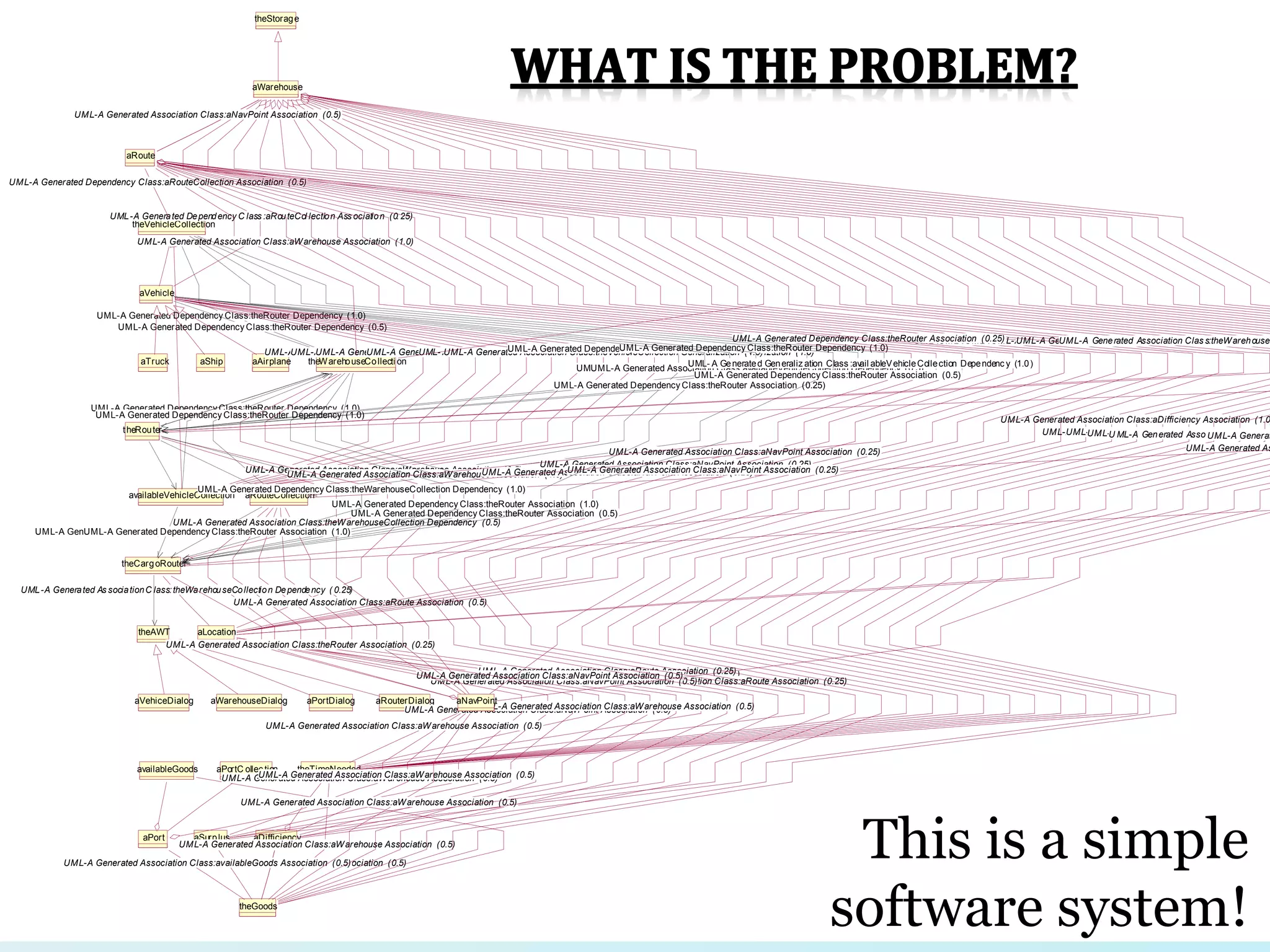
aTruck aShip aAirplane theWarehouseCollecti on
theVehicleCollection
UML-A Generated Dependency Class:theRouter Dependency (1.0)
theStorage
aVehicle
UML-A Generated Dependency Class:theRouter Dependency (0.5)
availableVehicleCollection
UML-A Generated Association Class:theVehicleCollection Generalization (1.0)UML-A Generated Association Class:theVehicleCollection Generalization (1.0)UML-A Generated Association Class:theVehicleCollection Generalization (1.0)UML-A Generated As sociationC lass:theVehicleC ollec tion Generalization (1.0)UML-A Generated Association Class:theVehicleCollection Generalization (1.0)UML-A Generated Association Class:theVehicleCollection Generalization (1.0)UML-A Generated Association Class:theVehicleCollection Generalization (1.0)UML-A Generated Association Class:theVehicleCollection Generalization (1.0)UML- A Generated Ass ociati onCl ass:theVehi cleCollection Generali zation (1.0)UML-A Generated Association Class:theVehicleCollection Generalization (1.0)
UML-A Generated Dependency Class:theRouter Dependency (1.0)
availableGoods
aPort
aPortC ollec tion
aSurplus aDifficiency
theTimeNeeded
theGoods
UML-A Generated Association Class:aWarehouse Association (0.5)
UML-A Generated Association Class:availableGoods Association (0.5)
aRouteCollection
UML-A Generated Association Class:aRoute Association (0.25)UML-A Generated Association Class:aRoute Association (0.25)UML-A Generated Association Class:aRoute Association (0.25)
UML-A Generated Association Class:aRoute Association (0.25)
UML-A Generated Dependency Class:theRouter Dependency (0.5)UML-A Generated Dependency Class:theRouter Dependency (1.0)
UML-A Generated Dependency Class:theRouter Dependency (1.0)
theAWT
aVehiceDialog aWarehouseDialog aPortDialog aRouterDialog
aWarehouse
UML-A Generated AssUML-A Generated Association Class:aDifficiency Associ
UML-A Generated Association Class:aDifficiency AssociatioUML-A Generated Association Class:aDifficiency Association (1.0
UML-A Generated Association Class:aDifficiency AU ML-A Generated AssociationClaUML-A Generated AssociatioUML-A Generated Association Class:aDifficieU ML-A Generated AssociationClass:aDUML-A Generat
UML-A GeneraUML-A Generated As
aLocation
UML-A Generated Association Class:aWarehouse Association (0.5)
UML-A Generated Association Class:aNavPoint Association (0.5)
UML-A Generated Association Class:aWarehouse Association (0.5)
aNavPoint
UML-A Generated Association Class:aWarehouse Association (1.0)
UML-A Generated Association Class:aWarehouse Association (0.5)UML-A Generated Association Class:aWarehouse Association (0.5)
UML-A Generated Association Class:aWarehouse Association (0.5)
UML-A Generated Association Class:aRoute Association (0.5)
aRoute
UML-A Generated Dependency C lass :aRouteCol lection Ass ociation (0.25)
UML-A Generated Association Class:aNavPoint Association (1.0)UML-A Generated Association Class:aNavPoint Association (0.5)
UML-A Generated Association Class:aWarehouse Association (1.0)
UML-A Generated Dependency Class:aRouteCollection Association (0.5)
UML-A Generated Association Class:aNavPoint Association (1.0)UML-A Generated Association Class:aNavPoint Association (1.0)UML-A Generated Association Class:aNavPoint Association (1.0)UML-A Generated Association Class:aNavPoint Association (1.0)UML-A Generated Association Class:aNavPoint Association (1
UML-A Generated Association Class:aNavPoint Association (0.25)
UML-A Generated Dependency Class:theRouter Association (0.25)
UML-A Generated Association Class:aNavPoint Association (0.25)
theCargoRouter
UML-A Generated As sociationC lass:theWarehouseCollection Dependency ( 0.25)
UML-A Generated Association Class:theRouter Association (0.25)
UML-A Generated Association Class:theRouter A
theRouter
UML-A Generated Association Class:theWarehouseCollection Dependency (0.5)
UML-A Generated Dependency Class :aRoUML-A Generated Association Clas s:theWarehouseC
UML-A Generated Association Class:theVehicleCollection Dependency (0.5)UML-A Generated Association Class:availableVehicleCollection Dependency (0.5)
UML- A Generated Generaliz ation Class :avail ableVehicleCollection Dependenc y (1.0)
UML-A Generated Dependency Class:theRouter Association (0.25)
UML-A Generated Dependency Class:theRouter Association (0.5)
UML-A Generated Dependency Class:theRouter Association (1.0)
UML-A Generated Dependency Class:theRouter Association (0.5)
UML-A Generated Dependency Class:theWarehouseCollection Dependency (1.0)
UML-A Generated Dependency Class:theRouter Association (1.0)UML-A Generated Dependency Class:theRouter Association (1.0)
This is a simple
software system!
7
8
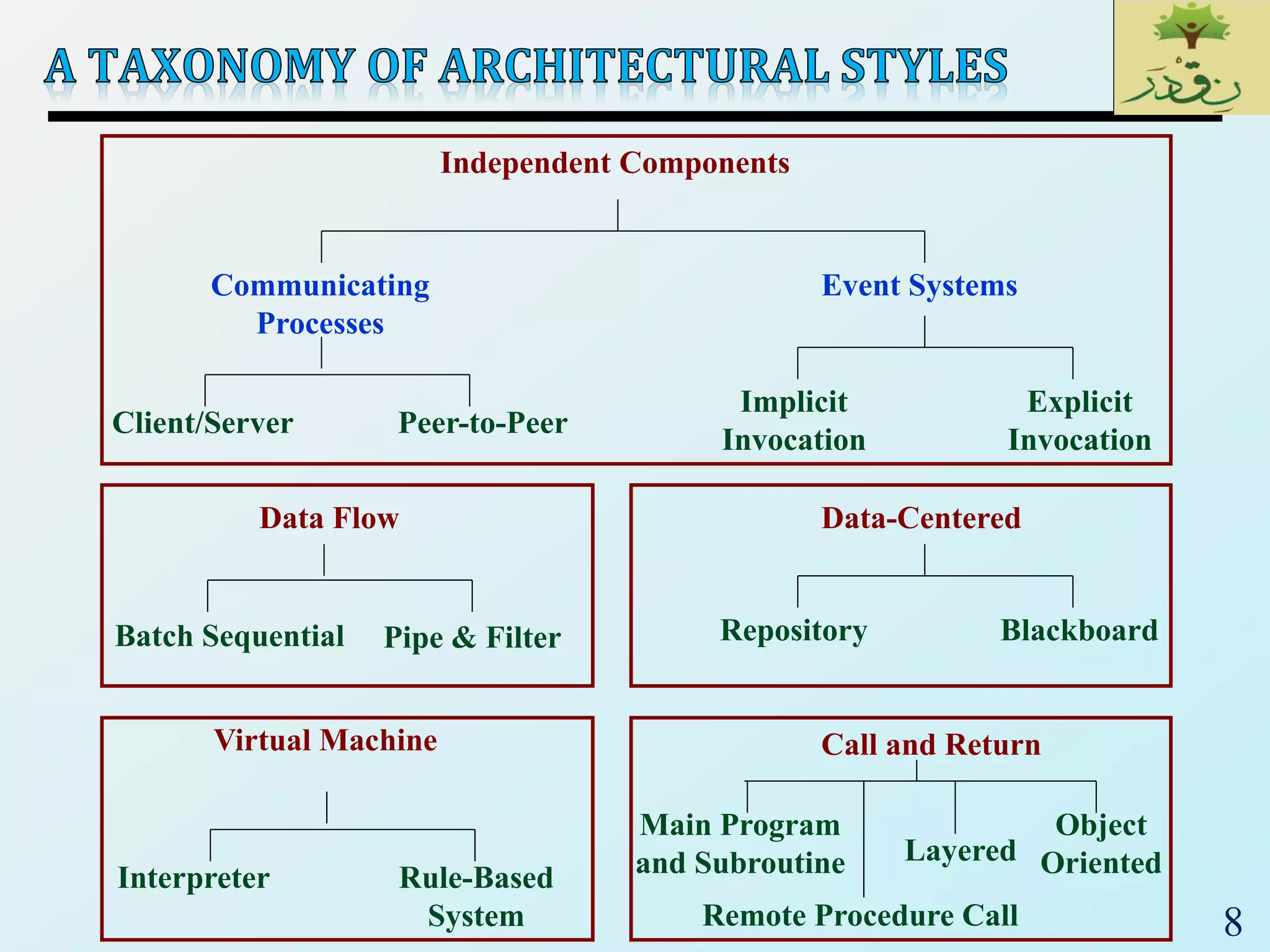
Independent Components
Communicating
Processes
Event Systems
Client/Server Peer-to-Peer
Implicit
Invocation
Explicit
Invocation
Data Flow
Batch Sequential Pipe & Filter
Virtual Machine
Interpreter Rule-Based
System
Data-Centered
Repository Blackboard
Call and Return
Main Program
and Subroutine
Object
OrientedLayered
Remote Procedure Call
9
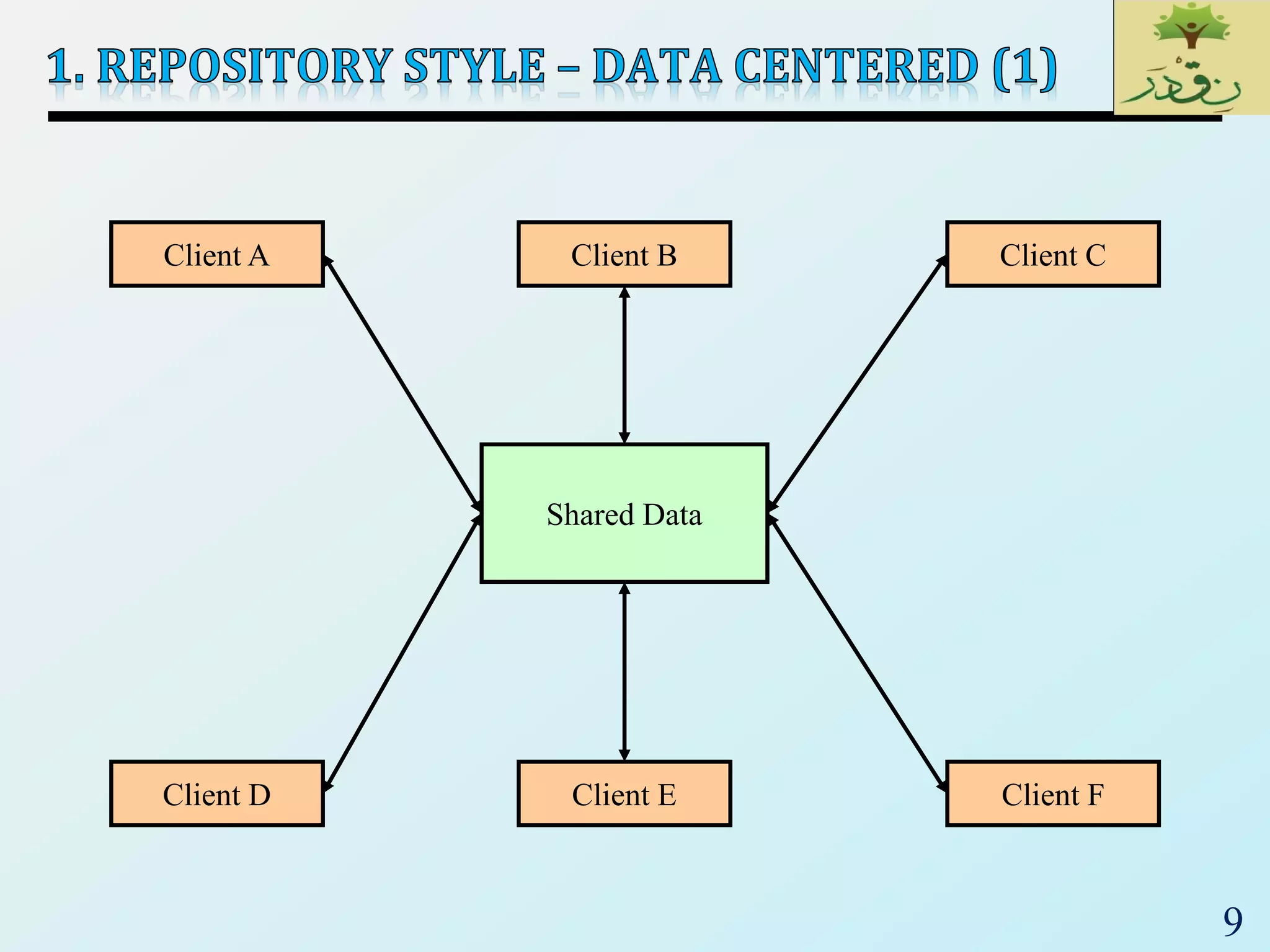
Shared Data
Client A Client B Client C
Client D Client E Client F
10
 Has goal of achieving the quality of integrability of data.
 The term refers to systems in which the access and update
of a widely accessed data store is their primary goal.
 Basically, it is nothing more than a centralized data store
that communicates with a number of clients.
 Important for this styles are three protocols:
communication, data definition and data manipulation
protocol
 A client runs on an independent thread of control.
 The means of communication distinguishes the two
subtypes: repository and blackboard
 Repository: a client sends a request to the system to perform
a necessary action (e.g. insert data)
 Blackboard: the system sends notification and data to
subscribers when data of interest changes, and is thus active
11
 Ensures data integrity
 Reliable, secure, easy to Backup, testability guaranteed
 Clients independent on the system: performance and
usability on the client side is good
 Problems with scalability
 Solutions: shared repositories, replication but this
increases complexity
12
 One of the most well-known examples of the data-
centered architecture, is a database architecture
 E.g. in RDBMS a set of related tables with fields, data
types, keys, ...
 Clients use data manipulation protocol to work with the
data
 E.g. SQL for inserting, selecting, deleting data, ...
 Depending on where clients are situated communication
protocol might be
 An inner-process communication
 Communication between components on the same machine
 Communication over network, e.g. LAN, Internet, etc.
13
 Has the goal of achieving the quality of reuse and
modifiability.
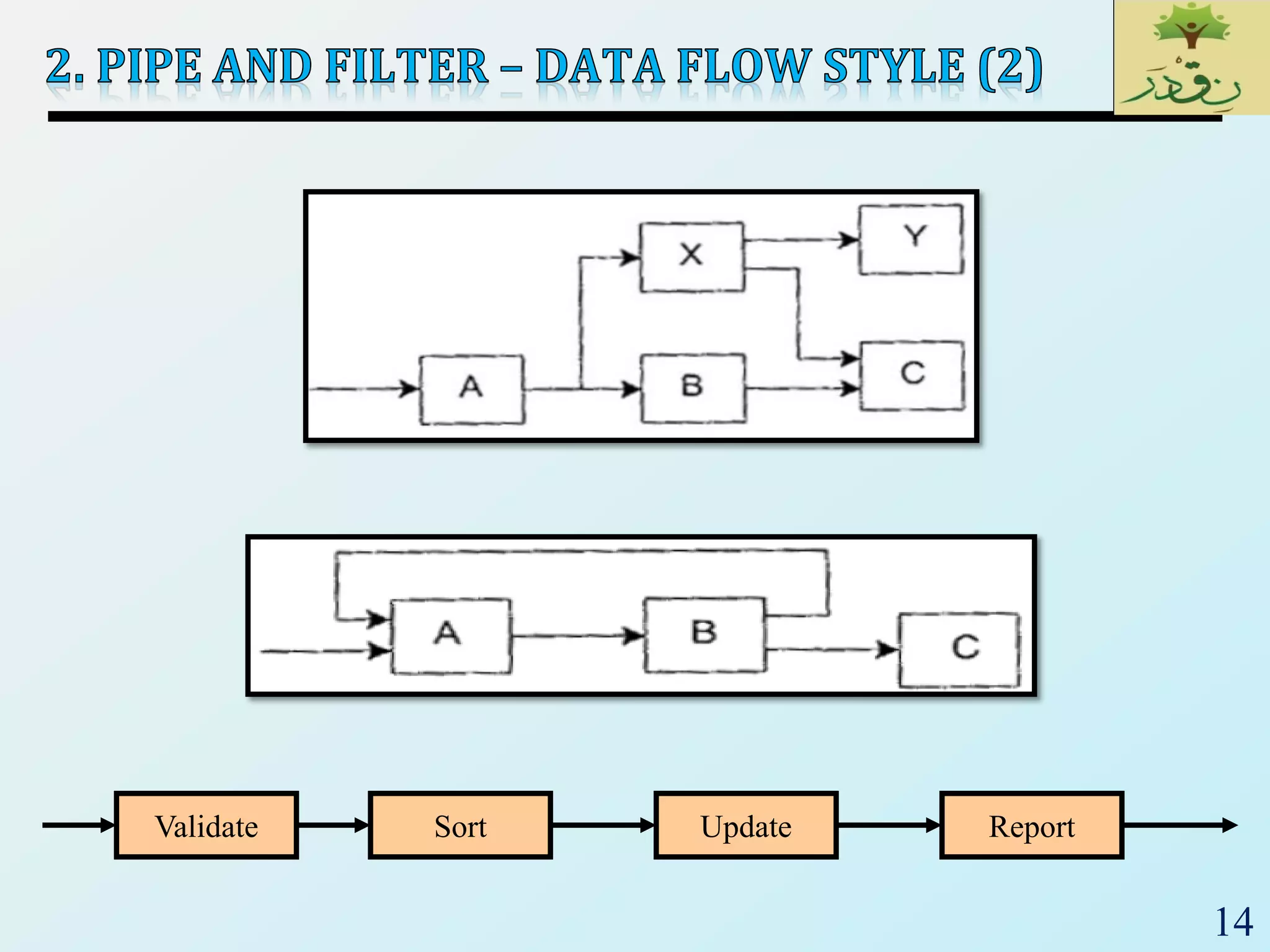
 The data-flow style is characterized by viewing the system
as a series of transformations on successive pieces of input
data.
 Data enter the system and then flows through the
components one at a time until
 Finally, the data is assigned to some final destination
(output or a data store).
 The architecture is very flexible.
 Almost all the components could be removed.
 Components could be replaced.
 New components could be inserted.
 Certain components could be reordered.
14
Validate Sort Update Report
15
 Batch sequential style
 The processing steps are independent components
 Each step runs to completion before the next step begins
 Pipe-and-filter style
 Emphasizes the incremental transformation of data by
successive components
 The filters incrementally transform the data (entering and
exiting via streams)
 The pipes are stateless and simply exist to move data
between filters
 Note That: It is easily made into a parallel or distributed
execution in order to enhance system performance
16
 Data flows through pipes: communication channels
between filters
 Processing units: filters
 Filters do not know anything about other filters
 Modularity, maintainability is good
 Data flows in streams: good for processing of images,
audio, video, ...
 Depending on where the filters reside different
execution architectures
 E.g. same process: filters run within threads
 E.g. same machine: filters run within own processes
 E.g. network: pipes use the networking architecture
17
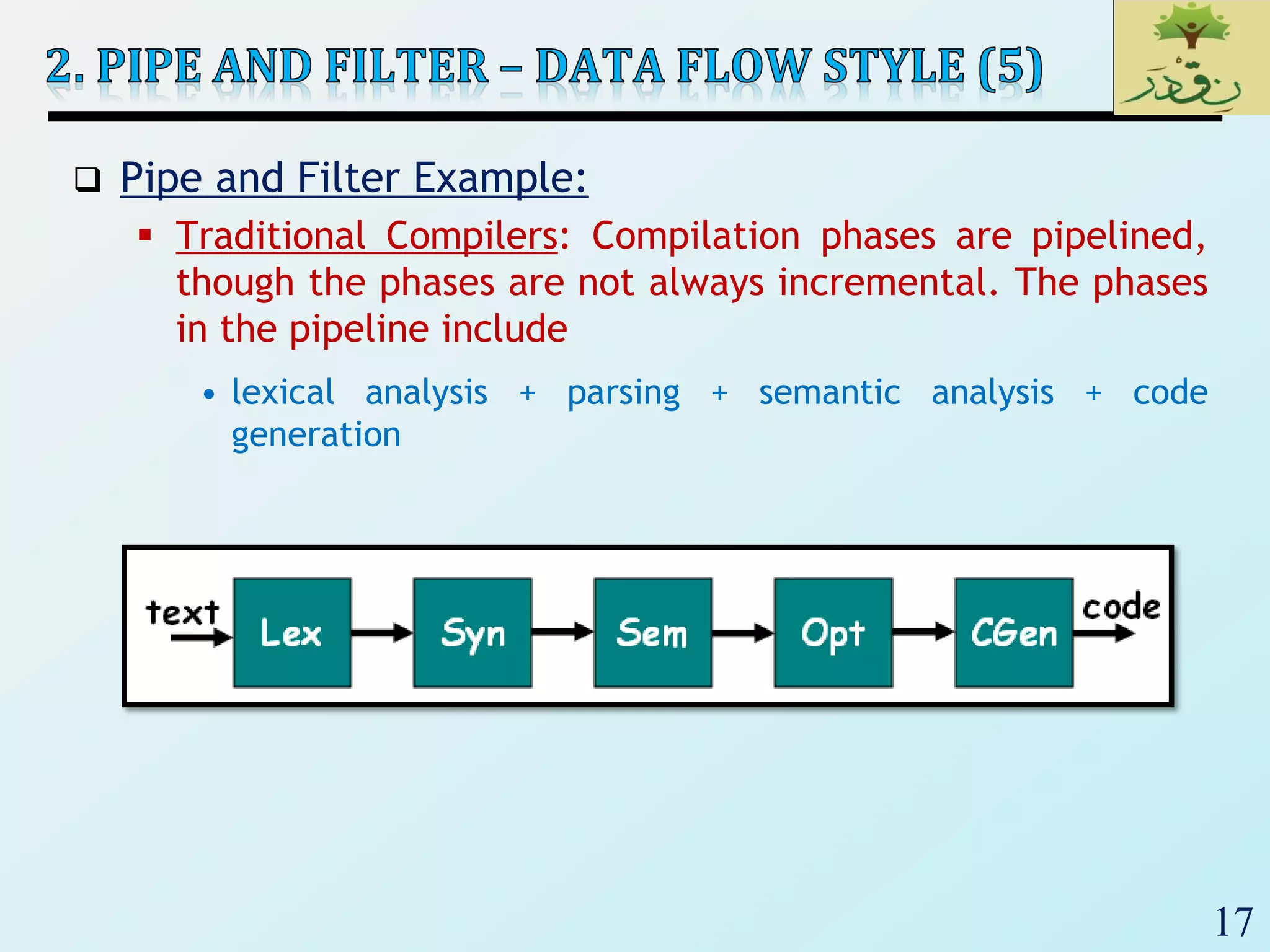
 Pipe and Filter Example:
 Traditional Compilers: Compilation phases are pipelined,
though the phases are not always incremental. The phases
in the pipeline include
• lexical analysis + parsing + semantic analysis + code
generation
18
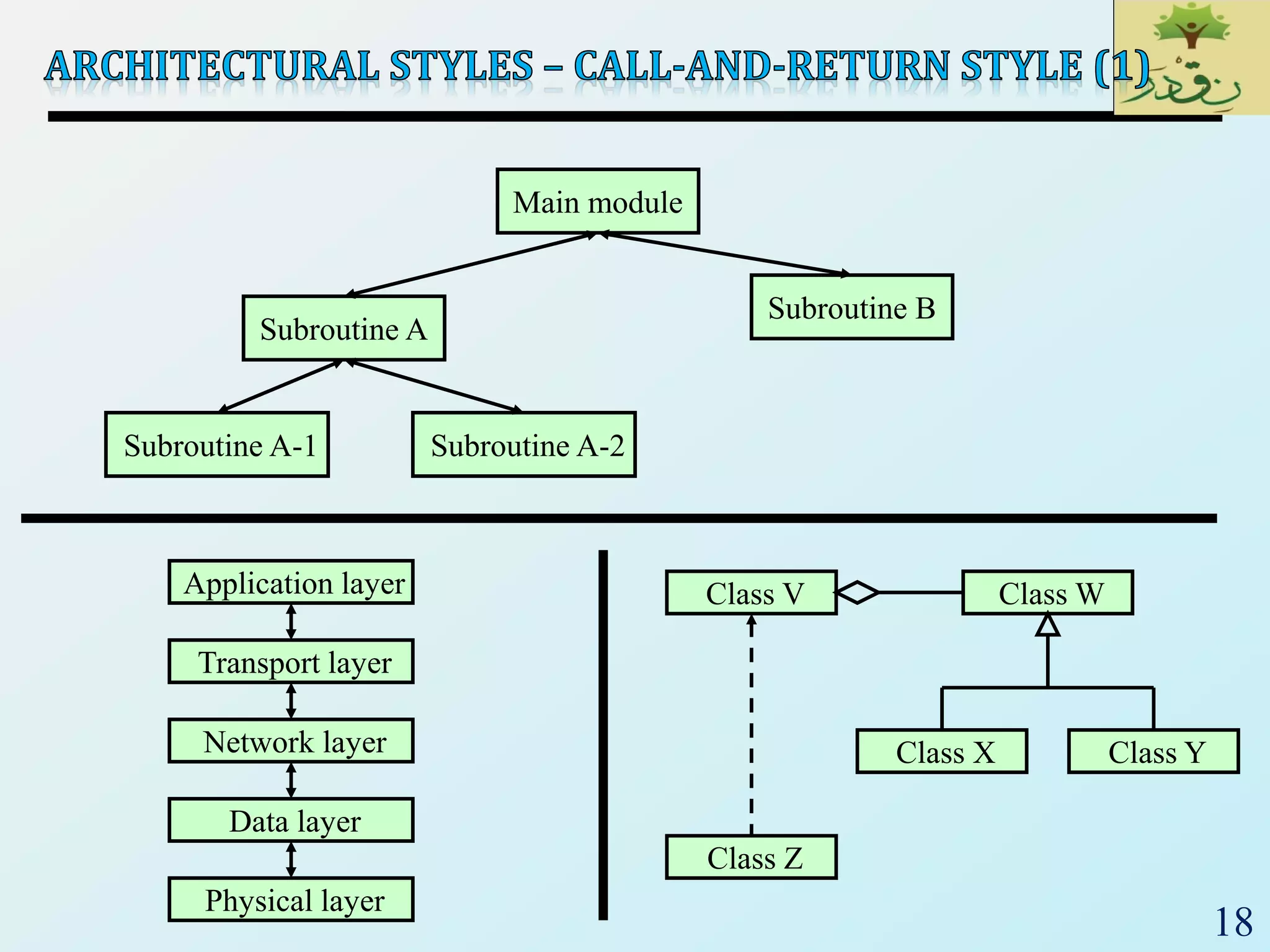
Main module
Subroutine A
Subroutine B
Subroutine A-1 Subroutine A-2
Physical layer
Data layer
Network layer
Transport layer
Application layer Class WClass V
Class X
Class Z
Class Y
19
 Has the goal of modifiability and scalability
 Has been the dominant architecture since the start of
software development
 Main program and subroutine style
 Decomposes a program hierarchically into small pieces (i.e.,
modules)
 Typically has a single thread of control that travels through
various components in the hierarchy
 Remote procedure call style
 Consists of main program and subroutine style of system that is
decomposed into parts that are resident on computers
connected via a network
 Strives to increase performance by distributing the computations
and taking advantage of multiple processors
 Incurs a finite communication time between subroutine call and
response.
20
 Object-oriented or abstract data type system
 Emphasizes the bundling of data and how to manipulate and
access data
 Keeps the internal data representation hidden and allows access
to the object only through provided operations
 Permits inheritance and polymorphism
 Layered system
 Assigns components to layers in order to control inter-
component interaction
 Only allows a layer to communicate with its immediate neighbor
21
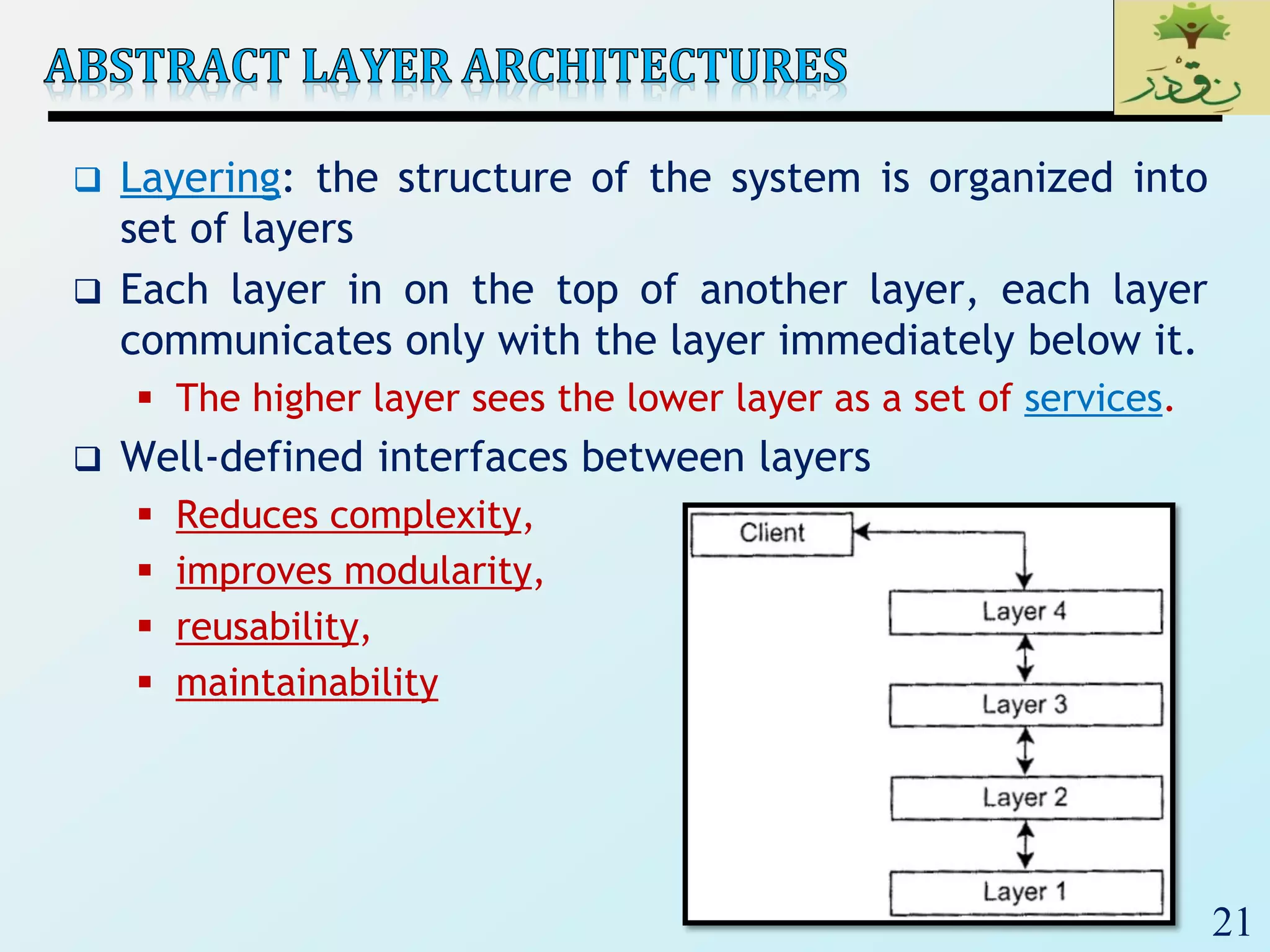
 Layering: the structure of the system is organized into
set of layers
 Each layer in on the top of another layer, each layer
communicates only with the layer immediately below it.
 The higher layer sees the lower layer as a set of services.
 Well-defined interfaces between layers
 Reduces complexity,
 improves modularity,
 reusability,
 maintainability
22
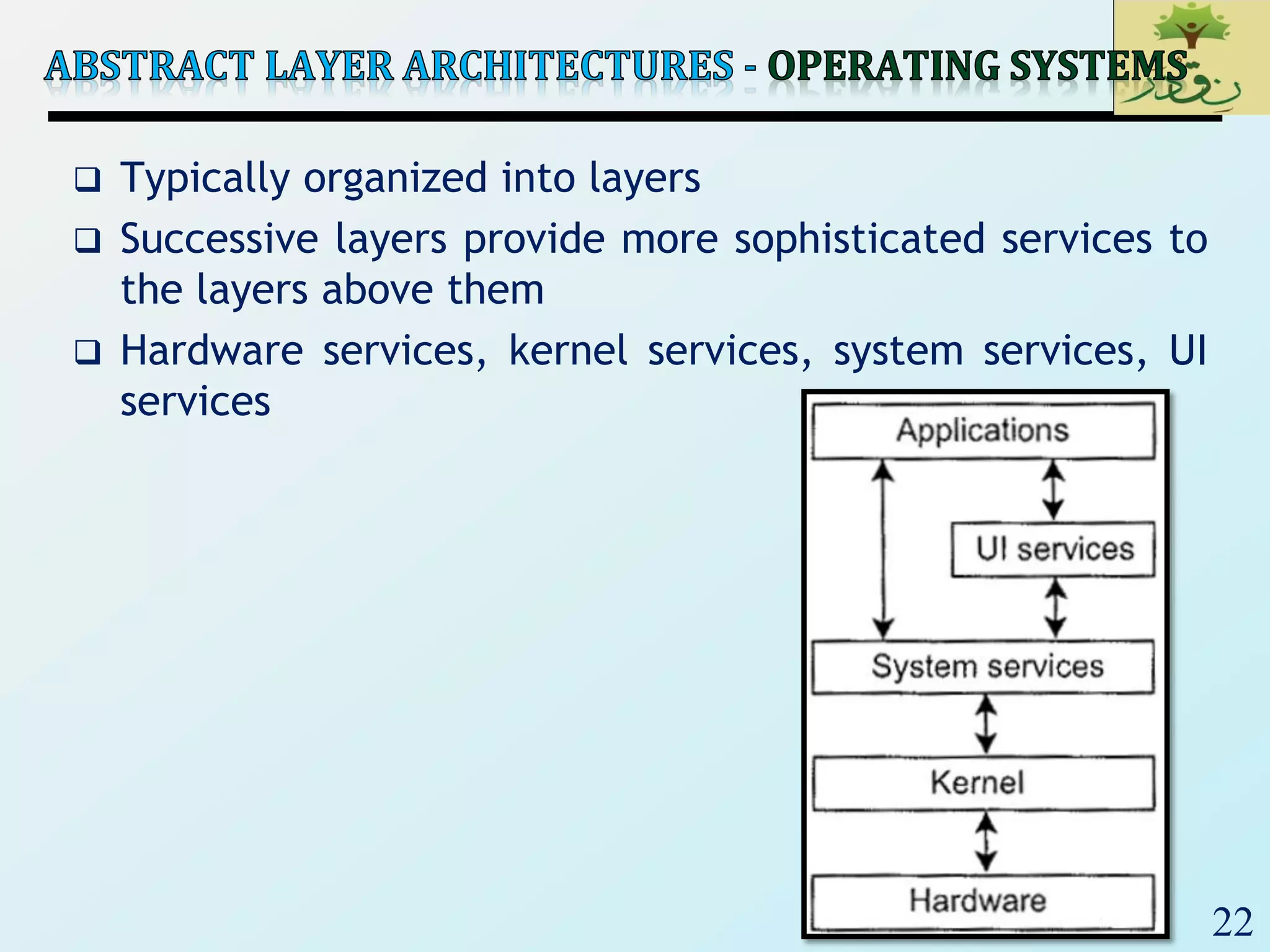
 Typically organized into layers
 Successive layers provide more sophisticated services to
the layers above them
 Hardware services, kernel services, system services, UI
services
23
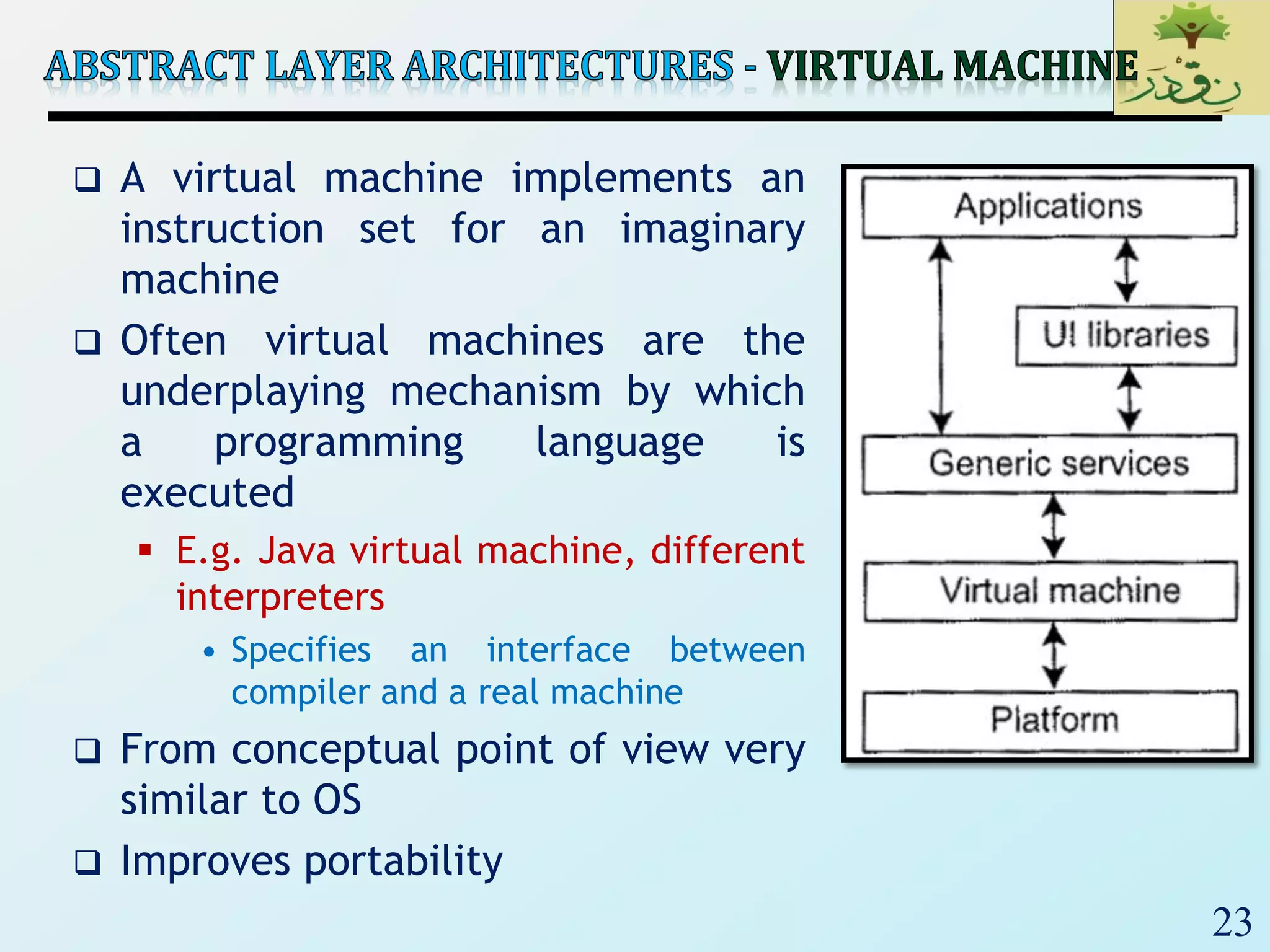
 A virtual machine implements an
instruction set for an imaginary
machine
 Often virtual machines are the
underplaying mechanism by which
a programming language is
executed
 E.g. Java virtual machine, different
interpreters
• Specifies an interface between
compiler and a real machine
 From conceptual point of view very
similar to OS
 Improves portability
24
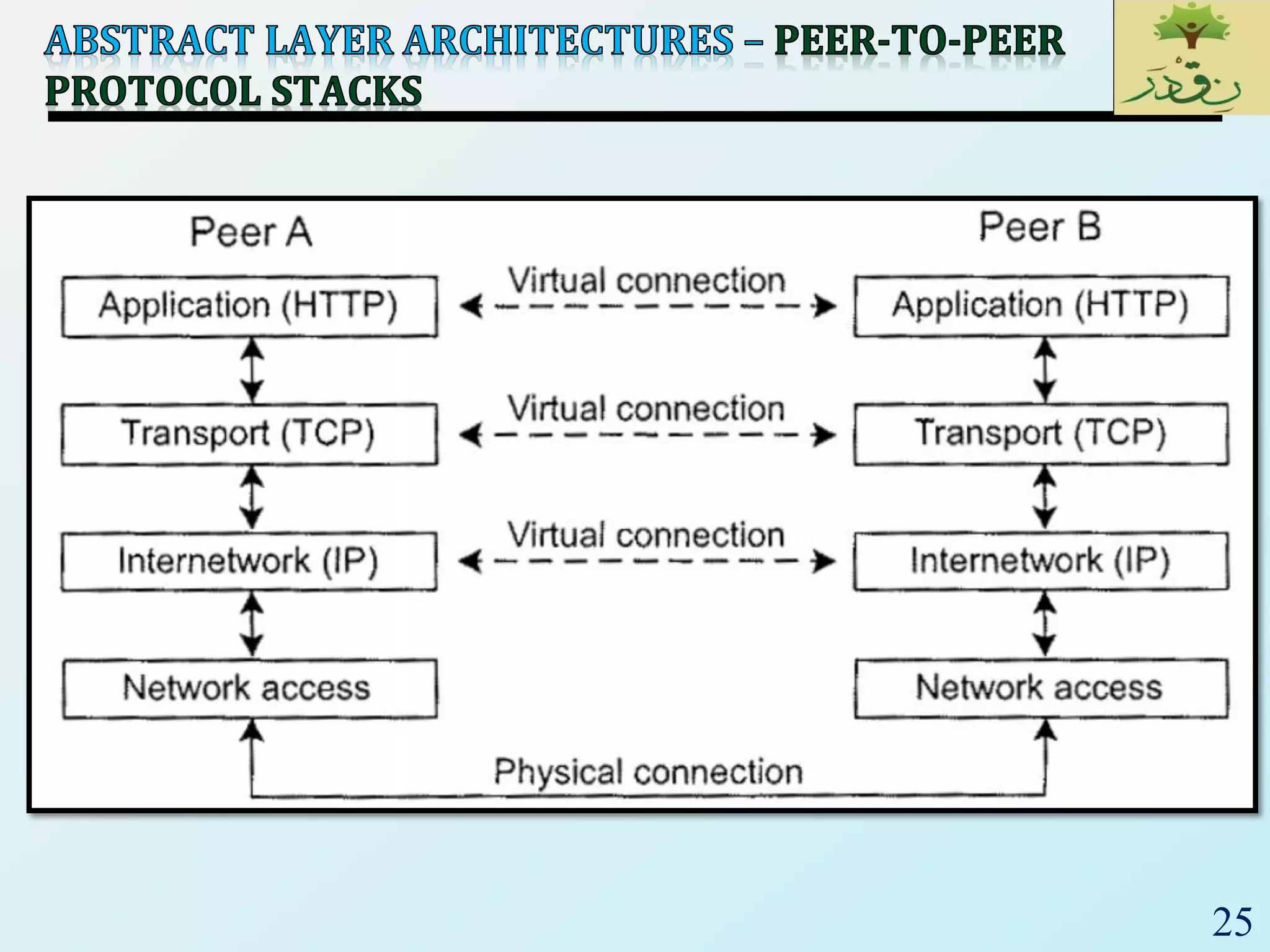
 A common example of layered architecture is a network
protocol stack
 E.g. TCP/IP protocol stack - Four layers
 The lowest layer: handles communication between two
computers
 The internet layer: handles routing of packets across the
network
 The transport layer: guarantees that packets are error-
free and received in the same order as sent
 The application layer: supports application-specific
protocols
• E.g. HTTP, SMTP, FTP, ...
25
26
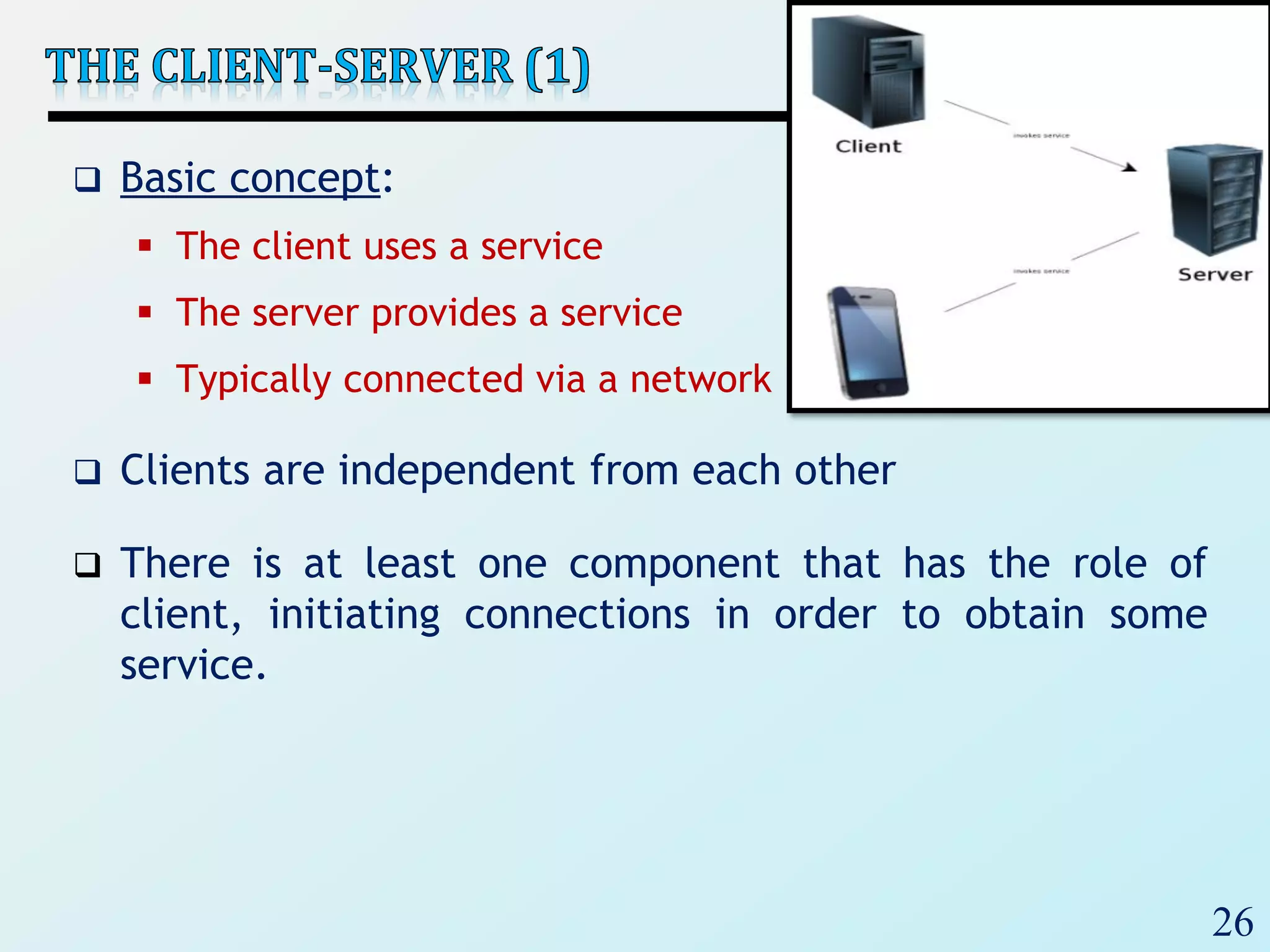
 Basic concept:
 The client uses a service
 The server provides a service
 Typically connected via a network
 Clients are independent from each other
 There is at least one component that has the role of
client, initiating connections in order to obtain some
service.
27
 Conceptually simple
 Clear separation of responsibilities, help testability
 Good scalability (if stateless)
 Excellent scalability (if server can be scaled out)
 Good for security, as data can be held at the server with
restricted access
 Risk of bad performance, if the communication between
client and server is slow, or has a high latency
 Need to develop/agree on a protocol between client and
server
 For stateful, centralized servers scalability is limited
28
 The server is no longer in the organizations network, but
somewhere in the Internet
 Example: cloud services by Salesforce, Google,
Microsoft
 Scalability, security, reliability is expected to be
handled by a specialized team
 Needs a working Internet connection
29
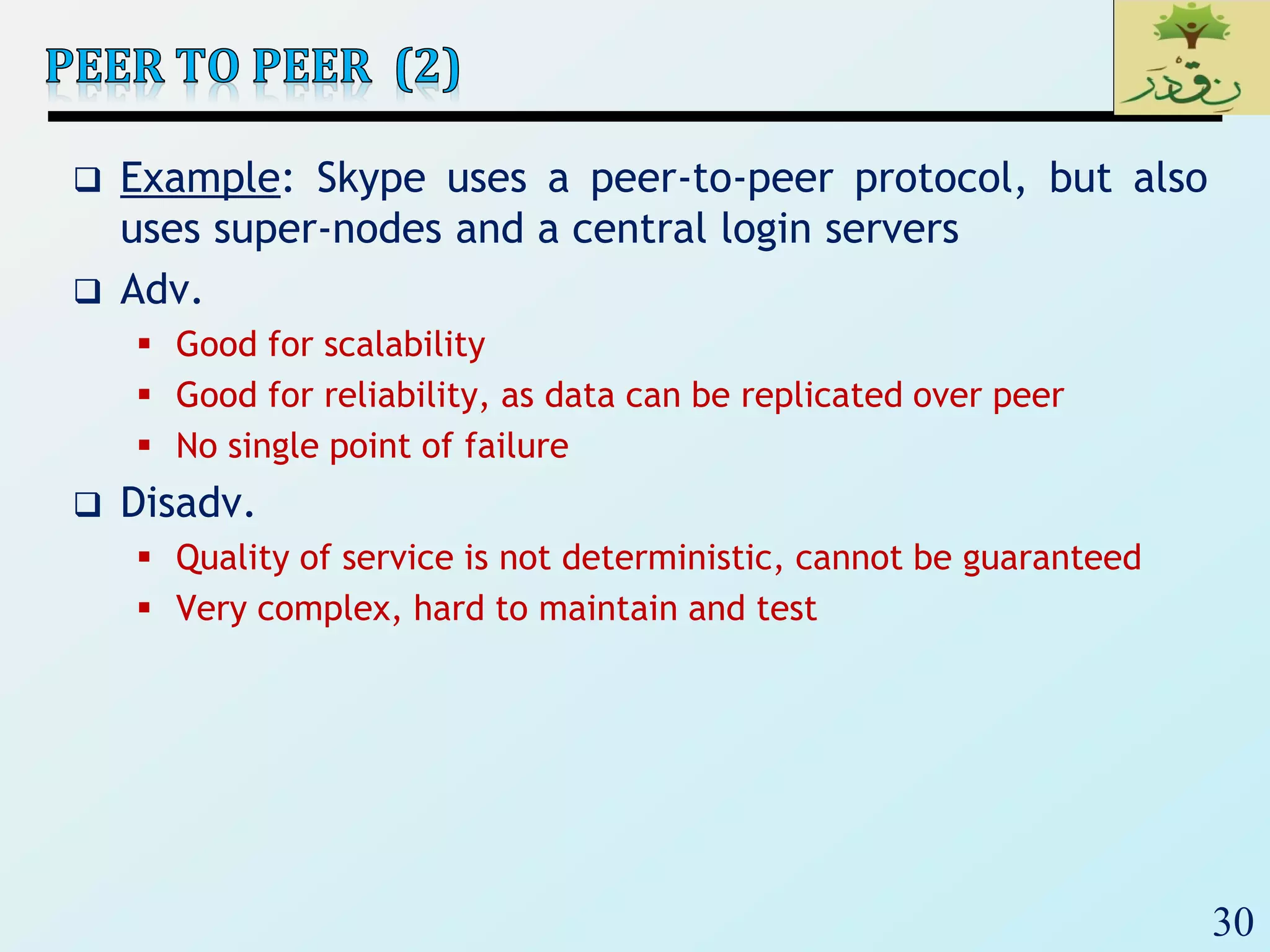
 Separation between client and server is removed
 Each client is a server at the same time, called peer
 The goal is to distribute the processing or data among many
peers
 No central administration or coordination
29
30
 Example: Skype uses a peer-to-peer protocol, but also
uses super-nodes and a central login servers
 Adv.
 Good for scalability
 Good for reliability, as data can be replicated over peer
 No single point of failure
 Disadv.
 Quality of service is not deterministic, cannot be guaranteed
 Very complex, hard to maintain and test
31
 The N-tier architecture is the modern client-server
architecture
 Originated with business applications
 Through the popularity of the Web today typically
related with Web applications
 Conceptually separate architecture into:
 Presentation,
 Application, and
 Data storage layers.
32
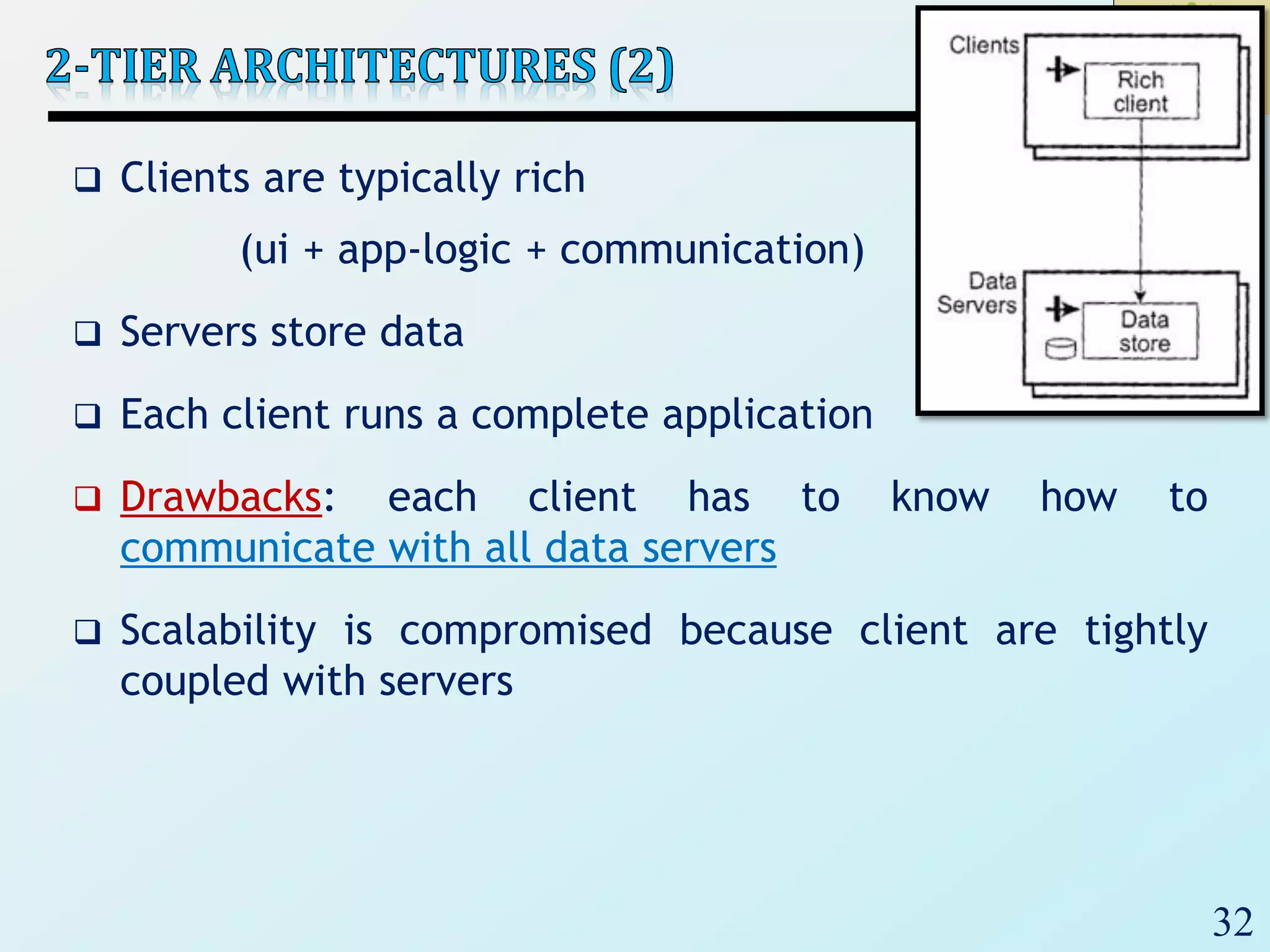
 Clients are typically rich
(ui + app-logic + communication)
 Servers store data
 Each client runs a complete application
 Drawbacks: each client has to know how to
communicate with all data servers
 Scalability is compromised because client are tightly
coupled with servers
33
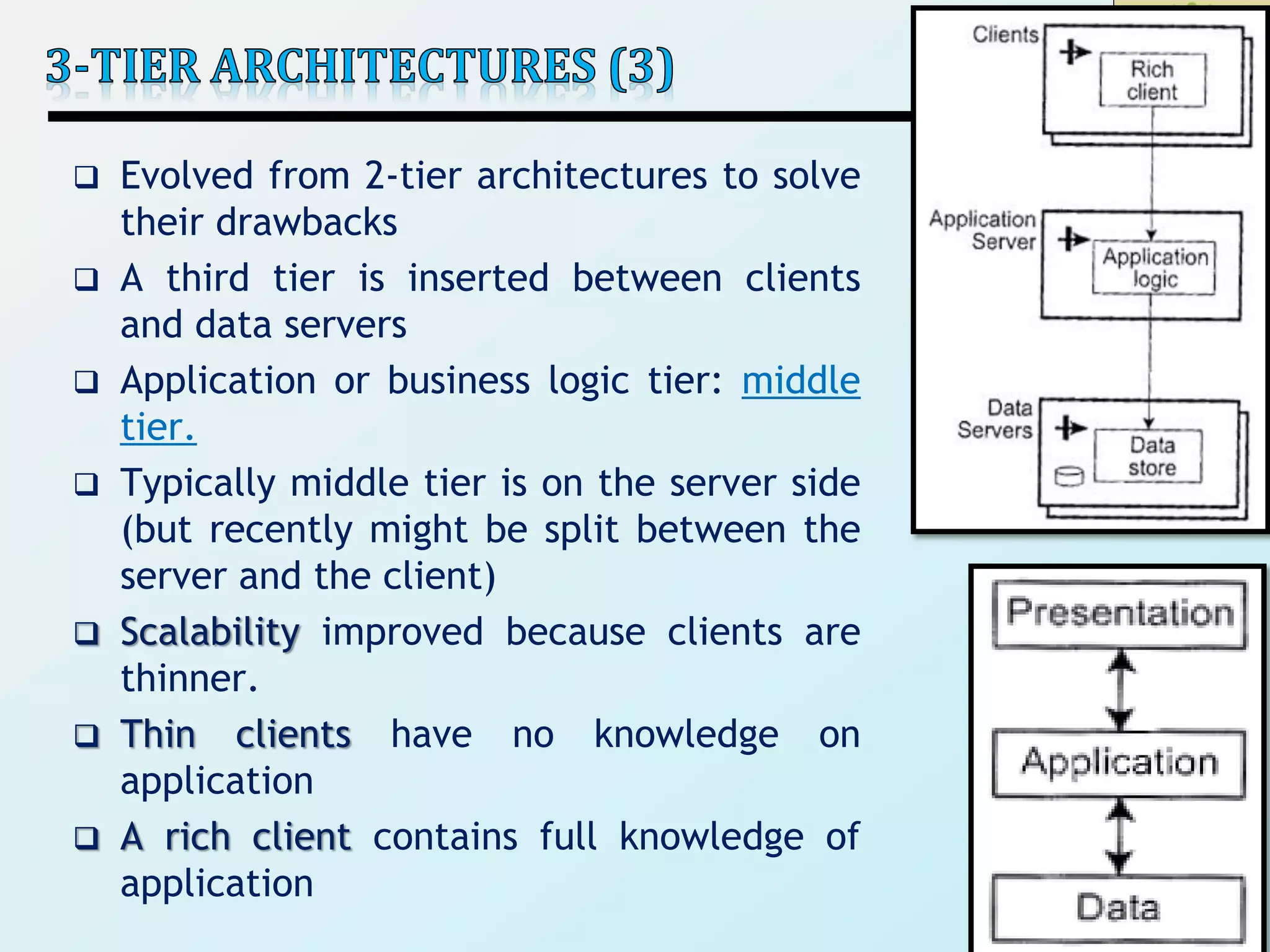
 Evolved from 2-tier architectures to solve
their drawbacks
 A third tier is inserted between clients
and data servers
 Application or business logic tier: middle
tier.
 Typically middle tier is on the server side
(but recently might be split between the
server and the client)
 Scalability improved because clients are
thinner.
 Thin clients have no knowledge on
application
 A rich client contains full knowledge of
application
34
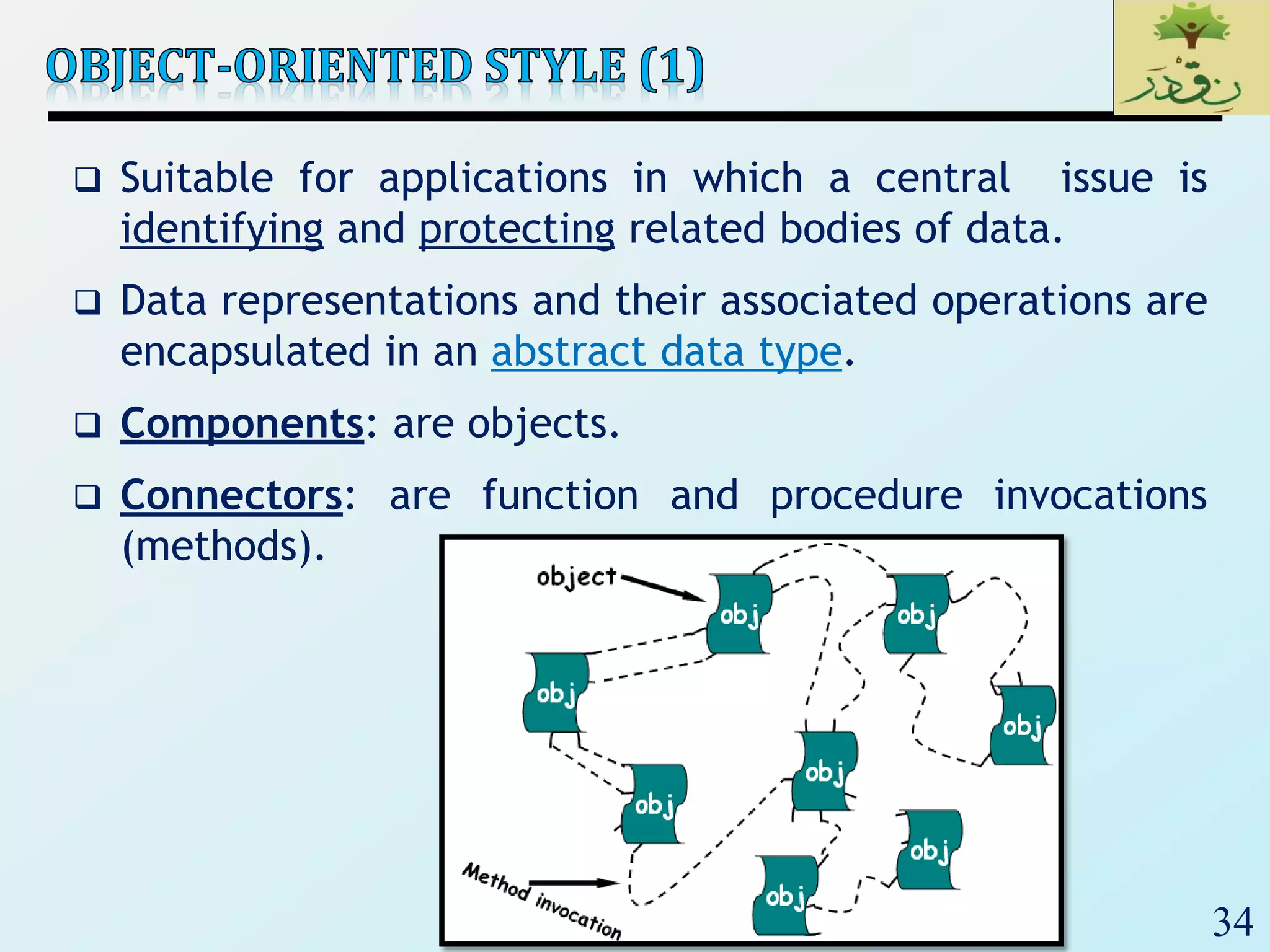
 Suitable for applications in which a central issue is
identifying and protecting related bodies of data.
 Data representations and their associated operations are
encapsulated in an abstract data type.
 Components: are objects.
 Connectors: are function and procedure invocations
(methods).
35
 Object-Oriented Invariants
 The data representation is hidden from other objects.
 Advantages
 it is possible to change the implementation without
affecting those clients.
 Can design systems as collections of autonomous
interacting agents.
 Disadvantages
 In order for one object to interact with another object (via
a method invocation) the first object must know the
identity of the second object
 Objects cause side effect problems:
• E.g., A and B both use object C, then B’s effects on C look
like unexpected side effects to A.
36
37
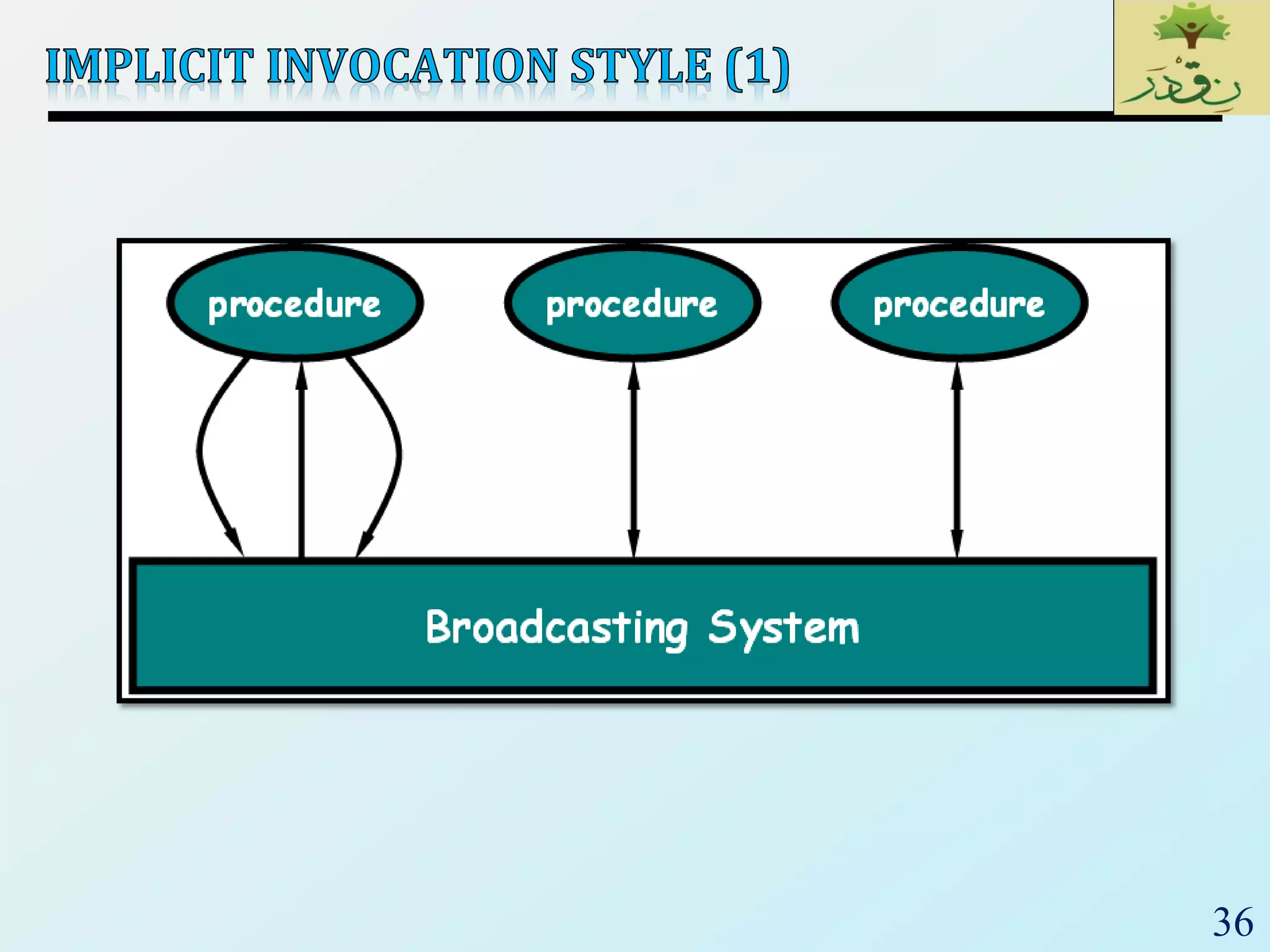
 Suitable for applications that involve loosely-coupled
collection of components, each of which carries out
some operation and may in the process enable other
operations.
 Instead of invoking a procedure directly ...
 A component can announce (or broadcast) one or more
events.
 Other components in the system can register an interest in
an event by associating a procedure with the event.
 When an event is announced, the broadcasting system
(connector) itself invokes all of the procedures that have
been registered for the event.
38
 Advantages:
 Provides strong support for reuse.
 Eases system evolution
 Disadvantages:
 When a component announces an event:
• it has no idea what other components will respond to it,
• it cannot rely on the order in which the responses are
invoked
• it cannot know when responses are finished
 Twitter, Google+
39
 Remote invocation architectures involve distributed
processing components
 Typically, a client component invokes a method
(function) on a remote component
 E.g. Web services
 Advantages:
 increased performance through distributed computation
 Disadvantages:
 tightly coupling of components
 increases communication overhead
40
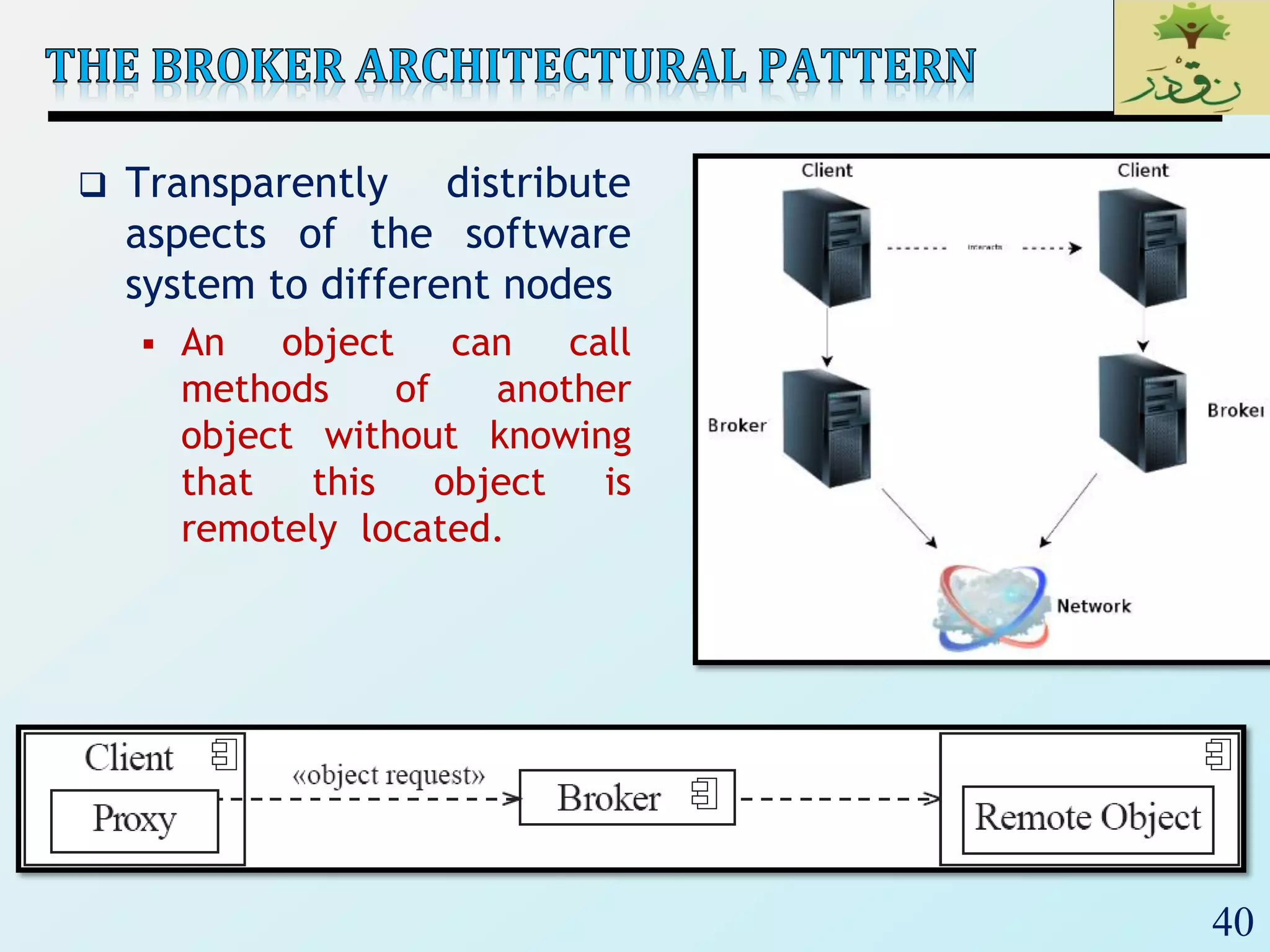
 Transparently distribute
aspects of the software
system to different nodes
 An object can call
methods of another
object without knowing
that this object is
remotely located.
41
 Systems are seldom built from a single architectural
style
 Three kinds of heterogeneity:
 Locationally heterogeneous
• The drawing of the architecture reveals different styles in
different areas (e.g., a branch of a call-and-return system
may have a shared repository)
 Hierarchically heterogeneous
• A component of one style, when decomposed, is structured
according to the rules of a different style
 Simultaneously heterogeneous
• Two or more architectural styles may both be appropriate
descriptions for the style used by a computer-based system
42
‫ر‬َ‫ـد‬ْ‫ق‬‫ِـ‬‫ن‬،،،‫لما‬‫اننا‬ ‫نصدق‬ْْ‫ق‬ِ‫ن‬‫ر‬َ‫د‬
43
 Are concerned with the control flow between sub-
systems.
 Centralized control
 One sub-system has overall responsibility for control and
starts and stops other sub-systems
 Event-based control
 Each sub-system can respond to externally generated
events from other sub-systems or the system’s
environment
44
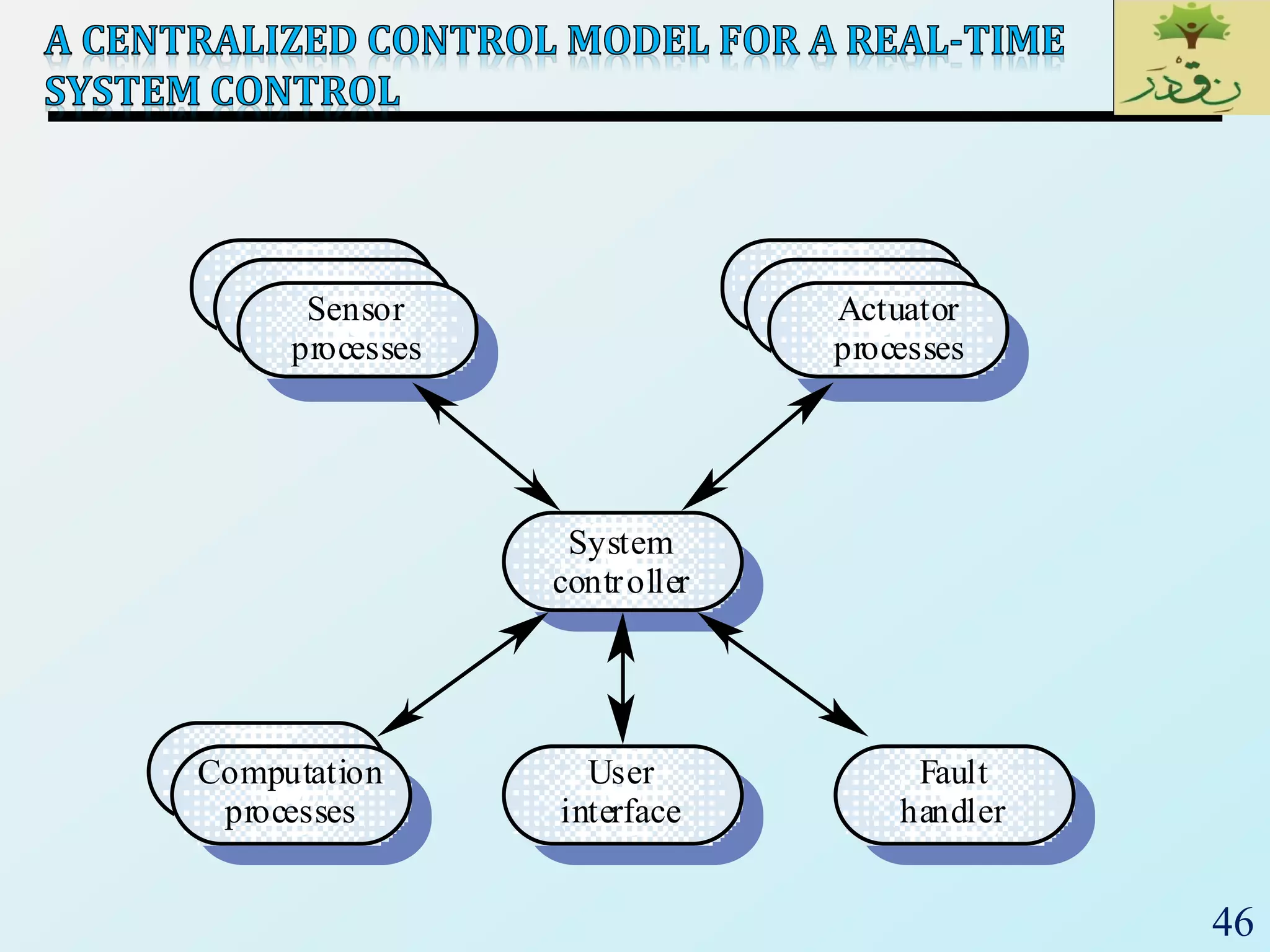
 A control sub-system takes responsibility for managing
the execution of other sub-systems
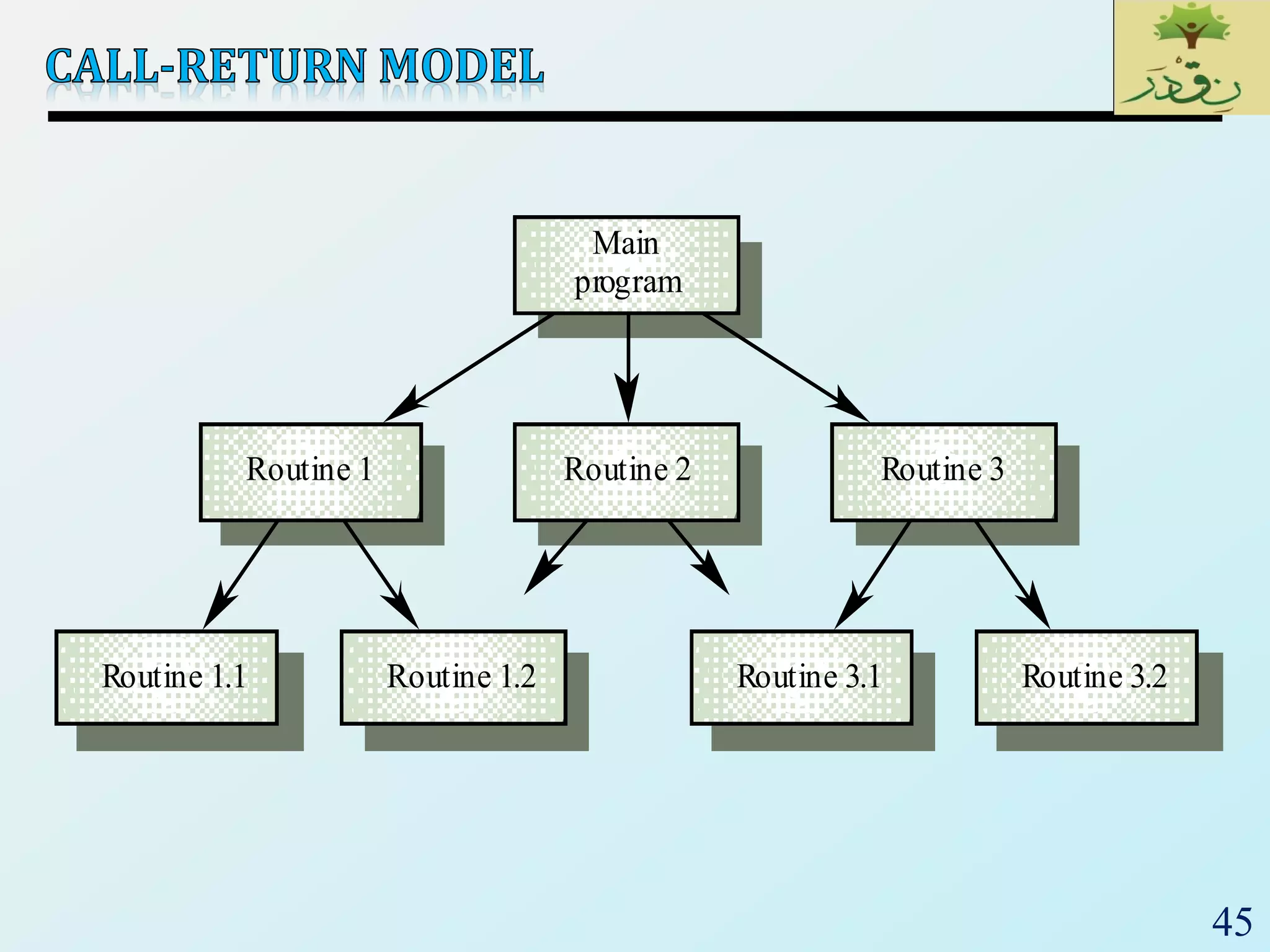
 Call-return model
 Top-down subroutine model
 Control starts at the top of a subroutine hierarchy and
moves downwards.
 Applicable to sequential systems
 Manager model
 One system component controls the stopping, starting
and coordination of other system processes.
 Applicable to concurrent systems.
45
Routine 1.2Routine 1.1 Routine 3.2Routine 3.1
Routine 2 Routine 3Routine 1
Main
program
46
System
controller
User
interface
Fault
handler
Computation
processes
Actuator
processes
Sensor
processes
47
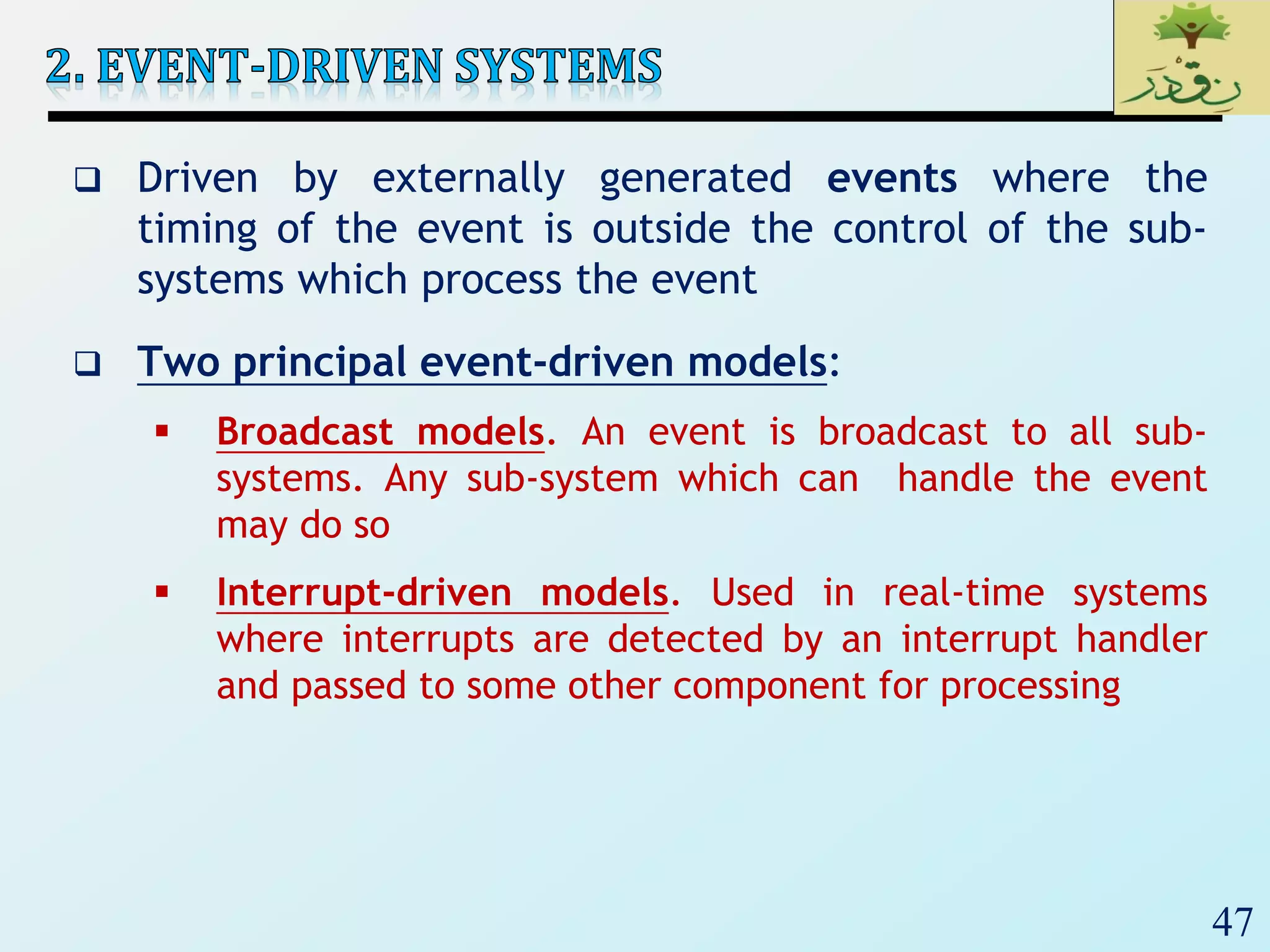
 Driven by externally generated events where the
timing of the event is outside the control of the sub-
systems which process the event
 Two principal event-driven models:
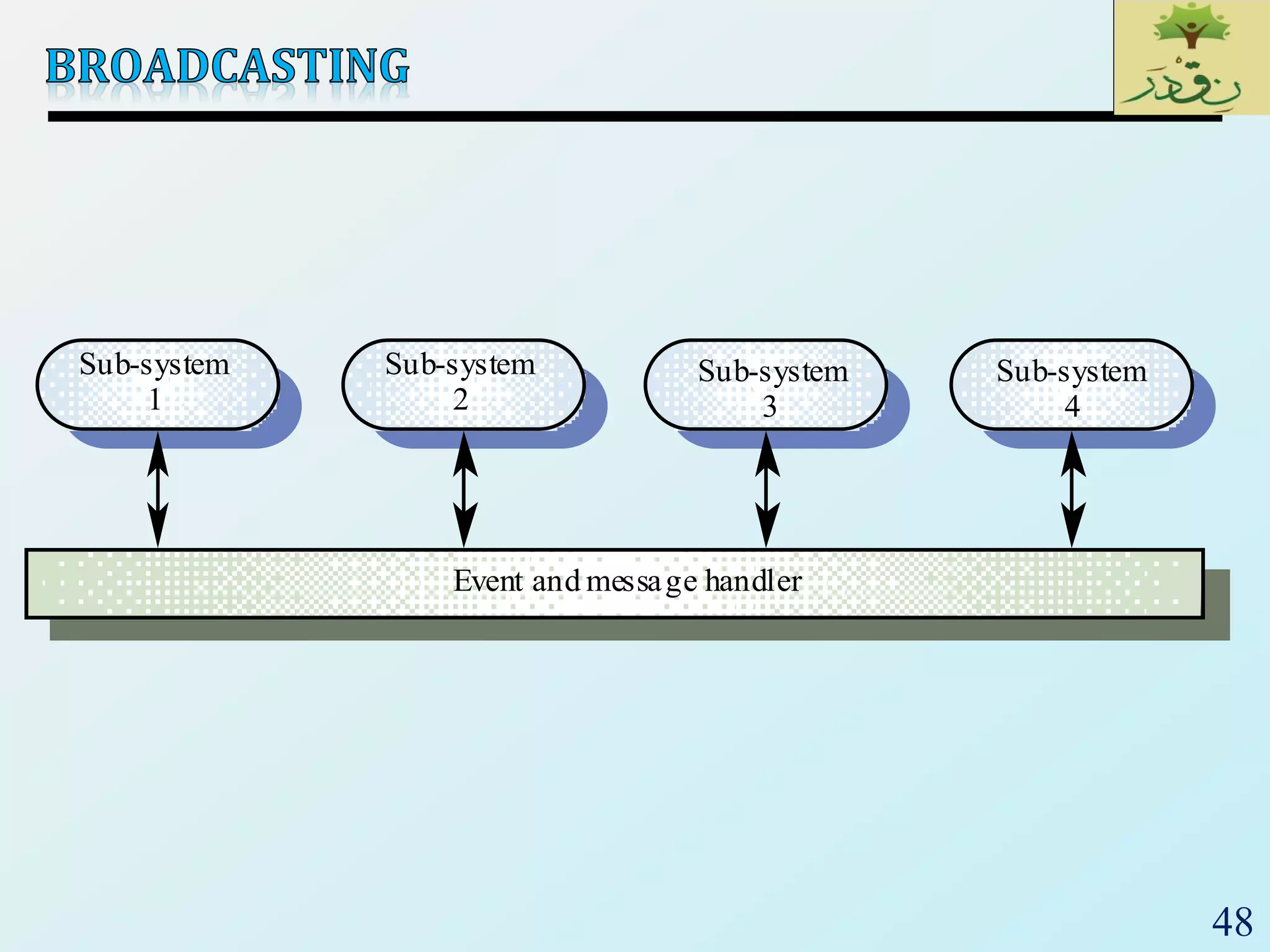
 Broadcast models. An event is broadcast to all sub-
systems. Any sub-system which can handle the event
may do so
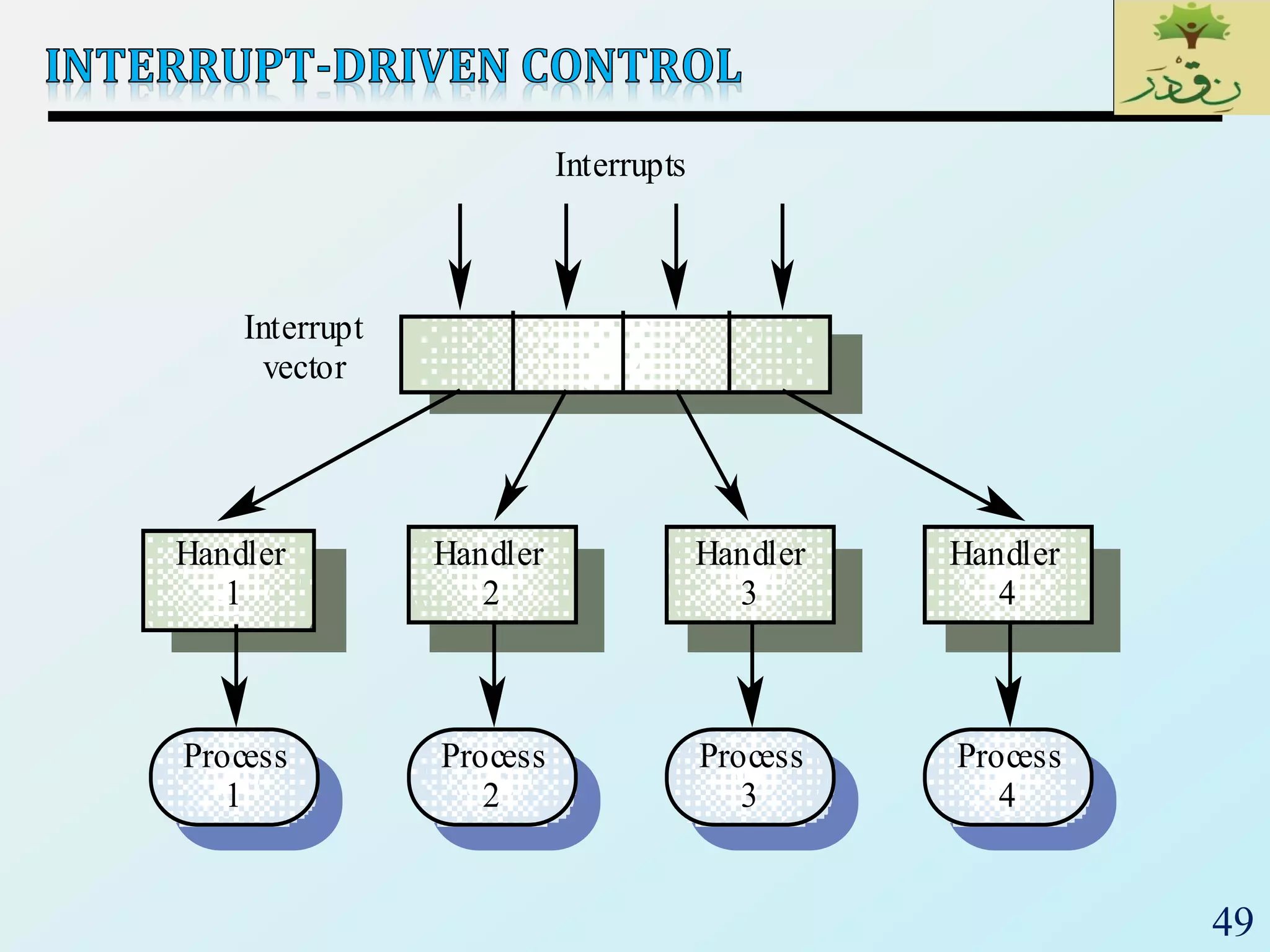
 Interrupt-driven models. Used in real-time systems
where interrupts are detected by an interrupt handler
and passed to some other component for processing
48
Sub-system
1
Event and message handler
Sub-system
2
Sub-system
3
Sub-system
4
49
Handler
1
Handler
2
Handler
3
Handler
4
Process
1
Process
2
Process
3
Process
4
Interrupts
Interrupt
vector
50

SE2018_Lec 16_ Architectural Design

  • 1.
  • 2.
    2  The softwarearchitecture of a program or computing system is the structure (or structures) of the system, including:  Dividing software into subsystems.  Deciding how these will interact.  Determining their interfaces. • The architecture is the core of the design, so all software engineers need to understand it. • The architecture will often constrain the overall efficiency, reusability and maintainability of the system
  • 3.
    3  Why youneed to develop an architectural model:  To enable everyone to better understand the system  To allow people to work on individual pieces of the system in isolation  To prepare for extension of the system  To facilitate reuse and reusability
  • 4.
    4  An architectureis an abstraction of a system that suppresses details of components that do not affect how they:  Use other components  Are used by other components  Relate to other components  Interact with other components
  • 5.
    5  To ensurethe maintainability and reliability of a system, an architectural model must be designed to be stable.  Being stable means that the new features can be easily added with only small changes to the architecture.
  • 6.
    6 aTruck aShip aAirplanetheWarehouseCollecti on theVehicleCollection UML-A Generated Dependency Class:theRouter Dependency (1.0) theStorage aVehicle UML-A Generated Dependency Class:theRouter Dependency (0.5) availableVehicleCollection UML-A Generated Association Class:theVehicleCollection Generalization (1.0)UML-A Generated Association Class:theVehicleCollection Generalization (1.0)UML-A Generated Association Class:theVehicleCollection Generalization (1.0)UML-A Generated As sociationC lass:theVehicleC ollec tion Generalization (1.0)UML-A Generated Association Class:theVehicleCollection Generalization (1.0)UML-A Generated Association Class:theVehicleCollection Generalization (1.0)UML-A Generated Association Class:theVehicleCollection Generalization (1.0)UML-A Generated Association Class:theVehicleCollection Generalization (1.0)UML- A Generated Ass ociati onCl ass:theVehi cleCollection Generali zation (1.0)UML-A Generated Association Class:theVehicleCollection Generalization (1.0) UML-A Generated Dependency Class:theRouter Dependency (1.0) availableGoods aPort aPortC ollec tion aSurplus aDifficiency theTimeNeeded theGoods UML-A Generated Association Class:aWarehouse Association (0.5) UML-A Generated Association Class:aWarehouse Association (0.5) UML-A Generated Association Class:availableGoods Association (0.5) aRouteCollection UML-A Generated Association Class:aRoute Association (0.25)UML-A Generated Association Class:aRoute Association (0.25)UML-A Generated Association Class:aRoute Association (0.25) UML-A Generated Association Class:aRoute Association (0.25) UML-A Generated Dependency Class:theRouter Dependency (0.5)UML-A Generated Dependency Class:theRouter Dependency (1.0) UML-A Generated Dependency Class:theRouter Dependency (1.0) theAWT aVehiceDialog aWarehouseDialog aPortDialog aRouterDialog aWarehouse UML-A Generated AssUML-A Generated Association Class:aDifficiency Associ UML-A Generated Association Class:aDifficiency AssociatioUML-A Generated Association Class:aDifficiency Association (1.0 UML-A Generated Association Class:aDifficiency AU ML-A Generated AssociationClaUML-A Generated AssociatioUML-A Generated Association Class:aDifficieU ML-A Generated AssociationClass:aDUML-A Generat UML-A GeneraUML-A Generated As aLocation UML-A Generated Association Class:aWarehouse Association (0.5) UML-A Generated Association Class:aNavPoint Association (0.5) UML-A Generated Association Class:aNavPoint Association (0.5) UML-A Generated Association Class:aNavPoint Association (0.5) UML-A Generated Association Class:aWarehouse Association (0.5) aNavPoint UML-A Generated Association Class:aWarehouse Association (1.0) UML-A Generated Association Class:aWarehouse Association (0.5)UML-A Generated Association Class:aWarehouse Association (0.5) UML-A Generated Association Class:aWarehouse Association (0.5) UML-A Generated Association Class:aWarehouse Association (0.5) UML-A Generated Association Class:aRoute Association (0.5) aRoute UML-A Generated Dependency C lass :aRouteCol lection Ass ociation (0.25) UML-A Generated Association Class:aNavPoint Association (1.0)UML-A Generated Association Class:aNavPoint Association (0.5) UML-A Generated Association Class:aWarehouse Association (1.0) UML-A Generated Dependency Class:aRouteCollection Association (0.5) UML-A Generated Association Class:aNavPoint Association (1.0)UML-A Generated Association Class:aNavPoint Association (1.0)UML-A Generated Association Class:aNavPoint Association (1.0)UML-A Generated Association Class:aNavPoint Association (1.0)UML-A Generated Association Class:aNavPoint Association (1 UML-A Generated Association Class:aNavPoint Association (0.25) UML-A Generated Association Class:aNavPoint Association (0.25) UML-A Generated Association Class:aNavPoint Association (0.25) UML-A Generated Dependency Class:theRouter Association (0.25) UML-A Generated Association Class:aNavPoint Association (0.25) theCargoRouter UML-A Generated As sociationC lass:theWarehouseCollection Dependency ( 0.25) UML-A Generated Association Class:theRouter Association (0.25) UML-A Generated Association Class:theRouter A theRouter UML-A Generated Association Class:theWarehouseCollection Dependency (0.5) UML-A Generated Dependency Class :aRoUML-A Generated Association Clas s:theWarehouseC UML-A Generated Association Class:theVehicleCollection Dependency (0.5)UML-A Generated Association Class:availableVehicleCollection Dependency (0.5) UML- A Generated Generaliz ation Class :avail ableVehicleCollection Dependenc y (1.0) UML-A Generated Dependency Class:theRouter Association (0.25) UML-A Generated Dependency Class:theRouter Association (0.5) UML-A Generated Dependency Class:theRouter Association (1.0) UML-A Generated Dependency Class:theRouter Association (0.5) UML-A Generated Dependency Class:theWarehouseCollection Dependency (1.0) UML-A Generated Dependency Class:theRouter Association (1.0)UML-A Generated Dependency Class:theRouter Association (1.0) This is a simple software system!
  • 7.
  • 8.
    8 Independent Components Communicating Processes Event Systems Client/ServerPeer-to-Peer Implicit Invocation Explicit Invocation Data Flow Batch Sequential Pipe & Filter Virtual Machine Interpreter Rule-Based System Data-Centered Repository Blackboard Call and Return Main Program and Subroutine Object OrientedLayered Remote Procedure Call
  • 9.
    9 Shared Data Client AClient B Client C Client D Client E Client F
  • 10.
    10  Has goalof achieving the quality of integrability of data.  The term refers to systems in which the access and update of a widely accessed data store is their primary goal.  Basically, it is nothing more than a centralized data store that communicates with a number of clients.  Important for this styles are three protocols: communication, data definition and data manipulation protocol  A client runs on an independent thread of control.  The means of communication distinguishes the two subtypes: repository and blackboard  Repository: a client sends a request to the system to perform a necessary action (e.g. insert data)  Blackboard: the system sends notification and data to subscribers when data of interest changes, and is thus active
  • 11.
    11  Ensures dataintegrity  Reliable, secure, easy to Backup, testability guaranteed  Clients independent on the system: performance and usability on the client side is good  Problems with scalability  Solutions: shared repositories, replication but this increases complexity
  • 12.
    12  One ofthe most well-known examples of the data- centered architecture, is a database architecture  E.g. in RDBMS a set of related tables with fields, data types, keys, ...  Clients use data manipulation protocol to work with the data  E.g. SQL for inserting, selecting, deleting data, ...  Depending on where clients are situated communication protocol might be  An inner-process communication  Communication between components on the same machine  Communication over network, e.g. LAN, Internet, etc.
  • 13.
    13  Has thegoal of achieving the quality of reuse and modifiability.  The data-flow style is characterized by viewing the system as a series of transformations on successive pieces of input data.  Data enter the system and then flows through the components one at a time until  Finally, the data is assigned to some final destination (output or a data store).  The architecture is very flexible.  Almost all the components could be removed.  Components could be replaced.  New components could be inserted.  Certain components could be reordered.
  • 14.
  • 15.
    15  Batch sequentialstyle  The processing steps are independent components  Each step runs to completion before the next step begins  Pipe-and-filter style  Emphasizes the incremental transformation of data by successive components  The filters incrementally transform the data (entering and exiting via streams)  The pipes are stateless and simply exist to move data between filters  Note That: It is easily made into a parallel or distributed execution in order to enhance system performance
  • 16.
    16  Data flowsthrough pipes: communication channels between filters  Processing units: filters  Filters do not know anything about other filters  Modularity, maintainability is good  Data flows in streams: good for processing of images, audio, video, ...  Depending on where the filters reside different execution architectures  E.g. same process: filters run within threads  E.g. same machine: filters run within own processes  E.g. network: pipes use the networking architecture
  • 17.
    17  Pipe andFilter Example:  Traditional Compilers: Compilation phases are pipelined, though the phases are not always incremental. The phases in the pipeline include • lexical analysis + parsing + semantic analysis + code generation
  • 18.
    18 Main module Subroutine A SubroutineB Subroutine A-1 Subroutine A-2 Physical layer Data layer Network layer Transport layer Application layer Class WClass V Class X Class Z Class Y
  • 19.
    19  Has thegoal of modifiability and scalability  Has been the dominant architecture since the start of software development  Main program and subroutine style  Decomposes a program hierarchically into small pieces (i.e., modules)  Typically has a single thread of control that travels through various components in the hierarchy  Remote procedure call style  Consists of main program and subroutine style of system that is decomposed into parts that are resident on computers connected via a network  Strives to increase performance by distributing the computations and taking advantage of multiple processors  Incurs a finite communication time between subroutine call and response.
  • 20.
    20  Object-oriented orabstract data type system  Emphasizes the bundling of data and how to manipulate and access data  Keeps the internal data representation hidden and allows access to the object only through provided operations  Permits inheritance and polymorphism  Layered system  Assigns components to layers in order to control inter- component interaction  Only allows a layer to communicate with its immediate neighbor
  • 21.
    21  Layering: thestructure of the system is organized into set of layers  Each layer in on the top of another layer, each layer communicates only with the layer immediately below it.  The higher layer sees the lower layer as a set of services.  Well-defined interfaces between layers  Reduces complexity,  improves modularity,  reusability,  maintainability
  • 22.
    22  Typically organizedinto layers  Successive layers provide more sophisticated services to the layers above them  Hardware services, kernel services, system services, UI services
  • 23.
    23  A virtualmachine implements an instruction set for an imaginary machine  Often virtual machines are the underplaying mechanism by which a programming language is executed  E.g. Java virtual machine, different interpreters • Specifies an interface between compiler and a real machine  From conceptual point of view very similar to OS  Improves portability
  • 24.
    24  A commonexample of layered architecture is a network protocol stack  E.g. TCP/IP protocol stack - Four layers  The lowest layer: handles communication between two computers  The internet layer: handles routing of packets across the network  The transport layer: guarantees that packets are error- free and received in the same order as sent  The application layer: supports application-specific protocols • E.g. HTTP, SMTP, FTP, ...
  • 25.
  • 26.
    26  Basic concept: The client uses a service  The server provides a service  Typically connected via a network  Clients are independent from each other  There is at least one component that has the role of client, initiating connections in order to obtain some service.
  • 27.
    27  Conceptually simple Clear separation of responsibilities, help testability  Good scalability (if stateless)  Excellent scalability (if server can be scaled out)  Good for security, as data can be held at the server with restricted access  Risk of bad performance, if the communication between client and server is slow, or has a high latency  Need to develop/agree on a protocol between client and server  For stateful, centralized servers scalability is limited
  • 28.
    28  The serveris no longer in the organizations network, but somewhere in the Internet  Example: cloud services by Salesforce, Google, Microsoft  Scalability, security, reliability is expected to be handled by a specialized team  Needs a working Internet connection
  • 29.
    29  Separation betweenclient and server is removed  Each client is a server at the same time, called peer  The goal is to distribute the processing or data among many peers  No central administration or coordination 29
  • 30.
    30  Example: Skypeuses a peer-to-peer protocol, but also uses super-nodes and a central login servers  Adv.  Good for scalability  Good for reliability, as data can be replicated over peer  No single point of failure  Disadv.  Quality of service is not deterministic, cannot be guaranteed  Very complex, hard to maintain and test
  • 31.
    31  The N-tierarchitecture is the modern client-server architecture  Originated with business applications  Through the popularity of the Web today typically related with Web applications  Conceptually separate architecture into:  Presentation,  Application, and  Data storage layers.
  • 32.
    32  Clients aretypically rich (ui + app-logic + communication)  Servers store data  Each client runs a complete application  Drawbacks: each client has to know how to communicate with all data servers  Scalability is compromised because client are tightly coupled with servers
  • 33.
    33  Evolved from2-tier architectures to solve their drawbacks  A third tier is inserted between clients and data servers  Application or business logic tier: middle tier.  Typically middle tier is on the server side (but recently might be split between the server and the client)  Scalability improved because clients are thinner.  Thin clients have no knowledge on application  A rich client contains full knowledge of application
  • 34.
    34  Suitable forapplications in which a central issue is identifying and protecting related bodies of data.  Data representations and their associated operations are encapsulated in an abstract data type.  Components: are objects.  Connectors: are function and procedure invocations (methods).
  • 35.
    35  Object-Oriented Invariants The data representation is hidden from other objects.  Advantages  it is possible to change the implementation without affecting those clients.  Can design systems as collections of autonomous interacting agents.  Disadvantages  In order for one object to interact with another object (via a method invocation) the first object must know the identity of the second object  Objects cause side effect problems: • E.g., A and B both use object C, then B’s effects on C look like unexpected side effects to A.
  • 36.
  • 37.
    37  Suitable forapplications that involve loosely-coupled collection of components, each of which carries out some operation and may in the process enable other operations.  Instead of invoking a procedure directly ...  A component can announce (or broadcast) one or more events.  Other components in the system can register an interest in an event by associating a procedure with the event.  When an event is announced, the broadcasting system (connector) itself invokes all of the procedures that have been registered for the event.
  • 38.
    38  Advantages:  Providesstrong support for reuse.  Eases system evolution  Disadvantages:  When a component announces an event: • it has no idea what other components will respond to it, • it cannot rely on the order in which the responses are invoked • it cannot know when responses are finished  Twitter, Google+
  • 39.
    39  Remote invocationarchitectures involve distributed processing components  Typically, a client component invokes a method (function) on a remote component  E.g. Web services  Advantages:  increased performance through distributed computation  Disadvantages:  tightly coupling of components  increases communication overhead
  • 40.
    40  Transparently distribute aspectsof the software system to different nodes  An object can call methods of another object without knowing that this object is remotely located.
  • 41.
    41  Systems areseldom built from a single architectural style  Three kinds of heterogeneity:  Locationally heterogeneous • The drawing of the architecture reveals different styles in different areas (e.g., a branch of a call-and-return system may have a shared repository)  Hierarchically heterogeneous • A component of one style, when decomposed, is structured according to the rules of a different style  Simultaneously heterogeneous • Two or more architectural styles may both be appropriate descriptions for the style used by a computer-based system
  • 42.
  • 43.
    43  Are concernedwith the control flow between sub- systems.  Centralized control  One sub-system has overall responsibility for control and starts and stops other sub-systems  Event-based control  Each sub-system can respond to externally generated events from other sub-systems or the system’s environment
  • 44.
    44  A controlsub-system takes responsibility for managing the execution of other sub-systems  Call-return model  Top-down subroutine model  Control starts at the top of a subroutine hierarchy and moves downwards.  Applicable to sequential systems  Manager model  One system component controls the stopping, starting and coordination of other system processes.  Applicable to concurrent systems.
  • 45.
    45 Routine 1.2Routine 1.1Routine 3.2Routine 3.1 Routine 2 Routine 3Routine 1 Main program
  • 46.
  • 47.
    47  Driven byexternally generated events where the timing of the event is outside the control of the sub- systems which process the event  Two principal event-driven models:  Broadcast models. An event is broadcast to all sub- systems. Any sub-system which can handle the event may do so  Interrupt-driven models. Used in real-time systems where interrupts are detected by an interrupt handler and passed to some other component for processing
  • 48.
    48 Sub-system 1 Event and messagehandler Sub-system 2 Sub-system 3 Sub-system 4
  • 49.
  • 50.