Chapter 16 – Software ReuseLecture 11Chapter 16 Software reuse
Topics coveredThe reuse landscape Application frameworksSoftware product lines COTS product reuseChapter 16 Software reuse2
Software reuseIn most engineering disciplines, systems are designed by composing existing components that have been used in other systems.Software engineering has been more focused on original development but it is now recognised that to achieve better software, more quickly and at lower cost, we need a design process that is based on systematic software reuse.There has been a  major switch to reuse-based development over the past 10 years.
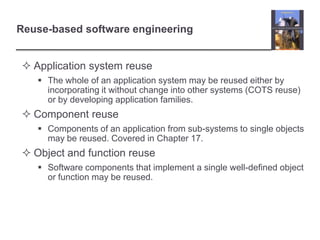
Reuse-based software engineeringApplication system reuseThe whole of an application system may be reused either by incorporating it without change into other systems (COTS reuse) or by developing application families.Component reuseComponents of an application from sub-systems to single objects may be reused. Covered in Chapter 17.Object and function reuseSoftware components that implement a single well-defined object or function may be reused.
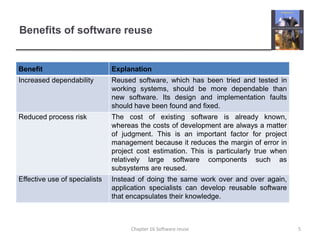
Benefits of software reuse5Chapter 16 Software reuse
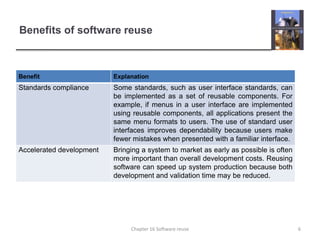
Benefits of software reuse6Chapter 16 Software reuse
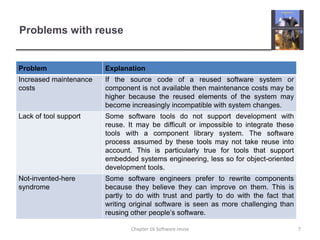
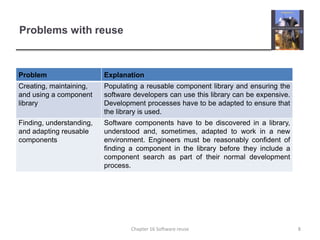
Problems with reuse7Chapter 16 Software reuse
Problems with reuse8Chapter 16 Software reuse
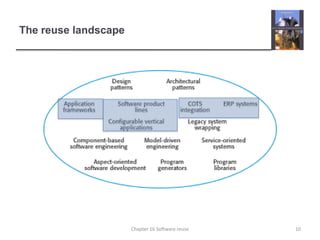
The reuse landscapeAlthough reuse is often simply thought of as the reuse of system components, there are many different approaches to reuse that may be used.Reuse is possible at a range of levels from simple functions to complete application systems.The reuse landscape covers the range of possible reuse techniques.
The reuse landscape10Chapter 16 Software reuse
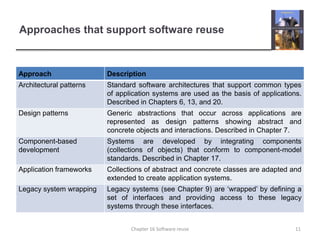
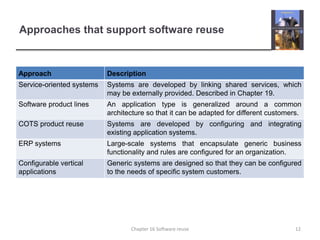
Approaches that support software reuse11Chapter 16 Software reuse
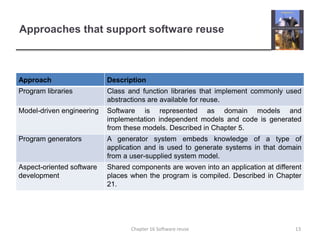
Approaches that support software reuse12Chapter 16 Software reuse
Approaches that support software reuse13Chapter 16 Software reuse
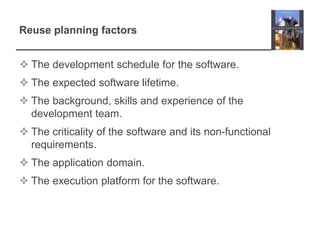
Reuse planning factorsThe development schedule for the software.The expected software lifetime.The background, skills and experience of the development team.The criticality of the software and its non-functional requirements.The application domain.The execution platform for the software.
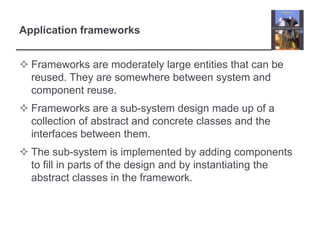
Application frameworksFrameworks are moderately large entities that can be reused. They are somewhere between system and component reuse.Frameworks are a sub-system design made up of a collection of abstract and concrete classes and the interfaces between them.The sub-system is implemented by adding components to fill in parts of the design and by instantiating the abstract classes in the framework.
Framework classesSystem infrastructure frameworksSupport the development of system infrastructures such as communications, user interfaces and compilers.Middleware integration frameworksStandards and classes that support component communication and information exchange.Enterprise application frameworksSupport the development of specific types of application such as telecommunications or financial systems.
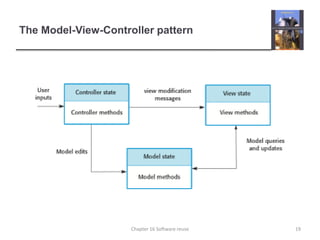
Web application frameworksSupport the construction of dynamic websites as a front-end for web applications.WAFs are now available for all of the commonly used web programming languages e.g. Java, Python, Ruby, etc.Interaction model is based on the Model-View-Controller composite pattern.Chapter 16 Software reuse17
Model-view controllerSystem infrastructure framework for GUI design.Allows for multiple presentations of an object and separate interactions with these presentations.MVC framework involves the instantiation of a number of patterns (as discussed in Chapter 7).
The Model-View-Controller pattern19Chapter 16 Software reuse
WAF featuresSecurityWAFsmay include classes to help implement user authentication (login) and access.Dynamic web pagesClasses are provided to help you define web page templates and to populate these dynamically from the system database.Database supportThe framework may provide classes that provide an abstract interface to different databases.Session managementClasses to create and manage sessions (a number of interactions with the system by a user) are usually part of a WAF.User interactionMost web frameworks now provide AJAX support (Holdener, 2008), which allows more interactive web pages to be created.Chapter 16 Software reuse20
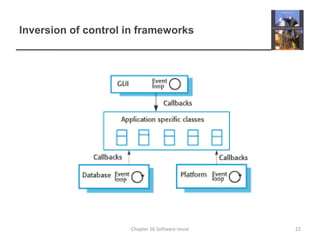
Extending frameworksFrameworks are generic and are extended to create a more specific application or sub-system. They provide a skeleton architecture for the system.Extending the framework involvesAdding concrete classes that inherit operations from abstract classes in the framework;Adding methods that are called in response to events that are recognised by the framework.Problem with frameworks is their complexity which means that it takes a long time to use them effectively.
Inversion of control in frameworks22Chapter 16 Software reuse
Key pointsMost new business software systems are now developed by reusing knowledge and code from previously implemented systems.There are many different ways to reuse software. These range from the reuse of classes and methods in libraries to the reuse of complete application systems.The advantages of software reuse are lower costs, faster software development and lower risks. System dependability is increased. Specialists can be used more effectively by concentrating their expertise on the design of reusable components.Application frameworks are collections of concrete and abstract objects that are designed for reuse through specialization and the addition of new objects. They usually incorporate good design practice through design patterns.Chapter 16 Software reuse23
Chapter 16 – Software ReuseLecture 224Chapter 16 Software reuse
Software product linesSoftware product lines or application families are applications with generic functionality that can be adapted and configured for use in a specific context.A software product line is a set of applications with a common architecture and shared components, with each application specialized to reflect different requirements. Adaptation may involve:Component and system configuration;Adding new components to the system;Selecting from a library of existing components;Modifying components to meet new requirements.
Application frameworks and product linesApplication frameworks rely on object-oriented features such as polymorphism to implement extensions. Product lines need not be object-oriented (e.g. embedded software for a mobile phone)Application frameworks focus on providing technical rather than domain-specific support. Product lines embed domain and platform information.Product lines often control applications for equipment.Software product lines are made up of a family of applications, usually owned by the same organization. Chapter 16 Software reuse26
Product line specialisationPlatform specializationDifferent versions of the application are developed for different platforms.Environment specializationDifferent versions of the application are created to handle different operating environments e.g. different types of communication equipment.Functional specializationDifferent versions of the application are created for customers with different requirements.Process specializationDifferent versions of the application are created to support different business processes.
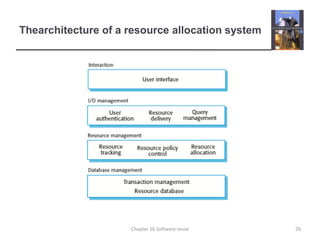
Product line architecturesArchitectures must be structured in such a way to separate different sub-systems and to allow them to be modified.The architecture should also separate entities and their descriptions and the higher levels in the system access entities through descriptions rather than directly.
Thearchitecture of a resource allocation system29Chapter 16 Software reuse
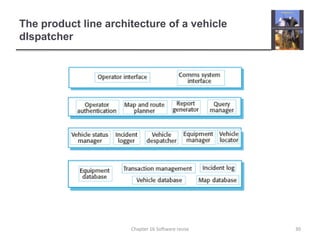
The product line architecture of a vehicle dIspatcher30Chapter 16 Software reuse
Vehicle dispatchingA specialised resource management system where the aim is to allocate resources (vehicles) to handle incidents.Adaptations include:At the UI level, there are components for operator display and communications;At the I/O management level, there are components that handle authentication, reporting and route planning;At the resource management level, there are components for vehicle location and despatch, managing vehicle status and incident logging;The database includes equipment, vehicle and map databases.
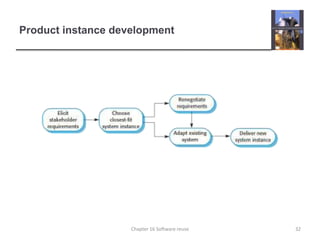
Product instance development32Chapter 16 Software reuse
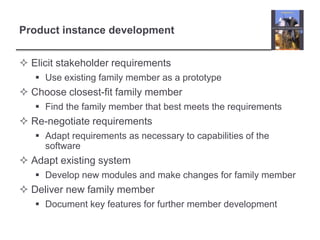
Product instance developmentElicit stakeholder requirementsUse existing family member as a prototypeChoose closest-fit family memberFind the family member that best meets the requirementsRe-negotiate requirementsAdapt requirements as necessary to capabilities of the softwareAdapt existing systemDevelop new modules and make changes for family memberDeliver new family memberDocument key features for further member development
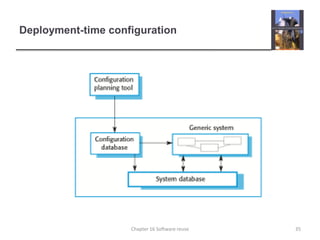
Product line configurationDesign time configurationThe product line is adapted and changed according to the requirements of particular customers.Deployment time configurationThe product line is configured by embedding knowledge of the customer’s requirements and business processes. The software source code itself is not changed.
Deployment-time configuration35Chapter 16 Software reuse
Levels of deployment time configurationComponent selection, where you select the modules in a system that provide the required functionality.Workflow and rule definition, where you define workflows (how information is processed, stage-by-stage) and validation rules that should apply to information entered by users or generated by the system. 3.	Parameter definition, where you specify the values of specific system parameters that reflect the instance of the application that you are creatingChapter 16 Software reuse36
COTS product reuseA commercial-off-the-shelf (COTS) product is a software system that can be adapted for different customers without changing the source code of the system.COTS systems have generic features and so can be used/reused in different environments.COTS products are adapted by using built-in configuration mechanisms that allow the functionality of the system to be tailored to specific customer needs.For example, in a hospital patient record system, separate input forms and output reports might be defined for different types of patient.  Chapter 16 Software reuse37
Benefits of COTS reuseAs with other types of reuse, more rapid deployment of a reliable system may be possible.It is possible to see what functionality is provided by the applications and so it is easier to judge whether or not they are likely to be suitable.Some development risks are avoided by using existing software. However, this approach has its own risks, as I discuss below.Businesses can focus on their core activity without having to devote a lot of resources to IT systems development.As operating platforms evolve, technology updates may be simplified as these are the responsibility of the COTS product vendor rather than the customer.Chapter 16 Software reuse38
Problems of COTS reuseRequirements usually have to be adapted to reflect the functionality and mode of operation of the COTS product.The COTS product may be based on assumptions that are practically impossible to change.Choosing the right COTS system for an enterprise can be a difficult process, especially as many COTS products are not well documented.There may be a lack of local expertise to support systems development.The COTS product vendor controls system support and evolution. Chapter 16 Software reuse39
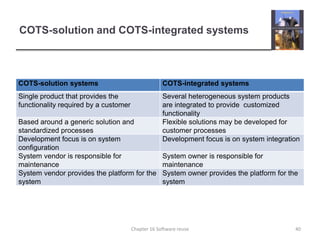
COTS-solution and COTS-integrated systems40Chapter 16 Software reuse
COTS solution systemsCOTS-solution systems are generic application systems that may be designed to support a particular business type, business activity or, sometimes, a complete business enterprise.For example, a COTS-solution system may be produced for dentists that handles appointments, dental records, patient recall, etc.Domain-specific COTS-solution systems, such as systems to support a business function (e.g. document management) provide functionality that is likely to be required by a range of potential users.Chapter 16 Software reuse41
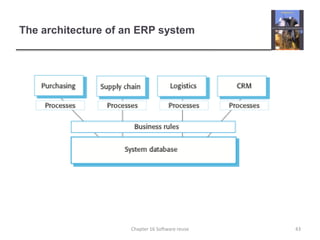
ERP systemsAn Enterprise Resource Planning (ERP) system is a generic system that supports common business processes such as ordering and invoicing, manufacturing, etc.These are very widely used in large companies - they represent probably the most common form of software reuse.The generic core is adapted by including modules and by incorporating knowledge of business processes and rules.
The architecture of an ERP system43Chapter 16 Software reuse
ERP architectureA number of modules to support different business functions.A defined set of business processes, associated with each module, which relate to activities in that module.A common database that maintains information about all related business functions.A set of business rules that apply to all data in the database. Chapter 16 Software reuse44
ERP configurationSelecting the required functionality from the system.Establishing a data model that defines how the organization’s data will be structured in the system database.Defining business rules that apply to that data.Defining the expected interactions with external systems.Designing the input forms and the output reports generated by the system.Designing new business processes that conform to the underlying process model supported by the system.Setting parameters that define how the system is deployed on its underlying platform.Chapter 16 Software reuse45
COTS integrated systemsCOTS-integrated systems are applications that include two or more COTS products and/or legacy application systems.You may use this approach when there is no single COTS system that meets all of your needs or when you wish to integrate a new COTS product with systems that you already use. Chapter 16 Software reuse46
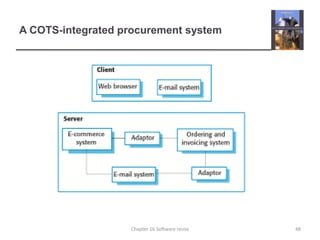
Design choicesWhich COTS products offer the most appropriate functionality?Typically, there will be several COTS products available, which can be combined in different ways.How will data be exchanged?Different products normally use unique data structures and formats. You have to write adaptors that convert from one representation to another.What features of a product will actually be used?COTS products may include more functionality than you need and functionality may be duplicated across different products.Chapter 16 Software reuse47
A COTS-integrated procurement system 48Chapter 16 Software reuse
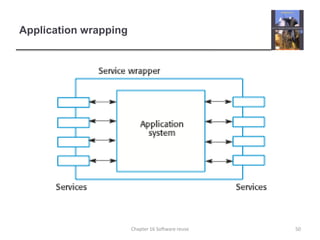
Service-oriented COTS interfacesCOTS integration can be simplified if a service-oriented approach is used.A service-oriented approach means allowing access to the application system’s functionality through a standard service interface, with a service for each discrete unit of functionality.Some applications may offer a service interface but, sometimes, this service interface has to be implemented by the system integrator. You have to program a wrapper that hides the application and provides externally visible services. Chapter 16 Software reuse49
Application wrapping50Chapter 16 Software reuse
COTS system integration problemsLack of control over functionality and performanceCOTS systems may be less effective than they appearProblems with COTS system inter-operabilityDifferent COTS systems may make different assumptions that means integration is difficultNo control over system evolutionCOTS vendors not system users control evolutionSupport from COTS vendorsCOTS vendors may not offer support  over the lifetime of the product
Key pointsSoftware product lines are related applications that are developed from a common base. This generic system is adapted to meet specific requirements for functionality, target platform or operational configuration.COTS product reuse is concerned with the reuse of large-scale, off-the-shelf systems. These provide a lot of functionality and their reuse can radically reduce costs and development time.  Systems may be developed by configuring a single, generic COTS product or by integrating two or more COTS products.Enterprise Resource Planning systems are examples of large-scale COTS reuse. You create an instance of an ERP system by configuring a generic system with information about the customer’s business processes and rules.Potential problems with COTS-based reuse include lack of control over functionality and performance, lack of control over system evolution, the need for support from external vendors and difficulties in ensuring that systems can inter-operate.Chapter 16 Software reuse52

Ch16-Software Engineering 9

  • 1.
    Chapter 16 –Software ReuseLecture 11Chapter 16 Software reuse
  • 2.
    Topics coveredThe reuselandscape Application frameworksSoftware product lines COTS product reuseChapter 16 Software reuse2
  • 3.
    Software reuseIn mostengineering disciplines, systems are designed by composing existing components that have been used in other systems.Software engineering has been more focused on original development but it is now recognised that to achieve better software, more quickly and at lower cost, we need a design process that is based on systematic software reuse.There has been a major switch to reuse-based development over the past 10 years.
  • 4.
    Reuse-based software engineeringApplicationsystem reuseThe whole of an application system may be reused either by incorporating it without change into other systems (COTS reuse) or by developing application families.Component reuseComponents of an application from sub-systems to single objects may be reused. Covered in Chapter 17.Object and function reuseSoftware components that implement a single well-defined object or function may be reused.
  • 5.
    Benefits of softwarereuse5Chapter 16 Software reuse
  • 6.
    Benefits of softwarereuse6Chapter 16 Software reuse
  • 7.
  • 8.
  • 9.
    The reuse landscapeAlthoughreuse is often simply thought of as the reuse of system components, there are many different approaches to reuse that may be used.Reuse is possible at a range of levels from simple functions to complete application systems.The reuse landscape covers the range of possible reuse techniques.
  • 10.
  • 11.
    Approaches that supportsoftware reuse11Chapter 16 Software reuse
  • 12.
    Approaches that supportsoftware reuse12Chapter 16 Software reuse
  • 13.
    Approaches that supportsoftware reuse13Chapter 16 Software reuse
  • 14.
    Reuse planning factorsThedevelopment schedule for the software.The expected software lifetime.The background, skills and experience of the development team.The criticality of the software and its non-functional requirements.The application domain.The execution platform for the software.
  • 15.
    Application frameworksFrameworks aremoderately large entities that can be reused. They are somewhere between system and component reuse.Frameworks are a sub-system design made up of a collection of abstract and concrete classes and the interfaces between them.The sub-system is implemented by adding components to fill in parts of the design and by instantiating the abstract classes in the framework.
  • 16.
    Framework classesSystem infrastructureframeworksSupport the development of system infrastructures such as communications, user interfaces and compilers.Middleware integration frameworksStandards and classes that support component communication and information exchange.Enterprise application frameworksSupport the development of specific types of application such as telecommunications or financial systems.
  • 17.
    Web application frameworksSupportthe construction of dynamic websites as a front-end for web applications.WAFs are now available for all of the commonly used web programming languages e.g. Java, Python, Ruby, etc.Interaction model is based on the Model-View-Controller composite pattern.Chapter 16 Software reuse17
  • 18.
    Model-view controllerSystem infrastructureframework for GUI design.Allows for multiple presentations of an object and separate interactions with these presentations.MVC framework involves the instantiation of a number of patterns (as discussed in Chapter 7).
  • 19.
  • 20.
    WAF featuresSecurityWAFsmay includeclasses to help implement user authentication (login) and access.Dynamic web pagesClasses are provided to help you define web page templates and to populate these dynamically from the system database.Database supportThe framework may provide classes that provide an abstract interface to different databases.Session managementClasses to create and manage sessions (a number of interactions with the system by a user) are usually part of a WAF.User interactionMost web frameworks now provide AJAX support (Holdener, 2008), which allows more interactive web pages to be created.Chapter 16 Software reuse20
  • 21.
    Extending frameworksFrameworks aregeneric and are extended to create a more specific application or sub-system. They provide a skeleton architecture for the system.Extending the framework involvesAdding concrete classes that inherit operations from abstract classes in the framework;Adding methods that are called in response to events that are recognised by the framework.Problem with frameworks is their complexity which means that it takes a long time to use them effectively.
  • 22.
    Inversion of controlin frameworks22Chapter 16 Software reuse
  • 23.
    Key pointsMost newbusiness software systems are now developed by reusing knowledge and code from previously implemented systems.There are many different ways to reuse software. These range from the reuse of classes and methods in libraries to the reuse of complete application systems.The advantages of software reuse are lower costs, faster software development and lower risks. System dependability is increased. Specialists can be used more effectively by concentrating their expertise on the design of reusable components.Application frameworks are collections of concrete and abstract objects that are designed for reuse through specialization and the addition of new objects. They usually incorporate good design practice through design patterns.Chapter 16 Software reuse23
  • 24.
    Chapter 16 –Software ReuseLecture 224Chapter 16 Software reuse
  • 25.
    Software product linesSoftwareproduct lines or application families are applications with generic functionality that can be adapted and configured for use in a specific context.A software product line is a set of applications with a common architecture and shared components, with each application specialized to reflect different requirements. Adaptation may involve:Component and system configuration;Adding new components to the system;Selecting from a library of existing components;Modifying components to meet new requirements.
  • 26.
    Application frameworks andproduct linesApplication frameworks rely on object-oriented features such as polymorphism to implement extensions. Product lines need not be object-oriented (e.g. embedded software for a mobile phone)Application frameworks focus on providing technical rather than domain-specific support. Product lines embed domain and platform information.Product lines often control applications for equipment.Software product lines are made up of a family of applications, usually owned by the same organization. Chapter 16 Software reuse26
  • 27.
    Product line specialisationPlatformspecializationDifferent versions of the application are developed for different platforms.Environment specializationDifferent versions of the application are created to handle different operating environments e.g. different types of communication equipment.Functional specializationDifferent versions of the application are created for customers with different requirements.Process specializationDifferent versions of the application are created to support different business processes.
  • 28.
    Product line architecturesArchitecturesmust be structured in such a way to separate different sub-systems and to allow them to be modified.The architecture should also separate entities and their descriptions and the higher levels in the system access entities through descriptions rather than directly.
  • 29.
    Thearchitecture of aresource allocation system29Chapter 16 Software reuse
  • 30.
    The product linearchitecture of a vehicle dIspatcher30Chapter 16 Software reuse
  • 31.
    Vehicle dispatchingA specialisedresource management system where the aim is to allocate resources (vehicles) to handle incidents.Adaptations include:At the UI level, there are components for operator display and communications;At the I/O management level, there are components that handle authentication, reporting and route planning;At the resource management level, there are components for vehicle location and despatch, managing vehicle status and incident logging;The database includes equipment, vehicle and map databases.
  • 32.
  • 33.
    Product instance developmentElicitstakeholder requirementsUse existing family member as a prototypeChoose closest-fit family memberFind the family member that best meets the requirementsRe-negotiate requirementsAdapt requirements as necessary to capabilities of the softwareAdapt existing systemDevelop new modules and make changes for family memberDeliver new family memberDocument key features for further member development
  • 34.
    Product line configurationDesigntime configurationThe product line is adapted and changed according to the requirements of particular customers.Deployment time configurationThe product line is configured by embedding knowledge of the customer’s requirements and business processes. The software source code itself is not changed.
  • 35.
  • 36.
    Levels of deploymenttime configurationComponent selection, where you select the modules in a system that provide the required functionality.Workflow and rule definition, where you define workflows (how information is processed, stage-by-stage) and validation rules that should apply to information entered by users or generated by the system. 3. Parameter definition, where you specify the values of specific system parameters that reflect the instance of the application that you are creatingChapter 16 Software reuse36
  • 37.
    COTS product reuseAcommercial-off-the-shelf (COTS) product is a software system that can be adapted for different customers without changing the source code of the system.COTS systems have generic features and so can be used/reused in different environments.COTS products are adapted by using built-in configuration mechanisms that allow the functionality of the system to be tailored to specific customer needs.For example, in a hospital patient record system, separate input forms and output reports might be defined for different types of patient. Chapter 16 Software reuse37
  • 38.
    Benefits of COTSreuseAs with other types of reuse, more rapid deployment of a reliable system may be possible.It is possible to see what functionality is provided by the applications and so it is easier to judge whether or not they are likely to be suitable.Some development risks are avoided by using existing software. However, this approach has its own risks, as I discuss below.Businesses can focus on their core activity without having to devote a lot of resources to IT systems development.As operating platforms evolve, technology updates may be simplified as these are the responsibility of the COTS product vendor rather than the customer.Chapter 16 Software reuse38
  • 39.
    Problems of COTSreuseRequirements usually have to be adapted to reflect the functionality and mode of operation of the COTS product.The COTS product may be based on assumptions that are practically impossible to change.Choosing the right COTS system for an enterprise can be a difficult process, especially as many COTS products are not well documented.There may be a lack of local expertise to support systems development.The COTS product vendor controls system support and evolution. Chapter 16 Software reuse39
  • 40.
    COTS-solution and COTS-integratedsystems40Chapter 16 Software reuse
  • 41.
    COTS solution systemsCOTS-solutionsystems are generic application systems that may be designed to support a particular business type, business activity or, sometimes, a complete business enterprise.For example, a COTS-solution system may be produced for dentists that handles appointments, dental records, patient recall, etc.Domain-specific COTS-solution systems, such as systems to support a business function (e.g. document management) provide functionality that is likely to be required by a range of potential users.Chapter 16 Software reuse41
  • 42.
    ERP systemsAn EnterpriseResource Planning (ERP) system is a generic system that supports common business processes such as ordering and invoicing, manufacturing, etc.These are very widely used in large companies - they represent probably the most common form of software reuse.The generic core is adapted by including modules and by incorporating knowledge of business processes and rules.
  • 43.
    The architecture ofan ERP system43Chapter 16 Software reuse
  • 44.
    ERP architectureA numberof modules to support different business functions.A defined set of business processes, associated with each module, which relate to activities in that module.A common database that maintains information about all related business functions.A set of business rules that apply to all data in the database. Chapter 16 Software reuse44
  • 45.
    ERP configurationSelecting therequired functionality from the system.Establishing a data model that defines how the organization’s data will be structured in the system database.Defining business rules that apply to that data.Defining the expected interactions with external systems.Designing the input forms and the output reports generated by the system.Designing new business processes that conform to the underlying process model supported by the system.Setting parameters that define how the system is deployed on its underlying platform.Chapter 16 Software reuse45
  • 46.
    COTS integrated systemsCOTS-integratedsystems are applications that include two or more COTS products and/or legacy application systems.You may use this approach when there is no single COTS system that meets all of your needs or when you wish to integrate a new COTS product with systems that you already use. Chapter 16 Software reuse46
  • 47.
    Design choicesWhich COTSproducts offer the most appropriate functionality?Typically, there will be several COTS products available, which can be combined in different ways.How will data be exchanged?Different products normally use unique data structures and formats. You have to write adaptors that convert from one representation to another.What features of a product will actually be used?COTS products may include more functionality than you need and functionality may be duplicated across different products.Chapter 16 Software reuse47
  • 48.
    A COTS-integrated procurementsystem 48Chapter 16 Software reuse
  • 49.
    Service-oriented COTS interfacesCOTSintegration can be simplified if a service-oriented approach is used.A service-oriented approach means allowing access to the application system’s functionality through a standard service interface, with a service for each discrete unit of functionality.Some applications may offer a service interface but, sometimes, this service interface has to be implemented by the system integrator. You have to program a wrapper that hides the application and provides externally visible services. Chapter 16 Software reuse49
  • 50.
  • 51.
    COTS system integrationproblemsLack of control over functionality and performanceCOTS systems may be less effective than they appearProblems with COTS system inter-operabilityDifferent COTS systems may make different assumptions that means integration is difficultNo control over system evolutionCOTS vendors not system users control evolutionSupport from COTS vendorsCOTS vendors may not offer support over the lifetime of the product
  • 52.
    Key pointsSoftware productlines are related applications that are developed from a common base. This generic system is adapted to meet specific requirements for functionality, target platform or operational configuration.COTS product reuse is concerned with the reuse of large-scale, off-the-shelf systems. These provide a lot of functionality and their reuse can radically reduce costs and development time. Systems may be developed by configuring a single, generic COTS product or by integrating two or more COTS products.Enterprise Resource Planning systems are examples of large-scale COTS reuse. You create an instance of an ERP system by configuring a generic system with information about the customer’s business processes and rules.Potential problems with COTS-based reuse include lack of control over functionality and performance, lack of control over system evolution, the need for support from external vendors and difficulties in ensuring that systems can inter-operate.Chapter 16 Software reuse52