MICRONUTRIENTS
AND THEIR
DEFICIENCIES
Dr. Sookun Rajeev K
M.D
Dept of Community Medicine
IMPORTANCE OF MICRONUTRIENTS
 Growth,
 Health,
 Development.
 Vitamins are organic substances that are
essential for several enzymatic functions in
human metabolism
 A compound is called vitamin when it cannot be
synthesized in sufficient quantities by an
organism, and must be obtained from the diet.
What are Vitamins?
Functions of Micronutrients
 Acts as hormones (vitamin D)
 Acts as antioxidant (vitamin E)
 Acts as mediators of cell signaling and
regulators of cell and tissue growth and
differentiation (vitamin A)
 Acts as precursors for enzyme cofactor
biomolecules(coenzymes) that help act as
catalysts and substrates in metabolism.
VITAMINS
 Vitamins are classified according to
solubility into fat soluble & water soluble.
 13 vitamins are known, 4 fat soluble
(K,E,D & A) & 9 water soluble (C, Folate &
the B group).
VITAMINS
 Water soluble - dissolve easily in water
readily excreted from the body.
 Fat soluble - absorbed through the
intestinal tract with the help of lipids(fats).
VITAMIN A
Vitamin A is a generic term for many related
compounds. Retinol (alcohol), Retinal (aldehyde)
are often called preformed vitamin A. Retinal can
be converted by the body to retinoic acid which is
known to affect gene transcription.
Body can convert b-carotene to retinol, thus
called provitamin A.
FUNCTIONS OF VITAMIN A
1. Immunity: important for activation of T lymphocyte,
maturation of WBC & integrity of physiological barrier.
2. Vision: integrity of eye & formation of rodopsin necessary for
dark adaptation.
3. Regulation of gene expression: vital to cell differentiation &
physiologic processes
4. Growth & development
5. Red blood cell production
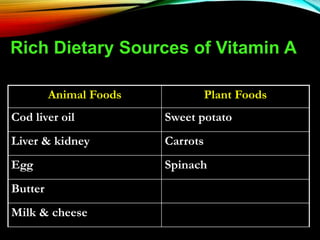
Animal Foods Plant Foods
Cod liver oil Sweet potato
Liver & kidney Carrots
Egg Spinach
Butter
Milk & cheese
Rich Dietary Sources of Vitamin A
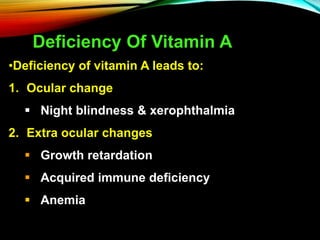
Deficiency Of Vitamin A
•Deficiency of vitamin A leads to:
1. Ocular change
 Night blindness & xerophthalmia
2. Extra ocular changes
 Growth retardation
 Acquired immune deficiency
 Anemia
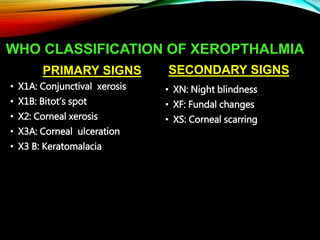
WHO CLASSIFICATION OF XEROPTHALMIA
PRIMARY SIGNS
• X1A: Conjunctival xerosis
• X1B: Bitot’s spot
• X2: Corneal xerosis
• X3A: Corneal ulceration
• X3 B: Keratomalacia
SECONDARY SIGNS
• XN: Night blindness
• XF: Fundal changes
• XS: Corneal scarring
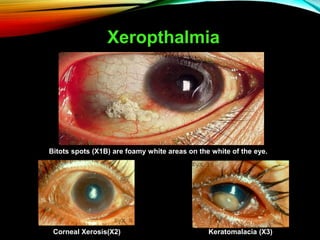
Xeropthalmia
Bitots spots (X1B) are foamy white areas on the white of the eye.
Corneal Xerosis(X2) Keratomalacia (X3)
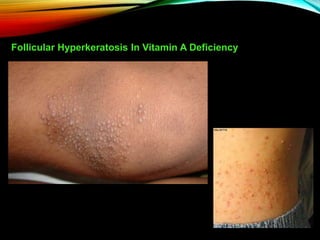
Follicular Hyperkeratosis In Vitamin A Deficiency
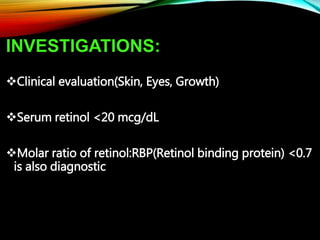
INVESTIGATIONS:
Clinical evaluation(Skin, Eyes, Growth)
Serum retinol <20 mcg/dL
Molar ratio of retinol:RBP(Retinol binding protein) <0.7
is also diagnostic
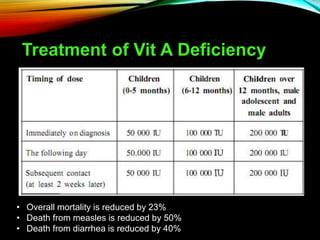
Treatment of Vit A Deficiency
• Overall mortality is reduced by 23%
• Death from measles is reduced by 50%
• Death from diarrhea is reduced by 40%
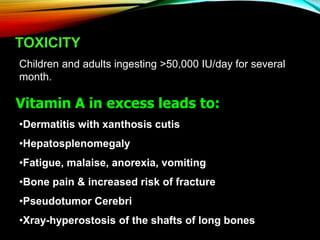
TOXICITY
Children and adults ingesting >50,000 IU/day for several
month.
Vitamin A in excess leads to:
•Dermatitis with xanthosis cutis
•Hepatosplenomegaly
•Fatigue, malaise, anorexia, vomiting
•Bone pain & increased risk of fracture
•Pseudotumor Cerebri
•Xray-hyperostosis of the shafts of long bones
VITAMIN D
 Vitamin D comprises a group of sterols; the most
important of which are cholecalciferol (vitamin D3) &
ergosterol (vitamin D2).
 Humans & animals utilize only vitamin D3 & they can
produce it inside their bodies from cholesterol.
 Cholesterol is converted to 7-dehydro-cholesterol
(7DC), which is a precursor of vitamin D3.
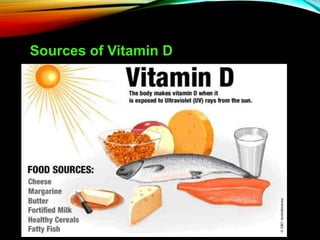
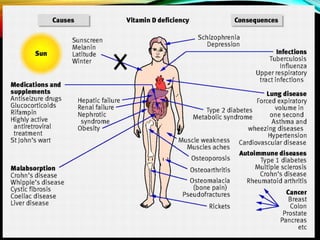
Sources of Vitamin D
FUNCTIONS
 Calcium metabolism: vitamin D enhances
Calcium absorption in the gut & renal tubules.
 Cell differentiation: particularly of collagen &
skin epithelium
 Immunity: important for Cell Mediated Immunity
& coordination of the immune response.
Deficiency of Vitamin D
•Deficiency of vitamin D leads to:
 Rickets in small children.
 Osteomalacia
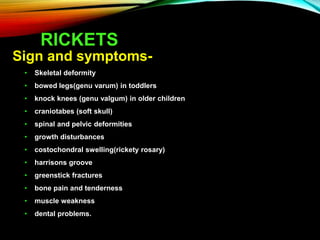
RICKETS
Sign and symptoms-
• Skeletal deformity
• bowed legs(genu varum) in toddlers
• knock knees (genu valgum) in older children
• craniotabes (soft skull)
• spinal and pelvic deformities
• growth disturbances
• costochondral swelling(rickety rosary)
• harrisons groove
• greenstick fractures
• bone pain and tenderness
• muscle weakness
• dental problems.
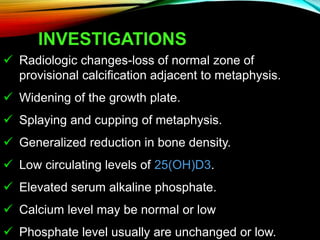
INVESTIGATIONS
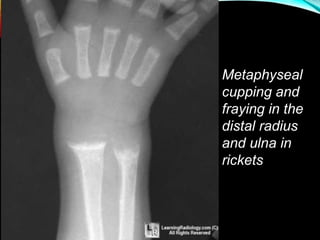
 Radiologic changes-loss of normal zone of
provisional calcification adjacent to metaphysis.
 Widening of the growth plate.
 Splaying and cupping of metaphysis.
 Generalized reduction in bone density.
 Low circulating levels of 25(OH)D3.
 Elevated serum alkaline phosphate.
 Calcium level may be normal or low
 Phosphate level usually are unchanged or low.
Metaphyseal
cupping and
fraying in the
distal radius
and ulna in
rickets
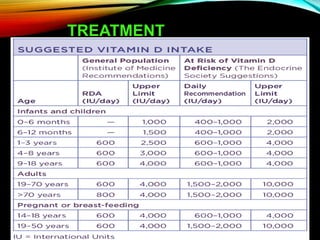
TREATMENT
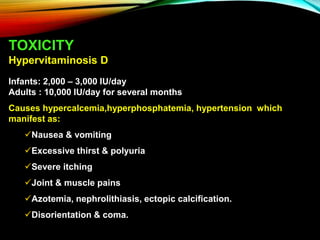
TOXICITY
Hypervitaminosis D
Infants: 2,000 – 3,000 IU/day
Adults : 10,000 IU/day for several months
Causes hypercalcemia,hyperphosphatemia, hypertension which
manifest as:
Nausea & vomiting
Excessive thirst & polyuria
Severe itching
Joint & muscle pains
Azotemia, nephrolithiasis, ectopic calcification.
Disorientation & coma.
VITAMIN C - ASCORBIC ACID
• Humans are among the few species that cannot
synthesize vitamin C and must obtain it from food
• Manufacture of collagen
• Helps support and protect blood vessels, bones,
joints, organs and muscles
• Protective barrier against infection and disease
• Promotes healing of wounds, fractures and bruises
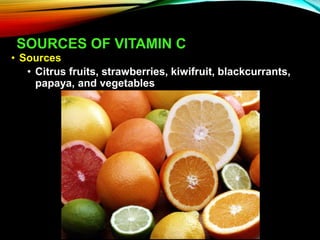
SOURCES OF VITAMIN C
• Sources
• Citrus fruits, strawberries, kiwifruit, blackcurrants,
papaya, and vegetables
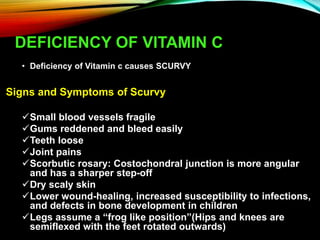
DEFICIENCY OF VITAMIN C
• Deficiency of Vitamin c causes SCURVY
Signs and Symptoms of Scurvy
Small blood vessels fragile
Gums reddened and bleed easily
Teeth loose
Joint pains
Scorbutic rosary: Costochondral junction is more angular
and has a sharper step-off
Dry scaly skin
Lower wound-healing, increased susceptibility to infections,
and defects in bone development in children
Legs assume a “frog like position”(Hips and knees are
semiflexed with the feet rotated outwards)
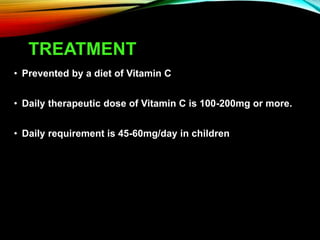
TREATMENT
• Prevented by a diet of Vitamin C
• Daily therapeutic dose of Vitamin C is 100-200mg or more.
• Daily requirement is 45-60mg/day in children
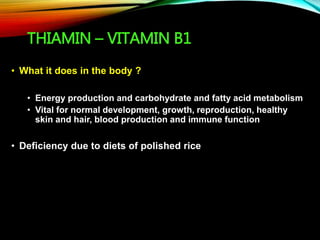
THIAMIN – VITAMIN B1
• What it does in the body ?
• Energy production and carbohydrate and fatty acid metabolism
• Vital for normal development, growth, reproduction, healthy
skin and hair, blood production and immune function
• Deficiency due to diets of polished rice
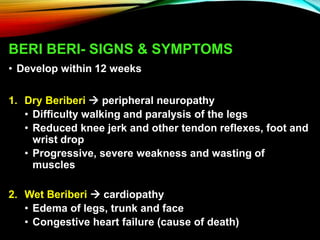
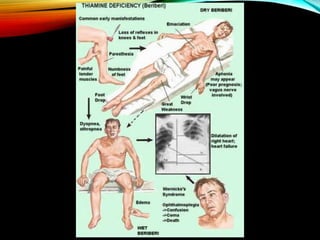
BERI BERI- SIGNS & SYMPTOMS
• Develop within 12 weeks
1. Dry Beriberi  peripheral neuropathy
• Difficulty walking and paralysis of the legs
• Reduced knee jerk and other tendon reflexes, foot and
wrist drop
• Progressive, severe weakness and wasting of
muscles
2. Wet Beriberi  cardiopathy
• Edema of legs, trunk and face
• Congestive heart failure (cause of death)
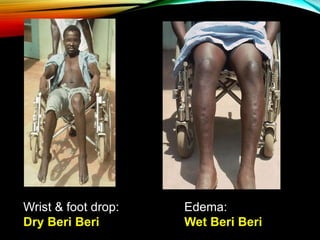
Wrist & foot drop:
Dry Beri Beri
Edema:
Wet Beri Beri
RIBOFLAVIN DEFICIENCY
• Deficiency is rare and often occurs with other B
vitamin deficiencies
• Several months for symptoms to occur
Burning, itching of eyes
Angular stomatitis
Cheilosis
Swelling and shallow ulcerations of lips
Glossitis
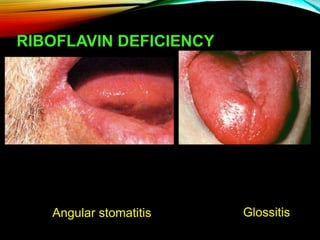
RIBOFLAVIN DEFICIENCY
Angular stomatitis Glossitis
NIACIN – VITAMIN B3
• Essential for healthy skin, tongue, digestive tract tissues, and
RBC formation
• Processing of grains removes most of their niacin content so
flour is enriched with the vitamin
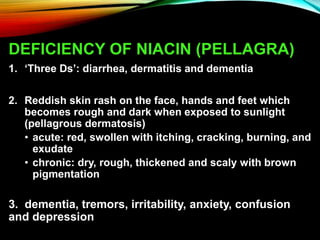
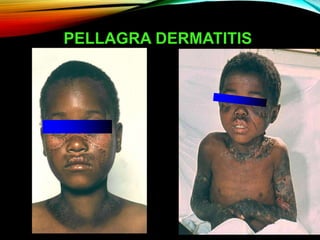
DEFICIENCY OF NIACIN (PELLAGRA)
1. ‘Three Ds’: diarrhea, dermatitis and dementia
2. Reddish skin rash on the face, hands and feet which
becomes rough and dark when exposed to sunlight
(pellagrous dermatosis)
• acute: red, swollen with itching, cracking, burning, and
exudate
• chronic: dry, rough, thickened and scaly with brown
pigmentation
3. dementia, tremors, irritability, anxiety, confusion
and depression
PELLAGRA DERMATITIS
VITAMIN K
It is a cofactor of the enzyme that catalyzes one step in the
formation of prothrombin.
Needed for the generation of several clotting factors in the
liver.
Source- green leafy vegetables.
Deficiency-coagulation defect due to hypoprothrombinemia
and deficiency of factor VII resulting in hemorrhagic disease
of the newborn.
1mg IM –newborn.
In severe deficiency-2.5 to 5 mg/day parenterally.
ANEMIA
• Iron deficiency is the most common cause of
anemia and most common preventable nutritional
deficiency.
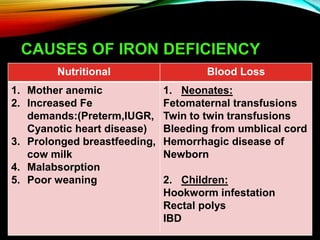
CAUSES OF IRON DEFICIENCY
Nutritional Blood Loss
1. Mother anemic
2. Increased Fe
demands:(Preterm,IUGR,
Cyanotic heart disease)
3. Prolonged breastfeeding,
cow milk
4. Malabsorption
5. Poor weaning
1. Neonates:
Fetomaternal transfusions
Twin to twin transfusions
Bleeding from umblical cord
Hemorrhagic disease of
Newborn
2. Children:
Hookworm infestation
Rectal polys
IBD
SIGNS & SYMPTOMS OF IRON DEFICIENCY
Symptoms
• Tiredness/ Fatigue/ Headache/Breathlessness
Signs
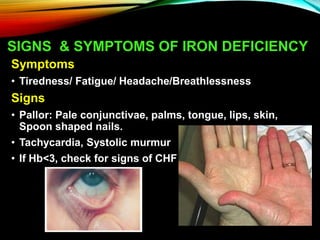
• Pallor: Pale conjunctivae, palms, tongue, lips, skin,
Spoon shaped nails.
• Tachycardia, Systolic murmur
• If Hb<3, check for signs of CHF
INVESTIGATIONS:
• CBC: 1) Hemoglobin <11.0 g/dL
• MVC/ MCH/ MCHC are all decreased
• Reticulocyte count: Normal or minimally elevated
• Peripheral blood smear:
Microcytic hypochromic anemia
• Serum Fe levels: Decreased
• TIBC: Increased
• Serum ferritin levels: Decreased
ANEMIA- TREATMENT
• Dietary counseling: Infants fortified milk formula less
than 1yr of age
• Dietary diversification
• Foods that are rich in iron include:
• Meat/ Fortified cereals/ Spinach/Lentils and beans
• Iron supplements
• Mild to moderate anemia: 3-6mg/kg/day of iron (3-5
months)
• Severe anemia and cardiac decompensation: Start
blood transfusions, packed RBC’s: (2-3ml/kg)
ZINC DEFICIENCY
 Zinc essential for the function of many enzymes and
metabolic processes
 Zinc deficiency is common in developing countries
with high mortality
 Zinc commonly the most deficient nutrient in
complementary food mixtures fed to infants during
weaning
 Zinc interventions are among those proposed to help
reduce child deaths globally by 63%.
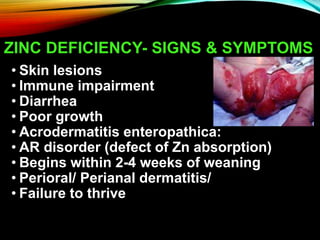
ZINC DEFICIENCY- SIGNS & SYMPTOMS
• Skin lesions
• Immune impairment
• Diarrhea
• Poor growth
• Acrodermatitis enteropathica:
• AR disorder (defect of Zn absorption)
• Begins within 2-4 weeks of weaning
• Perioral/ Perianal dermatitis/
• Failure to thrive
Zinc Deficiency- Treatment
 Regular zinc supplements can greatly reduce common
infant morbidities in developing countries
• Adjunct treatment of diarrhea
-10 mg/day for infants below 6 months,
-20mg/day of zinc for 10-14 days(>6months)
Zinc deficiency commonly coexists with other
micronutrient deficiencies including iron, making
single supplements inappropriate
Emperical trial of Zinc
supplementation(1ug/kg/day) is safe and
reasonable
Thank You

Micro Nutrients and their Deficiency by Dr. Sookun Rajeev Kumar

  • 1.
    MICRONUTRIENTS AND THEIR DEFICIENCIES Dr. SookunRajeev K M.D Dept of Community Medicine
  • 2.
    IMPORTANCE OF MICRONUTRIENTS Growth,  Health,  Development.
  • 3.
     Vitamins areorganic substances that are essential for several enzymatic functions in human metabolism  A compound is called vitamin when it cannot be synthesized in sufficient quantities by an organism, and must be obtained from the diet. What are Vitamins?
  • 4.
    Functions of Micronutrients Acts as hormones (vitamin D)  Acts as antioxidant (vitamin E)  Acts as mediators of cell signaling and regulators of cell and tissue growth and differentiation (vitamin A)  Acts as precursors for enzyme cofactor biomolecules(coenzymes) that help act as catalysts and substrates in metabolism.
  • 5.
    VITAMINS  Vitamins areclassified according to solubility into fat soluble & water soluble.  13 vitamins are known, 4 fat soluble (K,E,D & A) & 9 water soluble (C, Folate & the B group).
  • 6.
    VITAMINS  Water soluble- dissolve easily in water readily excreted from the body.  Fat soluble - absorbed through the intestinal tract with the help of lipids(fats).
  • 7.
    VITAMIN A Vitamin Ais a generic term for many related compounds. Retinol (alcohol), Retinal (aldehyde) are often called preformed vitamin A. Retinal can be converted by the body to retinoic acid which is known to affect gene transcription. Body can convert b-carotene to retinol, thus called provitamin A.
  • 8.
    FUNCTIONS OF VITAMINA 1. Immunity: important for activation of T lymphocyte, maturation of WBC & integrity of physiological barrier. 2. Vision: integrity of eye & formation of rodopsin necessary for dark adaptation. 3. Regulation of gene expression: vital to cell differentiation & physiologic processes 4. Growth & development 5. Red blood cell production
  • 9.
    Animal Foods PlantFoods Cod liver oil Sweet potato Liver & kidney Carrots Egg Spinach Butter Milk & cheese Rich Dietary Sources of Vitamin A
  • 10.
    Deficiency Of VitaminA •Deficiency of vitamin A leads to: 1. Ocular change  Night blindness & xerophthalmia 2. Extra ocular changes  Growth retardation  Acquired immune deficiency  Anemia
  • 11.
    WHO CLASSIFICATION OFXEROPTHALMIA PRIMARY SIGNS • X1A: Conjunctival xerosis • X1B: Bitot’s spot • X2: Corneal xerosis • X3A: Corneal ulceration • X3 B: Keratomalacia SECONDARY SIGNS • XN: Night blindness • XF: Fundal changes • XS: Corneal scarring
  • 12.
    Xeropthalmia Bitots spots (X1B)are foamy white areas on the white of the eye. Corneal Xerosis(X2) Keratomalacia (X3)
  • 13.
    Follicular Hyperkeratosis InVitamin A Deficiency
  • 14.
    INVESTIGATIONS: Clinical evaluation(Skin, Eyes,Growth) Serum retinol <20 mcg/dL Molar ratio of retinol:RBP(Retinol binding protein) <0.7 is also diagnostic
  • 15.
    Treatment of VitA Deficiency • Overall mortality is reduced by 23% • Death from measles is reduced by 50% • Death from diarrhea is reduced by 40%
  • 16.
    TOXICITY Children and adultsingesting >50,000 IU/day for several month. Vitamin A in excess leads to: •Dermatitis with xanthosis cutis •Hepatosplenomegaly •Fatigue, malaise, anorexia, vomiting •Bone pain & increased risk of fracture •Pseudotumor Cerebri •Xray-hyperostosis of the shafts of long bones
  • 17.
    VITAMIN D  VitaminD comprises a group of sterols; the most important of which are cholecalciferol (vitamin D3) & ergosterol (vitamin D2).  Humans & animals utilize only vitamin D3 & they can produce it inside their bodies from cholesterol.  Cholesterol is converted to 7-dehydro-cholesterol (7DC), which is a precursor of vitamin D3.
  • 18.
  • 19.
    FUNCTIONS  Calcium metabolism:vitamin D enhances Calcium absorption in the gut & renal tubules.  Cell differentiation: particularly of collagen & skin epithelium  Immunity: important for Cell Mediated Immunity & coordination of the immune response.
  • 20.
    Deficiency of VitaminD •Deficiency of vitamin D leads to:  Rickets in small children.  Osteomalacia
  • 22.
    RICKETS Sign and symptoms- •Skeletal deformity • bowed legs(genu varum) in toddlers • knock knees (genu valgum) in older children • craniotabes (soft skull) • spinal and pelvic deformities • growth disturbances • costochondral swelling(rickety rosary) • harrisons groove • greenstick fractures • bone pain and tenderness • muscle weakness • dental problems.
  • 23.
    INVESTIGATIONS  Radiologic changes-lossof normal zone of provisional calcification adjacent to metaphysis.  Widening of the growth plate.  Splaying and cupping of metaphysis.  Generalized reduction in bone density.  Low circulating levels of 25(OH)D3.  Elevated serum alkaline phosphate.  Calcium level may be normal or low  Phosphate level usually are unchanged or low.
  • 24.
    Metaphyseal cupping and fraying inthe distal radius and ulna in rickets
  • 25.
  • 26.
    TOXICITY Hypervitaminosis D Infants: 2,000– 3,000 IU/day Adults : 10,000 IU/day for several months Causes hypercalcemia,hyperphosphatemia, hypertension which manifest as: Nausea & vomiting Excessive thirst & polyuria Severe itching Joint & muscle pains Azotemia, nephrolithiasis, ectopic calcification. Disorientation & coma.
  • 27.
    VITAMIN C -ASCORBIC ACID • Humans are among the few species that cannot synthesize vitamin C and must obtain it from food • Manufacture of collagen • Helps support and protect blood vessels, bones, joints, organs and muscles • Protective barrier against infection and disease • Promotes healing of wounds, fractures and bruises
  • 28.
    SOURCES OF VITAMINC • Sources • Citrus fruits, strawberries, kiwifruit, blackcurrants, papaya, and vegetables
  • 29.
    DEFICIENCY OF VITAMINC • Deficiency of Vitamin c causes SCURVY Signs and Symptoms of Scurvy Small blood vessels fragile Gums reddened and bleed easily Teeth loose Joint pains Scorbutic rosary: Costochondral junction is more angular and has a sharper step-off Dry scaly skin Lower wound-healing, increased susceptibility to infections, and defects in bone development in children Legs assume a “frog like position”(Hips and knees are semiflexed with the feet rotated outwards)
  • 30.
    TREATMENT • Prevented bya diet of Vitamin C • Daily therapeutic dose of Vitamin C is 100-200mg or more. • Daily requirement is 45-60mg/day in children
  • 31.
    THIAMIN – VITAMINB1 • What it does in the body ? • Energy production and carbohydrate and fatty acid metabolism • Vital for normal development, growth, reproduction, healthy skin and hair, blood production and immune function • Deficiency due to diets of polished rice
  • 32.
    BERI BERI- SIGNS& SYMPTOMS • Develop within 12 weeks 1. Dry Beriberi  peripheral neuropathy • Difficulty walking and paralysis of the legs • Reduced knee jerk and other tendon reflexes, foot and wrist drop • Progressive, severe weakness and wasting of muscles 2. Wet Beriberi  cardiopathy • Edema of legs, trunk and face • Congestive heart failure (cause of death)
  • 34.
    Wrist & footdrop: Dry Beri Beri Edema: Wet Beri Beri
  • 35.
    RIBOFLAVIN DEFICIENCY • Deficiencyis rare and often occurs with other B vitamin deficiencies • Several months for symptoms to occur Burning, itching of eyes Angular stomatitis Cheilosis Swelling and shallow ulcerations of lips Glossitis
  • 36.
  • 37.
    NIACIN – VITAMINB3 • Essential for healthy skin, tongue, digestive tract tissues, and RBC formation • Processing of grains removes most of their niacin content so flour is enriched with the vitamin
  • 38.
    DEFICIENCY OF NIACIN(PELLAGRA) 1. ‘Three Ds’: diarrhea, dermatitis and dementia 2. Reddish skin rash on the face, hands and feet which becomes rough and dark when exposed to sunlight (pellagrous dermatosis) • acute: red, swollen with itching, cracking, burning, and exudate • chronic: dry, rough, thickened and scaly with brown pigmentation 3. dementia, tremors, irritability, anxiety, confusion and depression
  • 39.
  • 40.
    VITAMIN K It isa cofactor of the enzyme that catalyzes one step in the formation of prothrombin. Needed for the generation of several clotting factors in the liver. Source- green leafy vegetables. Deficiency-coagulation defect due to hypoprothrombinemia and deficiency of factor VII resulting in hemorrhagic disease of the newborn. 1mg IM –newborn. In severe deficiency-2.5 to 5 mg/day parenterally.
  • 41.
    ANEMIA • Iron deficiencyis the most common cause of anemia and most common preventable nutritional deficiency.
  • 42.
    CAUSES OF IRONDEFICIENCY Nutritional Blood Loss 1. Mother anemic 2. Increased Fe demands:(Preterm,IUGR, Cyanotic heart disease) 3. Prolonged breastfeeding, cow milk 4. Malabsorption 5. Poor weaning 1. Neonates: Fetomaternal transfusions Twin to twin transfusions Bleeding from umblical cord Hemorrhagic disease of Newborn 2. Children: Hookworm infestation Rectal polys IBD
  • 43.
    SIGNS & SYMPTOMSOF IRON DEFICIENCY Symptoms • Tiredness/ Fatigue/ Headache/Breathlessness Signs • Pallor: Pale conjunctivae, palms, tongue, lips, skin, Spoon shaped nails. • Tachycardia, Systolic murmur • If Hb<3, check for signs of CHF
  • 44.
    INVESTIGATIONS: • CBC: 1)Hemoglobin <11.0 g/dL • MVC/ MCH/ MCHC are all decreased • Reticulocyte count: Normal or minimally elevated • Peripheral blood smear: Microcytic hypochromic anemia • Serum Fe levels: Decreased • TIBC: Increased • Serum ferritin levels: Decreased
  • 45.
    ANEMIA- TREATMENT • Dietarycounseling: Infants fortified milk formula less than 1yr of age • Dietary diversification • Foods that are rich in iron include: • Meat/ Fortified cereals/ Spinach/Lentils and beans • Iron supplements • Mild to moderate anemia: 3-6mg/kg/day of iron (3-5 months) • Severe anemia and cardiac decompensation: Start blood transfusions, packed RBC’s: (2-3ml/kg)
  • 46.
    ZINC DEFICIENCY  Zincessential for the function of many enzymes and metabolic processes  Zinc deficiency is common in developing countries with high mortality  Zinc commonly the most deficient nutrient in complementary food mixtures fed to infants during weaning  Zinc interventions are among those proposed to help reduce child deaths globally by 63%.
  • 47.
    ZINC DEFICIENCY- SIGNS& SYMPTOMS • Skin lesions • Immune impairment • Diarrhea • Poor growth • Acrodermatitis enteropathica: • AR disorder (defect of Zn absorption) • Begins within 2-4 weeks of weaning • Perioral/ Perianal dermatitis/ • Failure to thrive
  • 48.
    Zinc Deficiency- Treatment Regular zinc supplements can greatly reduce common infant morbidities in developing countries • Adjunct treatment of diarrhea -10 mg/day for infants below 6 months, -20mg/day of zinc for 10-14 days(>6months) Zinc deficiency commonly coexists with other micronutrient deficiencies including iron, making single supplements inappropriate Emperical trial of Zinc supplementation(1ug/kg/day) is safe and reasonable
  • 49.