
Sprint Retrospectives
  Presented by Juan Banda
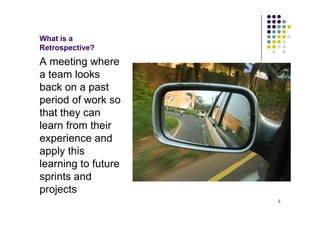
What is a
Retrospective?
A meeting where
a team looks
back on a past
period of work so
that they can
learn from their
experience and
apply this
learning to future
sprints and
projects
                     2
Agile Reflection
“At
•    regular intervals,
the team reflects on
how to become
more effective, then
tunes and adjusts its
behavior
accordingly.” Agile
Manifesto principle
•Agile projects aim to

use Retrospectives
during the life of the
project rather than
after catastrophic
failure!                  3
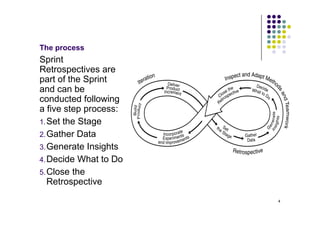
The process
Sprint
Retrospectives are
part of the Sprint
and can be
conducted following
a five step process:
1. Set the Stage
2. Gather Data
3. Generate Insights
4. Decide What to Do
5. Close the
   Retrospective
                       4
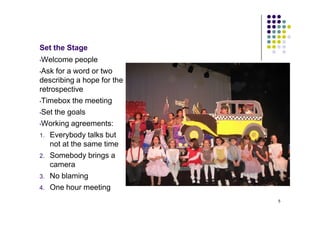
Set the Stage
•Welcome people
•Ask for a word or two

describing a hope for the
retrospective
•Timebox the meeting

•Set the goals

•Working agreements:

1. Everybody talks but
    not at the same time
2. Somebody brings a
    camera
3. No blaming
4. One hour meeting

                            5
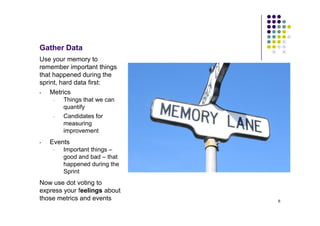
Gather Data
Use your memory to
remember important things
that happened during the
sprint, hard data first:
•   Metrics
     •   Things that we can
         quantify
     •   Candidates for
         measuring
         improvement
•   Events
     •   Important things –
         good and bad – that
         happened during the
         Sprint
Now use dot voting to
express your feelings about
those metrics and events       6
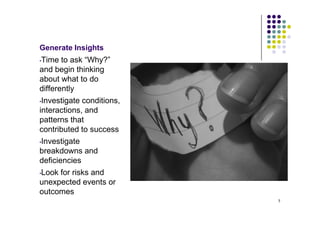
Generate Insights
Time to ask “Why?”
•

and begin thinking
about what to do
differently
•Investigate conditions,
interactions, and
patterns that
contributed to success
•Investigate
breakdowns and
deficiencies
Look for risks and
•

unexpected events or
outcomes
                           7
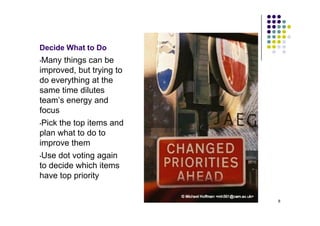
Decide What to Do
•Many things can be
improved, but trying to
do everything at the
same time dilutes
team’s energy and
focus
•Pick the top items and
plan what to do to
improve them
•Use dot voting again
to decide which items
have top priority

                          8
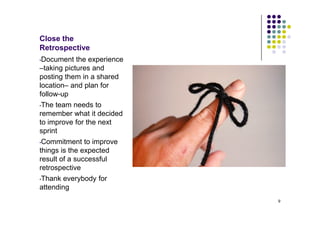
Close the
Retrospective
•Document the experience
–taking pictures and
posting them in a shared
location– and plan for
follow-up
•The team needs to
remember what it decided
to improve for the next
sprint
•Commitment to improve
things is the expected
result of a successful
retrospective
Thank everybody for
•

attending
                           9
Thanks for attending

Sprint Retrospectives

  • 1.
    Sprint Retrospectives Presented by Juan Banda
  • 2.
    What is a Retrospective? Ameeting where a team looks back on a past period of work so that they can learn from their experience and apply this learning to future sprints and projects 2
  • 3.
    Agile Reflection “At • regular intervals, the team reflects on how to become more effective, then tunes and adjusts its behavior accordingly.” Agile Manifesto principle •Agile projects aim to use Retrospectives during the life of the project rather than after catastrophic failure! 3
  • 4.
    The process Sprint Retrospectives are partof the Sprint and can be conducted following a five step process: 1. Set the Stage 2. Gather Data 3. Generate Insights 4. Decide What to Do 5. Close the Retrospective 4
  • 5.
    Set the Stage •Welcomepeople •Ask for a word or two describing a hope for the retrospective •Timebox the meeting •Set the goals •Working agreements: 1. Everybody talks but not at the same time 2. Somebody brings a camera 3. No blaming 4. One hour meeting 5
  • 6.
    Gather Data Use yourmemory to remember important things that happened during the sprint, hard data first: • Metrics • Things that we can quantify • Candidates for measuring improvement • Events • Important things – good and bad – that happened during the Sprint Now use dot voting to express your feelings about those metrics and events 6
  • 7.
    Generate Insights Time toask “Why?” • and begin thinking about what to do differently •Investigate conditions, interactions, and patterns that contributed to success •Investigate breakdowns and deficiencies Look for risks and • unexpected events or outcomes 7
  • 8.
    Decide What toDo •Many things can be improved, but trying to do everything at the same time dilutes team’s energy and focus •Pick the top items and plan what to do to improve them •Use dot voting again to decide which items have top priority 8
  • 9.
    Close the Retrospective •Document theexperience –taking pictures and posting them in a shared location– and plan for follow-up •The team needs to remember what it decided to improve for the next sprint •Commitment to improve things is the expected result of a successful retrospective Thank everybody for • attending 9
  • 10.