Revitalize your boring
Retrospectives
Scrum Retrospectives are a mirror of your sprint
Terri Spencer
Agenda
 Scrum Masters Job is to
figure out the right
retrospective
 Diversify your
Retrospectives
Mix it up
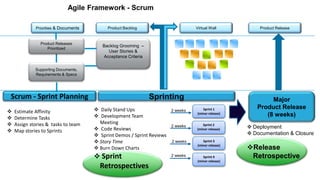
Priorities & Documents Product Backlog Virtual Wall Product Release
Backlog Grooming –
User Stories &
Acceptance Criteria
Product Releases
Prioritized
Supporting Documents,
Requirements & Specs
Major
Product Release
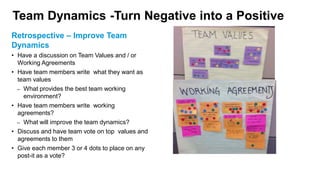
(8 weeks)
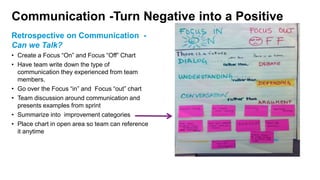
Sprint 1
(minor release)
Sprint 2
(minor release)
Sprint 3
(minor release)
Sprint 4
(minor release)
2 weeks
2 weeks
2 weeks
2 weeks
SprintingScrum - Sprint Planning
 Estimate Affinity
 Determine Tasks
 Assign stories & tasks to team
 Map stories to Sprints
 Daily Stand Ups
 Development Team
Meeting
 Code Reviews
 Sprint Demos / Sprint Reviews
 Story Time
 Burn Down Charts
 Sprint
Retrospectives
 Deployment
 Documentation & Closure
Release
Retrospective
Agile Framework - Scrum
Priorities & Documents Product Backlog Virtual Wall Product Release
Backlog Grooming –
User Stories &
Acceptance Criteria
Product Releases
Prioritized
Supporting Documents,
Requirements & Specs
Major
Product Release
(8 weeks)
Sprint 1
(minor release)
Sprint 2
(minor release)
Sprint 3
(minor release)
Sprint 4
(minor release)
2 weeks
2 weeks
2 weeks
2 weeks
SprintingScrum - Sprint Planning
 Estimate Affinity
 Determine Tasks
 Assign stories & tasks to team
 Map stories to Sprints
 Daily Stand Ups
 Development Team
Meeting
 Code Reviews
 Sprint Demos / Sprint Review
 Story Time
 Burn Down Charts
 Sprint
Retrospectives
 Deployment
 Documentation & Closure
Release
Retrospective
Agile Framework - Scrum
In agile development retrospectives play a very important role in iterative and
incremental development.At the end of every iteration a retrospective is held to look for
ways to improve the process for the next iteration.They call this the Sprint
Retrospective.
The process of doing retrospectives is at the heart of Scrum (Inspect &Adapt),
eXtreme Programming (XP) (fix what’s broken), and LEAN Software Development
(Kaizen or Continuous Improvements)
Wikipedia, 2014
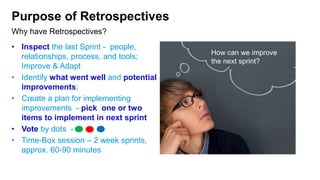
Purpose of Retrospectives
• Inspect the last Sprint - people,
relationships, process, and tools;
Improve & Adapt
• Identify what went well and potential
improvements;
• Create a plan for implementing
improvements - pick one or two
items to implement in next sprint
• Vote by dots -
• Time-Box session – 2 week sprints,
approx. 60-90 minutes
Why have Retrospectives?
How can we improve
the next sprint?
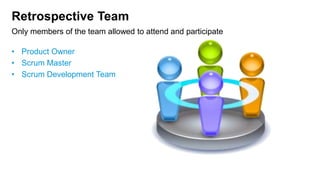
Retrospective Team
• Product Owner
• Scrum Master
• Scrum Development Team
Only members of the team allowed to attend and participate
How can we improve
the next sprint?
General Retrospectives
 New Team
 What’s Going On
 Impediments
 Innovation Games - Speedboat
 Innovation Games – Speed Car
I’m the new kid on the block………
 Do I know you?
 Do we know each other?
 Is this a new team?
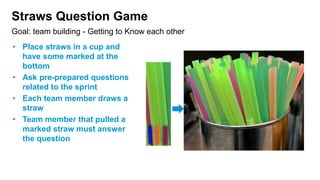
Straws Question Game
• Place straws in a cup and
have some marked at the
bottom
• Ask pre-prepared questions
related to the sprint
• Each team member draws a
straw
• Team member that pulled a
marked straw must answer
the question
Goal: team building - Getting to Know each other
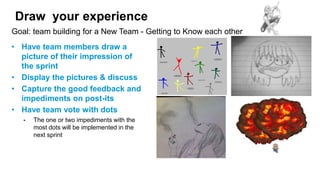
Draw your experience
• Have team members draw a
picture of their impression of
the sprint
• Display the pictures & discuss
• Capture the good feedback and
impediments on post-its
• Have team vote with dots
• The one or two impediments with the
most dots will be implemented in the
next sprint
Goal: team building for a New Team - Getting to Know each other
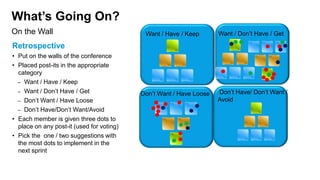
What’s Going On?
Retrospective
• Put on the walls of the conference
• Placed post-its in the appropriate
category
– Want / Have / Keep
– Want / Don’t Have / Get
– Don’t Want / Have Loose
– Don’t Have/Don’t Want/Avoid
• Each member is given three dots to
place on any post-it (used for voting)
• Pick the one / two suggestions with
the most dots to implement in the
next sprint
On the Wall Want / Have / Keep Want / Don’t Have / Get
Don’t Want / Have Loose Don’t Have/ Don’t Want /
Avoid
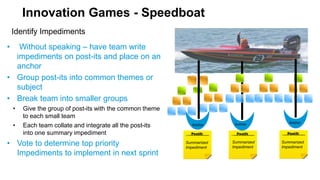
Innovation Games - Speedboat
• Without speaking – have team write
impediments on post-its and place on an
anchor
• Group post-its into common themes or
subject
• Break team into smaller groups
• Give the group of post-its with the common theme
to each small team
• Each team collate and integrate all the post-its
into one summary impediment
• Vote to determine top priority
Impediments to implement in next sprint
Identify Impediments
How can we improve
the next sprint?
Anchor Anchor Anchor
Summarized
Impediment
Summarized
Impediment
Summarized
Impediment
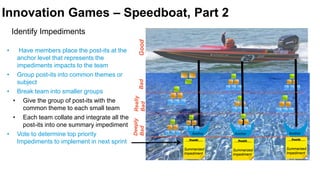
Innovation Games – Speedboat, Part 2
• Have members place the post-its at the
anchor level that represents the
impediments impacts to the team
• Group post-its into common themes or
subject
• Break team into smaller groups
• Give the group of post-its with the
common theme to each small team
• Each team collate and integrate all the
post-its into one summary impediment
• Vote to determine top priority
Impediments to implement in next sprint
Identify Impediments
How can we improve
the next sprint?
Anchor Anchor Anchor
Summarized
Impediment
Bad
Really
Bad
Deeply
Bad
Summarized
Impediment
Summarized
Impediment
Good
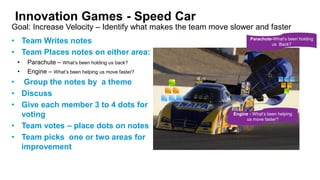
Innovation Games - Speed Car
• Team Writes notes
• Team Places notes on either area:
• Parachute – What’s been holding us back?
• Engine – What’s been helping us move faster?
• Group the notes by a theme
• Discuss
• Give each member 3 to 4 dots for
voting
• Team votes – place dots on notes
• Team picks one or two areas for
improvement
Goal: Increase Velocity – Identify what makes the team move slower and faster
Engine - What’s been helping
us move faster?
Parachute-What’s been holding
us Back?
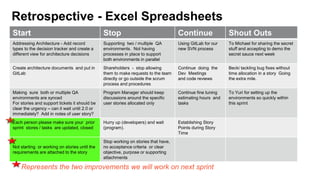
Retrospective - Excel Spreadsheets
Start Stop Continue Shout Outs
Addressing Architecture - Add record
types to the decision tracker and create a
different view for architecture decisions
Supporting two / multiple QA
environments. Not having
processes in place to support
both environments in parallel
Using GitLab for our
new SVN process
To Michael for sharing the secret
stuff and accepting to demo the
secret sauce next week
Create architecture documents and put in
GitLab
Shareholders - stop allowing
them to make requests to the team
directly or go outside the scrum
process and procedures
Continue doing the
Dev Meetings
and code reviews
Becki tackling bug fixes without
time allocation in a story Going
the extra mile.
Making sure both or multiple QA
environments are synced
For stories and support tickets it should be
clear the urgency – can it wait until 2.0 or
immediately? Add in notes of user story?
Program Manager should keep
discussions around the specific
user stories allocated only
Continue fine tuning
estimating hours and
tasks
To Yuri for setting up the
environments so quickly within
this sprint
Each person please make sure your prior
sprint stores / tasks are updated, closed
Hurry up (developers) and wait
(program).
Establishing Story
Points during Story
Time
Not starting or working on stories until the
requirements are attached to the story
Stop working on stories that have,
no acceptance criteria or clear
objective, purpose or supporting
attachments
Represents the two improvements we will work on next sprint
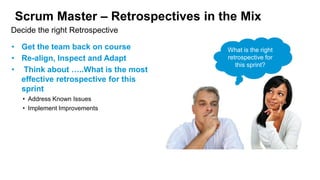
Scrum Master – Retrospectives in the Mix
• Get the team back on course
• Re-align, Inspect and Adapt
• Think about …..What is the most
effective retrospective for this
sprint
• Address Known Issues
• Implement Improvements
Decide the right Retrospective
What is the right
retrospective for
this sprint?
Impediments - Let’s Get Specific
 Known Issues
 Team Dynamics
 Team Values & Working Agreements
 Communication
 Root Cause – Why?
 What’s Your Story
 Leveraging Current Events
 Change Venue
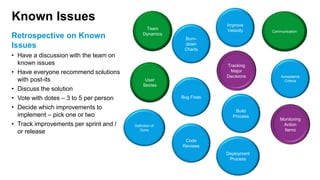
Known Issues
Retrospective on Known
Issues
• Have a discussion with the team on
known issues
• Have everyone recommend solutions
with post-its
• Discuss the solution
• Vote with dotes – 3 to 5 per person
• Decide which improvements to
implement – pick one or two
• Track improvements per sprint and /
or release
Improve
Velocity
Definition of
Done
Communication
Team
Dynamics
Build
Process
User
Stories
Acceptance
Criteria
Burn-
down
Charts
Monitoring
Action
Items
Tracking
Major
Decisions
Bug Fixes
Code
Reviews
Deployment
Process
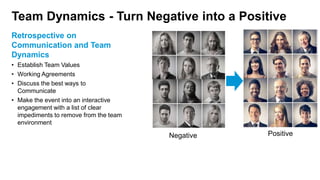
Team Dynamics - Turn Negative into a Positive
Retrospective on
Communication and Team
Dynamics
• Establish Team Values
• Working Agreements
• Discuss the best ways to
Communicate
• Make the event into an interactive
engagement with a list of clear
impediments to remove from the team
environment
Negative Positive
Team Dynamics -Turn Negative into a Positive
Retrospective – Improve Team
Dynamics
• Have a discussion on Team Values and / or
Working Agreements
• Have team members write what they want as
team values
– What provides the best team working
environment?
• Have team members write working
agreements?
– What will improve the team dynamics?
• Discuss and have team vote on top values and
agreements to them
• Give each member 3 or 4 dots to place on any
post-it as a vote?
Communication -Turn Negative into a Positive
Retrospective on Communication -
Can we Talk?
• Create a Focus “On” and Focus “Off” Chart
• Have team write down the type of
communication they experienced from team
members.
• Go over the Focus “in” and Focus “out” chart
• Team discussion around communication and
presents examples from sprint
• Summarize into improvement categories
• Place chart in open area so team can reference
it anytime
Team Dynamics and Communication - Positive
Retrospective on Team Dynamics
and Communication
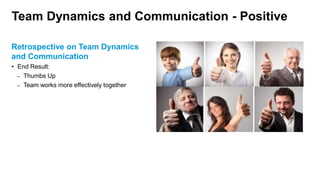
• End Result:
– Thumbs Up
– Team works more effectively together
Root Cause – Why?
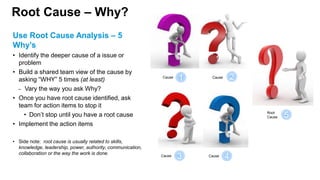
Use Root Cause Analysis – 5
Why’s
• Identify the deeper cause of a issue or
problem
• Build a shared team view of the cause by
asking “WHY” 5 times (at least)
– Vary the way you ask Why?
• Once you have root cause identified, ask
team for action items to stop it
• Don’t stop until you have a root cause
• Implement the action items
• Side note: root cause is usually related to skills,
knowledge, leadership, power, authority, communication,
collaboration or the way the work is done.
1 2
3 4
5
Cause Cause
Cause Cause
Root
Cause
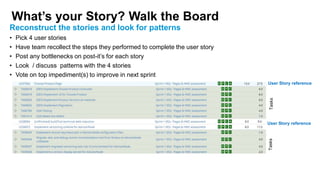
What’s your Story? Walk the Board
Reconstruct the stories and look for patterns
• Pick 4 user stories
• Have team recollect the steps they performed to complete the user story
• Post any bottlenecks on post-it’s for each story
• Look / discuss patterns with the 4 stories
• Vote on top impediment(s) to improve in next sprint
User Story reference
Tasks
User Story reference
Tasks
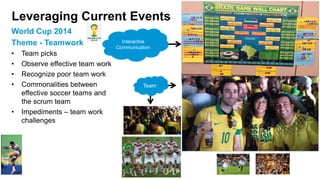
Leveraging Current Events
World Cup 2014
Theme - Teamwork
• Team picks
• Observe effective team work
• Recognize poor team work
• Commonalities between
effective soccer teams and
the scrum team
• Impediments – team work
challenges
Team
Interactive
Communication
“The better team wins. You can have
one or two special or key players
but, if you play like a team , you are
stronger than two or three players”
Jermaine Jones, soccer player, USA team at the World Cup 2014
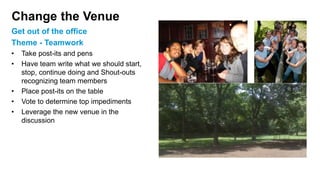
Change the Venue
Get out of the office
Theme - Teamwork
• Take post-its and pens
• Have team write what we should start,
stop, continue doing and Shout-outs
recognizing team members
• Place post-its on the table
• Vote to determine top impediments
• Leverage the new venue in the
discussion
DevCon 2014
HP’s first global Agile Development
Conference
June 2014, Palo Alto, CA
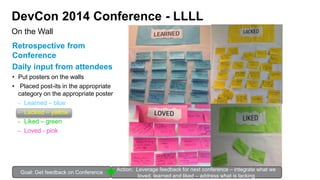
DevCon 2014 Conference - LLLL
Retrospective from
Conference
Daily input from attendees
• Put posters on the walls
• Placed post-its in the appropriate
category on the appropriate poster
– Learned – blue
– Lacked – yellow
– Liked – green
– Loved - pink
On the Wall
Goal: Get feedback on Conference
Action: Leverage feedback for next conference – integrate what we
loved, learned and liked – address what is lacking
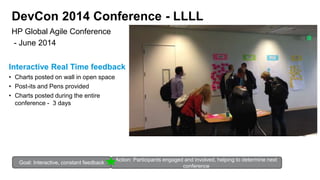
DevCon 2014 Conference - LLLL
Interactive Real Time feedback
• Charts posted on wall in open space
• Post-its and Pens provided
• Charts posted during the entire
conference - 3 days
HP Global Agile Conference
- June 2014
Goal: Interactive, constant feedback
Action: Participants engaged and involved, helping to determine next
conference
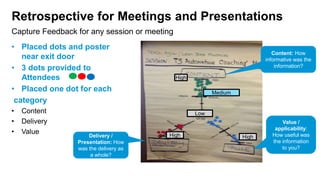
Retrospective for Meetings and Presentations
• Placed dots and poster
near exit door
• 3 dots provided to
Attendees
• Placed one dot for each
category
• Content
• Delivery
• Value
Capture Feedback for any session or meeting
Medium
High
High High
Low
Content: How
informative was the
information?
Value /
applicability:
How useful was
the information
to you?
Delivery /
Presentation: How
was the delivery as
a whole?
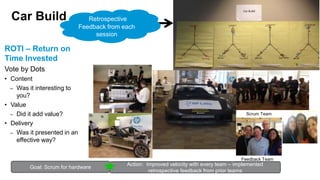
Car Build
ROTI – Return on
Time Invested
Vote by Dots
• Content
– Was it interesting to
you?
• Value
– Did it add value?
• Delivery
– Was it presented in an
effective way?
Retrospective
Feedback from each
session
Goal: Scrum for hardware
Action: Improved velocity with every team – implemented
retrospective feedback from prior teams
Feedback Team
Scrum Team
Release Retrospectives
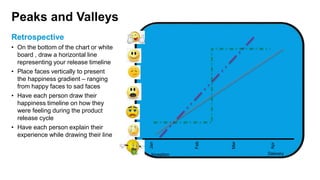
Peaks and Valleys
Retrospective
• On the bottom of the chart or white
board , draw a horizontal line
representing your release timeline
• Place faces vertically to present
the happiness gradient – ranging
from happy faces to sad faces
• Have each person draw their
happiness timeline on how they
were feeling during the product
release cycle
• Have each person explain their
experience while drawing their line
Jan
Feb
Inception
Mar
Apr
Delivery
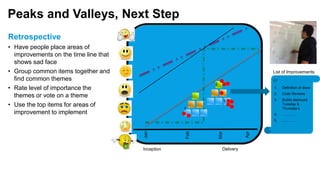
Peaks and Valleys, Next Step
Retrospective
• Have people place areas of
improvements on the time line that
shows sad face
• Group common items together and
find common themes
• Rate level of importance the
themes or vote on a theme
• Use the top items for areas of
improvement to implement
Jan
Feb
Inception
Mar
Apr
Delivery
1. Definition of done
2. Code Reviews
3. Builds deployed
Tuesday &
Thursday’s
4. ………..
5. ………..
1
2
3
List of Improvements
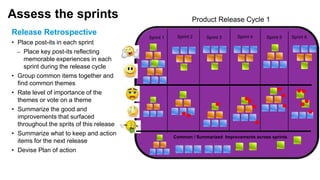
Assess the sprints
Release Retrospective
• Place post-its in each sprint
– Place key post-its reflecting
memorable experiences in each
sprint during the release cycle
• Group common items together and
find common themes
• Rate level of importance of the
themes or vote on a theme
• Summarize the good and
improvements that surfaced
throughout the sprits of this release
• Summarize what to keep and action
items for the next release
• Devise Plan of action
Sprint 1 Sprint 3 Sprint 4 Sprint 5Sprint 2 Sprint 6
Common / Summarized Improvements across sprints
Product Release Cycle 1
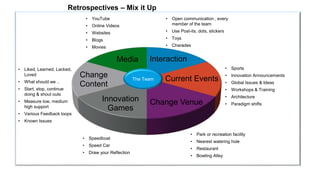
Interaction
Current Events
Change VenueInnovation
Games
Change
Content
Media
The Team
• Open communication , every
member of the team
• Use Post-its, dots, stickers
• Toys
• Charades
• Liked, Learned, Lacked,
Loved
• What should we ..
• Start, stop, continue
doing & shout outs
• Measure low, medium
high support
• Various Feedback loops
• Known Issues
• Speedboat
• Speed Car
• Draw your Reflection
• YouTube
• Online Videos
• Websites
• Blogs
• Movies
• Park or recreation facility
• Nearest watering hole
• Restaurant
• Bowling Alley
Retrospectives – Mix it Up
• Sports
• Innovation Announcements
• Global Issues & Ideas
• Workshops & Training
• Architecture
• Paradigm shifts
Summary
 Scrum Masters Job is to figure
out the right retrospective
 Diversify your Retrospectives
Thank you

Revitalizing your boring Retrospectives_3.0final

  • 1.
    Revitalize your boring Retrospectives ScrumRetrospectives are a mirror of your sprint Terri Spencer
  • 2.
    Agenda  Scrum MastersJob is to figure out the right retrospective  Diversify your Retrospectives Mix it up
  • 3.
    Priorities & DocumentsProduct Backlog Virtual Wall Product Release Backlog Grooming – User Stories & Acceptance Criteria Product Releases Prioritized Supporting Documents, Requirements & Specs Major Product Release (8 weeks) Sprint 1 (minor release) Sprint 2 (minor release) Sprint 3 (minor release) Sprint 4 (minor release) 2 weeks 2 weeks 2 weeks 2 weeks SprintingScrum - Sprint Planning  Estimate Affinity  Determine Tasks  Assign stories & tasks to team  Map stories to Sprints  Daily Stand Ups  Development Team Meeting  Code Reviews  Sprint Demos / Sprint Reviews  Story Time  Burn Down Charts  Sprint Retrospectives  Deployment  Documentation & Closure Release Retrospective Agile Framework - Scrum
  • 4.
    Priorities & DocumentsProduct Backlog Virtual Wall Product Release Backlog Grooming – User Stories & Acceptance Criteria Product Releases Prioritized Supporting Documents, Requirements & Specs Major Product Release (8 weeks) Sprint 1 (minor release) Sprint 2 (minor release) Sprint 3 (minor release) Sprint 4 (minor release) 2 weeks 2 weeks 2 weeks 2 weeks SprintingScrum - Sprint Planning  Estimate Affinity  Determine Tasks  Assign stories & tasks to team  Map stories to Sprints  Daily Stand Ups  Development Team Meeting  Code Reviews  Sprint Demos / Sprint Review  Story Time  Burn Down Charts  Sprint Retrospectives  Deployment  Documentation & Closure Release Retrospective Agile Framework - Scrum
  • 5.
    In agile developmentretrospectives play a very important role in iterative and incremental development.At the end of every iteration a retrospective is held to look for ways to improve the process for the next iteration.They call this the Sprint Retrospective. The process of doing retrospectives is at the heart of Scrum (Inspect &Adapt), eXtreme Programming (XP) (fix what’s broken), and LEAN Software Development (Kaizen or Continuous Improvements) Wikipedia, 2014
  • 6.
    Purpose of Retrospectives •Inspect the last Sprint - people, relationships, process, and tools; Improve & Adapt • Identify what went well and potential improvements; • Create a plan for implementing improvements - pick one or two items to implement in next sprint • Vote by dots - • Time-Box session – 2 week sprints, approx. 60-90 minutes Why have Retrospectives? How can we improve the next sprint?
  • 7.
    Retrospective Team • ProductOwner • Scrum Master • Scrum Development Team Only members of the team allowed to attend and participate How can we improve the next sprint?
  • 8.
    General Retrospectives  NewTeam  What’s Going On  Impediments  Innovation Games - Speedboat  Innovation Games – Speed Car
  • 9.
    I’m the newkid on the block………  Do I know you?  Do we know each other?  Is this a new team?
  • 10.
    Straws Question Game •Place straws in a cup and have some marked at the bottom • Ask pre-prepared questions related to the sprint • Each team member draws a straw • Team member that pulled a marked straw must answer the question Goal: team building - Getting to Know each other
  • 11.
    Draw your experience •Have team members draw a picture of their impression of the sprint • Display the pictures & discuss • Capture the good feedback and impediments on post-its • Have team vote with dots • The one or two impediments with the most dots will be implemented in the next sprint Goal: team building for a New Team - Getting to Know each other
  • 12.
    What’s Going On? Retrospective •Put on the walls of the conference • Placed post-its in the appropriate category – Want / Have / Keep – Want / Don’t Have / Get – Don’t Want / Have Loose – Don’t Have/Don’t Want/Avoid • Each member is given three dots to place on any post-it (used for voting) • Pick the one / two suggestions with the most dots to implement in the next sprint On the Wall Want / Have / Keep Want / Don’t Have / Get Don’t Want / Have Loose Don’t Have/ Don’t Want / Avoid
  • 13.
    Innovation Games -Speedboat • Without speaking – have team write impediments on post-its and place on an anchor • Group post-its into common themes or subject • Break team into smaller groups • Give the group of post-its with the common theme to each small team • Each team collate and integrate all the post-its into one summary impediment • Vote to determine top priority Impediments to implement in next sprint Identify Impediments How can we improve the next sprint? Anchor Anchor Anchor Summarized Impediment Summarized Impediment Summarized Impediment
  • 14.
    Innovation Games –Speedboat, Part 2 • Have members place the post-its at the anchor level that represents the impediments impacts to the team • Group post-its into common themes or subject • Break team into smaller groups • Give the group of post-its with the common theme to each small team • Each team collate and integrate all the post-its into one summary impediment • Vote to determine top priority Impediments to implement in next sprint Identify Impediments How can we improve the next sprint? Anchor Anchor Anchor Summarized Impediment Bad Really Bad Deeply Bad Summarized Impediment Summarized Impediment Good
  • 15.
    Innovation Games -Speed Car • Team Writes notes • Team Places notes on either area: • Parachute – What’s been holding us back? • Engine – What’s been helping us move faster? • Group the notes by a theme • Discuss • Give each member 3 to 4 dots for voting • Team votes – place dots on notes • Team picks one or two areas for improvement Goal: Increase Velocity – Identify what makes the team move slower and faster Engine - What’s been helping us move faster? Parachute-What’s been holding us Back?
  • 16.
    Retrospective - ExcelSpreadsheets Start Stop Continue Shout Outs Addressing Architecture - Add record types to the decision tracker and create a different view for architecture decisions Supporting two / multiple QA environments. Not having processes in place to support both environments in parallel Using GitLab for our new SVN process To Michael for sharing the secret stuff and accepting to demo the secret sauce next week Create architecture documents and put in GitLab Shareholders - stop allowing them to make requests to the team directly or go outside the scrum process and procedures Continue doing the Dev Meetings and code reviews Becki tackling bug fixes without time allocation in a story Going the extra mile. Making sure both or multiple QA environments are synced For stories and support tickets it should be clear the urgency – can it wait until 2.0 or immediately? Add in notes of user story? Program Manager should keep discussions around the specific user stories allocated only Continue fine tuning estimating hours and tasks To Yuri for setting up the environments so quickly within this sprint Each person please make sure your prior sprint stores / tasks are updated, closed Hurry up (developers) and wait (program). Establishing Story Points during Story Time Not starting or working on stories until the requirements are attached to the story Stop working on stories that have, no acceptance criteria or clear objective, purpose or supporting attachments Represents the two improvements we will work on next sprint
  • 17.
    Scrum Master –Retrospectives in the Mix • Get the team back on course • Re-align, Inspect and Adapt • Think about …..What is the most effective retrospective for this sprint • Address Known Issues • Implement Improvements Decide the right Retrospective What is the right retrospective for this sprint?
  • 18.
    Impediments - Let’sGet Specific  Known Issues  Team Dynamics  Team Values & Working Agreements  Communication  Root Cause – Why?  What’s Your Story  Leveraging Current Events  Change Venue
  • 19.
    Known Issues Retrospective onKnown Issues • Have a discussion with the team on known issues • Have everyone recommend solutions with post-its • Discuss the solution • Vote with dotes – 3 to 5 per person • Decide which improvements to implement – pick one or two • Track improvements per sprint and / or release Improve Velocity Definition of Done Communication Team Dynamics Build Process User Stories Acceptance Criteria Burn- down Charts Monitoring Action Items Tracking Major Decisions Bug Fixes Code Reviews Deployment Process
  • 20.
    Team Dynamics -Turn Negative into a Positive Retrospective on Communication and Team Dynamics • Establish Team Values • Working Agreements • Discuss the best ways to Communicate • Make the event into an interactive engagement with a list of clear impediments to remove from the team environment Negative Positive
  • 21.
    Team Dynamics -TurnNegative into a Positive Retrospective – Improve Team Dynamics • Have a discussion on Team Values and / or Working Agreements • Have team members write what they want as team values – What provides the best team working environment? • Have team members write working agreements? – What will improve the team dynamics? • Discuss and have team vote on top values and agreements to them • Give each member 3 or 4 dots to place on any post-it as a vote?
  • 22.
    Communication -Turn Negativeinto a Positive Retrospective on Communication - Can we Talk? • Create a Focus “On” and Focus “Off” Chart • Have team write down the type of communication they experienced from team members. • Go over the Focus “in” and Focus “out” chart • Team discussion around communication and presents examples from sprint • Summarize into improvement categories • Place chart in open area so team can reference it anytime
  • 23.
    Team Dynamics andCommunication - Positive Retrospective on Team Dynamics and Communication • End Result: – Thumbs Up – Team works more effectively together
  • 24.
    Root Cause –Why? Use Root Cause Analysis – 5 Why’s • Identify the deeper cause of a issue or problem • Build a shared team view of the cause by asking “WHY” 5 times (at least) – Vary the way you ask Why? • Once you have root cause identified, ask team for action items to stop it • Don’t stop until you have a root cause • Implement the action items • Side note: root cause is usually related to skills, knowledge, leadership, power, authority, communication, collaboration or the way the work is done. 1 2 3 4 5 Cause Cause Cause Cause Root Cause
  • 25.
    What’s your Story?Walk the Board Reconstruct the stories and look for patterns • Pick 4 user stories • Have team recollect the steps they performed to complete the user story • Post any bottlenecks on post-it’s for each story • Look / discuss patterns with the 4 stories • Vote on top impediment(s) to improve in next sprint User Story reference Tasks User Story reference Tasks
  • 26.
    Leveraging Current Events WorldCup 2014 Theme - Teamwork • Team picks • Observe effective team work • Recognize poor team work • Commonalities between effective soccer teams and the scrum team • Impediments – team work challenges Team Interactive Communication
  • 27.
    “The better teamwins. You can have one or two special or key players but, if you play like a team , you are stronger than two or three players” Jermaine Jones, soccer player, USA team at the World Cup 2014
  • 28.
    Change the Venue Getout of the office Theme - Teamwork • Take post-its and pens • Have team write what we should start, stop, continue doing and Shout-outs recognizing team members • Place post-its on the table • Vote to determine top impediments • Leverage the new venue in the discussion
  • 29.
    DevCon 2014 HP’s firstglobal Agile Development Conference June 2014, Palo Alto, CA
  • 30.
    DevCon 2014 Conference- LLLL Retrospective from Conference Daily input from attendees • Put posters on the walls • Placed post-its in the appropriate category on the appropriate poster – Learned – blue – Lacked – yellow – Liked – green – Loved - pink On the Wall Goal: Get feedback on Conference Action: Leverage feedback for next conference – integrate what we loved, learned and liked – address what is lacking
  • 31.
    DevCon 2014 Conference- LLLL Interactive Real Time feedback • Charts posted on wall in open space • Post-its and Pens provided • Charts posted during the entire conference - 3 days HP Global Agile Conference - June 2014 Goal: Interactive, constant feedback Action: Participants engaged and involved, helping to determine next conference
  • 32.
    Retrospective for Meetingsand Presentations • Placed dots and poster near exit door • 3 dots provided to Attendees • Placed one dot for each category • Content • Delivery • Value Capture Feedback for any session or meeting Medium High High High Low Content: How informative was the information? Value / applicability: How useful was the information to you? Delivery / Presentation: How was the delivery as a whole?
  • 33.
    Car Build ROTI –Return on Time Invested Vote by Dots • Content – Was it interesting to you? • Value – Did it add value? • Delivery – Was it presented in an effective way? Retrospective Feedback from each session Goal: Scrum for hardware Action: Improved velocity with every team – implemented retrospective feedback from prior teams Feedback Team Scrum Team
  • 34.
  • 35.
    Peaks and Valleys Retrospective •On the bottom of the chart or white board , draw a horizontal line representing your release timeline • Place faces vertically to present the happiness gradient – ranging from happy faces to sad faces • Have each person draw their happiness timeline on how they were feeling during the product release cycle • Have each person explain their experience while drawing their line Jan Feb Inception Mar Apr Delivery
  • 36.
    Peaks and Valleys,Next Step Retrospective • Have people place areas of improvements on the time line that shows sad face • Group common items together and find common themes • Rate level of importance the themes or vote on a theme • Use the top items for areas of improvement to implement Jan Feb Inception Mar Apr Delivery 1. Definition of done 2. Code Reviews 3. Builds deployed Tuesday & Thursday’s 4. ……….. 5. ……….. 1 2 3 List of Improvements
  • 37.
    Assess the sprints ReleaseRetrospective • Place post-its in each sprint – Place key post-its reflecting memorable experiences in each sprint during the release cycle • Group common items together and find common themes • Rate level of importance of the themes or vote on a theme • Summarize the good and improvements that surfaced throughout the sprits of this release • Summarize what to keep and action items for the next release • Devise Plan of action Sprint 1 Sprint 3 Sprint 4 Sprint 5Sprint 2 Sprint 6 Common / Summarized Improvements across sprints Product Release Cycle 1
  • 38.
    Interaction Current Events Change VenueInnovation Games Change Content Media TheTeam • Open communication , every member of the team • Use Post-its, dots, stickers • Toys • Charades • Liked, Learned, Lacked, Loved • What should we .. • Start, stop, continue doing & shout outs • Measure low, medium high support • Various Feedback loops • Known Issues • Speedboat • Speed Car • Draw your Reflection • YouTube • Online Videos • Websites • Blogs • Movies • Park or recreation facility • Nearest watering hole • Restaurant • Bowling Alley Retrospectives – Mix it Up • Sports • Innovation Announcements • Global Issues & Ideas • Workshops & Training • Architecture • Paradigm shifts
  • 39.
    Summary  Scrum MastersJob is to figure out the right retrospective  Diversify your Retrospectives
  • 40.

Editor's Notes

  • #4 Quick refresher of the scrum process The team should have a clear strategy of the product Then it is decided what will be the releasable product for the next sprint A sprint planning session happens Followed by daily stand-ups – which allow each team member to be updated on everyone’s progress and impediments At the end of the sprint you demonstrate the product , have a review of the sprint, Then investigate where you can improve Improvement is what it is all about That process of improvement is called RETROSPECTIVES
  • #5 RETROSPECTIVES Inspect & adapt
  • #8 I know some people may have experienced people who are not members of the team invite themselves to the retrospective or just show up This can cause tension .. some suggestions are to: Postponed or re-schedule retrospective Make it a session of shout- outs and what went well during the sprint - shorten the sprint to 5 or 10 minutes
  • #13  What do you have in place that works and you want to keep doing? What do you want that have that you don’t have right now that will be an improvement? What on earth are you doing that is not helpful and that we as a team need to drop that habit? What do you want to avoid ? Good thing we don’t have it and we don’t want it ! EVER
  • #15 Available online - good for distributed teams
  • #21 Oh no – engineers are thinking – left brain fluffy stuff, touchy feely stuff,, nope it isn’t Let’s say for example – members are not checking in code correctly, and not checking in to the master correctly Team members look and start pointing fingers,, ? Checked in the code and broke the build?” it is always them..” what is there Problem? I did my part, and it worked.. I don’t know what happened after that… I passed it to ?
  • #22 Team Values Pride in the output of product Respect Analyze and probe Willingness to Learn Simplicity Working Agreements Team owns the code Using Technical devices during meetings Stick to the subject of the meeting, take other topics offline When we make decisions stick to them Pair check-ins Respect Be on Time
  • #23 Socratic Method – Ask more questions than making statements Listening No judging while listening Don’t be spiteful
  • #28 US worked well as a team and Germany was even more effective as a team. Result: winner
  • #31 Loved Meeting People and exchanging knowledge Ignite Talks Joe Justice Wikispeed- Building the HP Car Learned How to build a car and have fun doing it! Agile style Design Thinking Foundation and benefits Lots of common issues Lacked More time between sessions Message Board Better Chairs Liked Real World Solutions track Networking Sessions were very interesting