Scrum 101
We are driven by helping teams and
individuals be the best they can be. We do
this through introducing and living agile,
people focused practices.
Chris Daily
Experiences across multiple
industries focused in Agile
Transformations and Software
Development. Led teams in start-
ups to Fortune 500 companies.
Tana Linback
Background focused on the
people and organizational culture
that are the foundation of
business and Agility. Unique
combination of work in software
development and human
resources leadership.
© 2016 beLithe, LLC
Agenda
SCRUM 101
LEARNING OBJECTIVES
• Waterfall project methodology basics
• Agile umbrella practices and frameworks
• Scrum empirical theory
• Parts of the Scrum framework
• Features of cultures that use Scrum
Waterfall Basics
Scrum Overview
Roles
01
02
Events
Artifacts
Rules
Parts of Scrum03
Features of Cultures that use Scrum04
Waterfall
A traditional approach to project management.
© 2016 beLithe, LLC
History of Waterfall Project Management
Project management processes were
developed based on step-by-step
manufacturing models the United States
military used during World War II.
Waterfall process developed from highly
structured physical environments where after-
the-fact changes are prohibitively costly, if not
impossible.
PhotoCourtesyofflintgm100.com
PhotoCourtesyofthwapschoolyard.com
© 2016 beLithe, LLC
Requirements
Design
Development
Testing
Deployment
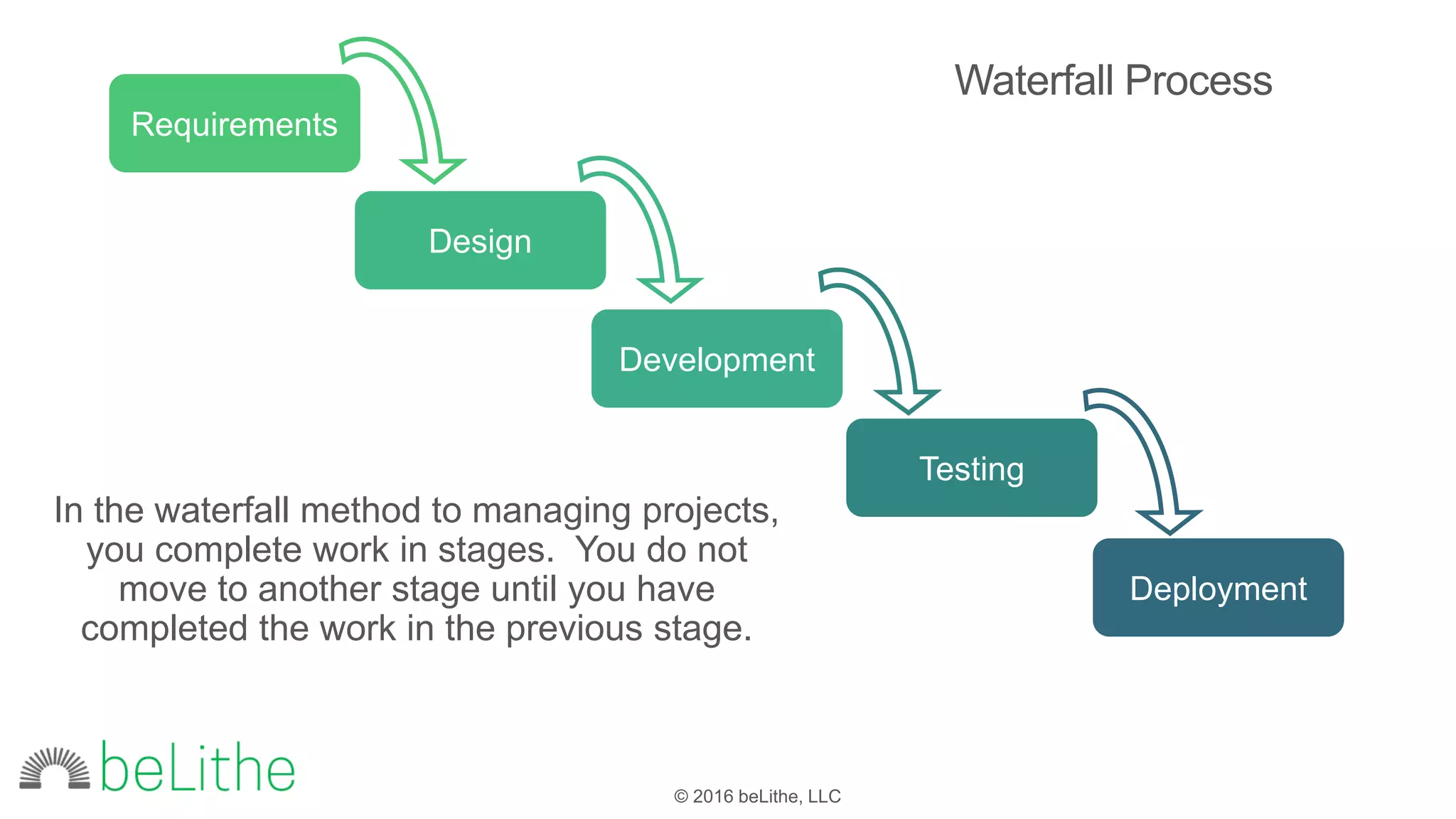
In the waterfall method to managing projects,
you complete work in stages. You do not
move to another stage until you have
completed the work in the previous stage.
Waterfall Process
© 2016 beLithe, LLC
Waterfall Project Stats
8
Standish Group 2014 CHAOS Report
16%
completed on-time
and on-budget
31%
cancelled before they
are finished
52%
significant cost
overruns
The problems with BDUF.
(big design up front)
Welcome to Agile
© 2016 beLithe, LLC
Agile
TDD
Kanba
n
XP
RUP
Crystal
Scrum
and a few more
© 2016 beLithe, LLC
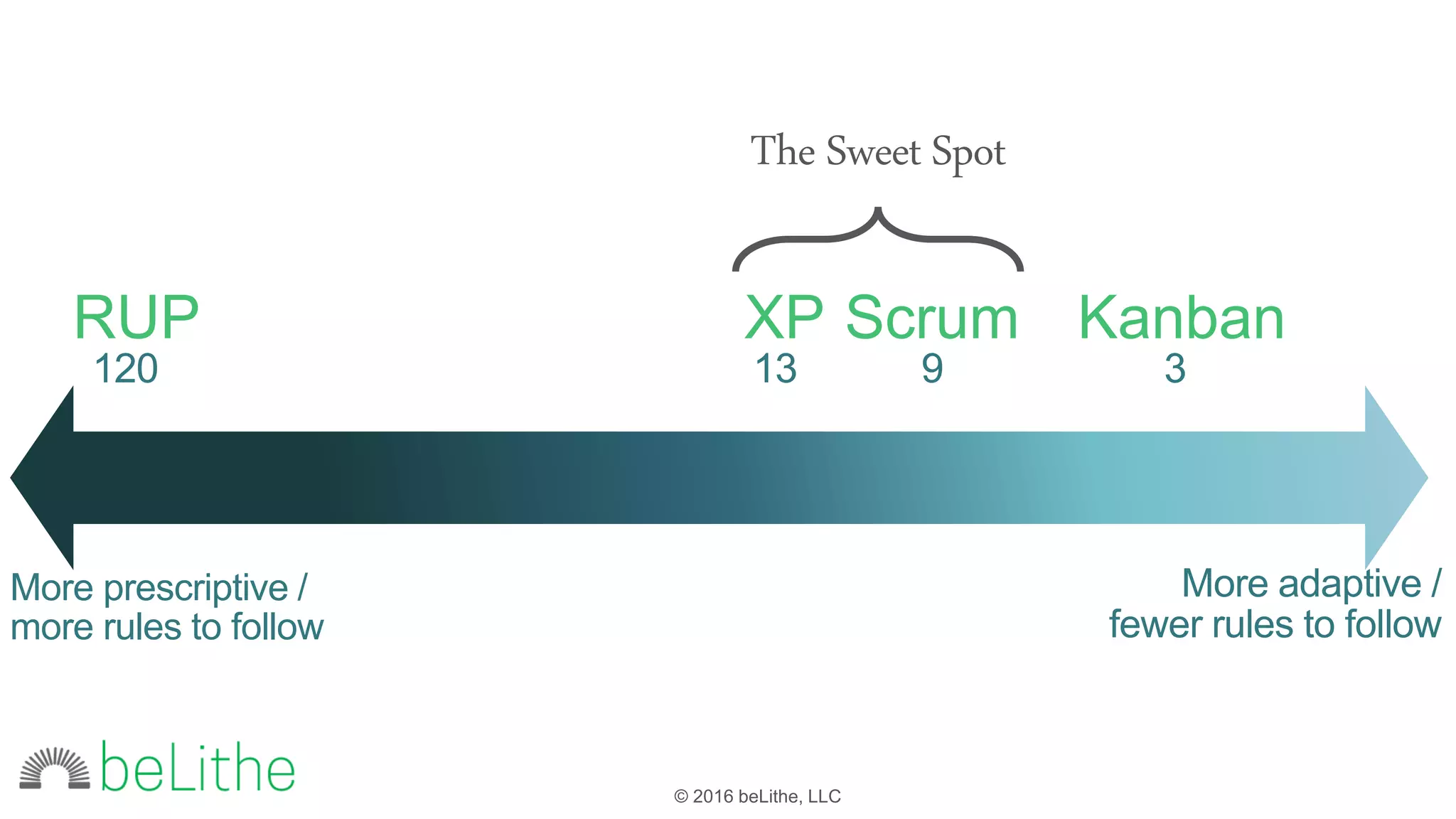
More prescriptive /
more rules to follow
More adaptive /
fewer rules to follow
KanbanXPRUP Scrum
120 13 9 3
The Sweet Spot
Scrum Overview
© 2016 beLithe, LLC
vv
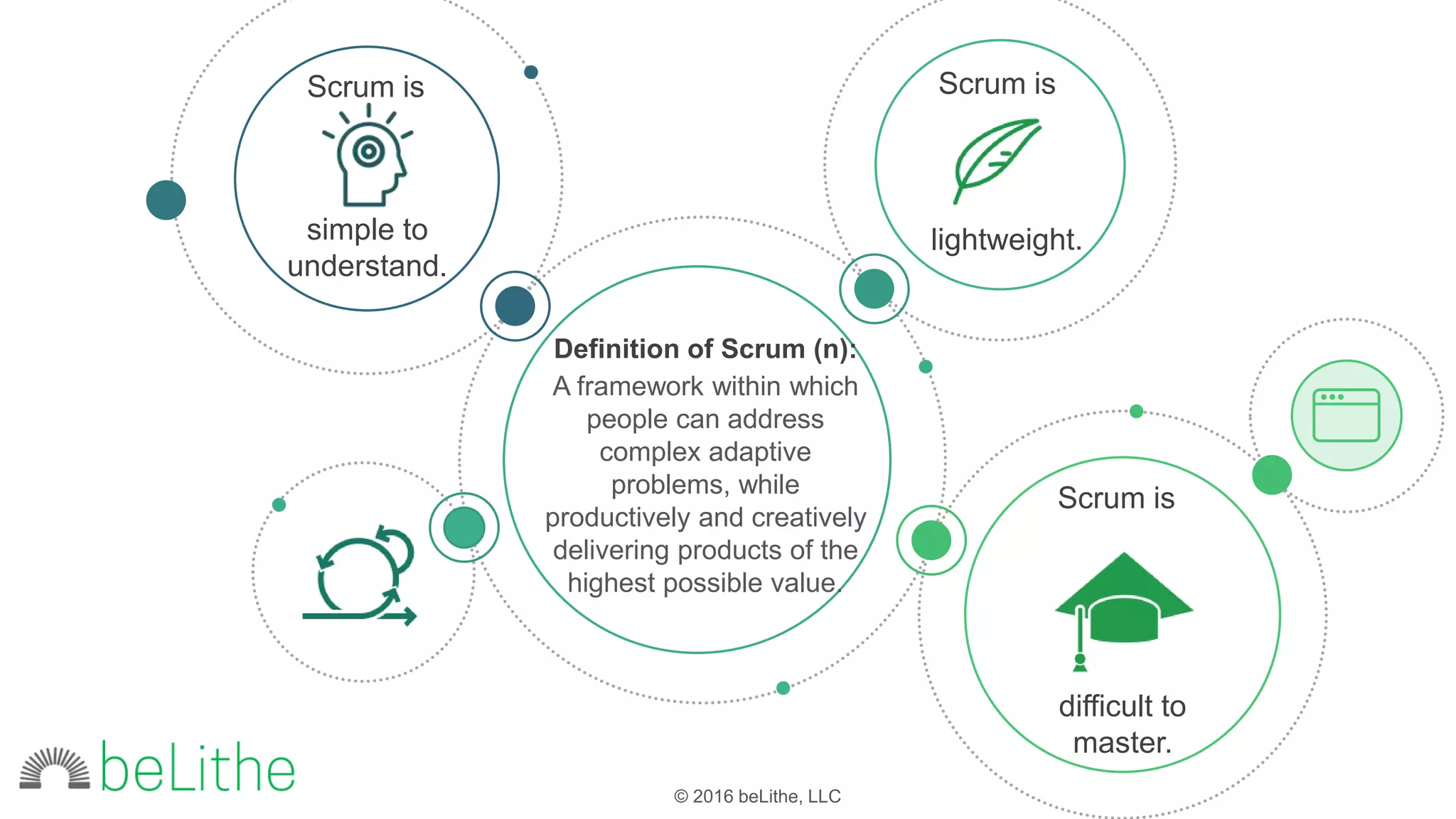
Definition of Scrum (n):
A framework within which
people can address
complex adaptive
problems, while
productively and creatively
delivering products of the
highest possible value.
Scrum is
Scrum isScrum is
lightweight.simple to
understand.
difficult to
master.
© 2016 beLithe, LLC
Learn as we go Plan for change Embrace Change Use, Inspect, Adapt
Command and control Planning for what you
expect to happen
Enforcing the plan Using change control
Scrum prefers
to...
overoveroverover
Scrum Theory: Empirical vs. Theoretical
© 2016 beLithe, LLC
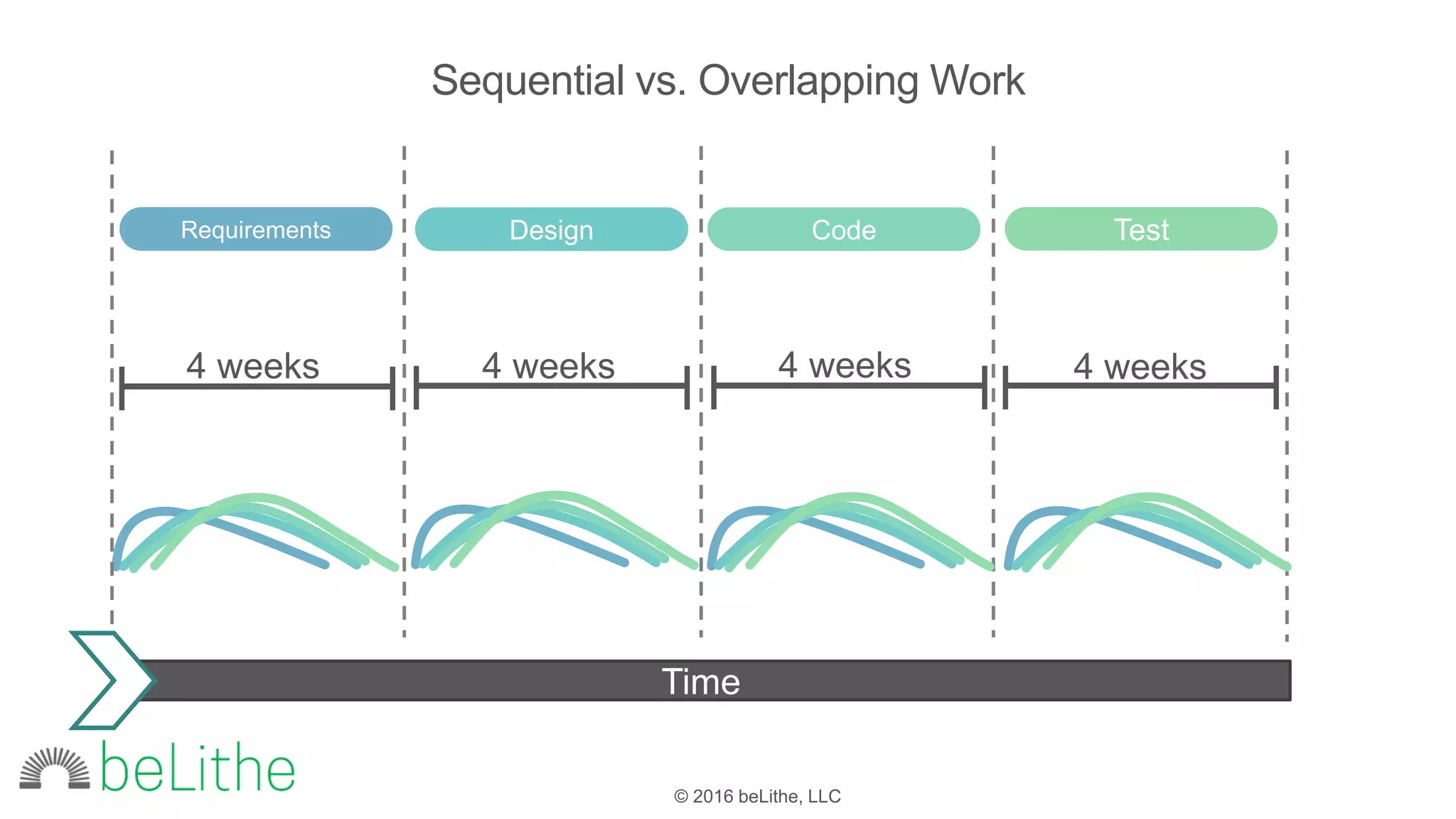
Sequential vs. Overlapping Work
Requirements Design Code Test
4 weeks 4 weeks 4 weeks 4 weeks
Time
© 2016 beLithe, LLC
Flexibility on Scrum Projects
Potential
Change
Potential
Change Potential
Change
Potential
Change
Potential
Change Potential
Change
Potential
Change
2 Years – No Change
2 Week Increments
© 2016 beLithe, LLC
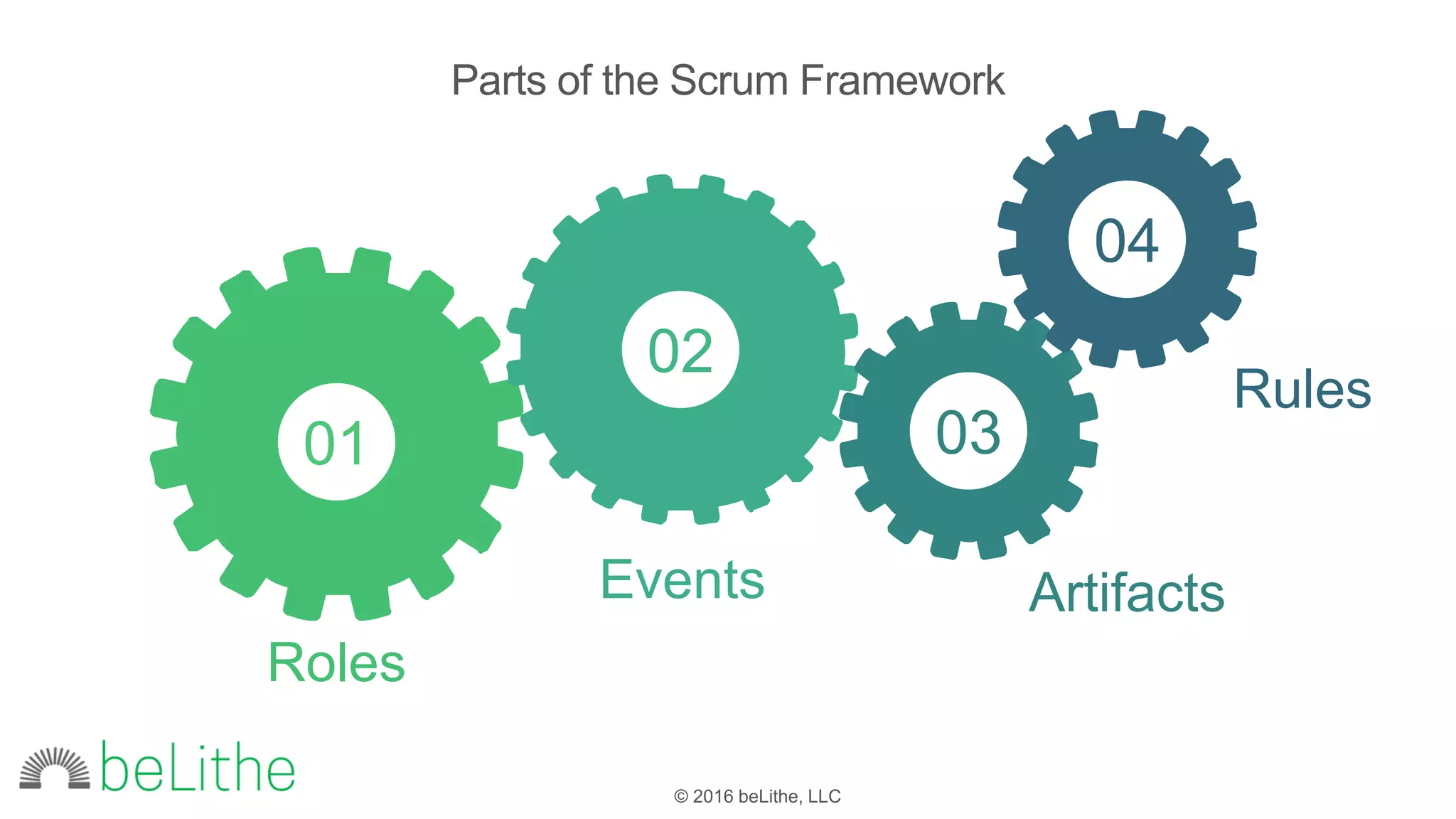
Parts of the Scrum Framework
Roles
Events Artifacts
Rules
01
02
03
04
Scrum Part 01:
Roles
© 2016 beLithe, LLC
Product Owner Scrum Master The Team
Scrum Roles
© 2016 beLithe, LLC
Scrum Master
Protects the
Team from
organizational
distractions
Facilitates
consensus
building within
the Team
Shields the
Team from
external
interferences
Helps remove
project
impediments
both reactively
and proactively
Acts as a
process coach
© 2016 beLithe, LLC
Product Owner
Works with
team to develop
common
understanding
of requirements
Single
source of
require-
ments
Owns
product
vision
Prioritizes
all work for
the product
Sets
release
schedule
© 2016 beLithe, LLC
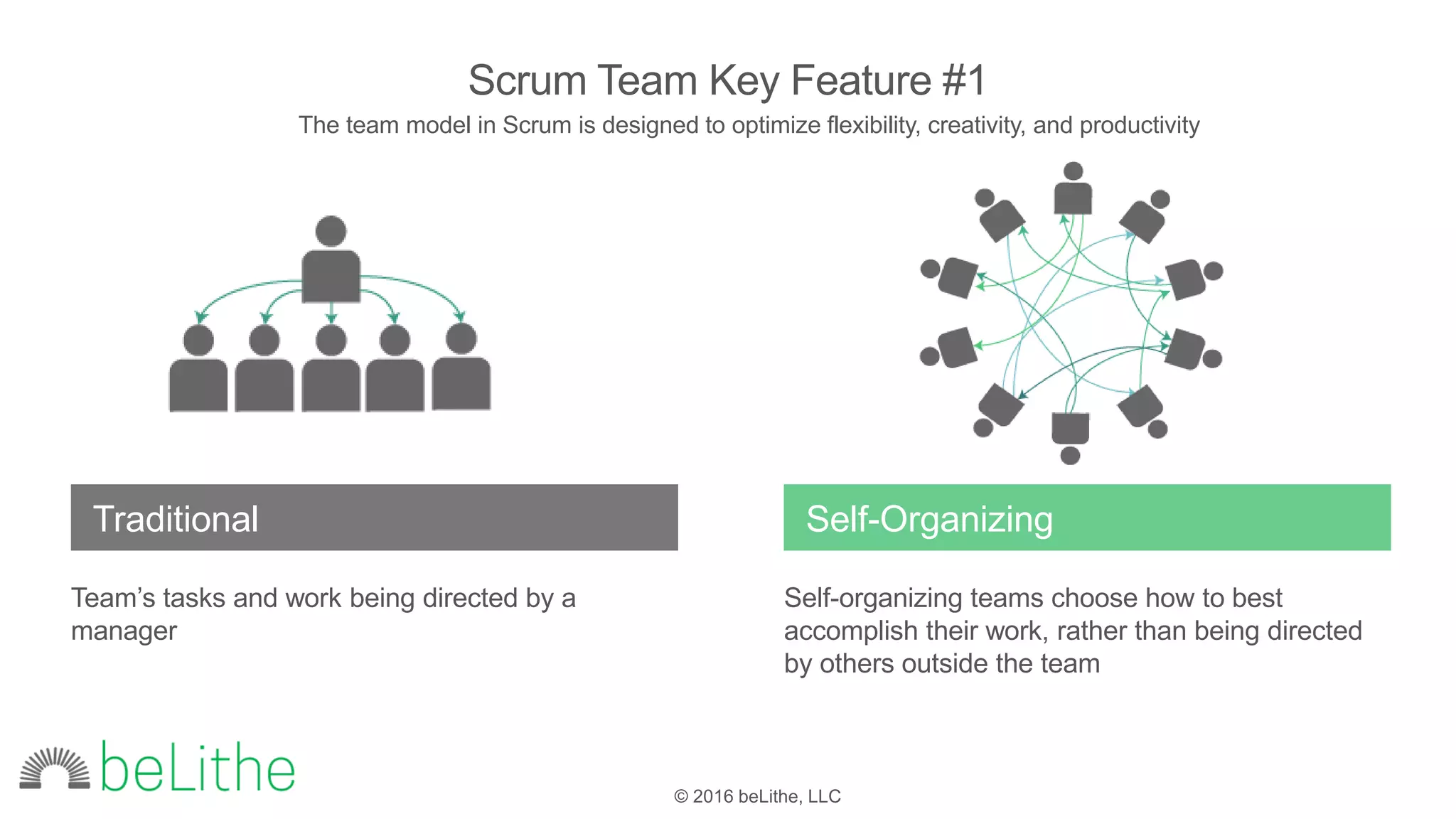
Scrum Team Key Feature #1
Self-Organizing
Self-organizing teams choose how to best
accomplish their work, rather than being directed
by others outside the team
The team model in Scrum is designed to optimize flexibility, creativity, and productivity
Traditional
Team’s tasks and work being directed by a
manager
© 2016 beLithe, LLC
Scrum Team Key Feature #2
Cross Functional
Cross functional teams have all the competencies
needed to accomplish the work without depending
on others not part of the team
Traditional
Traditional teams are formed by function
The team model in Scrum is designed to optimize flexibility, creativity, and productivity
© 2016 beLithe, LLC
Self-organizing and
self-managing: team
members determine
their own tasks
(sprint backlog) and
how they want to
complete them.
Team tracks and
focuses on how the
work gets
accomplished.
Cross-functional:
team members are
not tied to a single
skillset.
Members can be
anyone who has the
appropriate skills to
meet the objectives
of the sprint.
Directly accountable
for creating project
deliverables.
Ideally, team should
be: 1. dedicated to
one project for the
duration of the
project and 2.
collocated.
The Scrum Team
Scrum Part 02:
Events
© 2016 beLithe, LLC
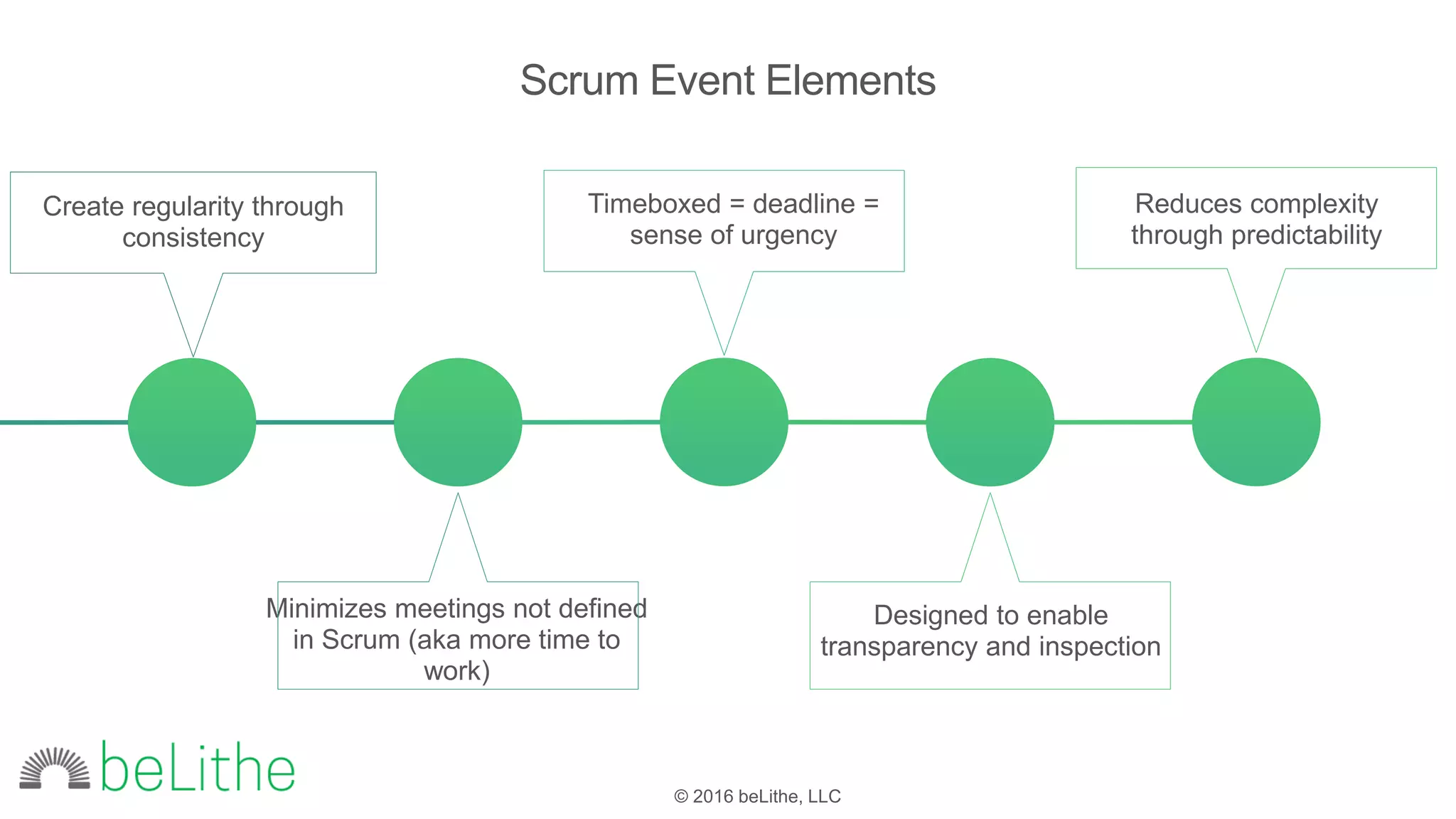
Scrum Event Elements
Minimizes meetings not defined
in Scrum (aka more time to
work)
Designed to enable
transparency and inspection
Timeboxed = deadline =
sense of urgency
Create regularity through
consistency
Reduces complexity
through predictability
© 2016 beLithe, LLC
Scrum Events
Sprint Planning
Daily Scrum Sprint Review
Sprint
RetrospectiveThe Sprint
© 2016 beLithe, LLC
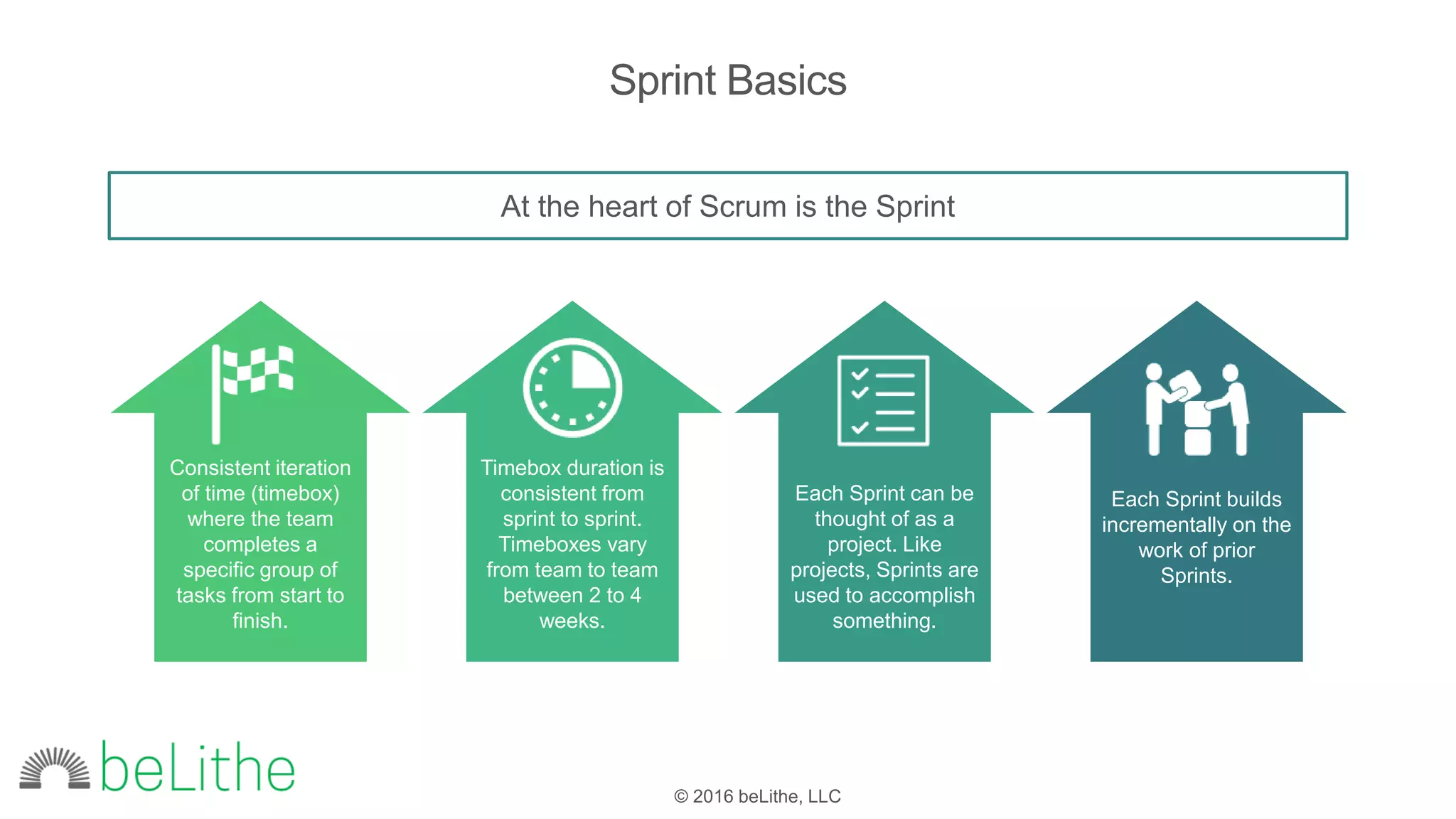
Sprint Basics
At the heart of Scrum is the Sprint
Consistent iteration
of time (timebox)
where the team
completes a
specific group of
tasks from start to
finish.
Timebox duration is
consistent from
sprint to sprint.
Timeboxes vary
from team to team
between 2 to 4
weeks.
Each Sprint can be
thought of as a
project. Like
projects, Sprints are
used to accomplish
something.
Each Sprint builds
incrementally on the
work of prior
Sprints.
© 2016 beLithe, LLC
Scrum Process
Scrum Part 03:
Artifacts
© 2016 beLithe, LLC
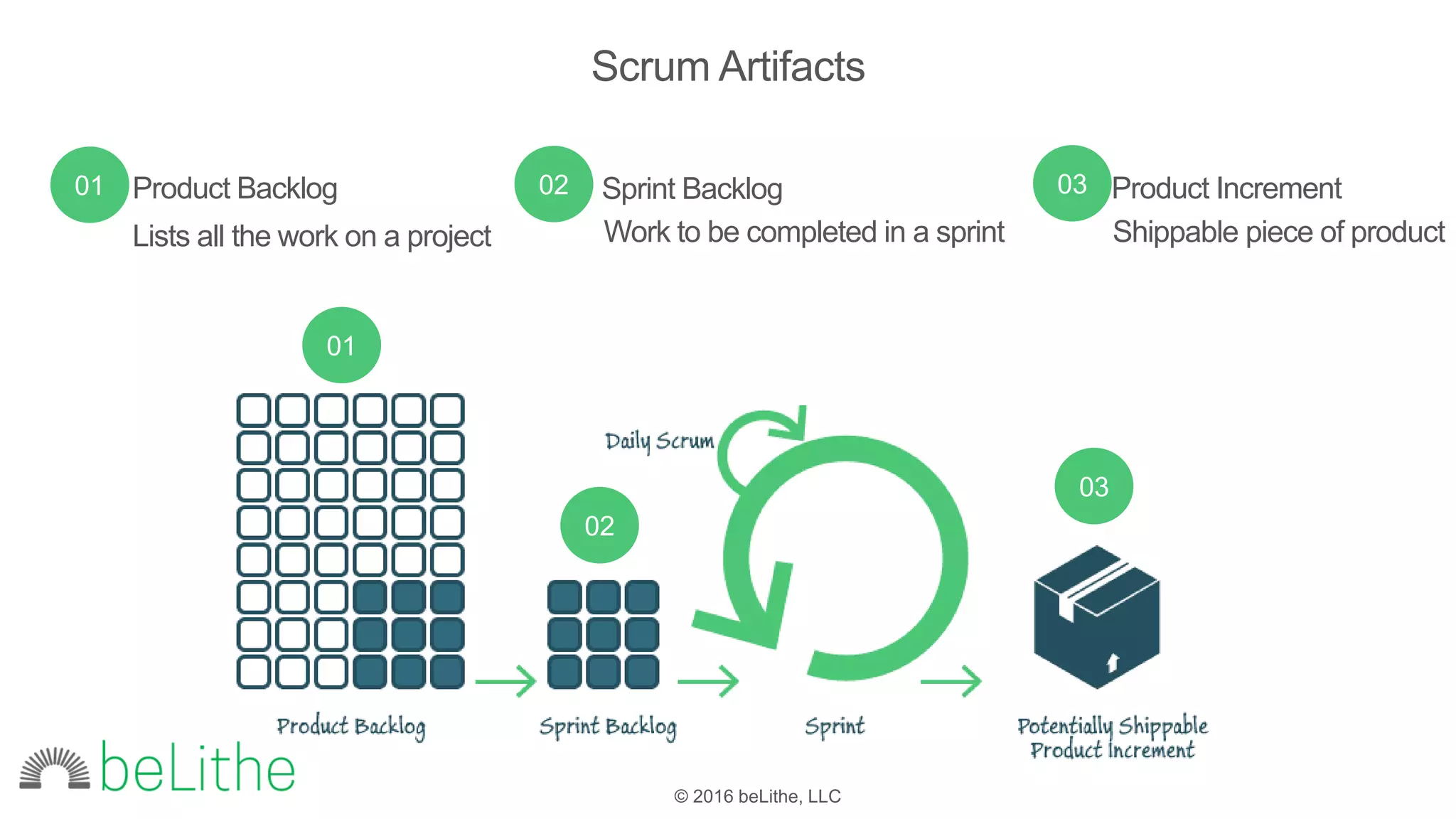
Scrum Artifacts
Product Backlog01 02 03Sprint Backlog Product Increment
01
02
03
Lists all the work on a project Work to be completed in a sprint Shippable piece of product
Scrum Part 04:
Rules
© 2016 beLithe, LLC
DOACT
CHECK
PLAN
PDCA
William Edwards
Deming“Cease dependence on mass inspection to
achieve quality. Improve the process and build
quality into the product in the first place”
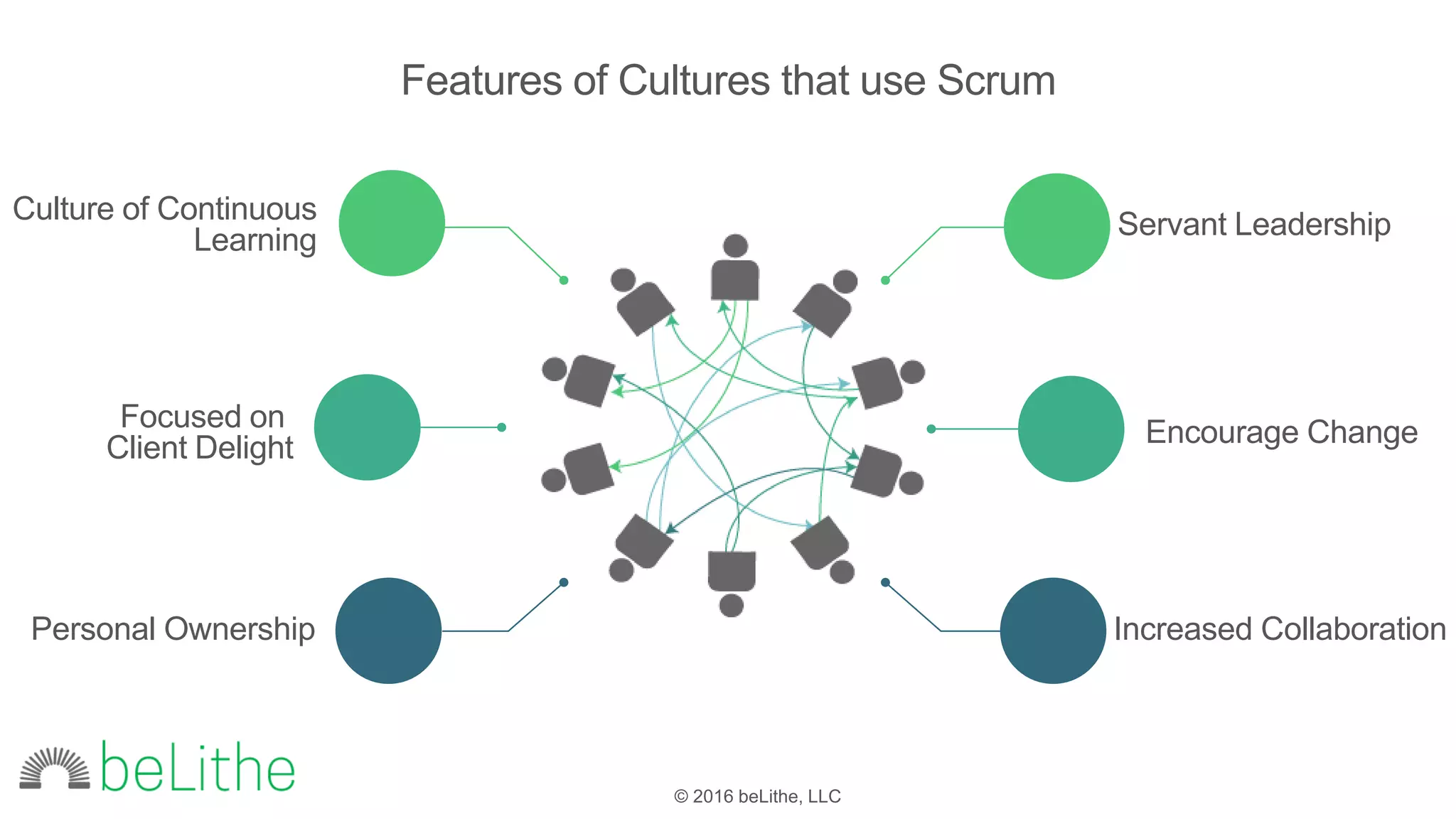
Features of Cultures
that use Scrum
© 2016 beLithe, LLC
Servant Leadership
Encourage Change
Increased Collaboration
Culture of Continuous
Learning
Focused on
Client Delight
Personal Ownership
Features of Cultures that use Scrum
© 2016 beLithe, LLC
Helpful Reference Material
Sites & Organizations
Scrum Alliance
www.scrumalliance.org
Scrum.org
www.scrum.org
Agile Alliance
www.agilealliance.org
Mountain Goat Software
www.mountaingoatsoftware.com
Leading Agile
www.leadingagile.com
beLithe
www.beLithe.com
Text
Scrum: A Breathtakingly Brief and Agile
Introduction
Scrum: The Art of Doing Twice the
Work in Half the Time
Succeeding with Agile: Software
Development Using Scrum
© 2016 beLithe, LLC
Tana Linback
www.beLithe.com
Thank you, stay in touch!
@CoachLinback
tlinback@beLithe.com
Chris Daily
@Chris_Daily
cdaily@beLithe.com
Treating employees like adult humans might
be common sense, but it is not common
practice.
- Jurgen Appelo
www.beLithe.com

Scrum 101

  • 1.
  • 2.
    We are drivenby helping teams and individuals be the best they can be. We do this through introducing and living agile, people focused practices.
  • 3.
    Chris Daily Experiences acrossmultiple industries focused in Agile Transformations and Software Development. Led teams in start- ups to Fortune 500 companies. Tana Linback Background focused on the people and organizational culture that are the foundation of business and Agility. Unique combination of work in software development and human resources leadership.
  • 4.
    © 2016 beLithe,LLC Agenda SCRUM 101 LEARNING OBJECTIVES • Waterfall project methodology basics • Agile umbrella practices and frameworks • Scrum empirical theory • Parts of the Scrum framework • Features of cultures that use Scrum Waterfall Basics Scrum Overview Roles 01 02 Events Artifacts Rules Parts of Scrum03 Features of Cultures that use Scrum04
  • 5.
    Waterfall A traditional approachto project management.
  • 6.
    © 2016 beLithe,LLC History of Waterfall Project Management Project management processes were developed based on step-by-step manufacturing models the United States military used during World War II. Waterfall process developed from highly structured physical environments where after- the-fact changes are prohibitively costly, if not impossible. PhotoCourtesyofflintgm100.com PhotoCourtesyofthwapschoolyard.com
  • 7.
    © 2016 beLithe,LLC Requirements Design Development Testing Deployment In the waterfall method to managing projects, you complete work in stages. You do not move to another stage until you have completed the work in the previous stage. Waterfall Process
  • 8.
    © 2016 beLithe,LLC Waterfall Project Stats 8 Standish Group 2014 CHAOS Report 16% completed on-time and on-budget 31% cancelled before they are finished 52% significant cost overruns
  • 9.
    The problems withBDUF. (big design up front)
  • 10.
  • 11.
    © 2016 beLithe,LLC Agile TDD Kanba n XP RUP Crystal Scrum and a few more
  • 12.
    © 2016 beLithe,LLC More prescriptive / more rules to follow More adaptive / fewer rules to follow KanbanXPRUP Scrum 120 13 9 3 The Sweet Spot
  • 13.
  • 14.
    © 2016 beLithe,LLC vv Definition of Scrum (n): A framework within which people can address complex adaptive problems, while productively and creatively delivering products of the highest possible value. Scrum is Scrum isScrum is lightweight.simple to understand. difficult to master.
  • 15.
    © 2016 beLithe,LLC Learn as we go Plan for change Embrace Change Use, Inspect, Adapt Command and control Planning for what you expect to happen Enforcing the plan Using change control Scrum prefers to... overoveroverover Scrum Theory: Empirical vs. Theoretical
  • 16.
    © 2016 beLithe,LLC Sequential vs. Overlapping Work Requirements Design Code Test 4 weeks 4 weeks 4 weeks 4 weeks Time
  • 17.
    © 2016 beLithe,LLC Flexibility on Scrum Projects Potential Change Potential Change Potential Change Potential Change Potential Change Potential Change Potential Change 2 Years – No Change 2 Week Increments
  • 18.
    © 2016 beLithe,LLC Parts of the Scrum Framework Roles Events Artifacts Rules 01 02 03 04
  • 19.
  • 20.
    © 2016 beLithe,LLC Product Owner Scrum Master The Team Scrum Roles
  • 21.
    © 2016 beLithe,LLC Scrum Master Protects the Team from organizational distractions Facilitates consensus building within the Team Shields the Team from external interferences Helps remove project impediments both reactively and proactively Acts as a process coach
  • 22.
    © 2016 beLithe,LLC Product Owner Works with team to develop common understanding of requirements Single source of require- ments Owns product vision Prioritizes all work for the product Sets release schedule
  • 23.
    © 2016 beLithe,LLC Scrum Team Key Feature #1 Self-Organizing Self-organizing teams choose how to best accomplish their work, rather than being directed by others outside the team The team model in Scrum is designed to optimize flexibility, creativity, and productivity Traditional Team’s tasks and work being directed by a manager
  • 24.
    © 2016 beLithe,LLC Scrum Team Key Feature #2 Cross Functional Cross functional teams have all the competencies needed to accomplish the work without depending on others not part of the team Traditional Traditional teams are formed by function The team model in Scrum is designed to optimize flexibility, creativity, and productivity
  • 25.
    © 2016 beLithe,LLC Self-organizing and self-managing: team members determine their own tasks (sprint backlog) and how they want to complete them. Team tracks and focuses on how the work gets accomplished. Cross-functional: team members are not tied to a single skillset. Members can be anyone who has the appropriate skills to meet the objectives of the sprint. Directly accountable for creating project deliverables. Ideally, team should be: 1. dedicated to one project for the duration of the project and 2. collocated. The Scrum Team
  • 26.
  • 27.
    © 2016 beLithe,LLC Scrum Event Elements Minimizes meetings not defined in Scrum (aka more time to work) Designed to enable transparency and inspection Timeboxed = deadline = sense of urgency Create regularity through consistency Reduces complexity through predictability
  • 28.
    © 2016 beLithe,LLC Scrum Events Sprint Planning Daily Scrum Sprint Review Sprint RetrospectiveThe Sprint
  • 29.
    © 2016 beLithe,LLC Sprint Basics At the heart of Scrum is the Sprint Consistent iteration of time (timebox) where the team completes a specific group of tasks from start to finish. Timebox duration is consistent from sprint to sprint. Timeboxes vary from team to team between 2 to 4 weeks. Each Sprint can be thought of as a project. Like projects, Sprints are used to accomplish something. Each Sprint builds incrementally on the work of prior Sprints.
  • 30.
    © 2016 beLithe,LLC Scrum Process
  • 31.
  • 32.
    © 2016 beLithe,LLC Scrum Artifacts Product Backlog01 02 03Sprint Backlog Product Increment 01 02 03 Lists all the work on a project Work to be completed in a sprint Shippable piece of product
  • 33.
  • 34.
    © 2016 beLithe,LLC DOACT CHECK PLAN PDCA William Edwards Deming“Cease dependence on mass inspection to achieve quality. Improve the process and build quality into the product in the first place”
  • 35.
  • 36.
    © 2016 beLithe,LLC Servant Leadership Encourage Change Increased Collaboration Culture of Continuous Learning Focused on Client Delight Personal Ownership Features of Cultures that use Scrum
  • 37.
    © 2016 beLithe,LLC Helpful Reference Material Sites & Organizations Scrum Alliance www.scrumalliance.org Scrum.org www.scrum.org Agile Alliance www.agilealliance.org Mountain Goat Software www.mountaingoatsoftware.com Leading Agile www.leadingagile.com beLithe www.beLithe.com Text Scrum: A Breathtakingly Brief and Agile Introduction Scrum: The Art of Doing Twice the Work in Half the Time Succeeding with Agile: Software Development Using Scrum
  • 38.
    © 2016 beLithe,LLC Tana Linback www.beLithe.com Thank you, stay in touch! @CoachLinback tlinback@beLithe.com Chris Daily @Chris_Daily cdaily@beLithe.com Treating employees like adult humans might be common sense, but it is not common practice. - Jurgen Appelo
  • 39.

Editor's Notes

  • #8 Waterfall process is highly disciplined, well-structured, approach is simple. Provides easily identifiable milestones in the development process.
  • #9 As reported by the Standish Group 2014 CHAOS report For application development projects run in waterfall methodology
  • #10 Poorly adaptable to changing requirements Assumes designers can foresee potential problems up front Lots of assumptions made up front that prove to be wrong Value isn’t achieved until end of project Don’t know things that need to be changed/fixed until it’s too late QA gets shoved in at the end and oftentimes isn’t completed thoroughly, quality isn’t baked in Follows the fail-late lifecycle
  • #11 Agile came about as a “solution” to the disadvantages of the waterfall methodology. Instead of a sequential design process, the Agile methodology follows an incremental approach.
  • #12 Agile is a mindset but has several practices and frameworks that help agilists employ the agile principles. Scrum is a framework under the agile umbrella. Scrum is the most widely used framework within agile
  • #15 Lightweight means there is as little overhead in the process as possible to maximize the amount of productive time available for getting useful work done
  • #19 Each component within the framework serves a specific purpose and is essential to Scrum’s success and usage
  • #21 Three primary roles in Scrum, PO, SM and the Team.
  • #22 External interferences - No increase in scope Pulling a teammate in part time to a project Facilitate Consensus – As a moderator will help the team reach compromises Make sure all voices get heard
  • #35 William Edwards Deming (October 14, 1900 – December 20, 1993) was an American statistician, professor, author, lecturer and consultant. He is perhaps best known for his work in Japan. There, from 1950 onward, he taught top management how to improve design (and thus service), product quality, testing and sales (the last through global markets)[1] through various methods, including the application of statistical methods.