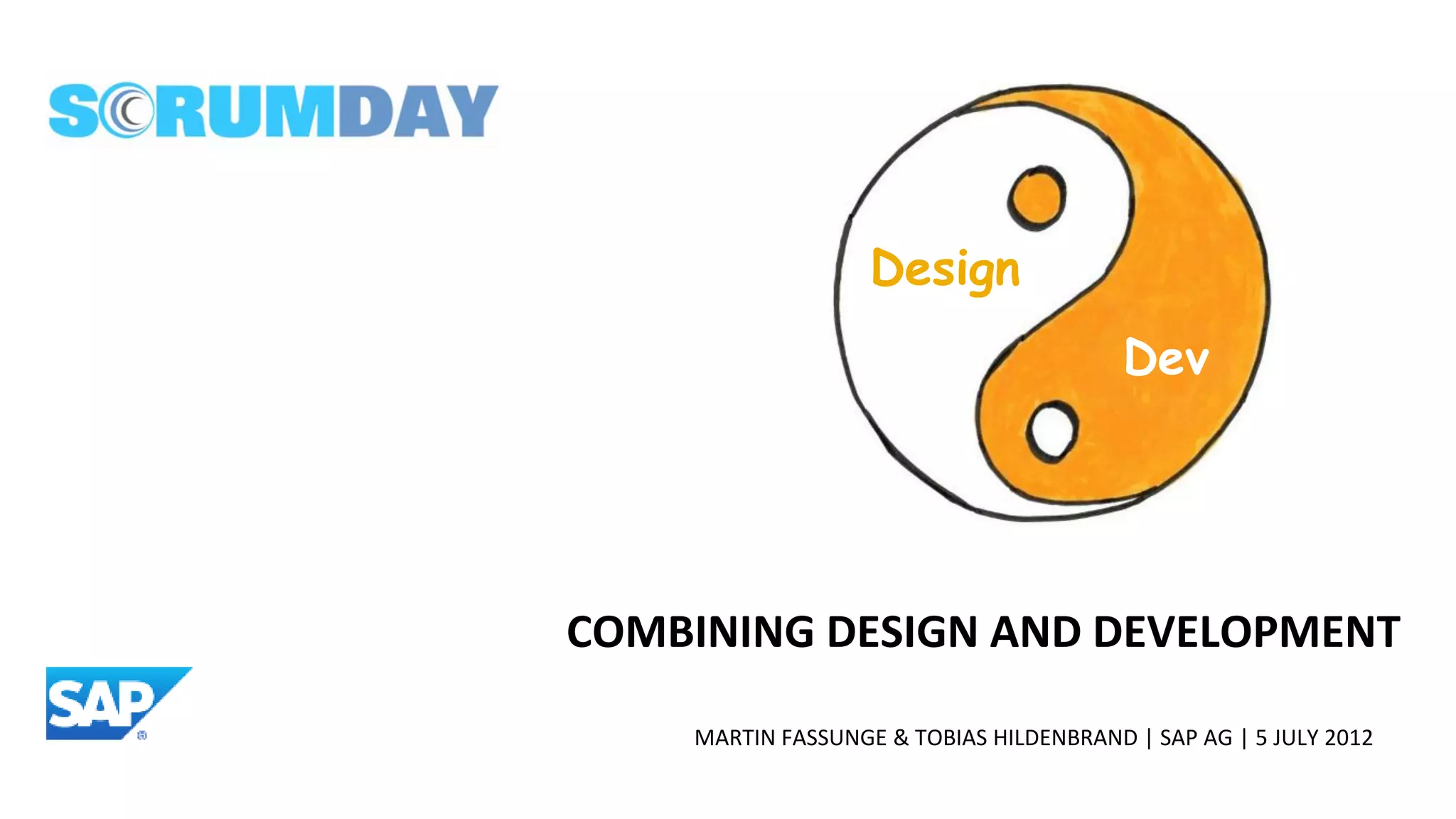
Design
                                         Dev


COMBINING DESIGN AND DEVELOPMENT

    MARTIN FASSUNGE & TOBIAS HILDENBRAND | SAP AG | 5 JULY 2012
WHERE DO WE COME FROM?


                         © SAP 2012 | 2
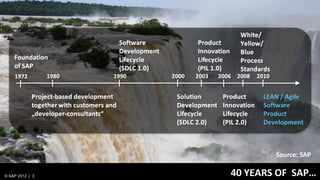
Source: SAP

© SAP 2012 | 3   40 YEARS OF SAP…
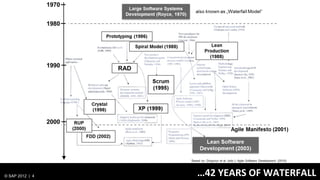
© SAP 2012 | 4   …42 YEARS OF WATERFALL
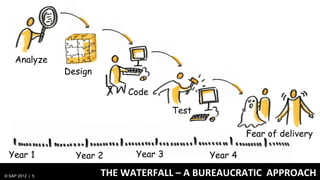
Analyze
                 Design

                              Code

                                         Test

                                                         Fear of delivery

  Year 1           Year 2       Year 3          Year 4

© SAP 2012 | 5            THE WATERFALL – A BUREAUCRATIC APPROACH
WHERE ARE WE TODAY?


                      © SAP 2012 | 6
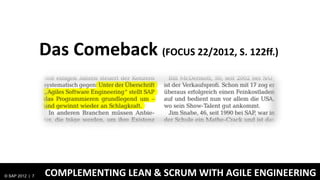
Das Comeback (FOCUS 22/2012, S. 122ff.)


© SAP 2012 | 7   COMPLEMENTING LEAN & SCRUM WITH AGILE ENGINEERING
AGILE = “ABLE TO MOVE QUICKLY & EASILY”*


       *) Definition from Longman Dictionary of Contemporary English   © SAP 2012 | 8
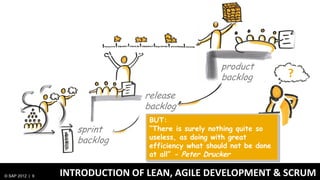
Chief Product
                                                     product
                                                    team
                                                     backlog          ?
                                release
                                backlog
                                 BUT:
                    sprint       “There is surely nothing quite so
                    backlog      useless, as doing with great
                                 efficiency what should not be done
                                 at all” - Peter Drucker

© SAP 2012 | 9   INTRODUCTION OF LEAN, AGILE DEVELOPMENT & SCRUM
…SO, WHAT DOES AGILE MEAN
FROM A BUSINESS PERSPECTIVE?


                               © SAP 2012 | 10
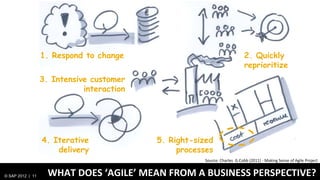
1. Respond to change                                      2. Quickly
                                                                            reprioritize
                  3. Intensive customer
                             interaction


                  4. Iterative             5. Right-sized
                      delivery                  processes
                                                       Source: Charles G.Cobb (2011) - Making Sense of Agile Project
                                                                                                     Management,

© SAP 2012 | 11     WHAT DOES ‘AGILE’ MEAN FROM A BUSINESS PERSPECTIVE?
WHY CAN„T WE JUST MAKE A MASTER PLAN?


                                 © SAP 2012 | 12
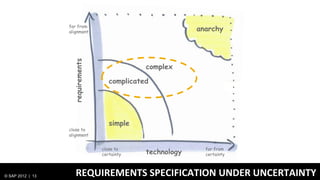
far from
                  alignment                                  anarchy


                    requirements
                                                complex

                                      complicated                          .
                                                                           .
                                                                           .


                                      simple
                  close to
                  alignment


                                   close to                    far from
                                   certainty    technology     certainty


© SAP 2012 | 13       REQUIREMENTS SPECIFICATION UNDER UNCERTAINTY
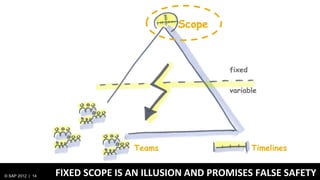
Scope


                                                    fixed

                                                    variable


                                 Teams                      Timelines


© SAP 2012 | 14   FIXED SCOPE IS AN ILLUSION AND PROMISES FALSE SAFETY
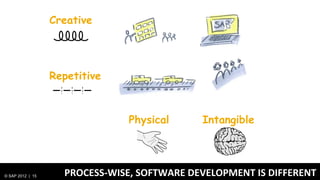
Creative


                  Repetitive


                                Physical     Intangible


© SAP 2012 | 15     PROCESS-WISE, SOFTWARE DEVELOPMENT IS DIFFERENT
WHY DO WE LIKE SCRUM?


                        © SAP 2012 | 16
Split organization            Split work
                      into teams


                                           Split time


                                   Risk
                  Deliver more
                  frequently                 Risk        Retrospectives

© SAP 2012 | 17                    SCRUM REDUCED RISKS DRAMATICALLY
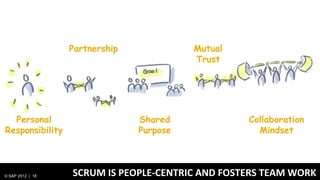
Partnership             Mutual
                                          Trust


  Personal                      Shared             Collaboration
Responsibility                  Purpose              Mindset


© SAP 2012 | 18   SCRUM IS PEOPLE-CENTRIC AND FOSTERS TEAM WORK
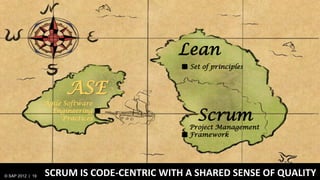
Lean
                                             Set of principles


                        ASE
                  Agile Software
                    Engineering
                       Practices               Scrum
                                             Project Management
                                             Framework


© SAP 2012 | 19   SCRUM IS CODE-CENTRIC WITH A SHARED SENSE OF QUALITY
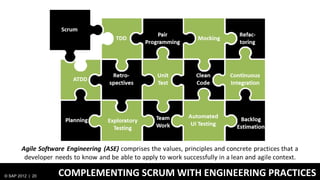
© SAP 2012 | 20   COMPLEMENTING SCRUM WITH ENGINEERING PRACTICES
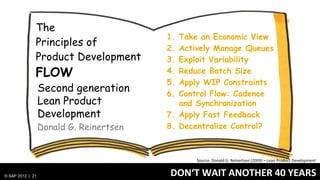
The
                                         1. Take an Economic View
              Principles of              2. Actively Manage Queues
              Product Development        3. Exploit Variability
              FLOW                       4. Reduce Batch Size
                                         5. Apply WIP Constraints
                  Second generation      6. Control Flow: Cadence
                  Lean Product              and Synchronization
                  Development            7. Apply Fast Feedback
                  Donald G. Reinertsen   8. Decentralize Control?


                                                Source: Donald G. Reinertsen (2009) – Lean Product Development
                                                                                                          Flow

© SAP 2012 | 21                          DON‘T WAIT ANOTHER 40 YEARS
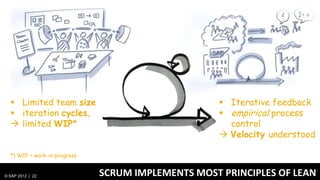
 Limited team size                                Iterative feedback
   iteration cycles,                                empirical process
   limited WIP*                                      control
                                                     Velocity understood

  *) WIP = work-in-progress


© SAP 2012 | 22               SCRUM IMPLEMENTS MOST PRINCIPLES OF LEAN
…BUT, WHAT ABOUT THE ECONOMIC VIEW?


                                © SAP 2012 | 23
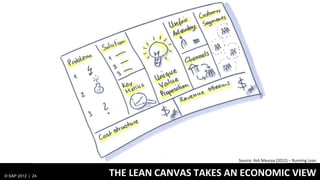
Source: Ash Maurya (2012) – Running Lean


© SAP 2012 | 24   THE LEAN CANVAS TAKES AN ECONOMIC VIEW
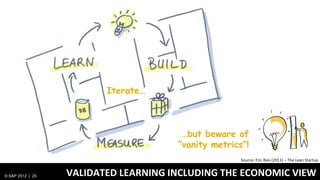
Iterate…


                                       …but beware of
                                      ”vanity metrics”!
                                                     Source: Eric Ries (2011) – The Lean Startup


© SAP 2012 | 25   VALIDATED LEARNING INCLUDING THE ECONOMIC VIEW
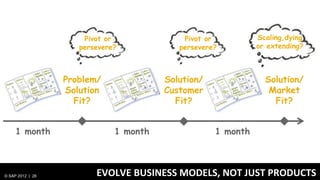
Pivot or              Pivot or          Scaling,dying
                     persevere?            persevere?         or extending?


                  Problem/              Solution/               Solution/
                  Solution              Customer                 Market
                    Fit?                  Fit?                    Fit?


     1 month                  1 month               1 month


© SAP 2012 | 26          EVOLVE BUSINESS MODELS, NOT JUST PRODUCTS
WHERE DO REQUIREMENTS COME FROM?


                              © SAP 2012 | 27
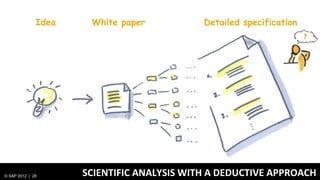
Idea    White paper           Detailed specification


© SAP 2012 | 28      SCIENTIFIC ANALYSIS WITH A DEDUCTIVE APPROACH
HOW DOES DESIGN WORK?


                        © SAP 2012 | 29
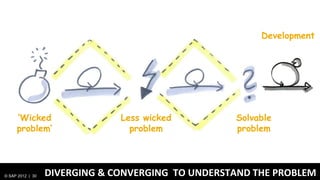
Development


     „Wicked                   Less wicked         Solvable
     problem„                    problem           problem


© SAP 2012 | 30   DIVERGING & CONVERGING TO UNDERSTAND THE PROBLEM
WHAT IS DESIGN THINKING?


                           © SAP 2012 | 31
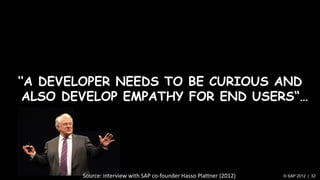
„„A DEVELOPER NEEDS TO BE CURIOUS AND
 ALSO DEVELOP EMPATHY FOR END USERS“…


        Source: interview with SAP co-founder Hasso Plattner (2012)   © SAP 2012 | 32
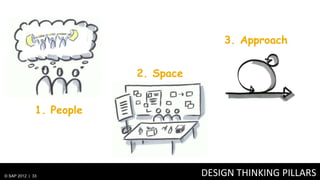
3. Approach


                          2. Space


              1. People


© SAP 2012 | 33                      DESIGN THINKING PILLARS
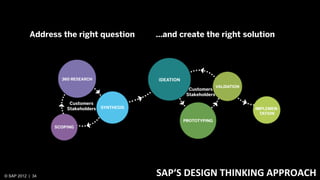
Address the right question   …and create the right solution


                                                Customers
                                               Stakeholders
                     Customers
                    Stakeholders


© SAP 2012 | 34                         SAP‘S DESIGN THINKING APPROACH
HOW DO WE COMBINE DESIGN
  & DEVELOPMENT TODAY?


                           © SAP 2012 | 35
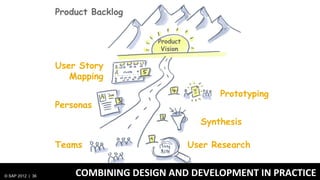
Product Backlog


                                     Product
                                      Vision

                  User Story
                     Mapping
                                                     Prototyping
                  Personas
                                                 Synthesis

                  Teams                        User Research


© SAP 2012 | 36       COMBINING DESIGN AND DEVELOPMENT IN PRACTICE
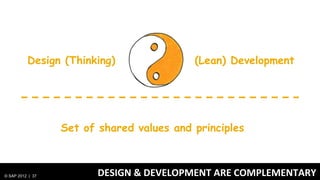
Design (Thinking)                (Lean) Development


                  Set of shared values and principles


© SAP 2012 | 37          DESIGN & DEVELOPMENT ARE COMPLEMENTARY
Thank You!
Contact Information:
Martin Fassunge                 Dr. Tobias Hildenbrand
SAP AG                          SAP AG
Dietmar-Hopp-Allee 16           Dietmar-Hopp-Allee 16
69190 Walldorf                  69190 Walldorf
T: +49 6227 7-47474             T: +49 6227 7-47474
martin.georg.fassunge@sap.com   tobias.hildenbrand@sap.com

Scrum Day 2012 Keynote: Combining Design and Development

  • 1.
    Design Dev COMBINING DESIGN AND DEVELOPMENT MARTIN FASSUNGE & TOBIAS HILDENBRAND | SAP AG | 5 JULY 2012
  • 2.
    WHERE DO WECOME FROM? © SAP 2012 | 2
  • 3.
    Source: SAP © SAP2012 | 3 40 YEARS OF SAP…
  • 4.
    © SAP 2012| 4 …42 YEARS OF WATERFALL
  • 5.
    Analyze Design Code Test Fear of delivery Year 1 Year 2 Year 3 Year 4 © SAP 2012 | 5 THE WATERFALL – A BUREAUCRATIC APPROACH
  • 6.
    WHERE ARE WETODAY? © SAP 2012 | 6
  • 7.
    Das Comeback (FOCUS22/2012, S. 122ff.) © SAP 2012 | 7 COMPLEMENTING LEAN & SCRUM WITH AGILE ENGINEERING
  • 8.
    AGILE = “ABLETO MOVE QUICKLY & EASILY”* *) Definition from Longman Dictionary of Contemporary English © SAP 2012 | 8
  • 9.
    Chief Product product team backlog ? release backlog BUT: sprint “There is surely nothing quite so backlog useless, as doing with great efficiency what should not be done at all” - Peter Drucker © SAP 2012 | 9 INTRODUCTION OF LEAN, AGILE DEVELOPMENT & SCRUM
  • 10.
    …SO, WHAT DOESAGILE MEAN FROM A BUSINESS PERSPECTIVE? © SAP 2012 | 10
  • 11.
    1. Respond tochange 2. Quickly reprioritize 3. Intensive customer interaction 4. Iterative 5. Right-sized delivery processes Source: Charles G.Cobb (2011) - Making Sense of Agile Project Management, © SAP 2012 | 11 WHAT DOES ‘AGILE’ MEAN FROM A BUSINESS PERSPECTIVE?
  • 12.
    WHY CAN„T WEJUST MAKE A MASTER PLAN? © SAP 2012 | 12
  • 13.
    far from alignment anarchy requirements complex complicated . . . simple close to alignment close to far from certainty technology certainty © SAP 2012 | 13 REQUIREMENTS SPECIFICATION UNDER UNCERTAINTY
  • 14.
    Scope fixed variable Teams Timelines © SAP 2012 | 14 FIXED SCOPE IS AN ILLUSION AND PROMISES FALSE SAFETY
  • 15.
    Creative Repetitive Physical Intangible © SAP 2012 | 15 PROCESS-WISE, SOFTWARE DEVELOPMENT IS DIFFERENT
  • 16.
    WHY DO WELIKE SCRUM? © SAP 2012 | 16
  • 17.
    Split organization Split work into teams Split time Risk Deliver more frequently Risk Retrospectives © SAP 2012 | 17 SCRUM REDUCED RISKS DRAMATICALLY
  • 18.
    Partnership Mutual Trust Personal Shared Collaboration Responsibility Purpose Mindset © SAP 2012 | 18 SCRUM IS PEOPLE-CENTRIC AND FOSTERS TEAM WORK
  • 19.
    Lean Set of principles ASE Agile Software Engineering Practices Scrum Project Management Framework © SAP 2012 | 19 SCRUM IS CODE-CENTRIC WITH A SHARED SENSE OF QUALITY
  • 20.
    © SAP 2012| 20 COMPLEMENTING SCRUM WITH ENGINEERING PRACTICES
  • 21.
    The 1. Take an Economic View Principles of 2. Actively Manage Queues Product Development 3. Exploit Variability FLOW 4. Reduce Batch Size 5. Apply WIP Constraints Second generation 6. Control Flow: Cadence Lean Product and Synchronization Development 7. Apply Fast Feedback Donald G. Reinertsen 8. Decentralize Control? Source: Donald G. Reinertsen (2009) – Lean Product Development Flow © SAP 2012 | 21 DON‘T WAIT ANOTHER 40 YEARS
  • 22.
     Limited teamsize  Iterative feedback  iteration cycles,  empirical process  limited WIP* control  Velocity understood *) WIP = work-in-progress © SAP 2012 | 22 SCRUM IMPLEMENTS MOST PRINCIPLES OF LEAN
  • 23.
    …BUT, WHAT ABOUTTHE ECONOMIC VIEW? © SAP 2012 | 23
  • 24.
    Source: Ash Maurya(2012) – Running Lean © SAP 2012 | 24 THE LEAN CANVAS TAKES AN ECONOMIC VIEW
  • 25.
    Iterate… …but beware of ”vanity metrics”! Source: Eric Ries (2011) – The Lean Startup © SAP 2012 | 25 VALIDATED LEARNING INCLUDING THE ECONOMIC VIEW
  • 26.
    Pivot or Pivot or Scaling,dying persevere? persevere? or extending? Problem/ Solution/ Solution/ Solution Customer Market Fit? Fit? Fit? 1 month 1 month 1 month © SAP 2012 | 26 EVOLVE BUSINESS MODELS, NOT JUST PRODUCTS
  • 27.
    WHERE DO REQUIREMENTSCOME FROM? © SAP 2012 | 27
  • 28.
    Idea White paper Detailed specification © SAP 2012 | 28 SCIENTIFIC ANALYSIS WITH A DEDUCTIVE APPROACH
  • 29.
    HOW DOES DESIGNWORK? © SAP 2012 | 29
  • 30.
    Development „Wicked Less wicked Solvable problem„ problem problem © SAP 2012 | 30 DIVERGING & CONVERGING TO UNDERSTAND THE PROBLEM
  • 31.
    WHAT IS DESIGNTHINKING? © SAP 2012 | 31
  • 32.
    „„A DEVELOPER NEEDSTO BE CURIOUS AND ALSO DEVELOP EMPATHY FOR END USERS“… Source: interview with SAP co-founder Hasso Plattner (2012) © SAP 2012 | 32
  • 33.
    3. Approach 2. Space 1. People © SAP 2012 | 33 DESIGN THINKING PILLARS
  • 34.
    Address the rightquestion …and create the right solution Customers Stakeholders Customers Stakeholders © SAP 2012 | 34 SAP‘S DESIGN THINKING APPROACH
  • 35.
    HOW DO WECOMBINE DESIGN & DEVELOPMENT TODAY? © SAP 2012 | 35
  • 36.
    Product Backlog Product Vision User Story Mapping Prototyping Personas Synthesis Teams User Research © SAP 2012 | 36 COMBINING DESIGN AND DEVELOPMENT IN PRACTICE
  • 37.
    Design (Thinking) (Lean) Development Set of shared values and principles © SAP 2012 | 37 DESIGN & DEVELOPMENT ARE COMPLEMENTARY
  • 38.
    Thank You! Contact Information: MartinFassunge Dr. Tobias Hildenbrand SAP AG SAP AG Dietmar-Hopp-Allee 16 Dietmar-Hopp-Allee 16 69190 Walldorf 69190 Walldorf T: +49 6227 7-47474 T: +49 6227 7-47474 martin.georg.fassunge@sap.com tobias.hildenbrand@sap.com