1
A
Seminar Presentation
on
Screen-less Display
Our Imagination Dressed into Reality
Presented By
Abhishek Raj
2
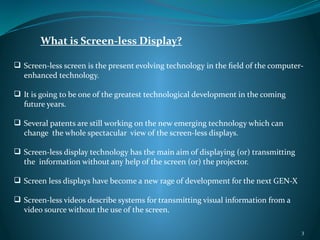
What is Screen-less Display?
 Screen-less screen is the present evolving technology in the field of the computer-
enhanced technology.
 It is going to be one of the greatest technological development in the coming
future years.
 Several patents are still working on the new emerging technology which can
change the whole spectacular view of the screen-less displays.
 Screen-less display technology has the main aim of displaying (or) transmitting
the information without any help of the screen (or) the projector.
 Screen less displays have become a new rage of development for the next GEN-X
 Screen-less videos describe systems for transmitting visual information from a
video source without the use of the screen.
3
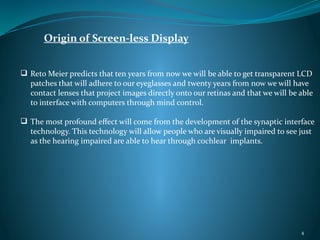
Origin of Screen-less Display
 Reto Meier predicts that ten years from now we will be able to get transparent LCD
patches that will adhere to our eyeglasses and twenty years from now we will have
contact lenses that project images directly onto our retinas and that we will be able
to interface with computers through mind control.
 The most profound effect will come from the development of the synaptic interface
technology. This technology will allow people who are visually impaired to see just
as the hearing impaired are able to hear through cochlear implants.
4
First Screen-less Display
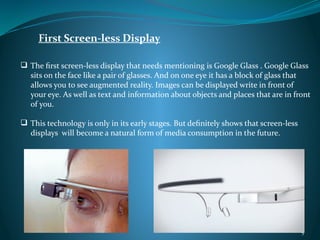
 The first screen-less display that needs mentioning is Google Glass . Google Glass
sits on the face like a pair of glasses. And on one eye it has a block of glass that
allows you to see augmented reality. Images can be displayed write in front of
your eye. As well as text and information about objects and places that are in front
of you.
 This technology is only in its early stages. But definitely shows that screen-less
displays will become a natural form of media consumption in the future.
5
The Sixth Sense Technology
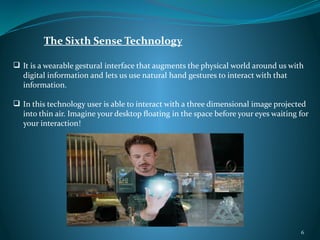
 It is a wearable gestural interface that augments the physical world around us with
digital information and lets us use natural hand gestures to interact with that
information.
 In this technology user is able to interact with a three dimensional image projected
into thin air. Imagine your desktop floating in the space before your eyes waiting for
your interaction!
6
Technology used in Screen-less Display
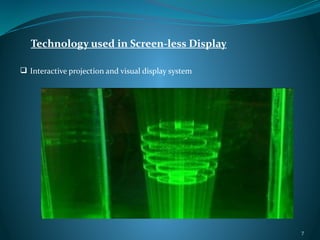
 Interactive projection and visual display system
7
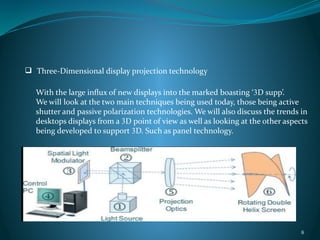
 Three-Dimensional display projection technology
With the large influx of new displays into the marked boasting ‘3D supp’.
We will look at the two main techniques being used today, those being active
shutter and passive polarization technologies. We will also discuss the trends in
desktops displays from a 3D point of view as well as looking at the other aspects
being developed to support 3D. Such as panel technology.
8
Types of Displays
Screen-less computing systems can be divided into three groups:
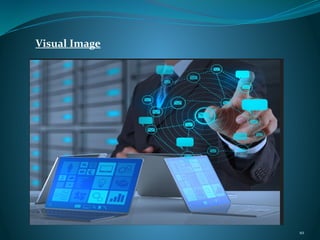
o Visual Image
o Retinal Projection
o Synaptic Interface/Brain computer interface
9
Visual Image
10
Projection Window
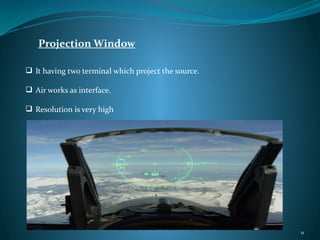
 It having two terminal which project the source.
 Air works as interface.
 Resolution is very high
11
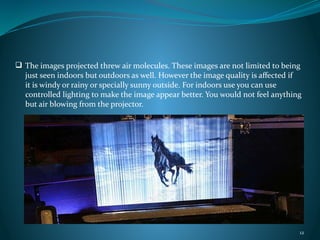
 The images projected threw air molecules. These images are not limited to being
just seen indoors but outdoors as well. However the image quality is affected if
it is windy or rainy or specially sunny outside. For indoors use you can use
controlled lighting to make the image appear better. You would not feel anything
but air blowing from the projector.
12
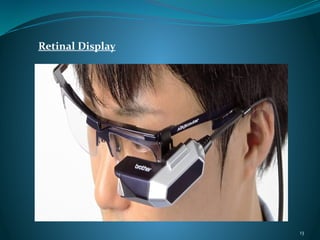
Retinal Display
13
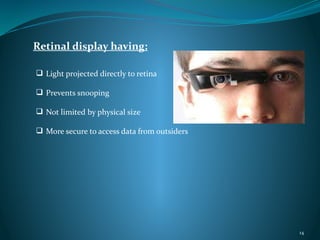
Retinal display having:
 Light projected directly to retina
 Prevents snooping
 Not limited by physical size
 More secure to access data from outsiders
14
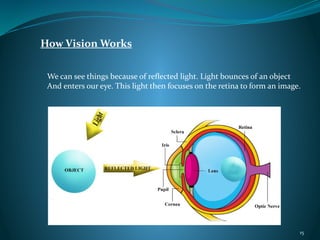
How Vision Works
We can see things because of reflected light. Light bounces of an object
And enters our eye. This light then focuses on the retina to form an image.
15
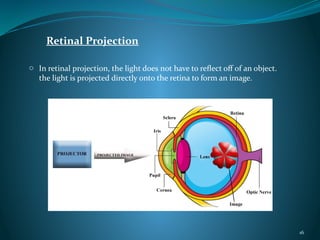
Retinal Projection
o In retinal projection, the light does not have to reflect off of an object.
the light is projected directly onto the retina to form an image.
16
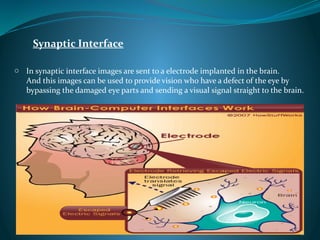
Synaptic Interface
o In synaptic interface images are sent to a electrode implanted in the brain.
And this images can be used to provide vision who have a defect of the eye by
bypassing the damaged eye parts and sending a visual signal straight to the brain.
17
Advantages of this technology
 Low power requirements
 Higher resolution images
 Greater portability
 Wider angle of view
 More accurate color
 Greater brightness and contrast
 Ability to present 3D images
 Ability to present far-point images
 Lower cost
18
Affects of Screenless Display
• Screen-less display technology is likely to affect:
Lighting and projection technologies
Software development/design
Lifestyles of the visually impaired
Career opportunities for the visually impaired
19
Thank You
20
Any Question???
21

Screenless displayy presentaion on bacheler of computer application

  • 1.
  • 2.
    A Seminar Presentation on Screen-less Display OurImagination Dressed into Reality Presented By Abhishek Raj 2
  • 3.
    What is Screen-lessDisplay?  Screen-less screen is the present evolving technology in the field of the computer- enhanced technology.  It is going to be one of the greatest technological development in the coming future years.  Several patents are still working on the new emerging technology which can change the whole spectacular view of the screen-less displays.  Screen-less display technology has the main aim of displaying (or) transmitting the information without any help of the screen (or) the projector.  Screen less displays have become a new rage of development for the next GEN-X  Screen-less videos describe systems for transmitting visual information from a video source without the use of the screen. 3
  • 4.
    Origin of Screen-lessDisplay  Reto Meier predicts that ten years from now we will be able to get transparent LCD patches that will adhere to our eyeglasses and twenty years from now we will have contact lenses that project images directly onto our retinas and that we will be able to interface with computers through mind control.  The most profound effect will come from the development of the synaptic interface technology. This technology will allow people who are visually impaired to see just as the hearing impaired are able to hear through cochlear implants. 4
  • 5.
    First Screen-less Display The first screen-less display that needs mentioning is Google Glass . Google Glass sits on the face like a pair of glasses. And on one eye it has a block of glass that allows you to see augmented reality. Images can be displayed write in front of your eye. As well as text and information about objects and places that are in front of you.  This technology is only in its early stages. But definitely shows that screen-less displays will become a natural form of media consumption in the future. 5
  • 6.
    The Sixth SenseTechnology  It is a wearable gestural interface that augments the physical world around us with digital information and lets us use natural hand gestures to interact with that information.  In this technology user is able to interact with a three dimensional image projected into thin air. Imagine your desktop floating in the space before your eyes waiting for your interaction! 6
  • 7.
    Technology used inScreen-less Display  Interactive projection and visual display system 7
  • 8.
     Three-Dimensional displayprojection technology With the large influx of new displays into the marked boasting ‘3D supp’. We will look at the two main techniques being used today, those being active shutter and passive polarization technologies. We will also discuss the trends in desktops displays from a 3D point of view as well as looking at the other aspects being developed to support 3D. Such as panel technology. 8
  • 9.
    Types of Displays Screen-lesscomputing systems can be divided into three groups: o Visual Image o Retinal Projection o Synaptic Interface/Brain computer interface 9
  • 10.
  • 11.
    Projection Window  Ithaving two terminal which project the source.  Air works as interface.  Resolution is very high 11
  • 12.
     The imagesprojected threw air molecules. These images are not limited to being just seen indoors but outdoors as well. However the image quality is affected if it is windy or rainy or specially sunny outside. For indoors use you can use controlled lighting to make the image appear better. You would not feel anything but air blowing from the projector. 12
  • 13.
  • 14.
    Retinal display having: Light projected directly to retina  Prevents snooping  Not limited by physical size  More secure to access data from outsiders 14
  • 15.
    How Vision Works Wecan see things because of reflected light. Light bounces of an object And enters our eye. This light then focuses on the retina to form an image. 15
  • 16.
    Retinal Projection o Inretinal projection, the light does not have to reflect off of an object. the light is projected directly onto the retina to form an image. 16
  • 17.
    Synaptic Interface o Insynaptic interface images are sent to a electrode implanted in the brain. And this images can be used to provide vision who have a defect of the eye by bypassing the damaged eye parts and sending a visual signal straight to the brain. 17
  • 18.
    Advantages of thistechnology  Low power requirements  Higher resolution images  Greater portability  Wider angle of view  More accurate color  Greater brightness and contrast  Ability to present 3D images  Ability to present far-point images  Lower cost 18
  • 19.
    Affects of ScreenlessDisplay • Screen-less display technology is likely to affect: Lighting and projection technologies Software development/design Lifestyles of the visually impaired Career opportunities for the visually impaired 19
  • 20.
  • 21.