 INTRODUCTION
 TYPES OF SCRENLESS DISPLAY
 WORKING OFTHREE GROUPS OF
SCREENLESS DISPLAY
 ADVANTAGES AND DISADVANTAGES
 CONCLUSION
Screen less display is the present evolving technology in the
field of computer enhanced technologies.
Screen less technology has the main aim of displaying or
transmitting the information without any help of the screen or
projector .
 It is going to be the one of the greatest technological
development in the coming future years .
 Screen less vedio describe system for transmitting visuals
information from a vedio source without the use of the screen .
1.Visual Image display
2. Retinal Display
3. Synaptic Interface display
The visual image is a type of screen less display, which
recognizes any type of image or thing with the help of the
human eye .The following are few examples of the visual
image display:
i. Holographic display
ii. Virtual reality goggles
iii. Heads up display
The working principle of this display states that the
light gets reflected by the intermediate object
before reaching the retina or the eye.The
intermediate object can be a hologram, Liquid
Crystal Displays (LCD)s or even windows.
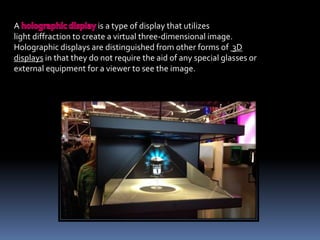
A is a type of display that utilizes
light diffraction to create a virtual three-dimensional image.
Holographic displays are distinguished from other forms of 3D
displays in that they do not require the aid of any special glasses or
external equipment for a viewer to see the image.
A is a transparent or miniaturized
display technology that does not require users to shift their
gaze from where they are naturally looking. A HUD should not
obstruct the user's view.This is typically achieved by the use of
projected or reflected transparent displays in line-of-sight.
The second category of advancement in display system, retinal display
as the name itself indicates the display of image directly onto the
retina. Instead of using some intermediate object for light reflection to
project the images, this display directly projects the image onto the
retina .The user will sense that the display is moving freely in the
space. Retinal display is commonly known as retinal scan display and
retinal projector .This display allows short light emission, coherent light
and narrow band color.
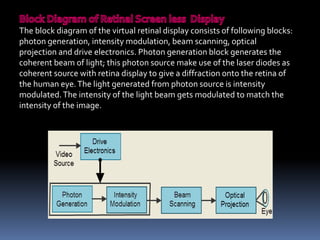
The block diagram of the virtual retinal display consists of following blocks:
photon generation, intensity modulation, beam scanning, optical
projection and drive electronics. Photon generation block generates the
coherent beam of light; this photon source make use of the laser diodes as
coherent source with retina display to give a diffraction onto the retina of
the human eye.The light generated from photon source is intensity
modulated.The intensity of the light beam gets modulated to match the
intensity of the image.
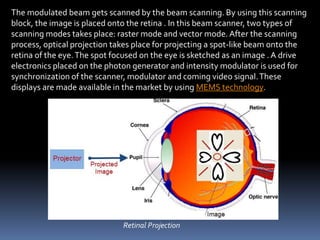
The modulated beam gets scanned by the beam scanning. By using this scanning
block, the image is placed onto the retina . In this beam scanner, two types of
scanning modes takes place: raster mode and vector mode. After the scanning
process, optical projection takes place for projecting a spot-like beam onto the
retina of the eye.The spot focused on the eye is sketched as an image . A drive
electronics placed on the photon generator and intensity modulator is used for
synchronization of the scanner, modulator and coming video signal.These
displays are made available in the market by using MEMS technology.
Retinal Projection
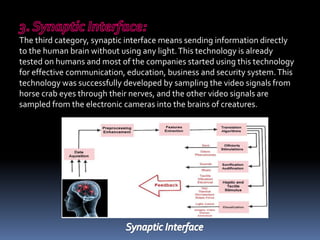
The third category, synaptic interface means sending information directly
to the human brain without using any light.This technology is already
tested on humans and most of the companies started using this technology
for effective communication, education, business and security system.This
technology was successfully developed by sampling the video signals from
horse crab eyes through their nerves, and the other video signals are
sampled from the electronic cameras into the brains of creatures.
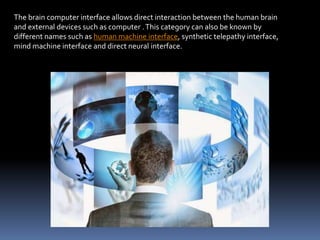
The brain computer interface allows direct interaction between the human brain
and external devices such as computer .This category can also be known by
different names such as human machine interface, synthetic telepathy interface,
mind machine interface and direct neural interface.
 Screen less display provides more accurate colors, higher
resolution images, and wider angle of view. Moreover, it requires
low power and provides higher levels of brightness & contrast.
The features such as ability to present 3d images and far-point
images enable their use in treatment of myopia.
 From the environment point of view, screen less display would
be preferred as toxic elements such as lead, arsenic, phosphorus,
mercury, and others are not used in their manufacturing process .
The cost of experiment models and prototypes of screen less
display is high.The virtual retinal display (VRD) technology is not
available in significant number.VRDTechnology is under
development.
May be in the future the world may be
dominated with the screen less display
technologies and this enriches the world of
technological empowerment in the field of the
computer technology.
SEMINAR.pptx

SEMINAR.pptx

  • 2.
     INTRODUCTION  TYPESOF SCRENLESS DISPLAY  WORKING OFTHREE GROUPS OF SCREENLESS DISPLAY  ADVANTAGES AND DISADVANTAGES  CONCLUSION
  • 3.
    Screen less displayis the present evolving technology in the field of computer enhanced technologies. Screen less technology has the main aim of displaying or transmitting the information without any help of the screen or projector .  It is going to be the one of the greatest technological development in the coming future years .  Screen less vedio describe system for transmitting visuals information from a vedio source without the use of the screen .
  • 4.
    1.Visual Image display 2.Retinal Display 3. Synaptic Interface display
  • 5.
    The visual imageis a type of screen less display, which recognizes any type of image or thing with the help of the human eye .The following are few examples of the visual image display: i. Holographic display ii. Virtual reality goggles iii. Heads up display The working principle of this display states that the light gets reflected by the intermediate object before reaching the retina or the eye.The intermediate object can be a hologram, Liquid Crystal Displays (LCD)s or even windows.
  • 6.
    A is atype of display that utilizes light diffraction to create a virtual three-dimensional image. Holographic displays are distinguished from other forms of 3D displays in that they do not require the aid of any special glasses or external equipment for a viewer to see the image.
  • 7.
    A is atransparent or miniaturized display technology that does not require users to shift their gaze from where they are naturally looking. A HUD should not obstruct the user's view.This is typically achieved by the use of projected or reflected transparent displays in line-of-sight.
  • 8.
    The second categoryof advancement in display system, retinal display as the name itself indicates the display of image directly onto the retina. Instead of using some intermediate object for light reflection to project the images, this display directly projects the image onto the retina .The user will sense that the display is moving freely in the space. Retinal display is commonly known as retinal scan display and retinal projector .This display allows short light emission, coherent light and narrow band color.
  • 9.
    The block diagramof the virtual retinal display consists of following blocks: photon generation, intensity modulation, beam scanning, optical projection and drive electronics. Photon generation block generates the coherent beam of light; this photon source make use of the laser diodes as coherent source with retina display to give a diffraction onto the retina of the human eye.The light generated from photon source is intensity modulated.The intensity of the light beam gets modulated to match the intensity of the image.
  • 10.
    The modulated beamgets scanned by the beam scanning. By using this scanning block, the image is placed onto the retina . In this beam scanner, two types of scanning modes takes place: raster mode and vector mode. After the scanning process, optical projection takes place for projecting a spot-like beam onto the retina of the eye.The spot focused on the eye is sketched as an image . A drive electronics placed on the photon generator and intensity modulator is used for synchronization of the scanner, modulator and coming video signal.These displays are made available in the market by using MEMS technology. Retinal Projection
  • 11.
    The third category,synaptic interface means sending information directly to the human brain without using any light.This technology is already tested on humans and most of the companies started using this technology for effective communication, education, business and security system.This technology was successfully developed by sampling the video signals from horse crab eyes through their nerves, and the other video signals are sampled from the electronic cameras into the brains of creatures.
  • 12.
    The brain computerinterface allows direct interaction between the human brain and external devices such as computer .This category can also be known by different names such as human machine interface, synthetic telepathy interface, mind machine interface and direct neural interface.
  • 13.
     Screen lessdisplay provides more accurate colors, higher resolution images, and wider angle of view. Moreover, it requires low power and provides higher levels of brightness & contrast. The features such as ability to present 3d images and far-point images enable their use in treatment of myopia.  From the environment point of view, screen less display would be preferred as toxic elements such as lead, arsenic, phosphorus, mercury, and others are not used in their manufacturing process . The cost of experiment models and prototypes of screen less display is high.The virtual retinal display (VRD) technology is not available in significant number.VRDTechnology is under development.
  • 14.
    May be inthe future the world may be dominated with the screen less display technologies and this enriches the world of technological empowerment in the field of the computer technology.