SCORING SYSTEMS
in
TRAUMATIZED CHILDREN
Prof. Mohamed Ezzat Moemen
Founder of
anaesthesia & intensive care,
faculty of medicine,
Zagazig university
Scoring systems aim to reduce
large amounts of data
to
simple grades or numbers
Aim
Do we need scoring systems ?
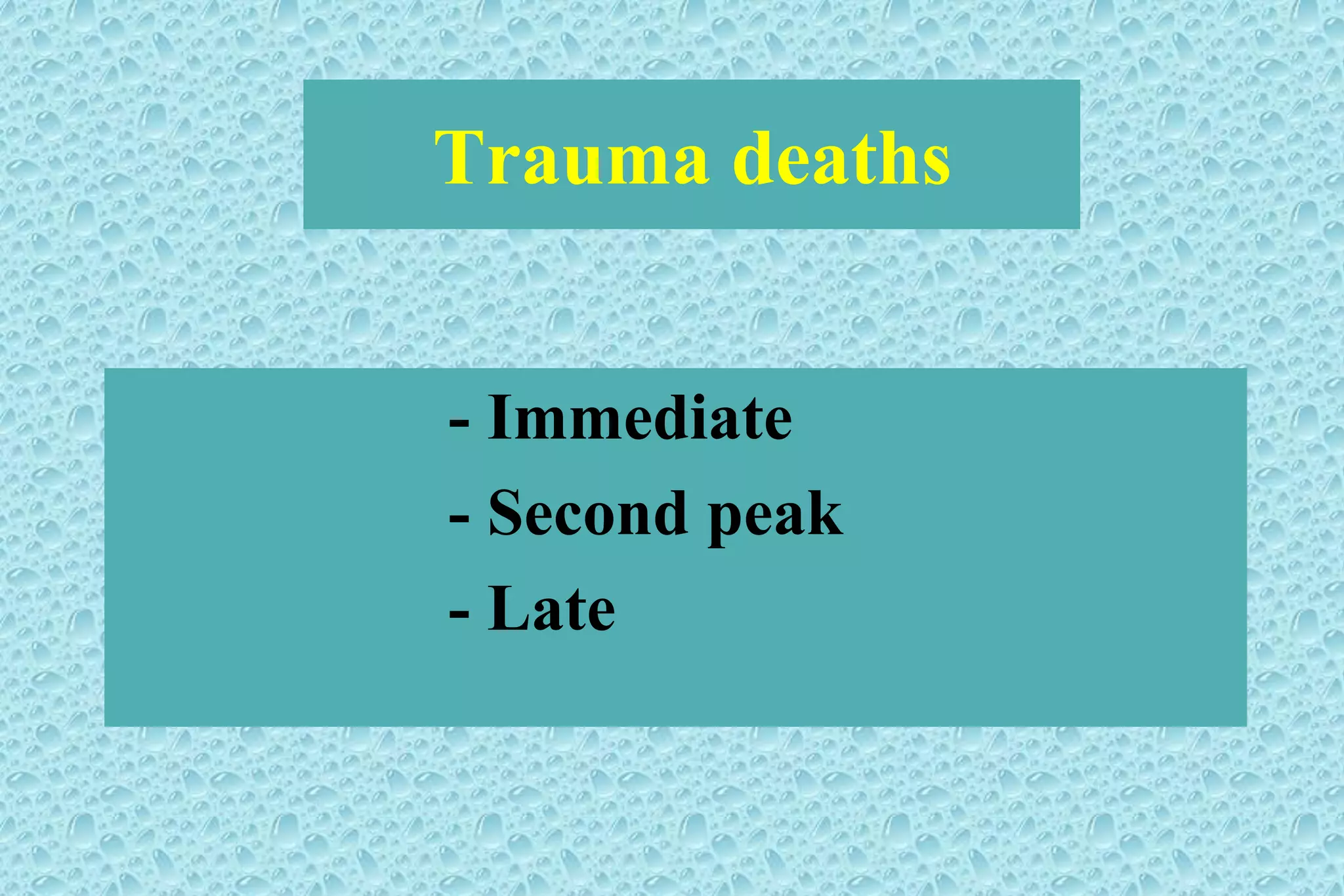
Trauma deaths
- Immediate
- Second peak
- Late
Patient triage
- Priorities
- Labels
- Repetition
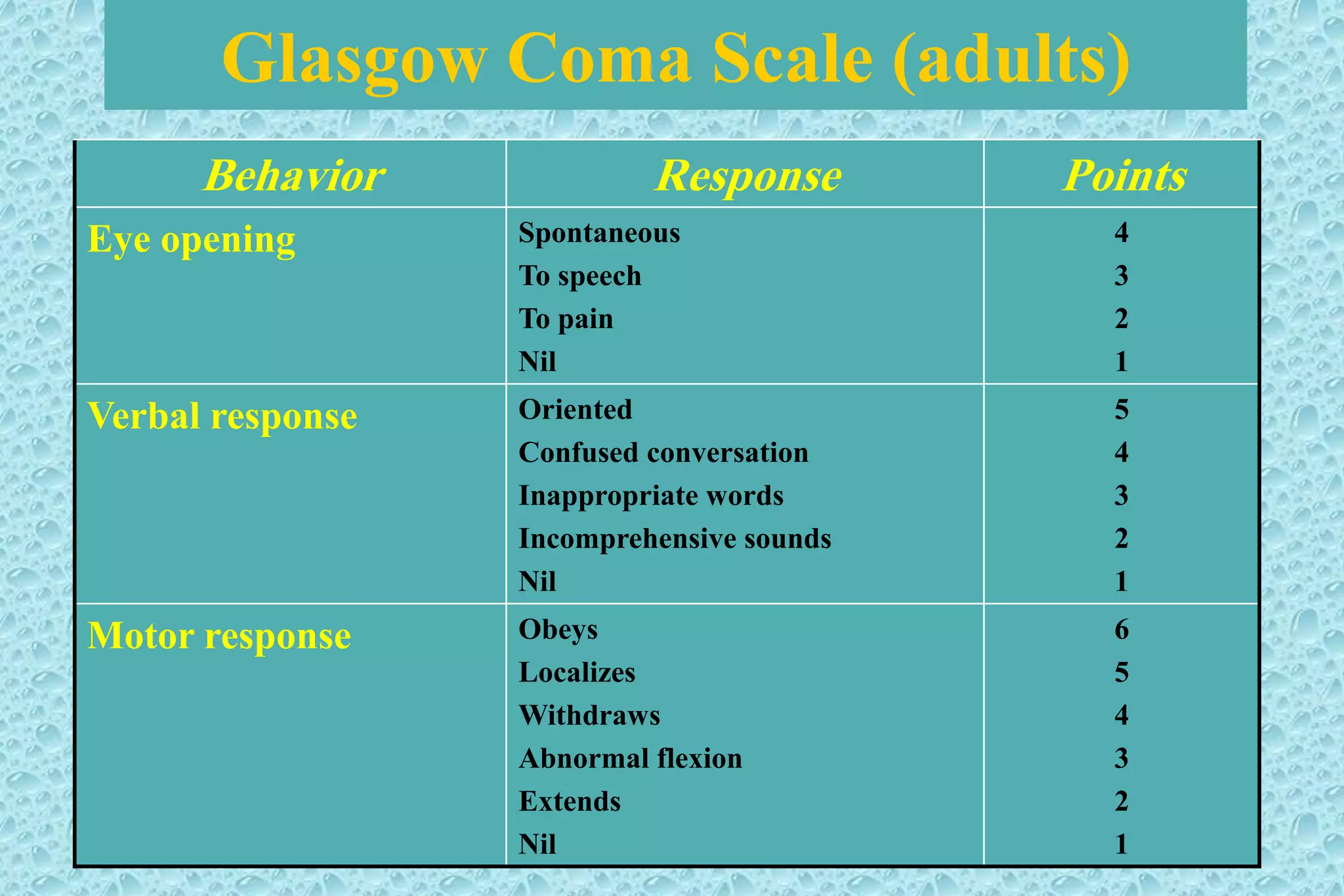
Glasgow Coma Scale (adults)
PointsResponseBehavior
4
3
2
1
Spontaneous
To speech
To pain
Nil
Eye opening
5
4
3
2
1
Oriented
Confused conversation
Inappropriate words
Incomprehensive sounds
Nil
Verbal response
6
5
4
3
2
1
Obeys
Localizes
Withdraws
Abnormal flexion
Extends
Nil
Motor response
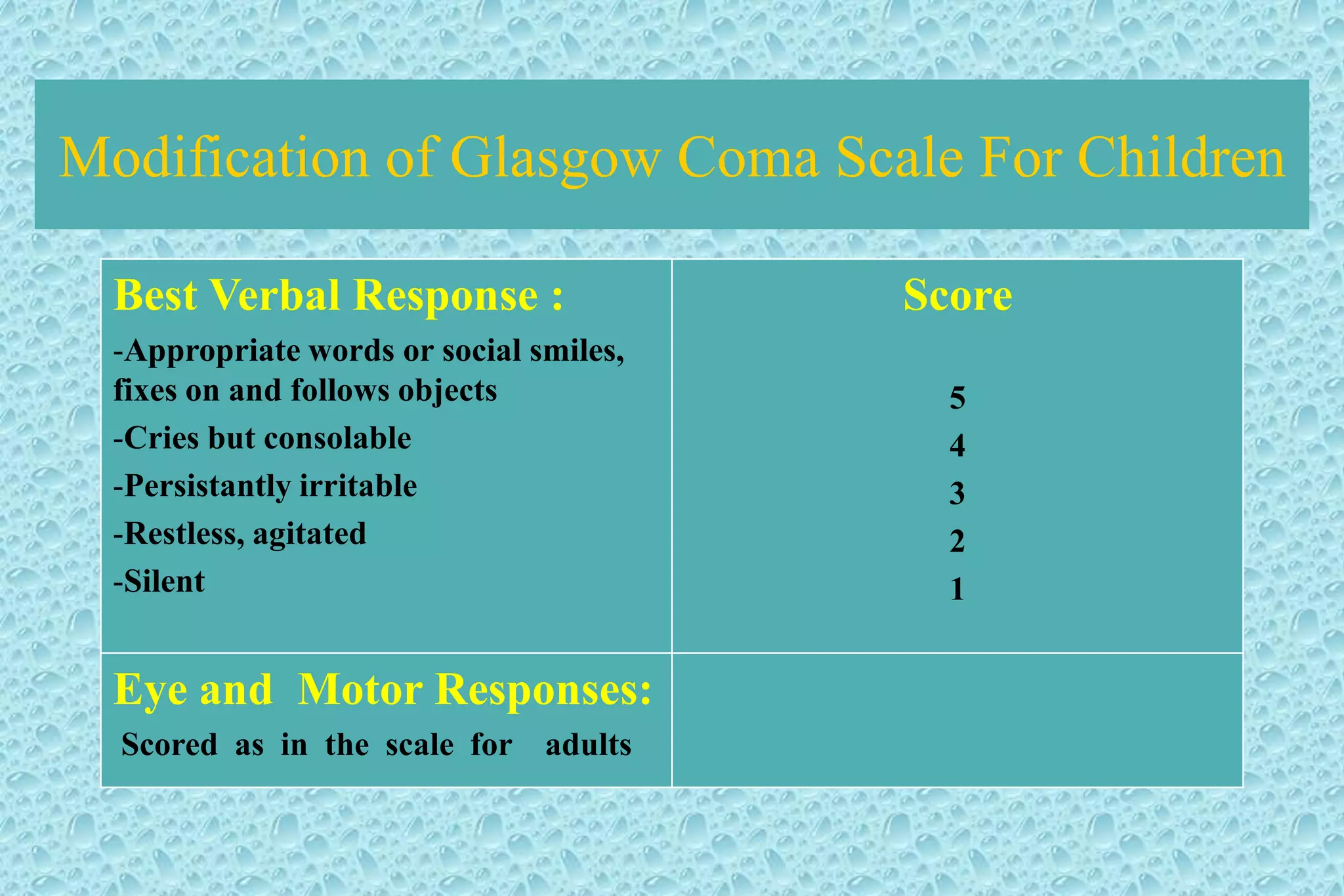
Modification of Glasgow Coma Scale For Children
Score
5
4
3
2
1
Best Verbal Response :
-Appropriate words or social smiles,
fixes on and follows objects
-Cries but consolable
-Persistantly irritable
-Restless, agitated
-Silent
Eye and Motor Responses:
Scored as in the scale for adults
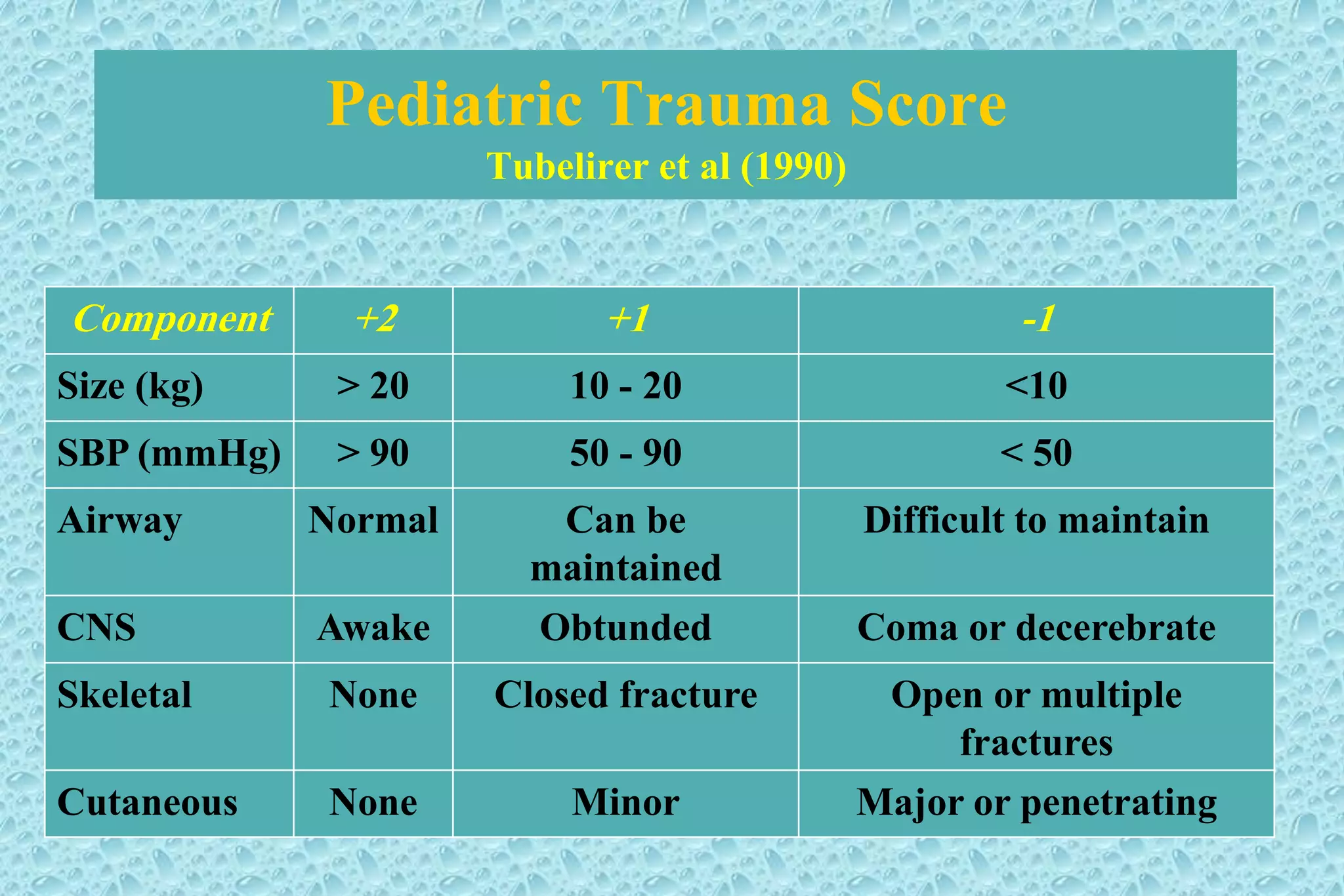
Pediatric Trauma Score
Tubelirer et al (1990)
-1+1+2Component
<1010 - 20> 20Size (kg)
< 5050 - 90> 90SBP (mmHg)
Difficult to maintainCan be
maintained
NormalAirway
Coma or decerebrateObtundedAwakeCNS
Open or multiple
fractures
Closed fractureNoneSkeletal
Major or penetratingMinorNoneCutaneous
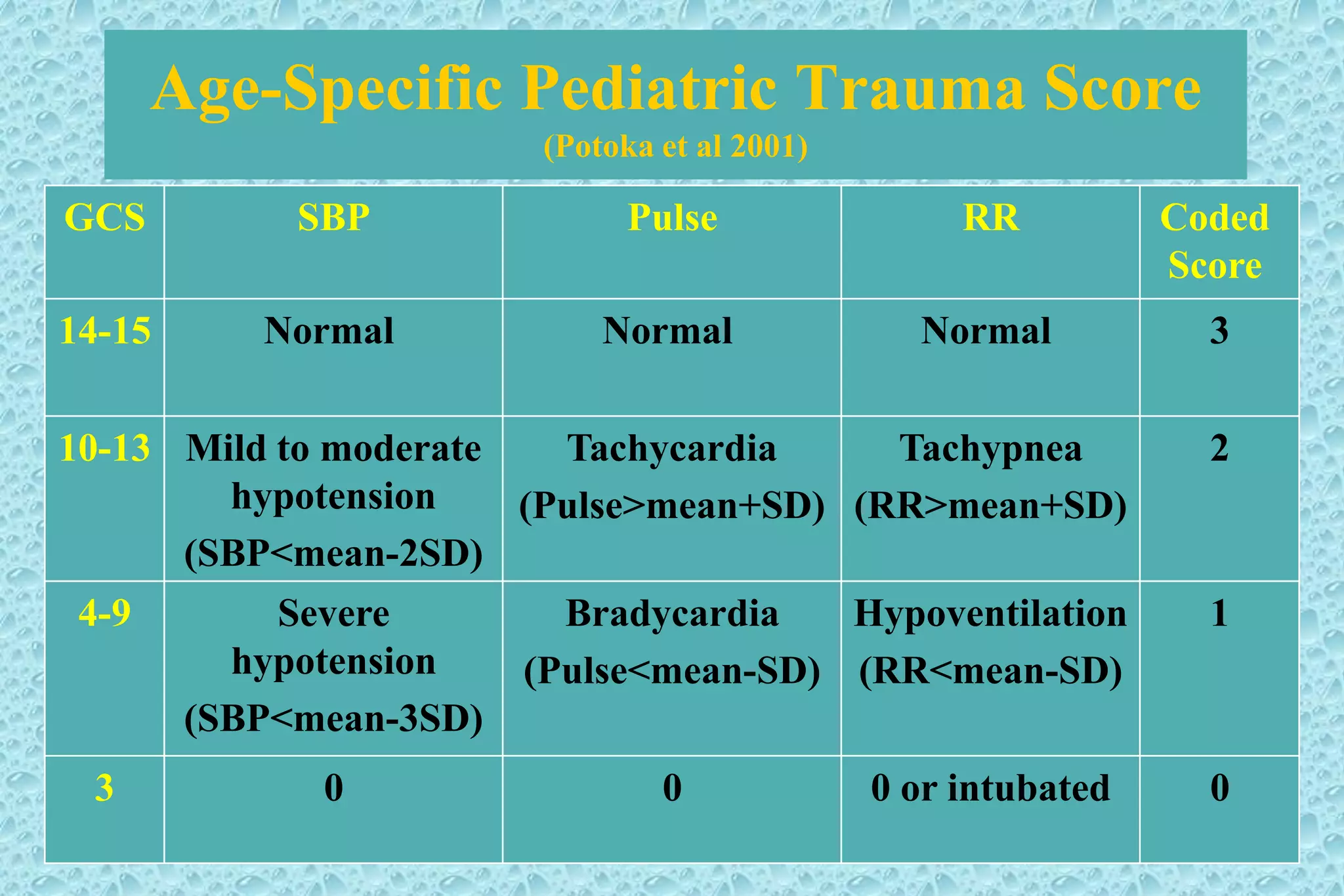
Age-Specific Pediatric Trauma Score
(Potoka et al 2001)
Coded
Score
RRPulseSBPGCS
3NormalNormalNormal14-15
2Tachypnea
(RR>mean+SD)
Tachycardia
(Pulse>mean+SD)
Mild to moderate
hypotension
(SBP<mean-2SD)
10-13
1Hypoventilation
(RR<mean-SD)
Bradycardia
(Pulse<mean-SD)
Severe
hypotension
(SBP<mean-3SD)
4-9
00 or intubated003
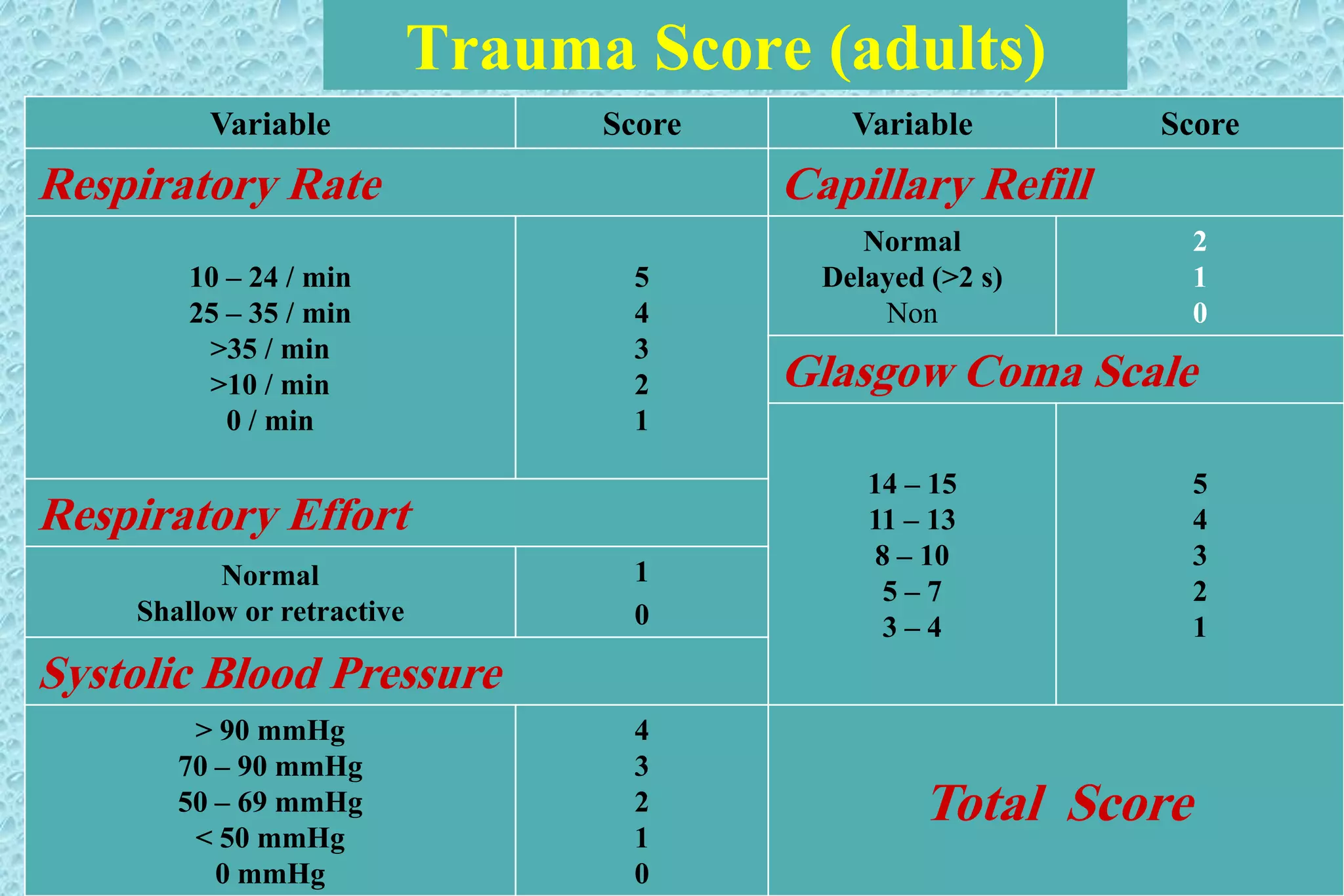
ScoreVariableScoreVariable
Capillary RefillRespiratory Rate
2
1
0
Normal
Delayed (>2 s)
Non
5
4
3
2
1
10 – 24 / min
25 – 35 / min
>35 / min
>10 / min
0 / min
Glasgow Coma Scale
5
4
3
2
1
14 – 15
11 – 13
8 – 10
5 – 7
3 – 4
Respiratory Effort
1
0
Normal
Shallow or retractive
Systolic Blood Pressure
Total Score
4
3
2
1
0
> 90 mmHg
70 – 90 mmHg
50 – 69 mmHg
< 50 mmHg
0 mmHg
Trauma Score (adults)
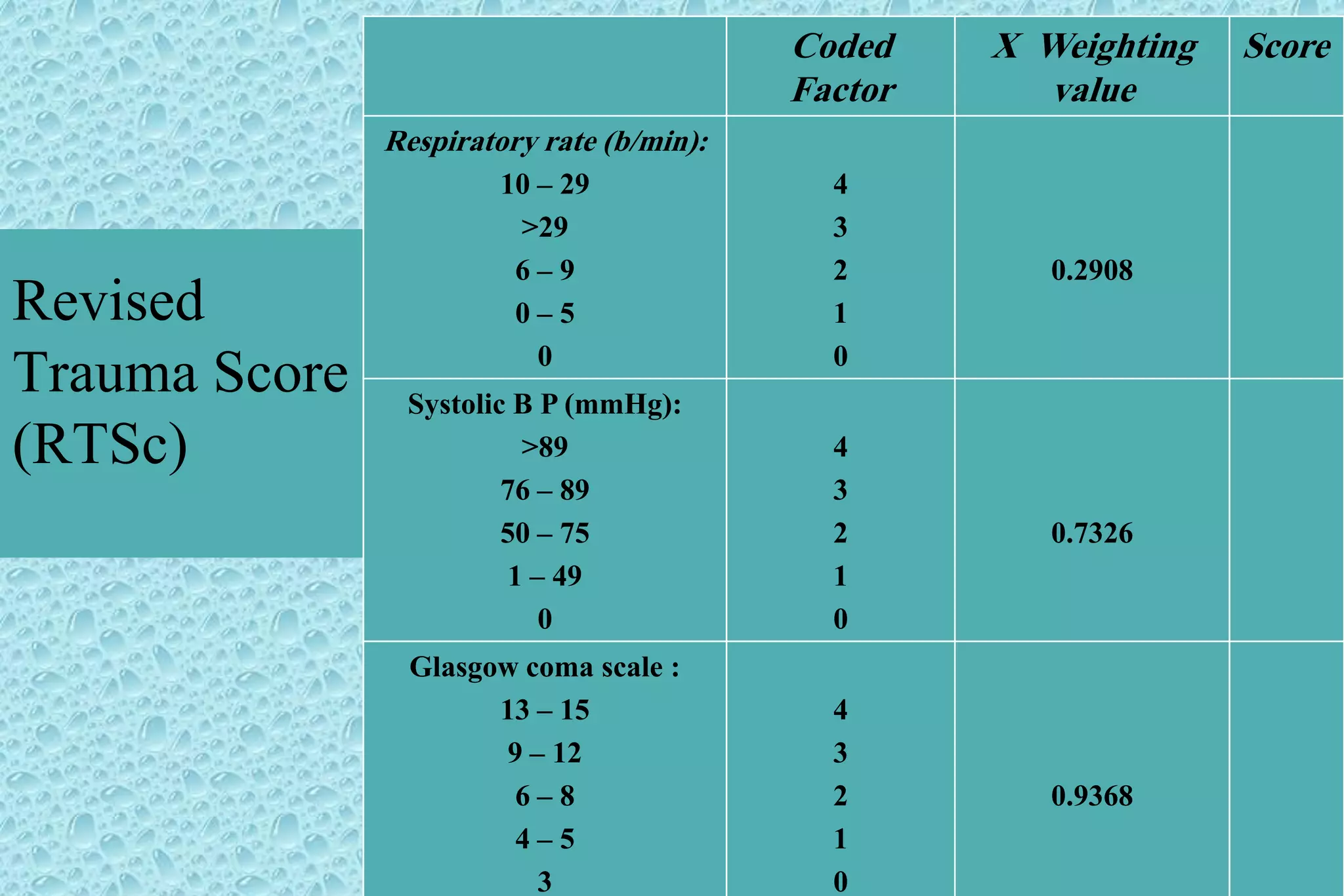
Revised
Trauma Score
(RTSc)
ScoreX Weighting
value
Coded
Factor
0.2908
4
3
2
1
0
Respiratory rate (b/min):
10 – 29
>29
6 – 9
0 – 5
0
0.7326
4
3
2
1
0
Systolic B P (mmHg):
>89
76 – 89
50 – 75
1 – 49
0
0.9368
4
3
2
1
0
Glasgow coma scale :
13 – 15
9 – 12
6 – 8
4 – 5
3
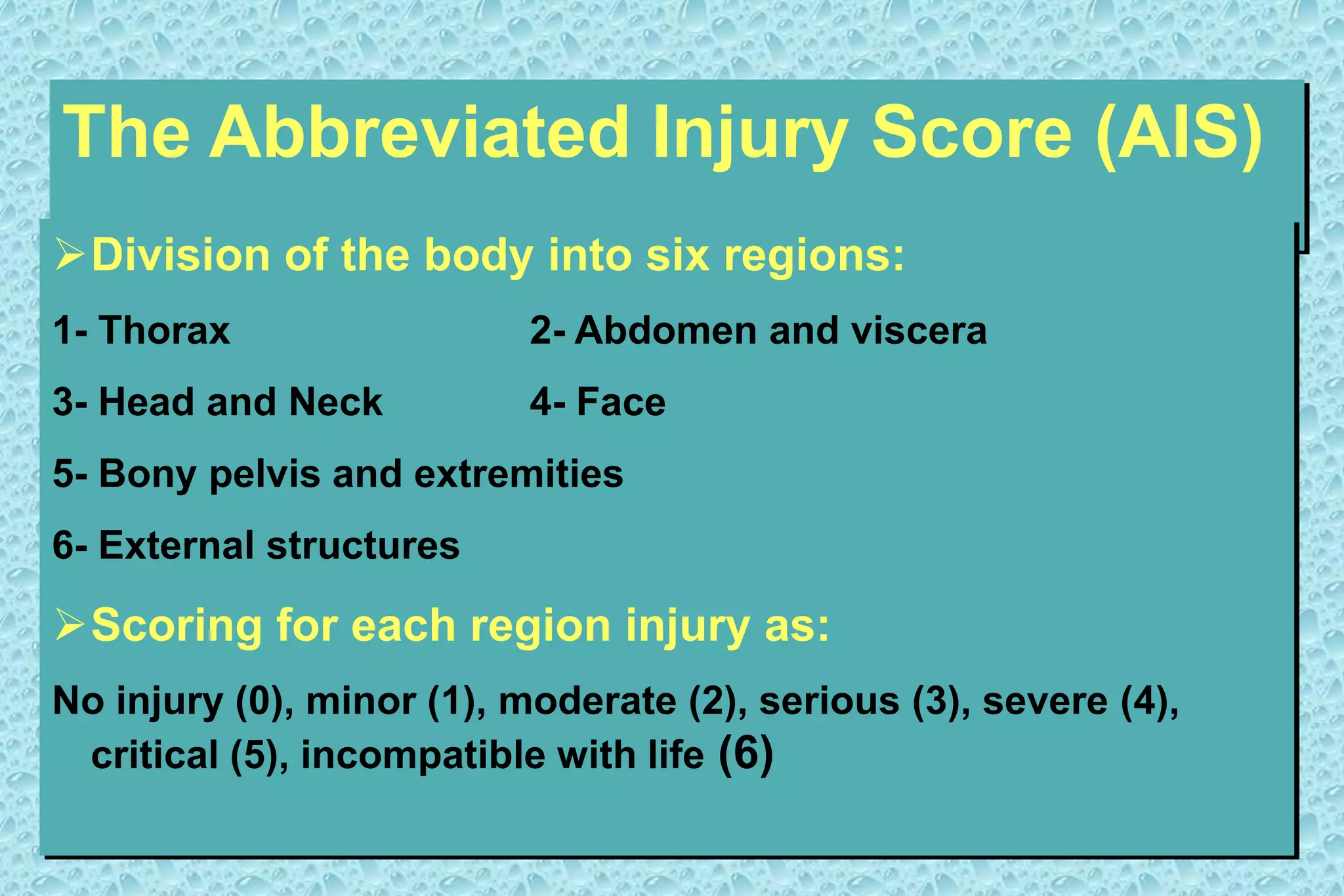
The Abbreviated Injury Score (AIS)
Division of the body into six regions:
1- Thorax 2- Abdomen and viscera
3- Head and Neck 4- Face
5- Bony pelvis and extremities
6- External structures
Scoring for each region injury as:
No injury (0), minor (1), moderate (2), serious (3), severe (4),
critical (5), incompatible with life (6)
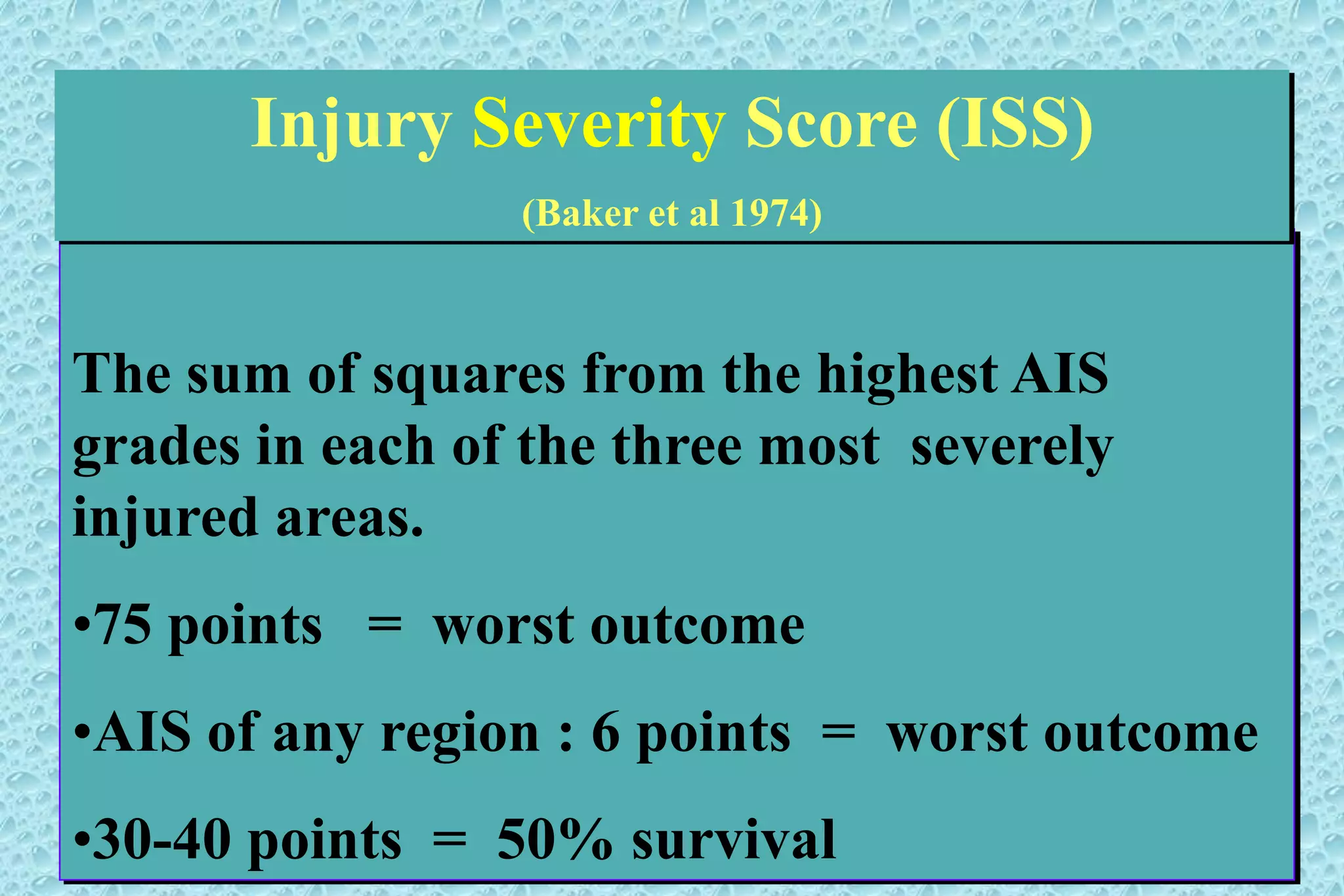
The sum of squares from the highest AIS
grades in each of the three most severely
injured areas.
•75 points = worst outcome
•AIS of any region : 6 points = worst outcome
•30-40 points = 50% survival
Injury Severity Score (ISS)
(Baker et al 1974)
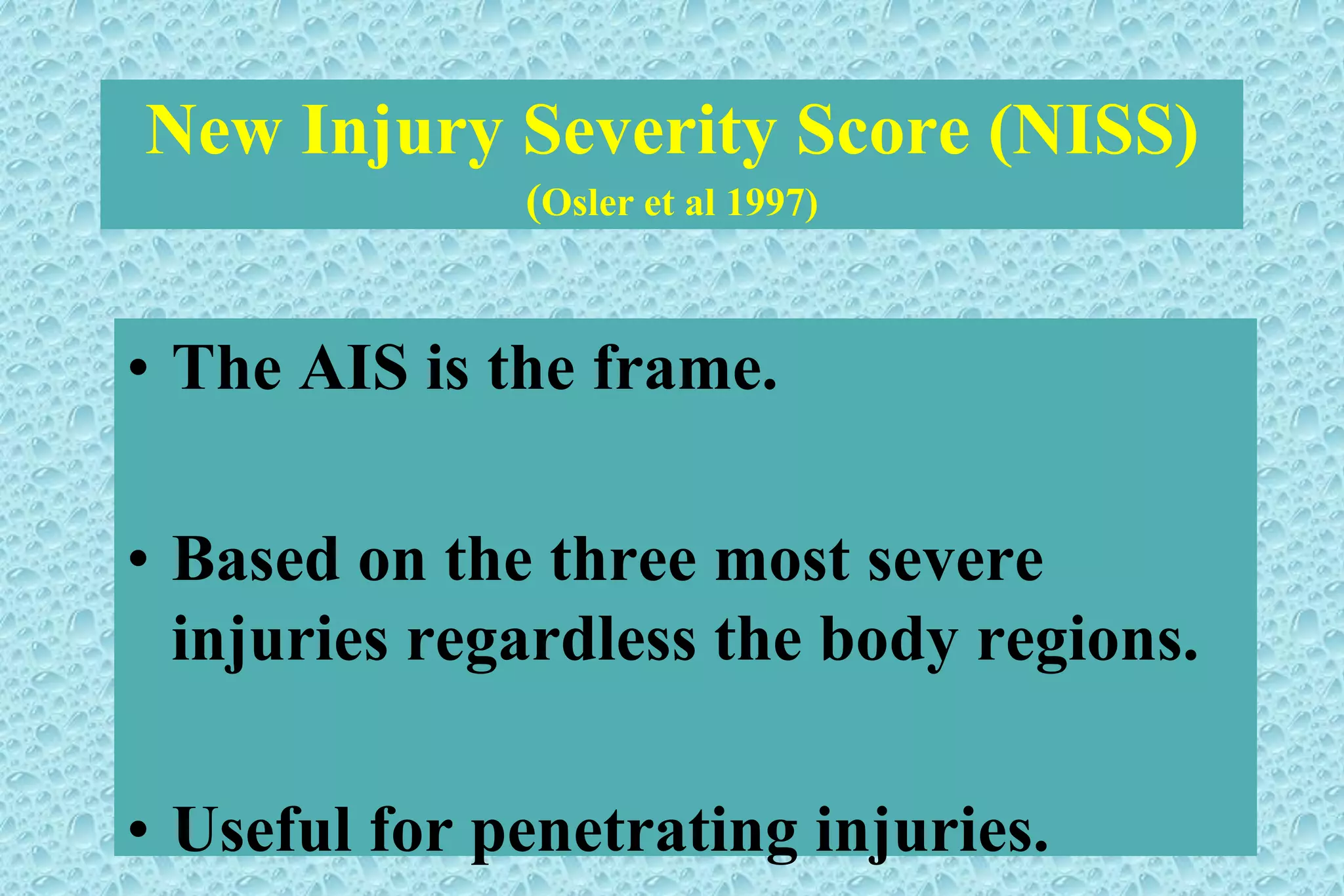
New Injury Severity Score (NISS)
(Osler et al 1997)
• The AIS is the frame.
• Based on the three most severe
injuries regardless the body regions.
• Useful for penetrating injuries.
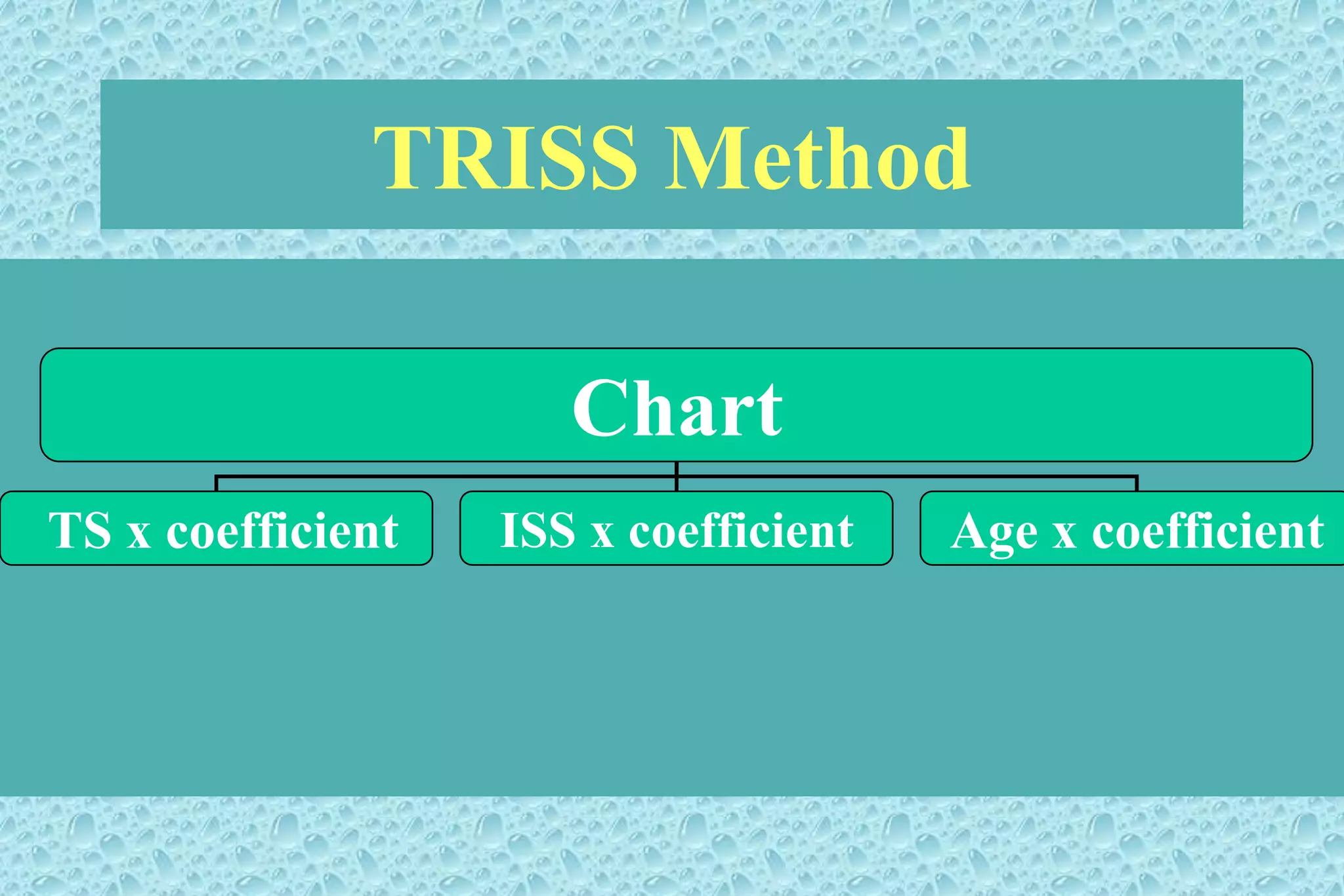
TRISS Method
Chart
TS x coefficient ISS x coefficient Age x coefficient
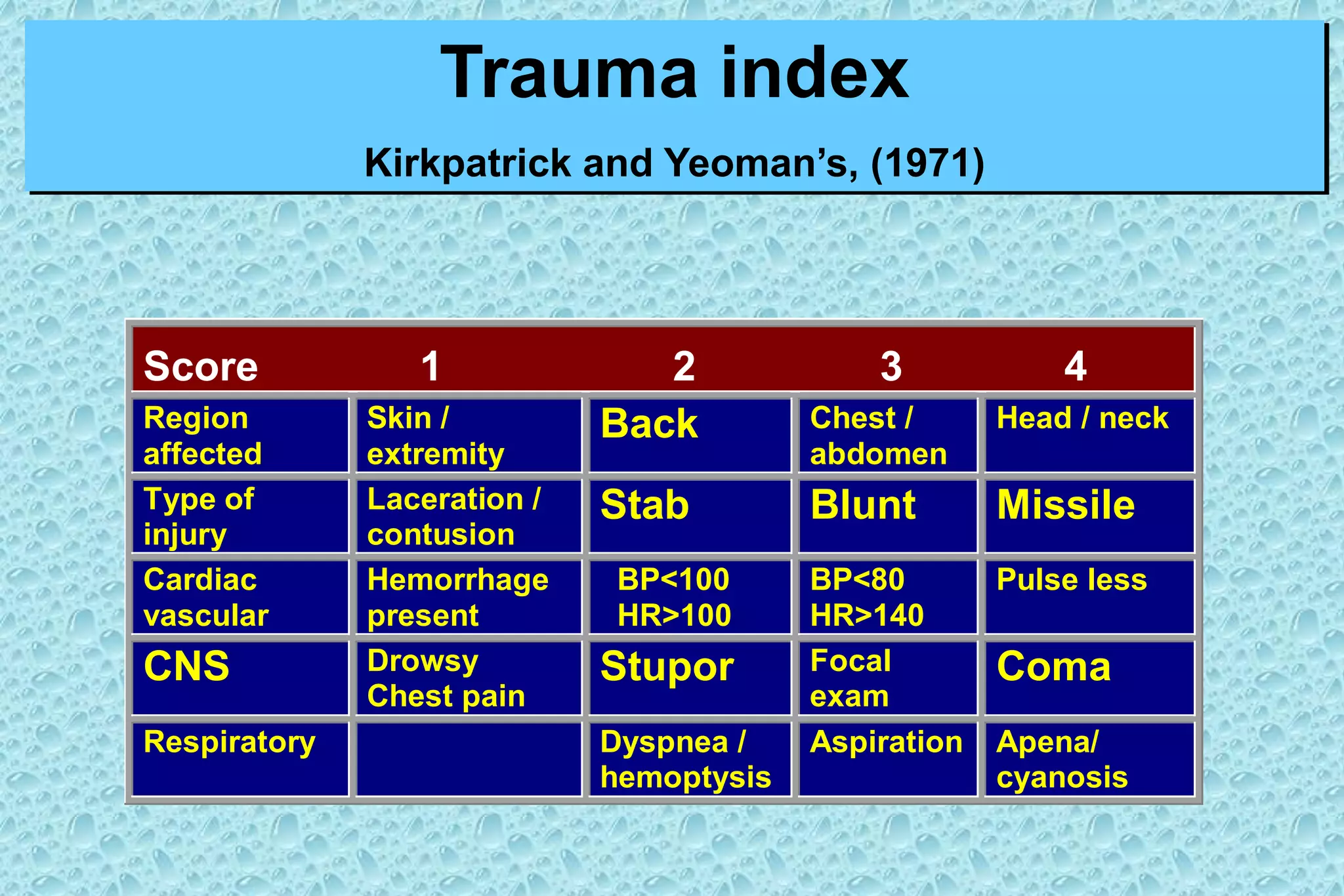
Score 1 2 3 4
Region
affected
Skin /
extremity
Back Chest /
abdomen
Head / neck
Type of
injury
Laceration /
contusion
Stab Blunt Missile
Cardiac
vascular
Hemorrhage
present
BP<100
HR>100
BP<80
HR>140
Pulse less
CNS Drowsy
Chest pain
Stupor Focal
exam
Coma
Respiratory Dyspnea /
hemoptysis
Aspiration Apena/
cyanosis
Trauma index
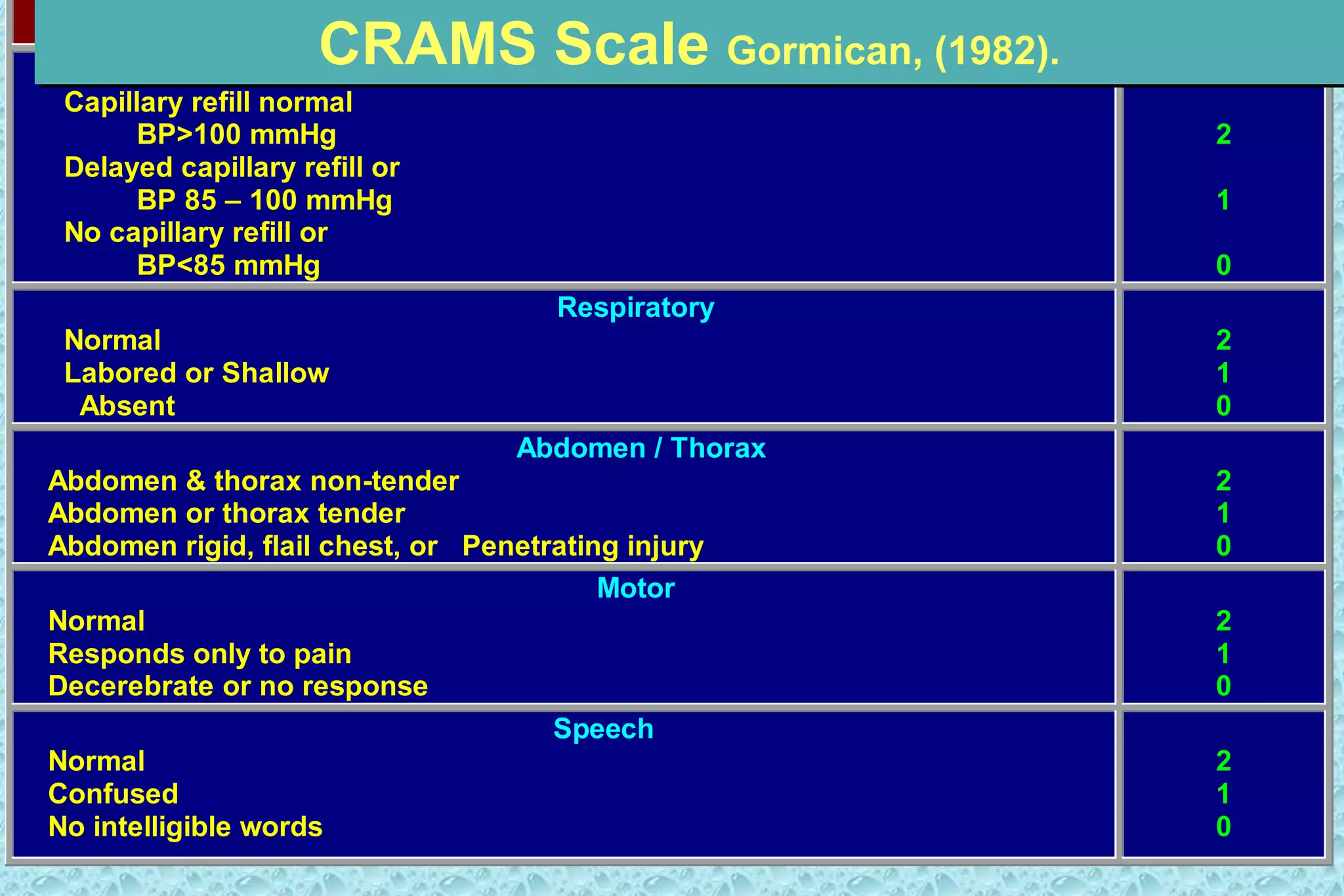
Kirkpatrick and Yeoman’s, (1971)
Variable Score
Circulation
Capillary refill normal
BP>100 mmHg
Delayed capillary refill or
BP 85 – 100 mmHg
No capillary refill or
BP<85 mmHg
2
1
0
Respiratory
Normal
Labored or Shallow
Absent
2
1
0
Abdomen / Thorax
Abdomen & thorax non-tender
Abdomen or thorax tender
Abdomen rigid, flail chest, or Penetrating injury
2
1
0
Motor
Normal
Responds only to pain
Decerebrate or no response
2
1
0
Speech
Normal
Confused
No intelligible words
2
1
0
CRAMS Scale Gormican, (1982).
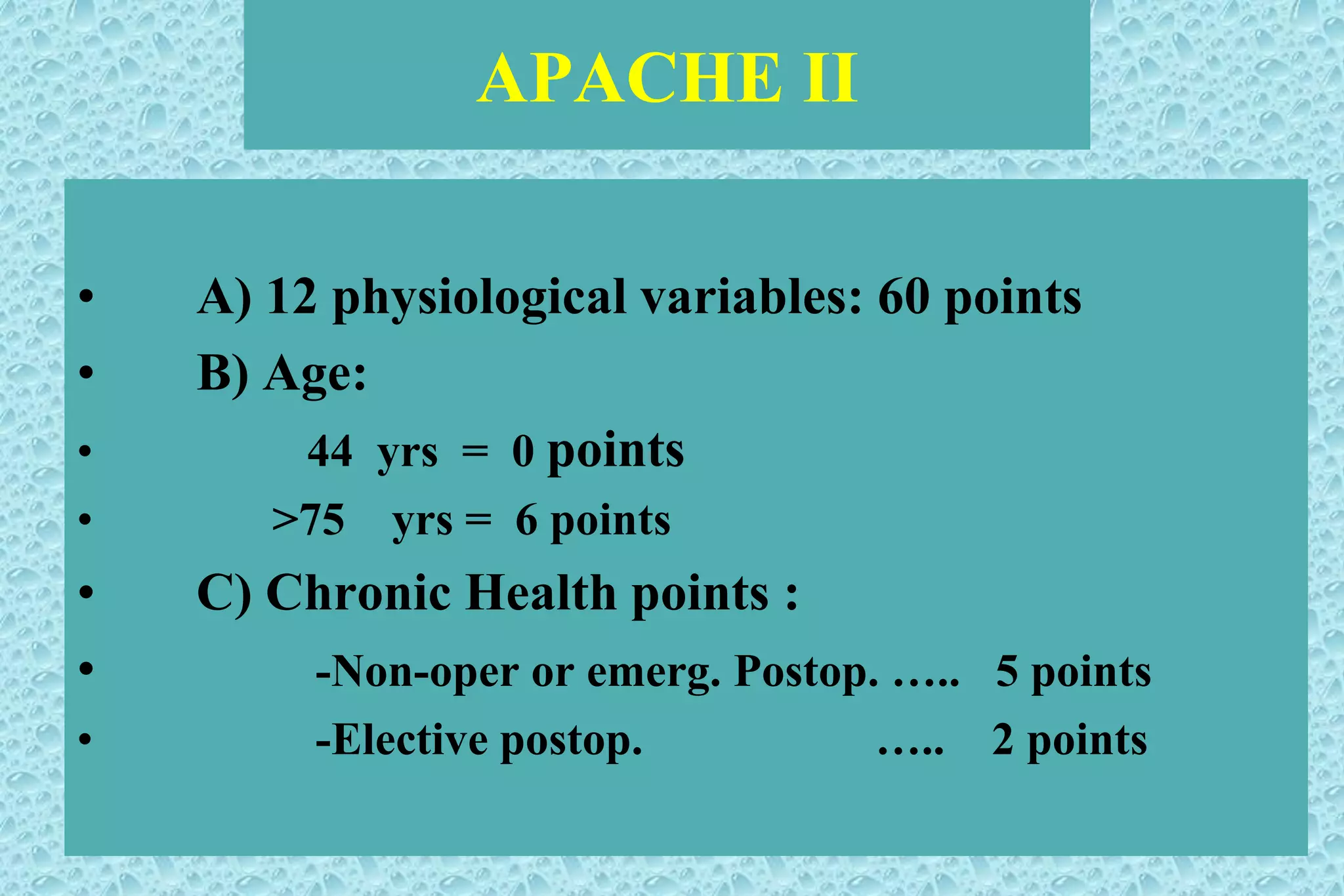
APACHE II
• A) 12 physiological variables: 60 points
• B) Age:
• 44 yrs = 0 points
• >75 yrs = 6 points
• C) Chronic Health points :
• -Non-oper or emerg. Postop. ….. 5 points
• -Elective postop. ….. 2 points
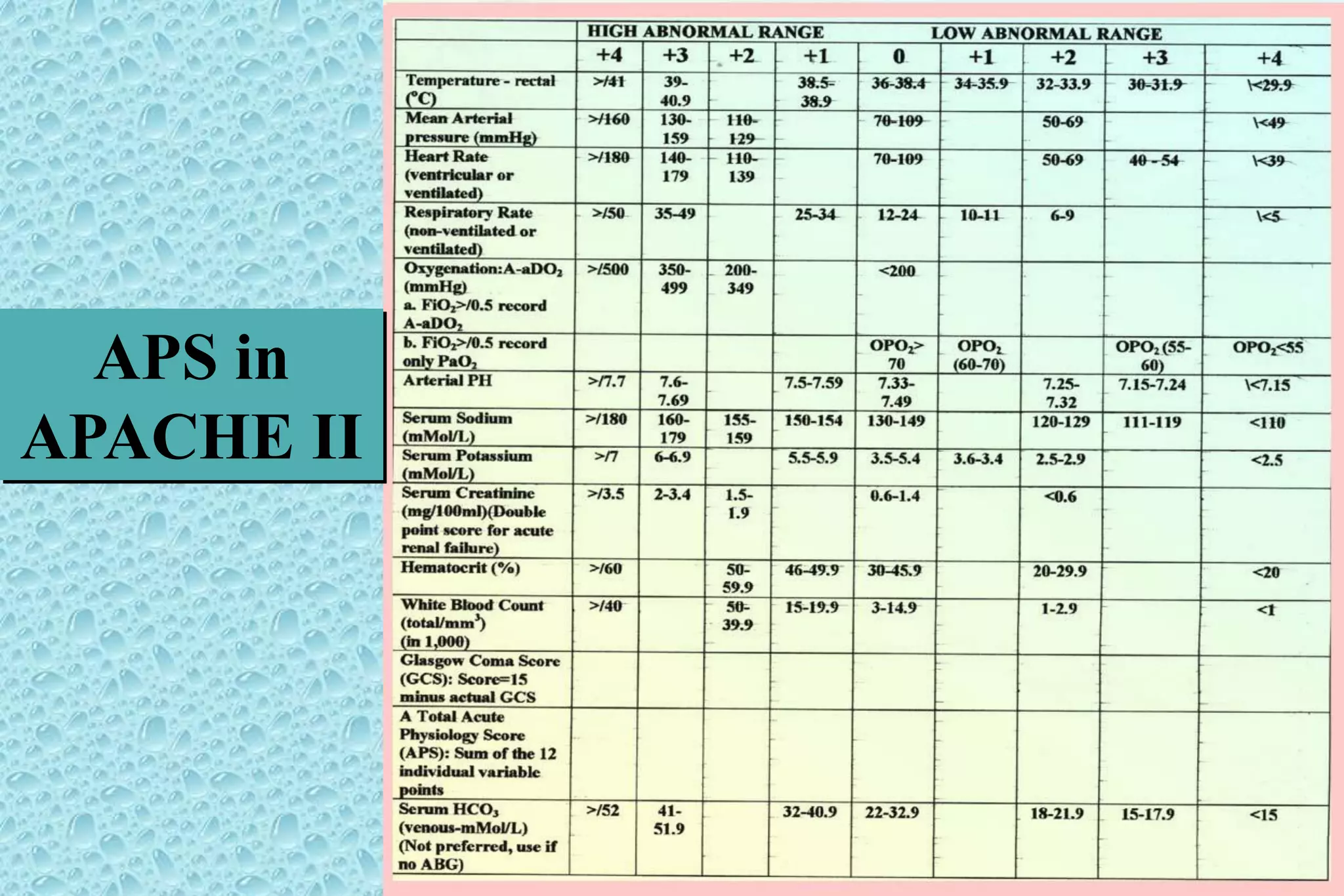
APS in
APACHE II
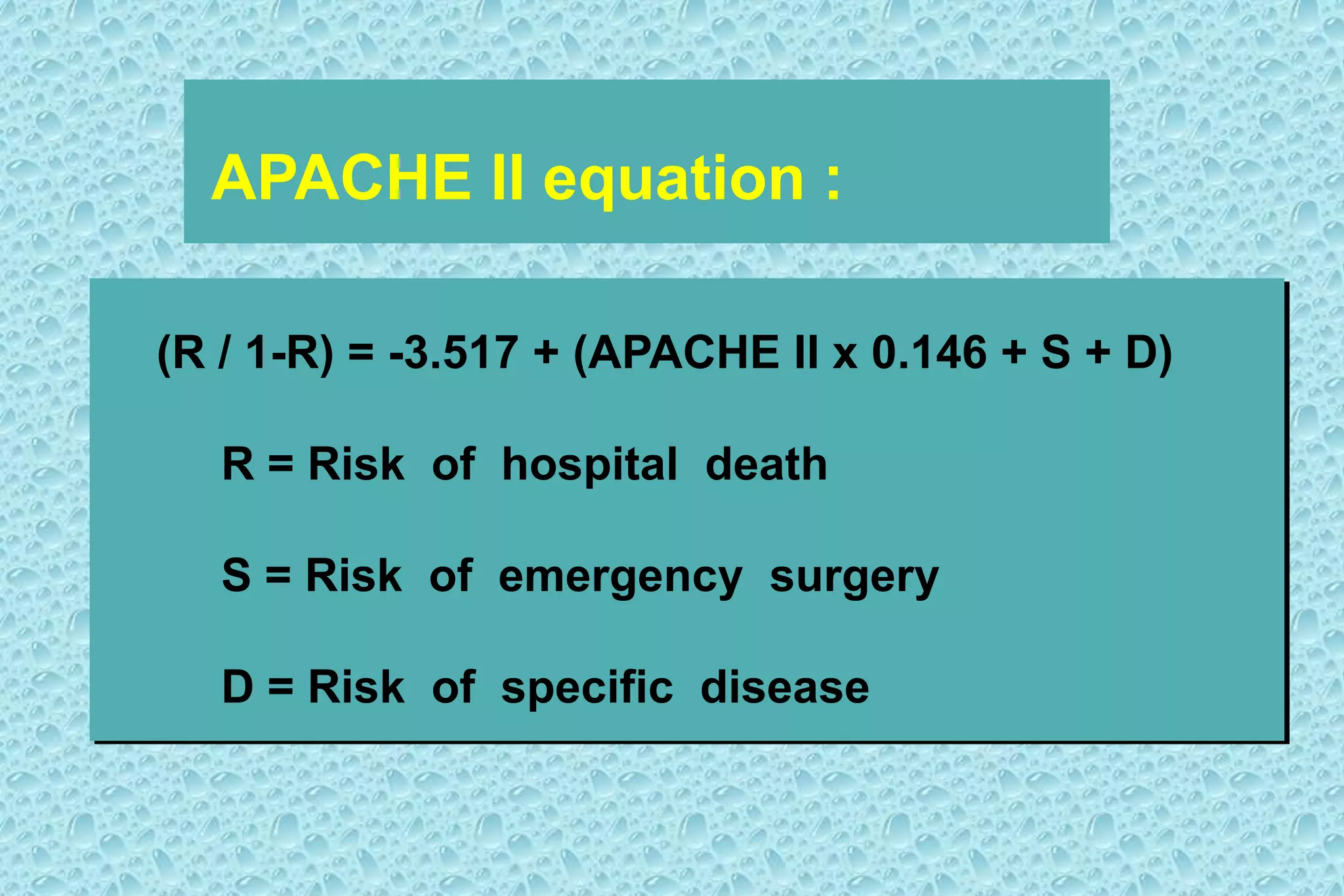
(R / 1-R) = -3.517 + (APACHE II x 0.146 + S + D)
R = Risk of hospital death
S = Risk of emergency surgery
D = Risk of specific disease
APACHE II equation :
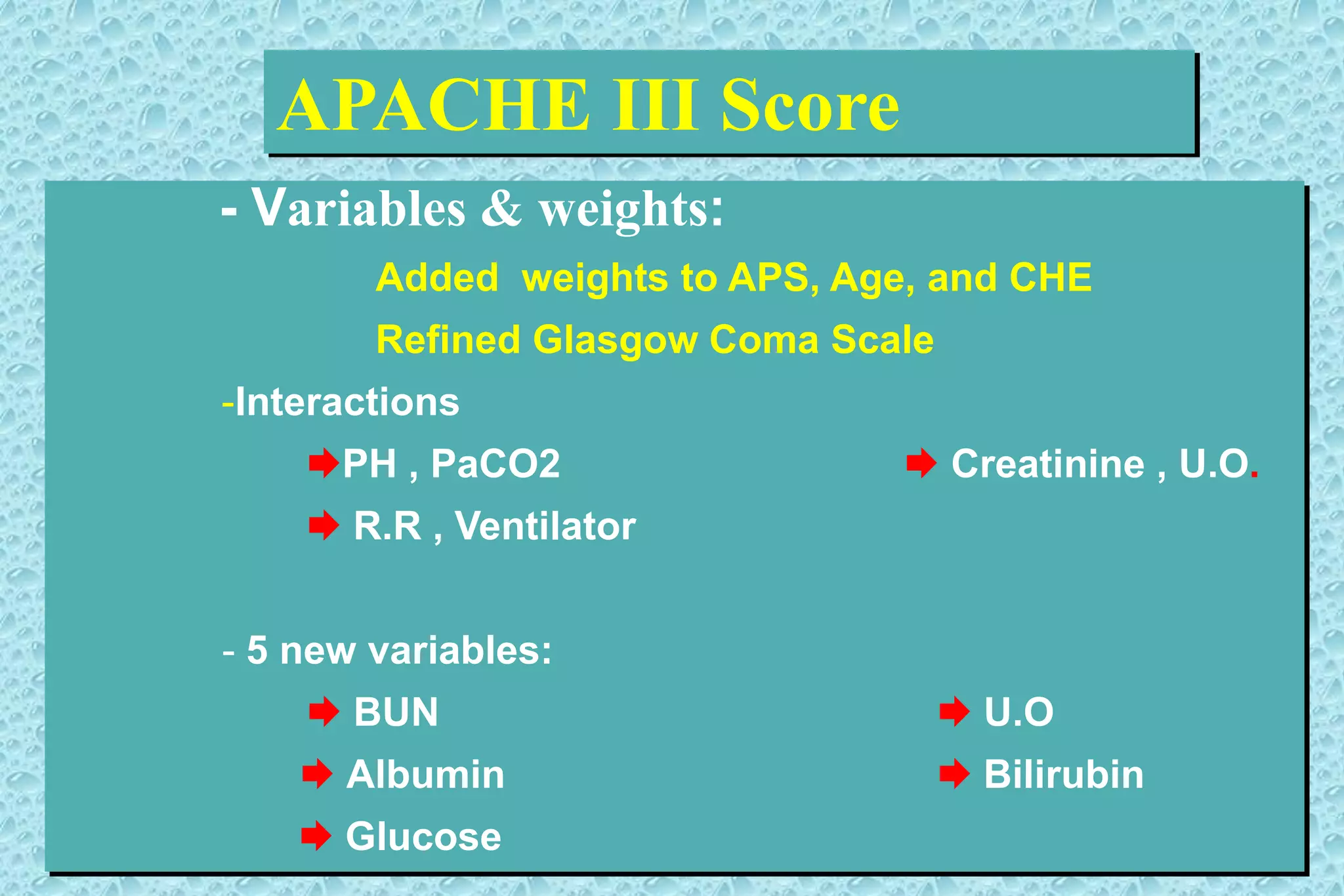
APACHE III Score
- Variables & weights:
Added weights to APS, Age, and CHE
Refined Glasgow Coma Scale
-Interactions
PH , PaCO2  Creatinine , U.O.
 R.R , Ventilator
- 5 new variables:
 BUN  U.O
 Albumin  Bilirubin
 Glucose
‫صفحه‬32
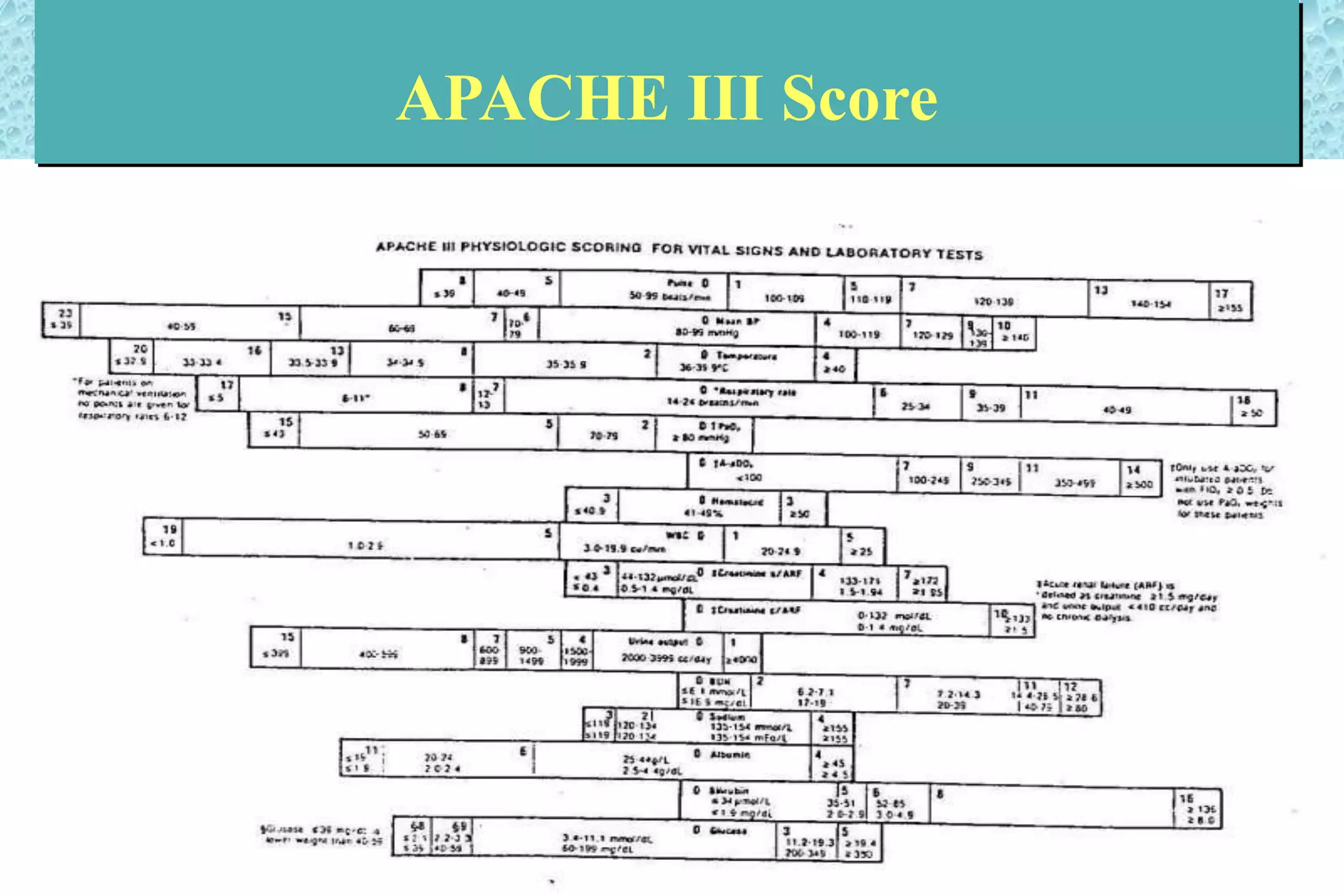
APACHE III Score
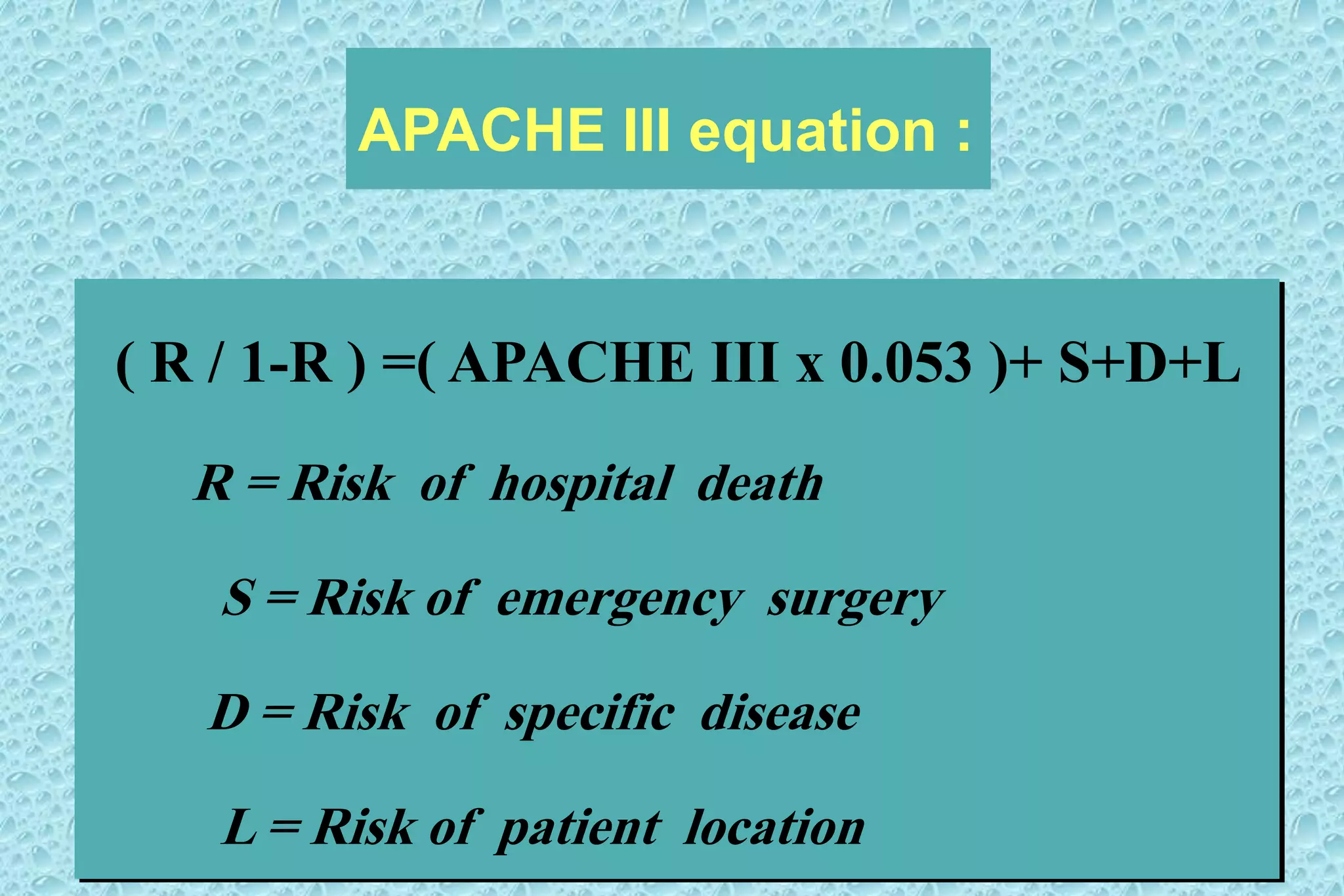
( R / 1-R ) =( APACHE III x 0.053 )+ S+D+L
R = Risk of hospital death
S = Risk of emergency surgery
D = Risk of specific disease
L = Risk of patient location
APACHE III equation :
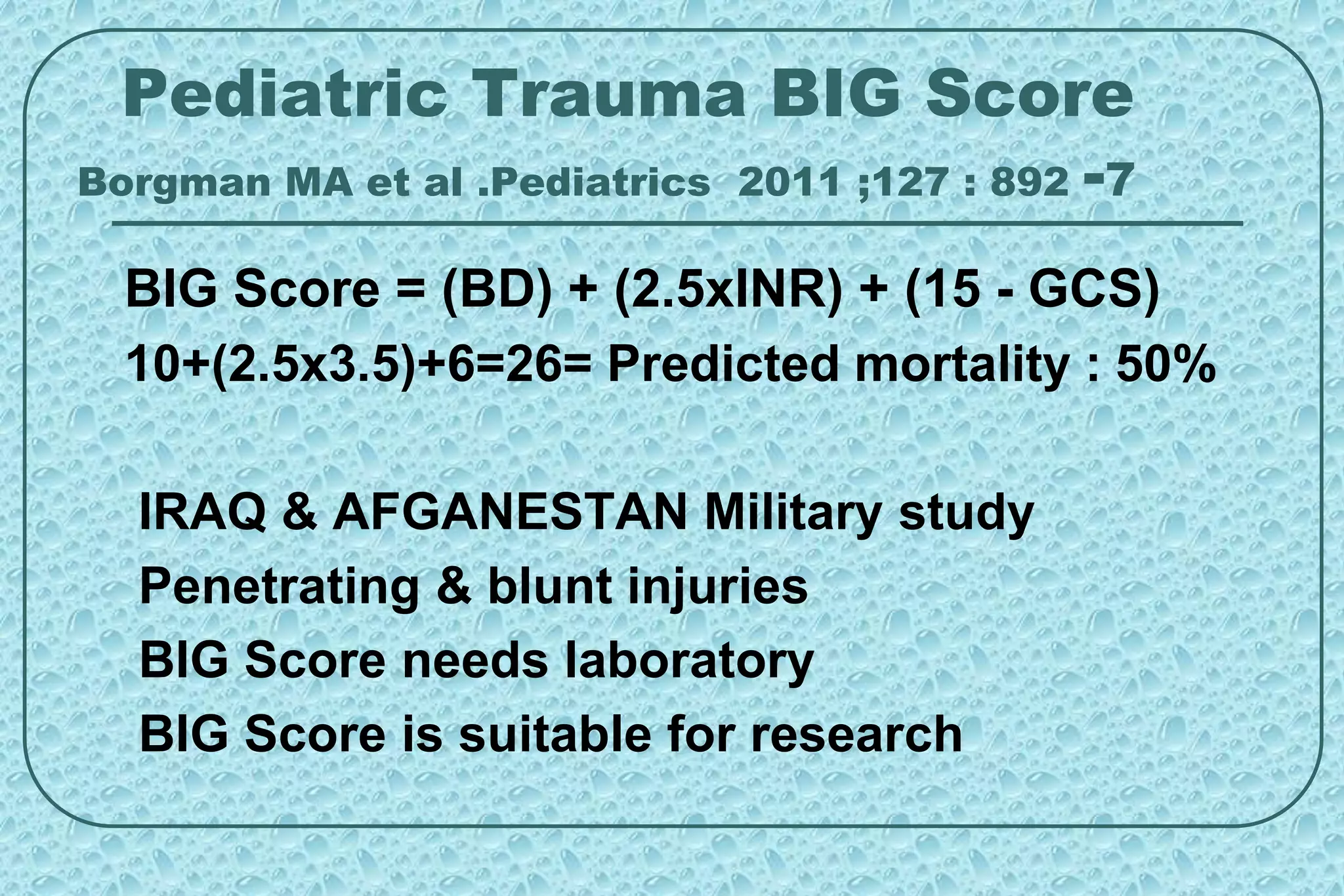
Pediatric Trauma BIG Score
Borgman MA et al .Pediatrics 2011 ;127 : 892 -7
BIG Score = (BD) + (2.5xINR) + (15 - GCS)
10+(2.5x3.5)+6=26= Predicted mortality : 50%
IRAQ & AFGANESTAN Military study
Penetrating & blunt injuries
BIG Score needs laboratory
BIG Score is suitable for research
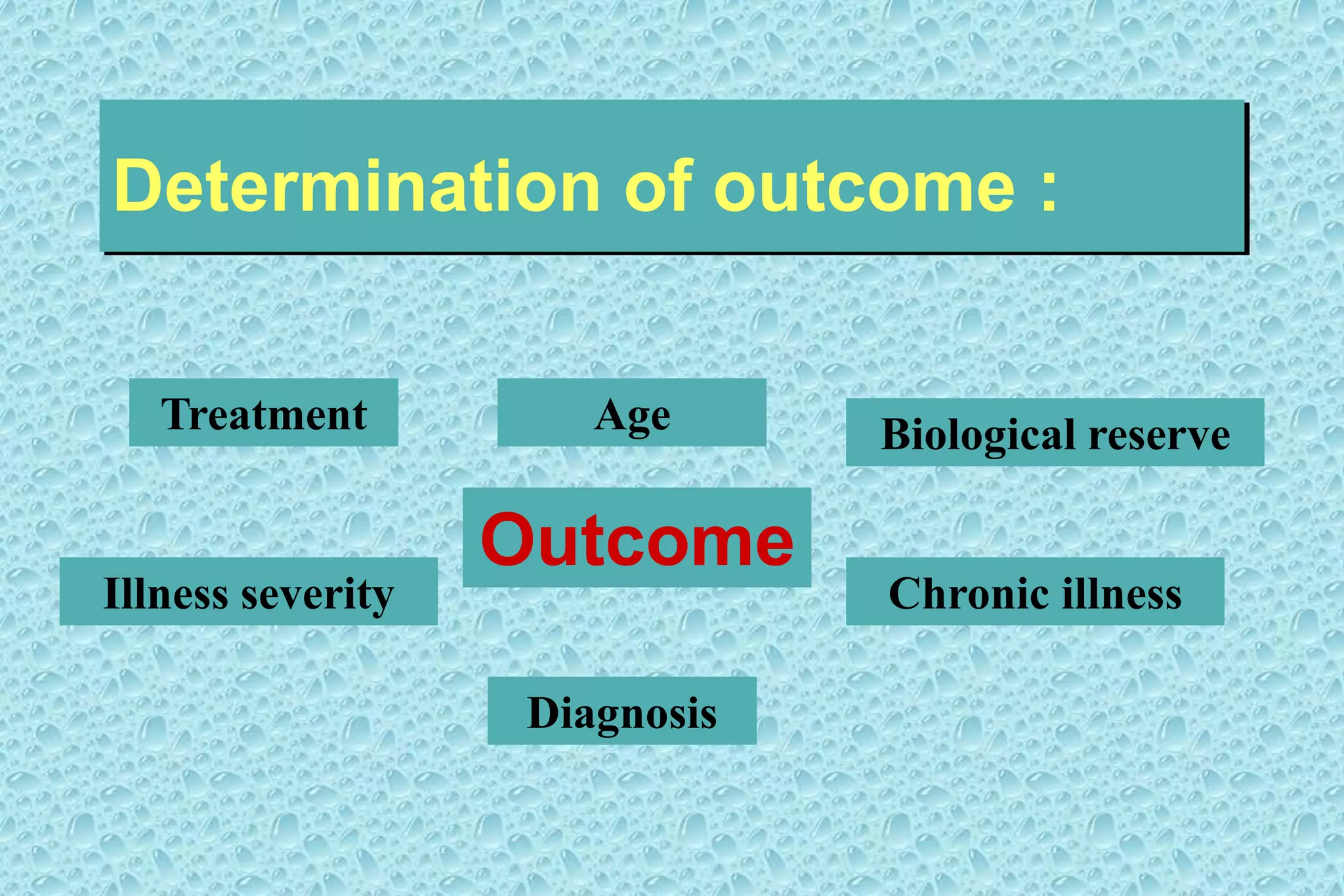
Determination of outcome :
Outcome
Age
Diagnosis
Illness severity
Treatment
Chronic illness
Biological reserve
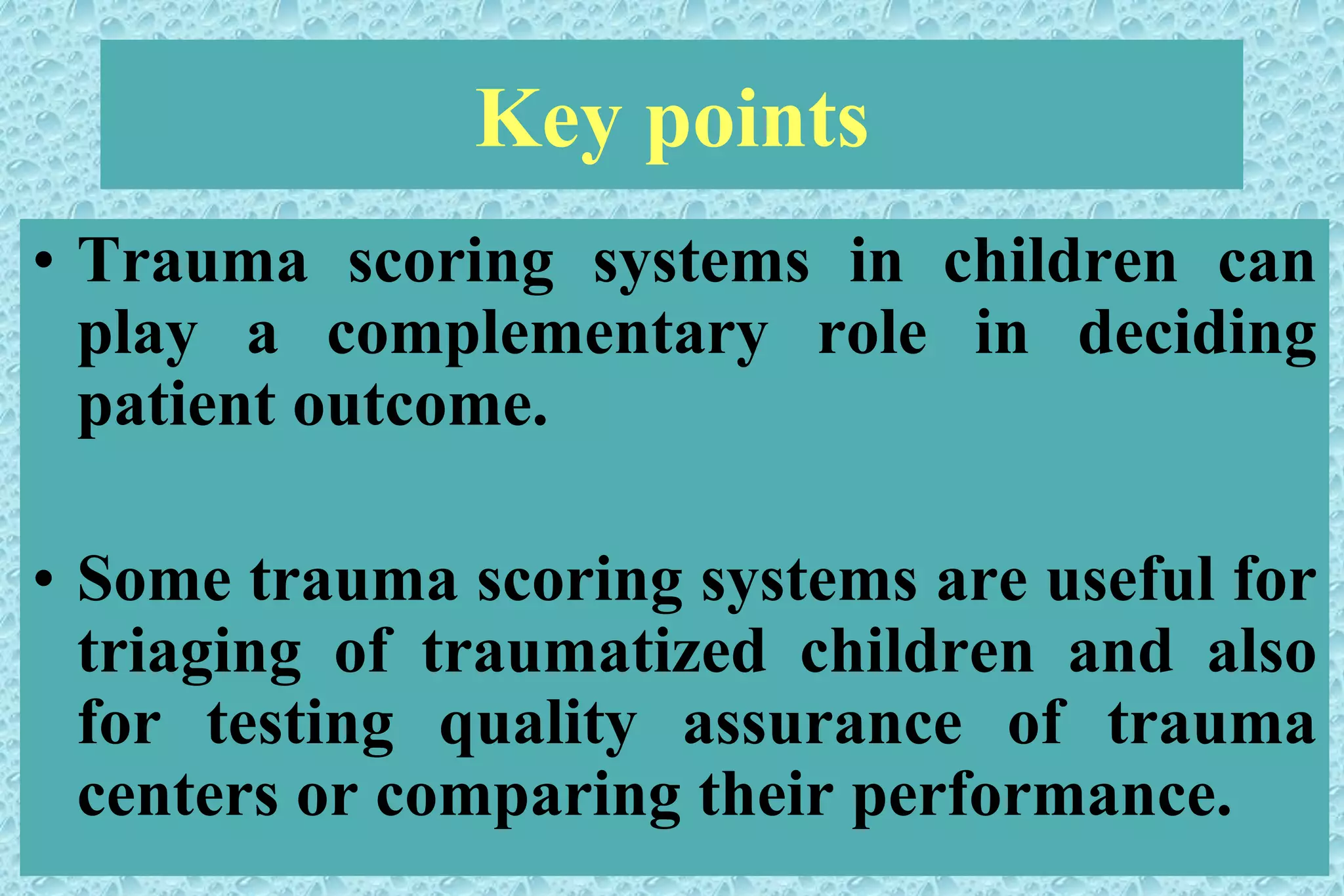
Key points
• Trauma scoring systems in children can
play a complementary role in deciding
patient outcome.
• Some trauma scoring systems are useful for
triaging of traumatized children and also
for testing quality assurance of trauma
centers or comparing their performance.
Scoring systems in traumatized children

Scoring systems in traumatized children

  • 1.
    SCORING SYSTEMS in TRAUMATIZED CHILDREN Prof.Mohamed Ezzat Moemen Founder of anaesthesia & intensive care, faculty of medicine, Zagazig university
  • 2.
    Scoring systems aimto reduce large amounts of data to simple grades or numbers Aim
  • 3.
    Do we needscoring systems ?
  • 4.
    Trauma deaths - Immediate -Second peak - Late
  • 5.
    Patient triage - Priorities -Labels - Repetition
  • 6.
    Glasgow Coma Scale(adults) PointsResponseBehavior 4 3 2 1 Spontaneous To speech To pain Nil Eye opening 5 4 3 2 1 Oriented Confused conversation Inappropriate words Incomprehensive sounds Nil Verbal response 6 5 4 3 2 1 Obeys Localizes Withdraws Abnormal flexion Extends Nil Motor response
  • 7.
    Modification of GlasgowComa Scale For Children Score 5 4 3 2 1 Best Verbal Response : -Appropriate words or social smiles, fixes on and follows objects -Cries but consolable -Persistantly irritable -Restless, agitated -Silent Eye and Motor Responses: Scored as in the scale for adults
  • 8.
    Pediatric Trauma Score Tubelireret al (1990) -1+1+2Component <1010 - 20> 20Size (kg) < 5050 - 90> 90SBP (mmHg) Difficult to maintainCan be maintained NormalAirway Coma or decerebrateObtundedAwakeCNS Open or multiple fractures Closed fractureNoneSkeletal Major or penetratingMinorNoneCutaneous
  • 9.
    Age-Specific Pediatric TraumaScore (Potoka et al 2001) Coded Score RRPulseSBPGCS 3NormalNormalNormal14-15 2Tachypnea (RR>mean+SD) Tachycardia (Pulse>mean+SD) Mild to moderate hypotension (SBP<mean-2SD) 10-13 1Hypoventilation (RR<mean-SD) Bradycardia (Pulse<mean-SD) Severe hypotension (SBP<mean-3SD) 4-9 00 or intubated003
  • 10.
    ScoreVariableScoreVariable Capillary RefillRespiratory Rate 2 1 0 Normal Delayed(>2 s) Non 5 4 3 2 1 10 – 24 / min 25 – 35 / min >35 / min >10 / min 0 / min Glasgow Coma Scale 5 4 3 2 1 14 – 15 11 – 13 8 – 10 5 – 7 3 – 4 Respiratory Effort 1 0 Normal Shallow or retractive Systolic Blood Pressure Total Score 4 3 2 1 0 > 90 mmHg 70 – 90 mmHg 50 – 69 mmHg < 50 mmHg 0 mmHg Trauma Score (adults)
  • 11.
    Revised Trauma Score (RTSc) ScoreX Weighting value Coded Factor 0.2908 4 3 2 1 0 Respiratoryrate (b/min): 10 – 29 >29 6 – 9 0 – 5 0 0.7326 4 3 2 1 0 Systolic B P (mmHg): >89 76 – 89 50 – 75 1 – 49 0 0.9368 4 3 2 1 0 Glasgow coma scale : 13 – 15 9 – 12 6 – 8 4 – 5 3
  • 12.
    The Abbreviated InjuryScore (AIS) Division of the body into six regions: 1- Thorax 2- Abdomen and viscera 3- Head and Neck 4- Face 5- Bony pelvis and extremities 6- External structures Scoring for each region injury as: No injury (0), minor (1), moderate (2), serious (3), severe (4), critical (5), incompatible with life (6)
  • 13.
    The sum ofsquares from the highest AIS grades in each of the three most severely injured areas. •75 points = worst outcome •AIS of any region : 6 points = worst outcome •30-40 points = 50% survival Injury Severity Score (ISS) (Baker et al 1974)
  • 14.
    New Injury SeverityScore (NISS) (Osler et al 1997) • The AIS is the frame. • Based on the three most severe injuries regardless the body regions. • Useful for penetrating injuries.
  • 15.
    TRISS Method Chart TS xcoefficient ISS x coefficient Age x coefficient
  • 16.
    Score 1 23 4 Region affected Skin / extremity Back Chest / abdomen Head / neck Type of injury Laceration / contusion Stab Blunt Missile Cardiac vascular Hemorrhage present BP<100 HR>100 BP<80 HR>140 Pulse less CNS Drowsy Chest pain Stupor Focal exam Coma Respiratory Dyspnea / hemoptysis Aspiration Apena/ cyanosis Trauma index Kirkpatrick and Yeoman’s, (1971)
  • 17.
    Variable Score Circulation Capillary refillnormal BP>100 mmHg Delayed capillary refill or BP 85 – 100 mmHg No capillary refill or BP<85 mmHg 2 1 0 Respiratory Normal Labored or Shallow Absent 2 1 0 Abdomen / Thorax Abdomen & thorax non-tender Abdomen or thorax tender Abdomen rigid, flail chest, or Penetrating injury 2 1 0 Motor Normal Responds only to pain Decerebrate or no response 2 1 0 Speech Normal Confused No intelligible words 2 1 0 CRAMS Scale Gormican, (1982).
  • 18.
    APACHE II • A)12 physiological variables: 60 points • B) Age: • 44 yrs = 0 points • >75 yrs = 6 points • C) Chronic Health points : • -Non-oper or emerg. Postop. ….. 5 points • -Elective postop. ….. 2 points
  • 19.
  • 20.
    (R / 1-R)= -3.517 + (APACHE II x 0.146 + S + D) R = Risk of hospital death S = Risk of emergency surgery D = Risk of specific disease APACHE II equation :
  • 21.
    APACHE III Score -Variables & weights: Added weights to APS, Age, and CHE Refined Glasgow Coma Scale -Interactions PH , PaCO2  Creatinine , U.O.  R.R , Ventilator - 5 new variables:  BUN  U.O  Albumin  Bilirubin  Glucose
  • 22.
  • 23.
    ( R /1-R ) =( APACHE III x 0.053 )+ S+D+L R = Risk of hospital death S = Risk of emergency surgery D = Risk of specific disease L = Risk of patient location APACHE III equation :
  • 24.
    Pediatric Trauma BIGScore Borgman MA et al .Pediatrics 2011 ;127 : 892 -7 BIG Score = (BD) + (2.5xINR) + (15 - GCS) 10+(2.5x3.5)+6=26= Predicted mortality : 50% IRAQ & AFGANESTAN Military study Penetrating & blunt injuries BIG Score needs laboratory BIG Score is suitable for research
  • 25.
    Determination of outcome: Outcome Age Diagnosis Illness severity Treatment Chronic illness Biological reserve
  • 26.
    Key points • Traumascoring systems in children can play a complementary role in deciding patient outcome. • Some trauma scoring systems are useful for triaging of traumatized children and also for testing quality assurance of trauma centers or comparing their performance.