The University of Dodoma
School of Medicine and Dentistry (SoMD)
Orthopedics, traumatology and Neurosurgery
Polytrauma, ATLS and Triage in mass causality
ATLS
• A Advanced
• T Trauma
• L Life
• S Support
Definition
• Simultaneous diagnostic and therapeutic activities intended to
identify and treat life threatening injuries, beginning with the
most immediate.
• This focus on urgent problems is first captured by the " Golden
hour“ catch phrase and is one of the most important lessons of
ATLS.
Golden hour
• Injuries that threaten life during golden hour
– Airway obstruction
– Tension pneumothorax
– Open pneumothorax
– Massive hemothorax
– Cardiac temponade
Components
• Preparation and triage
• Primary Survey
• Resuscitation
• Adjuncts to primary survey and resuscitation
• Secondary survey
• Adjuncts to secondary survey
• Definitive care
Preparation
• Pre-hospital phase
– Receiving hospital is notified first.
– Send to the closest, appropriate facility.
• Hospital Phase
– Advanced planning for the trauma patient arrival.
– Method to summon extra medical assistance
– Transfer agreement with verified trauma center established.
– Protect from communicable disease.
• The used of the following protective devices is recommended
– Goggles
– Gloves
– Fluid-impervious gowns or aprons
– Shoes covers and fluid- impervious leggings
– Mask
– Head covering
Primary Survey
• A Airway
• B Breathing
• C Circulation
• D Disability (mini-neurological examination)
• E Exposure and environmental control
Primary Survey
• During the primary survey life threatening conditions are
identified and management is instituted SIMULTANEOUSLY
Airway
Always consider cervical spine injury
• Open airway
• Give oxygen
• Stabilize cervical spine
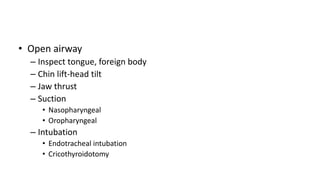
• Open airway
– Inspect tongue, foreign body
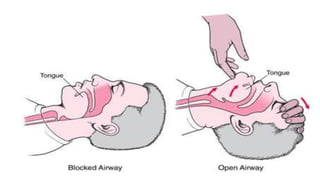
– Chin lift-head tilt
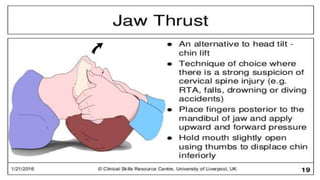
– Jaw thrust
– Suction
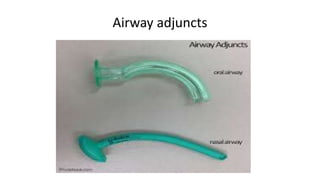
• Nasopharyngeal
• Oropharyngeal
– Intubation
• Endotracheal intubation
• Cricothyroidotomy
Airway adjuncts
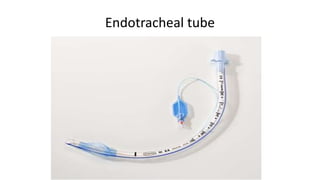
Endotracheal tube
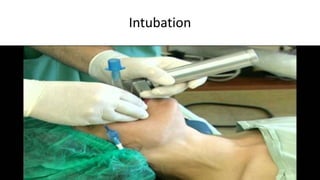
Intubation
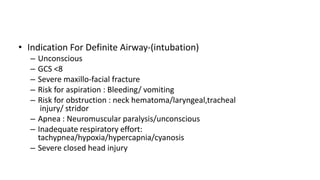
• Indication For Definite Airway-(intubation)
– Unconscious
– GCS <8
– Severe maxillo-facial fracture
– Risk for aspiration : Bleeding/ vomiting
– Risk for obstruction : neck hematoma/laryngeal,tracheal
injury/ stridor
– Apnea : Neuromuscular paralysis/unconscious
– Inadequate respiratory effort:
tachypnea/hypoxia/hypercapnia/cyanosis
– Severe closed head injury
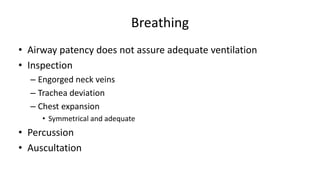
Breathing
• Airway patency does not assure adequate ventilation
• Inspection
– Engorged neck veins
– Trachea deviation
– Chest expansion
• Symmetrical and adequate
• Percussion
• Auscultation
Circulation
• Control external hemorrhage
• Check for Pulse rate, blood pressure, capillary refill, extremities
• Two IV large bore cannula
• Take blood sample for investigation
• Give bolus 2 litres of warm saline
– Children 20mls/kg
Disability
• AVPU
• Glasgow comma score (GCS)
• Pupils
– Equal size, reactive to light
• Lateralizing signs
• Movement of all extremities
– Upper and lower limbs
• Muscle power grade
AVPU scale
• A : Alert
• V : Responds to Vocal stimuli
• P : Responds to Painful stimuli
• U : Unresponsive to all stimuli
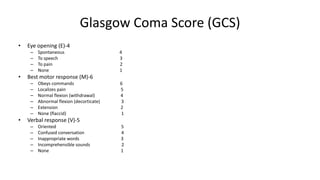
Glasgow Coma Score (GCS)
• Eye opening (E)-4
– Spontaneous 4
– To speech 3
– To pain 2
– None 1
• Best motor response (M)-6
– Obeys commands 6
– Localizes pain 5
– Normal flexion (withdrawal) 4
– Abnormal flexion (decorticate) 3
– Extension 2
– None (flaccid) 1
• Verbal response (V)-5
– Oriented 5
– Confused conversation 4
– Inappropriate words 3
– Incomprehensible sounds 2
– None 1
Exposure and environmental control
• Disrobe the patient
• Log roll maintaining axial traction
– Inspect back
– DRE
• Cover patient to keep warm
Resuscitation
• Oxygenation and ventilation
• Shock management, intravenous lines, warmed saline or
Ringer’s lactate solution
• Management of life-threatening problems identified in the
primary survey is continued
Adjuncts to primary survey and resuscitation
• Re-evaluate ABCDEs
• Electro-cardiographic Monitoring
• Nasogastric tube
• Urinary catheter
– Urethral injury should be suspected if
• Blood at the penile meatus
• Perineal ecchymosis
• Blood in the scrotum
• High riding or nonpalpable prostate
• Pelvic fracture
– Adult urine output 0.5ml/kg/hr
– Pediatric urine output 1mg/kg/hr
• Pain Management
• Monitoring
– Ventilatory rate & ABG
– Pulse oximetry
– Blood pressure
• X-Ray & Diagnostic Studies
– C-spine, CXR, Pelvic film
– Essential x-ray should not be avoided in a pregnant patient
• FAST
Secondary Survey
• Does not begin until the primary survey (ABCDEs) is
completed, resuscitative effort are well established & the
patient is demonstrating normalization of vital sign.
• Head to toe examination
• Complete history and physical examination
• Reassessment of all vital signs
• History
– A : Allergies.
– M : Medication currently used.
– P : Past illness/ Pregnancy.
– L : Last Meal
– E : Events/Environment related to the injury.
*blunt trauma/penetrating trauma/injuries due to cold &
burn/hazardous environment?
• Head to toe examination
– Head
• Raccoon’s eyes
• Rhinorrhea
• Nostrils
• Maxilla
• Mandible
– C spine
• Any area of tenderness
• Engorged neck veins
• Subcutaneous emphysema
• Trachea
• Chest
– Visual evaluation of anterior and posterior chest
• open pneumothorax
• flail chest
– Pain , dyspnea , hypoxia
– Cardiac tamponade , tension pneumothorax
• distended neck veins
• distant heart sound
• Abdomen
– Closed observation and frequent reevaluation
– Unexplained hypotension
– Equivocal abdominal finding
• Perineum/rectum/vagina
– contusion , hematoma , laceration , urethral bleeding
– rectal examination : blood , high-riding prostate, integrity of rectal
wall , sphincter tone
– female :
• Vaginal exam.: blood , laceration
• Pregnancy test
• Musculoskeletal
– Inspection : contusion , deformity
– Palpation : tenderness , abnormal movement
– Pelvic Fx : ecchymosis on iliac wings , pubis , labia, scrotum , pain on
palpation of pelvic ring
– Assessment of peripheral pulses
– Patient’s back examination
• Adjuncts to secondary survey
– Hemodynamic status
• CT scan
• Contrast x-ray studies
• Extremitry x-ray
• Endoscopy and ultrasonography
• Definitive care
– After identifying the patient’s injuries
– Managing life-threatening problems
– Obtaining special studies
• Transfer
– If the patient’s injuries exceed the institution’s treatment capabilities
TRIAGE
 Triage is the sorting of patients based on the need for treatment
and the available resources to provide that treatment.
 Color coding –
 Red(immediate/emergency) –patient requires immediate
management
 Yellow(urgent)-treatment can be delayed for a limited period of
time
 Green (delayed) –minor injuries such that treatment may be
delayed until other patients are stable
 Black –dead or severed injuries that are not expected to survive
TRIAGE IN MASS CAUSUALITY
• Multiple Casualties
– Number of severity & patient do not exceed the ability of the facility.
• Mass Casualties
– number & severity of patient EXCEED the capability of the facility &
staff.
MANAGEMENT OF
POLYTRAUMA
OBJECTIVES
By the end of this presentation students should be able:
1. To explain polytrauma
2. Describe ATLS
3. Describe management approach
4. To describe Damage control surgery
Polytrauma definition
 MONOTRAUMA
Injury to one body region
 MULTITRAUMA
Injury to more than one body region (not exceeding
Abbreviated Injury Score (AIS)≥3 in two regions) without
systemic inflammatory response syndrome (SIRS)
Polytrauma definition…..
POLYTRAUMA
Injury to at least two body regions with AIS≥ 3 in conjunction
with one or more of the listed physiologic parameters:
 Hypotension (SBP ≤ 90mmHg)
 Level of consciousness (GCS ≤ 8)
 Acidosis
 Coagulopathy (INR ≥ 1.4 or aPTT≥ 40s)
 Age (≥ 70years)
 Polytrauma is not synonym of multiple fractures.
 Multiple fractures are purely orthopedic problem as there is involvement
of skeletal system alone.
 While in Polytrauma there is involvement of more than one system,
Like associated head/spinal injury, chest injury, abdominal or pelvic injury.
 Polytrauma is a multi-system injury and needs management by
a team of surgeons and physicians.
 Orthopaedic surgeon is one of the team member of trauma unit.
POLYTRAUMA / MULTIPLE FRACTURES
The systemic inflammatory response
syndrome ( SIRS)
 SIRS describes the clinical presentation of patients with
systemic activation of the inflammatory response from any
underlying cause( Infection or trauma)
 As a consequence of SIRS, patients may develop multiple
organ dysfunction syndrome( MODS) and acute respiratory
distress syndrome (ARDS).
 The degree of SIRS following trauma is proportional to the
severity of injury.
Trauma scoring system
Purpose of scoring systems
 Appropriate triage and classification of trauma patients
 Predict outcomes (for patient and family counseling)
 Quality assurance
 Research
 – extremely useful for the study of outcomes
Classification Of Scoring Systems In
Trauma
Physiological Scores:
 Glasgow Coma Scale (GCS)
 Revised Trauma Score (RTS)
 Paediatric Trauma Score
 Acute Physiology and Chronic Health
Evaluation (APACHE)
 Systemic Inflammatory Response
Syndrome Score (SIRS)
Classification Of Scoring Systems In
Trauma……
Anatomical Scores:
 Abbreviated Injury Scale (AIS)
 Injury Severity Score (ISS)
 Anatomic Profile (AP)
 Penetrating Abdominal Trauma
Index (PATI)
Glasgow Coma Score
 The GCS is scored between 3 and 15, 3
being the worst, and 15 the best.
GCS is composed of three parameters :
 – Best Eye Response (4)
 – Best Verbal Response (5)
 – Best Motor Response (6)
Injury Severity Score (ISS)
The Injury Severity Score (ISS) is an established medical
score to assess
trauma severity.
 It correlates with mortality, morbidity and
hospitalization time after trauma.
Injury Severity Score (ISS)…..
 To calculate an ISS for an injured person, the
body is divided into six ISS body regions:
– Head or neck - including cervical spine
– Face - including the facial skeleton, nose, mouth, eyes and
ears
– Chest - thoracic spine and diaphragm
– Abdomen or pelvic contents - abdominal organs and lumbar
spine
– Extremities or pelvic girdle - pelvic skeleton
Injury Severity Score (ISS)…..
 Calculation is based upon the Abbreviated
Injury Scale (AIS) grades
0 - no injury
1 - minor
2 – moderate
3 - severe (not life-threatening)
4 - severe (life-threatening, survival probable)
5 - severe (critical, survival uncertain)
6 - maximal, possibly fatal
Injury Severity Score (ISS)…..
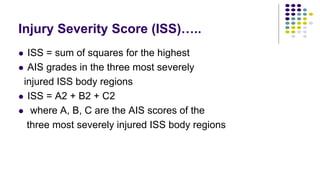
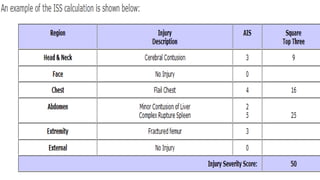
 ISS = sum of squares for the highest
 AIS grades in the three most severely
injured ISS body regions
 ISS = A2 + B2 + C2
 where A, B, C are the AIS scores of the
three most severely injured ISS body regions
Injury Severity Score (ISS)…..
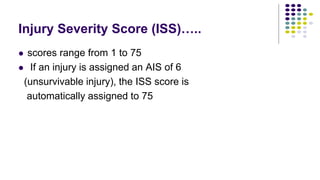
 scores range from 1 to 75
 If an injury is assigned an AIS of 6
(unsurvivable injury), the ISS score is
automatically assigned to 75
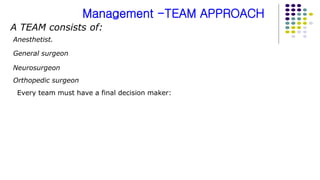
Every team must have a final decision maker:
Management -TEAM APPROACH
Anesthetist.
General surgeon
Neurosurgeon
Orthopedic surgeon
A TEAM consists of:
Damage control surgery
 Damage control surgery (DCS) is a form of surgery
typically by trauma surgeons utilized in severe unstable
injuries.
 This form of surgery puts more emphasis on
preventing the triad of death, rather than
correcting the anatomy
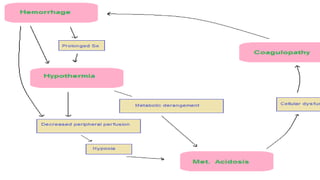
Trauma triad of death
 Massive hemorrhage lead to :
 1. Hypothermia
 2. Metabolic acidosis
 3. Coagulopathy
Damage Control Surgery
(“STAGED LAPROTOMY”)
•Arrest bleeding , and the resulting coagulopathy.
• Limit contamination and the sequelae .
•Close the abdomen to limit heat and fluid loss,
and to protect viscera.
Damage control orthopaedics
1st stage temporary stabilisation of #
2nd stage resuscitation and optimisation
3rd stage definitive fracture fixation
•External fixator is most commonly used for temporary stabilisation
•Change to definitive # fixation is done latter

ATLS , polytrauma and Triage.pptx

  • 1.
    The University ofDodoma School of Medicine and Dentistry (SoMD) Orthopedics, traumatology and Neurosurgery Polytrauma, ATLS and Triage in mass causality
  • 2.
    ATLS • A Advanced •T Trauma • L Life • S Support
  • 3.
    Definition • Simultaneous diagnosticand therapeutic activities intended to identify and treat life threatening injuries, beginning with the most immediate. • This focus on urgent problems is first captured by the " Golden hour“ catch phrase and is one of the most important lessons of ATLS.
  • 4.
    Golden hour • Injuriesthat threaten life during golden hour – Airway obstruction – Tension pneumothorax – Open pneumothorax – Massive hemothorax – Cardiac temponade
  • 5.
    Components • Preparation andtriage • Primary Survey • Resuscitation • Adjuncts to primary survey and resuscitation • Secondary survey • Adjuncts to secondary survey • Definitive care
  • 6.
    Preparation • Pre-hospital phase –Receiving hospital is notified first. – Send to the closest, appropriate facility. • Hospital Phase – Advanced planning for the trauma patient arrival. – Method to summon extra medical assistance – Transfer agreement with verified trauma center established. – Protect from communicable disease.
  • 7.
    • The usedof the following protective devices is recommended – Goggles – Gloves – Fluid-impervious gowns or aprons – Shoes covers and fluid- impervious leggings – Mask – Head covering
  • 8.
    Primary Survey • AAirway • B Breathing • C Circulation • D Disability (mini-neurological examination) • E Exposure and environmental control
  • 9.
    Primary Survey • Duringthe primary survey life threatening conditions are identified and management is instituted SIMULTANEOUSLY
  • 10.
    Airway Always consider cervicalspine injury • Open airway • Give oxygen • Stabilize cervical spine
  • 11.
    • Open airway –Inspect tongue, foreign body – Chin lift-head tilt – Jaw thrust – Suction • Nasopharyngeal • Oropharyngeal – Intubation • Endotracheal intubation • Cricothyroidotomy
  • 14.
  • 15.
  • 16.
  • 17.
    • Indication ForDefinite Airway-(intubation) – Unconscious – GCS <8 – Severe maxillo-facial fracture – Risk for aspiration : Bleeding/ vomiting – Risk for obstruction : neck hematoma/laryngeal,tracheal injury/ stridor – Apnea : Neuromuscular paralysis/unconscious – Inadequate respiratory effort: tachypnea/hypoxia/hypercapnia/cyanosis – Severe closed head injury
  • 18.
    Breathing • Airway patencydoes not assure adequate ventilation • Inspection – Engorged neck veins – Trachea deviation – Chest expansion • Symmetrical and adequate • Percussion • Auscultation
  • 19.
    Circulation • Control externalhemorrhage • Check for Pulse rate, blood pressure, capillary refill, extremities • Two IV large bore cannula • Take blood sample for investigation • Give bolus 2 litres of warm saline – Children 20mls/kg
  • 20.
    Disability • AVPU • Glasgowcomma score (GCS) • Pupils – Equal size, reactive to light • Lateralizing signs • Movement of all extremities – Upper and lower limbs • Muscle power grade
  • 21.
    AVPU scale • A: Alert • V : Responds to Vocal stimuli • P : Responds to Painful stimuli • U : Unresponsive to all stimuli
  • 22.
    Glasgow Coma Score(GCS) • Eye opening (E)-4 – Spontaneous 4 – To speech 3 – To pain 2 – None 1 • Best motor response (M)-6 – Obeys commands 6 – Localizes pain 5 – Normal flexion (withdrawal) 4 – Abnormal flexion (decorticate) 3 – Extension 2 – None (flaccid) 1 • Verbal response (V)-5 – Oriented 5 – Confused conversation 4 – Inappropriate words 3 – Incomprehensible sounds 2 – None 1
  • 23.
    Exposure and environmentalcontrol • Disrobe the patient • Log roll maintaining axial traction – Inspect back – DRE • Cover patient to keep warm
  • 24.
    Resuscitation • Oxygenation andventilation • Shock management, intravenous lines, warmed saline or Ringer’s lactate solution • Management of life-threatening problems identified in the primary survey is continued
  • 25.
    Adjuncts to primarysurvey and resuscitation • Re-evaluate ABCDEs • Electro-cardiographic Monitoring • Nasogastric tube • Urinary catheter – Urethral injury should be suspected if • Blood at the penile meatus • Perineal ecchymosis • Blood in the scrotum • High riding or nonpalpable prostate • Pelvic fracture – Adult urine output 0.5ml/kg/hr – Pediatric urine output 1mg/kg/hr • Pain Management
  • 26.
    • Monitoring – Ventilatoryrate & ABG – Pulse oximetry – Blood pressure • X-Ray & Diagnostic Studies – C-spine, CXR, Pelvic film – Essential x-ray should not be avoided in a pregnant patient • FAST
  • 27.
    Secondary Survey • Doesnot begin until the primary survey (ABCDEs) is completed, resuscitative effort are well established & the patient is demonstrating normalization of vital sign. • Head to toe examination • Complete history and physical examination • Reassessment of all vital signs
  • 28.
    • History – A: Allergies. – M : Medication currently used. – P : Past illness/ Pregnancy. – L : Last Meal – E : Events/Environment related to the injury. *blunt trauma/penetrating trauma/injuries due to cold & burn/hazardous environment?
  • 29.
    • Head totoe examination – Head • Raccoon’s eyes • Rhinorrhea • Nostrils • Maxilla • Mandible – C spine • Any area of tenderness • Engorged neck veins • Subcutaneous emphysema • Trachea
  • 32.
    • Chest – Visualevaluation of anterior and posterior chest • open pneumothorax • flail chest – Pain , dyspnea , hypoxia – Cardiac tamponade , tension pneumothorax • distended neck veins • distant heart sound
  • 33.
    • Abdomen – Closedobservation and frequent reevaluation – Unexplained hypotension – Equivocal abdominal finding
  • 34.
    • Perineum/rectum/vagina – contusion, hematoma , laceration , urethral bleeding – rectal examination : blood , high-riding prostate, integrity of rectal wall , sphincter tone – female : • Vaginal exam.: blood , laceration • Pregnancy test
  • 35.
    • Musculoskeletal – Inspection: contusion , deformity – Palpation : tenderness , abnormal movement – Pelvic Fx : ecchymosis on iliac wings , pubis , labia, scrotum , pain on palpation of pelvic ring – Assessment of peripheral pulses – Patient’s back examination
  • 36.
    • Adjuncts tosecondary survey – Hemodynamic status • CT scan • Contrast x-ray studies • Extremitry x-ray • Endoscopy and ultrasonography
  • 37.
    • Definitive care –After identifying the patient’s injuries – Managing life-threatening problems – Obtaining special studies • Transfer – If the patient’s injuries exceed the institution’s treatment capabilities
  • 38.
    TRIAGE  Triage isthe sorting of patients based on the need for treatment and the available resources to provide that treatment.  Color coding –  Red(immediate/emergency) –patient requires immediate management  Yellow(urgent)-treatment can be delayed for a limited period of time  Green (delayed) –minor injuries such that treatment may be delayed until other patients are stable  Black –dead or severed injuries that are not expected to survive
  • 39.
    TRIAGE IN MASSCAUSUALITY • Multiple Casualties – Number of severity & patient do not exceed the ability of the facility. • Mass Casualties – number & severity of patient EXCEED the capability of the facility & staff.
  • 40.
  • 41.
    OBJECTIVES By the endof this presentation students should be able: 1. To explain polytrauma 2. Describe ATLS 3. Describe management approach 4. To describe Damage control surgery
  • 42.
    Polytrauma definition  MONOTRAUMA Injuryto one body region  MULTITRAUMA Injury to more than one body region (not exceeding Abbreviated Injury Score (AIS)≥3 in two regions) without systemic inflammatory response syndrome (SIRS)
  • 43.
    Polytrauma definition….. POLYTRAUMA Injury toat least two body regions with AIS≥ 3 in conjunction with one or more of the listed physiologic parameters:  Hypotension (SBP ≤ 90mmHg)  Level of consciousness (GCS ≤ 8)  Acidosis  Coagulopathy (INR ≥ 1.4 or aPTT≥ 40s)  Age (≥ 70years)
  • 44.
     Polytrauma isnot synonym of multiple fractures.  Multiple fractures are purely orthopedic problem as there is involvement of skeletal system alone.  While in Polytrauma there is involvement of more than one system, Like associated head/spinal injury, chest injury, abdominal or pelvic injury.  Polytrauma is a multi-system injury and needs management by a team of surgeons and physicians.  Orthopaedic surgeon is one of the team member of trauma unit. POLYTRAUMA / MULTIPLE FRACTURES
  • 45.
    The systemic inflammatoryresponse syndrome ( SIRS)  SIRS describes the clinical presentation of patients with systemic activation of the inflammatory response from any underlying cause( Infection or trauma)  As a consequence of SIRS, patients may develop multiple organ dysfunction syndrome( MODS) and acute respiratory distress syndrome (ARDS).  The degree of SIRS following trauma is proportional to the severity of injury.
  • 46.
    Trauma scoring system Purposeof scoring systems  Appropriate triage and classification of trauma patients  Predict outcomes (for patient and family counseling)  Quality assurance  Research  – extremely useful for the study of outcomes
  • 47.
    Classification Of ScoringSystems In Trauma Physiological Scores:  Glasgow Coma Scale (GCS)  Revised Trauma Score (RTS)  Paediatric Trauma Score  Acute Physiology and Chronic Health Evaluation (APACHE)  Systemic Inflammatory Response Syndrome Score (SIRS)
  • 48.
    Classification Of ScoringSystems In Trauma…… Anatomical Scores:  Abbreviated Injury Scale (AIS)  Injury Severity Score (ISS)  Anatomic Profile (AP)  Penetrating Abdominal Trauma Index (PATI)
  • 49.
    Glasgow Coma Score The GCS is scored between 3 and 15, 3 being the worst, and 15 the best. GCS is composed of three parameters :  – Best Eye Response (4)  – Best Verbal Response (5)  – Best Motor Response (6)
  • 50.
    Injury Severity Score(ISS) The Injury Severity Score (ISS) is an established medical score to assess trauma severity.  It correlates with mortality, morbidity and hospitalization time after trauma.
  • 51.
    Injury Severity Score(ISS)…..  To calculate an ISS for an injured person, the body is divided into six ISS body regions: – Head or neck - including cervical spine – Face - including the facial skeleton, nose, mouth, eyes and ears – Chest - thoracic spine and diaphragm – Abdomen or pelvic contents - abdominal organs and lumbar spine – Extremities or pelvic girdle - pelvic skeleton
  • 52.
    Injury Severity Score(ISS)…..  Calculation is based upon the Abbreviated Injury Scale (AIS) grades 0 - no injury 1 - minor 2 – moderate 3 - severe (not life-threatening) 4 - severe (life-threatening, survival probable) 5 - severe (critical, survival uncertain) 6 - maximal, possibly fatal
  • 53.
    Injury Severity Score(ISS)…..  ISS = sum of squares for the highest  AIS grades in the three most severely injured ISS body regions  ISS = A2 + B2 + C2  where A, B, C are the AIS scores of the three most severely injured ISS body regions
  • 54.
    Injury Severity Score(ISS)…..  scores range from 1 to 75  If an injury is assigned an AIS of 6 (unsurvivable injury), the ISS score is automatically assigned to 75
  • 56.
    Every team musthave a final decision maker: Management -TEAM APPROACH Anesthetist. General surgeon Neurosurgeon Orthopedic surgeon A TEAM consists of:
  • 57.
    Damage control surgery Damage control surgery (DCS) is a form of surgery typically by trauma surgeons utilized in severe unstable injuries.  This form of surgery puts more emphasis on preventing the triad of death, rather than correcting the anatomy
  • 58.
    Trauma triad ofdeath  Massive hemorrhage lead to :  1. Hypothermia  2. Metabolic acidosis  3. Coagulopathy
  • 60.
    Damage Control Surgery (“STAGEDLAPROTOMY”) •Arrest bleeding , and the resulting coagulopathy. • Limit contamination and the sequelae . •Close the abdomen to limit heat and fluid loss, and to protect viscera. Damage control orthopaedics 1st stage temporary stabilisation of # 2nd stage resuscitation and optimisation 3rd stage definitive fracture fixation •External fixator is most commonly used for temporary stabilisation •Change to definitive # fixation is done latter

Editor's Notes

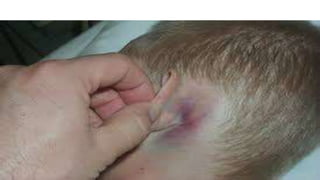
  • #30 Posterior auricular artery Mastoid process Fracture base of skull