Chapter 1
Lesson 3

Scope and
Sequence of the
Language
Subjects
The scope and sequence of your
subject area, the course
descriptions and goals or
expectations of your subjects will
become more concrete because
of the details. As you go over each
scope and sequence, you should
have an ideas on materials you
will be needing, teaching
strategies and techniques you will
be employing.
English
Elementary
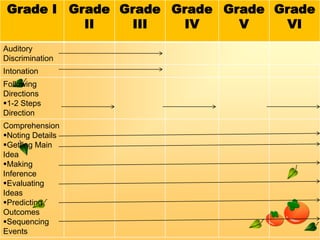
Listening
Grade I Grade Grade Grade Grade Grade
II
III
IV
V
VI
Auditory
Discrimination
Intonation

Following
Directions
1-2 Steps
Direction
Comprehension
Noting Details
Getting Main
Idea
Making
Inference
Evaluating
Ideas
Predicting
Outcomes
Sequencing
Events
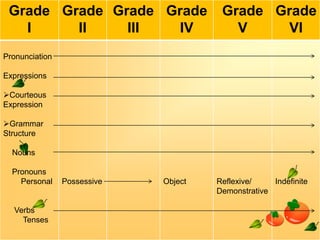
Speaking
Grade Grade Grade Grade
I
II
III
IV

Grade Grade
V
VI

Pronunciation
Expressions
Courteous
Expression
Grammar
Structure
Nouns
Pronouns
Personal

Verbs
Tenses
Possessive

Object

Reflexive/
Indefinite
Demonstrative
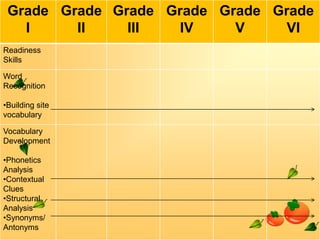
Reading
Grade Grade Grade Grade Grade Grade
I
II
III
IV
V
VI
Readiness
Skills
Word
Recognition
•Building site
vocabulary
Vocabulary
Development
•Phonetics
Analysis
•Contextual
Clues
•Structural
Analysis
•Synonyms/
Antonyms
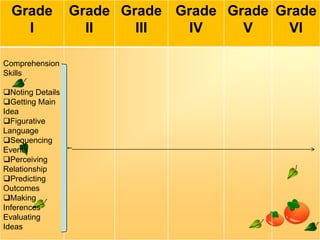
Grade
I
Comprehension
Skills

Noting Details
Getting Main
Idea
Figurative
Language
Sequencing
Events
Perceiving
Relationship
Predicting
Outcomes
Making
Inferences
Evaluating
Ideas

Grade Grade Grade Grade Grade
II
III
IV
V
VI
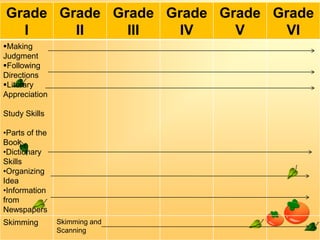
Grade Grade Grade Grade Grade Grade
I
II
III
IV
V
VI
Making
Judgment
Following
Directions
Literary
Appreciation
Study Skills

•Parts of the
Book
•Dictionary
Skills
•Organizing
Idea
•Information
from
Newspapers
Skimming

Skimming and
Scanning
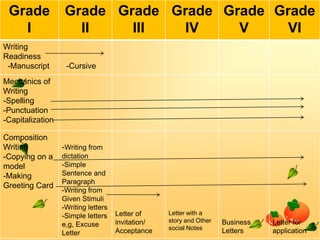
Writing
Grade
I
Writing
Readiness
-Manuscript

Grade Grade Grade Grade Grade
II
III
IV
V
VI
-Cursive

Mechanics of
Writing
-Spelling
-Punctuation
-Capitalization
Composition
Writing
-Copying on a
model
-Making
Greeting Card

-Writing from
dictation
-Simple
Sentence and
Paragraph
-Writing from
Given Stimuli
-Writing letters
-Simple letters
e,g, Excuse
Letter

Letter of
invitation/
Acceptance

Letter with a
story and Other
social Notes

Business
Letters

Letter for
application
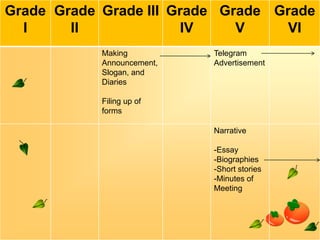
Grade Grade Grade III Grade Grade Grade
I
II
IV
V
VI
Making
Announcement,
Slogan, and
Diaries

Telegram
Advertisement

Filing up of
forms
Narrative
-Essay
-Biographies
-Short stories
-Minutes of
Meeting
English
Secondary
First
Year
Quarter 1
Getting in Touch
With self and
Other
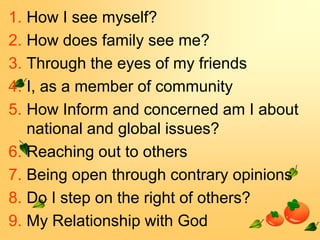
1. How I see myself?
2. How does family see me?
3. Through the eyes of my friends
4. I, as a member of community
5. How Inform and concerned am I about
national and global issues?
6. Reaching out to others
7. Being open through contrary opinions
8. Do I step on the right of others?
9. My Relationship with God
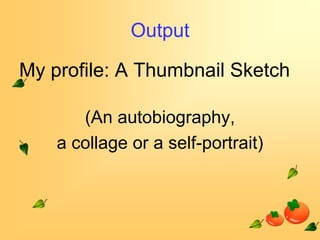
Output
My profile: A Thumbnail Sketch
(An autobiography,
a collage or a self-portrait)
Quarter 2
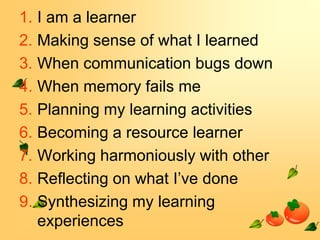
I as a Learner
1. I am a learner
2. Making sense of what I learned
3. When communication bugs down
4. When memory fails me
5. Planning my learning activities
6. Becoming a resource learner
7. Working harmoniously with other
8. Reflecting on what I’ve done
9. Synthesizing my learning
experiences
Output

My Portfolio
as a Learner
Quarter 3
My Relationship
with Nature
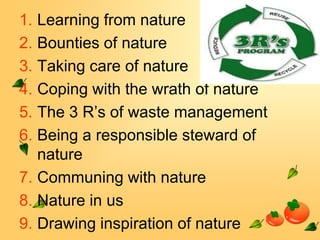
1. Learning from nature
2. Bounties of nature
3. Taking care of nature
4. Coping with the wrath of nature
5. The 3 R’s of waste management
6. Being a responsible steward of
nature
7. Communing with nature
8. Nature in us
9. Drawing inspiration of nature
Output

A Campaign for a
Change:
Treating Nature Right
Quarter 4

Science and
Technology:
Friend of Foe?
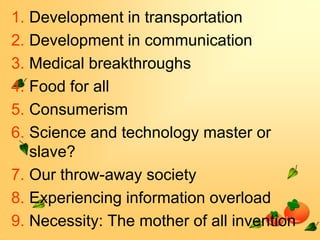
1. Development in transportation
2. Development in communication
3. Medical breakthroughs
4. Food for all
5. Consumerism
6. Science and technology master or
slave?
7. Our throw-away society
8. Experiencing information overload
9. Necessity: The mother of all invention
Output

Round table discussion on a
topic:
Science and Technology:
Friend of Foe?
Second
Year
Quarter 1
Learning
to Know
1. A wealth of knowledge
2. Learning to learn
3. Learning from experience
4. Learning from others
5. Learning from events
6. Learning from information technology
7. An analytical learner
8. Reflecting on what I’ve learned
9. Learning on an informative talk show
Output

An information
talk show related from
national and global
issues.
Quarter 2
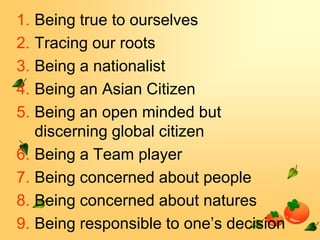
Learning to Be
1. Being true to ourselves
2. Tracing our roots
3. Being a nationalist
4. Being an Asian Citizen
5. Being an open minded but
discerning global citizen
6. Being a Team player
7. Being concerned about people
8. Being concerned about natures
9. Being responsible to one’s decision
Output
A peace book/wall or board
Quarter 3
Learning to
Become
1. Responding to differences of
opinions and culture
2. Responding to personal problems
3. Responding to societal problems
4. Responding to uncertainties
5. Responding to changes
6. Responding to media
7. Taking risks
8. Listening to events
9. Time out for reflection
Output

A show case of growth
to colors, shapes, objects,
sounds and language.
Quarter 4
Learning to Do
1. Viewing problems and issues from
different vantage point
2. Reading up on previous efforts
3. Noting friends
4. Drawing up plans
5. Trying things out
6. Analyzing result
7. Reflecting and evaluating process
8. Creating new applications
9. Presenting and sharing results
Output

A project proposal
and end-of-project
reports
Third
Year
Quarter 1

In The Realm of
Thoughts
1. Seeing patterns
2. Perception versus reality
3. Reconciling Contradictions
4. Breaking down walls
5. Up-down and up again: The S curve
6. People change
7. What's new?
8. Green housing ideas
9. Looking back, looking forward
Output

Making ideas make shape
through songs, paintings,
collage, etc.
Quarter 2
Interactions
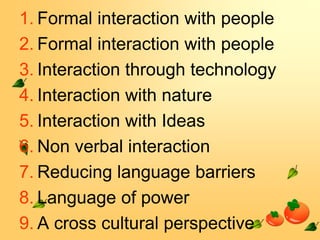
1. Formal interaction with people
2. Formal interaction with people
3. Interaction through technology
4. Interaction with nature
5. Interaction with Ideas
6. Non verbal interaction
7. Reducing language barriers
8. Language of power
9. A cross cultural perspective
Output

A phrase book of
basic conversational
expressions.
Quarter 3

Quality
Not Quantity
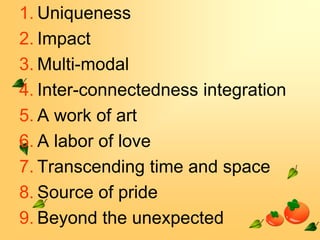
1. Uniqueness
2. Impact
3. Multi-modal
4. Inter-connectedness integration
5. A work of art
6. A labor of love
7. Transcending time and space
8. Source of pride
9. Beyond the unexpected
Output

Standards of Quality:
A Primer
Quarter 4

Making a
Difference
1.
2.
3.
4.
5.
6.
7.
8.
9.

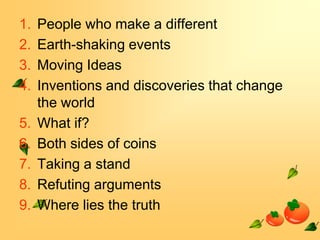
People who make a different
Earth-shaking events
Moving Ideas
Inventions and discoveries that change
the world
What if?
Both sides of coins
Taking a stand
Refuting arguments
Where lies the truth
Output

Debate
Fourth
Year
Quarter 1

Education for
Life
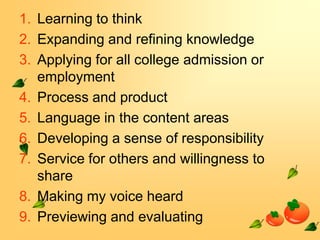
1. Learning to think
2. Expanding and refining knowledge
3. Applying for all college admission or
employment
4. Process and product
5. Language in the content areas
6. Developing a sense of responsibility
7. Service for others and willingness to
share
8. Making my voice heard
9. Previewing and evaluating
Output

Annotated
Bibliographies
and Note Cards
Quarter 2

Education for
Justice
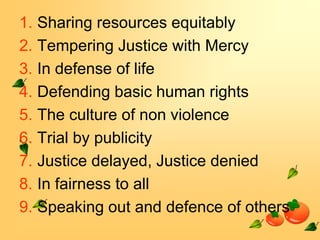
1. Sharing resources equitably
2. Tempering Justice with Mercy
3. In defense of life
4. Defending basic human rights
5. The culture of non violence
6. Trial by publicity
7. Justice delayed, Justice denied
8. In fairness to all
9. Speaking out and defence of others
Output

Debate
and Letters
to the Auditors
Quarter 3

Education for
Sustainable
Development
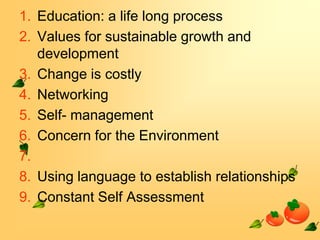
1. Education: a life long process
2. Values for sustainable growth and
development
3. Change is costly
4. Networking
5. Self- management
6. Concern for the Environment
7.
8. Using language to establish relationships
9. Constant Self Assessment
Output

Research Paper:
Drafts for Chapter 1-3
Quarter 4

Education for
Global
Citizenship
1.
2.
3.
4.
5.
6.
7.
8.
9.

Stressing interconnectedness
Looking at problems in a global context
Accepting cultural differences
Working cooperatively and responsibly
Thinking in critical and systematic way
Going “global”
Adjustments and re-adjustments
Language for survival in a global culture
Envisioning possible, preffered and plural
futures scenarios
Output

Research Paper
and
Simple Feasibility
Study

Scope and sequence of the language subjects