
TRANSPORTATION &
LOGISTIC
• What is Logistics ?
• Alignment of Firms & Logistics Strategies
• Goals & Decisions
• Networks
• Strategy Formulation
• Channel Strategy
• Strategy Implementation
• Measuring Logistics Performance
• What is importance ofTransportation in Logistics?
WHAT ISTRANSPORT AND LOGISTICS
INDUSTRY
“ The process of planning, implementing, and controlling the efficient,
cost effective flow and storage of raw materials, in-process inventory,
finished goods and related information from point of origin to point of
consumption for the purpose of meeting customer requirements. ”
ALIGNMENT OF FIRMS &
LOGISTICS STRATEGIES
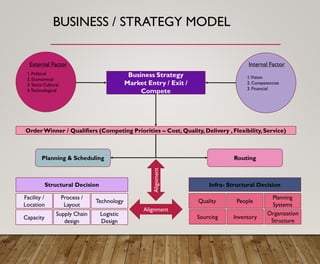
BUSINESS / STRATEGY MODEL
Business Strategy
Market Entry / Exit /
Compete
1. Political
2. Economical
3. Socio Cultural
4.Technological
1.Vision
2. Competencies
3. Financial
Order Winner / Qualifiers (Competing Priorities – Cost, Quality,Delivery , Flexibility,Service)
Planning & Scheduling Routing
Structural Decision
Facility /
Location
Process /
Layout
Technology Quality People
Planning
Systems
Infra- Structural Decision
Capacity
Supply Chain
design
Logistic
Design
Sourcing Inventory
Organization
Structure
External Factor Internal Factor
Alignment
Alignment
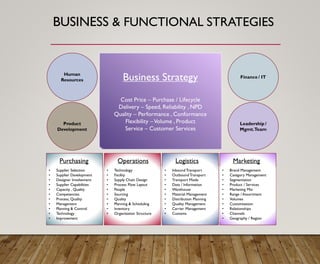
BUSINESS & FUNCTIONAL STRATEGIES
Human
Resources
Finance / IT
Leadership /
Mgmt.Team
Product
Development
Business Strategy
Cost Price – Purchase / Lifecycle
Delivery – Speed, Reliability , NPD
Quality – Performance , Conformance
Flexibility –Volume , Product
Service – Customer Services
Purchasing
• Supplier Selection
• Supplier Development
• Designer Involvement
• Supplier Capabilities
• Capacity , Quality
• Competencies
• Process, Quality
• Management
• Planning & Control
• Technology
• Improvement
Operations
• Technology
• Facility
• Supply Chain Design
• Process Flow Layout
• People
• Sourcing
• Quality
• Planning & Scheduling
• Inventory
• Organization Structure
Logistics
• Inbound Transport
• Outbound Transport
• Transport Mode
• Data / Information
• Warehouse
• Material Management
• Distribution Planning
• Quality Management
• Carrier Management
• Customs
Marketing
• Brand Management
• Category Management
• Segmentation
• Product / Services
• Marketing Mix
• Range / Assortment
• Volumes
• Customization
• Relationships
• Channels
• Geography / Region
LOGISTICS GOALS &
DECISION
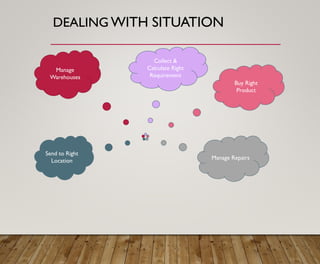
DEALING WITH SITUATION
Manage
Warehouses
Send to Right
Location
Buy Right
Product
Collect &
Calculate Right
Requirement
Manage Repairs
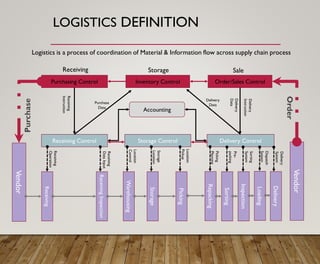
LOGISTICS DEFINITION
Logistics is a process of coordination of Material & Information flow across supply chain process
Purchasing Control Inventory Control Order/Sales Control
Receiving Storage Sale
Receiving Control Storage Control Delivery Control
Accounting
Receiving
ReceivingInspection
Warehousing
Storage
Picking
Repacking
Sorting
Inspection
Loading
Delivery
Vendor
Vendor
Receiving
Operation
Receiving
DataInput
Location
Control
Storage
Location
Location
Pickup
Picking
Planning
Pre-
packing
Sorting
System
Dispatch
System
Delivery
System
Receiving
Instruction
Purchase
Data
Purchase
Order
Delivery
Data
Delivery
Data
Delivery
Instruction
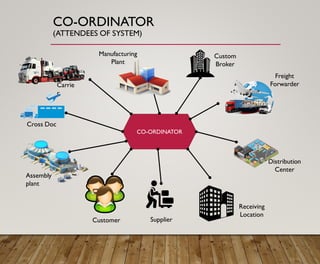
CO-ORDINATOR
(ATTENDEES OF SYSTEM)
CO-ORDINATOR
Carrie
r
Assembly
plant
Custom
Broker
Customer Supplier
Receiving
Location
Cross Doc
Distribution
Center
Freight
Forwarder
Manufacturing
Plant
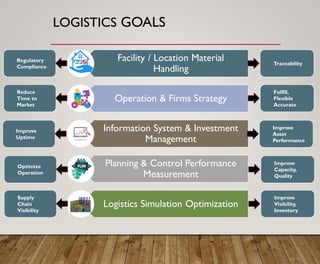
LOGISTICS GOALS
Facility / Location Material
Handling
Operation & Firms Strategy
Information System & Investment
Management
Planning & Control Performance
Measurement
Logistics Simulation Optimization
Traceability
Regulatory
Compliance
Fulfill,
Flexible
Accurate
Reduce
Time to
Market
Improve
Asset
Performance
Improve
Uptime
Improve
Capacity,
Quality
Optimize
Operation
Improve
Visibility,
Inventory
Supply
Chain
Visibility
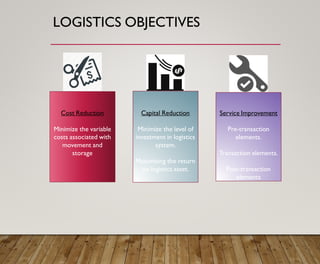
LOGISTICS OBJECTIVES
Cost Reduction
Minimize the variable
costs associated with
movement and
storage
Capital Reduction
Minimize the level of
investment in logistics
system.
Maximizing the return
on logistics asset.
Service Improvement
Pre-transaction
elements.
Transaction elements.
Post-transaction
elements
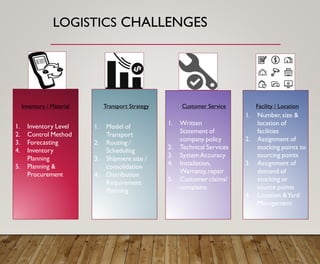
LOGISTICS CHALLENGES
1. Inventory Level
2. Control Method
3. Forecasting
4. Inventory
Planning
5. Planning &
Procurement
1. Model of
Transport
2. Routing /
Scheduling
3. Shipment size /
consolidation
4. Distribution
Requirement
Planning
1. Written
Statement of
company policy
2. Technical Services
3. SystemAccuracy
4. Installation,
Warranty,repair
5. Customer claims/
complains
1. Number, size &
location of
facilities
2. Assignment of
stocking points to
sourcing points
3. Assignment of
demand of
stocking or
source points
4. Location &Yard
Management
Inventory / Material Transport Strategy Customer Service Facility / Location
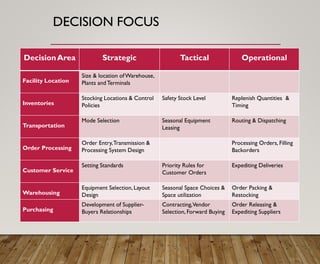
DECISION FOCUS
DecisionArea Strategic Tactical Operational
Facility Location
Size & location ofWarehouse,
Plants andTerminals
Inventories
Stocking Locations & Control
Policies
Safety Stock Level Replenish Quantities &
Timing
Transportation
Mode Selection Seasonal Equipment
Leasing
Routing & Dispatching
Order Processing
Order Entry,Transmission &
Processing System Design
Processing Orders, Filling
Backorders
Customer Service
Setting Standards Priority Rules for
Customer Orders
Expediting Deliveries
Warehousing
Equipment Selection, Layout
Design
Seasonal Space Choices &
Space utilization
Order Packing &
Restocking
Purchasing
Development of Supplier-
Buyers Relationships
Contracting,Vendor
Selection, Forward Buying
Order Releasing &
Expediting Suppliers
LOGISTICS NETWORK
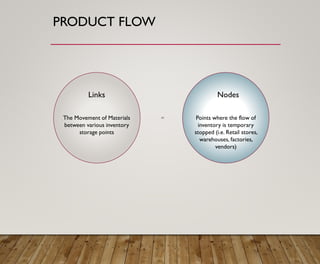
PRODUCT FLOW
Links Nodes
The Movement of Materials
between various inventory
storage points
Points where the flow of
inventory is temporary
stopped (i.e. Retail stores,
warehouses, factories,
vendors)
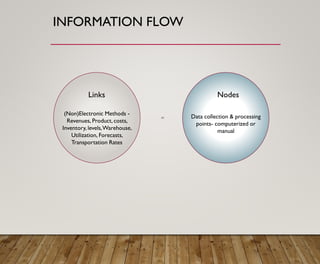
INFORMATION FLOW
Links Nodes
(Non)Electronic Methods -
Revenues, Product, costs,
Inventory, levels,Warehouse,
Utilization, Forecasts,
Transportation Rates
Data collection & processing
points- computerized or
manual
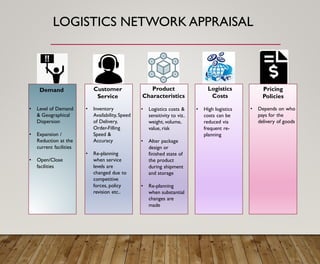
LOGISTICS NETWORK APPRAISAL
Demand Customer
Service
Product
Characteristics
Logistics
Costs
Pricing
Policies
• Level of Demand
& Geographical
Dispersion
• Expansion /
Reduction at the
current facilities
• Open/Close
facilities
• Inventory
Availability, Speed
of Delivery,
Order-Filling
Speed &
Accuracy
• Re-planning
when service
levels are
changed due to
competitive
forces, policy
revision etc..
• Logistics costs &
sensitivity to viz..
weight, volume,
value, risk
• Alter package
design or
finished state of
the product
during shipment
and storage
• Re-planning
when substantial
changes are
made
• High logistics
costs can be
reduced via
frequent re-
planning
• Depends on who
pays for the
delivery of goods
STRATEGY FORMULATION
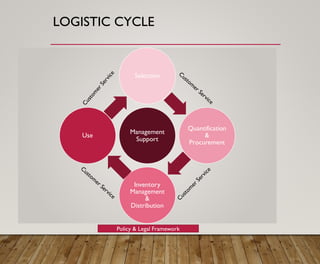
LOGISTIC CYCLE
Selection
Quantification
&
Procurement
Inventory
Management
&
Distribution
Use
Management
Support
Policy & Legal Framework
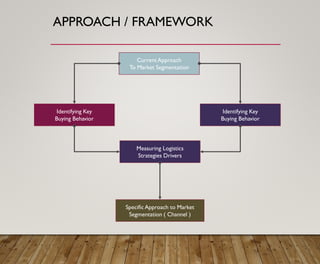
APPROACH / FRAMEWORK
Current Approach
To Market Segmentation
Identifying Key
Buying Behavior
Identifying Key
Buying Behavior
Measuring Logistics
Strategies Drivers
Specific Approach to Market
Segmentation ( Channel )
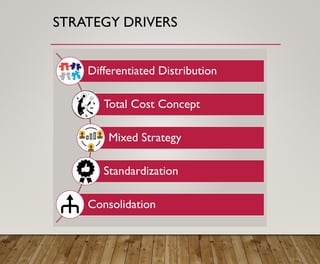
STRATEGY DRIVERS
Differentiated Distribution
Total Cost Concept
Mixed Strategy
Standardization
Consolidation
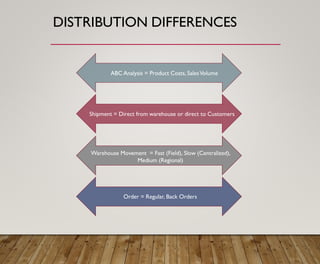
DISTRIBUTION DIFFERENCES
ABC Analysis = Product Costs, SalesVolume
Shipment = Direct from warehouse or direct to Customers
Warehouse Movement = Fast (Field), Slow (Centralized),
Medium (Regional)
Order = Regular, Back Orders
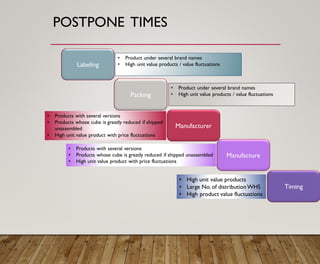
POSTPONE TIMES
Labeling
Packing
Manufacturer
Manufacture
• Product under several brand names
• High unit value products / value fluctuations
• Product under several brand names
• High unit value products / value fluctuations
• Products with several versions
• Products whose cube is greatly reduced if shipped
unassembled
• High unit value product with price fluctuations
• Products with several versions
• Products whose cube is greatly reduced if shipped unassembled
• High unit value product with price fluctuations
Timing
• High unit value products
• Large No.of distributionWHS
• High product value fluctuations
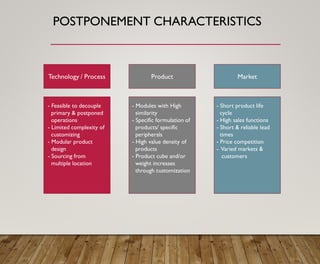
POSTPONEMENT CHARACTERISTICS
Technology / Process Product Market
- Short product life
cycle
- High sales functions
- Short & reliable lead
times
- Price competition
- Varied markets &
customers
- Modules with High
similarity
- Specific formulation of
products/ specific
peripherals
- High value density of
products
- Product cube and/or
weight increases
through customization
- Feasible to decouple
primary & postponed
operations
- Limited complexity of
customizing
- Modular product
design
- Sourcing from
multiple location
CHANNEL STRATEGIES
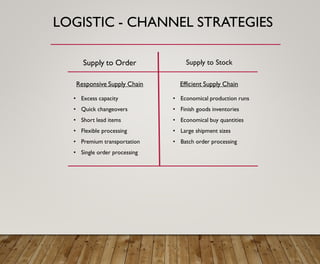
LOGISTIC - CHANNEL STRATEGIES
Supply to Order Supply to Stock
Responsive Supply Chain Efficient Supply Chain
• Excess capacity
• Quick changeovers
• Short lead items
• Flexible processing
• Premium transportation
• Single order processing
• Economical production runs
• Finish goods inventories
• Economical buy quantities
• Large shipment sizes
• Batch order processing
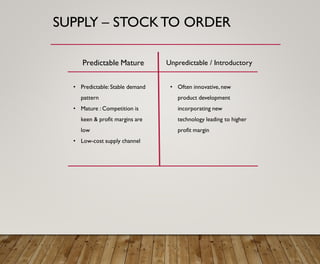
SUPPLY – STOCKTO ORDER
Predictable Mature Unpredictable / Introductory
• Predictable: Stable demand
pattern
• Mature : Competition is
keen & profit margins are
low
• Low-cost supply channel
• Often innovative, new
product development
incorporating new
technology leading to higher
profit margin
STRATEGIC IMPLEMENTATION
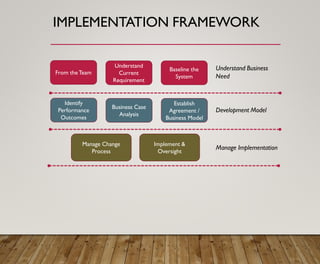
IMPLEMENTATION FRAMEWORK
From theTeam
Understand
Current
Requirement
Baseline the
System
Understand Business
Need
Identify
Performance
Outcomes
Business Case
Analysis
Establish
Agreement /
Business Model
Development Model
Manage Change
Process
Manage Implementation
Implement &
Oversight
MEASURING LOGISTIC
PERFORMANCE
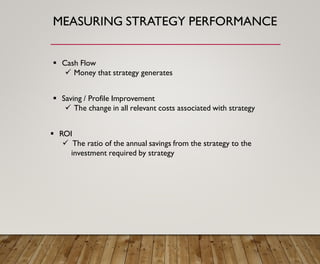
MEASURING STRATEGY PERFORMANCE
▪ Cash Flow
✓ Money that strategy generates
▪ Saving / Profile Improvement
✓ The change in all relevant costs associated with strategy
▪ ROI
✓ The ratio of the annual savings from the strategy to the
investment required by strategy
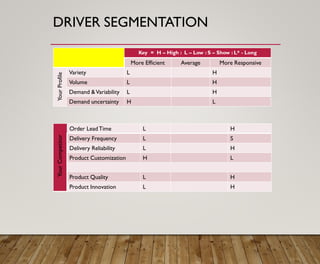
DRIVER SEGMENTATION
Key = H – High : L – Low : S – Show : L* - Long
More Efficient Average More Responsive
Variety L H
Volume L H
Demand &Variability L H
Demand uncertainty H L
Order LeadTime L H
Delivery Frequency L S
Delivery Reliability L H
Product Customization H L
Product Quality L H
Product Innovation L H
YourCompetitorYourProfile
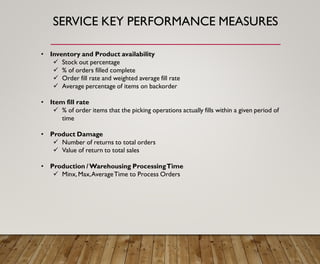
SERVICE KEY PERFORMANCE MEASURES
• Inventory and Product availability
✓ Stock out percentage
✓ % of orders filled complete
✓ Order fill rate and weighted average fill rate
✓ Average percentage of items on backorder
• Item fill rate
✓ % of order items that the picking operations actually fills within a given period of
time
• Product Damage
✓ Number of returns to total orders
✓ Value of return to total sales
• Production /Warehousing ProcessingTime
✓ Minx, Max,AverageTime to Process Orders
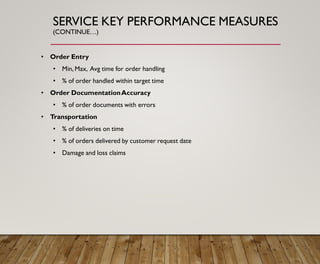
SERVICE KEY PERFORMANCE MEASURES
(CONTINUE…)
• Order Entry
• Min, Max, Avg time for order handling
• % of order handled within target time
• Order DocumentationAccuracy
• % of order documents with errors
• Transportation
• % of deliveries on time
• % of orders delivered by customer request date
• Damage and loss claims
THANKYOU
- JALADHI KUMAR BHATT

An Insight - Transport & Logistic Domain

  • 1.
  • 2.
    • What isLogistics ? • Alignment of Firms & Logistics Strategies • Goals & Decisions • Networks • Strategy Formulation • Channel Strategy • Strategy Implementation • Measuring Logistics Performance • What is importance ofTransportation in Logistics?
  • 3.
    WHAT ISTRANSPORT ANDLOGISTICS INDUSTRY “ The process of planning, implementing, and controlling the efficient, cost effective flow and storage of raw materials, in-process inventory, finished goods and related information from point of origin to point of consumption for the purpose of meeting customer requirements. ”
  • 4.
    ALIGNMENT OF FIRMS& LOGISTICS STRATEGIES
  • 5.
    BUSINESS / STRATEGYMODEL Business Strategy Market Entry / Exit / Compete 1. Political 2. Economical 3. Socio Cultural 4.Technological 1.Vision 2. Competencies 3. Financial Order Winner / Qualifiers (Competing Priorities – Cost, Quality,Delivery , Flexibility,Service) Planning & Scheduling Routing Structural Decision Facility / Location Process / Layout Technology Quality People Planning Systems Infra- Structural Decision Capacity Supply Chain design Logistic Design Sourcing Inventory Organization Structure External Factor Internal Factor Alignment Alignment
  • 6.
    BUSINESS & FUNCTIONALSTRATEGIES Human Resources Finance / IT Leadership / Mgmt.Team Product Development Business Strategy Cost Price – Purchase / Lifecycle Delivery – Speed, Reliability , NPD Quality – Performance , Conformance Flexibility –Volume , Product Service – Customer Services Purchasing • Supplier Selection • Supplier Development • Designer Involvement • Supplier Capabilities • Capacity , Quality • Competencies • Process, Quality • Management • Planning & Control • Technology • Improvement Operations • Technology • Facility • Supply Chain Design • Process Flow Layout • People • Sourcing • Quality • Planning & Scheduling • Inventory • Organization Structure Logistics • Inbound Transport • Outbound Transport • Transport Mode • Data / Information • Warehouse • Material Management • Distribution Planning • Quality Management • Carrier Management • Customs Marketing • Brand Management • Category Management • Segmentation • Product / Services • Marketing Mix • Range / Assortment • Volumes • Customization • Relationships • Channels • Geography / Region
  • 7.
  • 8.
    DEALING WITH SITUATION Manage Warehouses Sendto Right Location Buy Right Product Collect & Calculate Right Requirement Manage Repairs
  • 9.
    LOGISTICS DEFINITION Logistics isa process of coordination of Material & Information flow across supply chain process Purchasing Control Inventory Control Order/Sales Control Receiving Storage Sale Receiving Control Storage Control Delivery Control Accounting Receiving ReceivingInspection Warehousing Storage Picking Repacking Sorting Inspection Loading Delivery Vendor Vendor Receiving Operation Receiving DataInput Location Control Storage Location Location Pickup Picking Planning Pre- packing Sorting System Dispatch System Delivery System Receiving Instruction Purchase Data Purchase Order Delivery Data Delivery Data Delivery Instruction
  • 10.
    CO-ORDINATOR (ATTENDEES OF SYSTEM) CO-ORDINATOR Carrie r Assembly plant Custom Broker CustomerSupplier Receiving Location Cross Doc Distribution Center Freight Forwarder Manufacturing Plant
  • 11.
    LOGISTICS GOALS Facility /Location Material Handling Operation & Firms Strategy Information System & Investment Management Planning & Control Performance Measurement Logistics Simulation Optimization Traceability Regulatory Compliance Fulfill, Flexible Accurate Reduce Time to Market Improve Asset Performance Improve Uptime Improve Capacity, Quality Optimize Operation Improve Visibility, Inventory Supply Chain Visibility
  • 12.
    LOGISTICS OBJECTIVES Cost Reduction Minimizethe variable costs associated with movement and storage Capital Reduction Minimize the level of investment in logistics system. Maximizing the return on logistics asset. Service Improvement Pre-transaction elements. Transaction elements. Post-transaction elements
  • 13.
    LOGISTICS CHALLENGES 1. InventoryLevel 2. Control Method 3. Forecasting 4. Inventory Planning 5. Planning & Procurement 1. Model of Transport 2. Routing / Scheduling 3. Shipment size / consolidation 4. Distribution Requirement Planning 1. Written Statement of company policy 2. Technical Services 3. SystemAccuracy 4. Installation, Warranty,repair 5. Customer claims/ complains 1. Number, size & location of facilities 2. Assignment of stocking points to sourcing points 3. Assignment of demand of stocking or source points 4. Location &Yard Management Inventory / Material Transport Strategy Customer Service Facility / Location
  • 14.
    DECISION FOCUS DecisionArea StrategicTactical Operational Facility Location Size & location ofWarehouse, Plants andTerminals Inventories Stocking Locations & Control Policies Safety Stock Level Replenish Quantities & Timing Transportation Mode Selection Seasonal Equipment Leasing Routing & Dispatching Order Processing Order Entry,Transmission & Processing System Design Processing Orders, Filling Backorders Customer Service Setting Standards Priority Rules for Customer Orders Expediting Deliveries Warehousing Equipment Selection, Layout Design Seasonal Space Choices & Space utilization Order Packing & Restocking Purchasing Development of Supplier- Buyers Relationships Contracting,Vendor Selection, Forward Buying Order Releasing & Expediting Suppliers
  • 15.
  • 16.
    PRODUCT FLOW Links Nodes TheMovement of Materials between various inventory storage points Points where the flow of inventory is temporary stopped (i.e. Retail stores, warehouses, factories, vendors)
  • 17.
    INFORMATION FLOW Links Nodes (Non)ElectronicMethods - Revenues, Product, costs, Inventory, levels,Warehouse, Utilization, Forecasts, Transportation Rates Data collection & processing points- computerized or manual
  • 18.
    LOGISTICS NETWORK APPRAISAL DemandCustomer Service Product Characteristics Logistics Costs Pricing Policies • Level of Demand & Geographical Dispersion • Expansion / Reduction at the current facilities • Open/Close facilities • Inventory Availability, Speed of Delivery, Order-Filling Speed & Accuracy • Re-planning when service levels are changed due to competitive forces, policy revision etc.. • Logistics costs & sensitivity to viz.. weight, volume, value, risk • Alter package design or finished state of the product during shipment and storage • Re-planning when substantial changes are made • High logistics costs can be reduced via frequent re- planning • Depends on who pays for the delivery of goods
  • 19.
  • 20.
  • 21.
    APPROACH / FRAMEWORK CurrentApproach To Market Segmentation Identifying Key Buying Behavior Identifying Key Buying Behavior Measuring Logistics Strategies Drivers Specific Approach to Market Segmentation ( Channel )
  • 22.
    STRATEGY DRIVERS Differentiated Distribution TotalCost Concept Mixed Strategy Standardization Consolidation
  • 23.
    DISTRIBUTION DIFFERENCES ABC Analysis= Product Costs, SalesVolume Shipment = Direct from warehouse or direct to Customers Warehouse Movement = Fast (Field), Slow (Centralized), Medium (Regional) Order = Regular, Back Orders
  • 24.
    POSTPONE TIMES Labeling Packing Manufacturer Manufacture • Productunder several brand names • High unit value products / value fluctuations • Product under several brand names • High unit value products / value fluctuations • Products with several versions • Products whose cube is greatly reduced if shipped unassembled • High unit value product with price fluctuations • Products with several versions • Products whose cube is greatly reduced if shipped unassembled • High unit value product with price fluctuations Timing • High unit value products • Large No.of distributionWHS • High product value fluctuations
  • 25.
    POSTPONEMENT CHARACTERISTICS Technology /Process Product Market - Short product life cycle - High sales functions - Short & reliable lead times - Price competition - Varied markets & customers - Modules with High similarity - Specific formulation of products/ specific peripherals - High value density of products - Product cube and/or weight increases through customization - Feasible to decouple primary & postponed operations - Limited complexity of customizing - Modular product design - Sourcing from multiple location
  • 26.
  • 27.
    LOGISTIC - CHANNELSTRATEGIES Supply to Order Supply to Stock Responsive Supply Chain Efficient Supply Chain • Excess capacity • Quick changeovers • Short lead items • Flexible processing • Premium transportation • Single order processing • Economical production runs • Finish goods inventories • Economical buy quantities • Large shipment sizes • Batch order processing
  • 28.
    SUPPLY – STOCKTOORDER Predictable Mature Unpredictable / Introductory • Predictable: Stable demand pattern • Mature : Competition is keen & profit margins are low • Low-cost supply channel • Often innovative, new product development incorporating new technology leading to higher profit margin
  • 29.
  • 30.
    IMPLEMENTATION FRAMEWORK From theTeam Understand Current Requirement Baselinethe System Understand Business Need Identify Performance Outcomes Business Case Analysis Establish Agreement / Business Model Development Model Manage Change Process Manage Implementation Implement & Oversight
  • 31.
  • 32.
    MEASURING STRATEGY PERFORMANCE ▪Cash Flow ✓ Money that strategy generates ▪ Saving / Profile Improvement ✓ The change in all relevant costs associated with strategy ▪ ROI ✓ The ratio of the annual savings from the strategy to the investment required by strategy
  • 33.
    DRIVER SEGMENTATION Key =H – High : L – Low : S – Show : L* - Long More Efficient Average More Responsive Variety L H Volume L H Demand &Variability L H Demand uncertainty H L Order LeadTime L H Delivery Frequency L S Delivery Reliability L H Product Customization H L Product Quality L H Product Innovation L H YourCompetitorYourProfile
  • 34.
    SERVICE KEY PERFORMANCEMEASURES • Inventory and Product availability ✓ Stock out percentage ✓ % of orders filled complete ✓ Order fill rate and weighted average fill rate ✓ Average percentage of items on backorder • Item fill rate ✓ % of order items that the picking operations actually fills within a given period of time • Product Damage ✓ Number of returns to total orders ✓ Value of return to total sales • Production /Warehousing ProcessingTime ✓ Minx, Max,AverageTime to Process Orders
  • 35.
    SERVICE KEY PERFORMANCEMEASURES (CONTINUE…) • Order Entry • Min, Max, Avg time for order handling • % of order handled within target time • Order DocumentationAccuracy • % of order documents with errors • Transportation • % of deliveries on time • % of orders delivered by customer request date • Damage and loss claims
  • 36.