1-1
Lecture 1
Logistics’ Strategic Role in the Economy and
the Organisation
● Logistics’ Strategic Role in the Economy
and the Organisation
● Development of Logistic Management
● Key Logistics Activities
1-2
Logistics’ Strategic Role in the Economy
and the Organisation
• Purchasing, website services, logistics, and
distribution need to be carefully coordinated
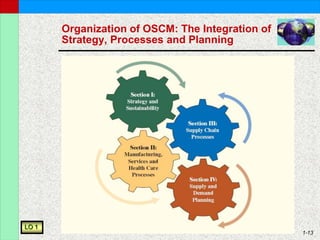
for success
• In the increased interconnected and
interdependent global economy, the process
of delivering finished goods, services, and
supplies from one place to another must be
accomplished
1-3
Development of Logistic Management
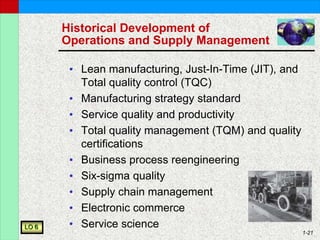
Process is one or more activities that transform
inputs into outputs that involves:
• Planning
• Sourcing
• Making
• Delivering
• Returning
1-4
Planning consists of the processes needed to
operate an existing supply chain strategically.
Here a firm must determine how anticipated
demand will be met with available resources.
A major aspect of planning is developing a set of
metrics to monitor the supply chain so that it is
efficient and delivers high quality and value to
customers.
1-5
Sourcing involves the selection of suppliers that will deliver
the goods and services needed to create the firm’s
product.
A set of pricing, delivery, and payment processes are
needed, along with metrics (measurement tool such as
balance score card) for monitoring and improving the
relationships between partners of the firm.
These processes include receiving shipment, verifying
them, transferring them to manufacturing facilities, and
authorizing supplier payments.
1-6
Making is where the major product is produced
or the service provided.
The step requires scheduling processes for
workers and the coordination of material and
other critical resources such as equipment to
support producing or providing the service.
Metrics that measure speed, quality, and worker
productivity are used to monitor these
processes.
1-7
Delivering is also referred to as logistics
processes.
Carriers are picked to move products to
warehouses and customers, coordinate and
schedule the movement of goods and
information through the supply network, develop
and operate a network of warehouses, and run
the information systems that manage the receipt
of orders from customers and the invoicing
systems that collect payments from customers.
1-8
Returning involves processes for receiving worn-
out, defective, and excess products back from
customers and support for customers who have
problems with delivered products.
In the case of services, this may involve all types
of follow-up activities required for after-sales
support.
McGraw-Hill/Irwin Copyright © 2011 The McGraw-Hill Companies, All Rights Reserved
Chapter 1
Operations and Supply Chain Management
1-10
Learning Objectives
1. Understand why it is important to study operations and
supply chain management.
2. Define efficient and effective operations.
3. Categorize operations and supply chain processes.
4. Contrast differences between services and goods
producing processes.
5. Identify operations and supply chain management
career opportunities.
6. Describe how the field has developed over time.
1-11
What is Operations and Supply
Chain Management?
• Operations and supply management
(OSM): the design, operation, and
improvement of the systems that create
and deliver the firm’s primary products
and services
– Functional field of business
– Clear line management responsibilities
• Concerned with the management of the
entire system that produces a good or
delivers a service
LO 1
1-12
Understanding the Global Supply
Chain
• Success in today’s global markets requires a
business strategy that matches the
preferences of customers with the realities of
supply networks
• A sustainable strategy is critical
– Meets the needs of shareholders and employees
– Preserves the environment
• Supply refers to processes that move
information and material to and from the
manufacturing and service processes of the
firm
LO 3
1-13
Organization of OSCM: The Integration of
Strategy, Processes and Planning
LO 1
1-14
Work Involved in Each Type of
Process
• Planning: the processes needed to operate
an existing supply chain strategically
• Sourcing: the selection of suppliers that will
deliver the goods and services needed to
create the firm’s product
• Making: Where the major product is produced
or the service provided
• Delivering: carriers are picked to move
products to warehouses and customers
• Returning: the processes for receiving worn-
out, defective, and excess products back from
customers
LO 3
1-15
Differences Between Services and
Goods
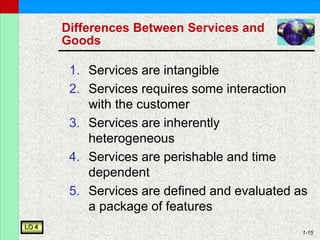
1. Services are intangible
2. Services requires some interaction
with the customer
3. Services are inherently
heterogeneous
4. Services are perishable and time
dependent
5. Services are defined and evaluated as
a package of features
LO 4
1-16
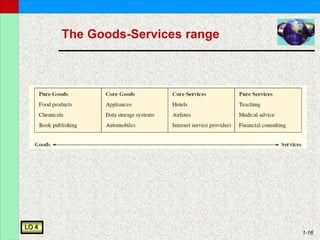
The Goods-Services range
LO 4
1-17
Servitization Strategies
• Servitization refers to a company
building service activities into its
product offerings for its current users
– Maintenance, spare parts, training, and so
on
• Success starts by drawing together the
service aspects of the business under
one roof
• Servitization may not be the best
approach for all companies
LO 4
1-18
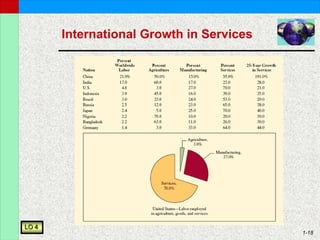
International Growth in Services
LO 4
1-19
Efficiency, Effectiveness, and
Value
• Efficiency: Doing something at the
lowest possible cost
• Effectiveness: Doing the right things to
create the most value for the company
• Value: quality divided by price
LO 2
1-20
Careers in Operations and Supply
Management
• Plant manager
• Hospital
administrator
• Branch manager
• Call center manager
• Supply chain
manager
• Purchasing
manager
• Business process
improvement
analyst
• Quality control
manager
• Lean improvement
manager
• Project manager
• Production control
analyst
• Facilities manager
LO 5
1-21
Historical Development of
Operations and Supply Management
• Lean manufacturing, Just-In-Time (JIT), and
Total quality control (TQC)
• Manufacturing strategy standard
• Service quality and productivity
• Total quality management (TQM) and quality
certifications
• Business process reengineering
• Six-sigma quality
• Supply chain management
• Electronic commerce
• Service science
LO 6
1-22
Current Issues in Operations and
Supply Management
1. Coordinating the relationship between
mutually supportive but separate
organizations
2. Optimizing global suppliers, production, and
distribution networks
3. Managing customer touch points
4. Raising senior management awareness of
operations as a significant competitive
weapon
5. Sustainability and the triple bottom line
LO 6
1-23
Key Logistics Activities
Logistics is the art and science of obtaining,
producing, and distributing material and product
in the proper place and in the proper quantities.
International logistics is all functions concerned
with the movement of materials and finished
goods on a global scale
1-24
Key Logistics Activities
Example: Transit Bus Operation
• Involves a logistics system.
• The term logistics refers to the movement of
things such as materials, people, or finished
goods
1-25
• used on campus or in a metropolitan area
• peaks in demand during the day and evening
• depending on the situation
Example:
The route has 60 stops, passengers request the
bus to stop or when the driver sees customers
waiting to board at a stop. In addition, this route
is busy during the day because visitors to the city
tend to start visiting early and continue until dark.
1-26
Key Logistics Activities
Example: IKEA
Activity-system maps is:
Diagrams that show how a company’s strategy
is delivered through a set of supporting activities
(refer to page 31)
1-27
Decisions related to logistics
A key decision area is deciding how material will
be transported.
The Logistics-System Design Matrix shows:
Exhibit 15.1 that there are six widely recognised
modes of transportation: highway (trucks), water
(ships), air (aircraft), rail (trains), pipelines, and
hand delivery
1-28
Highway (truck)
• Actually, few products are moved without
some highway transportation.
• The highway offers great flexibility for moving
goods to virtually any location not separated
by water.
• Size of the product, weight, and liquid or bulk
can all be accommodated with this mode.
1-29
Water (ship)
• Very high capacity and very low cost, but
transit times are slow, and large areas of the
world are not directly accessible to water
carriers.
• This mode is especially useful for bulk items
such as oil, coal, and chemical products.
1-30
Air
• Fast but expensive.
• Small, light, expensive items are most
appropriate for this mode of transportation.
1-31
Rail (trains)
• This is a fairly low-cost alternative, but transit times can
be long and may be subject to variability.
• The suitability of rail can vary depending on the rail
infrastructure.
• The European infrastructure is highly developed,
making this an attractive alternative compared to trucks,
while in the United States, the railroad infrastructure
has declined over the last 50 years, making it less
attractive.
1-32
Pipelines
• This is highly specialized and limited to liquids,
gases, and solids in slurry forms.
• No packaging is needed and the costs per mile
are low.
• The initial cost to build a pipeline is very high.
1-33
Hand Delivery
• This is the last step in many supply chains.
• Getting the product in the customer’s hand is
often a slow and costly activity due to the high
labor content.

logistics strategy

  • 1.
    1-1 Lecture 1 Logistics’ StrategicRole in the Economy and the Organisation ● Logistics’ Strategic Role in the Economy and the Organisation ● Development of Logistic Management ● Key Logistics Activities
  • 2.
    1-2 Logistics’ Strategic Rolein the Economy and the Organisation • Purchasing, website services, logistics, and distribution need to be carefully coordinated for success • In the increased interconnected and interdependent global economy, the process of delivering finished goods, services, and supplies from one place to another must be accomplished
  • 3.
    1-3 Development of LogisticManagement Process is one or more activities that transform inputs into outputs that involves: • Planning • Sourcing • Making • Delivering • Returning
  • 4.
    1-4 Planning consists ofthe processes needed to operate an existing supply chain strategically. Here a firm must determine how anticipated demand will be met with available resources. A major aspect of planning is developing a set of metrics to monitor the supply chain so that it is efficient and delivers high quality and value to customers.
  • 5.
    1-5 Sourcing involves theselection of suppliers that will deliver the goods and services needed to create the firm’s product. A set of pricing, delivery, and payment processes are needed, along with metrics (measurement tool such as balance score card) for monitoring and improving the relationships between partners of the firm. These processes include receiving shipment, verifying them, transferring them to manufacturing facilities, and authorizing supplier payments.
  • 6.
    1-6 Making is wherethe major product is produced or the service provided. The step requires scheduling processes for workers and the coordination of material and other critical resources such as equipment to support producing or providing the service. Metrics that measure speed, quality, and worker productivity are used to monitor these processes.
  • 7.
    1-7 Delivering is alsoreferred to as logistics processes. Carriers are picked to move products to warehouses and customers, coordinate and schedule the movement of goods and information through the supply network, develop and operate a network of warehouses, and run the information systems that manage the receipt of orders from customers and the invoicing systems that collect payments from customers.
  • 8.
    1-8 Returning involves processesfor receiving worn- out, defective, and excess products back from customers and support for customers who have problems with delivered products. In the case of services, this may involve all types of follow-up activities required for after-sales support.
  • 9.
    McGraw-Hill/Irwin Copyright ©2011 The McGraw-Hill Companies, All Rights Reserved Chapter 1 Operations and Supply Chain Management
  • 10.
    1-10 Learning Objectives 1. Understandwhy it is important to study operations and supply chain management. 2. Define efficient and effective operations. 3. Categorize operations and supply chain processes. 4. Contrast differences between services and goods producing processes. 5. Identify operations and supply chain management career opportunities. 6. Describe how the field has developed over time.
  • 11.
    1-11 What is Operationsand Supply Chain Management? • Operations and supply management (OSM): the design, operation, and improvement of the systems that create and deliver the firm’s primary products and services – Functional field of business – Clear line management responsibilities • Concerned with the management of the entire system that produces a good or delivers a service LO 1
  • 12.
    1-12 Understanding the GlobalSupply Chain • Success in today’s global markets requires a business strategy that matches the preferences of customers with the realities of supply networks • A sustainable strategy is critical – Meets the needs of shareholders and employees – Preserves the environment • Supply refers to processes that move information and material to and from the manufacturing and service processes of the firm LO 3
  • 13.
    1-13 Organization of OSCM:The Integration of Strategy, Processes and Planning LO 1
  • 14.
    1-14 Work Involved inEach Type of Process • Planning: the processes needed to operate an existing supply chain strategically • Sourcing: the selection of suppliers that will deliver the goods and services needed to create the firm’s product • Making: Where the major product is produced or the service provided • Delivering: carriers are picked to move products to warehouses and customers • Returning: the processes for receiving worn- out, defective, and excess products back from customers LO 3
  • 15.
    1-15 Differences Between Servicesand Goods 1. Services are intangible 2. Services requires some interaction with the customer 3. Services are inherently heterogeneous 4. Services are perishable and time dependent 5. Services are defined and evaluated as a package of features LO 4
  • 16.
  • 17.
    1-17 Servitization Strategies • Servitizationrefers to a company building service activities into its product offerings for its current users – Maintenance, spare parts, training, and so on • Success starts by drawing together the service aspects of the business under one roof • Servitization may not be the best approach for all companies LO 4
  • 18.
  • 19.
    1-19 Efficiency, Effectiveness, and Value •Efficiency: Doing something at the lowest possible cost • Effectiveness: Doing the right things to create the most value for the company • Value: quality divided by price LO 2
  • 20.
    1-20 Careers in Operationsand Supply Management • Plant manager • Hospital administrator • Branch manager • Call center manager • Supply chain manager • Purchasing manager • Business process improvement analyst • Quality control manager • Lean improvement manager • Project manager • Production control analyst • Facilities manager LO 5
  • 21.
    1-21 Historical Development of Operationsand Supply Management • Lean manufacturing, Just-In-Time (JIT), and Total quality control (TQC) • Manufacturing strategy standard • Service quality and productivity • Total quality management (TQM) and quality certifications • Business process reengineering • Six-sigma quality • Supply chain management • Electronic commerce • Service science LO 6
  • 22.
    1-22 Current Issues inOperations and Supply Management 1. Coordinating the relationship between mutually supportive but separate organizations 2. Optimizing global suppliers, production, and distribution networks 3. Managing customer touch points 4. Raising senior management awareness of operations as a significant competitive weapon 5. Sustainability and the triple bottom line LO 6
  • 23.
    1-23 Key Logistics Activities Logisticsis the art and science of obtaining, producing, and distributing material and product in the proper place and in the proper quantities. International logistics is all functions concerned with the movement of materials and finished goods on a global scale
  • 24.
    1-24 Key Logistics Activities Example:Transit Bus Operation • Involves a logistics system. • The term logistics refers to the movement of things such as materials, people, or finished goods
  • 25.
    1-25 • used oncampus or in a metropolitan area • peaks in demand during the day and evening • depending on the situation Example: The route has 60 stops, passengers request the bus to stop or when the driver sees customers waiting to board at a stop. In addition, this route is busy during the day because visitors to the city tend to start visiting early and continue until dark.
  • 26.
    1-26 Key Logistics Activities Example:IKEA Activity-system maps is: Diagrams that show how a company’s strategy is delivered through a set of supporting activities (refer to page 31)
  • 27.
    1-27 Decisions related tologistics A key decision area is deciding how material will be transported. The Logistics-System Design Matrix shows: Exhibit 15.1 that there are six widely recognised modes of transportation: highway (trucks), water (ships), air (aircraft), rail (trains), pipelines, and hand delivery
  • 28.
    1-28 Highway (truck) • Actually,few products are moved without some highway transportation. • The highway offers great flexibility for moving goods to virtually any location not separated by water. • Size of the product, weight, and liquid or bulk can all be accommodated with this mode.
  • 29.
    1-29 Water (ship) • Veryhigh capacity and very low cost, but transit times are slow, and large areas of the world are not directly accessible to water carriers. • This mode is especially useful for bulk items such as oil, coal, and chemical products.
  • 30.
    1-30 Air • Fast butexpensive. • Small, light, expensive items are most appropriate for this mode of transportation.
  • 31.
    1-31 Rail (trains) • Thisis a fairly low-cost alternative, but transit times can be long and may be subject to variability. • The suitability of rail can vary depending on the rail infrastructure. • The European infrastructure is highly developed, making this an attractive alternative compared to trucks, while in the United States, the railroad infrastructure has declined over the last 50 years, making it less attractive.
  • 32.
    1-32 Pipelines • This ishighly specialized and limited to liquids, gases, and solids in slurry forms. • No packaging is needed and the costs per mile are low. • The initial cost to build a pipeline is very high.
  • 33.
    1-33 Hand Delivery • Thisis the last step in many supply chains. • Getting the product in the customer’s hand is often a slow and costly activity due to the high labor content.