CONTACT LENS RELATED
DRY EYE
Nayab Farhana(b.optom, 3rd year)
CONTENT
• Introduction
• Factor affecting Contact lense associated dry eye
• PCTF
• Water content of CL
• CL Material
• CL Dehydration and Induced dryness
• Symptoms
• Ocular signs
• Management
INTRODUCTION
• “Dry eye is a disorder of the tear film due to tear deficiency or
excessive tear evaporation which causes damage to the interpalpebral
ocular surface and is associated with symptoms of ocular discomfort.”-
National Eye Institute (1995).
• Contact lens associated dry eye falls within the evaporative dry eye
section of the above definition.
PRE CORNEAL TEAR FILM(PCTF)
• It is well established that an adequate and stable pre-corneal tear
film (PCTF) is necessary to sustain contact lens (CL) wear.
• In the presence of a CL, several changes occur to the PCTF and
adnexa such as thinning of the PCTF, lipid layer disruption,
increase in mucous secretions, changes in the blink characteristic
and rate, and changes in lid conformity.
• As a result of these changes, some patients experience dry eye
symptoms associated with CL wear, hence referred to as CL-
induced or CL-associated dry eye.
WATER CONTENT OF CONTACT LENSE
• Many studies have tried to relate water content to lens dehydration and
symptoms of dryness.
• The higher the water content, the greater the water loss from 11 to 15% with
increased symptoms of dryness and the lower water content lenses
dehydrated the least, from 2 to 6% with less symptoms of dryness.
CL DEHYDRATION AND INDUCED DRYNESS
• A hypothesis put forth by some authors is that:-
CL loses water while wearing the lens, the oxygen transmissibility of the
lens is reduced, which in turn increases the hypoxic stress on the cornea and
reduces its sensitivity.
Therefore, there is reduced reflex tearing and thus you have a dryer eye.
SYMPTOMS OF DRY EYE
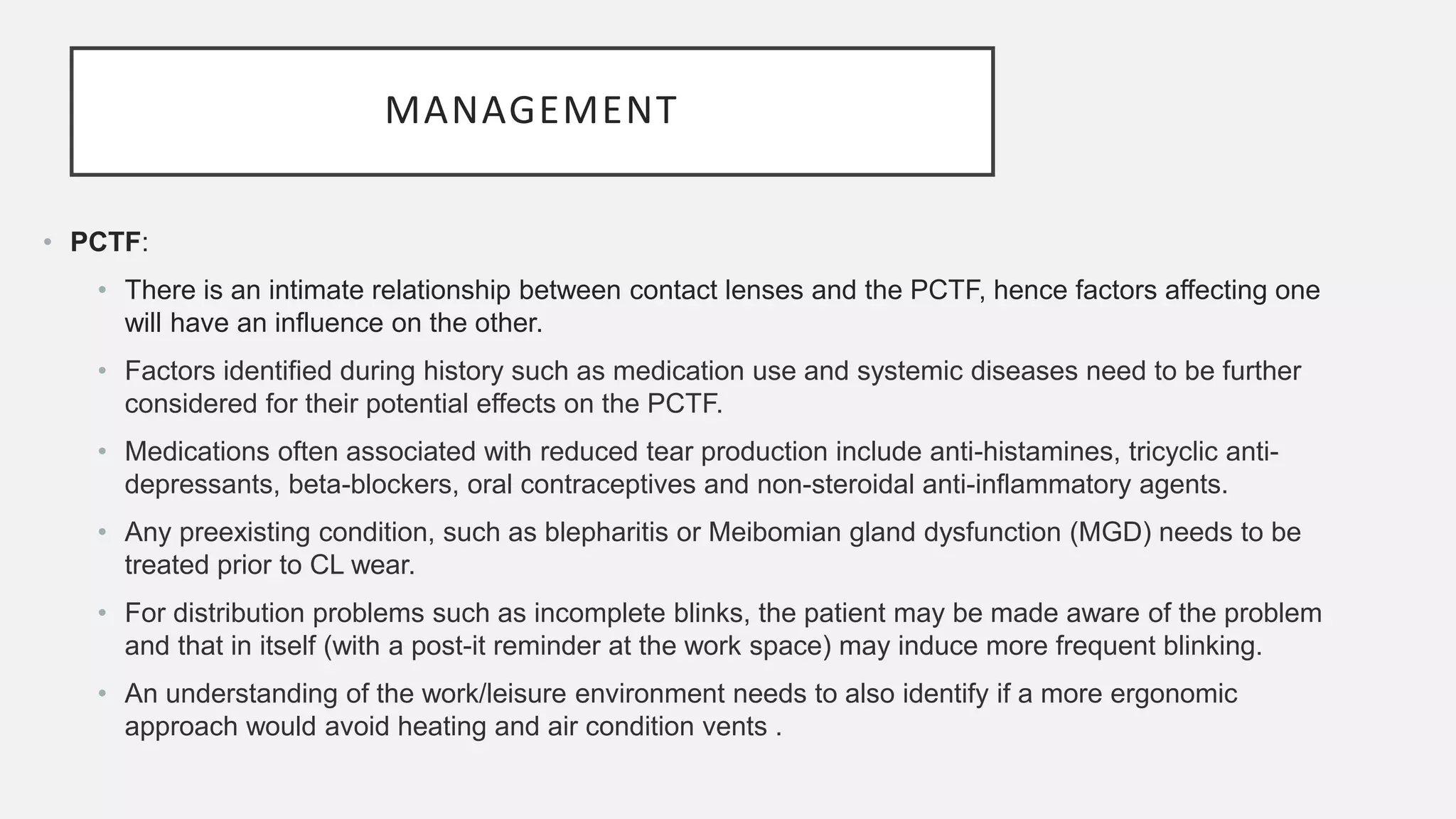
• CL-associated dry eye include:-
• foreign body sensation
• tearing or burning
• ocular discomfort
• red irritated eyes and
• a sensation of ocular surface dryness.
OCULAR SIGNS
• most commonly ocular sign associated with CL-
induced dry eye is corneal staining.
• With rigid gas permeable (RGP) lenses, the corneal
staining is most often found at 3 and 9 o'clock, close
to the limbus.
• With soft hydrogel lenses, the staining is most
commonly found on the lower third of the corneal
surface.
• Other common signs are lens surface dehydration,
surface deposits, bulbar hyperemia and an
increased conjunctival papillary response.
bulbar hyperemia
MANAGEMENT
• PCTF:
• There is an intimate relationship between contact lenses and the PCTF, hence factors affecting one
will have an influence on the other.
• Factors identified during history such as medication use and systemic diseases need to be further
considered for their potential effects on the PCTF.
• Medications often associated with reduced tear production include anti-histamines, tricyclic anti-
depressants, beta-blockers, oral contraceptives and non-steroidal anti-inflammatory agents.
• Any preexisting condition, such as blepharitis or Meibomian gland dysfunction (MGD) needs to be
treated prior to CL wear.
• For distribution problems such as incomplete blinks, the patient may be made aware of the problem
and that in itself (with a post-it reminder at the work space) may induce more frequent blinking.
• An understanding of the work/leisure environment needs to also identify if a more ergonomic
approach would avoid heating and air condition vents .
• Contact lenses Options:
• Lens Material. Change lens material, if ionic go to non-ionic, that is,
increase the material wettablility by adding n-vinyl pyrrolidone (nPVP)
instead of methacrylic acid (MA) or visaversa.
• Water Content:
• Change the water content, if high go lower or visaversa.
• Center Thickness:
• Try a slightly thicker lens, but, do not compromise oxygen transmission.
• Take into consideration the solutions the patient is using, perhaps a non-
preserved system would prevent preservative-deposit binding that
contributes to dryness and inflammation.
• Tear drop:
• Artificial tears containing active ingredients such as
carboxymethylcellulose and polyvinyl alcohol are helpful in mild cases of
dry eye syndrome.
• Punctal plug:
• Moderate to severe cases are often treated with a combination of
artificial tears, punctal occlusion and Restasis.
• Punctal occlusion is painless and performed in the office, taking only a
couple of minutes.
THANK YOU

Contact lens related dry eye

  • 1.
    CONTACT LENS RELATED DRYEYE Nayab Farhana(b.optom, 3rd year)
  • 2.
    CONTENT • Introduction • Factoraffecting Contact lense associated dry eye • PCTF • Water content of CL • CL Material • CL Dehydration and Induced dryness • Symptoms • Ocular signs • Management
  • 3.
    INTRODUCTION • “Dry eyeis a disorder of the tear film due to tear deficiency or excessive tear evaporation which causes damage to the interpalpebral ocular surface and is associated with symptoms of ocular discomfort.”- National Eye Institute (1995). • Contact lens associated dry eye falls within the evaporative dry eye section of the above definition.
  • 4.
    PRE CORNEAL TEARFILM(PCTF) • It is well established that an adequate and stable pre-corneal tear film (PCTF) is necessary to sustain contact lens (CL) wear. • In the presence of a CL, several changes occur to the PCTF and adnexa such as thinning of the PCTF, lipid layer disruption, increase in mucous secretions, changes in the blink characteristic and rate, and changes in lid conformity. • As a result of these changes, some patients experience dry eye symptoms associated with CL wear, hence referred to as CL- induced or CL-associated dry eye.
  • 5.
    WATER CONTENT OFCONTACT LENSE • Many studies have tried to relate water content to lens dehydration and symptoms of dryness. • The higher the water content, the greater the water loss from 11 to 15% with increased symptoms of dryness and the lower water content lenses dehydrated the least, from 2 to 6% with less symptoms of dryness.
  • 6.
    CL DEHYDRATION ANDINDUCED DRYNESS • A hypothesis put forth by some authors is that:- CL loses water while wearing the lens, the oxygen transmissibility of the lens is reduced, which in turn increases the hypoxic stress on the cornea and reduces its sensitivity. Therefore, there is reduced reflex tearing and thus you have a dryer eye.
  • 7.
    SYMPTOMS OF DRYEYE • CL-associated dry eye include:- • foreign body sensation • tearing or burning • ocular discomfort • red irritated eyes and • a sensation of ocular surface dryness.
  • 8.
    OCULAR SIGNS • mostcommonly ocular sign associated with CL- induced dry eye is corneal staining. • With rigid gas permeable (RGP) lenses, the corneal staining is most often found at 3 and 9 o'clock, close to the limbus. • With soft hydrogel lenses, the staining is most commonly found on the lower third of the corneal surface. • Other common signs are lens surface dehydration, surface deposits, bulbar hyperemia and an increased conjunctival papillary response.
  • 9.
  • 10.
    MANAGEMENT • PCTF: • Thereis an intimate relationship between contact lenses and the PCTF, hence factors affecting one will have an influence on the other. • Factors identified during history such as medication use and systemic diseases need to be further considered for their potential effects on the PCTF. • Medications often associated with reduced tear production include anti-histamines, tricyclic anti- depressants, beta-blockers, oral contraceptives and non-steroidal anti-inflammatory agents. • Any preexisting condition, such as blepharitis or Meibomian gland dysfunction (MGD) needs to be treated prior to CL wear. • For distribution problems such as incomplete blinks, the patient may be made aware of the problem and that in itself (with a post-it reminder at the work space) may induce more frequent blinking. • An understanding of the work/leisure environment needs to also identify if a more ergonomic approach would avoid heating and air condition vents .
  • 11.
    • Contact lensesOptions: • Lens Material. Change lens material, if ionic go to non-ionic, that is, increase the material wettablility by adding n-vinyl pyrrolidone (nPVP) instead of methacrylic acid (MA) or visaversa. • Water Content: • Change the water content, if high go lower or visaversa. • Center Thickness: • Try a slightly thicker lens, but, do not compromise oxygen transmission. • Take into consideration the solutions the patient is using, perhaps a non- preserved system would prevent preservative-deposit binding that contributes to dryness and inflammation. • Tear drop: • Artificial tears containing active ingredients such as carboxymethylcellulose and polyvinyl alcohol are helpful in mild cases of dry eye syndrome. • Punctal plug: • Moderate to severe cases are often treated with a combination of artificial tears, punctal occlusion and Restasis. • Punctal occlusion is painless and performed in the office, taking only a couple of minutes.
  • 12.

Editor's Notes